


 |
市場調查報告書
商品編碼
1940597
門窗:市場佔有率分析、產業趨勢與統計、成長預測(2026-2031)Windows And Doors - Market Share Analysis, Industry Trends & Statistics, Growth Forecasts (2026 - 2031) |
||||||

※ 本網頁內容可能與最新版本有所差異。詳細情況請與我們聯繫。
預計門窗市場規模將從 2025 年的 2,160.4 億美元成長到 2026 年的 2,253.8 億美元,到 2031 年將達到 2,783.6 億美元,2026 年至 2031 年的複合年成長率為 4.32%。
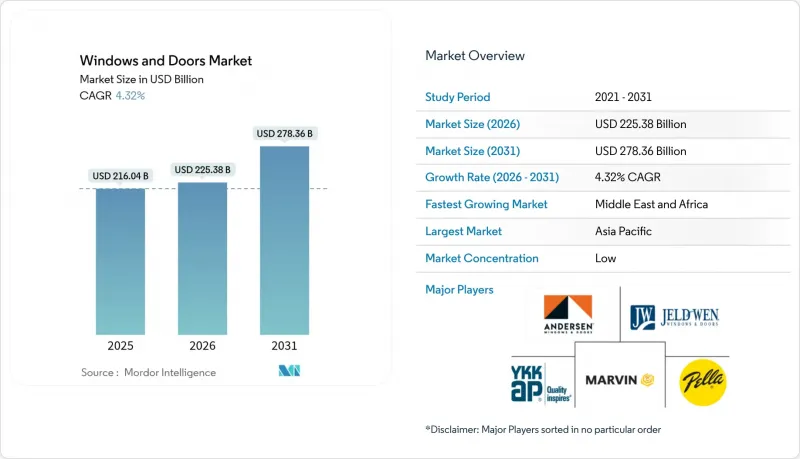
對節能建築圍護結構的強勁需求、更嚴格的性能標準以及穩定的維修支出,共同支撐著這一成長。美國能源之星7.0版更新已將寒冷地區的U值上限提高至0.22,推動了三層玻璃窗和先進窗框的普及。歐盟《建築能源性能指令》(EPBD)的同步舉措,正引領著到2030年實現零排放建築的規範制定,加速了高性能窗框在住宅和商業計劃中的應用。供應端的變化,特別是輕質窗框、模組化結構和智慧玻璃的升級,不斷拓展設計選擇並縮短前置作業時間,即便鋁材和勞動力短缺仍然是持續的阻力。能夠將材料創新、自動化製造和在地化供應鏈結合的製造商,將更有利於掌握下一波規範主導的門窗市場需求浪潮。
全球門窗市場趨勢與洞察
住宅維修熱潮及老舊住宅存量。
不斷上漲的借貸成本鎖定了有利的利率,使得人們能夠將資金用於維修而非搬遷。 2024年房屋維修支出激增,預計2025年將維持5%的成長。北美和歐洲老舊住宅的普遍存在支撐了這一趨勢,其中大部分房屋的房齡在20至39年之間,這正是更換門窗的最佳時期。美國沿海縣近一半的颶風災後重建計劃都包含門窗升級,凸顯了門窗兼具防護性和節能性的雙重價值。翻新專家也指出,「居家養老」的需求激增,這需要更寬的開口、更低的門檻和符合人體工學的五金配件。這些使用習慣使門窗市場與消費者對健康和舒適性的重視緊密契合。
節能法規(能源之星 V7.0、歐盟 EPBD)
主要經濟體正以協調一致的方式加強性能標準。在美國,能源之星V7.0標準將U值較上一版本降低了15%,有效地使三層玻璃成為寒冷氣候地區的標準配備。 2024年國際節能規範(IECC)將氣密性限制在0.35 cfm/ft²,並要求改進密封條和框架設計。在歐洲,修訂後的能源性能指令(EPBD)規定,自2030年起,新建建築必須達到零排放標準,並對現有建築設定分階段維修目標。優惠的稅額扣抵和公用事業收費補貼正在抵消部分初始成本,縮短投資回收期,並促進門窗市場的產品差異化。
原物料價格波動(鋁、PVC)
疫情後需求復甦期間,能源成本飆升和冶煉廠減產導致鋁供應減少,推高了平均溢價並延長了前置作業時間。 PVC製造商也面臨原料成本上漲和更嚴格的氯氣生產法規,尤其是在環境監管嚴格的歐洲。為了避免價格波動,製造商開始轉向使用回收鋼坯、熱塑性增強型材和區域採購協議。輕質複合複合材料框架在不犧牲強度的前提下減少了金屬用量,市佔率持續成長。然而,價格波動正在擠壓中小型製造商的利潤空間,導致計劃訂單減少,並成長抑制因素。
細分市場分析
門類產品預計在2025年佔總收入的58.02%,鞏固了其在各類建築中的基礎性地位。防盜門、防火組件和智慧鎖的定期更換週期,即使在經濟放緩時期也能保持相對穩定的需求。同時,由於嚴格的隔熱限制以及建築一體化光伏(BIPV)技術的日益普及(該技術可直接透過玻璃吸收太陽能),窗戶市場正以7.35%的複合年成長率強勁成長。這種帶動效應使窗戶成為門窗市場的技術領導者。
儘管門窗製造商正大力投資多點鎖定機制、抗衝擊面板和無縫智慧家居整合,但利潤最高的領域正轉向採用電致變色塗層和太陽能收集夾層的先進窗戶解決方案。勞倫斯伯克利國家實驗室的研究表明,此類裝置可將建築物的整體能耗降低高達15.9%,這項指標推高了窗戶的定價,並使其投資回報週期縮短。因此,窗戶市場預計將從2025年的890億美元成長到2031年的1,360億美元,儘管門窗市場在銷售方面仍將保持主導地位。
金屬框架,尤其是鋁材,由於其優異的強度重量比、纖細的視覺效果和可回收性,預計到2025年將佔銷售額的46.15%。帷幕牆高層建築、醫院和交通樞紐幾乎都指定使用鋁框架作為門窗和玻璃建築幕牆。然而,在快速發展的郊區和近郊住宅,塑膠/uPVC型材的市佔率成長速度最快,複合年成長率將達到8.59%,這些地區的預算控制和快速安裝至關重要。採用玻璃纖維和鋼微增強材料的改良配方在不犧牲剛度的前提下提高了隔熱性能,解決了傳統PVC結構局限性的詬病。
更嚴格的生命週期評估促使製造商採用不含鄰苯二甲酸酯和鉛的穩定劑,並採用閉合迴路回收技術,將邊角料回收用於新的擠出產品。同時,新興的木塑複合材料和玻璃纖維增強框架提供了一種折衷方案,兼具鋁材的剛性和乙烯基的隔熱性能。在此背景下,預計2026年至2031年間,採用PVC系統的門窗市場規模將成長136億美元。同時,由於原生鋁產能受限,金屬製品市場的成長預計將會放緩。歐盟關於2030年後可能逐步淘汰PVC的監管討論,既帶來了戰略風險,也推動了可回收和生物基聚合物混合物的創新。
門窗市場按產品類型(門、窗)、材料類型(木材、金屬、塑膠/UPVC/複合材料)、應用(鉸鏈門、滑動門等)、最終用戶(住宅、非住宅(商業、工業、公共))、安裝類型(新建、更換/維修)和地區進行細分。市場預測以價值(美元)和數量(單位)為單位。
區域分析
預計到2025年,亞太地區將佔全球收入的41.72%,這主要得益於快速的都市化發展以及對節能和氣候適應型建築的政策獎勵。中國、印度和印尼等國的國家建築規範已逐步降低了允許的U值,為隔熱框架和低輻射(Low-E)隔熱玻璃創造了有利環境。當地製造商正在擴大單元式建築幕牆向鄰近市場的出口,從而加強區域供應鏈並降低門窗市場的物流成本。
北美市場佔據第二大佔有率,這主要得益於強勁的房屋維修支出和日益成熟的異地住宅市場。儘管住宅開工量有所波動,但由於能源之星稅額扣抵和各州層級的房屋節能改造補貼,市場需求仍然強勁。技術純熟勞工短缺仍然是限制成長的主要瓶頸,但大型工廠不斷提高的自動化程度和一體化安裝方案正在緩解生產週期延誤的問題。在加拿大和美國北部,三層玻璃窗正迅速成為多用戶住宅計劃降低暖氣負荷的標準配備。
儘管歐洲的絕對市場規模較小,但由於《歐洲建築能源性能指令》(EPBD) 的實施,其利潤潛力巨大。該指令規定,自 2030 年起,新建建築必須達到零排放目標。最低能源性能標準還要求在同一年之前對能源效率最低的 16% 的非住宅存量維修,從而確保了穩定的維修需求。擁有檢驗的環境產品聲明 (EPD) 和循環經濟框架的製造商更有可能獲得優先採購評分。在門窗市場,巴黎和柏林等高密度城市推動了對隔音性能優異產品的高階需求,而可變遮陽系統在地中海度假勝地正逐漸成為標配。
預計到2031年,中東和非洲地區將以7.02%的複合年成長率實現最快成長,這主要得益於大規模的酒店、醫療保健和教育計劃。酷熱地區需要隔熱玻璃和寬搖擺門系統,以適應室內外混合使用模式。政府對綠建築認證的強制性要求以及不斷上漲的能源價格正在加速低輻射塗層的轉變。沿岸地區的本地組裝中心已開始向東非走廊供貨,這有助於縮短前置作業時間並增強門窗市場的區域韌性。
南美洲經濟成長趨於穩定,這主要得益於巴西、哥倫比亞和智利等都市區密度的增加。高通膨限制了短期可自由支配支出,但長期基礎設施特許經營協議使得公共計劃得以繼續進行。在智利和秘魯,修訂後的性能標準要求新建高海拔建築必須使用雙層玻璃,這進一步擴大了節能窗的潛在市場。
其他福利:
- Excel格式的市場預測(ME)表
- 分析師支持(3個月)
目錄
第1章 引言
- 研究假設和市場定義
- 調查範圍
第2章調查方法
第3章執行摘要
第4章 市場情勢
- 市場概覽
- 市場促進因素
- 住宅維修熱潮及老舊住宅存量。
- 節能法規(能源之星 V7.0、歐盟 EPBD)
- 亞太地區的快速都市化和基礎設施投資
- 模組化建築推動了單元式建築幕牆
- 抗衝擊窗框的保險福利
- 建築一體成型光伏(BIPV)窗的滲透率
- 市場限制
- 原物料價格波動(鋁、PVC)
- 安裝工作技術純熟勞工短缺
- 乙烯基生命週期排放的ESG評估
- 高階商業建築向智慧玻璃的轉變
- 價值/供應鏈分析
- 監管環境
- 技術展望
- 波特五力模型
- 新進入者的威脅
- 供應商的議價能力
- 買方的議價能力
- 替代品的威脅
- 產業間競爭
第5章 市場規模與成長預測
- 依產品類型
- 門
- 窗戶
- 材料
- 木頭
- 金屬
- 塑膠/uPVC/複合材料
- 透過使用
- 搖擺
- 滑動式
- 折疊式的
- 旋轉和其他
- 最終用戶
- 住宅
- 非住宅(商業、工業、公共設施)
- 按安裝類型
- 新房產
- 更換/改裝
- 按地區
- 北美洲
- 加拿大
- 美國
- 墨西哥
- 南美洲
- 巴西
- 秘魯
- 智利
- 阿根廷
- 南美洲其他地區
- 歐洲
- 英國
- 德國
- 法國
- 西班牙
- 義大利
- 比荷盧經濟聯盟(比利時、荷蘭、盧森堡)
- 北歐國家(丹麥、芬蘭、冰島、挪威、瑞典)
- 其他歐洲地區
- 亞太地區
- 印度
- 中國
- 日本
- 澳洲
- 韓國
- 東南亞(新加坡、馬來西亞、泰國、印尼、越南、菲律賓)
- 亞太其他地區
- 中東和非洲
- 阿拉伯聯合大公國
- 沙烏地阿拉伯
- 南非
- 奈及利亞
- 其他中東和非洲地區
- 北美洲
第6章 競爭情勢
- 市場集中度
- 策略趨勢
- 市佔率分析
- 公司簡介
- Andersen Corporation
- JELD-WEN Holding Inc.
- Pella Corporation
- YKK AP Inc.
- Marvin Windows & Doors
- Masonite International
- Cornerstone Building Brands/Ply Gem
- MI Windows and Doors
- LIXIL Corporation
- ASSA ABLOY Group
- Rehau Group
- VEKA AG
- Deceuninck NV
- Profine GmbH(Kommerling)
- Saint-Gobain Building Glass & Solutions
- Schuco International
- Aluplast GmbH
- Fenesta Building Systems(DCM Shriram)
- PGT Innovations
- Atrium Corporation
第7章 市場機會與未來展望
The Windows And Doors Market market is expected to grow from USD 216.04 billion in 2025 to USD 225.38 billion in 2026 and is forecast to reach USD 278.36 billion by 2031 at 4.32% CAGR over 2026-2031.
Strong demand for energy-efficient building envelopes, tighter performance codes, and steady renovation spend underpin this growth. The ENERGY STAR Version 7.0 update is already pushing U-factor limits toward 0.22 in colder U.S. zones, motivating triple-pane glazing and advanced framing. Parallel momentum in the EU's Energy Performance of Buildings Directive (EPBD) is steering specifications toward zero-emission buildings by 2030, accelerating adoption of high-performance fenestration across both residential and commercial projects. Supply-side shifts-especially light-weight framing options, modular construction, and smart-glass upgrades-continue to widen design choices and shorten lead times, even as aluminum and labor shortages remain persistent headwinds. Manufacturers able to combine material innovation, automated fabrication, and regional fulfillment are positioned to capture the next wave of specification-driven demand in the windows and doors market.
Global Windows And Doors Market Trends and Insights
Residential renovation boom and aging housing stock
Elevated borrowing costs have locked most homeowners into favorable rates, channeling discretionary capital toward upgrades rather than relocation. Remodel spending grew sharply in 2024 and is projected to maintain 5% growth in 2025, supported by an aging North American and European housing base, much of which crosses the 20- to 39-year prime replacement window for fenestration. Nearly half of hurricane recovery projects in coastal U.S. counties now include window or door upgrades, highlighting the dual value of protective and energy-saving features. Remodeling professionals also note a surge in "aging-in-place" requests that favor wider clear openings, lower sill heights, and ergonomic hardware. These usage patterns keep the windows and doors market firmly aligned with consumer wellness and resilience priorities.
Energy-efficiency regulations (ENERGY STAR V7.0, EU EPBD)
Performance codes are tightening in a coordinated fashion across major economies. In the United States, ENERGY STAR V7.0 pushes U-factors down 15% from the previous cycle, practically standardizing triple-pane construction in cold climates. The 2024 International Energy Conservation Code now caps air leakage at 0.35 cfm/ft2, demanding improved weather-stripping and frame design. Europe's revised EPBD locks in zero-emission requirements for new buildings starting 2030, along with staged renovation targets for the existing stock. Attractive tax credits and utility rebates offset part of the upfront cost, fostering faster payback and heightening product differentiation within the windows and doors market.
Raw-material price volatility (aluminum, PVC)
Energy cost spikes and smelter curtailments have trimmed aluminum supply just as post-pandemic demand recovered, lifting average premiums and lengthening lead times. PVC producers also struggle with higher input costs and stricter chlorine-production rules, especially in Europe, where environmental scrutiny is intense. To hedge volatility, manufacturers are pivoting toward recycled billet, thermoplastic-reinforced profiles, and regional sourcing agreements. Lightweight composite frames, which reduce metal use without sacrificing strength, continue to gain share. Nonetheless, price swings squeeze smaller fabricators' margins, slowing project awards and tempering growth in parts of the windows and doors market.
Other drivers and restraints analyzed in the detailed report include:
- Rapid urbanization and infrastructure spend in Asia-Pacific
- Modular construction driving unitized facades
- Skilled-labor shortage for installation
For complete list of drivers and restraints, kindly check the Table Of Contents.
Segment Analysis
Doors generated the majority of 2025 revenue at 58.02%, confirming their foundational role in every building type. Security doors, fire-rated assemblies, and smart locks sustain a replacement cadence that keeps demand relatively stable even during cyclical slowdowns. Conversely, windows outpace in growth at a 7.35% CAGR thanks to stringent heat-gain limits and the rise of building-integrated photovoltaics, which capture solar energy directly through glass. This pull-through effect positions windows as the technological spearhead of the windows and doors market.
Door makers invest in multi-point locking, impact-rated panels, and seamless smart-home integration; however, the highest margins are migrating to advanced window solutions that fuse electro-chromic coatings with solar-harvesting interlayers. Lawrence Berkeley National Laboratory recorded up to 15.9% whole-building energy savings from such installations, a metric that drives premium pricing and short paybacks. As a result, the windows and doors market size for the window segment is projected to rise from USD 89 billion in 2025 to USD 136 billion by 2031, even though the door segment will still dominate on volume.
Metal frames, particularly aluminum, held 46.15% revenue in 2025 because of their favorable strength-to-weight ratio, slim sightlines, and recyclability. Curtain-wall high-rises, hospitals, and transport hubs nearly always specify aluminum frames for both doors and glazed facades. Yet plastic/uPVC profiles are capturing the fastest gains, 8.59% CAGR, inside fast-growing suburban and peri-urban housing corridors where budget sensitivity and quick installation matter most. Updated formulations featuring embedded fiberglass or steel micro-reinforcements deliver thermal performance without compromising rigidity, answering earlier criticisms of PVC's structural limits.
Lifecycle scrutiny is pushing producers toward phthalate-free, lead-free stabilizers and closed-loop recycling commitments that turn profile off-cuts into new extrusions. Meanwhile, emerging wood-plastic composites and fiberglass frames offer a middle ground between aluminum's stiffness and vinyl's insulative edge. Against this backdrop, the windows and doors market size for PVC systems is projected to add USD 13.6 billion between 2026 and 2031, while metal growth moderates in line with primary-aluminum capacity constraints. Regulatory debates in the EU about potential PVC phase-downs beyond 2030 create strategic risk but also encourage innovation in recyclable and bio-based polymer blends.
The Windows and Doors Market is Segmented by Product Type (Doors, Windows), Material Type (Wood, Metal, Plastic / UPVC / Composite), Application (Swinging, Sliding, and More), End User (Residential and Non-Residential (Commercial, Industrial, Institutional)), Installation Type (New Construction, Replacement / Retrofit), Geography. The Market Forecasts are Provided in Terms of Value (USD) and Volume (Units).
Geography Analysis
Asia-Pacific held 41.72% of 2025 revenue, anchored by rapid urban build-outs and policy incentives for energy-conserving, climate-resilient construction. National building codes in China, India, and Indonesia have progressively lowered allowable U-values, setting a lucrative baseline for thermally broken frames and low-e insulated glass. Indigenous fabricators increasingly export unitised facades to neighboring markets, strengthening intra-regional supply chains and shaving logistics costs for the windows and doors market.
North America ranks second in size, propelled by strong renovation expenditure and a maturing off-site housing segment. ENERGY STAR tax credits and state-level storm hardening grants keep demand solid despite fluctuating housing starts. Skilled-labor scarcity remains the main growth bottleneck; however, rising automation rates at major plants, plus integrated installation programs, are mitigating cycle delays. Across Canada and the northern United States, triple glazing is fast becoming the baseline for multi-family projects seeking lower heating loads.
Europe commands a smaller absolute slice but offers high margin potential because the EPBD mandates zero-emission targets for new builds from 2030. Minimum energy performance standards also force upgrades of the worst 16% of non-residential stock by that same year, ensuring a steady retrofit pipeline. Manufacturers with verifiable environmental product declarations and circular-economy frameworks stand to gain preferential procurement scores. The windows and doors market sees premium demand for noise-attenuating units in dense cities such as Paris and Berlin, while adaptive shading packages become standard in Mediterranean resorts.
Middle East & Africa records the fastest CAGR at 7.02% through 2031, underpinned by large-scale hospitality, healthcare, and education projects. Extreme heat zones require solar-control glazing paired with wide-swing door systems that accommodate mixed indoor-outdoor occupancy patterns. Government mandates for green-building certifications, plus rising energy tariffs, hasten the shift to low-emissivity coatings. Local assembly hubs in the Gulf are beginning to serve East African corridors, reducing lead times and bolstering regional resilience within the windows and doors market.
South America shows a steadier climb, supported by urban densification in Brazil, Colombia, and Chile. High inflation limits short-term discretionary spend, yet long-term infrastructure concessions keep institutional projects moving forward. Revised performance codes in Chile and Peru now prescribe double-glazing for new high-altitude construction, further enlarging the addressable market for energy-conscious fenestration.
- Andersen Corporation
- JELD-WEN Holding Inc.
- Pella Corporation
- YKK AP Inc.
- Marvin Windows & Doors
- Masonite International
- Cornerstone Building Brands / Ply Gem
- MI Windows and Doors
- LIXIL Corporation
- ASSA ABLOY Group
- Rehau Group
- VEKA AG
- Deceuninck NV
- Profine GmbH (Kommerling)
- Saint-Gobain Building Glass & Solutions
- Schuco International
- Aluplast GmbH
- Fenesta Building Systems (DCM Shriram)
- PGT Innovations
- Atrium Corporation
Additional Benefits:
- The market estimate (ME) sheet in Excel format
- 3 months of analyst support
TABLE OF CONTENTS
1 Introduction
- 1.1 Study Assumptions and Market Definition
- 1.2 Scope of the Study
2 Research Methodology
3 Executive Summary
4 Market Landscape
- 4.1 Market Overview
- 4.2 Market Drivers
- 4.2.1 Residential renovation boom and aging housing stock
- 4.2.2 Energy-efficiency regulations (ENERGY STAR V7.0, EU EPBD)
- 4.2.3 Rapid urbanisation and infra spend in APAC
- 4.2.4 Modular construction driving unitised facades
- 4.2.5 Insurance incentives for impact-rated fenestration
- 4.2.6 Building-integrated PV (BIPV) window uptake
- 4.3 Market Restraints
- 4.3.1 Raw-material price volatility (aluminium, PVC)
- 4.3.2 Skilled-labour shortage for installation
- 4.3.3 ESG scrutiny on vinyl lifecycle emissions
- 4.3.4 Smart-glass shift in high-end commercial builds
- 4.4 Value / Supply-Chain Analysis
- 4.5 Regulatory Landscape
- 4.6 Technological Outlook
- 4.7 Porter's Five Forces
- 4.7.1 Threat of New Entrants
- 4.7.2 Bargaining Power of Suppliers
- 4.7.3 Bargaining Power of Buyers
- 4.7.4 Threat of Substitutes
- 4.7.5 Industry Rivalry
5 Market Size and Growth Forecasts
- 5.1 By Product Type
- 5.1.1 Doors
- 5.1.2 Windows
- 5.2 By Material
- 5.2.1 Wood
- 5.2.2 Metal
- 5.2.3 Plastic / uPVC / Composite
- 5.3 By Application
- 5.3.1 Swinging
- 5.3.2 Sliding
- 5.3.3 Folding
- 5.3.4 Revolving and Others
- 5.4 By End-User
- 5.4.1 Residential
- 5.4.2 Non-Residential (Commercial, Industrial, Institutional)
- 5.5 By Installation Type
- 5.5.1 New Construction
- 5.5.2 Replacement / Retrofit
- 5.6 By Geography
- 5.6.1 North America
- 5.6.1.1 Canada
- 5.6.1.2 United States
- 5.6.1.3 Mexico
- 5.6.2 South America
- 5.6.2.1 Brazil
- 5.6.2.2 Peru
- 5.6.2.3 Chile
- 5.6.2.4 Argentina
- 5.6.2.5 Rest of South America
- 5.6.3 Europe
- 5.6.3.1 United Kingdom
- 5.6.3.2 Germany
- 5.6.3.3 France
- 5.6.3.4 Spain
- 5.6.3.5 Italy
- 5.6.3.6 BENELUX (Belgium, Netherlands, Luxembourg)
- 5.6.3.7 NORDICS (Denmark, Finland, Iceland, Norway, Sweden)
- 5.6.3.8 Rest of Europe
- 5.6.4 Asia-Pacific
- 5.6.4.1 India
- 5.6.4.2 China
- 5.6.4.3 Japan
- 5.6.4.4 Australia
- 5.6.4.5 South Korea
- 5.6.4.6 South East Asia (Singapore, Malaysia, Thailand, Indonesia, Vietnam, Philippines)
- 5.6.4.7 Rest of Asia Pacific
- 5.6.5 Middle East and Africa
- 5.6.5.1 United Arab Emirates
- 5.6.5.2 Saudi Arabia
- 5.6.5.3 South Africa
- 5.6.5.4 Nigeria
- 5.6.5.5 Rest of Middle East and Africa
- 5.6.1 North America
6 Competitive Landscape
- 6.1 Market Concentration
- 6.2 Strategic Moves
- 6.3 Market Share Analysis
- 6.4 Company Profiles (includes Global level Overview, Market level overview, Core Segments, Financials as available, Strategic Information, Market Rank/Share for key companies, Products & Services, and Recent Developments)
- 6.4.1 Andersen Corporation
- 6.4.2 JELD-WEN Holding Inc.
- 6.4.3 Pella Corporation
- 6.4.4 YKK AP Inc.
- 6.4.5 Marvin Windows & Doors
- 6.4.6 Masonite International
- 6.4.7 Cornerstone Building Brands / Ply Gem
- 6.4.8 MI Windows and Doors
- 6.4.9 LIXIL Corporation
- 6.4.10 ASSA ABLOY Group
- 6.4.11 Rehau Group
- 6.4.12 VEKA AG
- 6.4.13 Deceuninck NV
- 6.4.14 Profine GmbH (Kommerling)
- 6.4.15 Saint-Gobain Building Glass & Solutions
- 6.4.16 Schuco International
- 6.4.17 Aluplast GmbH
- 6.4.18 Fenesta Building Systems (DCM Shriram)
- 6.4.19 PGT Innovations
- 6.4.20 Atrium Corporation
7 Market Opportunities & Future Outlook
- 7.1 White-space & Unmet-need Assessment

 2026年全球門窗維修服務市場報告
 門窗市場:依產品類型、材料、操作機構、開啟/關閉機構、類型、應用、安裝類型和分銷管道分類-全球預測,2026-2032年2026年全球鋁合金門窗市場報告
 商業用UPVC門窗市場-全球產業規模、佔有率、趨勢、機會及預測(依產品類型、通路、地區及競爭格局分類,2021-2031年)工業用UPVC門窗市場-全球產業規模、佔有率、趨勢、機會及預測(依產品類型、通路、地區及競爭格局分類,2021-2031年)
 門窗市場規模、佔有率和趨勢分析報告:按產品、材料、機制、應用、地區和細分市場預測,2026-2033年
 門窗市場規模、佔有率及成長分析(依產品類型、結構類型、材質、最終用途產業及地區分類)-2026-2033年產業預測
 門窗市場機會、成長促進因素、產業趨勢分析及預測(2026-2035年)美國單戶住宅窗戶和滑動玻璃門市場規模、佔有率和趨勢分析報告:按產品、應用和細分市場預測(2025-2033 年)
 2021-2031年亞太地區門窗自動化市場報告:範圍、細分、動態與競爭分析