


 |
市場調查報告書
商品編碼
1940596
生物辨識技術:市場佔有率分析、產業趨勢與統計、成長預測(2026-2031)Biometrics - Market Share Analysis, Industry Trends & Statistics, Growth Forecasts (2026 - 2031) |
||||||

※ 本網頁內容可能與最新版本有所差異。詳細情況請與我們聯繫。
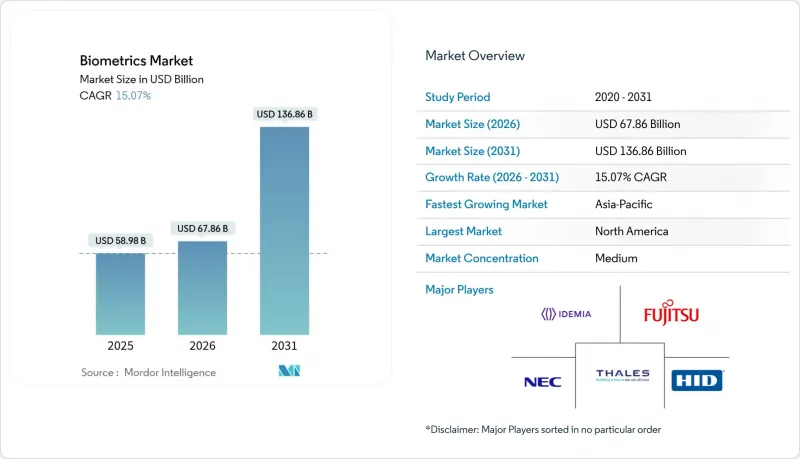
預計生物辨識市場將從 2025 年的 589.8 億美元成長到 2026 年的 678.6 億美元,到 2031 年將達到 1,368.6 億美元,2026 年至 2031 年的複合年成長率為 15.07%。
政府數位身分識別項目、支付代幣化技術的進步以及機場現代化建設的加速等因素推動了這一成長,所有這些因素都促使人們對無摩擦身份驗證的需求日益成長。儘管硬體在目前部署中仍佔據主導地位,但隨著企業從點解決方案轉向平台模式,雲端軟體引擎的成長速度最為迅猛。中國和歐盟新的隱私法規在加強合規要求的同時,也促進了兼顧準確性和使用者授權管理的多模態架構的建構。在北美,自2025年5月起實施的REAL ID法案,正推動聯邦和州政府對機場和車輛管理局(DMV,即駕駛執照考試中心)的部署產生迫切的採購需求。在亞太地區,生物辨識技術與超級應用、電子錢包和銀行電子KYC(電子了解你的客戶)框架的融合,預計將使該地區成為長期需求成長的加速器。
全球生物辨識市場趨勢與洞察
亞洲各國政府主導的國家電子識別計劃
亞洲各國政府正大力推動大規模數位身分轉型。例如,韓國基於智慧型手機的居民登記卡以及越南決定在2025年7月前將生物識別身份擴展到外國人,這些都為構建包容性生態系統樹立了標竿。印尼斥資2億美元打造的「INA Digital」平台以及菲律賓8,950萬公民的登記計劃,將使此前銀行帳戶享受過銀行服務的成年人也能獲得金融服務。斯里蘭卡結合指紋、臉部和視網膜掃描的多模態計畫於2026年完成,顯示新興經濟體正在跨越傳統基礎設施的鴻溝。
EMVCo與ISO標準推動指紋支付卡的普及
EMVCo 和 ISO 的統一規則推動生物辨識卡從試點階段走向商業發行。英飛凌的 SECORA Pay Bio 晶片和泰雷茲的全球試驗正在降低誤報率並提高交易限額。萬事達卡的身份驗證和密碼支援功能承諾提供無縫認證,幫助發卡機構減少詐欺和扣回爭議帳款。隨著銀行優先發展無密碼、非接觸式支付體驗,供應商預計到 2028 年,生物辨識卡的出貨量將達到 1.133 億張。
GDPR和BIPA訴訟風險抑制了其應用
這些案例,包括2024年至2025年間總額超過2億美元的《伊利諾伊州隱私法案》(BIPA)和解金,以及Clearview AI支付的5175萬美元,都表明,未經明確同意部署臉部辨識的公司可能面臨巨大的法律責任。 GDPR嚴格的資料最小化和本地處理規則,使得每次在歐洲部署的合規成本高達5萬至20萬歐元(約合5.65萬至22.6萬美元),這進一步縮小了小規模計劃的可用資金基礎。美國聯邦貿易委員會(FTC)對Rite Aid的執法行動,為演算法偏見審核樹立了美國先例,並隱私納入設計。
細分市場分析
軟體引擎從輔助角色發展成為成長最快的元件,複合年成長率達到 16.35%,而硬體則維持了 41.92% 的收入佔有率。各組織優先考慮雲端協作、基於人工智慧的活體檢測以及能夠持續適應不斷演變的詐騙的去中心化身份錢包。 Entrust 收購 Onfido 正契合了這一趨勢,新增了深度造假防護功能,並將其在防止身分造假方面的有效性提高了五倍。
硬體領域依然至關重要,其中專用感測器提供加密模板以保護元件安全。英飛凌經認證的用於汽車應用的指紋識別晶片就是一個很好的例子,它展示了量產級組件如何將生物識別市場拓展到移動出行和門禁控制領域。服務領域雖然規模最小,但隨著整合商為受監管產業量身打造多模態部署方案,其需求正穩定成長。
虹膜辨識將以17.85%的複合年成長率成長,這得益於液態透鏡光學技術的應用,該技術能夠降低組件成本並實現小型化。指紋辨識技術將持續保持強勁勢頭,到2025年將佔據生物辨識市場36.55%的佔有率,主要得益於智慧型手機、支付卡和考勤管理系統的普及。臉部認證正在機場和體育場館等場所穩步發展,而語音分析技術則在客服中心身份驗證領域佔據越來越重要的地位。
行為生物辨識技術,特別是步態模式和按鍵的動態特徵,可以在不增加使用者負擔的情況下,提供一層被動的增強安全保障。成熟的指紋和臉部認證解決方案正擴大與虹膜辨識、掌紋和語音辨識模組結合,形成多模態辨識套件,從而實現收入來源多元化,並降低單一認證方式的風險。
區域分析
到2025年,北美將佔全球收入的30.35%,這得益於聯邦政府的資金支持和私營部門的廣泛應用。運輸安全局)加速擴建通道,以及國土安全部(DHS)為身分國防安全保障撥出的2.508億美元預算,將支撐未來幾年對供應商的需求。加拿大和墨西哥正在對其陸地邊境的電子閘門進行現代化改造,以提高貿易效率並加強洲際合作。
亞太地區預計將成為成長最快的地區,到2031年複合年成長率將達到18.10%。韓國在全國範圍內推行的行動識別、中國立法實施的臉部認證法規以及印度與Aadhaar(印度居民識別系統)關聯的支付服務,正在推動一個超越單一國家項目的一體化生物識別市場。該地區48億數位錢包用戶正促使銀行和通訊業者將生物辨識客戶身份驗證(KYC)要求從可選變為強制執行。
在GDPR的嚴格監管下,歐洲經濟持續穩定成長。歐盟邊境控制系統正在申根國家實施生物辨識技術邊境管制,而英國新建的信任基礎設施正在推動私部門在身分驗證技術領域的創新。北歐國家的試點試驗表明,設備內處理能夠在不犧牲速度的前提下滿足隱私監管機構的要求,這有助於塑造歐洲的採購標準。
其他福利:
- Excel格式的市場預測(ME)表
- 3個月的分析師支持
目錄
第1章 引言
- 研究假設和市場定義
- 調查範圍
第2章調查方法
第3章執行摘要
第4章 市場情勢
- 市場概覽
- 市場促進因素
- 亞洲各國政府主導的國家電子身分證計劃
- EMVCo 和 ISO 標準推動北美和歐洲指紋支付卡的普及
- 疫情後歐洲商業不動產對非接觸式實體存取的需求
- TSA的生物辨識技術藍圖推動聯邦運輸安全局激增
- 中國的「智慧機場2025」計畫加速了臉部認證和語音辨識技術的應用
- 海灣合作理事會和非洲中央銀行的生物辨識KYC強制令
- 市場限制
- GDPR和BIPA訴訟風險抑制臉部辨識技術的應用
- 演算法對深色膚色的偏見導致採購暫停
- CMOS影像感測器供不應求對指紋認證模組供應帶來壓力
- 南美零售連鎖店的整合與投資報酬率問題
- 價值/供應鏈分析
- 監理展望
- 技術展望
- 波特五力分析
- 供應商的議價能力
- 買方的議價能力
- 新進入者的威脅
- 替代品的威脅
- 競爭對手之間的競爭
- 產業相關人員分析
- 投資與資金籌措分析
第5章 市場規模與成長預測
- 按組件
- 硬體
- 軟體
- 服務
- 透過生物辨識方法
- 生理生物特徵學
- 指紋辨識系統(AFIS)
- 指紋(非AFIS(自動指紋辨識系統))
- 臉部認證
- 虹膜辨識
- 其他(掌紋鑑定、手形鑑定)
- 行為生物特徵學
- 語音辨識
- 簽名驗證
- 其他(步態分析、擊鍵動力學)
- 生理生物特徵學
- 按聯絡方式
- 接觸式
- 非接觸式
- 混合
- 按身份驗證類型
- 單一因素
- 多種因素
- 透過使用
- 物理和邏輯存取控制
- 考勤管理
- 支付和交易認證
- 電子護照和邊境管制
- 病患識別和電子健康記錄 (EHR) 安全性
- 客戶註冊(電子身份驗證)
- 公共監督與安全
- 汽車和智慧車輛介面
- 按最終用途行業分類
- 政府和執法機關
- BFSI
- 衛生保健
- 家用電子電器
- 商業和零售
- 旅行和移民
- 軍事/國防
- 車
- 教育
- 其他
- 按地區
- 北美洲
- 美國
- 加拿大
- 墨西哥
- 南美洲
- 巴西
- 阿根廷
- 南美洲其他地區
- 歐洲
- 英國
- 德國
- 法國
- 義大利
- 西班牙
- 北歐國家
- 俄羅斯
- 其他歐洲地區
- 亞太地區
- 中國
- 日本
- 韓國
- 印度
- ASEAN
- 澳洲
- 紐西蘭
- 其他亞太地區
- 中東和非洲
- 中東
- 沙烏地阿拉伯
- 阿拉伯聯合大公國
- 土耳其
- 以色列
- 其他中東地區
- 非洲
- 南非
- 奈及利亞
- 肯亞
- 其他非洲地區
- 中東
- 北美洲
第6章 競爭情勢
- 市場集中度
- 策略趨勢
- 市佔率分析
- 公司簡介
- Thales Group
- NEC Corporation
- IDEMIA France SAS
- Fujitsu Limited
- HID Global Corporation
- Assa Abloy AB
- Aware Inc.
- Suprema Inc.
- Synaptics Incorporated
- Bio-Key International Inc.
- Zwipe AS
- Fingerprint Cards AB
- M2SYS Technology
- Infineon Technologies AG
- Entrust Corporation
- ImageWare Systems Inc.
- Phonexia sro
- BioID AG
- Crossmatch Technologies Inc.
- Hitachi Ltd.
第7章 市場機會與未來展望
The biometrics market is expected to grow from USD 58.98 billion in 2025 to USD 67.86 billion in 2026 and is forecast to reach USD 136.86 billion by 2031 at 15.07% CAGR over 2026-2031.
The expansion is underpinned by government digital-ID programs, rising payments tokenization, and surging airport modernization that collectively elevate the need for frictionless identity proofing. Hardware still dominates current deployments, yet cloud-ready software engines are scaling fastest as enterprises shift from point solutions to platform models. New privacy regulations in China and the European Union are tightening compliance requirements, simultaneously encouraging multi-modal architectures that balance accuracy with consent management. In North America, REAL ID enforcement from May 2025 is driving an urgent wave of federal and state procurements for airport and DMV roll-outs. Asia Pacific's integration of biometrics into super-apps, wallets, and bank e-KYC frameworks positions the region as the long-run demand accelerator.
Global Biometrics Market Trends and Insights
Government-backed National e-ID Programs Across Asia
Asian authorities are orchestrating large-scale digital identity transformations. South Korea's smartphone-based resident registration card and Vietnam's decision to extend biometric IDs to foreign nationals by July 2025 have set benchmarks for inclusive ecosystems. Indonesia's USD 200 million INA Digital platform and the Philippines' registration of 89.5 million citizens unlock financial services for previously unbanked adults. Sri Lanka's multi-modal program combining fingerprints, face, and retina scans targets completion in 2026, illustrating how emerging economies leapfrog legacy infrastructures.
EMVCo and ISO Standards Catalyzing Fingerprint Payment Cards
Harmonized EMVCo and ISO rules have moved biometric cards from pilots to commercial issuance. Infineon's SECORA Pay Bio silicon and Thales' global trials cut false-accept rates and allow higher transaction ceilings . Mastercard's Identity Check and passkey support promise frictionless authentication, helping issuers reduce fraud and chargebacks. Vendors forecast shipments of 113.3 million biometric cards by 2028 as banks prioritize PIN-free contactless experiences.
GDPR and BIPA Litigation Risks Curtailing Roll-outs
More than USD 200 million in BIPA settlements during 2024-2025, including Clearview AI's USD 51.75 million payment, signals material liability for enterprises deploying facial recognition without explicit consent. GDPR's strict data-minimization and local-processing rules add EUR 50,000-200,000 (USD 56,500-226,000) compliance cost per European installation, shrinking the addressable base for small projects. The FTC's enforcement against Rite Aid sets a U.S. precedent for algorithmic-bias audits, compelling vendors to redesign architectures for privacy by design.
Other drivers and restraints analyzed in the detailed report include:
- U.S. TSA Biometrics Road-map Driving Federal Procurement Surge
- China's "Smart Airport 2025" Policy Accelerating Face & Voice Biometrics
- Algorithmic Bias Triggering Procurement Moratoriums
For complete list of drivers and restraints, kindly check the Table Of Contents.
Segment Analysis
Software engines grew from a supporting role to the highest-growth component at a 16.35% CAGR, even while hardware kept the 41.92 revenue share. Organizations value cloud orchestration, AI-based liveness detection, and decentralized identity wallets that continuously adapt to evolving fraud. Entrust's acquisition of Onfido aligns with this trajectory, adding deep-fake countermeasures that improved forged-ID prevention five-fold.
The hardware segment remains indispensable where specialized sensors deliver cryptographic templates to secure elements. Infineon's automotive-qualified fingerprint ICs illustrate how production-grade components expand the biometrics market into mobility and access domains. Services, while smallest, record consistent uptake as integrators customize multi-modal deployments for regulated industries.
Iris recognition posts an 17.85% CAGR, supported by liquid-lens optics that lower bill-of-material cost and shrink form factors. Fingerprint remains entrenched with 36.55% of biometrics market share in 2025, thanks to smartphones, payment cards, and time-clock systems. Facial recognition steadily penetrates airports and stadiums, while voice analytics gains footing in call-center authentication.
Behavioral biometrics, particularly gait and keystroke dynamics, add passive layers that elevate security without user friction. Mature fingerprint and facial solutions increasingly pair with iris, palm-vein, or voice modules in multi-modal kits, diversifying revenue and diluting single-modality risk.
The Biometrics Market Report is Segmented by Component (Hardware, Software, Services), Biometric Modality (Physiological, Behavioral), Contact Type (Contact-Based, Contactless, Hybrid), Authentication Type (Single-Factor, Multi-Factor), Application (Access Control, Payment Authentication, and More), End-Use Industry (Government, BFSI, and More), and Geography. The Market Forecasts are Provided in Terms of Value (USD).
Geography Analysis
North America produced 30.35% of global revenue in 2025, anchored by federal budgets and widespread private-sector adoption. TSA's accelerating lane expansions and DHS's USD 250.8 million line-item for identity management provide a multi-year demand floor for vendors . Canada and Mexico modernize land-border e-gates to streamline trade, reinforcing continental scale.
Asia Pacific records the steepest trajectory with an 18.10% CAGR forecast to 2031. South Korea's nationwide mobile-ID completion, China's codified face-recognition rules, and India's Aadhaar-linked pay services cultivate a unified biometrics market bigger than any single-country program. The region's 4.8 billion digital-wallet users push biometric KYC from optional to mandatory across banks and telecoms.
Europe's growth remains steady under strict GDPR oversight. The EU Entry/Exit System rolls out border biometrics across Schengen states, while the United Kingdom's new trust framework fosters private-sector credential innovation. Nordic pilots prove that on-device processing can satisfy privacy watchdogs without sacrificing speed, shaping procurement criteria across the continent.
- Thales Group
- NEC Corporation
- IDEMIA France SAS
- Fujitsu Limited
- HID Global Corporation
- Assa Abloy AB
- Aware Inc.
- Suprema Inc.
- Synaptics Incorporated
- Bio-Key International Inc.
- Zwipe AS
- Fingerprint Cards AB
- M2SYS Technology
- Infineon Technologies AG
- Entrust Corporation
- ImageWare Systems Inc.
- Phonexia s.r.o.
- BioID AG
- Crossmatch Technologies Inc.
- Hitachi Ltd.
Additional Benefits:
- The market estimate (ME) sheet in Excel format
- 3 months of analyst support
TABLE OF CONTENTS
1 INTRODUCTION
- 1.1 Study Assumptions and Market Definition
- 1.2 Scope of the Study
2 RESEARCH METHODOLOGY
3 EXECUTIVE SUMMARY
4 MARKET LANDSCAPE
- 4.1 Market Overview
- 4.2 Market Drivers
- 4.2.1 Government-backed National e-ID Programs Across Asia
- 4.2.2 EMVCo and ISO Standards Catalyzing Fingerprint Payment Cards in North America and Europe
- 4.2.3 Post-pandemic Demand for Touch-free Physical Access in European Commercial Real-estate
- 4.2.4 U.S. TSA Biometrics Road-map Driving Federal Procurement Surge
- 4.2.5 China's "Smart Airport 2025" Policy Accelerating Face and Voice Biometrics
- 4.2.6 Biometric KYC Mandates by GCC and African Central Banks
- 4.3 Market Restraints
- 4.3.1 GDPR and BIPA Litigation Risks Curtailing Facial-Recognition Roll-outs
- 4.3.2 Algorithmic Bias Against Dark-Skin Demographics Triggering Procurement Moratoriums
- 4.3.3 CMOS Image-Sensor Shortages Constricting Fingerprint Module Supply
- 4.3.4 Integration and ROI Concerns in South-American Retail Chains
- 4.4 Value / Supply-Chain Analysis
- 4.5 Regulatory Outlook
- 4.6 Technological Outlook
- 4.7 Porter's Five Forces Analysis
- 4.7.1 Bargaining Power of Suppliers
- 4.7.2 Bargaining Power of Buyers
- 4.7.3 Threat of New Entrants
- 4.7.4 Threat of Substitutes
- 4.7.5 Intensity of Competitive Rivalry
- 4.8 Industry Stakeholder Analysis
- 4.9 Investment and Funding Analysis
5 MARKET SIZE AND GROWTH FORECASTS (VALUE)
- 5.1 By Component
- 5.1.1 Hardware
- 5.1.2 Software
- 5.1.3 Services
- 5.2 By Biometric Modality
- 5.2.1 Physiological Biometrics
- 5.2.1.1 Fingerprint AFIS
- 5.2.1.2 Fingerprint Non-AFIS (Automated Fingerprint Identification System)
- 5.2.1.3 Facial Recognition
- 5.2.1.4 Iris Recognition
- 5.2.1.5 Others (Palm Vein, Hand Geometry)
- 5.2.2 Behavioral Biometrics
- 5.2.2.1 Voice Recognition
- 5.2.2.2 Signature Verification
- 5.2.2.3 Others (Gait Analysis, Keystroke Dynamics)
- 5.2.1 Physiological Biometrics
- 5.3 By Contact Type
- 5.3.1 Contact-based
- 5.3.2 Contactless
- 5.3.3 Hybrid
- 5.4 By Authentication Type
- 5.4.1 Single-factor
- 5.4.2 Multi-factor
- 5.5 By Application
- 5.5.1 Physical and Logical Access Control
- 5.5.2 Time and Attendance Management
- 5.5.3 Payment and Transaction Authentication
- 5.5.4 e-Passport and Border Control
- 5.5.5 Patient Identification and EHR Security
- 5.5.6 Customer On-boarding (eKYC)
- 5.5.7 Public Surveillance and Safety
- 5.5.8 Automotive and Smart Vehicle Interfaces
- 5.6 By End-Use Industry
- 5.6.1 Government and Law Enforcement
- 5.6.2 BFSI
- 5.6.3 Healthcare
- 5.6.4 Consumer Electronics
- 5.6.5 Commercial and Retail
- 5.6.6 Travel and Immigration
- 5.6.7 Military and Defense
- 5.6.8 Automotive
- 5.6.9 Education
- 5.6.10 Others
- 5.7 By Geography
- 5.7.1 North America
- 5.7.1.1 United States
- 5.7.1.2 Canada
- 5.7.1.3 Mexico
- 5.7.2 South America
- 5.7.2.1 Brazil
- 5.7.2.2 Argentina
- 5.7.2.3 Rest of South America
- 5.7.3 Europe
- 5.7.3.1 United Kingdom
- 5.7.3.2 Germany
- 5.7.3.3 France
- 5.7.3.4 Italy
- 5.7.3.5 Spain
- 5.7.3.6 Nordics
- 5.7.3.7 Russia
- 5.7.3.8 Rest of Europe
- 5.7.4 Asia Pacific
- 5.7.4.1 China
- 5.7.4.2 Japan
- 5.7.4.3 South Korea
- 5.7.4.4 India
- 5.7.4.5 ASEAN
- 5.7.4.6 Australia
- 5.7.4.7 New Zealand
- 5.7.4.8 Rest of Asia Paccific
- 5.7.5 Middle East and Africa
- 5.7.5.1 Middle East
- 5.7.5.1.1 Saudi Arabia
- 5.7.5.1.2 United Arab Emirates
- 5.7.5.1.3 Turkey
- 5.7.5.1.4 Israel
- 5.7.5.1.5 Rest of Middle East
- 5.7.5.2 Africa
- 5.7.5.2.1 South Africa
- 5.7.5.2.2 Nigeria
- 5.7.5.2.3 Kenya
- 5.7.5.2.4 Rest of Africa
- 5.7.5.1 Middle East
- 5.7.1 North America
6 COMPETITIVE LANDSCAPE
- 6.1 Market Concentration
- 6.2 Strategic Moves
- 6.3 Market Share Analysis
- 6.4 Company Profiles (includes global overview, market overview, core segments, financials, strategic information, market rank/share, products and services, recent developments)
- 6.4.1 Thales Group
- 6.4.2 NEC Corporation
- 6.4.3 IDEMIA France SAS
- 6.4.4 Fujitsu Limited
- 6.4.5 HID Global Corporation
- 6.4.6 Assa Abloy AB
- 6.4.7 Aware Inc.
- 6.4.8 Suprema Inc.
- 6.4.9 Synaptics Incorporated
- 6.4.10 Bio-Key International Inc.
- 6.4.11 Zwipe AS
- 6.4.12 Fingerprint Cards AB
- 6.4.13 M2SYS Technology
- 6.4.14 Infineon Technologies AG
- 6.4.15 Entrust Corporation
- 6.4.16 ImageWare Systems Inc.
- 6.4.17 Phonexia s.r.o.
- 6.4.18 BioID AG
- 6.4.19 Crossmatch Technologies Inc.
- 6.4.20 Hitachi Ltd.
7 MARKET OPPORTUNITIES AND FUTURE OUTLOOK
- 7.1 White-space and Unmet-need Assessment

 生物識別系統市場:按組件、技術、認證方法、最終用戶和應用分類-2026-2032年全球市場預測生物識別掃描軟體市場:依技術、應用、最終用戶產業和部署模式分類-2026年至2032年全球市場預測生物識別和識別市場:按組件、技術、認證模式、部署模式和最終用戶分類-2026-2032年全球市場預測
 2026年全球生物辨識卡市場報告手形生物辨識市場:按組件、應用和最終用戶分類-2026-2032年全球市場預測2026年全球生物辨識市場報告2026年全球生物辨識技術市場報告
 指靜脈認證模組:全球市佔率及排名、總收入及需求預測(2026-2032)步態生物辨識市場:按組件、技術、部署模式、認證模式、應用和最終用戶分類-2026-2032年全球預測
 生物識別和身份驗證安全市場分析及預測(至2035年):按類型、產品、服務、技術、組件、應用、部署、最終用戶、功能和解決方案分類