


 |
市場調查報告書
商品編碼
1939751
切割機:市場佔有率分析、產業趨勢與統計、成長預測(2026-2031)Cutting Equipment - Market Share Analysis, Industry Trends & Statistics, Growth Forecasts (2026 - 2031) |
||||||

※ 本網頁內容可能與最新版本有所差異。詳細情況請與我們聯繫。
2025年切割機市值為343.2億美元,預計到2031年將達到419.6億美元,而2026年為354.9億美元。
預計在預測期(2026-2031 年)內,複合年成長率將達到 3.41%。
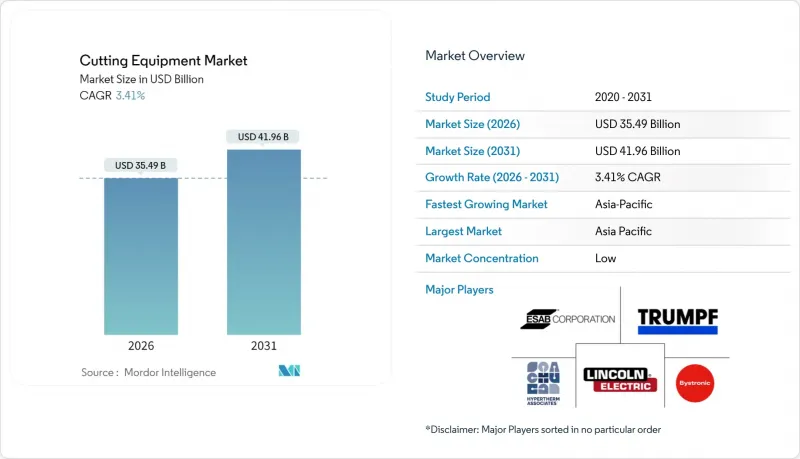
持續投資光纖雷射系統、自動化程度不斷提高以及材料組合的不斷擴展,即使在市場日趨成熟的情況下,也支撐著產業的穩定成長。光纖雷射技術已在雷射領域佔據領先地位,預計到2024年將佔據45.65%的市場佔有率,而超音波和人工智慧賦能的系統則進一步拓展了競爭格局。亞太地區製造業的快速成長支撐著全球近一半的需求,而汽車產業的電氣化以及電子產業對精度的需求,正在推動對先進機械設備的投資。同時,高資本密集度和熟練勞動力短缺限制產業的擴張,供應商正轉向提供承包、軟體豐富且節能的產品,以保障利潤並刺激其他需求。
全球切割機市場趨勢與洞察
精密加工在電動車/內燃機汽車和航太領域的重要性
電動車電池外殼和下一代航太零件的設計公差如今已遠低於一毫米,這要求工廠採用雷射、水刀和超音波加工等技術來避免因高溫造成的變形。安德里茨·舒勒公司的雷射落料生產線每分鐘可切割45個高抗張強度鋼零件,並透過智慧排料技術減少了17%的原料浪費。複合材料回收也面臨類似的精度要求,風力發電機纖維在回收利用前必須達到完美的機械閾值。對複合材料車身結構日益成長的需求推動了自適應切割參數和在線連續品管的發展,促使視覺系統和人工智慧分析技術被整合到每個工作站中。因此,即使在成熟的工廠中,高規格設備的更新換代需求也預計將持續存在。
工業4.0推動CNC/機器人自動化快速成長
製造商正日益將切割機與整合感測器的單元連接起來,這些單元能夠自我診斷磨損情況、規劃維護,並在工廠網路內共用生產數據。通快(TRUMPF)的 TruMatic 5000 將沖壓和雷射技術與 SheetMaster 處理系統結合,可在單一封閉回路型中完成零件的裝載、切割和排放,從而減少閒置時間和人工投入。像 Miller Electric 和 Novarc 這樣的合作夥伴正在將人工智慧應用於焊接接頭這一以往無法自動化的工藝,以幫助緩解熟練勞動力短缺的問題。 Bystronic 和 NanoLock 的網路安全解決方案可保護連網雷射裝置免受勒索軟體攻擊。這些創新使工廠能夠以更少的操作人員生產多品種、小批量產品,從而重塑成本結構,並加速切割市場對機器人技術的採用。
高昂的初始投資和整合成本
引入智慧雷射、機器人和儲存塔不僅需要購買機器,還需要加固地面、升級電力系統和整合ERP系統,所有這些都使許多中小型工廠的計劃預算超出了承受範圍。通快(TRUMPF)的全自動單元也構成了一大障礙:雷射、沖壓頭和SheetMaster裝載機需要同步授權和安全防護裝置,導致低產量用戶的投資回收期超過三年。公共部門津貼可涵蓋高達50%的支出,但申請週期和配套資金規則可能會延誤採購決策。同時,符合ISO 12100機器安全標準需要防護裝置和風險評估,這又增加了成本。在價格下降或租賃模式普及之前,高額的資本投入可能會限制中小企業採用這些設備。
細分市場分析
光纖雷射在切割機市場中佔最大佔有率,預計到2025年將佔總收入的45.12%。其高電光轉換效率、低維護成本和窄切割寬度使其適用於黑色金屬和非鐵金屬的加工。 nLIGHT的電暈光束整形單元代表了該領域的突破,無需更換光學元件即可在厚薄板材的環形模式之間進行即時切換。雖然CO2平台仍在一些專門加工厚不銹鋼的車間中使用,但隨著光纖雷射器擁有成本的持續下降,其市場佔有率正在不斷成長。
雷射設備的需求也受惠於更有效率的占地面積利用率,單頭雷射切割機即可實現以往只有大型龍門式系統才能達到的千瓦級功率輸出。超音波和混合雷射-等離子切割設備預計將在2026年至2031年間以4.98%的複合年成長率快速成長,但其基數較小。供應商正在將人工智慧視覺、自動噴嘴更換和預測性鏡頭清潔等技術納入產品藍圖,進一步鞏固光纖雷射在切割機市場的地位。
到2025年,半自動設備將佔切割機市場規模的42.06%,反映出穿梭台、套料軟體和操作員輔助裝載技術的普及。半自動化已成為許多中小企業的入門選擇,因為它使工廠能夠在保持柔軟性的同時減少人員配置。然而,隨著ISO 10218-2:2025標準的實施,整合龍門式裝載機和AGV的全機器人單元預計將在2031年之前以5.07%的複合年成長率成長,因為該標準使協作機器人的應用更加便捷。
將去毛邊、零件分類等多個外圍任務整合到同一工作單元中,可以提高投資報酬率。 TRUMPF 感測器即時監控吸盤的真空狀態,防止切削誤差,提高無人操作的可靠性。同時,運作載荷達 15 公斤的低成本協作機器人售價低於 3 萬美元,即使在小規模的加工車間也能實現無人值守的夜間運作。這些趨勢表明,即使人機協作的工作流程仍在繼續,自動化在切削設備市場中仍將扮演越來越重要的角色。
區域分析
預計到2025年,亞太地區將佔全球收入的48.62%,並在2031年之前維持4.31%的複合年成長率,這主要得益於中國-印度-東協走廊的產能擴張。 HSG Laser投資6,830萬美元在濟南興建的園區便是此規模的典型例證,園區承諾每年生產1萬台高功率設備,並縮短本地客戶的前置作業時間。電動車、航太和造船業的政策扶持預計將持續推動訂單成長,同時,國內工具製造商也拓展海外售後服務基地以支持出口。
北美擁有強大的現有設備基礎,並受益於旨在降低升級成本的新激勵措施。美國能源局2024年提供的4,000萬美元津貼將支持38個州219家工廠的節能維修,加速光纖雷射的普及應用。此外,7.5億美元的先進能源製造和回收計畫專門用於煤炭生產影響地區的工廠維修,並促進金屬加工廠向更清潔、更自動化的生產線轉型。加拿大的汽車產業叢集和墨西哥的近岸外包熱潮也進一步推動了區域需求。
歐洲精密工程的傳統和嚴格的監管體系幫助其在宏觀經濟成長放緩的情況下仍維持了銷售成長。百超(Bystronic)的「智慧切割製程」自主套件榮獲瑞士技術獎,展現了其在全無人雷射研發領域的領先地位。德國透過其DIN委員會主導國際標準制定,並積極參與制定強調高規格安全架構的ISO法規。歐盟環境指令也推動了對複合材料回收工廠的投資,間接帶動了超音波切割機和水刀切割機的訂單。中東、非洲和南美洲正在崛起新的成長中心,這些地區的基礎設施建設正在推動中價位等電漿切割機切割機和氧氣切割機的首次引入。
其他福利:
- Excel格式的市場預測(ME)表
- 3個月的分析師支持
目錄
第1章 引言
- 研究假設和市場定義
- 調查範圍
第2章調查方法
第3章執行摘要
第4章 市場情勢
- 市場概覽
- 市場促進因素
- 為電動車 (EV)/內燃機 (ICE) 汽車和航太工業製造精密關鍵零件
- 工業4.0主導CNC/機器人自動化蓬勃發展
- 亞太地區製造業產能快速擴張
- 疫情後促進節能型光纖雷射器進行資本投資的措施
- 先進複合材料的回收需要冷切割工藝
- 電動出行平台對輕量化電池外殼的需求
- 市場限制
- 高昂的初始投資和整合成本
- 全球熟練的CNC/電腦輔助製造工程師短缺
- 關鍵電子和光學元件的供應鏈波動
- 石榴石磨料短缺影響水刀作業成本。
- 價值/供應鏈分析
- 監管環境
- 技術展望
- 產業吸引力-波特五力分析
- 供應商的議價能力
- 買方的議價能力
- 新進入者的威脅
- 替代品的威脅
- 競爭對手之間的競爭
- 全球製造業概覽
- 金屬加工產業概覽
第5章 市場規模及成長預測(金額)
- 透過技術
- 雷射
- 纖維
- CO2
- 固體/其他
- 電漿
- 高解析度
- 傳統的
- 水刀
- 磨料
- 純的
- 火焰/氧氣燃料
- 超音波和新興技術
- 雷射
- 按自動化級別
- 手動的
- 半自動
- 機器人/全自動
- 按最終用戶行業分類
- 車
- 航太/國防
- 電氣和電子設備
- 建築和基礎設施
- 金屬加工合約工廠
- 造船
- 能源與電力
- 其他(醫療設備等)
- 依材料類型
- 鋼
- 非鐵金屬
- 複合材料
- 玻璃/陶瓷/石材
- 其他(聚合物/塑膠/木材等)
- 按地區
- 北美洲
- 美國
- 加拿大
- 墨西哥
- 南美洲
- 巴西
- 阿根廷
- 南美洲其他地區
- 歐洲
- 英國
- 德國
- 法國
- 義大利
- 西班牙
- 比荷盧經濟聯盟(比利時、荷蘭、盧森堡)
- 北歐國家(丹麥、芬蘭、冰島、挪威、瑞典)
- 其他歐洲地區
- 亞太地區
- 中國
- 印度
- 日本
- 澳洲
- 韓國
- 東協(印尼、泰國、菲律賓、馬來西亞、越南)
- 亞太其他地區
- 中東和非洲
- 沙烏地阿拉伯
- 阿拉伯聯合大公國
- 卡達
- 科威特
- 土耳其
- 埃及
- 南非
- 奈及利亞
- 其他中東和非洲地區
- 北美洲
第6章 競爭情勢
- 市場集中度
- 策略趨勢
- 市佔率分析
- 公司簡介
- TRUMPF SE+Co. KG
- Lincoln Electric Holdings, Inc.
- ESAB Corp.(ex-Colfax)
- Bystronic AG
- Hypertherm Associates
- IPG Photonics Corp.
- Mitsubishi Electric/Mazak Optonics
- Han's Laser Technology
- Messer Cutting Systems
- Flow International
- OMAX Corp.
- KMT Waterjet Systems
- Amada Miyachi
- Kennametal Inc.
- DAIHEN Corp.
- Koike Aronson, Inc.
- GCE Group
- Linde plc(Cutting gases)
- Prima Power
- Struers(sample-prep niche)
第7章 市場機會與未來展望
The cutting equipment market was valued at USD 34.32 billion in 2025 and estimated to grow from USD 35.49 billion in 2026 to reach USD 41.96 billion by 2031, at a CAGR of 3.41% during the forecast period (2026-2031).
Ongoing investments in fiber laser systems, rising automation adoption, and widening material portfolios sustain steady growth even as the marketplace matures. Fiber laser technology already leads the laser segment with a 45.65% share in 2024, and ultrasonic plus AI-enabled systems are broadening the competitive set. Asia-Pacific's manufacturing surge underpins nearly half the global demand, while electrification in automotive and precision needs in electronics pull advanced machinery spending. At the same time, high capital intensity and gaps in skilled labor temper expansion, pushing suppliers toward turnkey, software-rich, and energy-efficient offerings to defend margins and unlock replacement demand.
Global Cutting Equipment Market Trends and Insights
Precision-Critical Fabrication in EV/ICE Automotive & Aerospace
Design tolerances for EV battery housings and next-generation aerospace parts now fall below a millimeter, forcing plants to adopt lasers, water-jets, and ultrasonics that avoid heat-affected distortion. ANDRITZ Schuler's Laser Blanking Line cuts high-strength steel at 45 parts per minute and trims raw-material waste by 17% through intelligent nesting. Similar precision requirements extend to composite recycling, where reclaimed wind-turbine fibers must remain intact to meet mechanical thresholds for reuse. Demand for mixed-material body structures amplifies the need for adaptive cutting parameters and in-line quality control, pushing vendors to embed vision systems and AI analytics within every workstation. As a result, high-specification machinery sees durable replacement demand even in mature plants.
Industry 4.0 Driven CNC/Robotic Automation Surge
Manufacturers increasingly link cutting machines into sensor-rich cells that self-diagnose wear, schedule service, and share production data across the factory network. TRUMPF's TruMatic 5000 couples punch-laser tech with SheetMaster handling to load, cut, and unload parts in one closed loop, shrinking idle time and labor input. Partnerships such as Miller Electric-Novarc apply AI to weld joints previously impossible to automate, easing skilled-worker shortages. Cyber-security solutions from Bystronic and NanoLock now guard connected lasers against ransomware breaches. Collectively, these innovations let plants run small, high-mix batches with fewer operators, reshaping cost structures and accelerating the diffusion of robotics into the cutting equipment market.
High Upfront Capital & Integration Costs
Smart lasers, robots, and storage towers demand not only machine purchase but also reinforced floors, power upgrades, and ERP links, all of which raise project budgets beyond many smaller shops. TRUMPF's fully automated cells illustrate the hurdle: the laser, punch head, and SheetMaster loader require synchronized software licenses and safety fencing that push payback periods past three years for low-volume users. Public-sector grants cover up to 50% of outlays, yet application cycles and matching-fund rules can defer purchase decisions. Meanwhile, compliance with ISO 12100 machine-safety norms mandates guarding and risk assessments that add further cost layers. Until prices taper or leasing models proliferate, capital intensity will cap penetration rates among SMEs.
Other drivers and restraints analyzed in the detailed report include:
- Manufacturing Capacity Boom Across APAC
- Post-Pandemic Cap-Ex Incentives for Energy-Efficient Fiber Lasers
- Global Shortage of Skilled CNC/CAM Technicians
For complete list of drivers and restraints, kindly check the Table Of Contents.
Segment Analysis
Fiber lasers accounted for 45.12% of 2025 revenue, maintaining the largest slice of the cutting equipment market. Their high electrical-to-optical efficiency, lower service needs, and tight kerf widths suit both ferrous and non-ferrous metals. nLIGHT's Corona beam-shaping unit showcases the segment's pace, letting users toggle ring modes on the fly for thick or thin plates without optics swaps. CO2 platforms still survive in shops focused on thicker stainless edges, but incremental sales now gravitate toward fiber as ownership costs continue to compress.
Laser demand also benefits from tighter floor-space utilization, as single-head machines reach kilowatt ratings once reserved for large gantry systems. Over 2026-2031, ultrasonic and hybrid laser-plasma rigs are expected to post the fastest 4.98% CAGR, yet they start from a narrower base. Supplier roadmaps bundle AI vision, automated nozzle changeovers, and predictive lens cleaning, further cementing fiber's hold on the cutting equipment market.
Semi-automated setups held 42.06% of the cutting equipment market size in 2025, reflecting widespread use of shuttle tables, nesting software, and operator-assisted loading. Plants enjoy flexibility while trimming manpower, making semi-auto the entry point for many SMEs. Yet fully robotic cells, integrating gantry loaders and AGVs, look set for a 5.07% CAGR through 2031 as ISO 10218-2:2025 eases cobot adoption.
Return-on-investment improves when multiple peripheral tasks, such as deburring and part sorting, join the same work cell. TRUMPF's sensors check suction-cup vacuum in real time, avoiding crashed cuts and raising lights-out reliability. Meanwhile, low-cost cobots with 15 kg payloads now operate at under USD 30,000, putting unattended night shifts within reach for job shops. These trends point to automation's rising share of the cutting equipment market, even if human-in-the-loop workflows persist.
The Cutting Equipment Market Report is Segmented by Technology (Laser, Plasma, and More), by Automation Level (Manual, Semi-Automated, and Robotic/Fully-automated), by End-User Industry (Automotive, Aerospace & Defense, and More), by Material Type (Ferrous Metals, Non-Ferrous Metals, Composites, and More), and by Geography (North America, South America, Europe, and More). The Market Forecasts are Provided in Terms of Value (USD).
Geography Analysis
Asia-Pacific captured 48.62% of 2025 revenue and is on course for a 4.31% CAGR to 2031, buoyed by capacity additions across China, India, and the ASEAN corridor. HSG Laser's USD 68.3 million Jinan campus exemplifies the scale, promising 10,000 high-power units per year and shortening lead times for local buyers. Policy push for EVs, aerospace, and shipbuilding funnels continuous orders, while domestic toolmakers extend overseas after-sales centers to support exports.
North America holds a robust installed base and benefits from fresh incentives that defray upgrade costs. The Department of Energy's USD 40 million grant pool in 2024 subsidized efficiency retrofits for 219 factories across 38 states, accelerating fiber laser adoption. In addition, the USD 750 million Advanced Energy Manufacturing and Recycling program earmarks funds for plant rehabs in coal-impacted regions, nudging metal shops toward cleaner, automated lines. Canada's automotive cluster and Mexico's near-shoring boom further lift regional demand.
Europe leverages precision-engineering heritage and regulatory heft to sustain sales, even amid slower macro growth. Bystronic's Intelligent Cutting Process autonomy kit, winner of the Swiss Technology Award, underscores R&D leadership in fully unattended lasers. Germany drives global standards through DIN committees, shaping ISO rules that favor high-spec safety architectures. EU environmental directives also spur investments in composite recycling plants, indirectly pulling orders for ultrasonics and water-jets. Secondary growth pockets appear in the Middle East, Africa, and South America, where infrastructure build-outs prompt first-time purchases of mid-range plasma and oxy-fuel machines.
- TRUMPF SE + Co. KG
- Lincoln Electric Holdings, Inc.
- ESAB Corp. (ex-Colfax)
- Bystronic AG
- Hypertherm Associates
- IPG Photonics Corp.
- Mitsubishi Electric / Mazak Optonics
- Han's Laser Technology
- Messer Cutting Systems
- Flow International
- OMAX Corp.
- KMT Waterjet Systems
- Amada Miyachi
- Kennametal Inc.
- DAIHEN Corp.
- Koike Aronson, Inc.
- GCE Group
- Linde plc (Cutting gases)
- Prima Power
- Struers (sample-prep niche)
Additional Benefits:
- The market estimate (ME) sheet in Excel format
- 3 months of analyst support
TABLE OF CONTENTS
1 Introduction
- 1.1 Study Assumptions & Market Definition
- 1.2 Scope of the Study
2 Research Methodology
3 Executive Summary
4 Market Landscape
- 4.1 Market Overview
- 4.2 Market Drivers
- 4.2.1 Precision-critical fabrication in EV/ICE automotive & aerospace
- 4.2.2 Industry 4.0 driven CNC/robotic automation surge
- 4.2.3 Manufacturing capacity boom across APAC
- 4.2.4 Post-pandemic cap-ex incentives for energy-efficient fiber lasers
- 4.2.5 Recycling of advanced composites requiring cold-cutting processes
- 4.2.6 Lightweight battery-housing demand in e-mobility platforms
- 4.3 Market Restraints
- 4.3.1 High upfront capital & integration costs
- 4.3.2 Global shortage of skilled CNC / CAM technicians
- 4.3.3 Supply-chain volatility for critical electronic & optical components
- 4.3.4 Garnet-abrasive scarcity disrupting water-jet OPEX
- 4.4 Value / Supply-Chain Analysis
- 4.5 Regulatory Landscape
- 4.6 Technological Outlook
- 4.7 Industry Attractiveness - Porter's Five Forces Analysis
- 4.7.1 Bargaining Power of Suppliers
- 4.7.2 Bargaining Power of Buyers
- 4.7.3 Threat of New Entrants
- 4.7.4 Threat of Substitutes
- 4.7.5 Competitive Rivalry
- 4.8 Global Manufacturing-Sector Snapshot
- 4.9 Metalworking Industry Snapshot
5 Market Size & Growth Forecasts (Value, In USD Billion)
- 5.1 By Technology
- 5.1.1 Laser
- 5.1.1.1 Fiber
- 5.1.1.2 CO2
- 5.1.1.3 Solid-state / Other
- 5.1.2 Plasma
- 5.1.2.1 High-definition
- 5.1.2.2 Conventional
- 5.1.3 Water-Jet
- 5.1.3.1 Abrasive
- 5.1.3.2 Pure
- 5.1.4 Flame / Oxy-fuel
- 5.1.5 Ultrasonic & Emerging
- 5.1.1 Laser
- 5.2 By Automation Level
- 5.2.1 Manual
- 5.2.2 Semi-automated
- 5.2.3 Robotic / Fully-automated
- 5.3 By End-User Industry
- 5.3.1 Automotive
- 5.3.2 Aerospace & Defense
- 5.3.3 Electrical & Electronics
- 5.3.4 Construction & Infrastructure
- 5.3.5 Metal-Fabrication Job Shops
- 5.3.6 Shipbuilding
- 5.3.7 Energy & Power
- 5.3.8 Others (Medical Devices, etc.)
- 5.4 By Material Type
- 5.4.1 Ferrous Metals
- 5.4.2 Non-Ferrous Metals
- 5.4.3 Composites
- 5.4.4 Glass/Ceramics/Stone
- 5.4.5 Others (Polymers/Plastics/Wood, etc.)
- 5.5 By Geography
- 5.5.1 North America
- 5.5.1.1 United States
- 5.5.1.2 Canada
- 5.5.1.3 Mexico
- 5.5.2 South America
- 5.5.2.1 Brazil
- 5.5.2.2 Argentina
- 5.5.2.3 Rest of South America
- 5.5.3 Europe
- 5.5.3.1 United Kingdom
- 5.5.3.2 Germany
- 5.5.3.3 France
- 5.5.3.4 Italy
- 5.5.3.5 Spain
- 5.5.3.6 BENELUX (Belgium, Netherlands, and Luxembourg)
- 5.5.3.7 NORDICS (Denmark, Finland, Iceland, Norway, and Sweden)
- 5.5.3.8 Rest of Europe
- 5.5.4 Asia-Pacific
- 5.5.4.1 China
- 5.5.4.2 India
- 5.5.4.3 Japan
- 5.5.4.4 Australia
- 5.5.4.5 South Korea
- 5.5.4.6 ASEAN (Indonesia, Thailand, Philippines, Malaysia, Vietnam)
- 5.5.4.7 Rest of Asia-Pacific
- 5.5.5 Middle East and Africa
- 5.5.5.1 Saudi Arabia
- 5.5.5.2 United Arab Emirates
- 5.5.5.3 Qatar
- 5.5.5.4 Kuwait
- 5.5.5.5 Turkey
- 5.5.5.6 Egypt
- 5.5.5.7 South Africa
- 5.5.5.8 Nigeria
- 5.5.5.9 Rest of Middle East and Africa
- 5.5.1 North America
6 Competitive Landscape
- 6.1 Market Concentration
- 6.2 Strategic Moves
- 6.3 Market Share Analysis
- 6.4 Company Profiles (includes Global overview, Core segments, Financials, Strategic info, Products, Recent developments)
- 6.4.1 TRUMPF SE + Co. KG
- 6.4.2 Lincoln Electric Holdings, Inc.
- 6.4.3 ESAB Corp. (ex-Colfax)
- 6.4.4 Bystronic AG
- 6.4.5 Hypertherm Associates
- 6.4.6 IPG Photonics Corp.
- 6.4.7 Mitsubishi Electric / Mazak Optonics
- 6.4.8 Han's Laser Technology
- 6.4.9 Messer Cutting Systems
- 6.4.10 Flow International
- 6.4.11 OMAX Corp.
- 6.4.12 KMT Waterjet Systems
- 6.4.13 Amada Miyachi
- 6.4.14 Kennametal Inc.
- 6.4.15 DAIHEN Corp.
- 6.4.16 Koike Aronson, Inc.
- 6.4.17 GCE Group
- 6.4.18 Linde plc (Cutting gases)
- 6.4.19 Prima Power
- 6.4.20 Struers (sample-prep niche)
7 Market Opportunities & Future Outlook
- 7.1 White-space & Unmet-Need Assessment

 切割設備市場:依設備類型、動力來源、控制方式、機器尺寸、銷售管道、應用及最終用戶產業分類-2026-2032年全球市場預測
 切割設備市場規模、佔有率和成長分析:按設備類型、技術類型、自動化程度、最終用戶產業、分銷管道和地區分類-2026-2033年產業預測
 2026年全球自動化鋼筋切割生產線市場報告工業PCB分板機械設備市場:依技術、機器類型、動力來源、生產速度、應用複雜性、通路、終端用戶產業分類,全球預測,2026-2032年拉片切割設備市場:全球預測(按最終用戶產業、技術、自動化程度、產品類型、應用和銷售管道),2026-2032年盾形滾刀市場:依產品類型、材料、應用、最終用戶、通路分類,全球預測(2026-2032)頂管機切割器市場:依切割器類型、土壤條件、直徑範圍、操作模式和應用分類-全球預測,2026-2032年全球微型/小型LED雷射切割設備市場:按應用、最終用戶、雷射源、設備類型、雷射功率和配銷通路分類,2026-2032年預測工業PCB分板路由器市場依自動化程度、客戶類型、PCB配置、分板方法、銷售管道和最終用戶產業分類,全球預測,2026-2032年
 切割設備市場:依設備類型、依技術類型、依最終用戶產業、按地區分類