


 |
市場調查報告書
商品編碼
1939746
亞太地區紡織品:市佔率分析、產業趨勢與統計、成長預測(2026-2031)Asia-Pacific Textile - Market Share Analysis, Industry Trends & Statistics, Growth Forecasts (2026 - 2031) |
||||||

※ 本網頁內容可能與最新版本有所差異。詳細情況請與我們聯繫。
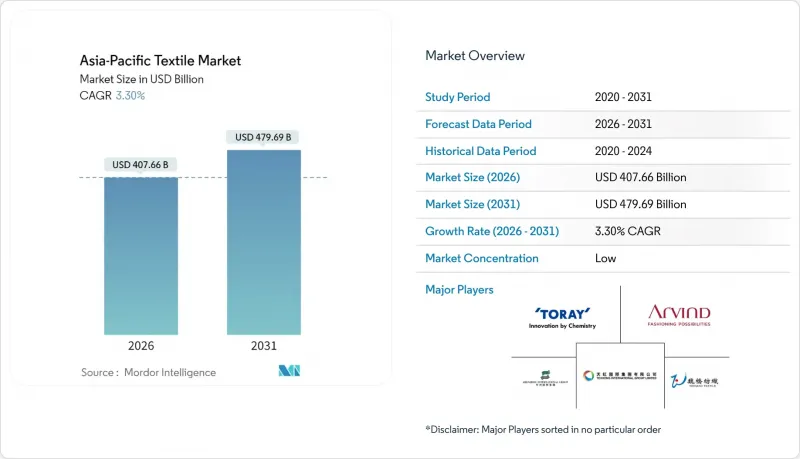
亞太地區紡織品市場預計將從 2025 年的 3,946.4 億美元成長到 2026 年的 4,076.6 億美元,預計到 2031 年將達到 4,796.9 億美元,2026 年至 2031 年的複合年成長率為 3.3%。
這些穩定成長數據的另一面是,低利潤的大眾商品與高價值技術應用(如今價格更高)之間的差距日益擴大。成本敏感型生產集中在傳統地區,而技術密集型製造業則正向擁有先進機械和技術熟練勞動力的新興次區域轉移。能源成本上漲、ESG合規要求以及自動化投資正在重塑競爭優勢,推動供應鏈多元化和垂直整合營運。因此,亞太紡織品市場正朝著兩極化的成長模式發展,效率提升和產品創新,而非單純的產量,將決定盈利。
亞太地區紡織品市場趨勢與洞察
服裝消費正變得越來越高階。
亞太地區都市區可支配收入的成長推動了對奢侈品和功能性服飾的需求。品牌紛紛回應,投資於可追溯性平台和環保生產流程,使製造商能夠透過垂直整合獲得更高的利潤率。例如,傑尼亞(Ermenegildo Zegna)公佈2023年亞太地區紡織品銷售額達1.661億美元,證實了其高階策略對原物料價格波動的緩衝作用。功能性纖維供應商將從中受益最多,因為其產品的性能特性使其價格比普通布料高出三到五倍。
有組織的時尚零售業的發展
大型零售連鎖店主導著分銷管道,對品質、交貨和合規性有嚴格的要求。獲得認證的工廠能夠滿足這些買家的要求,因此預計印度2025會計年度的出口將達到366億美元。隨著門市網路的擴張,競爭的焦點從價格轉向服務水準、環境審核和數位化協作工具,這使得規模小規模、不合規的工廠被淘汰。
能源價格波動
紡紗過程耗電量佔紡織廠電力消耗量的70%之多,因此電價大幅上漲將對毛利率造成壓力。雖然印度部分邦提供補貼,但大多數邦僅涵蓋部分成本,迫使小規模紡織廠關閉或合併。大型集團已透過長期購電協議和安裝現場太陽能發電設施進行對沖來緩解即時影響,但預計成長仍然低迷。
細分市場分析
工業和技術類紡織品正以4.65%的複合年成長率快速成長,其在亞太紡織品市場的佔有率逐年攀升,這主要得益於汽車、醫療和過濾行業的買家對高性能基材的需求。同時,時尚服裝類紡織品市場佔有率為46.55%,但由於永續發展方面的阻力抵消了快時尚的銷售成長,其成長勢頭較為緩慢。醫用不織布在疫情期間及之後蓬勃發展,而汽車紡織品則受惠於電動車的溫度控管需求。由於都市化,家用紡織品市場保持穩定,而防護裝備市場則因職業安全法規的加強而成長。先進的感測器整合技術正在模糊服裝和智慧布料之間的界限,從而擴大高階訂單的潛在市場。
短期內,技術供應商預計將透過監管障礙、醫療保健產業的ISO 13485標準以及運輸業嚴格的OEM規範來阻礙新進業者。現有供應商將透過投資自動化織造設備和先進塗層技術,鞏固其在高附加價值細分市場的地位。預計在預測期內,這些發展趨勢將擴大亞太地區紡織品市場技術型和商品型細分市場之間的盈利差距。
其他福利:
- Excel格式的市場預測(ME)表
- 分析師支持(3個月)
目錄
第1章 引言
- 研究假設和市場定義
- 調查範圍
第2章調查方法
第3章執行摘要
第4章 市場情勢
- 市場概覽
- 市場促進因素
- 奢侈品服裝消費趨勢
- 有組織的時尚零售業的發展
- 全球品牌的ESG相關採購義務
- 新興的「近岸外包」模式正在向東協和印度地區興起
- 生物基紡織品研發取得突破;
- 人工智慧需求預測的採用現狀
- 市場限制
- 能源價格波動會影響紡織業的利潤率。
- 對染料廠污水有嚴格的規定
- 中美貿易政策的不確定性
- 區域城市織布工人短缺
- 價值/供應鏈分析
- 監理展望
- 技術展望
- 電子商務市場洞察
- 產業吸引力—五力分析
- 買方的議價能力
- 供應商的議價能力
- 新進入者的威脅
- 替代品的威脅
- 競爭對手之間的競爭
第5章 市場規模及成長預測(價值,十億美元)
- 透過使用
- 時尚與服裝
- 工業/技術紡織品
- 家用紡織品
- 醫療和保健紡織品
- 汽車和運輸紡織品
- 其他(防護用紡織品、運動用紡織品等)
- 按原料
- 天然纖維
- 棉布
- 羊毛
- 絲綢
- 合成纖維
- 聚酯纖維
- 尼龍
- 人造絲/粘膠纖維
- 丙烯酸纖維
- 聚丙烯
- 再生纖維
- 其他(特殊高性能纖維(芳香聚醯胺、碳纖維、超高分子量聚乙烯))
- 天然纖維
- 透過製造程序/技術
- 織物
- 針織
- 不織布
- 紡絲成網(紡粘/熔噴)
- 乾式和水刺式
- 濕法成網
- 針刺加工
- 3D編織和間隔織物
- 按地區
- 中國
- 印度
- 孟加拉
- 澳洲
- 韓國
- 日本
- 東協(印尼、泰國、菲律賓、馬來西亞、越南)
- 亞太其他地區
第6章 競爭情勢
- 市場集中度
- 策略趨勢
- 市佔率分析
- 公司簡介
- Shenzhou International Group
- Weiqiao Textile
- Texhong Textile Group
- Toray Industries
- Arvind Ltd
- Vardhman Textiles Ltd
- Far Eastern New Century(FENC)
- Hyosung TNC
- Bombay Dyeing & Mfg Co
- Bombay Rayon Fashions
- Pacific Textiles
- Luthai Textile
- Nisshinbo Holdings
- PT Sri Rejeki Isman(Sritex)
- Raymond Ltd
- Fabindia Overseas
- Youngone Corp
- Indorama Ventures(IVL Fibres)
- Teijin Ltd
- Cotton Corporation of India
第7章 市場機會與未來展望
The APAC Textile Industry Market is expected to grow from USD 394.64 billion in 2025 to USD 407.66 billion in 2026 and is forecast to reach USD 479.69 billion by 2031 at 3.3% CAGR over 2026-2031.
This steady headline number masks a widening gap between low-margin bulk products and higher-value technical applications that now attract premium pricing. Cost-sensitive output continues to cluster in traditional hubs, while technology-intensive manufacturing migrates to newer sub-regions equipped with advanced machinery and skilled labor. Rising energy costs, ESG compliance mandates, and automation investments are reshaping competitive advantages, prompting both supply-chain diversification and vertically integrated operations. The APAC textile industry market, therefore, moves toward a dual-track growth pattern in which efficiency gains and product innovation, rather than volume alone, determine profitability.
Asia-Pacific Textile Market Trends and Insights
Premiumization of Apparel Spend
Growing disposable incomes in APAC's metropolitan areas lift demand for luxury and performance garments. Brands respond by investing in traceability platforms and low-impact production, which lets manufacturers capture higher margins through vertical integration. Ermenegildo Zegna, for instance, reported USD 166.1 million in regional textile revenue in 2023, underscoring the insulating effect of premium positioning against raw-material volatility. Technical-textile suppliers benefit most because their performance attributes justify price points that are three to five times above commodity fabrics.
Growth of Organized Fashion Retail
Large retail chains now dominate distribution and insist on strict quality, delivery, and compliance standards. India's exports reached USD 36.6 billion in FY 2025, in part because certified mills could meet these buyer requirements. As store networks scale, they shift competition away from price and toward service levels, environmental audits, and digital collaboration tools, edging out small, non-compliant factories.
Energy-Price Volatility
Spinning consumes up to 70% of a mill's electricity, so sudden rate hikes compress gross margins. While some Indian states offer subsidies, most cover only a fraction of costs, pushing small mills toward closure or merger. Larger groups hedge through long-term power-purchase agreements and on-site solar arrays, dampening the immediate impact but still trimming forecast growth.
Other drivers and restraints analyzed in the detailed report include:
- Near-shoring to ASEAN + India
- ESG-linked Sourcing Mandates
- Stringent Wastewater Norms
For complete list of drivers and restraints, kindly check the Table Of Contents.
Segment Analysis
Industrial and technical categories are on a 4.65% CAGR, lifting their portion of the APAC textile industry market size each year as automotive, medical, and filtration buyers specify higher-performance substrates. In contrast, fashion and apparel's 46.55% share shows minimal expansion because sustainability headwinds offset fast-fashion volume. Medical non-wovens surged during and after the pandemic, and automotive textiles benefit from electric-vehicle heat-management needs. Household segments hold steady due to urbanization, while protective gear grows alongside occupational-safety legislation. Greater sensor integration blurs lines between apparel and smart-fabric niches, expanding the addressable pool of premium orders.
The near-term outlook sees technical providers capitalizing on regulatory barriers, ISO 13485 in healthcare, and stringent OEM specifications in transport, which discourage new entrants. Existing suppliers invest in automated looms and advanced coatings, reinforcing their grip on value-added niches. Over the forecast period, these moves will widen the profitability gap between technical and commodity segments within the broader APAC textile industry market.
The Asia-Pacific Textile Market Report is Segmented by Application (Fashion & Apparel, Industrial/Technical Textiles, Household & Home Textiles, and More), by Raw Material (Natural Fibers, Synthetic Fibers, and More), by Process (Woven, Knitted, Non-Woven, and More), and by Geography (China, India, Bangladesh, Australia, South Korea, Japan, ASEAN, Rest of Asia-Pacific). The Market Forecasts are Provided in Terms of Value (USD).
List of Companies Covered in this Report:
- Shenzhou International Group
- Weiqiao Textile
- Texhong Textile Group
- Toray Industries
- Arvind Ltd
- Vardhman Textiles Ltd
- Far Eastern New Century (FENC)
- Hyosung TNC
- Bombay Dyeing & Mfg Co
- Bombay Rayon Fashions
- Pacific Textiles
- Luthai Textile
- Nisshinbo Holdings
- PT Sri Rejeki Isman (Sritex)
- Raymond Ltd
- Fabindia Overseas
- Youngone Corp
- Indorama Ventures (IVL Fibres)
- Teijin Ltd
- Cotton Corporation of India
Additional Benefits:
- The market estimate (ME) sheet in Excel format
- 3 months of analyst support
TABLE OF CONTENTS
1 Introduction
- 1.1 Study Assumptions & Market Definition
- 1.2 Scope of the Study
2 Research Methodology
3 Executive Summary
4 Market Landscape
- 4.1 Market Overview
- 4.2 Market Drivers
- 4.2.1 Premiumisation of apparel spend
- 4.2.2 Growth of organised fashion retail
- 4.2.3 ESG-linked sourcing mandates by global brands
- 4.2.4 Emerging "near-shoring" to ASEAN+India
- 4.2.5 Breakthroughs in bio-based fibre R&D
- 4.2.6 AI-driven demand-forecasting adoption
- 4.3 Market Restraints
- 4.3.1 Energy-price volatility hitting spinning margins
- 4.3.2 Stringent wastewater norms for dye-houses
- 4.3.3 US-China trade policy uncertainty
- 4.3.4 Loom-level labour shortages in tier-2 clusters
- 4.4 Value / Supply-Chain Analysis
- 4.5 Regulatory Outlook
- 4.6 Technological Outlook
- 4.7 Insights into the E-commerce Market
- 4.8 Industry Attractiveness - Porter's Five Forces
- 4.8.1 Bargaining Power of Buyers
- 4.8.2 Bargaining Power of Suppliers
- 4.8.3 Threat of New Entrants
- 4.8.4 Threat of Substitutes
- 4.8.5 Competitive Rivalry
5 Market Size & Growth Forecasts (Value, USD Billion)
- 5.1 By Application
- 5.1.1 Fashion & Apparel
- 5.1.2 Industrial/Technical Textiles
- 5.1.3 Household & Home Textiles
- 5.1.4 Medical & Healthcare Textiles
- 5.1.5 Automotive & Transport Textiles
- 5.1.6 Others (Protective, Sports Textiles, etc.)
- 5.2 By Raw Material
- 5.2.1 Natural Fibers
- 5.2.1.1 Cotton
- 5.2.1.2 Wool
- 5.2.1.3 Silk
- 5.2.2 Synthetic Fibers
- 5.2.2.1 Polyester
- 5.2.2.2 Nylon
- 5.2.2.3 Rayon / Viscose
- 5.2.2.4 Acrylic
- 5.2.2.5 Polypropylene
- 5.2.3 Recycled Fibers
- 5.2.4 Others (Speciality High-Performance Fibers (Aramid, Carbon, UHMWPE))
- 5.2.1 Natural Fibers
- 5.3 By Process / Technology
- 5.3.1 Woven
- 5.3.2 Knitted
- 5.3.3 Non-woven
- 5.3.3.1 Spunlaid (Spunbond / Melt-blown)
- 5.3.3.2 Dry-laid Hydro-entangled
- 5.3.3.3 Wet-Laid
- 5.3.3.4 Needle-punched
- 5.3.4 3-D Weaving & Spacer Fabrics
- 5.4 By Geography
- 5.4.1 China
- 5.4.2 India
- 5.4.3 Bangladesh
- 5.4.4 Australia
- 5.4.5 South Korea
- 5.4.6 Japan
- 5.4.7 ASEAN (Indonesia, Thailand, Philippines, Malaysia, Vietnam)
- 5.4.8 Rest of Asia-Pacific
6 Competitive Landscape
- 6.1 Market Concentration
- 6.2 Strategic Moves
- 6.3 Market Share Analysis
- 6.4 Company Profiles (includes Global level Overview, Market level overview, Core Segments, Financials as available, Strategic Information, Products & Services, and Recent Developments)
- 6.4.1 Shenzhou International Group
- 6.4.2 Weiqiao Textile
- 6.4.3 Texhong Textile Group
- 6.4.4 Toray Industries
- 6.4.5 Arvind Ltd
- 6.4.6 Vardhman Textiles Ltd
- 6.4.7 Far Eastern New Century (FENC)
- 6.4.8 Hyosung TNC
- 6.4.9 Bombay Dyeing & Mfg Co
- 6.4.10 Bombay Rayon Fashions
- 6.4.11 Pacific Textiles
- 6.4.12 Luthai Textile
- 6.4.13 Nisshinbo Holdings
- 6.4.14 PT Sri Rejeki Isman (Sritex)
- 6.4.15 Raymond Ltd
- 6.4.16 Fabindia Overseas
- 6.4.17 Youngone Corp
- 6.4.18 Indorama Ventures (IVL Fibres)
- 6.4.19 Teijin Ltd
- 6.4.20 Cotton Corporation of India
7 Market Opportunities & Future Outlook
- 7.1 White-space & Unmet-Need Assessment

 綠色紡織品市場-全球產業規模、佔有率、趨勢、機會、預測:按類型、原料、應用、地區和競爭格局分類,2021-2031年
 防護紡織品市場:按類型、產品類型、最終用途和分銷管道分類 - 2026-2032年全球市場預測動物源性紡織品市場:2026-2032年全球市場按形態、產品類型、通路和應用分類的預測紡織品市場:按材料、應用和分銷管道分類-2026-2032年全球市場預測
 2026-2034年全球服飾市場規模、佔有率、趨勢和成長分析報告紗線、纖維和線材市場:按產品類型、原料、製造流程、撚度、應用、分銷通路和最終用途產業分類-全球預測,2026-2032年
 南美紡織品:市場佔有率分析、產業趨勢與統計、成長預測(2026-2031)
 紡織品市場分析及預測(至2035年):依類型、產品類型、技術、應用、材料類型、最終用戶、製程、組件及採用度分類紡織品市場規模、佔有率、成長及全球產業分析:按類型、應用和地區分類,並預測至2026-2034年
 日本紡織品市場:規模、佔有率、趨勢和預測:按原料、產品、應用和地區分類,2026-2034年