

 |
市場調查報告書
商品編碼
1939670
半導體在醫療保健領域的應用:市場佔有率分析、產業趨勢與統計、成長預測(2026-2031 年)Semiconductor Applications In Healthcare - Market Share Analysis, Industry Trends & Statistics, Growth Forecasts (2026 - 2031) |
||||||

※ 本網頁內容可能與最新版本有所差異。詳細情況請與我們聯繫。
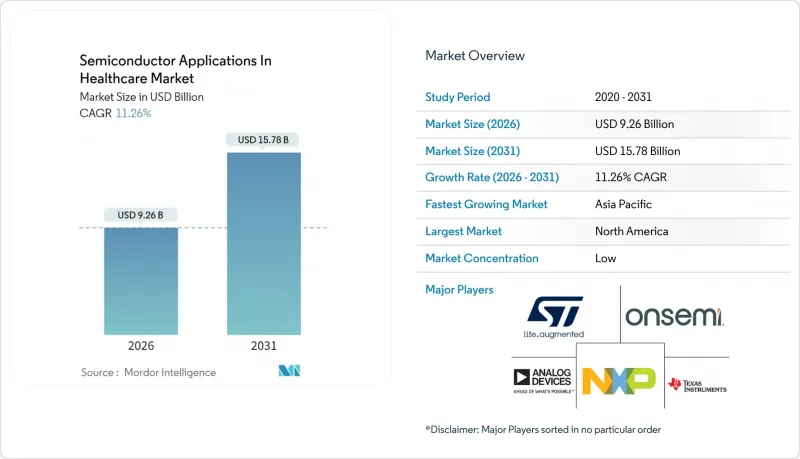
預計到 2026 年,醫療保健領域半導體應用的市場規模將達到 92.6 億美元,高於 2025 年的 83.2 億美元。
預計到 2031 年將達到 157.8 億美元,2026 年至 2031 年的複合年成長率為 11.26%。
この急速な成長は、病院における人工知能(AI)画像診断、埋め込み型バイオMEMS、集中檢查室から検査を分散させる實驗室晶片診断技術への投資に起因します。また、超低消費電力の系統晶片(SoC)やセキュアエレメントデバイスがネットワークエッジで患者データを収集,処理,保護する「コネクテッドケア」への決定的な推進も成長要素です。高度なパッケージング技術、生体適合性材料、長期製品サポートを組み合わせられるチップメーカーは、臨床医が長年安定運作する認証済みハードウェアを求める中、汎用ベンダーを上回る成長が見込まれます。最後に、各国の半導体奨励プログラムが供給基盤を再構築し、医療認証済みシリコンの前置作業時間短縮と単一地域生産拠点への依存低減を促進しています。
全球醫療保健領域半導體應用市場趨勢與洞察
接続型醫療設備とIoTの普及
智慧监护仪、输液泵和辅助生活设备正被部署到全球医院和居家醫療生态系统中,用于持续记录生命体征。這些系統依賴整合了藍牙低功耗 (Bluetooth LE)、Wi-Fi 6 或 5G 無線電模組、感測器介面和加密儲存的無線系統單晶片 (SoC),並在睡眠週期內以微瓦級功耗運作。长寿命纽扣电池的出现推动了对支持能源採集功能的电源管理整合电路 (PMIC) 的需求,促使供应商对无线电协议栈和电源域进行协同优化。这些设备还整合了硬體信任根模块,使临床医生能够验证韌體更新。隨著報銷機制向基於結果的模式轉變,醫療服務提供者擴大採用邊緣處理資料來降低延遲和網路擁塞,從而增加了每個設備的目標晶片容量。
人工智慧成像系統的應用日益普及
放射線科では、事後的な画像読影から、主機上で提供されるリアルタイムの意思決定支援へと移行しています。光子計数型CTスキャナーはより高い頻譜分解能を提供するため、生データの量が増加し、画像再構成や深層学習アルゴリズムを数ミリ秒で実行可能なオンボードアクセラレータアレイが必要となります。半導体設計者は、2.5Dインターポーザー内で高頻寬HBMスタックと低ジオメトリロジック晶粒を組み合わせることで、コンパクトなフットプリントを維持しながらスループットを向上させています。並行して、ガリウムヒ素やペロブスカイト材料を用いた化合物半導体檢測器は、より低い放射線量でより鮮明なコントラストを実現し、専用のアナログフロントエンドや高電圧ドライバに対するバックエンド需要を生み出しています。
レガシー醫療設備の高額なアップグレード費用
许多医院仍在運作十年前购置的核磁共振扫描仪、床旁监护仪和输液泵,这限制了用于半导体密集型升级的资金。這迫使原始設備製造商 (OEM) 推出適用於現有設備的即插即用型電路板,而不是全新的系統,減緩了下一代人工智慧處理器的普及。资金缺口在小規模的私立诊所和新兴经济体中尤为突出,这些地区的报销延迟,采购周期也远超西方平均水平。為了解決這一障礙,供應商提供了一系列融資方案,將晶片成本分攤到多年維護合約和基於使用量的服務模式中。
細分市場分析
至2025年,醫療影像將佔半導體應用市場總收入的35.22%,凸顯其作為醫療保健領域半導體應用市場核心價值創造者的地位。该领域採用超音波模块,整合高解析度数字化仪、现场可编程閘陣列(FPGA)和人工智慧晶粒,用于计算机断层扫描(CT)、磁振造影(MRI)和超声主機。頻譜CT和光子计数CT的普及推动了处理能力的提升,促使原始设备制造商(OEM)採用支持HBM的SoC,以处理超过4GB/s的数据速率。同时,攜帶式超音波系统利用单晶片整合技术,在紧急情况下实现照護現場诊断。根據預測模型,到2031年,醫療影像領域在醫療保健領域半導體應用市場的複合年成長率(CAGR)預計將維持在12.06%。
消費醫療電子領域也帶來了互補性成長,例如,連網血壓計、血糖儀和心電圖貼片等產品正在整合安全的無線功能和低功耗微控制器。诊断性病患監測和治疗设备也在稳步扩张,医院正在逐步採用联网的生命体征中心,并将数据传输到电子健康记录系统。醫療設備领域虽然较为稳定,但增长速度相对较慢,其重点在于採用成熟的65纳米及以上模拟工艺节点实现实验室自动化,并优先考虑精度和使用寿命。
區域分析
北米は2025年に32.74%の収益シェアを維持し、高精度診断機器の償還が可能な成熟した医療保険者エコシステムに牽引され、主導的地位を保っています。連邦政府の獎勵により国内のアナログ,ミックスドシグナルウエハー生産が加速し、FDA認可部品の前置作業時間短縮が図られています。カリフォルニア州、マサチューセッツ州、德克薩斯州を中心とした学術機関と医療機関の連携により、神経調節や埋め込み型センサーのプロトタイプが継続的に供給され、迅速に臨床試験へ移行しています。ただし、特定の高頻寬AIアクセラレータに対する輸出規制の考慮事項は、世界中にイメージング主機を出荷する多国籍OEMメーカーの計画に複雑さを生じています。
亚太地区以13.08%的复合年增长率呈现最快增长态势,这主要得益于中国、印度和东南亚地区对医院基础设施的大規模公共投资。深圳一家晶圆厂专注于医疗级ASIC晶片的生产,并提供符合ISO 13485标准的承包組裝服务,帮助区域内醫療設備Start-Ups缩短设计周期。在印度,政府主導的数字健康宣傳活動正在推动对整合低功耗蓝牙和低功耗RISC-V内核的成本优化型SoC的需求,从而实现农村诊所的生命体征采集。日本製造商則專注於精度和材料創新,近期已成功過渡到8吋碳化矽晶圓,用於支援MRI梯度放大器中的高壓電源。
欧州では醫療設備規則(MDR)を通じ、部品のトレーサビリティや市販後調査の要件を規定するなど、強力な規制発信力を維持しています。EUチップ法では、差し迫ったPFAS規制に対応するため、無溶剤ダイアタッチ化学薬品を採用するパッケージング工場への津貼が指定されています。汎欧州購買コンソーシアムは、サプライヤーの可再生エネルギー利用実績を重視する傾向が強まっており、チップメーカーに対し、カーボン削減藍圖の文書化を促しています。全体的な成長率はアジア太平洋地域に後れを取っていますが、欧州が永續性とデータ保護コンプライアンスを重視しているため、セキュアな処理と暗号化シリコンに対する高付加価値の注文が安定して発生しています。
其他福利:
- Excel格式的市場預測(ME)表
- 3個月的分析師支持
目錄
第1章 引言
- 研究假設和市場定義
- 調查範圍
第2章調查方法
第3章執行摘要
第4章 市場情勢
- 市場概覽
- 市場促進因素
- 接続型醫療設備およびIoTの普及
- 人工智慧成像系統的應用日益普及
- 慢性病負擔加重推動遠距監測
- 政府對醫療專用晶圓廠的獎勵措施
- Power-Supply-on-Chipを備えた埋め込み型バイオMEMS
- 實驗室晶片診断技術による中央檢查室依存度の低減
- 市場限制
- レガシー醫療設備の高額なアップグレード費用
- チップ変更に対する厳格な規制核准サイクル
- 小型化されたウェアラブル/植入機器における熱問題
- 特殊基板におけるサプライチェーンの集中化
- 產業價值鏈分析
- 監管環境
- 技術展望
- ポーターの五力分析
- 供應商的議價能力
- 買方的議價能力
- 新進入者的威脅
- 替代品的威脅
- 競爭對手之間的競爭
- 評估主要宏觀趨勢的影響
第5章 市場規模與成長預測
- 透過申請
- 醫學影像
- 民生用医療電子機器
- 診断,病患監測および治療
- 醫療設備
- 按組件
- 積體電路
- 模擬
- 邏輯
- 記憶
- 微型組件
- 光電子學
- 感應器
- 離散組件
- 研究所
- 積體電路
- 技術ノード別
- 28nm未満
- 28-65nm
- 65nm以上
- 按地區
- 北美洲
- 美國
- 加拿大
- 墨西哥
- 南美洲
- 巴西
- 阿根廷
- 南美洲其他地區
- 歐洲
- 德國
- 英國
- 法國
- 義大利
- 西班牙
- 俄羅斯
- 其他歐洲地區
- 亞太地區
- 中國
- 日本
- 印度
- 韓國
- 東南亞
- 亞太其他地區
- 中東
- 非洲
- 北美洲
第6章 競合情勢
- 市場集中度
- 策略趨勢
- 市佔率分析
- 公司簡介
- Analog Devices Inc.
- ams Osram AG
- Broadcom Inc.
- Dialog Semiconductor Ltd.
- Infineon Technologies AG
- Mediatek Inc.
- Microchip Technology Inc.
- Micron Technology Inc.
- Nordic Semiconductor ASA
- NXP Semiconductors NV
- ON Semiconductor Corp.
- Qualcomm Inc.
- Renesas Electronics Corp.
- Rohm Semiconductor
- Samsung Electronics Co. Ltd.
- Sensirion AG
- Skyworks Solutions Inc.
- STMicroelectronics NV
- Taiwan Semiconductor Manufacturing Co. Ltd.
- Texas Instruments Inc.
- Toshiba Electronic Devices & Storage Corp.
- Vishay Intertechnology Inc.
- Zilog Inc.
第7章 市場機會與未來展望
The semiconductor applications in the healthcare market size in 2026 is estimated at USD 9.26 billion, growing from 2025 value of USD 8.32 billion with 2031 projections showing USD 15.78 billion, growing at 11.26% CAGR over 2026-2031.
Rapid gains stem from hospital investments in artificial-intelligence imaging, implantable bio-MEMS, and lab-on-chip diagnostics that shift testing away from centralized laboratories. Growth also reflects a decisive push toward connected care, where ultra-low-power system-on-chips (SoCs) and secure element devices capture, process, and protect patient data at the network edge. Chipmakers able to combine advanced packaging, biocompatible materials, and long-lifecycle product support are positioned to outpace general-purpose vendors as clinicians demand certified hardware that runs reliably for years. Finally, national semiconductor incentive programs are reshaping the supply base, shortening lead times for medically validated silicon and reducing dependence on single-region production hubs.
Global Semiconductor Applications In Healthcare Market Trends and Insights
Proliferation of Connected Medical Devices and IoT
Global hospital and home-care ecosystems now deploy smart monitors, infusion pumps, and ambient-assisted living tools that continuously log vital signs. These systems rely on wireless SoCs that merge Bluetooth LE, Wi-Fi 6, or 5G radios with sensor interfaces and encrypted storage while consuming microwatts during sleep cycles. Long-life coin-cell operation reinforces demand for energy-harvesting PMICs, prompting suppliers to co-optimize radio stacks and power domains. Device fleets also incorporate hardware root-of-trust modules, allowing clinicians to authenticate firmware updates. As reimbursement frameworks shift toward outcome-based models, providers are increasingly favoring edge-processed data that reduces latency and network congestion, thereby expanding the addressable silicon content per device.
Growing Adoption of AI-Enabled Imaging Systems
Radiology suites are transitioning from retrospective image reads to real-time decision support delivered on-console. Photon-counting CT scanners offer higher spectral resolution, thereby increasing the raw data volume and necessitating on-board accelerator arrays capable of executing image reconstruction and deep-learning algorithms in milliseconds. Semiconductor designers address this by pairing high-bandwidth HBM stacks with low-geometry logic dies within 2.5-D interposers, thereby boosting throughput while maintaining compact footprints. In parallel, compound-semiconductor detectors using gallium arsenide or perovskite materials deliver sharper contrast at lower radiation doses, creating back-end demand for specialized analog front-ends and high-voltage drivers.
High Upgrade Costs for Legacy Medical Equipment
Many hospitals continue operating MRI scanners, bedside monitors, and infusion pumps purchased a decade ago, leaving limited capital for semiconductor-intensive upgrades. Original equipment manufacturers (OEMs), therefore, face pressure to release drop-in boards rather than entirely new systems, which slows the penetration of next-generation AI processors. Funding gaps are most acute in small private clinics and emerging economies, where reimbursements lag and procurement cycles extend well beyond Western averages. To counter the barrier, suppliers bundle financing packages and usage-based service models that amortize silicon costs over multi-year maintenance contracts.
Other drivers and restraints analyzed in the detailed report include:
- Rising Chronic-Disease Burden Driving Remote Monitoring
- Government Incentives for Healthcare-Specific Fabs
- Stringent Regulatory Approval Cycles for Chip Changes
For complete list of drivers and restraints, kindly check the Table Of Contents.
Segment Analysis
Medical imaging contributed 35.22% of 2025 revenue, underscoring its role as the core value generator for the semiconductor applications in the healthcare market. Within this arena, computed tomography, magnetic resonance imaging, and ultrasound consoles incorporate multi-die modules that combine high-resolution digitizers, field-programmable gate arrays, and AI accelerators. The migration toward spectral and photon-counting CT elevates processing demand, prompting OEMs to specify HBM-enabled SoCs that manage data rates exceeding 4 GB/s. Meanwhile, handheld ultrasound systems leverage single-chip integration to deliver point-of-care diagnostics in emergency settings. Forecast models indicate medical imaging will sustain a 12.06% CAGR in the semiconductor applications in the healthcare market by 2031.
Complementary growth stems from consumer medical electronics, where connected blood-pressure cuffs, glucose monitors, and ECG patches integrate secure radios and power-efficient microcontrollers. Diagnostic patient monitoring and therapy equipment also expand steadily as hospitals standardize on networked vital-sign hubs that stream data into electronic health records. Medical instruments remain a stable but less dynamic category, concentrating on laboratory automation that favors tried-and-tested 65 nm and above analog nodes for precision and longevity.
The Semiconductor Applications in Healthcare Market Report is Segmented by Application (Medical Imaging, Consumer Medical Electronics, Medical Instruments, and More), Component (Integrated Circuits, Optoelectronics, Sensors, and More), Technology Node (Less Than 28 Nm, 28-65 Nm, Above 65 Nm), and Geography (North America, South America, Europe, Asia-Pacific, and More). The Market Forecasts are Provided in Terms of Value (USD).
Geography Analysis
North America retains its leadership position, with 32.74% revenue in 2025, driven by a mature healthcare payer ecosystem that can reimburse premium diagnostics. Federal incentives have accelerated domestic analog and mixed-signal wafer starts, reducing lead times for FDA-cleared components. Academic-medical partnerships centered in California, Massachusetts, and Texas sustain a continuous pipeline of neuromodulation and implantable sensor prototypes that transition swiftly into clinical trials. However, export-control considerations on certain high-bandwidth AI accelerators introduce planning complexity for multinational OEMs shipping imaging consoles worldwide.
The Asia-Pacific region posts the fastest trajectory at a 13.08% CAGR, fueled by large-scale public investments in hospital infrastructure across China, India, and Southeast Asia. Shenzhen-based fabs specializing in medical-grade ASIC production now offer turnkey ISO 13485 assembly services, shortening design cycles for regional device startups. In India, government digital-health campaigns are spurring demand for cost-optimized SoCs that integrate Bluetooth LE and power-efficient RISC-V cores, enabling vital-sign collection in rural clinics. Japanese manufacturers emphasize precision and materials innovation; recent transitions to 8-inch SiC wafers support high-voltage supplies inside MRI gradient amplifiers.
Europe maintains a strong regulatory voice through its Medical Device Regulation, which shapes the requirements for component traceability and post-market surveillance. The EU Chips Act earmarks grants for packaging plants that adopt solvent-free die-attach chemistries to comply with impending PFAS restrictions. Pan-European purchasing consortiums increasingly weigh suppliers' renewable-energy footprints, encouraging chipmakers to document carbon-reduction roadmaps. While overall growth trails that of the Asia-Pacific region, Europe's emphasis on sustainability and data-protection compliance ensures consistent high-value orders for secure processing and encryption silicon.
- Analog Devices Inc.
- ams Osram AG
- Broadcom Inc.
- Dialog Semiconductor Ltd.
- Infineon Technologies AG
- Mediatek Inc.
- Microchip Technology Inc.
- Micron Technology Inc.
- Nordic Semiconductor ASA
- NXP Semiconductors N.V.
- ON Semiconductor Corp.
- Qualcomm Inc.
- Renesas Electronics Corp.
- Rohm Semiconductor
- Samsung Electronics Co. Ltd.
- Sensirion AG
- Skyworks Solutions Inc.
- STMicroelectronics N.V.
- Taiwan Semiconductor Manufacturing Co. Ltd.
- Texas Instruments Inc.
- Toshiba Electronic Devices & Storage Corp.
- Vishay Intertechnology Inc.
- Zilog Inc.
Additional Benefits:
- The market estimate (ME) sheet in Excel format
- 3 months of analyst support
TABLE OF CONTENTS
1 INTRODUCTION
- 1.1 Study Assumptions and Market Definition
- 1.2 Scope of the Study
2 RESEARCH METHODOLOGY
3 EXECUTIVE SUMMARY
4 MARKET LANDSCAPE
- 4.1 Market Overview
- 4.2 Market Drivers
- 4.2.1 Proliferation of connected medical devices and IoT
- 4.2.2 Growing adoption of AI-enabled imaging systems
- 4.2.3 Rising chronic-disease burden driving remote monitoring
- 4.2.4 Government incentives for healthcare-specific fabs
- 4.2.5 Implantable bio-MEMS with on-chip power
- 4.2.6 Lab-on-chip diagnostics reducing central-lab dependence
- 4.3 Market Restraints
- 4.3.1 High upgrade costs for legacy medical equipment
- 4.3.2 Stringent regulatory approval cycles for chip changes
- 4.3.3 Thermal issues in miniaturised wearable/implantables
- 4.3.4 Supply-chain concentration in specialist substrates
- 4.4 Industry Value Chain Analysis
- 4.5 Regulatory Landscape
- 4.6 Technological Outlook
- 4.7 Porter's Five Forces Analysis
- 4.7.1 Bargaining Power of Suppliers
- 4.7.2 Bargaining Power of Buyers
- 4.7.3 Threat of New Entrants
- 4.7.4 Threat of Substitutes
- 4.7.5 Intensity of Competitive Rivalry
- 4.8 Assessment of Impact of Key Macro Trends
5 MARKET SIZE AND GROWTH FORECASTS (VALUE)
- 5.1 By Application
- 5.1.1 Medical Imaging
- 5.1.2 Consumer Medical Electronics
- 5.1.3 Diagnostic Patient Monitoring and Therapy
- 5.1.4 Medical Instruments
- 5.2 By Component
- 5.2.1 Integrated Circuits
- 5.2.1.1 Analog
- 5.2.1.2 Logic
- 5.2.1.3 Memory
- 5.2.1.4 Micro-components
- 5.2.2 Optoelectronics
- 5.2.3 Sensors
- 5.2.4 Discrete Components
- 5.2.5 Research Institutes
- 5.2.1 Integrated Circuits
- 5.3 By Technology Node
- 5.3.1 Less than 28 nm
- 5.3.2 28-65 nm
- 5.3.3 Above 65 nm
- 5.4 By Geography
- 5.4.1 North America
- 5.4.1.1 United States
- 5.4.1.2 Canada
- 5.4.1.3 Mexico
- 5.4.2 South America
- 5.4.2.1 Brazil
- 5.4.2.2 Argentina
- 5.4.2.3 Rest of South America
- 5.4.3 Europe
- 5.4.3.1 Germany
- 5.4.3.2 United Kingdom
- 5.4.3.3 France
- 5.4.3.4 Italy
- 5.4.3.5 Spain
- 5.4.3.6 Russia
- 5.4.3.7 Rest of Europe
- 5.4.4 Asia-Pacific
- 5.4.4.1 China
- 5.4.4.2 Japan
- 5.4.4.3 India
- 5.4.4.4 South Korea
- 5.4.4.5 South-East Asia
- 5.4.4.6 Rest of Asia-Pacific
- 5.4.5 Middle East
- 5.4.6 Africa
- 5.4.1 North America
6 COMPETITIVE LANDSCAPE
- 6.1 Market Concentration
- 6.2 Strategic Moves
- 6.3 Market Share Analysis
- 6.4 Company Profiles (includes Global level Overview, Market level overview, Core Segments, Financials as available, Strategic Information, Market Rank/Share for key companies, Products and Services, and Recent Developments)
- 6.4.1 Analog Devices Inc.
- 6.4.2 ams Osram AG
- 6.4.3 Broadcom Inc.
- 6.4.4 Dialog Semiconductor Ltd.
- 6.4.5 Infineon Technologies AG
- 6.4.6 Mediatek Inc.
- 6.4.7 Microchip Technology Inc.
- 6.4.8 Micron Technology Inc.
- 6.4.9 Nordic Semiconductor ASA
- 6.4.10 NXP Semiconductors N.V.
- 6.4.11 ON Semiconductor Corp.
- 6.4.12 Qualcomm Inc.
- 6.4.13 Renesas Electronics Corp.
- 6.4.14 Rohm Semiconductor
- 6.4.15 Samsung Electronics Co. Ltd.
- 6.4.16 Sensirion AG
- 6.4.17 Skyworks Solutions Inc.
- 6.4.18 STMicroelectronics N.V.
- 6.4.19 Taiwan Semiconductor Manufacturing Co. Ltd.
- 6.4.20 Texas Instruments Inc.
- 6.4.21 Toshiba Electronic Devices & Storage Corp.
- 6.4.22 Vishay Intertechnology Inc.
- 6.4.23 Zilog Inc.
7 MARKET OPPORTUNITIES AND FUTURE OUTLOOK
- 7.1 White-space and Unmet-Need Assessment


