


 |
市場調查報告書
商品編碼
1939653
苯乙烯嵌段共聚物(SBC):市場佔有率分析、產業趨勢與統計、成長預測(2026-2031)Styrenic Block Copolymers (SBCs) - Market Share Analysis, Industry Trends & Statistics, Growth Forecasts (2026 - 2031) |
||||||

※ 本網頁內容可能與最新版本有所差異。詳細情況請與我們聯繫。
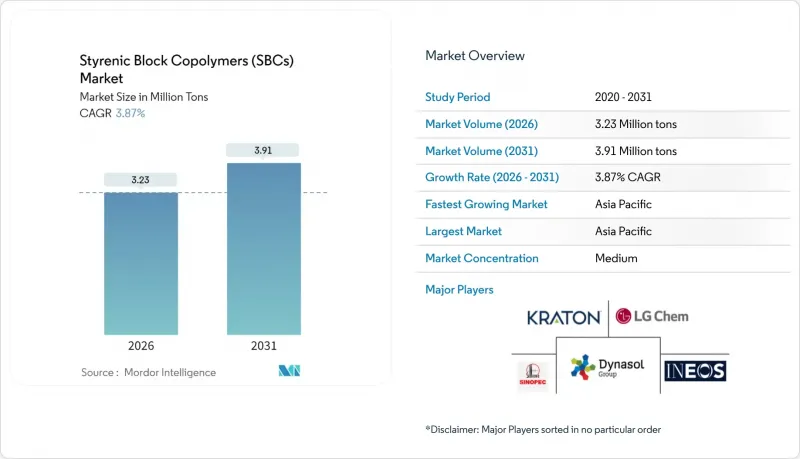
預計到 2026 年,苯乙烯嵌段共聚物 (SBC) 的市場規模將達到 323 萬噸。
這意味著產量將從 2025 年的 311 萬噸增加到 2031 年的 391 萬噸。從 2026 年到 2031 年,預計年複合成長率為 3.87%。
儘管市場需求已趨於成熟,但苯乙烯嵌段共聚物 (SBC) 市場仍受益於其廣泛的應用領域,從瀝青改質劑和防水卷材到高價值介電薄膜,無所不包。多角化經營使生產者免受單一產業週期性波動的影響,而原料整合和接近性終端用戶的區域優勢也日益成為競爭優勢的關鍵所在。亞太地區持續推動市場成長,各國政府對指定使用聚合物改質瀝青和防水卷材的建設計劃(包括高速公路、鐵路網和高層建築)進行投資。同時,氫化級苯乙烯嵌段專利到期為中端供應商創造了發展空間,而電動汽車電容器磺酸鹽化學的突破性進展也預示著苯乙烯嵌段共聚物 (SBC) 市場未來可能出現更多高價值細分領域。
全球苯乙烯嵌段共聚物(SBC)市場趨勢及展望
瀝青回收強制令推動性能要求
歐盟和美國的立法者已將最低再生材料含量要求納入道路建設標準,鼓勵設計人員優先選擇即使在使用輪胎或塑膠衍生油替代原生瀝青的情況下也能保持機械完整性的聚合物體系。近期測試證實,SBS改質混合料在反覆凍融循環和氧化壓力作用下性能優於未改質瀝青,滿足更嚴格的使用壽命標準。由於再生材料的多樣性增加了配方的複雜性,能夠提供滿足高雜質含量要求的苯乙烯嵌段共聚物(SBC)的供應商享有價格優勢。雖然資金籌措機制正在推動市場需求,但區域回收網路的缺乏以及熱解裝置許可證核准耗時較長,導致短期供應受限。因此,隨著回收要求從聯邦立法逐步落實到地方政府採購,苯乙烯嵌段共聚物(SBC)市場正經歷穩定的噸位成長。
亞太地區基礎建設熱潮推動了防水材料的需求。
中國、印度、越南和印尼創紀錄的公共支出持續刺激橋樑、地鐵和大型住宅開發項目對聚合物改質防水卷材的需求。 SCG Chemicals公司斥資7億美元對其龍山工廠進行升級改造,標誌著這家綜合性生產商正轉向使用軟性乙烷原料,以滿足瀝青和建築防水卷材對苯乙烯嵌段共聚物(SBC)的結構性接近性。區域建築商在熱帶、沙漠和高山氣候條件下的高速公路建設中指定使用苯乙烯嵌段共聚物(SBS)改性黏合劑,以確保低溫抗裂性和高溫路面抗車轍性能。靠近建築中心降低了運輸成本並縮短了交貨時間,這些優勢預計將推動亞太地區苯乙烯嵌段共聚物(SBC)的市場佔有率在2024年超過57%。儘管勞動力短缺和核准延誤在某些情況下導致計劃進度停滯,但多年的政府預算為製造商制定到2030年的產能擴張計劃提供了支持。
冷拌技術面臨的挑戰與傳統路面技術進行比較。
加拿大、德國和美國多個州的政府機構正在試行使用室溫固化的乳液型冷拌路面,以減少瀝青攪拌站的溫室氣體排放。早期現場性能評估表明,無聚合物配方可能滿足地方和次要道路的規範要求,從而有可能降低交通流量相對較低的地區對苯乙烯嵌段共聚物(SBS)的需求。然而,在交通繁忙的城市主幹道上,SBS提供的抗車轍性能仍然是必要的。推廣應用的障礙包括施工人員的熟悉程度、長期耐久性檢驗、特殊乳化劑供應有限。因此,儘管冷拌替代技術可能會限制某些細分市場的成長潛力,但苯乙烯嵌段共聚物(SBC)市場的核心預計仍將集中在高性能路面領域。
細分市場分析
到2025年,苯乙烯-丁二烯-苯乙烯(SBS)將繼續佔據苯乙烯嵌段共聚物(SBC)市場71.48%的主導佔有率,這印證了其在瀝青、鞋類和壓敏黏著劑等領域的具成本效益優勢。該聚合物成熟的供應鏈、廣泛的加工技術和配方靈活性降低了其在大規模生產應用中的替代風險。儘管SEBS和SEPS等氫化級苯乙烯嵌段共聚物的產量較低,但由於汽車製造商、家電品牌以及電線電纜製造商對耐熱性、抗紫外線線性和耐油性等基準值的不斷提高,預計到2031年,其複合年成長率將達到4.43%,成為成長最快的產品。在專利相關費用取消以及基於雲端的CAE平台商業化加速等級選擇等因素的推動下,預計氫化級苯乙烯嵌段共聚物市場規模在預測期內將增加約15萬噸。
同時,SIS在溶劑型壓敏黏著劑、造口護理用品和醫用敷料膠帶等特殊應用領域保持領先地位,其固有的黏性和抗泛化性能彌補了其價格溢價。製造商正在進一步改進氫化SIS,以減少熱熔加工過程中的氧化交聯,從而擴大其在衛生用品領域的應用範圍。原料的柔軟性,特別是優先使用異戊二烯而非價格較高的丁二烯,為SIS生產商提供了抵禦原料價格波動的有效途徑。這些趨勢,加上聚合物類型的多樣化,正在保護苯乙烯嵌段共聚物(SBC)市場免受宏觀經濟週期性波動的影響,同時為長期創新藍圖奠定基礎。
《苯乙烯嵌段共聚物 (SBC) 報告》按聚合物類型(苯乙烯-丁二烯-苯乙烯 (SBS)、苯乙烯-異戊二烯-苯乙烯 (SIS)、氫化苯乙烯嵌段共聚物 (HSBC))、應用領域(瀝青、歐洲地區、鞋類、聚合物改性、黏合劑和密封劑等)以及地區(南美洲亞地區進行分析)。市場預測以噸為單位。
區域分析
亞太地區在苯乙烯嵌段共聚物(SBC)市場佔據主導地位,預計到2025年將佔全球市場佔有率的56.63%,這反映了其作為全球製造地和重要基礎設施建設重點區域的地位。位置中國沿海地區、韓國和東協煉油走廊的資本密集型乙烯-丙烯聯合裝置提供了具有競爭力的原料,而國內建築公司透過多年期的高速公路、港口和地鐵計劃確保了穩定的需求。越南決定擴大其乙烷裂解產能,顯示該地區在原料供應方面柔軟性,而印度的快速都市化則為防水卷材的需求提供了永續的基礎。政策主導的工業化、電子產業群聚以及加速的汽車電氣化正在推動氫化SBC的應用,預計到2031年,該地區的複合年成長率將達到4.21%,高於全球平均水平。
在北美,聯邦政府的基礎設施支出計畫將投入數十億美元用於州際公路維修和機場跑道重鋪,這正在推動市場發展。同時,在苯乙烯嵌段共聚物(SBC)市場,由於英力士苯領公司永久關閉了其位於薩尼亞工廠的年產43萬噸的苯乙烯生產線,國內苯乙烯供應量有所下降。這導致商業單體供應緊張,進一步鞏固了垂直整合企業的市場主導地位。瀝青回收的強制性規定推動了黏合劑混合物中聚合物濃度的提高,而該地區的Start-Ups企業生態系統則推動了用於電動車電力電子的SBC基介電薄膜的發展。然而,由於頁岩氣液化產品和墨西哥灣沿岸颶風的影響,原物料價格波動,造成了不確定性,並限制了企業的擴張計畫。
歐洲是苯乙烯嵌段共聚物 (SBC) 市場中一個成熟且技術先進的細分市場,優先考慮永續性和循環經濟。高昂的能源價格和嚴格的環境法規迫使生產商以最佳運轉率運營,推動工廠合理化,同時也提高了製程效率。諸如「綠色交易」和「生產者延伸責任制」等監管促進因素刺激了對可回收和可再生聚合物系統的需求,其中SEBS 和磺酸鹽SBC 在食品接觸材料和醫用導管應用領域備受青睞。
其他福利:
- Excel格式的市場預測(ME)表
- 3個月的分析師支持
目錄
第1章 引言
- 研究假設和市場定義
- 調查範圍
第2章調查方法
第3章執行摘要
第4章 市場情勢
- 市場概覽
- 市場促進因素
- 歐盟和美國的瀝青回收強制令
- 亞太地區基礎建設蓬勃發展(高速公路、防水工程)
- 疫情導致一次性衛生薄膜需求增加
- 科騰公司匯豐銀行級專利到期,鼓勵新進業者。
- 用於下一代電動汽車電容器的磺酸鹽SBC
- 市場限制
- 與原油相關的苯乙烯-丁二烯原料價格波動
- 無瀝青冷拌鋪路技術
- POE/POP彈性體可作為包裝中SBC的替代品
- 價值鏈分析
- 波特五力模型
- 供應商的議價能力
- 買方的議價能力
- 新進入者的威脅
- 替代品的威脅
- 競爭程度
第5章 市場規模與成長預測
- 按聚合物類型
- 苯乙烯-丁二烯-苯乙烯(SBS)
- 苯乙烯-異戊二烯-苯乙烯(SIS)
- 氫化SBC(HSBC)
- 透過使用
- 瀝青改質(鋪路和屋頂)
- 鞋類
- 聚合物改性
- 黏合劑和密封劑
- 其他用途(醫療設備、電線電纜等)
- 按地區
- 亞太地區
- 中國
- 印度
- 日本
- 韓國
- 馬來西亞
- 泰國
- 印尼
- 越南
- 亞太其他地區
- 北美洲
- 美國
- 加拿大
- 墨西哥
- 歐洲
- 德國
- 英國
- 法國
- 義大利
- 西班牙
- 俄羅斯
- 土耳其
- 北歐國家
- 其他歐洲地區
- 南美洲
- 巴西
- 阿根廷
- 哥倫比亞
- 南美洲其他地區
- 中東和非洲
- 沙烏地阿拉伯
- 阿拉伯聯合大公國
- 卡達
- 埃及
- 奈及利亞
- 南非
- 其他中東和非洲地區
- 亞太地區
第6章 競爭情勢
- 市場集中度
- 策略趨勢(併購、合資、產能)
- 市佔率(%)/排名分析
- 公司簡介
- Asahi Kasei Corporation
- Avient Corporation
- Dynasol Group
- Eni SpA
- INEOS
- Kraton Corporation
- Kuraray Co., Ltd.
- LCY
- LG Chem
- Sibur
- Sinopec
- TSRC
- ZEON Corporation
第7章 市場機會與未來展望
Styrenic Block Copolymers market size in 2026 is estimated at 3.23 Million tons, growing from 2025 value of 3.11 Million tons with 2031 projections showing 3.91 Million tons, growing at 3.87% CAGR over 2026-2031.
Despite a mature demand base, the styrenic block copolymers market continues to benefit from its wide application spread, ranging from asphalt modification and waterproofing membranes to high-value dielectric films. Diversification protects producers from single-sector cyclicality, while feedstock integration and regional proximity to end users increasingly dictate competitive advantage. The Asia-Pacific region remains the growth engine as governments channel capital toward expressways, rail links, and high-rise construction that specify polymer-modified bitumen and membranes. Simultaneously, patent expiries in hydrogenated grades open space for mid-tier suppliers, and breakthroughs in sulfonated chemistries for EV capacitors hint at future premium niches for the styrenic block copolymers market.
Global Styrenic Block Copolymers (SBCs) Market Trends and Insights
Asphalt-Recycling Mandates Drive Performance Requirements
Legislators in the EU and United States have embedded minimum recycled-content thresholds into road construction codes, prompting designers to favor polymer systems that preserve mechanical integrity when tire-derived or plastic-derived oils replace virgin bitumen. Recent trials confirm that SBS-modified mixes outperform unmodified asphalt under repeated freeze-thaw cycles and oxidative stress, thereby meeting tougher service-life criteria. Suppliers capable of tailoring styrenic block copolymers to higher impurity loads enjoy a pricing premium, because recyclate variability increases formulation complexity. Although funding mechanisms accelerate market pull, gaps in regional collection networks and lengthy permitting cycles for pyrolysis units keep short-term supply tight. Consequently, the styrenic block copolymers market secures incremental tonnage growth as recycling mandates cascade from federal statutes to municipal procurement.
APAC Infrastructure Boom Accelerates Waterproofing Demand
Record-level public spending across China, India, Vietnam, and Indonesia continues to stimulate consumption of polymer-modified membranes for bridges, subways, and mega-residential complexes. SCG Chemicals' USD 700 million upgrade at its Long Son complex illustrates how integrated producers pivot to flexible ethane feedstock in anticipation of structural demand for SBCs in asphalt and building membranes. Regional contractors specify SBS-modified binders for expressways that traverse tropical, desert, and alpine climates, thereby guaranteeing low-temperature crack resistance and high-temperature rutting stability. Proximity to construction centers lowers freight cost and shortens delivery lead times, advantages that push APAC's share of the styrenic block copolymers market beyond 57% in 2024. While labor shortages and permitting delays occasionally stall project timelines, multi-year government budgets underpin visibility for producers mapping capacity additions through 2030.
Cold-Mix Technologies Challenge Traditional Applications
Government agencies in Canada, Germany, and several U.S. states have trialed emulsion-based cold-mix pavements that cure at ambient temperature, reducing greenhouse-gas emissions from asphalt plants. Early-stage field performance suggests that polymer-free recipes can meet rural and secondary road specifications, potentially eroding SBS demand where traffic loads are modest. Nonetheless, heavy-traffic urban arterials still require the rutting resistance imparted by SBS. Implementation barriers include contractor familiarity, untested long-term durability, and limited supply of specialized emulsifiers. Hence, although cold-mix alternatives cap upside in certain subsegments, the styrenic block copolymers market retains its core in high-performance pavements.
Other drivers and restraints analyzed in the detailed report include:
- Pandemic-Driven Hygiene Film Applications Create New Demand Vectors
- Sulfonated SBCs Unlock High-Value EV Capacitor Space
- POE/POP Elastomers Replace SBCs in Flexible Packaging
For complete list of drivers and restraints, kindly check the Table Of Contents.
Segment Analysis
Styrene-Butadiene-Styrene retained a commanding 71.48% share of the styrenic block copolymers market in 2025, underscoring cost-aligned performance in asphalt, footwear, and pressure-sensitive adhesives. The polymer enjoys a well-established supply chain, broad processing familiarity, and formulation versatility that limit substitution risk in mass-volume applications. Hydrogenated members such as SEBS and SEPS contributed a smaller tonnage base but registered the fastest 4.43% CAGR to 2031 as automakers, consumer-electronics brands, and wire-and-cable producers specified higher thermal, UV, and oil-resistance thresholds. The styrenic block copolymers market size for hydrogenated grades is projected to increase by nearly 0.15 million tons during the forecast window, buoyed by the collapse of patent-related royalties and the commercialization of cloud-enabled CAE platforms that accelerate grade selection.
In parallel, SIS maintained a specialized role in solvent-borne pressure-sensitive adhesives, ostomy-care appliances, and medical drape tapes where intrinsic tack and bloom resistance outweigh price premiums. Producers have optimized hydrogenated SIS variants to cut oxidative cross-linking during hot-melt processing, broadening their fit for hygiene applications. Feedstock mix flexibility, especially the ability to favor isoprene over high-priced butadiene, gives SIS producers a hedge against raw-material volatility. Collectively, these dynamics ensure that polymer-type diversification shields the styrenic block copolymers market from macroeconomic cyclicality while anchoring long-term innovation roadmaps.
The Styrenic Block Copolymers Report is Segmented by Polymer Type (Styrene-Butadiene-Styrene (SBS), Styrene-Isoprene-Styrene (SIS), and Hydrogenated SBCs (HSBC)), Application (Asphalt Modification, Footwear, Polymer Modification, Adhesives and Sealants, and Others), and Geography (Asia-Pacific, North America, Europe, South America, and Middle-East and Africa). The Market Forecasts are Provided in Terms of Volume (Tons).
Geography Analysis
Asia-Pacific's dominant 56.63% 2025 share of the styrenic block copolymers market reflects its combined status as a global manufacturing hub and infrastructure hot spot. Capital-intensive ethylene and propylene complexes along the Chinese coast, in South Korea, and within the ASEAN refinery corridor provide competitive feedstock; meanwhile, domestic contractors ensure stable off-take through multi-year freeway, port, and metro projects. Vietnam's decision to retrofit ethane cracking capacity underscores the region's flexibility in sourcing, while India's rapid urban migration underpins sustained waterproofing-membrane demand. The region's 4.21% projected CAGR to 2031 outpaces global averages thanks to policy-driven industrialization, electronics clustering, and accelerating vehicle electrification, all catalysts for hydrogenated SBC uptake.
North America is buoyed by federal infrastructure-spending packages that allocate billions toward Interstate rehabilitation and airport runway resurfacing. The styrenic block copolymers market faces reduced domestic styrene supply after INEOS Styrolution permanently idled its 430,000-ton Sarnia unit, tightening merchant monomer availability and advantaging vertically integrated players. Asphalt-recycling mandates drive higher polymer concentrations in binder blends, while the region's start-up ecosystem pushes SBC-based dielectric films for EV power electronics. However, feedstock volatility tied to shale gas liquids and hurricanes along the Gulf Coast introduces uncertainty that tempers expansion plans.
Europe commands a mature yet technologically sophisticated slice of the styrenic block copolymers market, prioritizing sustainability and circularity. High energy tariffs and strict environmental regulations compel producers to operate at optimized utilizations, leading to plant rationalizations but also encouraging process efficiency gains. Regulatory drivers such as the Green Deal and extended producer-responsibility frameworks stimulate demand for recyclable and recycled-compatible polymer systems, favoring SEBS and sulfonated SBCs in food-contact and medical tubing applications.
- Asahi Kasei Corporation
- Avient Corporation
- Dynasol Group
- Eni S.p.A.
- INEOS
- Kraton Corporation
- Kuraray Co., Ltd.
- LCY
- LG Chem
- Sibur
- Sinopec
- TSRC
- ZEON Corporation
Additional Benefits:
- The market estimate (ME) sheet in Excel format
- 3 months of analyst support
TABLE OF CONTENTS
1 Introduction
- 1.1 Study Assumptions and Market Definition
- 1.2 Scope of the Study
2 Research Methodology
3 Executive Summary
4 Market Landscape
- 4.1 Market Overview
- 4.2 Market Drivers
- 4.2.1 Asphalt-Recycling Mandates in EU and U.S.
- 4.2.2 APAC Infrastructure Boom (Expressways, Waterproofing)
- 4.2.3 Pandemic-Driven Rise in Single-Use Hygiene Films
- 4.2.4 Patent Expiry of Kraton's HSBC Grades Unlocking New Entrants
- 4.2.5 Sulfonated SBCs for Next-Gen EV Capacitors
- 4.3 Market Restraints
- 4.3.1 Volatility of Crude-Linked Styrene and Butadiene Feedstocks
- 4.3.2 Asphalt-Free Cold-Mix Road Technologies
- 4.3.3 POE/POP Elastomers Replacing SBCs in Packaging
- 4.4 Value Chain Analysis
- 4.5 Porter's Five Forces
- 4.5.1 Bargaining Power of Suppliers
- 4.5.2 Bargaining Power of Buyers
- 4.5.3 Threat of New Entrants
- 4.5.4 Threat of Substitutes
- 4.5.5 Degree of Competition
5 Market Size and Growth Forecasts (Volume)
- 5.1 By Polymer Type
- 5.1.1 Styrene-Butadiene-Styrene (SBS)
- 5.1.2 Styrene-Isoprene-Styrene (SIS)
- 5.1.3 Hydrogenated SBCs (HSBC)
- 5.2 By Application
- 5.2.1 Asphalt Modification (Paving and Roofing)
- 5.2.2 Footwear
- 5.2.3 Polymer Modification
- 5.2.4 Adhesives and Sealants
- 5.2.5 Other Applications (Medical devices and Wires and Cables)
- 5.3 Geography
- 5.3.1 Asia-Pacific
- 5.3.1.1 China
- 5.3.1.2 India
- 5.3.1.3 Japan
- 5.3.1.4 South Korea
- 5.3.1.5 Malaysia
- 5.3.1.6 Thailand
- 5.3.1.7 Indonesia
- 5.3.1.8 Vietnam
- 5.3.1.9 Rest of Asia-Pacific
- 5.3.2 North America
- 5.3.2.1 United States
- 5.3.2.2 Canada
- 5.3.2.3 Mexico
- 5.3.3 Europe
- 5.3.3.1 Germany
- 5.3.3.2 United Kingdom
- 5.3.3.3 France
- 5.3.3.4 Italy
- 5.3.3.5 Spain
- 5.3.3.6 Russia
- 5.3.3.7 Turkey
- 5.3.3.8 Nordic Countries
- 5.3.3.9 Rest of Europe
- 5.3.4 South America
- 5.3.4.1 Brazil
- 5.3.4.2 Argentina
- 5.3.4.3 Colombia
- 5.3.4.4 Rest of South America
- 5.3.5 Middle-East and Africa
- 5.3.5.1 Saudi Arabia
- 5.3.5.2 United Arab Emirates
- 5.3.5.3 Qatar
- 5.3.5.4 Egypt
- 5.3.5.5 Nigeria
- 5.3.5.6 South Africa
- 5.3.5.7 Rest of Middle-East and Africa
- 5.3.1 Asia-Pacific
6 Competitive Landscape
- 6.1 Market Concentration
- 6.2 Strategic Moves (Mergers and Acquisitions, JV, Capacity)
- 6.3 Market Share (%)/Ranking Analysis
- 6.4 Company Profiles (includes Global level Overview, Market level overview, Core Segments, Financials as available, Strategic Information, Market Rank/Share for key companies, Products and Services, and Recent Developments)
- 6.4.1 Asahi Kasei Corporation
- 6.4.2 Avient Corporation
- 6.4.3 Dynasol Group
- 6.4.4 Eni S.p.A.
- 6.4.5 INEOS
- 6.4.6 Kraton Corporation
- 6.4.7 Kuraray Co., Ltd.
- 6.4.8 LCY
- 6.4.9 LG Chem
- 6.4.10 Sibur
- 6.4.11 Sinopec
- 6.4.12 TSRC
- 6.4.13 ZEON Corporation
7 Market Opportunities and Future Outlook
- 7.1 White-space and Unmet-need Assessment

 SBC及其衍生產品的市場規模:依產品類型、應用和地區分類(2026-2034年)苯乙烯嵌段共聚物市場報告:按類型、應用和地區分類(2026-2034年)
 苯乙烯嵌段共聚物市場規模、佔有率和趨勢分析報告:按產品、應用、地區和細分市場預測(2026-2045 年)
 2026-2034年全球醫用苯乙烯嵌段共聚物市場規模、佔有率、趨勢和成長分析報告苯乙烯嵌段共聚物全球市場規模、佔有率、趨勢和成長分析報告(2026-2034)
 苯乙烯嵌段共聚物市場規模、佔有率及成長分析(依產品、應用、最終用戶及地區分類)-2026-2033年產業預測
 2025年全球醫用苯乙烯嵌段共聚物市場報告
 苯乙烯共聚物 ABS 和 SAN 的全球市場
 全球苯乙烯共聚物(SBC) 市場,依類型、應用進行需求分析,預測至 2034 年
 醫用苯乙烯嵌段共聚物市場(依產品、應用、國家及地區)-2025 年至 2032 年全球產業分析、市場規模、市場佔有率及預測