


 |
市場調查報告書
商品編碼
1939596
亞太地區軟質包裝:市佔率分析、產業趨勢與統計、成長預測(2026-2031)Asia-Pacific Flexible Packaging - Market Share Analysis, Industry Trends & Statistics, Growth Forecasts (2026 - 2031) |
||||||

※ 本網頁內容可能與最新版本有所差異。詳細情況請與我們聯繫。
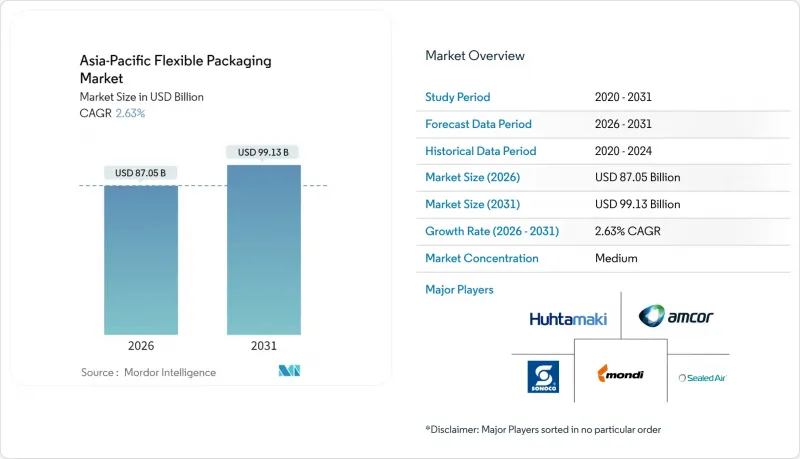
預計到 2026 年,亞太地區的軟質包裝市場規模將達到 870.5 億美元。
這意味著從 2025 年的 848.2 億美元成長到 2031 年的 991.3 億美元,2026 年至 2031 年的複合年成長率為 2.63%。
隨著日本、澳洲以及中國和印度試點城市的監管機構強制推行單一材料包裝規格,資金正從原物料噸位轉向高阻隔阻隔性和可回收設計。儘管中國仍保持規模優勢,但印度4.89%的複合年成長率表明,隨著加工商尋求更低的勞動力成本以及對零食和個人保健產品日益成長的需求,市場格局正在發生地域性轉移。預計到2024年,塑膠將佔據68.12%的市場佔有率,但生質塑膠和可堆肥材料正以4.33%的複合年成長率快速成長,品牌所有者正積極調整產品系列以適應不斷擴大的生產者責任延伸制度(EPR)。包裝袋和包裝盒仍是成本效益最高的包裝形式,佔產品類型總收入的47.63%。同時,小袋裝和條狀包裝的成長率為3.67%,反映了單份包裝產品在亞洲二、三線城市的成本效益。數位印刷每年成長 4.76%,使得 10,000 公尺以下的短版印刷有利可圖,並透過支持日本和韓國的限量版產品發布,重塑了加工商的經濟效益。
亞太地區軟質包裝市場趨勢與洞察
對便利包裝的需求日益成長
中國超過60%的都市化以及日本單人家庭比例的不斷上升,推動了對分量控制、可重複密封包裝袋的需求,這種包裝袋能夠縮短備餐時間並減少食物浪費。東南亞零售商計畫在2025年將軟質包裝產品種類增加22%,證明了加工商投資伺服驅動軟包裝生產線的合理性。 15分鐘內完成產品種類切換的能力提高了產能運轉率,並支援快速促銷。消費者願意支付8-12%的便利溢價,進而緩解樹脂價格波動帶來的利潤壓力。可支配收入的成長使得軟質包裝成為新興大都市地區零食、飲料和蒸餾食品的首選包裝。
包裝商品電子商務滲透率不斷提高
印度線上雜貨市場佔有率預計將從2020年的3.2%成長到2024年的7.8%,越南的電子商務物流網路預計到2024年將覆蓋85%的人口。為了應對「最後一公里」配送的挑戰,需要使用耐穿刺、霧面飾面且能承受多次搬運並在移動螢幕上清晰可見的薄膜。加工商目前正在設計抗穿刺強度達到4牛頓或更高的多層結構,並願意為此增加6-8%的材料成本,以避免高成本的退貨成本。數位印刷的可變數據碼能夠提升品牌互動,並將包裝與忠誠度計畫連接起來。兼具性能和美觀的軟包裝正鞏固其作為電商理想包裝容器的地位。
人們擔憂塑膠包裝和回收對環境的影響
在越南、泰國和菲律賓,生產者延伸責任制(EPR)的成本(佔廠價的0.8%至2.1%)使加工商的利潤率下降了40至60個基點。印度在2026年實現80%回收率的目標在農村地區仍然難以實現,這阻礙了品牌遵守相關規定。調查顯示,在日本和韓國,64%的消費者在有可回收替代品的情況下會避免使用多層包裝袋,這給傳統包裝形式帶來了壓力。可堆肥薄膜的價格仍然高出25%至30%,並且在潮濕環境中也面臨挑戰。在建立健全的回收系統之前,品牌所有者將面臨永續性與成本現實之間的矛盾。
細分市場分析
到2025年,塑膠將以67.35%的市場佔有率佔據主導地位,其中聚乙烯仍將是高速立式填充封口生產線的主要材料。在此基礎上,生質塑膠和可堆肥材料將以4.17%的複合年成長率實現最快成長,因為品牌商正在採用PLA和PHA混合物以滿足日本和澳洲即將訂定的回收標準。隨著全球供應鏈一體化程度的提高,亞太地區生質塑膠軟質包裝市場規模預計將會擴大,但來自歐洲的運費溢價仍將影響最終到岸成本結構。雙向拉伸聚丙烯(BOPP)憑藉其透明度和可印刷性,將繼續在零嘴零食領域保持領先地位,而鋁箔將在醫療和咖啡應用領域保持其市場地位,因為這些應用氧氣透過率低於0.5 cc/m²/天的要求非常嚴格。
整體包裝的普及迫使聚乙烯供應商開發阻隔性配方,以金屬化聚乙烯(PE)或高密度聚乙烯(HDPE)塗層取代聚對苯二甲酸乙二醇酯(PET)和尼龍層,以保持其可回收性。 Uflex 的 Flex-PET(預計於 2024 年商業化)的氧氣透過率達到 1.2 cc/m²/天,鞏固了聚乙烯在零食薄膜領域的領先地位。紙基複合材料在韓國化妝品市場日益受到青睞,儘管其成本溢價高達 18-22%,但其富含纖維,具有永續性優勢。金屬的阻隔性在製藥領域仍然無可匹敵,但其回收過程中的能源消耗正受到檢驗。整體而言,亞太地區軟質包裝市場正在經歷樹脂混合物的重新平衡,可回收聚烯比複雜的多層結構更受青睞。
預計到2025年,袋裝和軟包裝產品將佔據46.95%的市場佔有率,這主要得益於其在食品、寵物食品和農業領域的廣泛應用。然而,小袋裝和條狀包裝預計到2031年將以3.55%的複合年成長率成長。在亞太地區,小袋軟質包裝的市佔率正在成長,因為跨國公司正瞄準價格敏感型消費者,推出洗髮精、護髮素和護膚霜等一次性產品。聯合利華和寶潔公司計劃在2024年將小袋產品種類增加14%,以覆蓋月收入低於300美元的家庭。
薄膜和包裝材料的需求與產量密切相關,但由於日本和韓國進行可重複使用商品搭售的試驗,拉伸薄膜面臨不利影響。在液體清潔劑領域,帶有吸嘴的立式袋正在取代硬質瓶,重量減輕了40%,並提高了其對循環經濟的貢獻。亞太地區的軟質包裝市場繼續青睞適合電商物流的軟性包裝形式,因為更輕的重量可以降低最後一公里配送成本。諸如封蓋膜之類的細分產品正在尋求高利潤的烘焙食品和農產品外包裝。產品類型的多元化有助於加工商在樹脂價格波動的情況下保持其產品組合的韌性。
其他福利:
- Excel格式的市場預測(ME)表
- 分析師支持(3個月)
目錄
第1章 引言
- 研究假設和市場定義
- 調查範圍
第2章調查方法
第3章執行摘要
第4章 市場情勢
- 市場概覽
- 市場促進因素
- 對便利包裝的需求日益成長
- 長保存期限和創新包裝的需求
- 包裝商品電子商務滲透率不斷提高
- 採用單一材料軟質包裝,以符合回收義務
- 東南亞生鮮食品出口低溫運輸擴張迅猛
- 品牌所有者轉向數位印刷,以實現小批量、個性化生產。
- 市場限制
- 人們擔憂塑膠包裝和回收對環境的影響
- 石油化學原料價格波動
- 日本和澳洲對多層級結構的監管限制
- 食品級再生材料(用於軟質包裝)的供應限制
- 產業價值鏈分析
- 波特五力分析
- 新進入者的威脅
- 買方的議價能力
- 供應商的議價能力
- 替代品的威脅
- 競爭對手之間的競爭
- 宏觀經濟因素如何影響市場
第5章 市場規模與成長預測
- 材料
- 塑膠
- 聚乙烯(PE)
- 雙軸延伸聚丙烯(BOPP)
- 流延聚丙烯(CPP)
- 其他塑膠
- 紙
- 金屬箔
- 生質塑膠和可堆肥材料
- 塑膠
- 依產品類型
- 袋子和小袋
- 薄膜和包裝
- 小袋裝和條狀包裝
- 其他產品類型
- 按最終用戶行業分類
- 食物
- 烘焙產品
- 小吃
- 肉類、家禽和水產品
- 糖果甜點
- 寵物食品
- 其他食品
- 飲料
- 醫療和藥品
- 個人護理和化妝品
- 農業和園藝
- 其他終端用戶產業
- 食物
- 透過印刷技術
- 柔版印刷
- 凹版印刷
- 數位印刷
- 其他印刷技術
- 按國家/地區
- 中國
- 印度
- 日本
- 澳洲
- 韓國
- 亞太其他地區
第6章 競爭情勢
- 市場集中度
- 策略趨勢
- 市佔率分析
- 公司簡介
- Amcor plc
- Mondi plc
- Sonoco Products Company
- Rengo Co., Ltd.
- Sealed Air Corporation
- Formosa Flexible Packaging Corp.
- Wapo Corporation Ltd.
- Chuan Peng Enterprise Co., Ltd.
- TCPL Packaging Ltd.
- Ester Industries Limited
- Huhtamaki Oyj
- Uflex Ltd.
- ProAmpac Holdings Inc.
- Constantia Flexibles Group GmbH
- Winpak Ltd.
- Cosmo Films Ltd.
- Glenroy Inc.
- Toppan Printing Co., Ltd.
- Fujimori Kogyo Co., Ltd.
第7章 市場機會與未來展望
Asia-Pacific flexible packaging market size in 2026 is estimated at USD 87.05 billion, growing from 2025 value of USD 84.82 billion with 2031 projections showing USD 99.13 billion, growing at 2.63% CAGR over 2026-2031.
Capital now flows toward high-barrier, recyclable designs rather than raw tonnage, as regulators tighten mandates on mono-material formats in Japan, Australia, and pilot cities in China and India. China still offers scale advantages, yet India's 4.89% CAGR signals a geographic pivot as converters seek lower labor costs and rising demand for snacks and personal care. Plastics held a 68.12% share in 2024, but bioplastics and compostables are gaining momentum, expanding at a rate of 4.33% annually as brand owners future-proof their portfolios against extended producer responsibility schemes. Bags and pouches remained the cost-efficient workhorse, accounting for 47.63% of product-type revenue. Meanwhile, sachets and stick packs gained ground, with a 3.67% growth curve that speaks to the affordability of single-serve products across tier-2 and tier-3 Asian cities. Digital printing, growing at a rate of 4.76% per year, is reshaping converter economics by enabling profitable runs of less than 10,000 linear meters and supporting limited-edition launches in Japan and South Korea.
Asia-Pacific Flexible Packaging Market Trends and Insights
Increased Demand for Convenient Packaging
Urbanization exceeding 60% in China and a rising share of single-person households in Japan are shrinking meal-prep time, prompting demand for portion-controlled, resealable pouches that minimize food waste. Southeast Asian retailers have raised shelf allocation for flexible SKUs by 22% in 2025, validating converters' investments in servo-driven pouch lines. The ability to switch SKUs within 15 minutes boosts asset utilization and supports rapid promotions. Consumers pay a convenience premium of 8-12%, cushioning margin pressure from resin fluctuations. As disposable incomes increase, flexible packaging becomes the preferred choice for snacks, beverages, and ready-to-eat meals in emerging urban clusters.
Growing E-Commerce Penetration for Packaged Goods
India's online grocery share rose from 3.2% in 2020 to 7.8% in 2024, and Vietnam's e-commerce logistics network reached 85% population coverage in 2024. Last-mile realities demand puncture-resistant, matte-finish films that can withstand multiple handling points and display well on mobile screens. Converters now engineer multi-layer structures with a puncture strength of> 4 newtons, accepting a 6-8% material premium to avoid costly returns. Variable-data codes printed digitally drive brand engagement, tying packaging to loyalty programs. The performance-plus-aesthetics combination cements flexible packs as the logical e-commerce container.
Concerns About Environmental Impact and Recycling of Plastic Packaging
Extended producer responsibility fees of 0.8-2.1% of the ex-factory price in Vietnam, Thailand, and the Philippines shave 40-60 basis points off converter margins. India's 80% collection target by 2026 remains elusive in rural districts, hindering brand-owner compliance. Surveys show 64% of consumers in Japan and South Korea avoid multilayer pouches when recyclable alternatives exist, pressuring legacy formats. Compostable films still command premiums of 25-30% and struggle in humid, high-moisture environments. Until robust recycling streams emerge, brand owners face a tension between their sustainability pledges and the realities of cost.
Other drivers and restraints analyzed in the detailed report include:
- Adoption of Mono-Material Flexible Packaging to Meet Recycling Mandates
- Surge in Cold Chain Expansion for Fresh Produce Exports in Southeast Asia
- Volatility in Raw Material Prices for Petrochemical Feedstocks
For complete list of drivers and restraints, kindly check the Table Of Contents.
Segment Analysis
Plastics dominated 2025 with 67.35% share, and polyethylene remained the workhorse for high-speed vertical form-fill-seal lines. Within this base, bioplastics and compostables chart the fastest expansion at a 4.17% CAGR as brand owners adopt PLA and PHA blends to meet Japan and Australia's upcoming recyclability thresholds. The Asia-Pacific flexible packaging market size for bioplastics is on track to expand as global supply chains become more integrated, although freight premiums from Europe continue to impact landed cost structures. BOPP continues to excel in snacks and confectionery due to its clarity and printability, while aluminum foil maintains a niche in medical and coffee applications where sub-0.5 cc/m2/day oxygen levels are non-negotiable.
The drive to mono-material pushes polyethylene suppliers into higher-barrier formulations, replacing PET and nylon layers with metallized PE and HDPE coatings to maintain recyclability. Uflex's Flex-PET, commercialized in 2024, achieves 1.2 cc/m2/day oxygen transmission and reinforces polyethylene's claim on snack films. Paper-based laminates are gaining traction in South Korean cosmetics, trading at 18-22% cost premiums while offering a fiber-rich sustainability story. Metal's high barrier remains unmatched for pharmaceuticals yet faces scrutiny for recycling energy intensity. Net-net, the Asia-Pacific flexible packaging market faces a resin-mix recalibration favoring recyclable polyolefins over complex multilayers.
Bags and pouches held 46.95% share in 2025, powered by versatility across food, pet food, and agriculture. However, sachets and stick packs are projected to grow at a 3.55% CAGR through 2031. The Asia-Pacific flexible packaging market share for sachets is increasing as multinationals target price-sensitive consumers with single-use products such as shampoos, conditioners, and skincare creams. Unilever and Procter & Gamble expanded sachet SKUs by 14% in India in 2024 to reach households with monthly incomes of less than USD 300.
Films and wraps tie demand to manufacturing output, with stretch film facing headwinds from reusable bundling trials in Japan and South Korea. Stand-up pouches with spouts are replacing rigid bottles in liquid detergents, reducing weight by 40% and strengthening circular-economy credentials. The Asia-Pacific flexible packaging market continues to favor flexible formats that align with e-commerce logistics, as lighter parcels lower last-mile delivery costs. Niche types such as lidding films chase higher-margin bakery and produce overwraps. Collectively, product-type diversification supports converters' portfolio resilience amid fluctuating resin prices.
The Asia-Pacific Flexible Packaging Market Report is Segmented by Material (Plastics, Paper, Metal Foil, Bioplastics and Compostable Materials), Product Type (Bags and Pouches, Films and Wraps, and More), End-User Industry (Beverage, Healthcare and Pharmaceutical, Personal Care and Cosmetics, and More), Printing Technology (Flexography, Rotogravure, and More), and Country. The Market Forecasts are Provided in Terms of Value (USD).
List of Companies Covered in this Report:
- Amcor plc
- Mondi plc
- Sonoco Products Company
- Rengo Co., Ltd.
- Sealed Air Corporation
- Formosa Flexible Packaging Corp.
- Wapo Corporation Ltd.
- Chuan Peng Enterprise Co., Ltd.
- TCPL Packaging Ltd.
- Ester Industries Limited
- Huhtamaki Oyj
- Uflex Ltd.
- ProAmpac Holdings Inc.
- Constantia Flexibles Group GmbH
- Winpak Ltd.
- Cosmo Films Ltd.
- Glenroy Inc.
- Toppan Printing Co., Ltd.
- Fujimori Kogyo Co., Ltd.
Additional Benefits:
- The market estimate (ME) sheet in Excel format
- 3 months of analyst support
TABLE OF CONTENTS
1 INTRODUCTION
- 1.1 Study Assumptions and Market Definition
- 1.2 Scope of the Study
2 RESEARCH METHODOLOGY
3 EXECUTIVE SUMMARY
4 MARKET LANDSCAPE
- 4.1 Market Overview
- 4.2 Market Drivers
- 4.2.1 Increased Demand for Convenient Packaging
- 4.2.2 Demand for Longer Shelf Life and Innovative Packaging
- 4.2.3 Growing E-Commerce Penetration for Packaged Goods
- 4.2.4 Adoption of Mono-Material Flexible Packaging to Meet Recycling Mandates
- 4.2.5 Surge in Cold Chain Expansion for Fresh Produce Exports in Southeast Asia
- 4.2.6 Brand Owner Shift Toward Digital Printing for Short-Run Personalization
- 4.3 Market Restraints
- 4.3.1 Concerns About Environmental Impact and Recycling of Plastic Packaging
- 4.3.2 Volatility in Raw Material Prices for Petrochemical Feedstocks
- 4.3.3 Regulatory Restrictions on Multilayer Structures in Japan and Australia
- 4.3.4 Limited Food-Grade Recyclate Availability for Flexible Formats
- 4.4 Industry Value Chain Analysis
- 4.5 Porter's Five Forces Analysis
- 4.5.1 Threat of New Entrants
- 4.5.2 Bargaining Power of Buyers
- 4.5.3 Bargaining Power of Suppliers
- 4.5.4 Threat of Substitute Products
- 4.5.5 Intensity of Competitive Rivalry
- 4.6 Impact of Macroeconomic Factors on the Market
5 MARKET SIZE AND GROWTH FORECASTS (VALUE)
- 5.1 By Material
- 5.1.1 Plastics
- 5.1.1.1 Polyethylene (PE)
- 5.1.1.2 Biaxially Oriented Polypropylene (BOPP)
- 5.1.1.3 Cast Polypropylene (CPP)
- 5.1.1.4 Other Plastics
- 5.1.2 Paper
- 5.1.3 Metal Foil
- 5.1.4 Bioplastics and Compostable Materials
- 5.1.1 Plastics
- 5.2 By Product Type
- 5.2.1 Bags and Pouches
- 5.2.2 Films and Wraps
- 5.2.3 Sachets and Stick Packs
- 5.2.4 Other Product Types
- 5.3 BY End-user Industry
- 5.3.1 Food
- 5.3.1.1 Baked Goods
- 5.3.1.2 Snacks
- 5.3.1.3 Meat, Poultry and Seafood
- 5.3.1.4 Confectionery
- 5.3.1.5 Pet Food
- 5.3.1.6 Other Food Products
- 5.3.2 Beverage
- 5.3.3 Healthcare and Pharmaceutical
- 5.3.4 Personal Care and Cosmetics
- 5.3.5 Agriculture and Horticulture
- 5.3.6 Other End-User Industries
- 5.3.1 Food
- 5.4 By Printing Technology
- 5.4.1 Flexography
- 5.4.2 Rotogravure
- 5.4.3 Digital Printing
- 5.4.4 Other Printing Technologies
- 5.5 By Country
- 5.5.1 China
- 5.5.2 India
- 5.5.3 Japan
- 5.5.4 Australia
- 5.5.5 South Korea
- 5.5.6 Rest of Asia-Pacific
6 COMPETITIVE LANDSCAPE
- 6.1 Market Concentration
- 6.2 Strategic Moves
- 6.3 Market Share Analysis
- 6.4 Company Profiles (includes Global level Overview, Market level Overview, Core Segments, Financials as available, Strategic Information, Market Rank/Share for key companies, Products and Services, and Recent Developments)
- 6.4.1 Amcor plc
- 6.4.2 Mondi plc
- 6.4.3 Sonoco Products Company
- 6.4.4 Rengo Co., Ltd.
- 6.4.5 Sealed Air Corporation
- 6.4.6 Formosa Flexible Packaging Corp.
- 6.4.7 Wapo Corporation Ltd.
- 6.4.8 Chuan Peng Enterprise Co., Ltd.
- 6.4.9 TCPL Packaging Ltd.
- 6.4.10 Ester Industries Limited
- 6.4.11 Huhtamaki Oyj
- 6.4.12 Uflex Ltd.
- 6.4.13 ProAmpac Holdings Inc.
- 6.4.14 Constantia Flexibles Group GmbH
- 6.4.15 Winpak Ltd.
- 6.4.16 Cosmo Films Ltd.
- 6.4.17 Glenroy Inc.
- 6.4.18 Toppan Printing Co., Ltd.
- 6.4.19 Fujimori Kogyo Co., Ltd.
7 MARKET OPPORTUNITIES AND FUTURE OUTLOOK
- 7.1 White-Space and Unmet-Need Assessment

 2034年全球軟包裝市場預測-按材料、產品類型、印刷技術、包裝形式、應用和地區分類的分析永續軟性包裝市場預測至2034年—按材料、包裝類型、應用、最終用戶和地區分類的全球分析紙本保護包裝市場預測至2034年-全球產品類型、材料類型、包裝形式、功能、分銷管道、最終用戶和區域分析
 軟性包裝市場:按材料、包裝形式、技術、結構、最終用戶和分銷管道分類-2026-2032年全球市場預測
 軟性包裝市場:依材料、產品類型、應用、地區分類軟性工業包裝市場:按材料、產品類型、包裝形式、最終用途和分銷管道分類-2026-2032年全球市場預測
 泰國軟包裝市場:市場佔有率分析、產業趨勢與統計及成長預測(2026-2031)
 軟包裝市場規模、佔有率、趨勢和預測:按產品類型、原料、印刷技術、應用和地區分類,2026-2034年非食品麥芽酚市場依用途、等級和形態分類,全球預測(2026-2032年)
 軟性膠合板市場規模、佔有率和成長分析:按膠合板類型、產品厚度、等級、最終用戶產業和地區分類-2026-2033年產業預測