


 |
市場調查報告書
商品編碼
1939588
乙醛:市場佔有率分析、產業趨勢與統計、成長預測(2026-2031)Acetaldehyde - Market Share Analysis, Industry Trends & Statistics, Growth Forecasts (2026 - 2031) |
||||||

※ 本網頁內容可能與最新版本有所差異。詳細情況請與我們聯繫。
2025年乙醛市場價值為119萬噸,預計到2031年將達到141萬噸,高於2026年的122萬噸。
預計在預測期(2026-2031 年)內,複合年成長率將達到 2.88%。
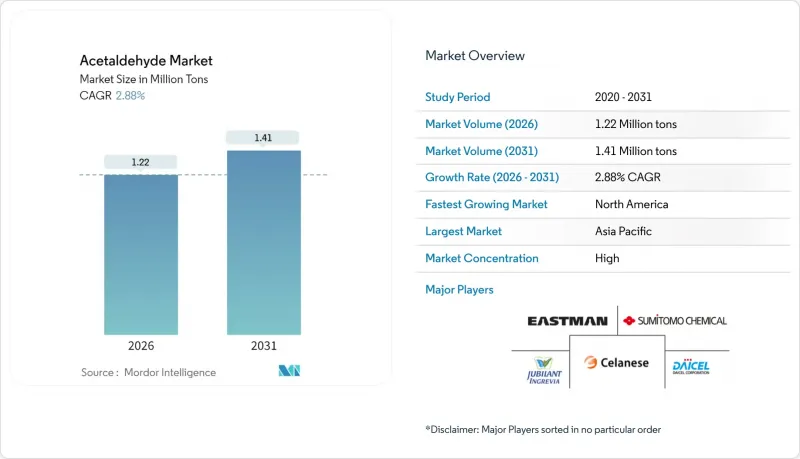
這一成長反映了乙醛作為高價值衍生物(如乙酸、吡啶鹼、新戊四醇和乙酸酯)中間體的既定地位,從而能夠應用於低VOC溶劑系統、永續塗料和PET循環回收解決方案。亞太地區的一體化石化網路持續主導著價格走勢,而北美生產商則透過利用頁岩氣衍生的乙烷和突破性的乙烷製乙醛觸媒技術,正獲得發展動力。競爭優勢正向那些能夠確保原料供應柔軟性、提供用於藥物合成的高純度乙醛以及為先進PET回收製程提供特種清除劑添加劑的公司轉移。在預測期內,技術應用、監管壓力和永續性措施將決定整個乙醛市場的價值獲取。
全球乙醛市場趨勢與洞察
對吡啶及其衍生物的需求不斷成長
製藥業正迅速擴張,複雜的藥物分子越來越依賴乙醛衍生的吡啶中間體。預計到2030年,乙醛衍生的吡啶中間體市場將以3.94%的複合年成長率成長,顯示該衍生物在腫瘤和神經系統疾病治療領域具有重要的策略意義。在這些領域,提高乙醛的純度可以提高反應產率,並確保符合FDA cGMP的監管要求。亞洲的學名藥生產商正在擴大其多用途原料原料藥線,推動了該地區對高純度乙醛的需求。個人化醫療的興起需要專門的結構單元,這確保了吡啶鏈的銷售穩定成長。能夠保證低殘留雜質的生產商正在獲得高合約,從而強化了乙醛市場中以品質主導的需求良性循環。
拓展新戊四醇在醇酸樹脂和紫外光固化樹脂的應用
新戊四醇由乙醛和甲醛合成,隨著塗料配方師不斷轉向生物基醇酸樹脂和快速固化UV體系,其重要性日益凸顯。北美和歐洲的供應商報告稱,隨著汽車製造商採用UV固化透明塗層(可縮短生產週期並降低能耗),回收量增加。一項最新研究表明,添加新戊四醇的生物基醇酸樹脂在90天內可實現70%的生物分解,而傳統樹脂的生物分解率僅為34.7%。這種永續性優勢支撐了其價格溢價。塗料產業對低VOC(揮發性有機化合物)的需求推動了對醋酸酯助溶劑的需求,並增強了乙醛價值鏈中衍生的協同效應。因此,新戊四醇刺激了生產需求的成長,並為乙醛市場的穩定需求奠定了基礎。
乙酸生產中甲醇羰基化的過渡。
目前,全球超過85%的乙酸產能採用甲醇羰基化法,省去了中間體乙醛步驟,削弱了傳統的市場需求。此方法使用銠(Rh)和銥(Ir)催化劑,具有優異的選擇性和能源效率,抑制了對乙醛基乙酸的新投資。東亞主要生產商的產能擴張計畫將進一步加速這一趨勢,使乙醛的複合年成長率(CAGR)預測值下降0.4個百分點。為了抵消這種長期下滑的影響,生產商正在重新調整其在乙醛市場的業務組合,轉向生產吡啶、新戊四醇和PET回收添加劑等高附加價值產品。
細分市場分析
到2025年,乙酸將佔乙醛市佔率的27.95%,但由於甲醇羰基化等結構取代反應,其銷售成長速度仍在放緩。同時,受亞太地區醫藥生產快速成長的推動,吡啶及其鹼類產品預計到2031年將維持3.74%的強勁複合年成長率。塗料產業對新戊四醇的需求推動了其銷售成長,而乙酸酯類產品則為符合低VOC法規的系統提供了支援。總體而言,在成熟的乙酸市場中,特種衍生的存在使乙醛市場免於停滯不前。
向高價值細分市場的轉型推動了純度要求的不斷提高,促使企業在提純塔、分子篩和連續蒸餾控制系統等方面進行資本投資。掌握製程分析技術的生產商可以獲得合約溢價,而落後者則面臨被降級至大宗商品市場的風險。丁二醇、氯醛和過氧乙酸仍屬於小眾市場,但化妝品、製藥和水處理產業的持續需求維持了健康的運轉率。這種結合了大宗商品產量和特殊產品利潤的多層衍生性商品組合,決定了乙醛市場的長期韌性。
乙醛市場報告按衍生(吡啶及吡啶鹼、新戊四醇、乙酸、乙酸酯等)、終端用戶行業(黏合劑、食品飲料、油漆塗料、製藥及其他終端用戶行業)和地區(亞太、北美、歐洲、南美、中東和非洲)進行細分。市場預測以噸為單位。
區域分析
到2025年,亞太地區將佔全球需求的57.20%,這主要得益於中國龐大的全球石化產業群聚和一體化的芳烴到乙醯基供應鏈。日本DAICEL株式會社正引領技術進步,而印度戈達瓦里生物精煉則致力於彌合石化原料和生物基原料之間的差距。
預計到2031年,北美地區將以3.10%的複合年成長率成長,這主要得益於乙烷製乙醛觸媒技術的發展以及監管部門對循環化學的大力推動。塞拉尼斯公司的Clear Lake平台以及區域PET回收設施的擴建,標誌著生產方式正向低碳、高純度方向轉變。
歐洲的永續性概念支撐了對高性能衍生的利基需求,而南美、中東和非洲則透過乙醇升級和原料優勢顯著的石化中心逐步增加產能。這種區域格局平衡了成熟的大宗市場和新興市場,進一步強化了乙醛市場的全球多元化。
其他福利:
- Excel格式的市場預測(ME)表
- 分析師支持(3個月)
目錄
第1章 引言
- 研究假設和市場定義
- 調查範圍
第2章調查方法
第3章執行摘要
第4章 市場情勢
- 市場概覽
- 市場促進因素
- 對吡啶及其衍生物的需求不斷成長
- 拓展新戊四醇在醇酸樹脂和紫外光固化樹脂的應用
- 低VOC溶劑混合物中對乙酸酯的需求不斷增加。
- 一種創新的PdO催化乙烷製乙醛反應
- 回收PET的脫醛處理可提高質量,從而提升瓶子的品質標準。
- 市場限制
- 乙酸生產中甲醇羰基化的過渡
- 致癌性重新分類與收緊職場接觸標準
- 乙烯價格波動對瓦克製程公司的利潤率帶來壓力。
- 價值鏈分析
- 波特五力模型
- 新進入者的威脅
- 供應商的議價能力
- 買方的議價能力
- 替代品的威脅
- 競爭程度
第5章 市場規模與成長預測
- 導數
- 吡啶和吡啶鹼
- 新戊四醇
- 醋酸
- 乙酸酯
- 丁二醇
- 其他衍生物(氯醛、過乙酸等)
- 按最終用戶行業分類
- 黏合劑
- 食品/飲料
- 油漆和塗料
- 製藥
- 其他終端用戶產業(水處理、塑膠、橡膠、燃料添加劑等)
- 按地區
- 亞太地區
- 中國
- 印度
- 日本
- 韓國
- 亞太其他地區
- 北美洲
- 美國
- 加拿大
- 墨西哥
- 歐洲
- 德國
- 英國
- 法國
- 義大利
- 西班牙
- 俄羅斯
- 北歐國家
- 土耳其
- 其他歐洲地區
- 南美洲
- 巴西
- 阿根廷
- 其他南美洲
- 中東和非洲
- 沙烏地阿拉伯
- 南非
- 其他中東和非洲地區
- 亞太地區
第6章 競爭情勢
- 市場集中度
- 策略趨勢
- 市佔率(%)/排名分析
- 公司簡介
- Celanese Corporation
- Daicel Corporation
- Eastman Chemical Company
- Jubilant Ingrevia Limited
- Laxmi Organic Industries Ltd.
- LCY
- Lonza
- Merck KGaA
- Resonac Corporation
- Sekab
- Sumitomo Chemical Co., Ltd.
第7章 市場機會與未來展望
The Acetaldehyde Market was valued at 1.19 million tons in 2025 and estimated to grow from 1.22 million tons in 2026 to reach 1.41 million tons by 2031, at a CAGR of 2.88% during the forecast period (2026-2031).
This expansion reflects the chemical's entrenched role as an intermediate for high-value derivatives such as acetic acid, pyridine bases, pentaerythritol, and acetate esters that enable low-VOC solvent systems, sustainable coatings, and circular PET recycling solutions. Asia-Pacific's integrated petrochemical networks continue to shape price discovery, while North American producers gain momentum by leveraging shale-derived ethane and breakthrough ethane-to-acetaldehyde catalysis. Competitive positioning is shifting toward players that can secure feedstock flexibility, achieve superior purity grades for pharmaceutical syntheses, and offer specialized scavenging additives for advanced PET recycling. Over the forecast horizon, technology adoption, regulatory pressure, and sustainability credentials will determine value capture across the acetaldehyde market.
Global Acetaldehyde Market Trends and Insights
Rising Demand for Pyridine and Pyridine-Base Derivatives
Pharmaceutical manufacturing is scaling rapidly, and complex drug molecules increasingly rely on acetaldehyde-derived pyridine intermediates. The 3.94% CAGR to 2030 underscores the derivative's strategic relevance for oncology and neurology therapies, where acetaldehyde purity improvements deliver higher reaction yields and regulatory compliance with FDA cGMP requirements. Asian generic producers are expanding multi-purpose active-pharmaceutical-ingredient lines, which lifts regional consumption of high-purity acetaldehyde grades. The personalized-medicine shift calls for specialized building blocks, ensuring robust volume growth for pyridine chains. Producers that can certify low residual impurities win premium contracts, reinforcing a virtuous cycle of quality-driven demand in the acetaldehyde market.
Expanding Pentaerythritol Use in Alkyd and UV-Curable Resins
Coatings formulators pivot toward bio-based alkyd and fast-curing UV systems, and pentaerythritol, synthesized from acetaldehyde and formaldehyde, has become indispensable. North American and European suppliers report accelerating off-takes as automakers adopt UV-curable clear coats that shorten production cycles and cut energy consumption. Recent research showed bio-alkyds featuring pentaerythritol achieve 70% biodegradability in 90 days versus 34.7% for conventional resins, a sustainability edge that supports price premiums. The coatings industry's low-VOC imperative boosts acetate-ester co-solvents, reinforcing derivative synergies along the acetaldehyde value chain. Consequently, pentaerythritol draws incremental capacity additions, anchoring stable demand in the acetaldehyde market.
Shift to Methanol Carbonylation for Acetic-Acid Production
More than 85% of global acetic-acid capacity now employs methanol carbonylation, obviating acetaldehyde intermediacy and eroding a legacy demand pillar. The Rh- and Ir-catalyzed route delivers superior selectivity and energy efficiency, depressing new investments in acetaldehyde-based acetic acid. Incremental expansions by East-Asian giants accentuate the swing, removing 0.4 percentage points from the acetaldehyde CAGR forecast. To offset this secular decline, producers push into higher-value pyridine, pentaerythritol, and PET-recycling additives, redefining portfolio priorities within the acetaldehyde market.
Other drivers and restraints analyzed in the detailed report include:
- Growing Acetate-Ester Demand in Low-VOC Solvent Blends
- Breakthrough Ethane-to-Acetaldehyde PdO Catalysis
- Carcinogenic Re-Classification and Tighter Workplace Exposure Limits
For complete list of drivers and restraints, kindly check the Table Of Contents.
Segment Analysis
Acetic acid retained a 27.95% slice of the acetaldehyde market share in 2025, but its volume growth remains muted amid structural substitution by methanol carbonylation. Conversely, pyridine and pyridine bases are set to register a robust 3.74% CAGR through 2031, propelled by surging pharmaceutical output in Asia-Pacific. The paints sector's appetite for pentaerythritol drives incremental additions, while acetate esters underpin compliant low-VOC systems. Collectively, specialty derivatives insulate the acetaldehyde market size against stagnation in the mature acetic-acid pool.
The migration to high-value niches heightens purity requirements, inviting capital investments in purification columns, molecular sieves, and continuous distillation control. Producers that master in-process analytics secure contract premiums, while laggards risk relegation to commodity pools. Butylene glycol, chloral, and peracetic acid remain niche outlets, yet continued demand from cosmetics, pharmaceuticals, and water treatment keeps asset utilization healthy. This tiered derivative portfolio balances commodity volume with specialty margins, defining long-run resilience for the acetaldehyde market.
The Acetaldehyde Report is Segmented by Derivative (Pyridine and Pyridine Bases, Pentaerythritol, Acetic Acid, Acetate Esters, and More), End-User Industry (Adhesives, Food and Beverage, Paints and Coatings, Pharmaceuticals, and Other End-User Industries), and Geography (Asia-Pacific, North America, Europe, South America, and Middle-East and Africa). The Market Forecasts are Provided in Terms of Volume (Tons).
Geography Analysis
Asia-Pacific commanded 57.20% of global demand in 2025, anchored by China's world-scale petrochemical complexes and integrated aromatics-to-acetyl chains. Japan's Daicel Corporation augments technological sophistication, while India's Godavari Biorefineries bridges petrochemical and bio-based streams.
North America is poised for a 3.10% CAGR through 2031, underpinned by ethane-to-acetaldehyde catalysts and clear regulatory tailwinds for circular chemistry. Celanese's Clear Lake platform and regional PET-recycling build-outs exemplify the pivot to low-carbon, high-purity production.
Europe's sustainability ethos sustains niche demand for high-performance derivatives, while South America and Middle-East and Africa gradually scale capacity via ethanol upgrading and feedstock-advantaged petrochemical hubs. This regional mosaic balances mature bulk markets with frontier growth, reinforcing global dispersion of the acetaldehyde market.
- Celanese Corporation
- Daicel Corporation
- Eastman Chemical Company
- Jubilant Ingrevia Limited
- Laxmi Organic Industries Ltd.
- LCY
- Lonza
- Merck KGaA
- Resonac Corporation
- Sekab
- Sumitomo Chemical Co., Ltd.
Additional Benefits:
- The market estimate (ME) sheet in Excel format
- 3 months of analyst support
TABLE OF CONTENTS
1 Introduction
- 1.1 Study Assumptions and Market Definition
- 1.2 Scope of the Study
2 Research Methodology
3 Executive Summary
4 Market Landscape
- 4.1 Market Overview
- 4.2 Market Drivers
- 4.2.1 Rising Demand for Pyridine and Pyridine-Base Derivatives
- 4.2.2 Expanding Pentaerythritol Use in Alkyd And UV-Curable Resins
- 4.2.3 Growing Acetate-Ester Demand in Low-VOC Solvent Blends
- 4.2.4 Breakthrough Ethane-To-Acetaldehyde PdO Catalysis
- 4.2.5 Circular PET De-Aldehyde Upgrades Raising Bottle-Grade Quality Bar
- 4.3 Market Restraints
- 4.3.1 Shift to Methanol Carbonylation for Acetic-Acid Production
- 4.3.2 Carcinogenic Re-Classification and Tighter Workplace Exposure Limits
- 4.3.3 Ethylene Price Volatility Squeezing Wacker-Process Margins
- 4.4 Value Chain Analysis
- 4.5 Porter's Five Forces
- 4.5.1 Threat of New Entrants
- 4.5.2 Bargaining Power of Suppliers
- 4.5.3 Bargaining Power of Buyers
- 4.5.4 Threat of Substitutes
- 4.5.5 Degree of Competition
5 Market Size and Growth Forecasts (Volume)
- 5.1 By Derivative
- 5.1.1 Pyridine and Pyridine Bases
- 5.1.2 Pentaerythritol
- 5.1.3 Acetic Acid
- 5.1.4 Acetate Esters
- 5.1.5 Butylene Glycol
- 5.1.6 Other Derivatives (Chloral, Peracetic Acid, etc.)
- 5.2 By End-User Industry
- 5.2.1 Adhesives
- 5.2.2 Food and Beverage
- 5.2.3 Paints and Coatings
- 5.2.4 Pharmaceuticals
- 5.2.5 Other End-user Industries (Water Treatment, Plastics, Rubber, Fuel Additives, etc.)
- 5.3 By Geography
- 5.3.1 Asia-Pacific
- 5.3.1.1 China
- 5.3.1.2 India
- 5.3.1.3 Japan
- 5.3.1.4 South Korea
- 5.3.1.5 Rest of Asia-Pacific
- 5.3.2 North America
- 5.3.2.1 United States
- 5.3.2.2 Canada
- 5.3.2.3 Mexico
- 5.3.3 Europe
- 5.3.3.1 Germany
- 5.3.3.2 United Kingdom
- 5.3.3.3 France
- 5.3.3.4 Italy
- 5.3.3.5 Spain
- 5.3.3.6 Russia
- 5.3.3.7 NORDIC
- 5.3.3.8 Turkey
- 5.3.3.9 Rest of Europe
- 5.3.4 South America
- 5.3.4.1 Brazil
- 5.3.4.2 Argentina
- 5.3.4.3 Rest of South America
- 5.3.5 Middle-East and Africa
- 5.3.5.1 Saudi Arabia
- 5.3.5.2 South Africa
- 5.3.5.3 Rest of Middle-East and Africa
- 5.3.1 Asia-Pacific
6 Competitive Landscape
- 6.1 Market Concentration
- 6.2 Strategic Moves
- 6.3 Market Share (%)/Ranking Analysis
- 6.4 Company Profiles (includes Global level Overview, Market level overview, Core Segments, Financials as available, Strategic Information, Market Rank/Share for key companies, Products and Services, and Recent Developments)
- 6.4.1 Celanese Corporation
- 6.4.2 Daicel Corporation
- 6.4.3 Eastman Chemical Company
- 6.4.4 Jubilant Ingrevia Limited
- 6.4.5 Laxmi Organic Industries Ltd.
- 6.4.6 LCY
- 6.4.7 Lonza
- 6.4.8 Merck KGaA
- 6.4.9 Resonac Corporation
- 6.4.10 Sekab
- 6.4.11 Sumitomo Chemical Co., Ltd.
7 Market Opportunities and Future Outlook
- 7.1 White-space and Unmet-Need Assessment

 乙醛市場:依生產流程、等級、形態、終端用途產業及通路分類-2026-2032年全球市場預測
 乙醛全球市場規模、佔有率、趨勢和成長分析報告(2026-2034年)乙醛市場規模、佔有率、成長率及全球產業分析:按類型、應用和地區分類,並提供2026-2034年的洞察和預測
 2025-2029年全球乙酸醛市場
 乙醛市場-全球產業規模、佔有率、趨勢、機會及預測(依製程、衍生物、應用、地區及競爭格局分類,2021-2031年)乙醛市場-2026-2031年預測
 乙醛市場規模、佔有率及成長分析(按製程、衍生物、應用及地區分類)-產業預測,2026-2033年
 乙醛全球市場需求,預測分析(2018-2034)
 全球乙醛市場:市場規模、佔有率、趨勢分析(按製程、應用和地區)、細分市場預測(2025-2030 年)
 乙醛市場報告:2030 年趨勢、預測與競爭分析