


 |
市場調查報告書
商品編碼
1939583
菸草包裝:市場佔有率分析、產業趨勢與統計、成長預測(2026-2031)Tobacco Packaging - Market Share Analysis, Industry Trends & Statistics, Growth Forecasts (2026 - 2031) |
||||||

※ 本網頁內容可能與最新版本有所差異。詳細情況請與我們聯繫。
預計到 2026 年,菸草包裝市場價值將達到 193.2 億美元,高於 2025 年的 187 億美元,預計到 2031 年將達到 227.4 億美元。
預計從 2026 年到 2031 年,其複合年成長率將達到 3.32%。
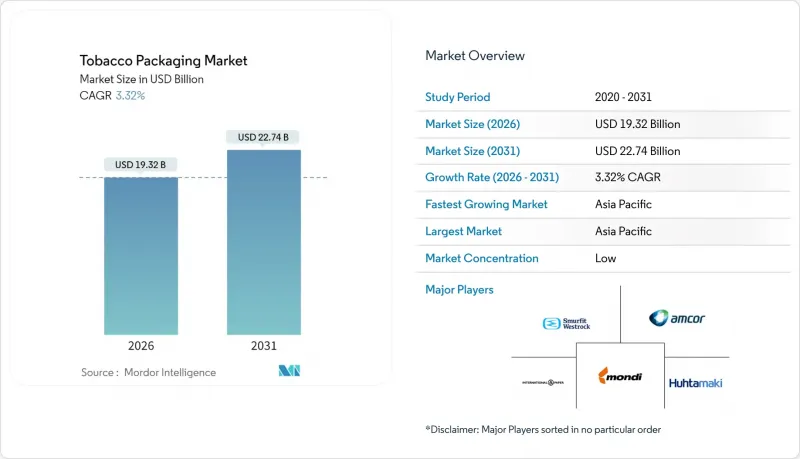
目前已有25個司法管轄區實施了簡易包裝強制令,歐盟《包裝和包裝廢棄物法規》推動使用100%可回收材料,加之對溯源解決方案的投資不斷增加,這些因素共同構成了菸草包裝市場最強勁的成長要素。能夠整合防偽技術、紙基阻隔材料和自動化相容包裝形式的供應商,將抓住高所得地區吸菸率下降所帶來的停滯需求。向紙板和生物分解性塑膠的轉變將降低監管風險,同時增加對防潮和防臭材料的需求,從而維持對鋁箔襯墊和全像撕膜等高價值組件的需求。亞太地區憑藉其大規模的消費量以及中國、日本和韓國加熱菸草包裝方法的快速統一,將繼續保持主導地位。這些因素共同作用,將使菸草包裝市場在2030年前保持穩定且受監管主導的成長態勢。
全球菸草包裝市場趨勢與洞察
加強統一包裝和圖形警告的強制執行
目前已有25個國家實施了簡易包裝,澳洲也宣布了一項政策,計劃在2025年將警示訊息直接印在菸捲上,這很可能會消除品牌識別。供應商必須重新設計包裝結構以保持其完整性,即便超過75%的包裝面積需要用於健康警示圖案。這確保了即使菸草銷售量趨於平穩,也能獲得可預測的合規收入。加拿大採用的滑動式包裝(也稱為外殼式包裝)將警示面積擴大了41%,是監管變化如何催生全新包裝結構的典型例證。英國將於2024年就將標準化推廣至所有菸草產品進行磋商,顯示該領域將取得進一步進展。
為了永續性和節省成本,改用紙板
歐盟的《一次性塑膠指令》將香菸過濾嘴列為海灘上第二大常見廢棄物,迫使各大品牌重新思考其層壓結構。阻隔性紙塗層正在取代金屬化薄膜,同時也能穩定水分含量。 ITC 的 InnovPack 目前每年將超過 10 萬噸可再生板加工成符合 Bioseal 和 Oxyblock 規格的產品,展現出與多層塑膠大規模成本競爭力。對雙層水性塗佈紙板的研究表明,沉澱在提供與聚合物薄膜相當的香氣保護的同時,還能滿足堆肥要求。
消費稅上調會降低消費
加拿大 2025 年的附加稅稅將要求製造商繳納與銷售額掛鉤的年度附加稅,這將增加成本壓力,並影響包裝預算;而印尼 2024 年的法規將規定每包香菸的最小規格為 20 支,這凸顯了稅收政策和包裝設計之間的相互作用。
細分市場分析
到2025年,紙和紙板將佔菸草包裝市場82.74%的佔有率,這反映了監管重點和阻隔塗層技術的成熟。規模較小的塑膠包裝市場預計將以7.08%的複合年成長率成長,主要得益於用於加熱菸草煙彈和兒童安全電子煙煙油盒的多層薄膜市場佔有率的成長。 2026年至2031年,塑膠菸草包裝市場預計將成長10.6億美元,這主要得益於自動化相容複合材料的廣泛應用,這種複合材料能夠以每分鐘600包的速度生產包裝而不會出現破損。鋁箔在高階產品線(例如Treasurer London Aluminum)中保持著穩定但有限的市場佔有率,主要用於保持菸草的風味。
對木質素-高密度聚乙烯複合材料和海藻基薄膜的快速研究表明,到2030年,預計將塑膠使用量從原生塑膠中轉移5%,這與歐盟100%可回收包裝的目標相符。 Smurfit-Westlock公司整合金屬化阻隔層的混合板材,其氧氣透過率已低於1克/平方米,同時仍適用於城市廢棄物收集,這表明加工商如何利用規模效應快速將實驗室突破性成果商業化。
受監管法規要求所有零售包裝單元均須標註健康警示的推動,到2025年,初級包裝將佔煙草包裝市場佔有率的65.10%。由於免稅店對捆綁包裝的需求不斷成長,以及對配備RFID/QR碼以實現可追溯性的產品的需求增加,二級紙盒預計將以5.34%的複合年成長率成長。隨著整合線上序列化的高速裝箱機的廣泛應用,預計到2031年,二級包裝解決方案市場規模將達到66.6億美元。
供應商將採用智慧撕開膠帶,撕開後會顯現全像圖,進而降低重複使用率,為產品增添價值。為滿足公司範圍3的排放目標,公路運輸包裝將使用消費後回收材料含量超過30%的再生紙板。高檔硬紙盒將繼續限量生產,例如Davidoff Winston Churchill 2025限量版,其特點是再生紙板核心材料上覆以多層山毛櫸木單板。
本煙草包裝市場報告按材料(紙/紙板、塑膠、金屬、玻璃、生質塑膠)、包裝類型(初級包裝、二級包裝、散裝包裝、高檔硬盒)、產品形式(軟包裝、硬包裝、袋裝、管裝、條狀)、煙草類型(無菸煙草、無菸煙草、新一代無菸煙草、雪茄)和地區(北美、歐洲、南美)進行分析。市場預測以美元以金額為準。
區域分析
預計到2025年,亞太地區將佔全球菸草包裝收入的37.95%,年均成長率達6.45%。中國、印度和印尼作為全球最大的吸菸群體,在不斷加強電子菸標準的同時,也推動了這一成長。亞太地區菸草包裝市場規模預計在2026年至2031年間達到17.2億美元,主要得益於國內紙板生產商擴大阻隔塗佈紙板的生產。此外,中國一線城市的都市化和優質化也推動了假日期間對金屬禮品罐的需求。
北美在材料創新方面處於領先地位,Amco公司的AmFiber紙計劃於2025年在歐洲獲得專利並在美國上市。它將供應給希望在紙煙外包裝中替代PVdC薄膜的加工商。加拿大每年徵收的菸草稅和醒目的警示標籤預計將使每包香菸的遵循成本增加約2分錢,儘管紙煙銷售量持平,但包裝價值仍將略有上升。
在歐洲,嚴格的 PFAS 禁令和 2040 年前實現無菸目標迫在眉睫,迫使加工商投資水性阻隔化學品和閉合迴路回收技術。中東和非洲地區預計將迎來高階市場成長,其中海灣國家將引領成長。免稅店更青睞燙金紙盒。由於經濟波動,南美洲的進展較為緩慢,但巴西計劃於 2026 年更新國家健康警示標籤,預計將推動全部區域印刷品質的提升。
其他福利:
- Excel格式的市場預測(ME)表
- 分析師支持(3個月)
目錄
第1章 引言
- 研究假設和市場定義
- 調查範圍
第2章調查方法
第3章執行摘要
第4章 市場情勢
- 市場概覽
- 市場促進因素
- 擴大使用扁平包裝的義務範圍,並加強警示標籤的執行力度
- 為了永續性和節省成本,改用紙包裝
- 逐一產品實施防偽技術
- 適用於高溫高壓/電子菸的自動化相容包裝規範
- 文化活動限量套餐
- 市場限制
- 消費稅上調將導致消費下降。
- 全球採用簡易包裝會降低投資收益
- 歐盟和美國收緊 PFAS 和塑膠法規
- 供應鏈分析
- 監管環境
- 技術展望
- 波特五力分析
- 供應商的議價能力
- 買方的議價能力
- 新進入者的威脅
- 替代品的威脅
- 競爭對手之間的競爭
第5章 市場規模與成長預測
- 材料
- 紙和紙板
- 塑膠(BOPP、PET、PVC)
- 金屬(鋁箔、馬口鐵)
- 玻璃和陶瓷
- 生質塑膠和可堆肥材料
- 按包裝類型
- 主要的
- 次要
- 散裝/轉運
- 高階豪華硬盒
- 按產品形式
- 軟包裝香煙
- 紙煙硬盒/鉸鏈鏈蓋紙盒
- 小袋和包裝袋
- 煙管、煙條和加熱菸草棒
- 依香煙類型分類
- 吸煙
- 無煙煙草
- 下一代產品(加熱菸草製品和電子菸)
- 雪茄和小雪茄
- 按地區
- 北美洲
- 美國
- 加拿大
- 墨西哥
- 歐洲
- 德國
- 英國
- 法國
- 義大利
- 西班牙
- 俄羅斯
- 其他歐洲地區
- 亞太地區
- 中國
- 印度
- 日本
- 韓國
- 澳洲和紐西蘭
- 亞太其他地區
- 中東和非洲
- 中東
- 阿拉伯聯合大公國
- 沙烏地阿拉伯
- 土耳其
- 其他中東地區
- 非洲
- 南非
- 奈及利亞
- 埃及
- 其他非洲地區
- 中東
- 南美洲
- 巴西
- 阿根廷
- 其他南美洲
- 北美洲
第6章 競爭情勢
- 市場集中度
- 策略趨勢
- 市佔率分析
- 公司簡介
- Amcor plc
- Smurfit Westrock
- International Paper Company
- Mondi Group
- Innovia Films Ltd.
- Philip Morris International Inc.
- Sonoco Products Company
- Siegwerk Druckfarben AG & Co. KGaA
- Japan Tobacco International
- Treofan Film International
- Stora Enso Oyj
- ITC Limited(Packaging & Printing)
- British American Tobacco plc
- Shenzhen Jinjia Group Co. Ltd.
- Huhtamaki Oyj
- Uflex Ltd.
- DS Smith plc
- Jindal Poly Films Ltd.
- Oji Holdings Corp.
- SCHUR Flexibles Holding
第7章 市場機會與未來展望
The tobacco packaging market size in 2026 is estimated at USD 19.32 billion, growing from 2025 value of USD 18.70 billion with 2031 projections showing USD 22.74 billion, growing at 3.32% CAGR over 2026-2031.
Mandatory plain-pack rules now enforced in 25 jurisdictions, the drive for 100% recyclable materials under the EU Packaging and Packaging Waste Regulation, and accelerating investment in track-and-trace solutions together shape the most powerful growth levers for the tobacco packaging market. Suppliers able to integrate anti-counterfeit technology, paper-based barrier materials and automation-ready formats capture volume that would otherwise stagnate as smoking prevalence edges down in high-income regions. Material shifts toward paperboard and biodegradable plastics lower regulatory risk yet increase demand for moisture and aroma barriers, sustaining premiumisation in components such as foil liners and hologram tear tapes. Asia-Pacific retains leadership thanks to large-scale consumption and rapid harmonisation of heated-tobacco packaging laws in China, Japan, and South Korea. Together, these forces keep the tobacco packaging market on a steady yet regulation-dominated growth path through 2030.
Global Tobacco Packaging Market Trends and Insights
Rising plain-pack mandates and graphic warnings
Twenty-five countries now enforce plain packaging, and Australia moved warnings directly onto cigarette sticks in 2025, leaving brand imagery almost obsolete. Suppliers must redesign structural features to preserve pack integrity despite 75 %-plus panel space devoted to health graphics, ensuring predictable compliance revenue even where cigarette volumes plateau. Canada's slide-and-shell format enlarged warning area by 41 %, illustrating how rule changes prompt entirely new pack architectures. The UK's 2024 consultation to extend standardisation to all tobacco products signals further momentum.
Paperboard shift for sustainability and cost
The EU Single-Use Plastics Directive ranks cigarette filters as the second most littered beach item, prompting brands to overhaul laminates and adopt high-barrier paper coatings that replace metallised films while keeping moisture content stable. ITC's InnovPack now converts more than 100,000 tonnes of recyclable board into Bioseal and Oxyblock formats annually, demonstrating large-scale cost parity with multi-layer plastics. Research on double-layer water-based coated boards shows aluminium-plated paper achieving comparable aroma protection to polymer films yet meeting compostability targets.
Escalating excise taxes shrink consumption
Canada's 2025 Tobacco Charges Regulations oblige manufacturers to pay annual levies indexed to sales, adding cost pressure that trickles into packaging budgets. Similar hikes appear in Indonesia's 2024 rule mandating minimum pack sizes of 20 cigarettes, showing how tax policy and packaging design interact.
Other drivers and restraints analyzed in the detailed report include:
- Unit-level anti-counterfeit technology adoption
- Automation-ready pack formats for HTP/e-cig
- Global plain-pack roll-out reduces branding ROI
For complete list of drivers and restraints, kindly check the Table Of Contents.
Segment Analysis
Paper & paperboard captured 82.74 % of the tobacco packaging market in 2025, reflecting both regulatory preference and maturing barrier-coating technology. The plastics segment, though smaller, will post the highest 7.08 % CAGR as multilayer films tailored for heated-tobacco cartridges and child-resistant e-liquid pods gain share. The tobacco packaging market size for plastics is forecast to add USD 1.06 billion between 2026 and 2031, buoyed by automation-ready laminates that run at 600 packs/minute without seal failure. Aluminium foil maintains a narrow but stable role for aroma retention in premium lines such as Treasurer London Aluminum.
Rapid research into lignin-HDPE blends and seaweed-based films indicates potential to shift a further 5 % volume away from virgin plastic by 2030, aligning with the EU target of 100 % recyclable packs. Smurfit WestRock's hybrid board with integrated metallised barrier already satisfies <1 g/m2 oxygen transmission while remaining curb-side recyclable, demonstrating how converters use scale to commercialise lab breakthroughs swiftly.
Primary packs delivered 65.10 % of the tobacco packaging market share in 2025 thanks to regulatory mandates for health messaging on every retail unit. Secondary cartons will outpace at 5.34 % CAGR, driven by duty-free bundle formats and growing need to embed RFID or QR codes for track-and-trace. Tobacco packaging market size for secondary solutions is projected to touch USD 6.66 billion by 2031, supported by high-speed case packers integrating on-line serialisation.
Suppliers add value through smart tear tapes that reveal holograms when opened, deterring reuse. In line haul, transit packaging leverages recycled corrugated grades exceeding 30 % post-consumer content to meet corporate scope-3 emission commitments. Luxury rigid boxes endure in limited runs, such as Davidoff's Winston Churchill 2025 edition using layered beech veneer over recycled board cores.
The Tobacco Packaging Market Report is Segmented by Material (Paper and Paperboard, Plastics, Metals, Glass, Bioplastics), Packaging Type (Primary, Secondary, Bulk, Luxury Rigid Boxes), Product Form (Soft Pack, Hard Pack, Pouch, Tube and Stick), Tobacco Type (Smoking, Smokeless, Next-Generation Products, Cigars), and Geography (North America, Europe, Asia-Pacific, MEA, South America). Market Forecasts are in Value (USD).
Geography Analysis
Asia-Pacific commanded 37.95 % of revenue in 2025 and will expand 6.45 % annually as China, India and Indonesia tighten e-cigarette standards yet maintain the world's largest smoking populations. Tobacco packaging market size additions in Asia-Pacific will reach USD 1.72 billion over 2026-2031, supported by domestic board mills scaling barrier-coated grades. Urbanisation and premiumisation in tier-one Chinese cities also fuel demand for metallicised gift tins during festival peaks.
North America stays material-innovation leader, with Amcor's AmFiber paper gaining European patent in 2025 and slated for US commercial roll-out, supplying converters aiming to replace PVdC films in cigarette overwrap.Canada's annual tobacco charges and large graphic warnings will lift compliance spend per pack by an estimated 2 US cents, modestly boosting packaging value despite flat cigarette volumes.
Europe faces stringent PFAS bans and the 2040 tobacco-free goal, compelling converters to invest in water-based barrier chemistries and closed-loop recycling. The Middle East & Africa offer pockets of premium growth in the Gulf, where duty-free outlets favour gold-foil embossed cartons. South America's progress is slower amid economic volatility but Brazil's national health-warning refresh slated for 2026 should spark regional print-quality upgrades.
- Amcor plc
- Smurfit Westrock
- International Paper Company
- Mondi Group
- Innovia Films Ltd.
- Philip Morris International Inc.
- Sonoco Products Company
- Siegwerk Druckfarben AG & Co. KGaA
- Japan Tobacco International
- Treofan Film International
- Stora Enso Oyj
- ITC Limited (Packaging & Printing)
- British American Tobacco plc
- Shenzhen Jinjia Group Co. Ltd.
- Huhtamaki Oyj
- Uflex Ltd.
- DS Smith plc
- Jindal Poly Films Ltd.
- Oji Holdings Corp.
- SCHUR Flexibles Holding
Additional Benefits:
- The market estimate (ME) sheet in Excel format
- 3 months of analyst support
TABLE OF CONTENTS
1 INTRODUCTION
- 1.1 Study Assumptions and Market Definition
- 1.2 Scope of the Study
2 RESEARCH METHODOLOGY
3 EXECUTIVE SUMMARY
4 MARKET LANDSCAPE
- 4.1 Market Overview
- 4.2 Market Drivers
- 4.2.1 Rising plain-pack mandates and graphic warnings
- 4.2.2 Paperboard shift for sustainability and cost
- 4.2.3 Unit-level anti-counterfeit tech adoption
- 4.2.4 Automation-ready pack formats for HTP/e-cig
- 4.2.5 Cultural-event limited-edition packs
- 4.3 Market Restraints
- 4.3.1 Escalating excise taxes shrink consumption
- 4.3.2 Global plain-pack roll-out erodes branding ROI
- 4.3.3 PFAS and plastics bans tightening in EU and US
- 4.4 Supply-Chain Analysis
- 4.5 Regulatory Landscape
- 4.6 Technological Outlook
- 4.7 Porter's Five Forces Analysis
- 4.7.1 Bargaining Power of Suppliers
- 4.7.2 Bargaining Power of Buyers
- 4.7.3 Threat of New Entrants
- 4.7.4 Threat of Substitutes
- 4.7.5 Intensity of Competitive Rivalry
5 MARKET SIZE AND GROWTH FORECASTS (VALUE)
- 5.1 By Material
- 5.1.1 Paper and Paperboard
- 5.1.2 Plastics (BOPP, PET, PVC)
- 5.1.3 Metals (Al Foil, Tinplate)
- 5.1.4 Glass and Ceramics
- 5.1.5 Bioplastics and Compostables
- 5.2 By Packaging Type
- 5.2.1 Primary
- 5.2.2 Secondary
- 5.2.3 Bulk / Transit
- 5.2.4 High-End Luxury Rigid Boxes
- 5.3 By Product Form
- 5.3.1 Cigarette Soft Pack
- 5.3.2 Cigarette Hard Pack / Hinge-lid Carton
- 5.3.3 Pouch and Sachet
- 5.3.4 Tube, Stick and Heat-Not-Burn Sticks
- 5.4 By Tobacco Type
- 5.4.1 Smoking Tobacco
- 5.4.2 Smokeless Tobacco
- 5.4.3 Next-Generation Products (HTP and e-cig)
- 5.4.4 Cigars and Cigarillos
- 5.5 By Geography
- 5.5.1 North America
- 5.5.1.1 United States
- 5.5.1.2 Canada
- 5.5.1.3 Mexico
- 5.5.2 Europe
- 5.5.2.1 Germany
- 5.5.2.2 United Kingdom
- 5.5.2.3 France
- 5.5.2.4 Italy
- 5.5.2.5 Spain
- 5.5.2.6 Russia
- 5.5.2.7 Rest of Europe
- 5.5.3 Asia-Pacific
- 5.5.3.1 China
- 5.5.3.2 India
- 5.5.3.3 Japan
- 5.5.3.4 South Korea
- 5.5.3.5 Australia and New Zealand
- 5.5.3.6 Rest of Asia-Pacific
- 5.5.4 Middle East and Africa
- 5.5.4.1 Middle East
- 5.5.4.1.1 United Arab Emirates
- 5.5.4.1.2 Saudi Arabia
- 5.5.4.1.3 Turkey
- 5.5.4.1.4 Rest of Middle East
- 5.5.4.2 Africa
- 5.5.4.2.1 South Africa
- 5.5.4.2.2 Nigeria
- 5.5.4.2.3 Egypt
- 5.5.4.2.4 Rest of Africa
- 5.5.4.1 Middle East
- 5.5.5 South America
- 5.5.5.1 Brazil
- 5.5.5.2 Argentina
- 5.5.5.3 Rest of South America
- 5.5.1 North America
6 COMPETITIVE LANDSCAPE
- 6.1 Market Concentration
- 6.2 Strategic Moves
- 6.3 Market Share Analysis
- 6.4 Company Profiles (includes Global level Overview, Market level overview, Core Segments, Financials as available, Strategic Information, Market Rank/Share for key companies, Products and Services, and Recent Developments)
- 6.4.1 Amcor plc
- 6.4.2 Smurfit Westrock
- 6.4.3 International Paper Company
- 6.4.4 Mondi Group
- 6.4.5 Innovia Films Ltd.
- 6.4.6 Philip Morris International Inc.
- 6.4.7 Sonoco Products Company
- 6.4.8 Siegwerk Druckfarben AG & Co. KGaA
- 6.4.9 Japan Tobacco International
- 6.4.10 Treofan Film International
- 6.4.11 Stora Enso Oyj
- 6.4.12 ITC Limited (Packaging & Printing)
- 6.4.13 British American Tobacco plc
- 6.4.14 Shenzhen Jinjia Group Co. Ltd.
- 6.4.15 Huhtamaki Oyj
- 6.4.16 Uflex Ltd.
- 6.4.17 DS Smith plc
- 6.4.18 Jindal Poly Films Ltd.
- 6.4.19 Oji Holdings Corp.
- 6.4.20 SCHUR Flexibles Holding
7 MARKET OPPORTUNITIES AND FUTURE OUTLOOK
- 7.1 White-space and Unmet-Need Assessment

 菸草包裝市場分析:按材料類型、包裝類型、最終用途和地區分類(2026-2034 年)
 菸草包裝市場規模、佔有率、成長及全球產業分析:按類型、應用和地區分類,並預測至2026-2034年全球菸草包裝市場規模、佔有率、趨勢和成長分析報告(2026-2034年)菸草包裝市場-2026-2031年預測
 菸草包裝:全球市場佔有率和排名、總收入和需求預測(2025-2031年)
 全球菸草包裝市場:市場規模、佔有率和趨勢分析(按材料、包裝類型、產品和地區)、細分市場預測(2025-2030 年)
 全球菸草包裝市場:2025年
 全球菸草包裝市場:市場規模、佔有率、趨勢、產業分析(依包裝材料、產品、材料類型和地區)、未來預測(2025-2034)全球菸草包裝市場按類型、材料、最終用戶和地區分類(2026-2032 年)
 菸草包裝市場規模、佔有率、成長分析、按材料類型、按包裝類型、按最終用戶、按地區 - 行業預測,2024-2031 年