


 |
市場調查報告書
商品編碼
1939581
機器學習即服務 (MLaaS):市場佔有率分析、產業趨勢與統計、成長預測 (2026-2031)Machine Learning As A Service (MLaaS) - Market Share Analysis, Industry Trends & Statistics, Growth Forecasts (2026 - 2031) |
||||||

※ 本網頁內容可能與最新版本有所差異。詳細情況請與我們聯繫。
2025 年機器學習即服務 (MLaaS) 市場價值為 457.6 億美元,預計到 2031 年將達到 2,718.8 億美元,高於 2026 年的 615.8 億美元。
預計在預測期(2026-2031 年)內,複合年成長率將達到 34.58%。
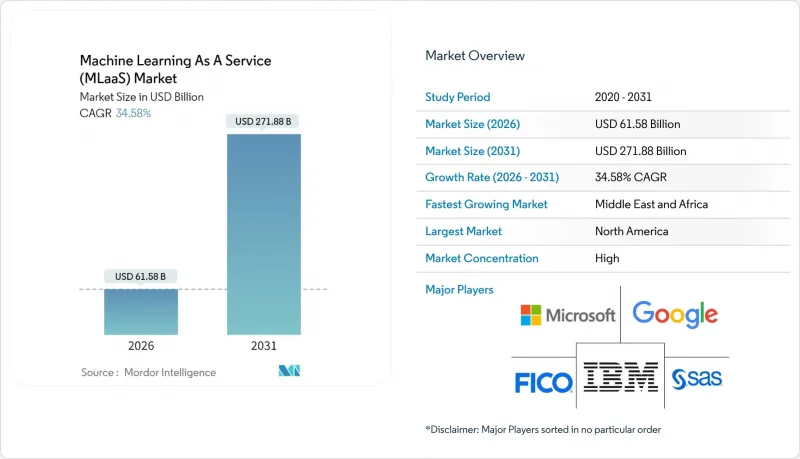
計量收費GPU實例的快速普及、生成式AI工具包的民主化以及將敏感資料保留在本國的主權雲端計劃,都在加速推動市場需求。企業也正在轉向機器學習即服務(MLaaS),以避免在本地基礎設施上投入巨額資金,同時滿足即將訂定的關於可解釋性和資料居住的監管要求。來自中東主權財富基金的資金流入,以及新加坡、歐盟和中國的國家人工智慧戰略,正在推動符合監管要求的雲端區域的區域擴張。同時,基於人工智慧的威脅偵測的保費折扣以及超大規模企業的競爭性定價,進一步降低了中小企業(SME)的進入門檻。
全球機器學習即服務 (MLaaS) 市場趨勢與洞察
生成式人工智慧工具包作為一種服務而大量湧現
主流雲端基礎架構模型目錄現已包含承包、編配和向量資料庫連接器。亞馬遜的 Nova 套件可直接與 Bedrock 整合,使企業能夠在數小時內而非數季內測試多模態原型。微軟與 xAI 合作,在 Azure 上託管 Grok 3,增加了模型選擇的多樣性,並在 API 層整合了偏差減少遙測功能。這些創新使機器學習背景有限的開發人員也能將文字、圖像和影片推理功能整合到他們的工作流程中。較低的技能要求縮短了概念驗證(PoC) 週期,降低了實施成本,並擴大了機器學習即服務 (MLaaS) 市場的潛在基本客群。基於現有的付費使用制模式,財務部門將高階人工智慧視為營運支出。
加速新興亞洲中小企業的雲端遷移
在東協地區,99%的企業都是中小企業,政府政策正在推動後勤部門營運和客戶體驗功能的數位化。寬頻補貼、金融科技賦能的小額貸款以及區域資料中心的擴張,共同推動了2024年雲端運算採用率成長37%。新加坡的國家雲端計畫提供一系列預先已通過核准的機器學習即服務(MLaaS)額度,使營運商無需資本投入即可部署需求預測模型。越南和印尼的出口型製造商正在試驗預測性維護儀表板,將感測器資料直接連接到雲端託管的自動化機器學習(AutoML)引擎。隨著中小企業越來越依賴雲端服務供應商來實現可擴展性,MLaaS市場正在吸引數百萬傾向於訂閱模式的新興高成長用戶。
人工智慧模型知識產權糾紛
使用自身資料對基礎模型進行微調的機構正面臨著關於衍生重所有權的激烈爭論。 OpenAI因訓練資料權利問題被處以1500萬歐元的GDPR罰款,這一事件已成為熱門話題,促使風險管理部門要求籤訂嚴格的授權合約。由於缺乏既定的法律先例,越來越多的專案部署被推遲或凍結,直到法務部門在合約條款中明確所有權、賠償和特許權使用費等條款。Start-Ups擔心,如果智慧財產權索賠威脅到後續收入,可能會失去創業融資。這種不確定性正在扭曲董事會層面的風險評估,並阻礙機器學習即服務(MLaaS)市場的成長。
細分市場分析
到2025年,模型訓練和調優將佔總收入的30.62%,這主要得益於企業加速將基礎模型應用於專業資料集的趨勢。這一趨勢導致生產工作負載激增,使得可觀測性至關重要。因此,機器學習運作和監控預計將以35.30%的最高複合年成長率成長,並在2031年之前鞏固其在機器學習服務市場規模中的基礎地位。整合工具鏈現已整合資料沿襲擷取、公平性指標和回滾觸發器,以滿足監管機構對持續檢驗的要求。
Start-Ups仍依賴低程式碼開發工作室進行快速原型製作,但隨著使用量的激增,它們正轉向託管式機器學習維運服務 (MLOps)。隨著邊緣最佳化運行時支援低延遲的關鍵零售和行動應用,推理和配置收入穩步成長。受影片分析計劃對多模態標註需求的推動,資料準備服務也維持成長動能。總體而言,服務組合表明,決定機器學習服務市場長期價值創造的關鍵在於管治和運作保證,而不是原始模型建構。
到2025年,詐欺偵測將佔收入的26.95%,銀行將從交易流程中提取異常模式。電腦視覺是下一個發展浪潮,其複合年成長率將達到36.85%,因為配備攝影機的預測性維護平台可以將非計劃性停機時間減少高達70%。製造商正在對傳統生產線進行改造,加裝人工智慧攝影機,以便在毫秒內檢測缺陷,從而實現每個工廠六位數的成本節約。零售商正在部署貨架掃描機器人來減少缺貨情況,醫院正在採用跌倒偵測艙來提高病患安全。
行銷部門正在將視覺API與生成模型結合,以實現廣告創意的自動化生成,並利用視覺線索進行受眾創新。通訊業者正在塔架上安裝視覺感測器,用於結構健康檢查,並將影像串流傳輸到雲端推理叢集。視覺技術、物聯網和機器學習即服務(MLaaS)的整合,正在為電腦視覺即服務(CVAaS)創造多元化的市場機會。
機器學習即服務 (MLaaS) 市場報告按服務類型(模型開發、資料準備、訓練、推理、MLOps)、應用領域(行銷、預測性維護、詐欺偵測、網路管理、電腦視覺)、組織規模(中小企業、大型企業)、最終用戶(IT、銀行、金融服務和保險 (BFSI)、醫療保健、汽車私人、零售、政府及其他)、部署混合雲端和企業類型預測數據以美元計價。
區域分析
歐洲機器學習即服務 (MLaaS) 市場正取得顯著進展,在政府和私營部門對人工智慧和機器學習技術的大規模投資推動下,2019 年至 2024 年的年均成長率約為 35%。德國、法國和英國等主要經濟體強大的數位基礎設施以及工業 4.0舉措的日益普及,都為這一成長提供了有力支撐。歐洲企業尤其關注在工業自動化、預測性維護和提升客戶體驗方面利用 MLaaS。該地區嚴格的資料保護條例,特別是《一般資料保護規則》(GDPR),正在推動安全合規的 MLaaS 解決方案的開發,並為資料隱私和安全設定了高標準。歐盟委員會的數位轉型和人工智慧發展計畫為 MLaaS 的應用創造了有利環境,各國多樣化的人工智慧策略也進一步加速了市場成長。該地區對永續和合乎倫理的人工智慧發展的重視,也影響著 MLaaS 解決方案的演進,確保這些技術在各個領域得到負責任的應用。
其他福利:
- Excel格式的市場預測(ME)表
- 3個月的分析師支持
目錄
第1章 引言
- 研究假設和市場定義
- 調查範圍
第2章調查方法
第3章執行摘要
第4章 市場情勢
- 市場概覽
- 市場促進因素
- 「即服務」型生成式人工智慧工具包的激增
- 加速新興亞洲中小企業的雲端遷移
- 基於人工智慧的威脅偵測可享網路保險折扣
- 超大規模資料中心業者提供的計量收費GPU定價
- 產業特定機器學習模型市場
- 國家人工智慧雲端計畫(例如歐盟的 Gaia-X)
- 市場限制
- 關於人工智慧模式智慧財產權所有權的爭議
- 主權雲端授權的興起
- 揭露隱性碳成本
- 運行時數據偏差責任
- 產業價值鏈分析
- 監管環境
- 技術展望
- 波特五力分析
- 新進入者的威脅
- 買方的議價能力
- 供應商的議價能力
- 替代品的威脅
- 競爭對手之間的競爭
第5章 市場規模與成長預測
- 按服務類型
- 模型開發平台
- 資料準備和標註
- 模型訓練和調優
- 推理與配置
- MLOps 和監控
- 透過使用
- 行銷與廣告
- 預測性維護
- 詐欺偵測與風險分析
- 自動化網路管理
- 電腦視覺
- 按組織規模
- 中小企業
- 主要企業
- 按最終用戶行業分類
- 資訊科技和電信
- BFSI
- 醫療保健和生命科學
- 汽車與出行
- 零售與電子商務
- 政府和國防部
- 其他終端用戶產業(能源、教育等)
- 透過部署模式
- 公共雲端
- 私有雲端
- 混合/多重雲端
- 按地區
- 北美洲
- 美國
- 加拿大
- 墨西哥
- 歐洲
- 英國
- 德國
- 法國
- 義大利
- 其他歐洲地區
- 亞太地區
- 中國
- 日本
- 印度
- 韓國
- 其他亞洲地區
- 中東
- 以色列
- 沙烏地阿拉伯
- 阿拉伯聯合大公國
- 土耳其
- 其他中東地區
- 非洲
- 南非
- 埃及
- 其他非洲地區
- 南美洲
- 巴西
- 阿根廷
- 南美洲其他地區
- 北美洲
第6章 競爭情勢
- 市場集中度
- 策略趨勢
- 市佔率分析
- 公司簡介
- Amazon Web Services, Inc.
- Microsoft Corporation
- Alphabet Inc.(Google Cloud)
- IBM Corporation
- Salesforce, Inc.
- Oracle Corporation
- SAP SE
- Hewlett Packard Enterprise Company
- Alibaba Cloud Computing Co., Ltd.
- Baidu, Inc.
- SAS Institute Inc.
- H2O.ai, Inc.
- DataRobot, Inc.
- BigML, Inc.
- FICO(Fair Isaac Corporation)
- Yottamine Analytics, LLC
- MonkeyLearn, Inc.
- C3.ai, Inc.
- Sift Science, Inc.
- Iflowsoft Solutions, Inc.
第7章 市場機會與未來展望
The Machine Learning As A Service Market was valued at USD 45.76 billion in 2025 and estimated to grow from USD 61.58 billion in 2026 to reach USD 271.88 billion by 2031, at a CAGR of 34.58% during the forecast period (2026-2031).
Rapid adoption of pay-per-use GPU instances, the democratization of generative AI toolkits, and sovereign-cloud programs that keep sensitive data inside national borders jointly accelerate demand. Enterprises also gravitate toward MLaaS to meet looming regulatory requirements on explainability and data residency while avoiding large capital outlays on on-premises infrastructure. Capital inflows from sovereign wealth funds in the Middle East and national AI strategies in Singapore, the EU, and China reinforce regional buildouts of compliant cloud zones. At the same time, insurers' premium rebates for AI-based threat detection and hyperscale's' competitive pricing further lower barriers for small and medium enterprises (SMEs).
Global Machine Learning As A Service (MLaaS) Market Trends and Insights
Surge in Gen-AI Toolkits Offered "As-a-Service
Foundation-model catalogues from leading clouds now ship with turnkey fine-tuning, orchestration, and vector-database connectors. Amazon's Nova suite integrates directly with Bedrock so enterprises can test multimodal prototypes in hours rather than quarters. Microsoft's partnership with xAI to host Grok 3 on Azure adds diversity to model choices and embeds bias-mitigation telemetry at the API layer. These innovations allow developers with limited ML backgrounds to embed text, image, and video reasoning into workflows. Lower skill requirements shorten proof-of-concept cycles, slash implementation costs, and boost the Machine Learning as a Service market's addressable base. Because the offerings ride on existing consumption-based billing, finance teams treat advanced AI as an operating expense.
Rapid SME Cloud Migration in Emerging Asia
Across ASEAN, 99% of firms qualify as SMEs, and government policy pushes them to digitize back-office and customer-experience functions. Subsidized broadband, fintech-enabled micro-lending, and regional data-centre expansions combine to lift cloud adoption by 37% in 2024. Singapore's national cloud program bundles pre-approved MLaaS credits, letting merchants deploy demand-forecasting models without capex. Export-oriented manufacturers in Vietnam and Indonesia are piloting predictive-maintenance dashboards that feed sensor data straight to cloud-hosted AutoML engines. As SMEs lean on cloud providers for scalability, the Machine Learning as a Service market gains millions of new, high-growth tenants that prefer subscription models.
AI-Model IP-Ownership Disputes
Organizations fine-tuning foundation models on proprietary data increasingly debate who owns derivative weights. The issue hit center stage when OpenAI drew a EUR 15 million GDPR penalty over training-data rights, spurring risk teams to demand watertight licenses. Without clear case law, legal teams slow or freeze deployments until contract clauses spell out ownership, indemnity, and royalty terms. Start-ups fear venture funding gaps if IP claims threaten downstream revenue. The uncertainty skews board-level risk assessments and subtracts points from the Machine Learning as a Service market growth trajectory.
Other drivers and restraints analyzed in the detailed report include:
- Cyber-Insurance Rebates for AI-Enabled Threat Detection
- Pay-Per-Use GPU Pricing by Hyperscale's
- Rising Sovereign-Cloud Mandates
For complete list of drivers and restraints, kindly check the Table Of Contents.
Segment Analysis
Model Training and Tuning retained 30.62% of 2025 revenue as firms rushed to adapt foundation models to specialty datasets. That activity produced an explosion of production workloads, making observability indispensable. Consequently, MLOps and Monitoring are expected to log the highest 35.30% CAGR, reinforcing its role as the connective tissue of the Machine Learning as a Service market size through 2031. Integrated toolchains now bundle lineage capture, fairness metrics, and rollback triggers, answering regulators' calls for continuous validation.
Start-ups still lean on low-code development studios to prototype quickly, yet they pivot to managed MLOps once usage spikes. Inference and Deployment revenues grow steadily as edge-optimized runtimes enable latency-critical retail and mobility applications. Data Preparation services keep pace thanks to multimodal labelling demands from video-analytic projects. Overall, the service mix shows that governance and uptime assurance, not raw model building, now determine long-term value creation in the Machine Learning as a Service market.
Fraud Detection supplied 26.95% of 2025 sales as banks mined transaction streams for anomalous patterns. The next wave belongs to Computer Vision, which is tracking a 36.85% CAGR thanks to camera-fed predictive-maintenance platforms that cut unplanned downtime by up to 70%. Manufacturers retrofit legacy lines with AI cameras that flag defects in milliseconds, unlocking six-figure savings per plant. Retailers deploy shelf-scanning robots to curb stock-outs, while hospitals adopt fall-detection pods to boost patient safety.
Marketing teams increasingly pair vision APIs with generative models to auto-produce ad creatives and segment audiences by visual cues. Network operators attach vision sensors to towers for structural-integrity checks, streaming imagery into cloud inference clusters. This convergence of vision, IoT, and MLaaS propels a diversified addressable market for Computer-Vision-as-a-Service.
The MLaaS Market Report is Segmented by Service Type (Model Development, Data Preparation, Training, Inference, Mlops), Application (Marketing, Predictive Maintenance, Fraud Detection, Network Management, Computer Vision), Organization Size (SMEs, Large Enterprises), End-User (IT, BFSI, Healthcare, Automotive, Retail, Government, Others), Deployment (Public, Private, Hybrid Cloud), and Geography. Forecasts in Value (USD).
Geography Analysis
Europe has demonstrated remarkable progress in the machine learning as a service market, experiencing approximately 35% growth annually from 2019 to 2024, driven by significant governmental and private sector investments in AI and ML technologies. The region's growth is underpinned by strong digital infrastructure development and the increasing adoption of Industry 4.0 initiatives across major economies like Germany, France, and the United Kingdom. European organizations are particularly focused on leveraging MLaaS for industrial automation, predictive maintenance, and enhanced customer experiences. The region's stringent data protection regulations, particularly GDPR, have shaped the development of secure and compliant MLaaS solutions, setting high standards for data privacy and security. The European Commission's commitment to digital transformation and AI development has created a favorable environment for MLaaS adoption, while various national AI strategies have further accelerated market growth. The region's focus on sustainable and ethical AI development has also influenced the evolution of MLaaS solutions, ensuring responsible implementation of these technologies across various sectors.
- Amazon Web Services, Inc.
- Microsoft Corporation
- Alphabet Inc. (Google Cloud)
- IBM Corporation
- Salesforce, Inc.
- Oracle Corporation
- SAP SE
- Hewlett Packard Enterprise Company
- Alibaba Cloud Computing Co., Ltd.
- Baidu, Inc.
- SAS Institute Inc.
- H2O.ai, Inc.
- DataRobot, Inc.
- BigML, Inc.
- FICO (Fair Isaac Corporation)
- Yottamine Analytics, LLC
- MonkeyLearn, Inc.
- C3.ai, Inc.
- Sift Science, Inc.
- Iflowsoft Solutions, Inc.
Additional Benefits:
- The market estimate (ME) sheet in Excel format
- 3 months of analyst support
TABLE OF CONTENTS
1 INTRODUCTION
- 1.1 Study Assumptions and Market Definition
- 1.2 Scope of the Study
2 RESEARCH METHODOLOGY
3 EXECUTIVE SUMMARY
4 MARKET LANDSCAPE
- 4.1 Market Overview
- 4.2 Market Drivers
- 4.2.1 Surge in Gen-AI toolkits offered "as-a-service"
- 4.2.2 Rapid SME cloud-migration in emerging Asia
- 4.2.3 Cyber-insurance rebates for AI-enabled threat-detection
- 4.2.4 Pay-per-use GPU pricing by hyperscalers
- 4.2.5 Vertical-specific ML model marketplaces
- 4.2.6 National AI-cloud programs (e.g., EU's Gaia-X)
- 4.3 Market Restraints
- 4.3.1 AI-model IP-ownership disputes
- 4.3.2 Rising sovereign-cloud mandates
- 4.3.3 Hidden carbon-cost disclosures
- 4.3.4 Run-time data-bias liabilities
- 4.4 Industry Value-Chain Analysis
- 4.5 Regulatory Landscape
- 4.6 Technological Outlook
- 4.7 Porter's Five Forces Analysis
- 4.7.1 Threat of New Entrants
- 4.7.2 Bargaining Power of Buyers
- 4.7.3 Bargaining Power of Suppliers
- 4.7.4 Threat of Substitutes
- 4.7.5 Competitive Rivalry
5 MARKET SIZE AND GROWTH FORECASTS (VALUE)
- 5.1 By Service Type
- 5.1.1 Model Development Platforms
- 5.1.2 Data Preparation and Annotation
- 5.1.3 Model Training and Tuning
- 5.1.4 Inference and Deployment
- 5.1.5 MLOps and Monitoring
- 5.2 By Application
- 5.2.1 Marketing and Advertising
- 5.2.2 Predictive Maintenance
- 5.2.3 Fraud Detection and Risk Analytics
- 5.2.4 Automated Network Management
- 5.2.5 Computer Vision
- 5.3 By Organization Size
- 5.3.1 Small and Medium-sized Enterprises (SMEs)
- 5.3.2 Large Enterprises
- 5.4 By End-User Industry
- 5.4.1 IT and Telecom
- 5.4.2 BFSI
- 5.4.3 Healthcare and Life-Sciences
- 5.4.4 Automotive and Mobility
- 5.4.5 Retail and E-commerce
- 5.4.6 Government and Defense
- 5.4.7 Others End-User Industry (Energy, Education, etc.)
- 5.5 By Deployment Mode
- 5.5.1 Public Cloud
- 5.5.2 Private Cloud
- 5.5.3 Hybrid / Multi-Cloud
- 5.6 By Geography
- 5.6.1 North America
- 5.6.1.1 United States
- 5.6.1.2 Canada
- 5.6.1.3 Mexico
- 5.6.2 Europe
- 5.6.2.1 United Kingdom
- 5.6.2.2 Germany
- 5.6.2.3 France
- 5.6.2.4 Italy
- 5.6.2.5 Rest of Europe
- 5.6.3 Asia-Pacific
- 5.6.3.1 China
- 5.6.3.2 Japan
- 5.6.3.3 India
- 5.6.3.4 South Korea
- 5.6.3.5 Rest of Asia
- 5.6.4 Middle East
- 5.6.4.1 Israel
- 5.6.4.2 Saudi Arabia
- 5.6.4.3 United Arab Emirates
- 5.6.4.4 Turkey
- 5.6.4.5 Rest of Middle East
- 5.6.5 Africa
- 5.6.5.1 South Africa
- 5.6.5.2 Egypt
- 5.6.5.3 Rest of Africa
- 5.6.6 South America
- 5.6.6.1 Brazil
- 5.6.6.2 Argentina
- 5.6.6.3 Rest of South America
- 5.6.1 North America
6 COMPETITIVE LANDSCAPE
- 6.1 Market Concentration
- 6.2 Strategic Moves
- 6.3 Market Share Analysis
- 6.4 Company Profiles (includes Global-level Overview, Market-level Overview, Core Segments, Financials as available, Strategic Information, Market Rank/Share, Products and Services, Recent Developments)
- 6.4.1 Amazon Web Services, Inc.
- 6.4.2 Microsoft Corporation
- 6.4.3 Alphabet Inc. (Google Cloud)
- 6.4.4 IBM Corporation
- 6.4.5 Salesforce, Inc.
- 6.4.6 Oracle Corporation
- 6.4.7 SAP SE
- 6.4.8 Hewlett Packard Enterprise Company
- 6.4.9 Alibaba Cloud Computing Co., Ltd.
- 6.4.10 Baidu, Inc.
- 6.4.11 SAS Institute Inc.
- 6.4.12 H2O.ai, Inc.
- 6.4.13 DataRobot, Inc.
- 6.4.14 BigML, Inc.
- 6.4.15 FICO (Fair Isaac Corporation)
- 6.4.16 Yottamine Analytics, LLC
- 6.4.17 MonkeyLearn, Inc.
- 6.4.18 C3.ai, Inc.
- 6.4.19 Sift Science, Inc.
- 6.4.20 Iflowsoft Solutions, Inc.
7 Market Opportunities and Future Outlook
- 7.1 White-space and Unmet-Need Assessment

 機器學習即服務 (MLaaS) 全球市場規模、佔有率、趨勢和成長分析報告(2026-2034 年)
 機器學習即服務 (MLaaS) 市場報告:按組件、組織規模、應用、最終用戶和地區分類 (2026–2034)
 機器學習即服務 (MLaaS) 市場:按部署類型、最終用途和區域分類
 2026年全球機器學習即服務(MLaaS)市場報告2026年全球雲端人工智慧(AI)解決方案市場報告
 機器學習即服務 (MLaaS) 市場分析及至 2035 年預測:按類型、產品、服務、技術、組件、應用、部署模式、最終用戶、解決方案和功能分類
 全球雲端人工智慧(AI)市場,2025-2029年
 機器學習即服務 (MaaS) 市場規模、佔有率和成長分析(按組件、組織規模、應用、最終用戶和地區分類)—2026-2033 年行業預測
 機器學習即服務市場-全球產業規模、佔有率、趨勢、機會和預測(按應用、組織規模、最終用戶、地區和競爭格局分類,2020-2030 年預測)
 2025-2029年全球雲端客服中心解決方案人工智慧市場