


 |
市場調查報告書
商品編碼
1939159
玻璃包裝:市場佔有率分析、產業趨勢與統計、成長預測(2026-2031)Glass Packaging - Market Share Analysis, Industry Trends & Statistics, Growth Forecasts (2026 - 2031) |
||||||

※ 本網頁內容可能與最新版本有所差異。詳細情況請與我們聯繫。
2025年玻璃包裝市場價值為1.2792億噸,預計到2031年將達到1.5486億噸,而2026年為1.3206億噸。
預計在預測期(2026-2031 年)內,複合年成長率將達到 3.24%。
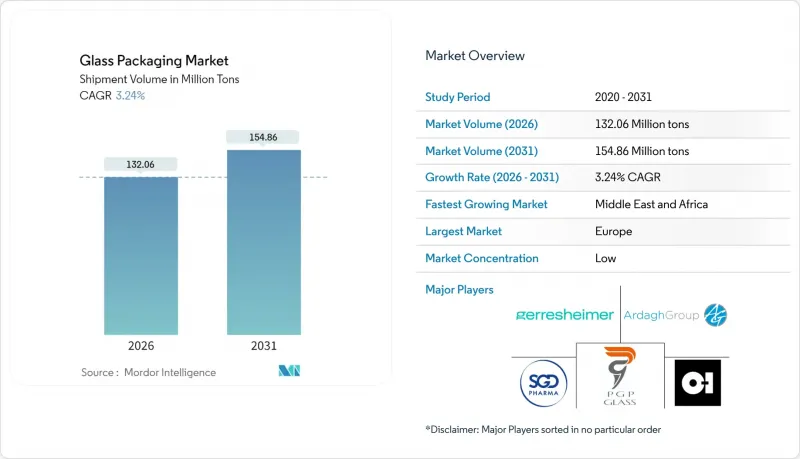
銷售穩定成長反映了產業向永續材料轉型、新型生物製藥產品管瓶生產的快速擴張以及飲料領域持續的優質化。玻璃仍然至關重要,它具有無限的可回收性、優異的阻隔性以及有助於品牌差異化的高階外觀。製造商正在投資電爐、提高玻璃屑含量並設計輕質瓶,以減少排放和整體材料用量。同時,由於家庭服裝的流行以及電商通路大宗購買採購的增加,500毫升至1公升的中容量容器正在獲得越來越多的市場佔有率。
全球玻璃包裝市場趨勢與洞察
精釀啤酒和頂級烈酒的快速成長推動了對玻璃瓶的需求。
精釀酒廠和新酒廠的興起推動了對玻璃瓶的訂單成長。為了滿足這一需求,阿達格集團(Ardagh Group)於2024年擴展了其頂級烈酒產品線。預計到2024年,英國烈酒市場規模將達到168億英鎊,屆時將有超過50家新酒廠進入市場。這充分體現了高階策略如何推動玻璃包裝的普及。即飲雞尾酒市場預計到2030年將以每年16.2%的速度成長,玻璃瓶因其能夠更好地保護風味並展現產品的真實性而備受青睞。烈酒生產超當地語系化的趨勢也推動了體現傳統工藝的小批量玻璃瓶的生產。品牌擁有者在展示高階烈酒時,重視玻璃的透明度、堅固性和惰性。
mRNA疫苗和載體疫苗的普及推動了對藥用管瓶的需求。
新型生物製藥的擴大生產推動了對I型管瓶的持續需求。肖特製藥公司(SCHOTT Pharma)正在其位於北卡羅來納州的工廠投資3.71億美元,用於生產GLP-1類藥物的玻璃注射器和mRNA藥物的可重複填充聚合物系統。美國食品藥物管理局(FDA)發布了2024年容器和密封系統變更的最新指南,強調了監管機構對管瓶品質的重視。康寧公司的「Valor」製程去除了硼元素,防止分層,從而確保藥物安全並實現自動化填充生產線。這些進展凸顯了醫藥玻璃包裝市場解決方案的長期成長潛力。
替代解決方案的激增
輕質鋁材和新興的生物基塑膠正在蠶食玻璃包裝市場的潛在需求,尤其是在對成本高度敏感的飲料領域。 Copu Water強調了鋁材優異的剩餘價值,這使其在閉合迴路通路中幾乎可以實現100%的回收率。 Blue Triton已開始為Poland Spring飲料採用鋁瓶,從而提高了回收的經濟效益。歐洲旨在減少石化產品的政策正在推動PLA和PEF的創新,加劇了玻璃包裝市場的競爭。
細分市場分析
預計到2025年,涵蓋食品、飲料和美容行業的瓶罐將佔市場佔有率的64.55%。受新型細胞和基因療法對惰性包裝的需求推動,管瓶和安瓿預計將以6.28%的複合年成長率呈現最快的成長軌跡。管瓶製藥公司(SCHOTT Pharma)累計,其2024年注射器和管瓶解決方案的收入將達到10.34億美元。康寧公司的具成本效益玻璃可防止分層,並提高自動化填充生產線的耐用性。隨著生物製藥產品線的成熟,小瓶玻璃包裝市場預計將穩定成長。
包括實驗室容器在內的多種特種產品雖然仍屬於小眾市場,但市場穩定。從手工吹製生產轉向自動化生產,確保了壁厚的一致性和尺寸的精確性。 Gerresheimer 收購 Bormioli Pharma 後,獲得了 EZ-fill Smart 平台,簡化了填充準備流程。目前,競爭優勢主要體現在表面塗層和用於監測藥物依從性的智慧瓶蓋上。
預計到2025年,飲料品類將佔54.10%的市場佔有率,主要得益於啤酒、葡萄酒和烈酒玻璃包裝的普及。精釀品牌則選擇玻璃瓶來凸顯酒液的色澤和氣泡。高階果汁和乳類飲料等非酒精飲料也優先選擇玻璃瓶包裝,以更好地保持風味。由於高階產品(SKU)的成長速度超過了大眾品牌,飲料品類的玻璃包裝市場佔有率預計將保持穩定。
醫藥產業是成長最快的細分市場,複合年成長率達7.11%。受mRNA疫苗和GLP-1注射生產擴張的推動,預計到2031年,醫藥玻璃包裝市場規模將達到新高。化妝品、香水和個人保健產品也紛紛採用玻璃包裝,以達到回收目標,同時提升產品質感。食品應用領域對玻璃包裝的需求仍然強勁,尤其是醬料和高階調味品,因為玻璃包裝能夠提升產品的視覺效果。
玻璃包裝市場報告按產品類型(瓶/罐等)、終端用途行業(食品、飲料、醫藥等)、顏色(無色、琥珀色等)、容量(小於200毫升、200-500毫升、500-1000毫升、大於1000毫升)和地區(北美、歐洲、亞太、中東和非洲、南美)進行細分。市場預測以噸為單位。
區域分析
2025年,歐洲玻璃市場佔全球銷量的37.75%,這主要得益於其成熟的製造業基礎、嚴格的回收目標以及濃厚的葡萄酒和烈酒文化。 Velaria在干邑白蘭地安裝了首座全電熔爐,二氧化碳排放減少了60%,彰顯了其在該地區脫碳領域的領先地位。 AGC Glass Europe在2023年回收了70萬噸玻璃廢料,進一步推動了循環經濟的發展。嚴格的生產者責任指令使玻璃在監管方面優於某些塑膠。由於啤酒銷售量下降,2024年玻璃需求略有減弱,但創新和優質化保持了價格的穩定。
北美仍然是關鍵市場,這主要得益於其精釀飲料和生物技術中心的發展。作為該地區最大的玻璃生產商,OI Glass 正在考慮 2025 年年中將產能削減 7%,以應對需求波動。其位於沃什和阿洛伊斯工廠的電氣化投資凸顯了該集團致力於減少排放的決心。鼓勵使用回收材料和提供先進製造技術稅額扣抵的監管激勵措施有望加速現代化進程。
儘管中國目前存在暫時的庫存積壓,但亞太地區仍呈現穩健成長。 BG Container Glass累計2023年營收將達4.32億美元,到2030年複合年成長率將達到4.7%。中國平板玻璃製造商正將重心轉向太陽能和汽車市場,一旦需求復甦,便可釋放出容器玻璃的產能。快速的都市化、新興中產階級的崛起以及即飲飲料的蓬勃發展,都為玻璃包裝市場的長期擴張提供了支撐。
預計到2031年,中東和非洲地區將以7.67%的複合年成長率實現最高成長速度,主要得益於基礎建設和包裝產品需求的成長。維特羅計劃在埃及投資4億美元用於玻璃生產,以因應該地區的成長。 HORN已在奈及利亞為Frigo Glass公司運作一座新熔爐,展現了當地生產能力的提升。政府促進國內製造業發展的政策正在幫助降低進口依賴,並增強供應鏈韌性。
受大眾飲料和不斷完善的回收體系的推動,南美洲預計將保持穩定成長。生產商正在研發更輕便的瓶子,以降低該地區的物流成本。區域趨勢凸顯了永續性框架、能源價格和消費者偏好如何塑造不同地區的成長軌跡。
其他福利:
- Excel格式的市場預測(ME)表
- 3個月的分析師支持
目錄
第1章 引言
- 研究假設和市場定義
- 調查範圍
第2章調查方法
第3章執行摘要
第4章 市場情勢
- 市場概覽
- 市場促進因素
- 精釀啤酒和頂級烈酒需求激增,帶動了玻璃瓶裝酒的需求。
- mRNA疫苗和載體疫苗的推廣應用正在推動全球對藥用管瓶的需求。
- 化妝品產業對高品質包裝材料的需求不斷成長
- 亞洲即飲咖啡和機能飲料的興起推動了對輕質玻璃瓶的需求。
- 玻璃容器的多重優點推動了它們的流行。
- 市場限制
- 替代方案的可用性
- 藥用級硼矽酸玻璃管短缺限制了管瓶的供應。
- 玻璃製造過程中的高碳排放阻礙了市場成長
- 供應鏈分析
- 玻璃包裝行業標準和法規
- 進出口資料(依相關HS編碼)
- 玻璃包裝的回收趨勢
- 原料分析
- 玻璃包裝需求與供給分析
- 波特五力分析
- 供應商的議價能力
- 買方的議價能力
- 新進入者的威脅
- 替代品的威脅
- 競爭對手之間的競爭
第5章 市場規模與成長預測
- 依產品類型
- 瓶子和罐子
- 管瓶和安瓿
- 其他產品類型
- 按顏色
- 燧石
- 琥珀色
- 綠色的
- 其他顏色
- 按產能
- 少於200毫升
- 200至500毫升
- 500至1000毫升
- 超過1000毫升
- 按最終用途行業分類
- 食物
- 飲料
- 酒精飲料
- 啤酒
- 葡萄酒
- 烈酒
- 其他酒精飲料(蘋果酒和其他發酵飲料)
- 不含酒精的飲料
- 碳酸飲料
- 汁
- 乳製品飲料
- 其他非酒精飲料
- 酒精飲料
- 製藥
- 化妝品和個人護理
- 其他終端用戶產業
- 按地區
- 北美洲
- 美國
- 加拿大
- 墨西哥
- 歐洲
- 德國
- 英國
- 法國
- 義大利
- 西班牙
- 俄羅斯
- 其他歐洲地區
- 亞太地區
- 中國
- 印度
- 日本
- 韓國
- 澳洲和紐西蘭
- 亞太其他地區
- 中東和非洲
- 中東
- 阿拉伯聯合大公國
- 沙烏地阿拉伯
- 土耳其
- 其他中東地區
- 非洲
- 南非
- 奈及利亞
- 埃及
- 其他非洲地區
- 中東
- 南美洲
- 巴西
- 阿根廷
- 其他南美洲
- 北美洲
第6章 競爭情勢
- 市場集中度
- 策略趨勢與發展
- 市佔率分析
- 公司簡介
- OI Glass Inc.(Owens-Illinois)
- Ardagh Group
- Gerresheimer AG
- Wiegand-Glas GmbH
- Piramal Glass Pvt. Ltd.
- Hindustan National Glass & Industries Ltd.
- Verallia Deutschland AG
- SGD Pharma
- WestPack LLC
- Berlin Packaging LLC
- SGD Kipfenberg GmbH
- HEINZ-GLAS GmbH & Co. KGaA
- BA Glass Germany GmbH
- AGI glaspac
- Glashutte Freital GmbH
- KP Glas GmbH & Co. KG
- San Miguel Yamamura Packaging Corporation
- Hung Phu Glass Joint Stock Company(HuphuMeglass)
- Vietnam Nashley Technology Joint Stock Company
- Feemio Group Co., Ltd.
- Pavico Packaging Company Limited
- SCHOTT Pharma(SCHOTT Group)
- Pharma-Q Holdings(Pty)Ltd.
- Nurrin Pharmalab
- Stevanato Group Spa
- Corning Incorporated
- Kapoor Glass India Pvt. Ltd.
- Neelam Global Pvt. Ltd
- Khemka Glass
- Amputech Industry
- Stevanato Group
- Hindustan Glass Works
第7章 市場機會與未來展望
The glass packaging market was valued at 127.92 million tons in 2025 and estimated to grow from 132.06 million tons in 2026 to reach 154.86 million tons by 2031, at a CAGR of 3.24% during the forecast period (2026-2031).
This steady, volume-driven growth reflects the industry's shift toward sustainable materials, the rapid scale-up of vial production for new biologics, and continuing premiumization in beverages. Glass maintains relevance because it offers infinite recyclability, strong barrier properties, and a premium look that supports brand differentiation. Manufacturers are investing in electric furnaces, higher cullet content, and lightweight bottle designs to cut emissions and reduce total material use. At the same time, mid-size containers between 500 ml and 1 l are winning share thanks to the rise of family packs and bulk purchasing through e-commerce channels.
Global Glass Packaging Market Trends and Insights
Craft Beer and Premium Spirits Surge Fueling Glass Bottle Demand
Rising craft breweries and new distilleries are fueling incremental glass bottle orders. Ardagh Group broadened its premium spirits portfolio in 2024 to meet this appetite. The UK spirits market reached GBP 16.8 billion in 2024 with more than 50 additional distilleries, demonstrating how premium positioning drives glass uptake. Ready-to-drink cocktails are projected to grow 16.2% per year to 2030, favouring glass because it safeguards flavour and signals authenticity. The hyperlocal trend in spirits production also benefits small-batch glass bottle runs that showcase craft heritage. Brand owners value the material's clarity, rigidity, and inertness when presenting super-premium liquids.
mRNA and Vector-Vaccine Rollout Boosting Pharmaceutical Glass Vials
Scaling production of new biologics drives sustained demand for Type I vials. SCHOTT Pharma committed USD 371 million to a North Carolina plant that will supply glass syringes for GLP-1 drugs and refillable polymer systems for mRNA medicines. The FDA issued updated guidance on container-closure changes in 2024, underscoring regulatory focus on vial quality. Corning's Valor formulation removes boron to prevent delamination, addressing drug safety while enabling automated filling lines. These moves confirm the long-term growth runway for pharma glass packaging market solutions.
Availability of Alternative Solutions
Lightweight aluminum and emerging bio-based plastics are eating into the addressable volume of the glass packaging market, particularly in cost-sensitive beverage segments. Kopu Water highlights the superior residual value of aluminum, which supports near-100% capture rates in closed-loop channels. BlueTriton adopted aluminum bottles for Poland Spring to improve recycling economics. European policy that targets petrochemical reduction accelerates innovation in PLA and PEF, raising competitive intensity for glass.
Other drivers and restraints analyzed in the detailed report include:
- Increasing Demand from Cosmetics Industry for Premium Packaging
- RTD Coffee and Functional Drinks Uptake in Asia Spurring Lightweight Glass Bottles
- Shortage of Pharma-Grade Borosilicate Tubing Limits Vial Supply
For complete list of drivers and restraints, kindly check the Table Of Contents.
Segment Analysis
Bottles and jars held 64.55% of 2025 volumes as they span food, beverage, and beauty sectors. Vials and ampoules posted the fastest trajectory, growing at 6.28% CAGR on the back of new cell-and-gene therapies that require inert packaging. SCHOTT Pharma generated USD 1.034 billion revenue in 2024 from syringe and vial solutions. Corning's Valor glass eliminates delamination, improving durability in automated fill lines. The glass packaging market size for vials is projected to climb steadily as biologic pipelines mature.
Broader specialty items such as laboratory containers remain niche but stable. Automation has replaced hand-blown production, ensuring uniform wall thickness and dimensional accuracy. Gerresheimer's acquisition of Bormioli Pharma adds the EZ-fill Smart platform to streamline ready-to-fill processing. Competitive differentiation now centres on surface coatings and smart caps that monitor adherence.
Beverages commanded 54.10% share in 2025 thanks to entrenched glass preferences in beer, wine, and spirits. Craft labels choose flint bottles to showcase colour and carbonation. Non-alcoholic drinks such as premium juices and dairy blends also lean on glass for flavour integrity. The glass packaging market share held by beverages is expected to persist as premium SKUs outgrow mass brands.
Pharmaceuticals represent the fastest-growing vertical at 7.11% CAGR. Production of mRNA vaccines and GLP-1 injectables will push the glass packaging market size for pharma to new highs by 2031. Cosmetics, fragrances, and personal care lines turn to glass to communicate luxury while meeting recyclability goals. Food applications maintain baseline demand, particularly for sauces and gourmet condiments that benefit from product visibility.
The Glass Packaging Market Report is Segmented by Product Type (Bottles and Jars, and More), End-Use Industry (Food, Beverage, Pharmaceuticals, and More), Color (Flint, Amber, and More), Capacity (Less Than 200ml, 200-500ml, 500-1000ml, More Than 1000ml), and Geography (North America, Europe, Asia-Pacific, Middle East and Africa, South America). The Market Forecasts are Provided in Terms of Volume (Tons).
Geography Analysis
Europe controlled 37.75% of 2025 volume owing to a mature manufacturing base, stringent recycling targets, and entrenched wine and spirits culture. Verallia switched on the first fully electric furnace in Cognac, trimming CO2 by 60% and demonstrating the region's decarbonization leadership AGC Glass Europe recycled 700,000 tons of cullet during 2023, reinforcing circular-economy momentum. Stringent producer-responsibility directives tilt the regulatory field toward glass over certain plastics. Demand pulled back slightly in 2024 on softer beer volumes, yet innovation and premiumization keep value stable.
North America remains a pivotal market supported by craft beverages and biotech hubs. O-I Glass, the region's largest producer, is reviewing a 7% capacity cut by mid-2025 to align supply with demand shifts. Investments in electrification at Veauche and Alloa plants highlight the group's commitment to emission reductions. Regulatory incentives for recycled content and advanced manufacturing tax credits could accelerate modernization.
Asia-Pacific shows resilient growth despite temporary inventory overhangs in China. BG Container Glass posted USD 432 million revenue in 2023 and expects 4.7% CAGR through 2030. China's flat glass makers are pivoting toward photovoltaic and automotive markets, freeing capacity for container glass once demand rebounds. Rapid urbanization, new middle-class consumers, and the RTD boom all support long-term expansion of the glass packaging market.
The Middle East and Africa is set to record the strongest 7.67% CAGR through 2031, driven by infrastructure build-out and rising packaged-goods demand. Vitro plans USD 400 million of glass investments in Egypt to meet regional growth. HORN fired up a new furnace for Frigoglass in Nigeria, proving local capability gains. Government policies encouraging domestic manufacturing reduce import reliance and build supply-chain resilience.
South America delivers steady gains from beverage staples and improving recycling systems. Producers are exploring lightweight bottles to cut logistics costs across vast geographies. Altogether, geographic dynamics highlight how sustainability frameworks, energy prices, and consumer preferences create diverse regional trajectories.
- O-I Glass Inc. (Owens-Illinois)
- Ardagh Group
- Gerresheimer AG
- Wiegand-Glas GmbH
- Piramal Glass Pvt. Ltd.
- Hindustan National Glass & Industries Ltd.
- Verallia Deutschland AG
- SGD Pharma
- WestPack LLC
- Berlin Packaging LLC
- SGD Kipfenberg GmbH
- HEINZ-GLAS GmbH & Co. KGaA
- BA Glass Germany GmbH
- AGI glaspac
- Glashutte Freital GmbH
- KP Glas GmbH & Co. KG
- San Miguel Yamamura Packaging Corporation
- Hung Phu Glass Joint Stock Company (HuphuMeglass)
- Vietnam Nashley Technology Joint Stock Company
- Feemio Group Co., Ltd.
- Pavico Packaging Company Limited
- SCHOTT Pharma (SCHOTT Group)
- Pharma-Q Holdings (Pty) Ltd.
- Nurrin Pharmalab
- Stevanato Group Spa
- Corning Incorporated
- Kapoor Glass India Pvt. Ltd.
- Neelam Global Pvt. Ltd
- Khemka Glass
- Amputech Industry
- Stevanato Group
- Hindustan Glass Works
Additional Benefits:
- The market estimate (ME) sheet in Excel format
- 3 months of analyst support
TABLE OF CONTENTS
1 INTRODUCTION
- 1.1 Study Assumptions and Market Definition
- 1.2 Scope of the Study
2 RESEARCH METHODOLOGY
3 EXECUTIVE SUMMARY
4 MARKET LANDSCAPE
- 4.1 Market Overview
- 4.2 Market Drivers
- 4.2.1 Craft beer and premium spirits surge, fueling the demand for glass bottles
- 4.2.2 mRNA and vector-vaccine rollout boosting pharma glass vials globally
- 4.2.3 Increasing Demand from the Cosmetics Industry for Premium Packaging
- 4.2.4 RTD coffee and functional drinks uptake in Asia spurring lightweight glass bottles
- 4.2.5 Multifaceted Advantages of Container Glass Increasing Its Popularity
- 4.3 Market Restraints
- 4.3.1 Availability of Alternative Solutions
- 4.3.2 Shortage of pharma-grade borosilicate tubing limits vial supply
- 4.3.3 Higher Carbon Footprint Glass Manufacturing Hampers Market Growth
- 4.4 Supply-Chain Analysis
- 4.5 Industry Standards and Regulations for Glass Packaging
- 4.6 Export - Import Data (Under Relevant Hs Code)
- 4.7 Recycling Trends for Glass Packaging
- 4.8 Raw Material Analysis
- 4.9 Demand vs. Supply Analysis for Glass Packaging
- 4.10 Porter's Five Forces Analysis
- 4.10.1 Bargaining Power of Suppliers
- 4.10.2 Bargaining Power of Buyers
- 4.10.3 Threat of New Entrants
- 4.10.4 Threat of Substitute Products
- 4.10.5 Intensity of Competitive Rivalry
5 MARKET SIZE AND GROWTH FORECASTS (VOLUME)
- 5.1 By Product Type
- 5.1.1 Bottles and Jars
- 5.1.2 Vials and Ampoules
- 5.1.3 Others Product Types
- 5.2 By Color
- 5.2.1 Flint
- 5.2.2 Amber
- 5.2.3 Green
- 5.2.4 Other Colors
- 5.3 By Capacity
- 5.3.1 Less than 200 ml
- 5.3.2 200-500 ml
- 5.3.3 500-1000 ml
- 5.3.4 More than 1000 ml
- 5.4 By End-Use Industry
- 5.4.1 Food
- 5.4.2 Beverage
- 5.4.2.1 Alcoholic Beverage
- 5.4.2.1.1 Beer
- 5.4.2.1.2 Wine
- 5.4.2.1.3 Spirits
- 5.4.2.1.4 Other Alcoholic Beverages (Cider and Other Fermented Drinks)
- 5.4.2.2 Non-Alcoholic Beverage
- 5.4.2.2.1 Carbonated Soft Drinks
- 5.4.2.2.2 Juices
- 5.4.2.2.3 Dairy Product Based Drinks
- 5.4.2.2.4 Other Non-Alcoholic Beverages
- 5.4.2.1 Alcoholic Beverage
- 5.4.3 Pharmaceuticals
- 5.4.4 Cosmetics and Personal Care
- 5.4.5 Other End-Use Indusry
- 5.5 By Geography
- 5.5.1 North America
- 5.5.1.1 United States
- 5.5.1.2 Canada
- 5.5.1.3 Mexico
- 5.5.2 Europe
- 5.5.2.1 Germany
- 5.5.2.2 United Kingdom
- 5.5.2.3 France
- 5.5.2.4 Italy
- 5.5.2.5 Spain
- 5.5.2.6 Russia
- 5.5.2.7 Rest of Europe
- 5.5.3 Asia-Pacific
- 5.5.3.1 China
- 5.5.3.2 India
- 5.5.3.3 Japan
- 5.5.3.4 South Korea
- 5.5.3.5 Australia and New Zealand
- 5.5.3.6 Rest of Asia-Pacific
- 5.5.4 Middle East and Africa
- 5.5.4.1 Middle East
- 5.5.4.1.1 United Arab Emirates
- 5.5.4.1.2 Saudi Arabia
- 5.5.4.1.3 Turkey
- 5.5.4.1.4 Rest of Middle East
- 5.5.4.2 Africa
- 5.5.4.2.1 South Africa
- 5.5.4.2.2 Nigeria
- 5.5.4.2.3 Egypt
- 5.5.4.2.4 Rest of Africa
- 5.5.4.1 Middle East
- 5.5.5 South America
- 5.5.5.1 Brazil
- 5.5.5.2 Argentina
- 5.5.5.3 Rest of South America
- 5.5.1 North America
6 COMPETITIVE LANDSCAPE
- 6.1 Market Concentration
- 6.2 Strategic Moves and Developments
- 6.3 Market Share Analysis
- 6.4 Company Profiles (includes Global level Overview, Market level overview, Core Segments, Financials as available, Strategic Information, Market Rank/Share for key companies, Products and Services, and Recent Developments)
- 6.4.1 O-I Glass Inc. (Owens-Illinois)
- 6.4.2 Ardagh Group
- 6.4.3 Gerresheimer AG
- 6.4.4 Wiegand-Glas GmbH
- 6.4.5 Piramal Glass Pvt. Ltd.
- 6.4.6 Hindustan National Glass & Industries Ltd.
- 6.4.7 Verallia Deutschland AG
- 6.4.8 SGD Pharma
- 6.4.9 WestPack LLC
- 6.4.10 Berlin Packaging LLC
- 6.4.11 SGD Kipfenberg GmbH
- 6.4.12 HEINZ-GLAS GmbH & Co. KGaA
- 6.4.13 BA Glass Germany GmbH
- 6.4.14 AGI glaspac
- 6.4.15 Glashutte Freital GmbH
- 6.4.16 KP Glas GmbH & Co. KG
- 6.4.17 San Miguel Yamamura Packaging Corporation
- 6.4.18 Hung Phu Glass Joint Stock Company (HuphuMeglass)
- 6.4.19 Vietnam Nashley Technology Joint Stock Company
- 6.4.20 Feemio Group Co., Ltd.
- 6.4.21 Pavico Packaging Company Limited
- 6.4.22 SCHOTT Pharma (SCHOTT Group)
- 6.4.23 Pharma-Q Holdings (Pty) Ltd.
- 6.4.24 Nurrin Pharmalab
- 6.4.25 Stevanato Group Spa
- 6.4.26 Corning Incorporated
- 6.4.27 Kapoor Glass India Pvt. Ltd.
- 6.4.28 Neelam Global Pvt. Ltd
- 6.4.29 Khemka Glass
- 6.4.30 Amputech Industry
- 6.4.31 Stevanato Group
- 6.4.32 Hindustan Glass Works
7 MARKET OPPORTUNITIES AND FUTURE OUTLOOK
- 7.1 White-space and Unmet-need Assessment

 復古相機市場:全球產業規模、市場佔有率、趨勢、機會和預測(按類型、狀況、分銷管道和地區分類)、競爭格局(2021-2031 年)
 玻璃包裝市場報告:按產品、最終用戶和地區分類(2026-2034 年)
 玻璃包裝市場:2026-2032年全球市場預測(依包裝類型、應用、玻璃類型及通路分類)
 玻璃包裝市場:按類型、終端用戶行業和地區分類
 全球玻璃包裝市場規模、佔有率、趨勢和成長分析報告(2026-2034年)琥珀色玻璃容器市場:按應用、類型和分銷管道分類-2026-2032年全球市場預測玻璃復古包裝市場:按銷售量、最終用途和分銷管道分類,全球預測(2026-2032年)
 全球玻璃包裝市場:趨勢與展望(至2034年)烈酒玻璃市場:按產品類型、材質、設計美學、銷售管道和最終用戶分類,全球預測(2026-2032)
 復古相機市場規模、佔有率和成長分析(按相機類型、目標用戶、價格範圍、配件和地區分類)—2026-2033年產業預測