


 |
市場調查報告書
商品編碼
1939150
炭黑:市場佔有率分析、產業趨勢與統計、成長預測(2026-2031)Carbon Black - Market Share Analysis, Industry Trends & Statistics, Growth Forecasts (2026 - 2031) |
||||||

※ 本網頁內容可能與最新版本有所差異。詳細情況請與我們聯繫。
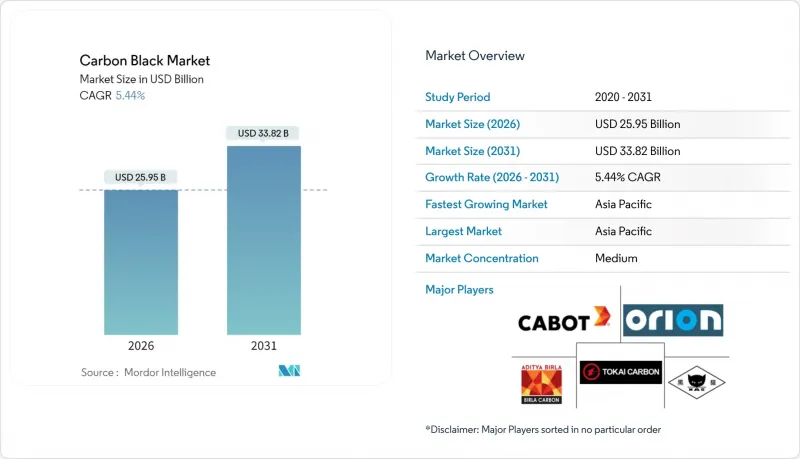
預計炭黑市場規模將從 2025 年的 246.1 億美元成長到 2026 年的 259.5 億美元,到 2031 年將達到 338.2 億美元,2026 年至 2031 年的複合年成長率為 5.44%。
輪胎增強材料、塑膠複合材料、電池電極和高性能塗料的強勁需求支撐著銷售穩定成長,同時也推動產品結構逐步轉向高階特種等級。亞太地區的產能擴張為生產規模的擴大奠定了基礎,但原料價格的波動和日益成長的永續性要求迫使生產商實施更嚴格的成本控制和製程創新。電氣化進程的加速正在加速導電等級炭黑的應用,而等離子甲烷熱解等製程創新正在重塑其競爭格局。作為傳統交通運輸和新興儲能價值鏈中的關鍵材料投入,炭黑市場持續創造價值。
全球炭黑市場趨勢與洞察
輪胎製造能力快速成長,尤其是在亞太地區
中國、印度和東南亞的新建輪胎工廠持續簽署多年期炭黑承購協議,支撐可預測的需求模式。Yokohama Rubber在中國的持續產能擴張就是一個很好的例子,它顯示大規模輪胎生產基地如何帶動附近炭黑生產設施的同步投資,從而降低物流成本並支持準時制供應模式。區域集聚提高了炭黑的需求密度,並支持有利於爐法黑顏料生產商的規模經濟。通過ISO 14001認證的供應商獲得了優先供應商地位,並在符合環保標準的工廠中鞏固了市場佔有率。因此,輪胎生產和炭黑消費之間的結構性連結提供了支撐性需求,從而平滑了收入週期並支持了長期資本規劃。
從標準黑色到特種黑色的快速過渡
OEM廠商對低滾動阻力和高導電性的需求迫使輪胎製造商採用工程級炭黑,其價格比通用爐法炭黑顏料高出40%至60%。這些特殊配方能夠提高燃油經濟性和延長胎面壽命,帶來可衡量的性能提升,足以抵消額外的成本。投資於專有表面改質技術和超潔淨爐設計的製造商,能夠在利潤豐厚的細分市場中獲得永續的競爭優勢。技術差異化和客戶認證通訊協定增加了轉換成本,並強化了供應商鎖定。同時,特種炭黑在炭黑市場的佔有率逐年穩定成長。研發團隊和輪胎設計師之間的緊密合作正在加速向高級炭黑的轉變。
原物料價格波動
炭黑生產嚴重依賴碳基原料,例如煤焦油和殘渣燃料油,這些原料成本可佔總營運成本的50%之多。 2024年底,碳和石墨產品的生產者物價指數大幅上漲,在合約轉嫁條款生效前,利潤空間受到擠壓。依賴進口的工廠面臨額外的運費風險,加劇了區域價格差異,並影響了貿易流量套利。雖然擁有長期供應合約的一體化生產商可以部分保障其收入,但現貨買家則面臨利潤波動,這會影響維護計畫和運轉率。因此,有效的避險和籌資策略對於穩定整個炭黑市場的現金流量仍然至關重要。
細分市場分析
到2025年,爐法炭黑將佔總收入的76.30%,展現出其在輪胎和橡膠製品等核心領域的多功能性和經濟競爭力。然而,隨著特種製程的日益普及,爐法炭黑的市佔率將逐漸下降。燈法炭黑預計到2031年將以7.35%的強勁複合年成長率成長,這得益於其固有的高比表面積結構,使其在電子和儲能塗層中具有優異的導電性。氣法炭黑將繼續用於精細分散油墨,而熱感炭黑將用於對結構要求較低的特殊聚合物共混物。等離子甲烷技術的創新應用正在拓展製程選擇,提供一條低排放路徑,可與原始設備製造商(OEM)的碳核算框架相契合。
競爭策略包括對現有爐線進行模組化反應器改造,從而能夠生產半特種等級的炭黑。卡博特和比爾拉碳素公司正在測試先進的原料噴射控制技術,以在不引入新製程的情況下,縮小粒徑分佈並改善結構指標。成功的改造有望在保持規模優勢的同時,抓住向特種產品價值轉移的機會。隨著美國材料與試驗協會(ASTM)制定再生炭黑的統一分類標準,爐窯製造商可能會採用再生炭黑(rCB)混合策略,在不影響化合物性能的前提下實現循環經濟目標。總而言之,通用製程和特種製程的並存正在推動炭黑市場出現兩種成長模式。
區域分析
預計到2025年,亞太地區將佔全球收入的61.85%,並在2031年之前以5.85%的複合年成長率成長,這主要得益於中國輪胎製造業的集中以及印度特種化學品市場的擴張。中國正透過整合毗鄰大型輪胎廠的炭黑生產基地,提高原料採購和物流效率,進而增強其區域競爭力。印度喜馬德里特種化學品有限公司(Himadri Specialty Chemicals Ltd.)將於2024年新增7萬噸優質產能,這標誌著其產品供應正從大宗商品轉向為高性能輪胎和電池組件提供高附加價值粉末。日本和韓國擁有技術領先優勢,而東南亞國家則擁有成本低廉的勞動力和不斷成長的國內汽車需求。
北美地區的消費市場正呈現成熟且穩定的態勢,這主要得益於對替換輪胎的需求、高性能塗料的需求以及低排放製程的早期應用。 Monolith Materials公司位於內布拉斯加州的等離子體工廠正在引入符合綠色採購目標的替代供應基地,而Cabot公司則利用其在美國的特種工廠將通膨成本轉嫁給消費者,同時保持了產量的穩定成長。 《電池激勵法案》間接促進了導電炭黑的成長,為該地區的炭黑市場提供了結構性利好因素。
在歐洲,永續性和特殊應用備受重視,碳邊境調節機制鼓勵本地生產和從低碳供應商採購。限制多環芳烴(PAH)和二氧化碳排放的法規正在加速老舊爐窯的現代化改造或關閉。擁有先進後後處理系統的生產商能夠維持市場進入,並透過價格溢價來抵消監管成本。
儘管南美洲和中東/非洲的市場佔有率總合較小,但受汽車組裝擴張和工業化進程加快的推動,這兩個地區正處於高成長期。巴西汽車產業的復甦帶動了當地輪胎生產,並刺激了對國內炭黑生產的投資。中東企業正利用與石化原料的整合,並提案新的爐窯裝置,但下游需求仍低於亞太地區水準。南非的塗料和採礦業對特種分散劑用炭黑的需求旺盛,但匯率波動影響了其資本規劃。總體而言,隨著關鍵市場的成熟,這些地區為企業提供了擴張機會,使多元化生產商能夠在全球炭黑市場中平衡區域週期波動。
其他福利:
- Excel格式的市場預測(ME)表
- 3個月的分析師支持
目錄
第1章 引言
- 研究假設和市場定義
- 調查範圍
第2章調查方法
第3章執行摘要
第4章 市場情勢
- 市場概覽
- 市場促進因素
- 輪胎製造能力快速成長,尤其是在亞太地區
- 從標準黑色到特種黑色的快速過渡
- 主導推動了對導電級/乙炔級材料的需求。
- 低碳等離子甲烷黑可獲得OEM積分
- 電動車需求激增推動炭黑市場成長
- 市場限制
- 原物料價格波動
- 爐灶二氧化碳/多環芳烴排放的監管限值
- 再生炭黑(rCB)品質的差異性
- 價值鏈分析
- 技術展望
- 波特五力模型
- 供應商的議價能力
- 買方的議價能力
- 新進入者的威脅
- 替代品的威脅
- 競爭程度
- 定價分析
- 生產與貿易分析
第5章 市場規模與成長預測
- 透過製造程序
- 爐黑顏料
- 煤炭黑
- 熱感黑
- 燈黑
- 透過使用
- 輪胎和工業橡膠製品
- 塑膠
- 碳粉和列印油墨
- 塗層
- 纖維
- 其他
- 按地區
- 亞太地區
- 中國
- 印度
- 日本
- 韓國
- 泰國
- 亞太其他地區
- 北美洲
- 美國
- 加拿大
- 墨西哥
- 歐洲
- 德國
- 英國
- 法國
- 義大利
- 俄羅斯
- 其他歐洲地區
- 南美洲
- 巴西
- 阿根廷
- 其他南美洲
- 中東和非洲
- 沙烏地阿拉伯
- 阿拉伯聯合大公國
- 南非
- 其他中東和非洲地區
- 亞太地區
第6章 競爭情勢
- 市場集中度
- 策略趨勢
- 市佔率(%)/排名分析
- 公司簡介
- Asahi Carbon Co. Ltd
- Birla Carbon(Aditya Birla Group)
- BKT Carbon
- Black Bear Carbon BV
- Cabot Corporation
- Continental Carbon Company
- Denka Company Limited
- Epsilon Carbon Pvt Ltd
- Himadri Speciality Chemical Ltd
- Imerys SA
- Jiangxi Black Cat Carbon Black Co. Ltd
- Longxing Chemical Stock Co. Ltd
- Mitsubishi Chemical Corporation
- OCI Company Ltd
- Omsk Carbon Group
- Orion Engineered Carbons SA
- PCBL Limited
- Tokai Carbon Co. Ltd
第7章 市場機會與未來展望
The Carbon Black market is expected to grow from USD 24.61 billion in 2025 to USD 25.95 billion in 2026 and is forecast to reach USD 33.82 billion by 2031 at 5.44% CAGR over 2026-2031.
Strong demand from tire reinforcement, plastics compounding, battery electrodes, and high-performance coatings anchors steady volume growth while enabling a gradual mix shift toward premium specialty grades. Capacity additions across Asia-Pacific underpin output expansion, yet feedstock volatility and rising sustainability requirements force producers to adopt tighter cost control and process innovation. Heightened electrification accelerates conductive grade uptake, and process breakthroughs such as plasma methane pyrolysis reshape competitive positioning. The carbon black market continues to capture value as a critical material input for traditional mobility and emerging energy storage supply chains.
Global Carbon Black Market Trends and Insights
Surge in tire manufacturing capacity, especially in the Asia-Pacific region
New tire plants across China, India, and Southeast Asia continue to lock in multi-year carbon black off-take contracts that underpin predictable demand patterns. Yokohama's ongoing Chinese capacity additions exemplify how large tire complexes stimulate parallel investments in nearby carbon black units, lowering logistics costs and encouraging just-in-time delivery models. Regional clustering raises carbon black demand density and supports economies of scale that benefit furnace black producers. Suppliers with ISO 14001-certified operations secure preferred vendor status, consolidating share among environmentally compliant facilities. The structural link between tire output and carbon black consumption therefore provides a demand floor that smooths revenue cycles and aids long-range capital planning.
Rapid shift from standard to specialty blacks
OEM requirements for lower rolling resistance and higher conductivity push tire makers to adopt engineered grades that command 40-60% premiums over commodity furnace blacks. These specialty formulations enhance fuel economy and extend tread life, thereby generating measurable performance benefits that outweigh incremental cost. Producers investing in proprietary surface modification and ultra-clean furnace configurations gain sustainable advantages in a higher-margin niche. Technical differentiation and customer qualification protocols create switching costs that strengthen supplier lock-in, while the share of specialty shipments in the carbon black market rises steadily each year. Tight integration between research and development teams and tire designers accelerates the pivot toward advanced grades.
Volatile feedstock pricing
Carbon black production relies heavily on carbonaceous feedstocks such as coal tar and residual fuel oil that can represent up to 50% of total operating cost. The Producer Price Index for carbon and graphite products climbed sharply through late 2024, squeezing margins before contractual pass-through clauses could take effect. Import-dependent plants face added freight exposure that widens regional price differentials and influences trade flow arbitrage. Integrated producers with long-term supply agreements partially shield earnings, whereas spot buyers endure profit swings that influence maintenance turnarounds and capacity utilization. Effective hedging and procurement strategies, therefore, remain essential to stabilize cash flows across the carbon black market.
Other drivers and restraints analyzed in the detailed report include:
- Electrification-led demand for conductive/acetylene grades
- Low-carbon plasma-methane blacks gain OEM credits
- Regulatory caps on CO2/PAH emissions from furnaces
For complete list of drivers and restraints, kindly check the Table Of Contents.
Segment Analysis
Furnace black accounted for 76.30% of 2025 revenue, highlighting its versatility and competitive economics across core tire and rubber goods. Nonetheless, the carbon black market size in furnace applications confronts a gradual share drift as specialty processes gain traction. Lamp black, supported by a 7.35% forecast CAGR through 2031, benefits from an inherent high-surface-area morphology that delivers superior conductivity in electronics and energy storage coatings. Gas black maintains usage in fine-dispersion inks, whereas thermal black serves niche polymer blends requiring low structure. The disruptive entrance of plasma methane technology extends the process palette by offering a low-emission pathway that can align with OEM carbon accounting frameworks.
Competitive responses include modular reactor retrofits that enable production of semi-specialty grades within existing furnace lines. Cabot Corporation and Birla Carbon are piloting advanced feed-injection controls to tighten particle size distribution and boost structure indices without needing new processes. Successful adaptation preserves scale advantages while capturing value migration toward specialty products. As ASTM develops a unified classification for recovered carbon black, furnace producers may incorporate rCB blending strategies to meet circularity targets without jeopardizing compound performance. Overall, the coexistence of commodity and specialty processes drives a dual-track growth model within the carbon black market.
The Carbon Black Market Report is Segmented by Process Type (Furnace Black, Gas Black, Thermal Black, and Lamp Black), Application (Tire and Industrial Rubber Product, Plastic, Toner and Printing Ink, Coating, Textile Fiber, and Others), and Geography (Asia-Pacific, North America, Europe, South America, and Middle-East and Africa). The Market Forecasts are Provided in Terms of Value (USD).
Geography Analysis
Asia-Pacific held 61.85% of global revenue in 2025, supported by China's tire manufacturing concentration and India's specialty grade expansion, and is forecast to log a 5.85% CAGR to 2031. China integrates large tire plants with adjacent carbon black units, achieving feedstock and logistics efficiencies that bolster regional competitiveness. India's Himadri Speciality Chemical added 70,000 MTPA of premium capacity in 2024, signaling a shift from commodity supply toward higher-margin powders for performance tires and battery components. Japan and South Korea contribute technology leadership, while Southeast Asian economies supply cost-effective labor and growing domestic auto demand.
North America records mature yet stable consumption, driven by replacement tire demand, high-performance coatings, and early adoption of low-emission processes. Monolith Materials' Nebraska plasma facility introduces an alternative supply base aligned with green procurement objectives, while Cabot Corporation leverages its U.S. specialty plants to pass through inflationary costs without significant volume attrition. The Inflation Reduction Act's battery incentives indirectly support conductive grade growth, providing a structural tailwind for the carbon black market in the region.
Europe emphasizes sustainability and specialty applications, with the Carbon Border Adjustment Mechanism encouraging localized production or preferential sourcing from low-carbon suppliers. Caps on PAH and CO2 emissions accelerate modernization or closure of legacy furnaces. Producers with advanced after-treatment systems maintain market access and negotiate price premiums that offset compliance expenditures.
South America, the Middle East, and Africa collectively account for a smaller share but exhibit pockets of high growth linked to expanding automotive assembly and broader industrialization. Brazil's automotive recovery drives localized tire output that stimulates domestic carbon black production investment. Middle Eastern players leverage petrochemical raw material integration to propose new furnace units, though downstream demand still lags Asia-Pacific scale. South Africa's coatings and mining sectors require specialty dispersion blacks, yet currency volatility clouds capital planning. Combined, these regions offer expansion optionality as primary markets mature, allowing diversified producers to balance regional cycles within the global carbon black market.
- Asahi Carbon Co. Ltd
- Birla Carbon (Aditya Birla Group)
- BKT Carbon
- Black Bear Carbon B.V.
- Cabot Corporation
- Continental Carbon Company
- Denka Company Limited
- Epsilon Carbon Pvt Ltd
- Himadri Speciality Chemical Ltd
- Imerys S.A.
- Jiangxi Black Cat Carbon Black Co. Ltd
- Longxing Chemical Stock Co. Ltd
- Mitsubishi Chemical Corporation
- OCI Company Ltd
- Omsk Carbon Group
- Orion Engineered Carbons S.A.
- PCBL Limited
- Tokai Carbon Co. Ltd
Additional Benefits:
- The market estimate (ME) sheet in Excel format
- 3 months of analyst support
TABLE OF CONTENTS
1 Introduction
- 1.1 Study Assumptions and Market Definition
- 1.2 Scope of the Study
2 Research Methodology
3 Executive Summary
4 Market Landscape
- 4.1 Market Overview
- 4.2 Market Drivers
- 4.2.1 Surge in tire manufacturing capacity, especially in the Asia-Pacific region
- 4.2.2 Rapid shift from standard to specialty blacks
- 4.2.3 Electrification-led demand for conductive/acetylene grades
- 4.2.4 Low-carbon plasma-methane blacks gain OEM credits
- 4.2.5 Surging electric vehicle demand fuels carbon black market growth
- 4.3 Market Restraints
- 4.3.1 Volatile feedstock pricing
- 4.3.2 Regulatory caps on CO2/PAH emissions from furnaces
- 4.3.3 Quality variability of recovered carbon black (rCB)
- 4.4 Value Chain Analysis
- 4.5 Technological Outlook
- 4.6 Porter's Five Forces
- 4.6.1 Bargaining Power of Suppliers
- 4.6.2 Bargaining Power of Buyers
- 4.6.3 Threat of New Entrants
- 4.6.4 Threat of Substitutes
- 4.6.5 Degree of Competition
- 4.7 Pricing Analysis
- 4.8 Production and Trade Analysis
5 Market Size and Growth Forecasts (Value)
- 5.1 By Process Type
- 5.1.1 Furnace Black
- 5.1.2 Gas Black
- 5.1.3 Thermal Black
- 5.1.4 Lamp Black
- 5.2 By Application
- 5.2.1 Tire and Industrial Rubber Product
- 5.2.2 Plastic
- 5.2.3 Toner and Printing Ink
- 5.2.4 Coating
- 5.2.5 Textile Fiber
- 5.2.6 Others
- 5.3 By Geography
- 5.3.1 Asia-Pacific
- 5.3.1.1 China
- 5.3.1.2 India
- 5.3.1.3 Japan
- 5.3.1.4 South Korea
- 5.3.1.5 Thailand
- 5.3.1.6 Rest of Asia-Pacific
- 5.3.2 North America
- 5.3.2.1 United States
- 5.3.2.2 Canada
- 5.3.2.3 Mexico
- 5.3.3 Europe
- 5.3.3.1 Germany
- 5.3.3.2 United Kingdom
- 5.3.3.3 France
- 5.3.3.4 Italy
- 5.3.3.5 Russia
- 5.3.3.6 Rest of Europe
- 5.3.4 South America
- 5.3.4.1 Brazil
- 5.3.4.2 Argentina
- 5.3.4.3 Rest of South America
- 5.3.5 Middle-East and Africa
- 5.3.5.1 Saudi Arabia
- 5.3.5.2 United Arab Emirates
- 5.3.5.3 South Africa
- 5.3.5.4 Rest of Middle-East and Africa
- 5.3.1 Asia-Pacific
6 Competitive Landscape
- 6.1 Market Concentration
- 6.2 Strategic Moves
- 6.3 Market Share(%)/Ranking Analysis
- 6.4 Company Profiles (includes Global level Overview, Market level overview, Core Segments, Financials as available, Strategic Information, Market Rank/Share, Products and Services, and Recent Developments)
- 6.4.1 Asahi Carbon Co. Ltd
- 6.4.2 Birla Carbon (Aditya Birla Group)
- 6.4.3 BKT Carbon
- 6.4.4 Black Bear Carbon B.V.
- 6.4.5 Cabot Corporation
- 6.4.6 Continental Carbon Company
- 6.4.7 Denka Company Limited
- 6.4.8 Epsilon Carbon Pvt Ltd
- 6.4.9 Himadri Speciality Chemical Ltd
- 6.4.10 Imerys S.A.
- 6.4.11 Jiangxi Black Cat Carbon Black Co. Ltd
- 6.4.12 Longxing Chemical Stock Co. Ltd
- 6.4.13 Mitsubishi Chemical Corporation
- 6.4.14 OCI Company Ltd
- 6.4.15 Omsk Carbon Group
- 6.4.16 Orion Engineered Carbons S.A.
- 6.4.17 PCBL Limited
- 6.4.18 Tokai Carbon Co. Ltd
7 Market Opportunities and Future Outlook
- 7.1 White-space and Unmet-Need Assessment

 炭黑市場:依類型、等級、實體形態、應用、最終用途產業及通路分類-2026-2032年全球市場預測爐法炭黑市場:依等級、功能、形態、通路和應用分類-2026-2032年全球市場預測
 炭黑市場預測至2034年-按生產流程、等級、永續性、應用、終端用戶產業和地區分類的全球分析
 炭黑市場規模、佔有率、趨勢和預測:按類型、等級、應用和地區分類,2026-2034年鉛酸蓄電池市場中的炭黑:2026年至2032年全球市場預測(依產品類型、形態、電池類型、電池組件、應用、客戶類型和銷售管道)
 2026年全球黑火藥市場報告
 炭黑市場:依產品類型、最終用戶和地區分類
 炭黑市場規模、佔有率和趨勢分析報告:按應用、地區和細分市場預測(2026-2033 年)特種奈米碳管管粉末市場:依純度、類型、生產方法、功能、最終用途和應用分類-全球預測,2026-2032年
 全球炭黑市場(2026-2036)