


 |
市場調查報告書
商品編碼
1939141
業務流程管理:市場佔有率分析、產業趨勢與統計、成長預測(2026-2031)Business Process Management - Market Share Analysis, Industry Trends & Statistics, Growth Forecasts (2026 - 2031) |
||||||

※ 本網頁內容可能與最新版本有所差異。詳細情況請與我們聯繫。
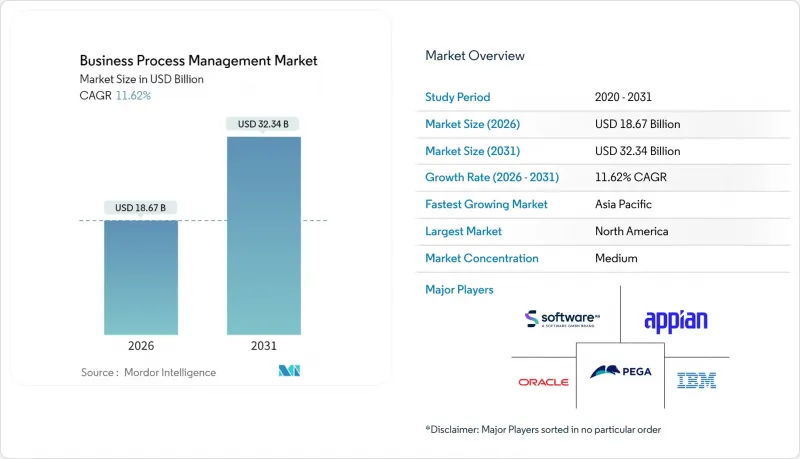
2025年業務流程管理市場價值為167.3億美元,預計到2031年將達到323.4億美元,高於2026年的186.7億美元。
預計在預測期(2026-2031 年)內,複合年成長率將達到 11.62%。
數位化優先營運模式的擴展、人工智慧引擎與工作流程套件的整合以及監管審查的日益嚴格,都支撐著對端到端流程協作平台的穩定需求。雲端原生交付、低程式碼開發以及由流程挖掘驅動的數位雙胞胎正在融合,加速大中型企業等採用者實現價值。亞太地區積極的自動化計劃,以及銀行、金融服務和保險(BFSI)和醫療保健行業合規計劃範圍的擴大,進一步推動了成長潛力。這市場領導領導者加快建立生態系統策略,以建立整合分析、規則引擎和機器人助理的超自動化堆疊。
全球業務流程管理市場趨勢與洞察
加速採用低程式碼/無程式碼 BPM 套件推動流程自動化的普及。
到 2025 年,四分之三的 BPM 平台將整合低程式碼工具,使業務團隊無需深厚的編碼知識即可配置工作流程。這將使計劃交付時間從數月縮短至數週,並在初始採用階段將流程效率提高 30%。公民開發人員的加入將有助於中小企業繞過有限的 IT 資源,同時透過模板和視覺化版本控制來維持管治。像 Bizagi 這樣的供應商將擴展 AI 代理,使其能夠根據自然語言提示自動生成模型,從而在不影響合規性的前提下擴大存取權限。
雲端原生流程自動化平台提供彈性可擴充性
像 Camunda Zeebe 這樣的橫向擴展引擎能夠隨著叢集節點的增加而線性提升吞吐量,這使得一家公共部門計費處理領域的早期採用者實現了自動化覆蓋率 65% 的提升。雲端交付降低了資本支出,並確保了混合環境的彈性, Oracle最新季度 62 億美元的雲端收入也印證了這一點。快速連接器庫加速了整合,這與雲端 BPM 服務消費量年增 27% 的成長相吻合。
異質IT環境中日益成長的整合複雜性
一項針對ERP的長期研究表明,由傳統ERP、雲端SaaS和細分業務線應用構成的多層生態系統會增加BPM整合的範圍,並使初始預算估算翻倍。 BPM協會警告稱,忽視API深度、事件流和資料映射要求會增加計劃失敗的機率和總體擁有成本。
細分市場分析
預計到 2031 年,混合部署將佔業務流程管理市場規模的 17.80%,複合年成長率最高,而雲端將在 2025 年保持 61.35% 的市場佔有率。金融監管機構基於位置的數據規則使得混合部署成為需要本地審核追蹤但又能受益於彈性分析沙箱的工作負載的最佳選擇。
各組織指出,混合雲的風險平衡特性是實現現代化轉型的關鍵,無需耗費巨資大規模遷移高容量事務核心系統。例如,歐洲的 GDPR 法規要求政府機構在利用雲端 AI 引擎進行文件分類的同時,將個人資料保留在本地伺服器上。美國退伍軍人事務部利用 Camunda 的靈活分區技術,實現了自動化率 65% 的提升,便是一個很好的例證。隨著整合平台的日趨成熟,預計到 2031 年,混合雲環境在業務流程管理市場的佔有率將不斷成長,但純公共雲端仍將是新部署的主流選擇。
雖然流程自動化以 39.20% 的佔有率領先收入,但流程挖掘和分析預計將以 22.10% 的複合年成長率成長,成為業務流程管理市場中最具活力的細分市場,因為早期採用者轉向主動異常檢測和預測性工作流程調整,而這是傳統任務自動化無法實現的。
此平台藍圖整合了資料探勘模組和即時推薦功能,旨在降低轉換成本並縮短價值實現時間。 Celonis 在 2024 年福布斯雲端 100 強榜單中的排名表明了市場對流程智慧的需求,而對 Symbio 等公司的收購則標誌著其業務拓展至設計管治和持續改進領域。儘管內容管理、案例管理和規則引擎仍將保持其重要性,但成長的主要驅動力正轉向以分析為中心的編配套件。
區域分析
到2025年,北美將佔據全球業務流程管理市場41.10%的佔有率,這主要得益於成熟的雲端技術應用、先進的整合技能以及密集的AI賦能服務供應商生態系統。金融服務、公共部門和科技業佔據了該地區的大部分需求,超自動化先導計畫正穩步過渡到大規模計畫。供應商之間的競爭十分激烈,推動功能不斷更新、訂閱定價模式的創新。
預計到2031年,亞太地區的複合年成長率將達到14.20%。這反映了印度、印尼和越南等國政府主導的數位轉型政策,這些政策正將自動化預算導向業務流程管理(BPM)平台。 IBM的研究表明,71%的亞太企業難以實現數位投資的完全回報,因此BPM被視為端到端最佳化的結構框架。電信、電子商務和公共部門數位身分識別方案是早期採用BPM的重點領域。低程式碼的普及進一步降低了快速成長的中小型企業的實施風險。
歐洲正經歷穩定成長,GDPR、ESG報告以及新的人工智慧監管要求迫使企業將資料沿襲和同意管理納入協調流程。在拉丁美洲,金融科技的快速發展,例如巴西擁有1.3億用戶的即時支付系統PIX,正在催生對後勤部門協調和風險分析模組的大量需求。中東和非洲則呈現選擇性加速發展,各國政府的數位政府憲章為稅務、海關和公民服務等職能部門的工作流程現代化提供了財政支持。
其他福利:
- Excel格式的市場預測(ME)表
- 分析師支持(3個月)
目錄
第1章 引言
- 研究假設和市場定義
- 調查範圍
第2章調查方法
第3章執行摘要
第4章 市場情勢
- 市場概覽
- 市場促進因素
- 加速採用低程式碼/無程式碼 BPM 套件
- 雲端原生流程自動化平台的需求日益成長
- 擴展整合RPA和AI的超自動化計劃
- 合規主導的銀行、金融服務和醫療保健產業數位轉型
- 流程挖掘驅動的數位雙胞胎技術在最佳化的應用
- 嵌入BPM解決方案的ESG報告工作流程
- 市場限制
- 異質IT環境中日益成長的整合複雜性
- 企業級部署的前期成本高昂,且投資收益(ROI) 不確定。
- 公民開發者 BPM舉措的管理技能短缺
- 由於獨家流程模型標準而導致的供應商鎖定風險
- 價值鏈分析
- 監管環境
- 技術展望
- 波特五力分析
- 買方的議價能力
- 供應商的議價能力
- 新進入者的威脅
- 替代品的威脅
- 競爭對手之間的競爭
- 宏觀經濟因素的影響
第5章 市場規模與成長預測
- 透過部署
- 雲
- 本地部署
- 混合
- 透過解決方案
- 流程改善
- 流程自動化
- 內容和文件管理
- 個案管理
- 業務規則管理
- 整合與最佳化
- 流程挖掘與分析
- 按組織規模
- 主要企業
- 小型企業
- 按最終用戶行業分類
- 銀行、金融服務和保險(BFSI)
- 政府和公共部門
- 醫療保健和生命科學
- 資訊科技/通訊
- 零售和消費品
- 製造業和工業
- 其他產業(能源、教育等)
- 按地區
- 北美洲
- 美國
- 加拿大
- 墨西哥
- 南美洲
- 巴西
- 阿根廷
- 南美洲其他地區
- 歐洲
- 英國
- 德國
- 法國
- 義大利
- 其他歐洲地區
- 亞太地區
- 中國
- 日本
- 印度
- 韓國
- 亞太其他地區
- 中東和非洲
- 中東
- 以色列
- 沙烏地阿拉伯
- 阿拉伯聯合大公國
- 土耳其
- 其他中東地區
- 非洲
- 南非
- 埃及
- 其他非洲地區
- 中東
- 北美洲
第6章 競爭情勢
- 市場集中度
- 策略趨勢
- 市佔率分析
- 公司簡介
- IBM Corporation
- OpenText Corporation
- Oracle Corporation
- Software AG
- TIBCO Software Inc.
- Fujitsu Limited
- Ultimus Inc.
- BP Logix Inc.
- Pegasystems Inc.
- Appian Corporation
- SAP Signavio(SAP SE)
- ASG Technologies Group, LLC
- Kissflow Inc.
- Nintex Global Ltd
- Comindware(CMW Lab)
- Microsoft Corporation
- Celonis SE
- UiPath Inc.
- Camunda Services GmbH
- Bizagi Group Ltd
第7章 市場機會與未來展望
The business process management market was valued at USD 16.73 billion in 2025 and estimated to grow from USD 18.67 billion in 2026 to reach USD 32.34 billion by 2031, at a CAGR of 11.62% during the forecast period (2026-2031).
Expanding digital-first operating models, the integration of AI engines into workflow suites, and heightened regulatory oversight are reinforcing steady demand for end-to-end process orchestration platforms. Cloud-native delivery, low-code development, and process-mining-enabled digital twins are converging to reduce time-to-value for both enterprise and mid-market adopters. Asia-Pacific's aggressive automation agenda, combined with the widening scope of compliance programs across BFSI and healthcare, further amplifies growth potential. Market leaders are therefore accelerating ecosystem plays that blend analytics, rules engines, and robotic assistants into unified hyper-automation stacks.
Global Business Process Management Market Trends and Insights
Accelerated adoption of low-code / no-code BPM suites democratizes process automation
Three out of four BPM platforms embed low-code tooling in 2025, allowing business teams to configure workflows without deep coding knowledge, which trims project delivery cycles from months to weeks and lifts process efficiency by 30% in early programs .Citizen-developer rollouts help SMEs bypass scarce IT resources while preserving governance through templates and visual version control . Vendors such as Bizagi extend AI agents that auto-generate models from natural-language prompts, broadening access without jeopardizing compliance.
Cloud-native process automation platforms enable elastic scalability
Horizontal scale-out engines like Camunda Zeebe maintain linear throughput growth as cluster nodes are added, which delivers 65% gains in automation coverage for early adopters in public-sector claims processing. Cloud delivery mitigates capex and ensures fault tolerance across hybrid footprints, an attribute underscored by USD 6.2 billion in Oracle's latest quarterly cloud revenue . Rapid connector libraries accelerate integration, aligning with the 27% YoY surge in cloud BPM services consumption.
Rising integration complexity in heterogeneous IT landscapes
Multi-layered ecosystems blending legacy ERPs, cloud SaaS, and niche line-of-business apps inflate BPM integration scopes and can double original budget estimates, as documented in longitudinal ERP studies. The BPM Institute warns that overlooking API depth, event streams, and data-mapping demands elevates project-failure odds and total cost of ownership.
Other drivers and restraints analyzed in the detailed report include:
- Hyper-automation initiatives integrate RPA and AI for end-to-end process intelligence
- Compliance-driven digital transformation accelerates across BFSI and healthcare
- High upfront costs and uncertain ROI for enterprise-wide roll-outs
For complete list of drivers and restraints, kindly check the Table Of Contents.
Segment Analysis
Hybrid deployment accounted for 17.80% of the business process management market size and is forecast to post the fastest CAGR through 2031, whereas cloud retained 61.35% share in 2025. Financial regulators' location-based data rules make hybrid the preferred pathway for workloads requiring on-premise audit trails yet benefiting from elastic analytics sandboxes.
Organizations cite hybrid's risk-balanced profile as critical to sustain modernization while avoiding expensive wholesale migration of high-volume transactional cores. Europe's GDPR mandates, for instance, push government agencies to retain personal data in local servers while tapping cloud AI engines for document classification, exemplified by the U.S. Veterans Affairs' 65% automation rate leap using Camunda's flexible partitioning. As integration fabrics mature, hybrid footprints are expected to capture a larger slice of the business process management market by 2031 without displacing pure public-cloud exemplars in greenfield contexts.
Process automation dominated revenue with 39.20% share, yet process mining and analytics is set to expand at 22.10% CAGR, making it the most dynamic segment within the business process management market. Early adopters pivot toward proactive anomaly detection and predictive workflow tuning, capabilities that conventional task automation lacks.
Platform roadmaps now bundle mining modules with real-time recommendations, thereby raising switching costs and shrinking time to savings. Celonis' ranking in the 2024 Forbes Cloud 100 underlines market appetite for process intelligence, while acquisitions such as Symbio extend reach into design governance and continuous improvement. Content management, case management, and rule engines retain specialist relevance but cede headline growth to analytics-centric orchestration suites.
The Business Process Management Market Report Segments the Industry Into by Deployment (Cloud, On-Premise), by Solution (Process Improvement, Process Automation, Content and Document Management, and More), by End-User Industry (Banking, Financial Services, and Insurance (BFSI), Government and Defense, Healthcare, and More), and by Geography. The Market Forecasts are Provided in Terms of Value (USD).
Geography Analysis
North America accounted for 41.10% of the business process management market size in 2025 thanks to mature cloud adoption, deep integration skill sets, and a dense ecosystem of AI-enabled service providers. Financial services, public sector, and technology verticals represent the bulk of regional demand, with hyper-automation pilots shifting steadily into scaled programs. Vendor competition is pronounced, spurring continuous feature refresh and driving subscription-pricing innovations.
Asia-Pacific is on track for a 14.20% CAGR to 2031, reflecting government-backed digital-transformation mandates across India, Indonesia, and Vietnam that funnel automation budgets into BPM platforms. IBM's survey shows 71% of Asia-Pacific enterprises struggle to unlock full digital investment returns, positioning BPM as the structural framework for end-to-end optimization. Telecommunications, e-commerce, and public-sector digital-identity schemes are early adoption hotspots; low-code access further de-risks adoption for burgeoning SMEs.
Europe maintains steady growth buoyed by GDPR, ESG reporting, and emerging AI-act requirements that force enterprises to codify data lineage and consent management into orchestrated processes. Latin America's fintech surge, exemplified by Brazil's PIX real-time payment rails serving 130 million users, creates a demand cascade for back-office orchestration and risk analysis modules. Middle East and Africa see selective acceleration where national digital-government charters bankroll workflow modernization for tax, customs, and citizen-service functions.
- IBM Corporation
- OpenText Corporation
- Oracle Corporation
- Software AG
- TIBCO Software Inc.
- Fujitsu Limited
- Ultimus Inc.
- BP Logix Inc.
- Pegasystems Inc.
- Appian Corporation
- SAP Signavio (SAP SE)
- ASG Technologies Group, LLC
- Kissflow Inc.
- Nintex Global Ltd
- Comindware (CMW Lab)
- Microsoft Corporation
- Celonis SE
- UiPath Inc.
- Camunda Services GmbH
- Bizagi Group Ltd
Additional Benefits:
- The market estimate (ME) sheet in Excel format
- 3 months of analyst support
TABLE OF CONTENTS
1 INTRODUCTION
- 1.1 Study Assumptions and Market Definition
- 1.2 Scope of the Study
2 RESEARCH METHODOLOGY
3 EXECUTIVE SUMMARY
4 MARKET LANDSCAPE
- 4.1 Market Overview
- 4.2 Market Drivers
- 4.2.1 Accelerated adoption of low-code / no-code BPM suites
- 4.2.2 Growing demand for cloud-native process automation platforms
- 4.2.3 Expansion of hyper-automation initiatives integrating RPA and AI
- 4.2.4 Compliance-driven digital transformation across BFSI and healthcare
- 4.2.5 Emergence of process-mining-driven digital twins for optimisation
- 4.2.6 Embedded ESG reporting workflows within BPM solutions
- 4.3 Market Restraints
- 4.3.1 Rising integration complexity in heterogeneous IT landscapes
- 4.3.2 High upfront costs and uncertain ROI for enterprise-wide roll-outs
- 4.3.3 Skills shortage to govern citizen-developer BPM initiatives
- 4.3.4 Vendor lock-in risks from proprietary process-model standards
- 4.4 Value Chain Analysis
- 4.5 Regulatory Landscape
- 4.6 Technological Outlook
- 4.7 Porter's Five Forces Analysis
- 4.7.1 Bargaining Power of Buyers
- 4.7.2 Bargaining Power of Suppliers
- 4.7.3 Threat of New Entrants
- 4.7.4 Threat of Substitutes
- 4.7.5 Intensity of Competitive Rivalry
- 4.8 Impact of Macroeconomic Factors
5 MARKET SIZE AND GROWTH FORECASTS (VALUE)
- 5.1 By Deployment
- 5.1.1 Cloud
- 5.1.2 On-Premise
- 5.1.3 Hybrid
- 5.2 By Solution
- 5.2.1 Process Improvement
- 5.2.2 Process Automation
- 5.2.3 Content and Document Management
- 5.2.4 Case Management
- 5.2.5 Business Rules Management
- 5.2.6 Integration and Optimisation
- 5.2.7 Process Mining and Analytics
- 5.3 By Organization Size
- 5.3.1 Large Enterprises
- 5.3.2 Small and Medium Enterprises
- 5.4 By End-User Industry
- 5.4.1 Banking, Financial Services and Insurance (BFSI)
- 5.4.2 Government and Public Sector
- 5.4.3 Healthcare and Life Sciences
- 5.4.4 IT and Telecommunication
- 5.4.5 Retail and Consumer Goods
- 5.4.6 Manufacturing and Industrial
- 5.4.7 Other Industries (Energy, Education, etc.)
- 5.5 By Geography
- 5.5.1 North America
- 5.5.1.1 United States
- 5.5.1.2 Canada
- 5.5.1.3 Mexico
- 5.5.2 South America
- 5.5.2.1 Brazil
- 5.5.2.2 Argentina
- 5.5.2.3 Rest of South America
- 5.5.3 Europe
- 5.5.3.1 United Kingdom
- 5.5.3.2 Germany
- 5.5.3.3 France
- 5.5.3.4 Italy
- 5.5.3.5 Rest of Europe
- 5.5.4 Asia-Pacific
- 5.5.4.1 China
- 5.5.4.2 Japan
- 5.5.4.3 India
- 5.5.4.4 South Korea
- 5.5.4.5 Rest of Asia-Pacific
- 5.5.5 Middle East and Africa
- 5.5.5.1 Middle East
- 5.5.5.1.1 Israel
- 5.5.5.1.2 Saudi Arabia
- 5.5.5.1.3 United Arab Emirates
- 5.5.5.1.4 Turkey
- 5.5.5.1.5 Rest of Middle East
- 5.5.5.2 Africa
- 5.5.5.2.1 South Africa
- 5.5.5.2.2 Egypt
- 5.5.5.2.3 Rest of Africa
- 5.5.5.1 Middle East
- 5.5.1 North America
6 COMPETITIVE LANDSCAPE
- 6.1 Market Concentration
- 6.2 Strategic Moves
- 6.3 Market Share Analysis
- 6.4 Company Profiles {(includes Global level Overview, Market level overview, Core Segments, Financials as available, Strategic Information, Market Rank/Share for key companies, Products and Services, and Recent Developments)}
- 6.4.1 IBM Corporation
- 6.4.2 OpenText Corporation
- 6.4.3 Oracle Corporation
- 6.4.4 Software AG
- 6.4.5 TIBCO Software Inc.
- 6.4.6 Fujitsu Limited
- 6.4.7 Ultimus Inc.
- 6.4.8 BP Logix Inc.
- 6.4.9 Pegasystems Inc.
- 6.4.10 Appian Corporation
- 6.4.11 SAP Signavio (SAP SE)
- 6.4.12 ASG Technologies Group, LLC
- 6.4.13 Kissflow Inc.
- 6.4.14 Nintex Global Ltd
- 6.4.15 Comindware (CMW Lab)
- 6.4.16 Microsoft Corporation
- 6.4.17 Celonis SE
- 6.4.18 UiPath Inc.
- 6.4.19 Camunda Services GmbH
- 6.4.20 Bizagi Group Ltd
7 MARKET OPPORTUNITIES AND FUTURE OUTLOOK
- 7.1 White-space and Unmet-Need Assessment

 2026年全球資料集文件工具市場報告
 房地產業務流程管理市場:按組件、應用、最終用戶和部署類型分類-2026-2032年全球市場預測2026年全球業務流程文件工具市場報告2026年全球業務流程管理市場報告業務流程監控與最佳化市場:依組件、產業、部署類型與組織規模分類-2026-2032年全球預測
 業務流程管理 (BPM) 市場分析及至 2035 年預測:按類型、產品類型、服務、技術、組件、應用、部署類型、最終用戶和功能分類
 全球業務流程管理市場規模、佔有率、趨勢和成長分析報告(2026-2034年)
 業務流程管理 (BPM) 市場規模、佔有率、趨勢和預測(按實施類型、組件、業務功能、組織規模、行業垂直領域和地區分類),2026-2034 年
 商業活動監控軟體市場規模、佔有率和成長分析(按部署類型、組織規模、垂直產業、功能、供應商類型和地區分類)-2026-2033年產業預測業務流程管理市場規模、佔有率、成長及全球產業分析:按類型、應用和地區劃分的洞察與預測(2026-2034)