


 |
市場調查報告書
商品編碼
1939122
防腐蝕塗料:市場佔有率分析、產業趨勢與統計、成長預測(2026-2031)Anti-Corrosion Coatings - Market Share Analysis, Industry Trends & Statistics, Growth Forecasts (2026 - 2031) |
||||||

※ 本網頁內容可能與最新版本有所差異。詳細情況請與我們聯繫。
預計防腐蝕塗料市場將從 2025 年的 248.2 億美元成長到 2026 年的 255.8 億美元,到 2031 年將達到 297.1 億美元,2026 年至 2031 年的複合年成長率為 3.04%。
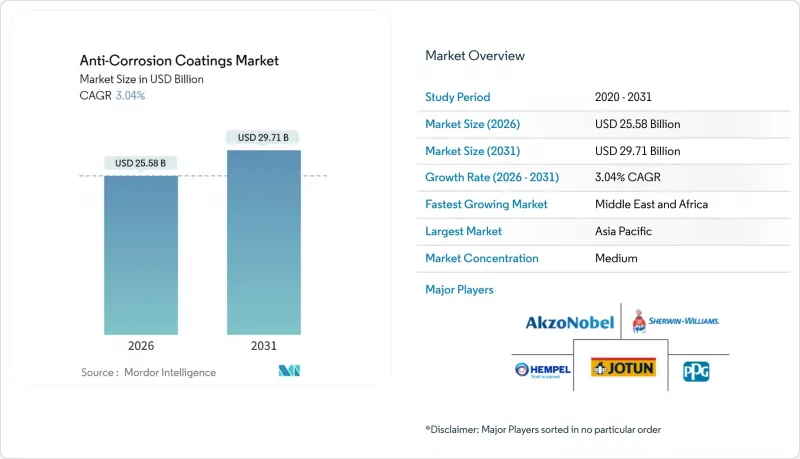
公共部門基礎設施投資的增加、離岸風力發電電場規範的日益嚴格以及浮式生產儲油卸油設備油船(FPSO)維修週期的延長,正推動防腐蝕塗料市場從以銷量主導主導的模式向以性能主導的模式轉變。雖然水性塗料在嚴格監管的領域越來越受歡迎,但在失效風險大於環境影響的領域,溶劑型塗料仍然佔據主導地位。樹脂技術的創新也不斷進步,生物基環氧樹脂和混合聚氨酯系統在兼顧永續性和耐久性競標越來越受到關注。液化天然氣(LNG接收站對隔熱材料下防腐蝕解決方案日益成長的需求,凸顯了市場正從通用維護塗料到特定應用工程塗料的轉變。
全球防腐蝕塗料市場趨勢及洞察
美國、歐盟和日本的基礎建設更新超級週期
大規模政府專案正在推動對高性能塗料的需求,這些塗料的使用壽命遠遠超過傳統的維護週期。美國《基礎建設投資與就業法案》撥款5,500億美元用於維修使用壽命長的橋樑、鐵路和港口設施。歐洲綠色交易的資金優先考慮低揮發性有機化合物(VOC)和耐用產品,引導設計負責人採用生物基環氧樹脂和混合聚氨酯系統。日本國家韌性計畫要求隧道和海岸防禦設施採用柔軟性且抗震的塗層,推動了對更堅韌的聚氨酯彈性體化學的研究。這些協同效應正在推動塗料從基礎醇酸樹脂塗料穩步過渡到可提供25-30年保護週期的工程系統。能夠提供全生命週期保固和快速反應的現場技術支援的供應商正在獲得更高的利潤,因為業主將塗料視為策略性的風險緩解工具,而不是消耗品。
離岸風力發電電場塗料需求激增
到2030年,全球離岸風力發電裝置容量預計將超過380吉瓦,將對單樁基礎、過渡段和機艙保護等零件提出特殊要求。渦輪機部件需要能夠承受循環鹽霧、漂浮物衝擊和陰極剝離的塗層。奈米陶瓷增強環氧底漆與脂肪族聚氨酯面漆的組合正逐漸成為標準,因為它們能夠在25年的使用壽命內保持光澤和阻隔性能。在聯邦政府30吉瓦藍圖的推動下,美國東海岸的計劃擴大採用水性或高固態塗料,這些塗料既符合嚴格的VOC法規,又不會影響性能。製造渦輪機導管架的亞洲造船廠正在加快類似系統的認證,以確保符合歐洲開發商的競標要求,這加劇了全球特殊防腐蝕原料供應鏈的壓力。
全球更嚴格的揮發性有機化合物(VOC)法規和異氰酸酯暴露限值
美國和歐盟部分地區對揮發性有機化合物(VOC)含量限制(50克/公升)的調整,給溶劑型聚氨酯塗料的銷售帶來了壓力。製造商被迫轉向水性塗料和高固態塗料,而這些塗料對固化時間和現場濕度控制的要求越來越高。額外的培訓、設備改造和第三方認證成本正在擠壓利潤空間,同時,與傳統溶劑型技術相比,性能差距仍然是船舶和重工業用戶關注的問題。同時,關於二異氰酸酯標籤的新REACH法規增加了跨境運輸雙組分聚氨酯的物流障礙,並延長了關鍵維護期間的前置作業時間。
細分市場分析
到2025年,環氧塗料將佔據防腐蝕塗料市場38.92%的佔有率,這主要得益於其卓越的附著力和耐化學性(尤其是在船舶安定器艙和橋樑樑體中)。近期開發的生物基環氧塗料正在蠶食傳統雙酚A基塗料的市場佔有率,因為它們符合綠色採購標準,且不影響鹽霧試驗時間(耐腐蝕性)。儘管原料成本有所波動,但該細分市場仍保持強勁勢頭,配方師正透過最佳化稀釋劑來穩定交付價格。
聚氨酯的銷售成長最為迅猛,年複合成長率高達3.79%,這主要得益於開發商選擇其軟性薄膜用於離岸風力發電塔架,以吸收振動並增強抗機械分層性能。在地震頻繁的亞洲地區,聚氨酯在交通隧道中的應用日益廣泛,進一步縮小了其與環氧樹脂之間的差距。儘管醇酸樹脂、聚酯樹脂和乙烯基酯樹脂在成本至關重要或需要極高耐化學性的細分市場中仍佔有一席之地,但環氧底漆與聚氨酯面漆相結合的混合技術正在成為長壽命鋼結構的主要塗料選擇。
防腐蝕塗料報告按樹脂類型(環氧樹脂、醇酸樹脂、聚酯樹脂、聚氨酯樹脂等)、技術(水性、溶劑型、粉末塗料、紫外光固化塗料等)、終端用戶產業(石油天然氣、船舶、電力、基礎設施、工業、航太與國防等)以及地區(亞太地區、北美地區、歐洲地區等)進行細分。市場預測以美元計價。
區域分析
受中國「一帶一路」港口擴建、印度離岸風力發電訂單以及日本抗震基礎設施建設規劃的推動,亞太地區預計到2025年將佔全球收入的46.60%。國內製造商受益於一體化的樹脂生產基地,縮短了前置作業時間並降低了外匯風險;同時,日益嚴格的當地環保法規也推動了沿海省份水性塗料的普及。東南亞造船廠正在採用符合國際海事組織(IMO)PSPC核准的塗料系統,以訂單,這進一步提振了對全球高階品牌的需求。
北美市場繼續佔據較大佔有率,這主要得益於《基礎設施投資和就業創造法案》下橋樑和隧道維修計劃的持續推進,以及美國墨西哥灣沿岸石化工廠不斷上漲的維護成本。為了加快恢復速度,最大限度地減少繁忙州際公路的車道封閉,塗料製造商正轉向使用高固態環氧塗料。
在歐洲,綠色交易補貼正在催生一個成熟的市場,資金與低揮發性有機化合物(VOC)、生物基和再生材料製成的塗料掛鉤。為了滿足更嚴格的健康法規,北海的船舶修理廠正在採用先進的矽酸鋅基底漆,這種底漆與快乾、無溶劑面漆相容。
預計到2031年,中東和非洲地區的複合年成長率將達到3.36%,主要得益於沙烏地阿拉伯NEOM新城和奈及利亞海事中心等大型企劃的推動。高紫外線照射、砂粒磨損和高鹽度環境要求使用高品質的含氟聚合物面漆,並結合玻璃鱗片環氧樹脂。技術優勢而非價格優勢是贏得合約的關鍵因素。阿曼和卡達煉油廠產能的擴張正在推動對耐腐蝕底塗層(CUI)內襯的需求穩定成長,這些內襯將應用於數公里長的保溫管道。
其他福利:
- Excel格式的市場預測(ME)表
- 3個月的分析師支持
目錄
第1章 引言
- 研究假設和市場定義
- 調查範圍
第2章調查方法
第3章執行摘要
第4章 市場情勢
- 市場概覽
- 市場促進因素
- 美國、歐盟和日本的基礎建設更新超級週期
- 離岸風力發電塗料需求快速成長
- 拉丁美洲和西非的FPSO維修日益增多
- LNG接收站的隔熱材料層下腐蝕(CUI)失效
- 生物基樹脂創新確保「綠色採購」競標
- 市場限制
- 全球範圍內VOC法規和異氰酸酯暴露限值日益收緊
- 奈米陶瓷分散生產線需要高資本投入
- 環氧樹脂原料價格波動(BisA、ECH)
- 價值鏈分析
- 波特五力模型
- 供應商的議價能力
- 買方的議價能力
- 新進入者的威脅
- 替代品的威脅
- 競爭程度
第5章 市場規模與成長預測
- 依樹脂類型
- 環氧樹脂
- 醇酸樹脂
- 聚酯纖維
- 聚氨酯
- 乙烯基酯樹脂
- 其他樹脂類型
- 透過技術
- 水性塗料
- 溶劑型
- 粉末
- 紫外線固化
- 按最終用戶行業分類
- 石油和天然氣
- 海上
- 電力
- 基礎設施
- 產業
- 航太與國防
- 運輸
- 其他終端用戶產業
- 按地區
- 亞太地區
- 中國
- 印度
- 日本
- 韓國
- 東南亞國協
- 亞太其他地區
- 北美洲
- 美國
- 加拿大
- 墨西哥
- 歐洲
- 德國
- 英國
- 法國
- 西班牙
- 義大利
- 北歐國家
- 其他歐洲地區
- 南美洲
- 巴西
- 阿根廷
- 其他南美洲
- 中東和非洲
- 沙烏地阿拉伯
- 阿拉伯聯合大公國
- 南非
- 奈及利亞
- 其他中東和非洲地區
- 亞太地區
第6章 競爭情勢
- 市場集中度
- 策略趨勢
- 市佔率/排名分析
- 公司簡介
- Akzo Nobel NV
- Axalta Coating Systems, LLC
- BASF
- Beckers Group
- Berger Paints India
- Carboline
- Chugoku Marine Paints, Ltd.
- HB Fuller Company
- Hempel A/S
- Jotun
- Kansai Paint Co., Ltd.
- Nippon Paint Holdings Co., Ltd.
- PPG Industries, Inc.
- RPM International Inc.
- Sika AG
- Teknos Group
- The Sherwin-Williams Company
- Tikkurila
第7章 市場機會與未來展望
The Anti-Corrosion Coatings Market is expected to grow from USD 24.82 billion in 2025 to USD 25.58 billion in 2026 and is forecast to reach USD 29.71 billion by 2031 at 3.04% CAGR over 2026-2031.
Strong public-sector infrastructure spending, more demanding offshore wind specifications, and the expanding refurbishment cycle for floating production storage offloading (FPSO) vessels are shifting the anti-corrosion coatings market from a volume-led arena to a performance-driven ecosystem. Water-borne chemistries are advancing in regulatory-sensitive regions, yet solvent-borne systems still dominate where failure risk outweighs environmental trade-offs. Resin innovation is also accelerating, with bio-based epoxies and hybrid polyurethane systems gaining traction in bids that score sustainability alongside lifetime durability. Greater demand for corrosion-under-insulation solutions at LNG terminals highlights the market's transition from generalized maintenance paints toward application-specific engineered coatings.
Global Anti-Corrosion Coatings Market Trends and Insights
Infrastructure Renewal Super-cycle in U.S., EU and Japan
Massive government programs are steering demand toward high-performance coatings that extend service life well beyond conventional maintenance cycles. The Infrastructure Investment and Jobs Act in the United States earmarked USD 550 billion for upgrades that prioritize long-life bridge, rail, and port assets. European Green Deal allocations link funding to low-VOC, high-durability products, nudging specifiers toward bio-based epoxy and hybrid polyurethane systems. Japan's national resilience plan requires flexible, seismic-resistant finishes for tunnels and coastal defenses, propelling research into tougher polyurethane elastomer chemistries. The combined effect is a steady replacement of basic alkyd films with engineered systems offering 25-30-year protection intervals. Suppliers capable of lifecycle assurance and rapid on-site technical support are capturing premium margins as owners view coatings as strategic risk mitigators rather than consumables.
Offshore Wind Farm Coating Demand Surge
Global offshore wind capacity is targeted to exceed 380 GW by 2030, driving specialized needs for monopile, transition-piece, and nacelle protection. Turbine components demand coatings that withstand cyclical salt spray, impact from floating debris, and cathodic disbondment. Nano-ceramic-reinforced epoxy primers topped with aliphatic polyurethane finishes are emerging as a standard stack because they retain gloss and barrier integrity for 25-year service windows. U.S. East Coast projects, galvanized by a federal roadmap for 30 GW of installations, are specifying water-borne or high-solids variants to honor strict VOC caps without compromising performance. Asian yards fabricating turbine jackets are fast-tracking qualification of similar systems to stay compliant with European developer tenders, tightening global raw-material supply chains for specialty anticorrosive pigments.
Tightening Global VOC Caps and Isocyanate Exposure Limits
Revised limits of 50 g/L VOC in several U.S. and EU districts are squeezing solvent-borne polyurethane sales. Manufacturers must invest in water-borne or high-solids upgrades, often accepting slower cure times and stricter humidity controls on job sites. The added training, equipment adaptation, and third-party certification expenses erode margins while the performance gap relative to legacy solvent technologies still worries marine and heavy-industrial users. In parallel, new REACH rules on di-isocyanate labeling raise logistical hurdles for shipping two-pack polyurethanes across borders, extending lead times in critical maintenance windows.
Other drivers and restraints analyzed in the detailed report include:
- Growing FPSO Refurbishments in Latin America and West Africa
- Corrosion-under-insulation Failures in LNG Terminals
- High Capex for Nano-ceramic Dispersion Lines
For complete list of drivers and restraints, kindly check the Table Of Contents.
Segment Analysis
Epoxy systems accounted for 38.92% of the anti-corrosion coatings market size in 2025, thanks to unmatched adhesion and chemical resistance, especially in marine ballast tanks and bridge girders. Recent bio-based epoxy variants satisfy green-procurement scoring without sacrificing salt-spray hours, pulling share from conventional bis-A formulations. The segment remains resilient despite raw-material cost swings, as formulators lean on diluent optimization to keep delivered prices stable.
Polyurethane volumes are expanding fastest, supported by a 3.79% CAGR as developers choose flexible films that absorb vibration and resist mechanical chipping on offshore wind towers. Growing polyurethane acceptance in seismic-prone Asian transport tunnels further narrows the gap to epoxy. Alkyd, polyester, and vinyl ester niches maintain relevance where cost sensitivity or extreme chemical resistance dictates, but hybrid technology blending epoxy primers with polyurethane topcoats now dominates specification sheets for long-life steel infrastructure.
The Anti-Corrosion Coatings Report is Segmented by Resin Type (Epoxy, Alkyds, Polyester, Polyurethane, and More), Technology (Water-Borne, Solvent-Borne, Powder, and UV-Cured), End-User Industry (Oil and Gas, Marine, Power, Infrastructure, Industrial, Aerospace and Defense, and More), and Geography (Asia-Pacific, North America, Europe, and More). The Market Forecasts are Provided in Terms of Value (USD).
Geography Analysis
Asia-Pacific held 46.60% of 2025 revenue, driven by China's Belt and Road port expansions, India's offshore wind farm orders, and Japan's seismic infrastructure initiatives. Domestic manufacturers benefit from integrated resin production hubs that compress lead times and reduce currency risk, yet rising local environmental rules are pushing waterborne adoption in coastal provinces. Southeast Asian shipyards, eager to win EU-flag vessel contracts, are aligning with IMO PSPC-approved coating systems, adding further pull for global premium brands.
North America's share remains sizeable owing to the Infrastructure Investment and Jobs Act pipeline of bridge and tunnel rehabilitation, combined with elevated maintenance spending on U.S. Gulf Coast petrochemical plants. Specifiers are pivoting toward high-solids epoxies with rapid return-to-service properties to minimize lane-closure durations on busy interstates.
Europe hosts a sophisticated market where Green Deal subsidies tie funding to low-VOC, bio-based, or recycled-content coatings. Ship repair yards in the North Sea embrace advanced zinc-silicate primers compatible with fast-flush solvent-free topcoats to rebalance stricter health regulations.
The Middle East and Africa is projected to rise at a3.36% CAGR through 2031 due to mega-projects such as Saudi Arabia's NEOM and Nigeria's offshore hubs. High UV levels, sand abrasion, and salinity demand premium fluoropolymer topcoats paired with glass-flake epoxies, positioning technical superiority over price as the chief contract award criterion. Rising refinery capacity in Oman and Qatar fuels steady demand for CUI-resistant linings across kilometers of insulated piping.
- Akzo Nobel N.V.
- Axalta Coating Systems, LLC
- BASF
- Beckers Group
- Berger Paints India
- Carboline
- Chugoku Marine Paints, Ltd.
- H.B. Fuller Company
- Hempel A/S
- Jotun
- Kansai Paint Co., Ltd.
- Nippon Paint Holdings Co., Ltd.
- PPG Industries, Inc.
- RPM International Inc.
- Sika AG
- Teknos Group
- The Sherwin-Williams Company
- Tikkurila
Additional Benefits:
- The market estimate (ME) sheet in Excel format
- 3 months of analyst support
TABLE OF CONTENTS
1 Introduction
- 1.1 Study Assumptions and Market Definition
- 1.2 Scope of the Study
2 Research Methodology
3 Executive Summary
4 Market Landscape
- 4.1 Market Overview
- 4.2 Market Drivers
- 4.2.1 Infrastructure renewal super-cycle in U.S., EU and Japan
- 4.2.2 Offshore wind farm coating demand surge
- 4.2.3 Growing FPSO refurbishments in Latin America and West Africa
- 4.2.4 Corrosion-under-insulation (CUI) failures in LNG terminals
- 4.2.5 Bio-based resin innovations securing "green procurement" bids
- 4.3 Market Restraints
- 4.3.1 Tightening global VOC caps and isocyanate exposure limits
- 4.3.2 High capex for nano-ceramic dispersion lines
- 4.3.3 Volatility in epoxy raw material prices (bis-A, ECH)
- 4.4 Value Chain Analysis
- 4.5 Porter's Five Forces
- 4.5.1 Bargaining Power of Suppliers
- 4.5.2 Bargaining Power of Buyers
- 4.5.3 Threat of New Entrants
- 4.5.4 Threat of Substitutes
- 4.5.5 Degree of Competition
5 Market Size and Growth Forecasts (Value)
- 5.1 By Resin Type
- 5.1.1 Epoxy
- 5.1.2 Alkyds
- 5.1.3 Polyester
- 5.1.4 Polyurethane
- 5.1.5 Vinyl Ester
- 5.1.6 Other Resin Types
- 5.2 By Technology
- 5.2.1 Water-borne
- 5.2.2 Solvent-borne
- 5.2.3 Powder
- 5.2.4 UV-cured
- 5.3 By End-user Industry
- 5.3.1 Oil and Gas
- 5.3.2 Marine
- 5.3.3 Power
- 5.3.4 Infrastructure
- 5.3.5 Industrial
- 5.3.6 Aerospace and Defense
- 5.3.7 Transportation
- 5.3.8 Other End-user Industries
- 5.4 By Geography
- 5.4.1 Asia-Pacific
- 5.4.1.1 China
- 5.4.1.2 India
- 5.4.1.3 Japan
- 5.4.1.4 South Korea
- 5.4.1.5 ASEAN Countries
- 5.4.1.6 Rest of Asia-Pacific
- 5.4.2 North America
- 5.4.2.1 United States
- 5.4.2.2 Canada
- 5.4.2.3 Mexico
- 5.4.3 Europe
- 5.4.3.1 Germany
- 5.4.3.2 United Kingdom
- 5.4.3.3 France
- 5.4.3.4 Spain
- 5.4.3.5 Italy
- 5.4.3.6 NORDIC Countries
- 5.4.3.7 Rest of Europe
- 5.4.4 South America
- 5.4.4.1 Brazil
- 5.4.4.2 Argentina
- 5.4.4.3 Rest of South America
- 5.4.5 Middle-East and Africa
- 5.4.5.1 Saudi Arabia
- 5.4.5.2 United Arab Emirates
- 5.4.5.3 South Africa
- 5.4.5.4 Nigeria
- 5.4.5.5 Rest of Middle-East and Africa
- 5.4.1 Asia-Pacific
6 Competitive Landscape
- 6.1 Market Concentration
- 6.2 Strategic Moves
- 6.3 Market Share/Ranking Analysis
- 6.4 Company Profiles (includes Global level Overview, Market level overview, Core Segments, Financials as available, Strategic Information, Market Rank/Share for key companies, Products and Services, and Recent Developments)
- 6.4.1 Akzo Nobel N.V.
- 6.4.2 Axalta Coating Systems, LLC
- 6.4.3 BASF
- 6.4.4 Beckers Group
- 6.4.5 Berger Paints India
- 6.4.6 Carboline
- 6.4.7 Chugoku Marine Paints, Ltd.
- 6.4.8 H.B. Fuller Company
- 6.4.9 Hempel A/S
- 6.4.10 Jotun
- 6.4.11 Kansai Paint Co., Ltd.
- 6.4.12 Nippon Paint Holdings Co., Ltd.
- 6.4.13 PPG Industries, Inc.
- 6.4.14 RPM International Inc.
- 6.4.15 Sika AG
- 6.4.16 Teknos Group
- 6.4.17 The Sherwin-Williams Company
- 6.4.18 Tikkurila
7 Market Opportunities and Future Outlook
- 7.1 White-space and Unmet-need Assessment

 奈米工程塗層市場預測至2034年-全球分析(按塗層類型、奈米材料類型、技術、基材類型、應用、最終用戶和地區分類)
 防腐蝕塗料市場規模、佔有率和成長分析:按塗料類型、技術、應用、終端用戶產業、基材類型、功能和地區分類-2026-2033年產業預測
 全球防腐蝕塗料市場規模、佔有率、趨勢和成長分析報告(2026-2034)
 防腐蝕包裝市場:商機、成長要素、產業趨勢分析及2026-2035年預測
 防腐蝕塗料市場:2026-2032年全球市場預測(依塗料類型、類別、技術、基材、應用和最終用途產業分類)全球高性能防腐蝕塗料市場規模、佔有率、趨勢和成長分析報告(2026-2034)防防腐蝕塗料市場:依塗料類型、基材、技術、最終用途產業和應用分類-2026-2032年全球市場預測
 腐蝕防護奈米工程半導體塗層市場分析及預測(至2035年):依類型、產品、服務、技術、應用、材質、製程、最終用戶及功能分類
 全球防鏽包裝市場,市場規模、佔有率、成長和行業分析:按產品類型、最終用途和地區的預測(至2034年)全球防腐蝕塗料市場規模、佔有率、趨勢和成長分析報告(2026-2034)