


 |
市場調查報告書
商品編碼
1939103
汽車塗料:市場佔有率分析、產業趨勢與統計、成長預測(2026-2031)Automotive Coatings - Market Share Analysis, Industry Trends & Statistics, Growth Forecasts (2026 - 2031) |
||||||

※ 本網頁內容可能與最新版本有所差異。詳細情況請與我們聯繫。
2025年汽車塗料市場價值為296億美元,預計到2031年將達到388.2億美元,高於2026年的309.7億美元。
預計在預測期(2026-2031 年)內,複合年成長率將達到 4.62%。
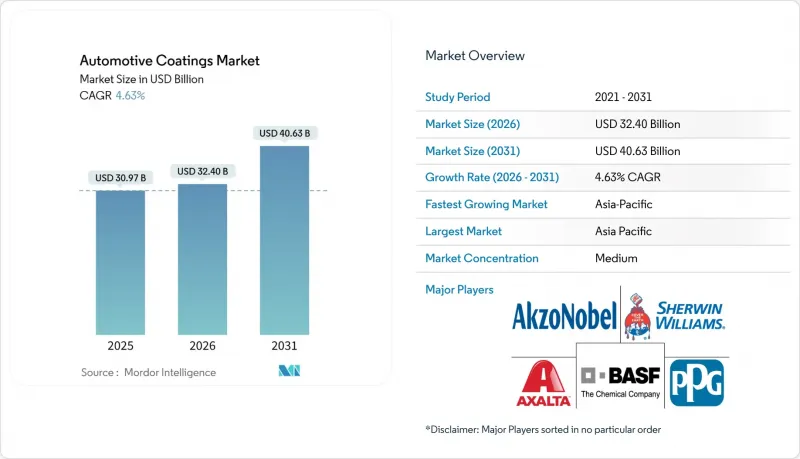
全球汽車生產的復甦、向低VOC配方的轉變以及電動車(EV)產量的激增,都支撐著不斷成長的需求。然而,原物料價格的波動和日益嚴格的溶劑法規正給利潤率帶來壓力。供應商正在加速採用水性塗料和粉末塗料系統,以在滿足即將訂定的排放法規的同時,保持與原廠配套(OEM)產品相同的耐久性。 OEM塗裝車間的數位化,包括在線連續固化、機器人檢測和基於雲端的配色,在提高生產效率的同時,也提高了技術准入門檻。同時,市場分散仍在持續,中型區域供應商與有能力投資大規模永續性和自動化項目的跨國公司展開激烈的市場佔有率爭奪。
全球汽車塗料市場趨勢與洞察
全球汽車產量復甦並擴張
預計到2024年,北美輕型車產量將達到1,550萬輛,延續成長勢頭,並支撐工廠對車身外部和底盤塗料的需求。輕型卡車目前佔每月銷量的84%,推動了高階耐刮透明塗層的消費。在中國,產能的提升和出口的強勁勢頭支撐著穩定的塗料需求,但區域產能過剩的擔憂也開始顯現。疫情造成的衝擊過後,全球汽車製造商已恢復了可預測的採購計劃,使供應商能夠最佳化批量生產和物流。隨著汽車製造商在追求品牌專屬美學的同時滿足耐久標準,對先進塗裝自動化和差異化塗裝技術的投資也日益凸顯。
為符合VOC法規,過渡到水性和粉末塗料系統。
加州嚴格的VOC排放上限將於2025年生效,歐盟綠色交易的推進正在加速溶劑型塗料的重新配方。水性底塗層在大型汽車修理廠的滲透率已達64%,證明了商業性可行性。BASF的Glaslit 100系列產品就是一個典型的例子,這是一款高效低VOC產品,已被1000多家碰撞維修中心採用。粉末塗料在輪轂、引擎室和電動車電池外殼等領域的市場佔有率不斷成長,這主要得益於雷射固化爐的廣泛應用,雷射固化爐可降低50%的能耗。擁有豐富樹脂和顏料產品組合的供應商正透過在更嚴格的法規訂定前迅速引導客戶轉向粉末塗料,從而獲得先發優勢。
嚴格限制溶劑和異氰酸酯的暴露
美國職業安全與健康管理局 (OSHA) 的重點監督計畫加強了對噴漆房的檢查,強制要求提高通風量並個人防護設備,以降低異氰酸酯相關氣喘和皮膚炎的風險。小規模的汽車修補企業面臨著因遵守法規而產生的巨額資金成本,或者被迫轉型使用低異氰酸酯化學品,這可能會犧牲性能。底漆和透明塗層配方生產商正在將不含聚脲的替代品推向市場,但由於耐久性標準仍在不斷檢驗,這些替代品的推廣應用仍然持謹慎態度。
細分市場分析
到2025年,丙烯酸塗料將佔汽車塗料市場需求的48.10%,憑藉其成本效益和均衡的耐候性,鞏固其市場地位。聚氨酯塗料到2031年將以5.00%的複合年成長率成長,滿足對優質透明塗層和軟性基材的需求,尤其適用於對耐刮擦性能要求極高的豪華運動型多用途車(SUV)和電動車(EV)。隨著新型脂肪族二異氰酸酯化學品符合嚴格的黃變測試標準,預計北美OEM生產線中的聚氨酯汽車塗料市場規模將顯著擴大。環氧樹脂將繼續在陰極電塗裝這一細分市場佔據主導地位,因為防腐蝕至關重要;同時,生物基混合技術正在歐洲OEM主導的概念項目中嶄露頭角。
聚氨酯的需求成長主要受產品使用壽命延長的推動,這促使人們對其耐用性提出更高要求。然而,美國職業安全與健康管理局 (OSHA) 對異氰酸酯處理的監管日益嚴格,促使企業投資建造封閉式混合單元和機器人噴塗室。科思創等供應商目前提供含 33% 回收碳的聚氨酯,顯示符合原始設備製造商 (OEM) 的永續性目標。丙烯酸化學品製造商則積極研發新一代交聯劑,以提高耐腐蝕性,同時不增加揮發性有機化合物 (VOC) 的含量。競爭優勢越來越依賴兼具機械韌性和低溫固化性能的專利組合,從而滿足能源使用法規和輕質基材的要求。
溶劑型塗料憑藉其優異的流動性和顯色性,在金屬漆和珠光漆的塗裝中仍將佔據70.20%的市場佔有率。然而,隨著全球VOC排放上限的日益嚴格,汽車塗料市場正明顯轉向其他技術。水性塗料目前在歐盟OEM底塗層線中佔據主導地位,日本OEM廠商如馬自達已實現了15克/平方米的行業最低VOC排放。粉末塗料雖然目前仍佔少數,但隨著節能型雷射固化隧道在電動車零件生產線上的普及,預計其複合成長率將最高。
在監管區域,水性修補漆已佔據汽車塗料市場60%以上的佔有率,因為汽車修理廠需要遵守環保許可規定。樹脂乳化和閃蒸控制的技術突破消除了水性漆與溶劑型底漆的性能差距。一級供應商正利用模組化樹脂結構實現快速配方調整,以應對新法規對揮發性有機化合物(VOC)和有害空氣污染物(HAPS)排放限量的日益嚴格,從而保護客戶免受法規週期中期合規方面的意外情況。
區域分析
到2025年,亞太地區將佔全球收入的58.40%,這主要得益於中國崛起為淨出口國以及在主導地位。印尼百萬噸級塗料廠和越南快速發展的供應商園區等產能擴張項目,支撐著該地區6.05%的複合年成長率預測。本地整車製造商正與跨國配方商合作,在保持與溶劑型塗料外觀一致性的同時,實現水性樹脂的在地化生產。政府對新能源汽車的支持措施也進一步推動了對電池專用功能塗料的需求。
預計2024年北美輕型汽車產量將成長9.6%,產能緊張的工廠通常會運作運轉,從而為塗料定價創造有利條件。美國農業部(USDA)的BioPreferred法規以及美國環保署(EPA)計劃收緊對全氟烷基物質(PFAS)的限制,正在推動無氟面漆的快速認證,並迫使供應商加快研發步伐。隨著加拿大和墨西哥的企業遵守美國法規,低VOC系統的汽車塗料市場佔有率預計將會擴大。
歐洲對碳中和的重視促使原始設備製造商(OEM)安裝100%再生能源的噴漆車間和溶劑回收焚化爐。二氧化鈦反傾銷稅推高了成本結構,但乾式洗滌噴漆室和封閉回路型污泥回收技術的廣泛應用在一定程度上抵消了成本增加。包括波蘭和匈牙利在內的東歐叢集的崛起,提供了低工資的組裝,但也要求供應商為一級噴漆模組建立準時制生產中心。
在南美洲,由於南方共同市場關稅的降低,汽車製造商正加快向巴西和阿根廷轉移新型SUV平台,從而增加了整車廠的塗料消耗量。然而,匯率波動迫使塗料製造商採用與美元掛鉤的合約。儘管中東和非洲地區仍處於發展中,但預計未來前景光明,沙烏地阿拉伯的「2030願景」旨在促進國內汽車生產,並擴大塗料生產設施以供應出口市場。
其他福利:
- Excel格式的市場預測(ME)表
- 3個月的分析師支持
目錄
第1章 引言
- 研究假設和市場定義
- 調查範圍
第2章調查方法
第3章執行摘要
第4章 市場情勢
- 市場概覽
- 市場促進因素
- 全球汽車產量復甦並擴張
- 為符合VOC法規,正在過渡到水性和粉末系統。
- 對電動車專用塗層(用於電池溫度控管)的需求不斷成長
- 成熟市場的碰撞維修量復甦
- 原始設備製造商採用數位配色和在線連續固化技術
- 市場限制
- 嚴格限制溶劑和異氰酸酯的暴露
- 石化原料價格波動
- 電動滑板平台減少了噴漆面積
- 價值鏈分析
- 波特五力模型
- 供應商的議價能力
- 買方的議價能力
- 新進入者的威脅
- 替代產品和服務的威脅
- 競爭程度
第5章 市場規模與成長預測
- 依樹脂類型
- 聚氨酯
- 環氧樹脂
- 丙烯酸纖維
- 其他
- 透過技術
- 溶劑型
- 水溶液
- 粉末
- 透過塗層
- 電著底漆
- 底漆
- 底塗層
- 透明塗層
- 透過使用
- OEM
- 翻新
- 按地區
- 亞太地區
- 中國
- 印度
- 日本
- 韓國
- 澳洲和紐西蘭
- 印尼
- 馬來西亞
- 泰國
- 其他東南亞國協
- 亞太其他地區
- 北美洲
- 美國
- 加拿大
- 墨西哥
- 歐洲
- 德國
- 法國
- 英國
- 義大利
- 西班牙
- 俄羅斯
- 其他歐洲地區
- 南美洲
- 巴西
- 阿根廷
- 其他南美洲
- 中東和非洲
- 沙烏地阿拉伯
- 南非
- 埃及
- 其他中東和非洲地區
- 亞太地區
第6章 競爭情勢
- 市場集中度
- 策略趨勢
- 市佔率分析
- 公司簡介
- Akzo Nobel NV
- Asian Paints PPG Pvt., Ltd.
- Axalta Coating Systems, LLC
- BASF
- Beckers Group
- Cabot Corporation
- Eastman Chemical Company
- Hempel A/S
- HMG Paints Limited
- Jotun
- Kansai Nerolac Paints Limited
- KCC Corporation
- Nippon Paint Holdings Co., Ltd.
- Parker Hannifin Corp
- PPG Industries Inc.
- RPM International Inc.
- Shanghai Kinlita Chemical Co., Ltd.
- The Sherwin-Williams Company
第7章 市場機會與未來展望
The Automotive Coatings Market was valued at USD 29.60 billion in 2025 and estimated to grow from USD 30.97 billion in 2026 to reach USD 38.82 billion by 2031, at a CAGR of 4.62% during the forecast period (2026-2031).
The rebound in global vehicle production, the pivot toward low-Volatile Organic Compound (VOC) formulations, and surging electric-vehicle (EV) output underpin demand expansion, even as raw-material price swings and tightening solvent regulations constrain margins. Suppliers are accelerating launches of water-borne and powder systems that comply with imminent emissions caps while still delivering Original Equipment Manufacturer (OEM)-level durability. OEM paint-shop digitalization spanning inline curing, robotic inspection, and cloud-based color matching is raising throughput and widening technical barriers to entry. Meanwhile, fragmentation persists as regional midsized suppliers vie for share against multinationals that can fund large-scale sustainability and automation programs.
Global Automotive Coatings Market Trends and Insights
Growing Global Vehicle Production Rebound
North American light-vehicle output reached 15.5 Million units in 2024 and continues rising, sustaining factory demand for exterior and under-body coatings. Light trucks now represent 84% of monthly sales, propelling the consumption of premium, scratch-resistant clear coats. In China, capacity additions and export momentum reinforce steady coating volumes, even as localized overcapacity looms. Automakers worldwide reinstate predictable sourcing schedules after pandemic disruptions, enabling suppliers to optimize batch production and logistics. Parallel investments in advanced paint-shop automation and differentiated finishes surfaced as OEMs seek brand-distinctive aesthetics while meeting durability standards .
Shift Toward Water-borne & Powder Systems to Meet VOC Caps
The 2025 enforcement of stricter VOC ceilings in California and forthcoming EU Green Deal measures are accelerating reformulation of solvent-borne systems. Leading body shops already report 64% penetration of water-borne basecoats, validating commercial viability. BASF's Glasurit 100 Line exemplifies high-efficiency, low-VOC products now used by more than 1,000 collision centers. Powder coatings are gaining share in wheels, under-hood parts, and EV battery casings, helped by laser-curing ovens that cut energy use by 50%. Suppliers with broad resin and pigment portfolios are fastest to convert customers, establishing early-mover advantages before regulations tighten further.
Stringent Solvent & Isocyanate Exposure Limits
Occupational Safety and Health Administration (OSHA)'s National Emphasis Program intensifies inspections of paint booths, mandating enhanced ventilation and personal protective equipment to mitigate asthma and dermatitis risks from isocyanates . Small refinishing operations face steep capital costs for compliant spray booths or must migrate to low-isocyanate chemistries that may sacrifice performance. Primer and clear-coat formulators commercialize polyurea-free variants, although adoption remains cautious while durability benchmarks are validated.
Other drivers and restraints analyzed in the detailed report include:
- Rising EV-specific Coating Demand for Battery Thermal Management
- Recovery of Collision-repair Volumes in Mature Markets
- Volatile Petrochemical-based Raw-material Pricing
For complete list of drivers and restraints, kindly check the Table Of Contents.
Segment Analysis
In 2025, acrylics supplied 48.10% of the Automotive Coatings market demand, cementing their status owing to cost-efficiency and balanced weatherability. Polyurethane formulations, advancing at a 5.00% CAGR to 2031, fulfill premium clear-coat and flexible-substrate needs, especially on luxury Sports Utility Vehicles (SUVs) and EVs requiring superior scratch resistance. The automotive coatings market size for polyurethane systems is expected to widen notably in North American OEM lines as new aliphatic diisocyanate chemistries meet stricter yellowing tests. Epoxy resins continue niche dominance in cathodic e-coats where corrosion protection is critical, while bio-based hybrids are emerging in concept programs led by European OEMs.
The polyurethane push is amplified by longer ownership cycles driving demand for durability, though OSHA scrutiny around isocyanate handling is prompting investment in closed-mixing cells and robot-spray enclosures. Suppliers such as Covestro now offer 33% renewable-carbon polyurethanes, illustrating alignment with OEM sustainability targets. Acrylic chemists are responding with next-generation crosslinkers that improve mar resistance without raising VOC levels. Competitive advantage increasingly hinges on patent portfolios that combine mechanical robustness with low-temperature cure profiles, addressing both energy-use mandates and lightweight-substrate requirements.
Solvent-borne finishes still held 70.20% revenue in 2025, propelled by superior flow and color depth demanded on metallic and pearlescent shades. Yet the automotive coatings market is unmistakably tilting toward alternatives as global VOC ceilings narrow. Water-borne systems now dominate EU OEM base-coat lines, with Japanese OEMs such as Mazda achieving industry-low emissions of 15 g VOC/m2. Powder coatings, while presently a minority, post the highest compound growth as energy-efficient laser-cure tunnels become standard on EV component lines.
The automotive coatings market share for water-borne refinish lines has surpassed 60% in regulated regions as body shops align with environmental permits. Technological breakthroughs in resin emulsification and flash-off control have closed the performance gap with solvent-borne primers. Tier-one suppliers leverage modular resin architectures, enabling fast reformulation when each new rule tightens permissible VOCs or HAPS (hazardous air pollutants), insulating customers from mid-cycle compliance surprises.
The Automotive Coatings Market Report is Segmented by Resin Type (Polyurethane, Epoxy, Acrylic, and Others), Technology (Solvent-Borne, Water-Borne, and Powder), Coating Layer (E-Coat, Primer, Base Coat, and Clear Coat), Application (OEM and Refinish), and Geography (Asia-Pacific, North America, Europe, South America, and Middle East and Africa). The Market Forecasts are Provided in Terms of Value (USD).
Geography Analysis
Asia-Pacific accounted for 58.40% of global 2025 revenue, buoyed by China's ascent as a net exporter and leadership in EV output. Capacity additions such as Indonesia's million-ton paint plant and Vietnam's fast-growing supplier parks underpin a 6.05% regional CAGR forecast. Local OEMs collaborate with multinational formulators to localize water-borne resins while preserving appearance parity with solvent benchmarks. Government stimulus on new-energy vehicles further amplifies demand for battery-specific functional coatings.
North America, with light-vehicle builds rising 9.6% in 2024, exhibits that constrained capacity plants regularly exceed rated throughput, creating favorable pricing for coatings. Stringent United States Department of Agriculture (USDA) BioPreferred and upcoming Environmental Protection Agency (EPA) per- and polyfluoroalkyl substances (PFAS) rules spur rapid qualification of fluorine-free top coats, compelling suppliers to accelerate R&D. The automotive coatings market share of low-VOC systems is poised to expand as Canadian and Mexican operations align with United States regulations.
Europe's focus on carbon neutrality pushes OEMs toward 100% renewable-electric paint shops and solvent-capture incinerators. Anti-dumping duties on titanium dioxide elevate cost structures, but wide adoption of dry-scrubber booths and closed-loop sludge recycling partially offsets outlays. Eastern European cluster growth, including Poland and Hungary offers lower-wage assembly yet requires suppliers to establish just-in-sequence hubs for tier-one paint modules.
South America benefits from Mercosur tariff reductions that encourage automakers to allocate new SUV platforms to Brazil and Argentina, lifting OEM-paint consumption. Nonetheless, currency volatility prompts formulators to adopt US-dollar-pegged contracts. Middle East & Africa remains nascent but shows promise as Saudi Arabia's Vision 2030 sparks domestic vehicle production and related coating capacity build-outs targeting export markets.
- Akzo Nobel N.V.
- Asian Paints PPG Pvt., Ltd.
- Axalta Coating Systems, LLC
- BASF
- Beckers Group
- Cabot Corporation
- Eastman Chemical Company
- Hempel A/S
- HMG Paints Limited
- Jotun
- Kansai Nerolac Paints Limited
- KCC Corporation
- Nippon Paint Holdings Co., Ltd.
- Parker Hannifin Corp
- PPG Industries Inc.
- RPM International Inc.
- Shanghai Kinlita Chemical Co., Ltd.
- The Sherwin-Williams Company
Additional Benefits:
- The market estimate (ME) sheet in Excel format
- 3 months of analyst support
TABLE OF CONTENTS
1 Introduction
- 1.1 Study Assumptions & Market Definition
- 1.2 Scope of the Study
2 Research Methodology
3 Executive Summary
4 Market Landscape
- 4.1 Market Overview
- 4.2 Market Drivers
- 4.2.1 Growing Global Vehicle Production Rebound
- 4.2.2 Shift Toward Water-borne & Powder Systems to Meet VOC Caps
- 4.2.3 Rising EV-specific Coating Demand for Battery Thermal Management
- 4.2.4 Recovery of Collision-repair Volumes in Mature Markets
- 4.2.5 OEM Adoption of Digital Color-matching & Inline Curing
- 4.3 Market Restraints
- 4.3.1 Stringent Solvent & Isocyanate Exposure Limits
- 4.3.2 Volatile Petrochemical-based Raw-material Pricing
- 4.3.3 EV Skateboard Platforms Reducing Painted Surface Area
- 4.4 Value Chain Analysis
- 4.5 Porter's Five Forces
- 4.5.1 Bargaining Power of Suppliers
- 4.5.2 Bargaining Power of Buyers
- 4.5.3 Threat of New Entrants
- 4.5.4 Threat of Substitute Products & Services
- 4.5.5 Degree of Competition
5 Market Size & Growth Forecasts (Value)
- 5.1 By Resin Type
- 5.1.1 Polyurethane
- 5.1.2 Epoxy
- 5.1.3 Acrylic
- 5.1.4 Others
- 5.2 By Technology
- 5.2.1 Solvent-borne
- 5.2.2 Water-borne
- 5.2.3 Powder
- 5.3 By Coating Layer
- 5.3.1 E-coat
- 5.3.2 Primer
- 5.3.3 Base Coat
- 5.3.4 Clear Coat
- 5.4 By Application
- 5.4.1 OEM
- 5.4.2 Refinish
- 5.5 By Geography
- 5.5.1 Asia-Pacific
- 5.5.1.1 China
- 5.5.1.2 India
- 5.5.1.3 Japan
- 5.5.1.4 South Korea
- 5.5.1.5 Australia and New Zealand
- 5.5.1.6 Indonesia
- 5.5.1.7 Malaysia
- 5.5.1.8 Thailand
- 5.5.1.9 Rest of ASEAN
- 5.5.1.10 Rest of Asia-Pacific
- 5.5.2 North America
- 5.5.2.1 United States
- 5.5.2.2 Canada
- 5.5.2.3 Mexico
- 5.5.3 Europe
- 5.5.3.1 Germany
- 5.5.3.2 France
- 5.5.3.3 United Kingdom
- 5.5.3.4 Italy
- 5.5.3.5 Spain
- 5.5.3.6 Russia
- 5.5.3.7 Rest of Europe
- 5.5.4 South America
- 5.5.4.1 Brazil
- 5.5.4.2 Argentina
- 5.5.4.3 Rest of South America
- 5.5.5 Middle East and Africa
- 5.5.5.1 Saudi Arabia
- 5.5.5.2 South Africa
- 5.5.5.3 Egypt
- 5.5.5.4 Rest of Middle East and Africa
- 5.5.1 Asia-Pacific
6 Competitive Landscape
- 6.1 Market Concentration
- 6.2 Strategic Moves
- 6.3 Market Share Analysis
- 6.4 Company Profiles (includes Global level Overview, Market level overview, Core Segments, Financials as available, Strategic Information, Market Rank/Share for key companies, Products & Services, and Recent Developments)
- 6.4.1 Akzo Nobel N.V.
- 6.4.2 Asian Paints PPG Pvt., Ltd.
- 6.4.3 Axalta Coating Systems, LLC
- 6.4.4 BASF
- 6.4.5 Beckers Group
- 6.4.6 Cabot Corporation
- 6.4.7 Eastman Chemical Company
- 6.4.8 Hempel A/S
- 6.4.9 HMG Paints Limited
- 6.4.10 Jotun
- 6.4.11 Kansai Nerolac Paints Limited
- 6.4.12 KCC Corporation
- 6.4.13 Nippon Paint Holdings Co., Ltd.
- 6.4.14 Parker Hannifin Corp
- 6.4.15 PPG Industries Inc.
- 6.4.16 RPM International Inc.
- 6.4.17 Shanghai Kinlita Chemical Co., Ltd.
- 6.4.18 The Sherwin-Williams Company
7 Market Opportunities & Future Outlook
- 7.1 White-space & Unmet-need Assessment
- 7.2 Self-Cleaning Coating Technology

 汽車塗料市場預測至2034年-全球分析(按塗層、樹脂類型、車輛類型、技術、應用、基材、性能特徵和地區分類)
 汽車塗料市場規模、佔有率和趨勢分析報告:按產品、技術、應用、最終用途、地區和細分市場分類(2026-2033 年)
 汽車塗料市場:2026-2032年全球市場預測(依樹脂技術、塗料類型、樹脂類型、應用、車輛類型及通路分類)
 汽車塗料添加劑市場報告:按類型、車輛類型、應用和地區分類(2026-2034 年)
 汽車塗料市場規模、佔有率、成長率及全球產業分析:按類型、應用和地區分類的洞察,2026-2034 年預測汽車塗料市場:依產品類型、車輛類型、技術、樹脂和應用分類-2026-2032年全球市場預測汽車等離子處理設備市場:按系統類型、應用和最終用戶分類,全球預測,2026-2032年全球汽車塗料市場規模、佔有率、趨勢和成長分析報告(2026-2034)
 汽車塗料市場:全球產業分析、市場規模、市場佔有率及預測(依樹脂類型、應用、塗層、技術、車輛類型、國家及地區分類),2025年至2032年日本汽車塗料市場規模、佔有率、趨勢及預測(按樹脂類型、技術、分層、應用和地區分類),2026-2034年