


 |
市場調查報告書
商品編碼
1939028
鉭:市場佔有率分析、產業趨勢與統計、成長預測(2026-2031)Tantalum - Market Share Analysis, Industry Trends & Statistics, Growth Forecasts (2026 - 2031) |
||||||

※ 本網頁內容可能與最新版本有所差異。詳細情況請與我們聯繫。
預計鉭市場將從 2025 年的 3 千噸增加到 2026 年的 3.15 千噸,到 2031 年將達到 4.02 千噸,2026 年至 2031 年的複合年成長率為 4.99%。
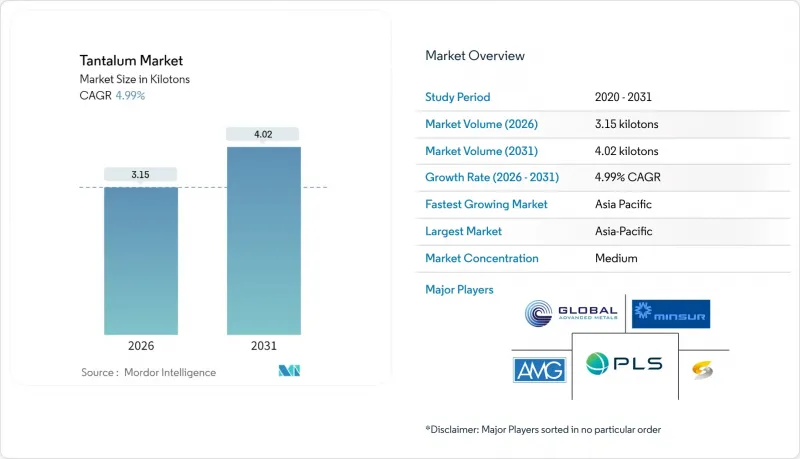
這種成長軌跡反映了其無與倫比的耐腐蝕性、生物相容性和高介電強度,從而支撐了電容器、濺鍍靶材、高溫合金、植入式醫療設備等領域的強勁需求。電子產品小型化的快速發展、5G部署的加速以及航太引擎生產的穩步推進,持續推動需求成長。同時,澳洲和辛巴威鋰偉晶岩礦的共同生產正在緩解結構性供應風險,儘管人們對衝突礦產合規性和現貨價格波動的擔憂仍然存在。航太和醫療技術原始設備製造商(OEM)繼續將供應穩定性置於價格之上,支援長期合約以穩定採購,即便市場交易環境充滿不確定性。
全球鉭市場趨勢與洞察
5G設備對小型鉭電容器的需求激增
5G基礎設施的進步和行動電話的升級正在加速固體鉭晶片電容器的採購,即使在高頻開關條件下也能保持電容穩定性。據元件製造商稱,與多層陶瓷電容器相比,鉭電容器具有更高的體積效率和更低的等效串聯電阻(ESR),這對於旗艦智慧型手機和小型基地台基地台台中空間受限的電源管理電路至關重要。鉭電容器在-55°C至+175°C的溫度範圍內均具有可靠性,這使得通訊設備製造商優先考慮鉭元件,因為他們優先考慮的是避免現場故障。目前的封裝藍圖目標是最小的封裝尺寸,小至0201,其中粉末處理的陽極可以在不犧牲機械強度的情況下實現高電容電壓比(CV)。鉭市場直接受益於輕量化材料日益成長的趨勢,而裝置小型化則提高了每克材料的使用量。
先進半導體節點對鉭濺射靶材的需求
7nm以下的邏輯晶片和DRAM製造製程圖規定使用鉭和氮化鉭擴散隔離層來防止銅擴散,同時保持低線路電阻。極紫外光刻技術將純度標準提高到99.999%或更高,這使得供應商僅限於擁有超高真空冶金技術的精煉廠。與亞洲主要晶圓代工廠簽署的長期供應協議(有效期至2025年)表明,這種前驅體在維持晶圓產量比率的重要性日益凸顯。因此,韓國、台灣和中國當地的產能升級正在轉化為對高純度粉末生產商的穩定需求。然而,一旦中非地區的鉭精礦供應受到地緣政治動盪的影響,供應緊張的風險仍然存在,這進一步加劇了鉭市場對價格穩定性的重視。
衝突礦產合規成本和供應中斷
美國和歐盟法規規定的嚴格實質審查義務要求下游製造商追溯精礦來源,確保其來自非衝突地區的冶煉廠,這增加了審核和認證費用,使成品零件成本增加高達四分之一。中非的小規模生產仍然佔據全球供應的很大一部分,而週期性的邊境關閉和安全事件可能會在短時間內中斷分銷。因此,電容器和高溫合金供應商持有更大的安全庫存,並傾向於簽訂多年期照付不議契約,以保證即使現貨價格下跌也能獲得供貨。
細分市場分析
2025年,粉末鉭市佔率佔鉭市場36.10%,主要得益於電容器陽極材料和濺鍍靶材消耗量的快速成長。預計到2031年,粉末鉭市場將以5.43%的複合年成長率成長,這主要受粒度細化程度提高帶來的對更窄粒度分佈和更高比電容需求的推動。金屬坯料、線材和板材雖然市場佔有率僅次於粉末鉭,但在需要鍛造形狀的應用中仍然至關重要,例如化學設備和航太熱端部件。硬質合金牌號為優先考慮硬度超過2000 HV的切削刀具和耐磨板製造商提供支持,而合金添加劑則為噴射引擎以高溫合金提供支援。
向積層製造技術的轉型正在開闢新的成長途徑。針對雷射粉末層熔融製程最佳化的球形粉末能夠實現醫療植入中複雜的晶格結構。主要粉末供應商正在擴建其霧化生產線,以提供氧含量低於200 ppm、D50值約為3 µm的粉末,這些規格是骨骼固定籠和顱面網片的理想選擇。對形狀精度的更嚴格控制將確保粉末在預測期內繼續保持其在鉭市場的主導地位。
本鉭市場報告按產品類型(金屬、碳化物、粉末、合金及其他形態)、純度類型(<99.95% 和 ≥99.95%)、應用類型(電容器、半導體、引擎渦輪葉片、化工設備等)以及地區(亞太地區、北美地區、歐洲地區、南美地區、引擎渦輪葉片、化學設備等)以及地區(亞太地區、北美地區、歐洲地區、南美地區、中東和非洲地區)進行分析。市場預測以噸為單位。
區域分析
亞太地區在2025年佔全球消費量的46.50%,預計到2031年將以5.93%的複合年成長率成長。中國、日本和韓國集中了大量的電容器組裝線、儲存晶片工廠和顯示面板工廠,這些工廠需要消耗粉末和濺射靶材。台灣邏輯晶圓代工廠的擴張增加了對超高純度金屬的需求,而韓國的記憶體製造商正在利用國內研發項目,試點用於DDR6內存模組的鉭基MIM(金屬-絕緣體-金屬)電容器。澳洲作為特定產品供應來源的崛起,增強了區域供應安全,減少了對非洲礦藏的過度依賴,並提高了價值鏈的韌性。
北美仍然是重要的終端用戶區域,其核心產業包括航太、國防和醫療設備。雖然初級礦產開採僅限於加拿大的坦科礦,但強大的二次回收網路可處理高溫合金廢料和電子廢棄物,用於粉末和合金電路應用。美國優先採購衝突礦產的政策維持了價格溢價,並確保了噴射引擎原始設備製造商和心臟節律管理設備製造商的供應量。
歐洲的需求曲線成熟且穩定,其特徵是技術標準高、環境法規嚴格。德國一級汽車供應商推動了對高級駕駛輔助模組電容器的需求,而法國核能設備製造商則指定使用鉭襯裡用於放射性廢棄物處理系統。歐盟的衝突礦產指令收緊了合規預算,但循環經濟框架中包含的回收義務正在逐步抵消新增原料需求。東歐的電容器工廠在滿足全部區域可追溯性要求的同時,提供具有成本競爭力的組裝。
其他福利:
- Excel格式的市場預測(ME)表
- 3個月的分析師支持
目錄
第1章 引言
- 研究假設和市場定義
- 調查範圍
第2章調查方法
第3章執行摘要
第4章 市場情勢
- 市場概覽
- 市場促進因素
- 5G設備對小型化鉭電容器的需求激增
- 先進半導體節點對鉭濺射靶材的需求
- 提高超合金噴射引擎零件的產量
- 透過與鋰硬岩礦聯合生產來增強供應穩定性
- 醫用鉭塗層(用於神經植入)
- 市場限制
- 衝突礦產合規成本和供應中斷
- 不透明交易市場現貨價格波動劇烈
- 在ADAS系統中用鈮電容器取代鉭電容器
- 價值鏈分析
- 監理政策分析
- 科技趨勢
- 波特五力模型
- 供應商的議價能力
- 買方的議價能力
- 新進入者的威脅
- 替代品的威脅
- 競爭對手之間的競爭
- 價格指數
- 進出口趨勢
第5章 市場規模與成長預測
- 依產品
- 金屬
- 碳化物
- 粉末
- 合金
- 其他形式
- 純度
- 純度低於99.95%
- 純度99.95%或以上
- 透過使用
- 電容器
- 半導體
- 引擎渦輪葉片
- 化學處理設備
- 醫療設備
- 其他用途
- 按地區
- 生產分析
- 美國
- 澳洲
- 巴西
- 中國
- 剛果
- 衣索比亞
- 奈及利亞
- 盧安達
- 其他國家
- 消費分析
- 亞太地區
- 中國
- 印度
- 日本
- 韓國
- 亞太其他地區
- 北美洲
- 美國
- 加拿大
- 墨西哥
- 歐洲
- 德國
- 英國
- 義大利
- 法國
- 其他歐洲地區
- 南美洲
- 巴西
- 阿根廷
- 其他南美洲
- 中東和非洲
- 沙烏地阿拉伯
- 南非
- 其他中東和非洲地區
- 亞太地區
- 生產分析
第6章 競爭情勢
- 市場集中度
- 策略趨勢
- 市佔率(%)/排名分析
- 公司簡介
- AMG
- Advanced MaterialsTM, LLC
- CNMC Ningxia Orient Group Co., Ltd
- Energy Transition Minerals Ltd
- F&X Electro-Materials Limited
- Global Advanced Metals Pty Ltd
- Inframat
- Jiujiang Nonferrous Metals Smelting Co., Ltd
- JX Advanced Metals Corporation
- Lorad Chemical Corporation
- Materion Corporation
- Minsur
- Mitsui Mining & Smelting Co., Ltd.
- MPIL
- Pilbara Minerals Limited
- SAJAN OVERSEAS
- Star Earth Minerals Pvt Ltd.
- Taki Chemical Co., Ltd
- Tantalex Lithium Resources
- Ulba Metallurgical Plant
- Ximei Resources Holding Limited
第7章 市場機會與未來展望
The Tantalum market is expected to grow from 3 kilotons in 2025 to 3.15 kilotons in 2026 and is forecast to reach 4.02 kilotons by 2031 at 4.99% CAGR over 2026-2031.
This growth trajectory reflects the metal's unmatched combination of corrosion resistance, biocompatibility, and high dielectric strength that keeps demand resilient across capacitors, sputtering targets, super-alloys, and implantable medical devices. Robust electronics miniaturization, accelerating 5G deployment, and steady aerospace engine build rates remain primary demand catalysts. Parallelly, co-production from lithium pegmatite mines in Australia and Zimbabwe is easing structural supply risk even as concerns over conflict-mineral compliance and spot-price volatility persist. OEMs in aerospace and medical technology continue to prioritize security of supply over price, supporting long-term contracts that stabilize procurement despite the market's opaque trading environment.
Global Tantalum Market Trends and Insights
Surging Demand for Miniaturised Tantalum Capacitors in 5G-Enabled Devices
5G infrastructure densification and handset upgrades are accelerating procurement of solid tantalum chip capacitors that can maintain capacitance stability under high-frequency switching. Component makers report that tantalum capacitors provide superior volumetric efficiency and lower equivalent series resistance than multi-layer ceramic types, features critical for space-constrained power-management circuits in flagship smartphones and small-cell base stations. Reliability across -55 °C to +175 °C temperature excursions makes tantalum devices the preferred choice for telecommunications OEMs keen to avoid field failures. Packaging road-maps now target case sizes as low as 0201, a node where powder-engineered anodes deliver high CV (capacitance-voltage) ratios without sacrificing mechanical integrity. The tantalum market benefits directly as device miniaturization lifts grams-per-unit usage despite broader material-lightweighting trends.
Demand for Tantalum Sputtering Targets in Advanced Semiconductor Nodes
Sub-7 nm logic and DRAM production flow-sheets specify tantalum and tantalum nitride diffusion-barrier layers that prevent copper migration while preserving low line resistance. Extreme ultraviolet lithography raises purity thresholds to 99.999%+, narrowing the supplier base to refiners with ultra-high-vacuum metallurgy capabilities. Long-term offtake agreements signed by leading Asian foundries in 2025 underscore how strategic this precursor has become in maintaining wafer yield. Equipment upgrades in South Korea, Taiwan, and mainland China are therefore translating into steady volumes for high-purity powder producers. Supply tightness remains a possibility whenever geopolitical disruptions affect concentrate flows from Central Africa, reinforcing the tantalum market's tendency to price security at a premium.
Conflict-Mineral Compliance Costs and Supply Disruptions
Stringent due-diligence mandates under U.S. and EU regulations oblige downstream manufacturers to trace concentrate back to conflict-free smelters, adding audit and certification fees that lift finished-component costs by as much as one-quarter. Artisanal production from Central Africa still provides a significant share of global supply, and periodic border closures or security incidents can interrupt flows with little notice. As a result, capacitor and super-alloy suppliers hold larger safety stocks and favor multi-year take-or-pay contracts that lock in volumes even if spot prices ease.
Other drivers and restraints analyzed in the detailed report include:
- Rising Production of Super-Alloy Jet-Engine Components
- Co-Production with Lithium Hard-Rock Mines Enhancing Supply Security
- Niobium Capacitors Replacing Tantalum in ADAS Systems
For complete list of drivers and restraints, kindly check the Table Of Contents.
Segment Analysis
Powder accounted for 36.10% of the tantalum market share in 2025, propelled by surging capacitor anode and sputtering-target consumption. This sub-segment is forecast to post a 5.43% CAGR through 2031 as miniaturization pushes demand for tighter particle-size distributions and higher specific capacitance. Metal billet, wire, and sheet collectively trail powder but remain essential for chemical-processing equipment and aerospace hot-zone components where wrought form factors are mandatory. Carbide grades serve cutting-tool and wear-plate manufacturers who value hardness exceeding 2,000 HV, while alloy additions underpin jet-engine super-alloys.
The shift toward additive manufacturing is opening a parallel growth lane: spherical powder optimized for laser powder-bed fusion enables complex lattice geometries in medical implants. Key powder suppliers scale atomization lines to deliver D50 values near 3 µm with oxygen content below 200 ppm, a specification sweet spot for orthopedic cages and craniofacial meshes. Tight form-factor control will keep powder at the epicenter of the tantalum market during the forecast horizon.
The Tantalum Market Report is Segmented by Product (Metal, Carbide, Powder, Alloys, Other Forms), Purity (Less Than 99. 95% Purity and More Than 99. 95% Purity), Application (Capacitors, Semiconductors, Engine Turbine Blades, Chemical Processing Equipment, and More), and Geography (Asia-Pacific, North America, Europe, South America, and Middle-East and Africa). The Market Forecasts are Provided in Terms of Volume (tons).
Geography Analysis
Asia-Pacific dominated with 46.50% of global consumption in 2025, and the region is forecast to post a 5.93% CAGR through 2031. China, Japan, and South Korea concentrate capacitor assembly lines, memory-chip fabs, and display-panel plants that absorb powder and sputtering targets. Taiwan's logic-foundry expansion amplifies ultra-high-purity demand, while Korean memory producers leverage domestic research programs to trial tantalum-based MIM (metal-insulator-metal) capacitors in DDR6 modules. Australia's rise as a co-product supplier strengthens regional supply security, reducing over-reliance on African concentrates and bolstering value-chain resilience.
North America remains a strategic end-use region anchored by aerospace, defense, and medical device verticals. Although primary mine output is limited to Canada's Tanco operation, a robust secondary recovery network processes super-alloy scrap and electronic waste, feeding powder and alloy circuits. U.S. procurement policies that prioritize conflict-free sourcing sustain price premiums yet secure volume for jet-engine OEMs and cardiac-rhythm-management manufacturers.
Europe exhibits a mature yet stable demand curve, characterized by high engineering standards and stringent environmental regulations. Germany's Tier-1 automotive suppliers drive capacitor off-take for advanced driver-assistance modules, while French nuclear-equipment firms specify tantalum linings for rad-waste systems. The European Union's conflict-minerals directive tightens compliance budgets, but recycling mandates embedded in the circular economy framework gradually offset virgin-material needs. Eastern European capacitor plants offer cost-competitive assembly yet still adhere to region-wide traceability requirements.
- AMG
- Advanced MaterialsTM, LLC
- CNMC Ningxia Orient Group Co., Ltd
- Energy Transition Minerals Ltd
- F&X Electro-Materials Limited
- Global Advanced Metals Pty Ltd
- Inframat
- Jiujiang Nonferrous Metals Smelting Co., Ltd
- JX Advanced Metals Corporation
- Lorad Chemical Corporation
- Materion Corporation
- Minsur
- Mitsui Mining & Smelting Co., Ltd.
- MPIL
- Pilbara Minerals Limited
- SAJAN OVERSEAS
- Star Earth Minerals Pvt Ltd.
- Taki Chemical Co., Ltd
- Tantalex Lithium Resources
- Ulba Metallurgical Plant
- Ximei Resources Holding Limited
Additional Benefits:
- The market estimate (ME) sheet in Excel format
- 3 months of analyst support
TABLE OF CONTENTS
1 Introduction
- 1.1 Study Assumptions and Market Definition
- 1.2 Scope of the Study
2 Research Methodology
3 Executive Summary
4 Market Landscape
- 4.1 Market Overview
- 4.2 Market Drivers
- 4.2.1 Surging demand for miniaturised tantalum capacitors in 5G-enabled devices
- 4.2.2 Demand for tantalum sputtering targets in advanced semiconductor nodes
- 4.2.3 Rising production of super-alloy jet-engine components
- 4.2.4 Co-production with lithium hard-rock mines enhancing supply security
- 4.2.5 Medical-grade tantalum coatings for neuro-implants
- 4.3 Market Restraints
- 4.3.1 Conflict-mineral compliance costs and supply disruptions
- 4.3.2 High spot-price volatility in an opaque trading market
- 4.3.3 Niobium capacitors replacing tantalum in ADAS systems
- 4.4 Value Chain Analysis
- 4.5 Regulatory Policy Analysis
- 4.6 Technological Snapshot
- 4.7 Porter's Five Forces
- 4.7.1 Bargaining Power of Suppliers
- 4.7.2 Bargaining Power of Buyers
- 4.7.3 Threat of New Entrants
- 4.7.4 Threat of Substitutes
- 4.7.5 Competitive Rivalry
- 4.8 Price Index
- 4.9 Import-Export Trends
5 Market Size and Growth Forecasts (Volume)
- 5.1 By Product
- 5.1.1 Metal
- 5.1.2 Carbide
- 5.1.3 Powder
- 5.1.4 Alloys
- 5.1.5 Other Forms
- 5.2 By Purity
- 5.2.1 Less than 99.95% Purity
- 5.2.2 More than 99.95% Purity
- 5.3 By Application
- 5.3.1 Capacitors
- 5.3.2 Semiconductors
- 5.3.3 Engine Turbine Blades
- 5.3.4 Chemical Processing Equipment
- 5.3.5 Medical Equipment
- 5.3.6 Other Applications
- 5.4 By Geography
- 5.4.1 Production Analysis
- 5.4.1.1 United States
- 5.4.1.2 Australia
- 5.4.1.3 Brazil
- 5.4.1.4 China
- 5.4.1.5 Congo
- 5.4.1.6 Ethiopia
- 5.4.1.7 Nigeria
- 5.4.1.8 Rwanda
- 5.4.1.9 Other Countries
- 5.4.2 Consumption Analysis
- 5.4.2.1 Asia-Pacific
- 5.4.2.1.1 China
- 5.4.2.1.2 India
- 5.4.2.1.3 Japan
- 5.4.2.1.4 South Korea
- 5.4.2.1.5 Rest of Asia-Pacific
- 5.4.2.2 North America
- 5.4.2.2.1 United States
- 5.4.2.2.2 Canada
- 5.4.2.2.3 Mexico
- 5.4.2.3 Europe
- 5.4.2.3.1 Germany
- 5.4.2.3.2 United Kingdom
- 5.4.2.3.3 Italy
- 5.4.2.3.4 France
- 5.4.2.3.5 Rest of Europe
- 5.4.2.4 South America
- 5.4.2.4.1 Brazil
- 5.4.2.4.2 Argentina
- 5.4.2.4.3 Rest of South America
- 5.4.2.5 Middle-East and Africa
- 5.4.2.5.1 Saudi Arabia
- 5.4.2.5.2 South Africa
- 5.4.2.5.3 Rest of Middle-East and Africa
- 5.4.2.1 Asia-Pacific
- 5.4.1 Production Analysis
6 Competitive Landscape
- 6.1 Market Concentration
- 6.2 Strategic Moves
- 6.3 Market Share (%)/Ranking Analysis
- 6.4 Company Profiles (includes Global level Overview, Market level overview, Core Segments, Financials as available, Strategic Information, Market Rank/Share for key companies, Products and Services, and Recent Developments)
- 6.4.1 AMG
- 6.4.2 Advanced MaterialsTM, LLC
- 6.4.3 CNMC Ningxia Orient Group Co., Ltd
- 6.4.4 Energy Transition Minerals Ltd
- 6.4.5 F&X Electro-Materials Limited
- 6.4.6 Global Advanced Metals Pty Ltd
- 6.4.7 Inframat
- 6.4.8 Jiujiang Nonferrous Metals Smelting Co., Ltd
- 6.4.9 JX Advanced Metals Corporation
- 6.4.10 Lorad Chemical Corporation
- 6.4.11 Materion Corporation
- 6.4.12 Minsur
- 6.4.13 Mitsui Mining & Smelting Co., Ltd.
- 6.4.14 MPIL
- 6.4.15 Pilbara Minerals Limited
- 6.4.16 SAJAN OVERSEAS
- 6.4.17 Star Earth Minerals Pvt Ltd.
- 6.4.18 Taki Chemical Co., Ltd
- 6.4.19 Tantalex Lithium Resources
- 6.4.20 Ulba Metallurgical Plant
- 6.4.21 Ximei Resources Holding Limited
7 Market Opportunities and Future Outlook
- 7.1 White-space and Unmet-Need Assessment

 鉭市場-2026-2032年全球市場預測純鉭帶市場依最終用途產業、應用、產品等級、厚度、銷售管道、寬度和缺陷類型分類-2026-2032年全球預測
 鉭礦開採市場規模、佔有率及趨勢分析報告:按應用、地區和細分市場預測(2025-2033 年)