


 |
市場調查報告書
商品編碼
1939013
貨櫃型資料中心:市場佔有率分析、產業趨勢與統計資料、成長預測(2026-2031 年)Containerized Data Center - Market Share Analysis, Industry Trends & Statistics, Growth Forecasts (2026 - 2031) |
||||||

※ 本網頁內容可能與最新版本有所差異。詳細情況請與我們聯繫。
預計到 2026 年,貨櫃型資料中心市場規模將達到 202.4 億美元,高於 2025 年的 171.3 億美元。
預計到 2031 年將達到 465.4 億美元,2026 年至 2031 年的複合年成長率為 18.12%。
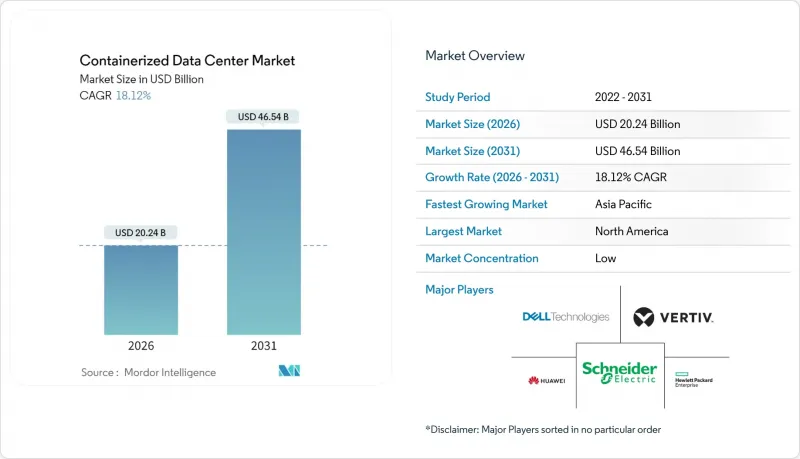
由於5G部署、邊緣運算以及日益嚴格的永續性推動了對快速部署容量的激增需求,訂單持續成長。超大規模業者正在利用貨櫃模組來消除長達數年的建設延誤,企業也正在採用貨櫃模組來應對資料主權法規。預製建築的效率提高了電源使用效率 (PUE) 並降低了整體擁有成本,而移動性則成為競爭優勢。供應商正在利用液冷、熱回收以及核能或氫能微電網等技術來開發未開發的能源,從而推動貨櫃型資料中心市場持續兩位數成長。
全球貨櫃型資料中心市場趨勢與洞察
邊緣/5G部署推動微站點加速
通訊業者正在部署數千個微型邊緣節點以支援超低延遲服務,他們選擇模組化單元,這些單元可以在幾週內完成從採購訂單到運作的部署。 2024 年 5 月修訂的 ANSI/TIA-942-C 標準將建立 A 類和 B 類微型邊緣評估標準,為營運商提供統一的合規路徑並加快採購週期。貨櫃式外形規格使提供者能夠隨著覆蓋範圍的演變重新部署容量,從而增強貨櫃型資料中心市場從人口密集的城市中心到鄉村空白區域的影響力。需求涵蓋自動駕駛汽車、工業IoT和擴增實境/虛擬實境 (AR/VR) 等,所有這些都要求網路邊緣始終保持低於 10 毫秒的延遲。供應商目前正在將 5G 無線電、MEC 伺服器和電池儲存整合到單吊單元中,從而縮短部署時間並降低資本風險。隨著 5G 密集化在 2026 年達到高峰,第二波專用網路計劃將持續推動微型站點的發展。
一級樞紐機場運力短缺
北維吉尼亞、矽谷和倫敦的土地、電力和核准瓶頸導致新的超大規模資料中心計劃運作時間推遲至2028年,迫使營運商租賃可在8至12週內投入運作的模組化臨時容量。這使得貨櫃型資料中心市場從臨時容量擴張轉向策略性位置,使雲端公司即使在電網限制下也能維持客戶服務等級協定(SLA)。維吉尼亞的房地產投資者表示,靠近計畫中的變電站升級地點的模組化園區租金溢價超過20%。企業將模組化設施視為應對核准延誤和電力限制的保障,許多企業計劃在永久設施運作後重新部署這些模組。
有限的機架密度滿足了超大規模需求缺口
符合 ISO 標準的 40 英尺貨櫃通常每個機架支援 10-15 千瓦的功率,將單模組 IT 系統的功率限制在 60-180 千瓦。而專用超大規模資料中心則可在相近的占地面積內提供 20-40 千瓦的功率密度和 300-500 千瓦的功率輸出。人工智慧和高效能運算叢集需要每個機架數百個 GPU,因此需要多個貨櫃或專門的液冷改造,從而推高每兆瓦的資本成本。在東京和法蘭克福等寸土寸金的房地產市場,這種密度差距更為顯著,因為每一平方公尺都價值不斐。供應商正在透過浸沒式冷板設計來應對這項挑戰,但部署仍然有限。在密度差距縮小之前,一些超大規模架構師可能會將容器化系統保留用於周邊設備和過渡性負載。
細分市場分析
到2025年,購買模式將佔據貨櫃型資料中心市場77.60%的佔有率,這主要得益於銀行、金融和保險(BFSI)行業以及政府機構的需求,這些機構都將資產管理放在首位。然而,隨著財務長轉向能夠追蹤利用率的營運成本模型,租賃/「運轉率閒置頻段即服務」模式正以19.74%的複合年成長率成長。早期採用者指出,捆綁式監控和更新服務可以減輕員工負擔,並消除技術過時的風險。惠普企業(Hewlett Packard Enterprise)的「設施服務」提供多年效能服務等級協定(SLA)保障,這顯示現有供應商正在積極擁抱訂閱經濟模式。
租賃模式正在使中型企業也能享受高規格的資料中心容量,並推動貨櫃型資料中心市場在二線城市和邊緣應用場景中的擴張。Start-Ups可以避免前期資本支出,大型企業則可以降低殘值風險。合約期滿後,模組的退還、轉移或更換的柔軟性也滿足了人工智慧工作負載的動態特性。雖然在安全等級和客製化設計比租賃更重要的領域,購買模式仍將繼續存在,但預計到2031年,租賃服務的普及率將呈現快速成長趨勢。
截至2025年,符合ISO 40英尺標準的貨櫃型資料中心將佔據54.10%的市場佔有率,這主要得益於其與全球貨運標準的兼容性以及較低的機架單價。同時,客製化/一體化撬裝式資料中心將以19.18%的複合年成長率成長,其整合了高密度機架、晶片級直接冷卻和內建UPS等技術,對人工智慧/分析叢集的吸引力日益增強。 UL 2755認證確保了其與固定設施同等的安全性能,從而降低了企業的採購門檻。
對客製化散熱環境日益成長的需求迫使供應商在非標準尺寸的面積內設計30kW以上的機架和熱回收迴路,這推高了平均售價,同時縮短了部署時間(相比新建設施而言)。隨著機架功率在2026年後持續成長,許多超大規模資料中心的設計者將客製化撬裝方案視為將GPU放置在可再生能源供應點附近的唯一可行方案。儘管ISO 20英尺貨櫃的應用範圍有限,但它仍然適用於電信邊緣機房和空間受限的都市區屋頂安裝。
貨櫃型資料中心市場按所有權類型(購買、租賃/閒置頻段即服務)、貨櫃類型(ISO 20 英尺、ISO 40 英尺、客製化/一體化撬裝貨櫃)、安裝位置(核心/園區、邊緣/微型、遠端/惡劣環境)、最終用戶產業(IT 和電信、銀行、金融和保險等)以及地區進行細分。市場預測以美元以金額為準(USD) 為單位。
區域分析
到2025年,北美將佔全球收入的29.05%,這主要得益於德克薩斯州、喬治亞和亞伯達的加密貨幣挖礦設施轉型為超大規模人工智慧園區。美國正在部署模組化資料中心,以避免新建電網連接出現長達數年的排隊等待;加拿大則採用加固型貨櫃用於瀝青砂監測和北極寬頻閘道器。墨西哥近岸外包的復興正促使墨西哥加工出口區的工廠主部署邊緣貨櫃,將即時品質資料與美國物流中心同步。這些趨勢共同推動貨櫃型資料中心市場成為整個北美大陸的戰略基礎。
亞太地區正經歷最快成長,複合年成長率高達18.01%。中國、印度和東南亞國協正在擴大5G廣域基地台建設和智慧城市示範計畫。各部會正在加快貨櫃叢集的核准流程,這些集群日後可根據城市規劃的變化進行遷移。印度的資料本地化法規刺激了對微區域資料中心的需求,使雲端服務供應商能夠將公民資料隔離在更靠近消費區域的地方。日本和澳洲則重視鋼結構模組的抗震抗旋風性能。這些多元化的需求因素共同促成了該地區強勁的訂單儲備。
其他福利:
- Excel格式的市場預測(ME)表
- 3個月的分析師支持
目錄
第1章 引言
- 研究假設和市場定義
- 調查範圍
第2章調查方法
第3章執行摘要
第4章 市場情勢
- 市場概覽
- 市場促進因素
- 便攜性和快速部署
- 邊緣/5G部署加速微型站點建設
- 一級樞紐資料中心容量不足
- 透過節能預製構件降低總擁有成本 (TCO)
- 使用小型模組化反應器 (SMR) 的微電網將使離網資料中心成為可能。
- 透過從加密貨幣網站轉向人工智慧網站,可以利用閒置電力。
- 市場限制
- 有限的機架數量和計算密度與超大規模需求之間的差距
- 與現有資料中心資產整合的複雜性
- ISO貨櫃供應鏈中的瓶頸
- 維修液冷系統會增加資本支出(CAPEX)。
- 供應鏈分析
- 監管環境
- 技術展望
- 波特五力模型
- 供應商的議價能力
- 買方的議價能力
- 新進入者的威脅
- 替代品的威脅
- 激烈的競爭
- 評估市場中的宏觀經濟因素
第5章 市場規模與成長預測
- 依所有權類型
- 購買
- 租賃/空置空間服務
- 按容器類型
- ISO 20 英尺
- ISO 40英尺
- 客製化產品/一體式托盤
- 按安裝位置
- 核心/校園
- 邊緣/微
- 偏遠/惡劣環境
- 按最終用戶行業分類
- 資訊科技/通訊
- BFSI
- 政府/國防
- 衛生保健
- 教育
- 其他
- 按地區
- 北美洲
- 美國
- 加拿大
- 墨西哥
- 南美洲
- 巴西
- 阿根廷
- 其他南美洲
- 歐洲
- 德國
- 英國
- 法國
- 荷蘭
- 其他歐洲地區
- 亞太地區
- 中國
- 日本
- 印度
- 韓國
- 澳洲和紐西蘭
- 亞太其他地區
- 中東和非洲
- 中東
- 阿拉伯聯合大公國
- 沙烏地阿拉伯
- 土耳其
- 其他中東地區
- 非洲
- 南非
- 埃及
- 奈及利亞
- 其他非洲地區
- 中東
- 北美洲
第6章 競爭情勢
- 市場集中度
- 策略趨勢
- 市佔率分析
- 公司簡介
- Vertiv
- Schneider Electric
- Huawei Technologies
- Dell Technologies
- Hewlett Packard Enterprise
- IBM Corporation
- Cisco Systems
- Rittal GmbH and Co. KG
- Delta Electronics
- Eaton Corporation
- Johnson Controls
- PCX Corporation
- BMarko Structures
- Baselayer Technology
- Flexenclosure(Xerxes)
- Cirrascale Cloud Services
- ZTE Corporation
- AST Modular(subs. of Schneider)
- Cannon Technologies
- EdgeMicro/EDJX
- Compass Datacenters
- EdgeConneX
- Vertiv(Emerson Network Power legacy)
- Stulz GmbH
第7章 市場機會與未來展望
The containerized data center market size in 2026 is estimated at USD 20.24 billion, growing from 2025 value of USD 17.13 billion with 2031 projections showing USD 46.54 billion, growing at 18.12% CAGR over 2026-2031.
Surging demand for rapid-deployment capacity, driven by 5G rollouts, edge computing, and stricter sustainability mandates, continues to lengthen order books. Hyperscale operators use container modules to bridge multi-year construction lags, while enterprises deploy them to meet data-sovereignty rules. Prefabricated efficiencies are tightening power usage effectiveness (PUE) margins and lowering total cost of ownership, making mobility a competitive differentiator. Vendors combine liquid cooling, heat-recovery, and nuclear or hydrogen micro-grids to unlock stranded power, positioning the containerized data center market for sustained double-digit expansion.
Global Containerized Data Center Market Trends and Insights
Edge/5G build-outs accelerate micro-sites
Telecom carriers are rolling out thousands of micro edge nodes to support ultra-low-latency services, choosing modular units that move from purchase order to "lights on" in weeks. The May 2024 ANSI/TIA-942-C update created Type A and Type B micro-edge ratings, giving operators a uniform compliance path and accelerating procurement cycles. Container form factors let providers relocate capacity as coverage maps evolve, strengthening the containerized data center market presence in dense urban cores and rural gaps alike. Demand spans autonomous vehicles, industrial IoT, and AR/VR, all of which require consistent sub-10 ms latency at the network edge. Vendors now bundle 5G radios, MEC servers, and battery storage into single-lift units, compressing deployment timelines and capital risk. As 5G densification peaks in 2026, a second wave of private-network projects will keep micro-site pipelines active.
Capacity shortages in Tier-1 hubs
Land, power, and permitting bottlenecks in Northern Virginia, Silicon Valley, and London have pushed new hyperscale projects into 2028 commissioning windows, forcing operators to lease interim modular capacity that can be live in 8-12 weeks. The containerized data center market thus shifts from temporary overflow to strategic footprint, enabling cloud firms to preserve customer SLAs despite grid constraints. Real-estate investors in Virginia report occupancy premiums topping 20% for modular campuses positioned near substation upgrades. Enterprises view the modules as insurance against entitlement delays and grid curtailments, and many plan to redeploy units once permanent halls come online.
Limited rack density vs hyperscale needs
ISO 40-foot boxes typically support 10-15 kW per rack, capping a single module at 60-180 kW IT power, whereas purpose-built hyperscale suites reach 20-40 kW densities and 300-500 kW in comparable floor area. AI and HPC clusters demanding hundreds of GPUs per rack therefore require multiple containers or specialized liquid-cooling retrofits, inflating capital cost per MW. The density gap is magnified in high-real-estate markets like Tokyo and Frankfurt, where every square meter carries a premium. Vendors answer with immersed cold-plate designs, yet deployment proof points remain limited. Until density parity closes, some hyperscale architects will reserve containerized systems for peripheral or transitional loads.
Other drivers and restraints analyzed in the detailed report include:
- Energy-efficient prefabrication lowers TCO
- SMR-powered micro-grids enable off-grid DCs
- Legacy estate integration complexity
For complete list of drivers and restraints, kindly check the Table Of Contents.
Segment Analysis
The Purchase option held 77.60% of containerized data center market share in 2025, fueled by BFSI and government mandates for asset control. However, Lease/"White-Space-as-a-Service" is growing at 19.74% CAGR as CFOs pivot to OpEx models that track utilization. Early adopters note that bundled monitoring and refresh services reduce staffing burdens and de-risk technology obsolescence. Hewlett Packard Enterprise's Facility-as-a-Service offering guarantees performance SLAs over multi-year terms, signaling that incumbent vendors embrace subscription economics.
Leasing democratizes high-spec capacity for mid-tier firms, swelling the containerized data center market footprint across secondary metros and edge use cases. Start-ups avoid upfront capital outlays, while large enterprises offload residual-value risk. The flexibility to return, relocate, or swap modules after the term also fits volatile AI workload profiles. Purchase models will persist where security classification or custom engineering outweigh leasing's convenience, yet the service curve is poised to steepen through 2031.
ISO 40-foot shells retained 54.10% of containerized data center market size in 2025, benefiting from global freight standards and lower per-rack cost. Customized/All-in-One Skids, advancing at 19.18% CAGR, integrate higher rack counts, direct-to-chip liquid cooling, and on-board UPS, appealing to AI and analytics clusters. UL 2755 certification assures safety parity with fixed facilities, easing enterprise procurement hurdles.
Demand for bespoke thermal envelopes pushes vendors to engineer 30 kW-plus racks and heat-reuse loops inside nonstandard footprints, lifting average selling price yet compressing deployment times compared with greenfield halls. As rack power escalates post-2026, many hyperscale architects view custom skids as the only pragmatic route to situate GPUs near renewable feed-in points. ISO 20-foot boxes, while niche, remain relevant for telecom edge shelters and space-constrained urban rooftops.
Containerized Data Center Market is Segmented by Ownership Type ( Purchase, Lease / "White-Space-As-A-Service"), Container Type (ISO 20-Ft, ISO 40-Ft, Customized/All-in-One Skids), Deployment Location ( Core / Campus, Edge / Micro, Remote / Harsh-Environment), End User Industry (IT and Telecommunications, BFSI and More), and by Geography. The Market Forecasts are Provided in Terms of Value (USD).
Geography Analysis
North America held 29.05% of 2025 revenue, anchored by hyperscale conversions of crypto mines into AI campuses across Texas, Georgia, and Alberta. The United States absorbs modules to circumvent multi-year queue backlogs for new grid interconnects, while Canada employs ruggedized pods for tar-sand monitoring and Arctic broadband gateways. Mexico's near-shoring renaissance drives maquiladora plant owners to install edge pods that sync real-time quality data with US logistics hubs. Together these trends reinforce the containerized data center market as a strategic overlay across the continent.
Asia-Pacific, the fastest-growing region at 18.01% CAGR, scales 5G macro builds and smart-city pilots across China, India, and ASEAN. Provinces grant accelerated permits for container clusters that can later shift sites as urban plans evolve. India's data-localization rulebook boosts demand for micro-regional pods, allowing cloud providers to ring-fence citizen data near consumption zones. Japan and Australia value seismic and cyclone resilience inherent in steel-framed modules. Collectively, diversified drivers keep the region's order pipeline robust.
- Vertiv
- Schneider Electric
- Huawei Technologies
- Dell Technologies
- Hewlett Packard Enterprise
- IBM Corporation
- Cisco Systems
- Rittal GmbH and Co. KG
- Delta Electronics
- Eaton Corporation
- Johnson Controls
- PCX Corporation
- BMarko Structures
- Baselayer Technology
- Flexenclosure (Xerxes)
- Cirrascale Cloud Services
- ZTE Corporation
- AST Modular (subs. of Schneider)
- Cannon Technologies
- EdgeMicro / EDJX
- Compass Datacenters
- EdgeConneX
- Vertiv (Emerson Network Power legacy)
- Stulz GmbH
Additional Benefits:
- The market estimate (ME) sheet in Excel format
- 3 months of analyst support
TABLE OF CONTENTS
1 INTRODUCTION
- 1.1 Study Assumptions and Market Definition
- 1.2 Scope of the Study
2 RESEARCH METHODOLOGY
3 EXECUTIVE SUMMARY
4 MARKET LANDSCAPE
- 4.1 Market Overview
- 4.2 Market Drivers
- 4.2.1 Portability and rapid deployment
- 4.2.2 Edge/5G build-outs accelerate micro-sites
- 4.2.3 Data-center capacity shortages in Tier-1 hubs
- 4.2.4 Energy-efficient prefabrication lowers TCO
- 4.2.5 SMR-powered micro-grids enable off-grid DCs
- 4.2.6 Crypto-to-AI site conversions unlock stranded power
- 4.3 Market Restraints
- 4.3.1 Limited rack and compute density vs hyperscale needs
- 4.3.2 Integration complexity with legacy DC estates
- 4.3.3 ISO-container supply-chain bottlenecks
- 4.3.4 Liquid-cooling retrofits raise CAPEX
- 4.4 Supply-Chain Analysis
- 4.5 Regulatory Landscape
- 4.6 Technological Outlook
- 4.7 Porter's Five Forces
- 4.7.1 Bargaining Power of Suppliers
- 4.7.2 Bargaining Power of Buyers
- 4.7.3 Threat of New Entrants
- 4.7.4 Threat of Substitutes
- 4.7.5 Intensity of Rivalry
- 4.8 Assesment of Macroeconomic Factors on the Market
5 MARKET SIZE AND GROWTH FORECASTS (VALUE)
- 5.1 By Ownership Type
- 5.1.1 Purchase
- 5.1.2 Lease / White-Space-as-a-Service
- 5.2 By Container Type
- 5.2.1 ISO 20-ft
- 5.2.2 ISO 40-ft
- 5.2.3 Customized/All-in-One Skids
- 5.3 By Deployment Location
- 5.3.1 Core / Campus
- 5.3.2 Edge / Micro
- 5.3.3 Remote / Harsh-Environment
- 5.4 By End-User Industry
- 5.4.1 IT and Telecommunications
- 5.4.2 BFSI
- 5.4.3 Government and Defense
- 5.4.4 Healthcare
- 5.4.5 Education
- 5.4.6 Others
- 5.5 By Geography
- 5.5.1 North America
- 5.5.1.1 United States
- 5.5.1.2 Canada
- 5.5.1.3 Mexico
- 5.5.2 South America
- 5.5.2.1 Brazil
- 5.5.2.2 Argentina
- 5.5.2.3 Rest of South America
- 5.5.3 Europe
- 5.5.3.1 Germany
- 5.5.3.2 United Kingdom
- 5.5.3.3 France
- 5.5.3.4 Netherlands
- 5.5.3.5 Rest of Europe
- 5.5.4 Asia-Pacific
- 5.5.4.1 China
- 5.5.4.2 Japan
- 5.5.4.3 India
- 5.5.4.4 South Korea
- 5.5.4.5 Australia and New Zealand
- 5.5.4.6 Rest of Asia-Pacific
- 5.5.5 Middle East and Africa
- 5.5.5.1 Middle East
- 5.5.5.1.1 United Arab Emirates
- 5.5.5.1.2 Saudi Arabia
- 5.5.5.1.3 Turkey
- 5.5.5.1.4 Rest of Middle East
- 5.5.5.2 Africa
- 5.5.5.2.1 South Africa
- 5.5.5.2.2 Egypt
- 5.5.5.2.3 Nigeria
- 5.5.5.2.4 Rest of Africa
- 5.5.5.1 Middle East
- 5.5.1 North America
6 COMPETITIVE LANDSCAPE
- 6.1 Market Concentration
- 6.2 Strategic Moves
- 6.3 Market Share Analysis
- 6.4 Company Profiles (includes Global level Overview, Market level overview, Core Segments, Financials as available, Strategic Information, Market Rank/Share for key companies, Products and Services, and Recent Developments)
- 6.4.1 Vertiv
- 6.4.2 Schneider Electric
- 6.4.3 Huawei Technologies
- 6.4.4 Dell Technologies
- 6.4.5 Hewlett Packard Enterprise
- 6.4.6 IBM Corporation
- 6.4.7 Cisco Systems
- 6.4.8 Rittal GmbH and Co. KG
- 6.4.9 Delta Electronics
- 6.4.10 Eaton Corporation
- 6.4.11 Johnson Controls
- 6.4.12 PCX Corporation
- 6.4.13 BMarko Structures
- 6.4.14 Baselayer Technology
- 6.4.15 Flexenclosure (Xerxes)
- 6.4.16 Cirrascale Cloud Services
- 6.4.17 ZTE Corporation
- 6.4.18 AST Modular (subs. of Schneider)
- 6.4.19 Cannon Technologies
- 6.4.20 EdgeMicro / EDJX
- 6.4.21 Compass Datacenters
- 6.4.22 EdgeConneX
- 6.4.23 Vertiv (Emerson Network Power legacy)
- 6.4.24 Stulz GmbH
7 MARKET OPPORTUNITIES AND FUTURE OUTLOOK
- 7.1 White-space and Unmet-Need Assessment

 中國GPU液冷市場:市佔率分析、產業趨勢與統計及成長預測(2026-2031年)亞太地區GPU浸沒式散熱市場:市佔率分析、產業趨勢與統計及成長預測(2026-2031年)歐洲GPU浸沒式散熱:市佔率分析、產業趨勢與統計及成長預測(2026-2031年)
 2026年全球戶外微型資料中心機櫃市場報告
 液冷式伺服器市場報告:趨勢、預測與競爭分析(至2035年)
 貨櫃型資料中心市場:依解決方案組件、貨櫃類型、冷卻技術、機架數量、企業規模和最終用戶分類-2026-2032年全球市場預測2026年全球人工智慧資料中心市場報告2026年全球貨櫃型資料中心市場報告
 貨櫃型資料中心市場分析及預測(至2035年):依類型、產品類型、服務、技術、元件、應用、形式、部署形式、最終使用者及模組分類
 貨櫃型資料中心市場規模、佔有率、趨勢和預測:按容器類型、組織規模、應用、最終用戶產業和地區分類,2026-2034 年