


 |
市場調查報告書
商品編碼
1939011
鈹:市場佔有率分析、產業趨勢與統計、成長預測(2026-2031)Beryllium - Market Share Analysis, Industry Trends & Statistics, Growth Forecasts (2026 - 2031) |
||||||

※ 本網頁內容可能與最新版本有所差異。詳細情況請與我們聯繫。
2025年鈹市場價值為337.26噸,預計從2026年的349.67噸增加到2031年的418.86噸。
預計在預測期(2026-2031 年)內,複合年成長率將達到 3.68%。
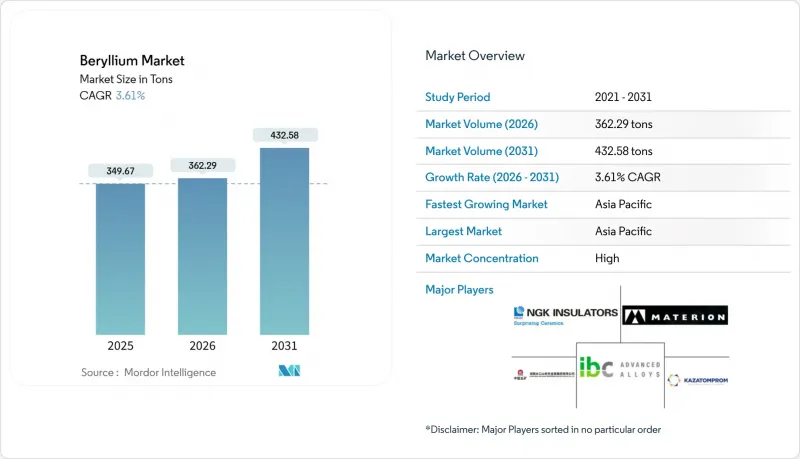
其強勁成長得益於諸多特性,例如卓越的剛度重量比、優異的導熱性和中子滲透性,這些特性使其成為國防、航太、電子和新興清潔能源系統的關鍵材料。 5G基礎設施的擴展、可重複使用火箭計劃以及先進電力電子平台的進步正在推動市場需求,而更嚴格的職業暴露法規以及哈薩克和中國的供應鏈集中度則對成本和安全性構成壓力。由於亞太地區的消費驅動力強勁,美國生產商的策略整合正在增強國內市場的韌性。競爭優勢體現在合金創新、粉末冶金工藝和快速原型製造能力等方面,旨在為高價值應用提供輕盈耐用的零件。
全球鈹市場趨勢與洞察
鈹銅合金在5G和毫米波基地台射頻濾波器的應用日益廣泛
全球5G的部署正推動對高頻射頻連接器前所未有的需求,而銅鈹因其優異的電氣和機械性能以及耐腐蝕性,是此類連接器的必要材料。毫米波基地台每個節點使用的鈹銅比4G設備更多,總消耗量加倍。加工技術的不斷進步使得生產24GHz以上系統所需的超薄精密帶材成為可能。 5G基礎設施被列為關鍵國家基礎設施,從供應安全的角度來看,這進一步提升了鈹市場的戰略意義。雖然亞太地區仍然是需求中心,但北美和歐洲的營運商堅持嚴格的規格要求,優先考慮高純度合金。
可重複使用運載火箭對輕質、高剛性結構的需求日益成長
從一次性運載火箭系統向可重複使用運載火箭系統的過渡,依賴能夠承受反覆極端溫度和振動而不增加質量的材料。鈹的剛性重量比是鋼的六倍,但重量卻只有鋼的四分之一,這使得製造輕型光學平台、感測器支架和結構面板成為可能。鈹鋁複合材料,例如 AlBeMet 和 Beralcast,在溫度波動下具有尺寸穩定性,詹姆斯韋伯太空望遠鏡的鏡面組件證明了這一點。隨著商業發射業者每年進行數百次發射,對耐用鈹零件的需求也隨之成長。
嚴格的職業暴露限值和不斷上漲的合規成本
美國職業安全與健康管理局 (OSHA) 已將允許暴露限值從 2 μg/m³ 降至 0.2 μg/m³,要求生產商實施更嚴格的通風、隔離措施和醫療監測系統,從而增加了單位成本。歐洲 REACH 法規體系下也實施了類似的規定,形成了一個更嚴格的法規環境。小規模加工商難以承擔這些成本,加速了產業整合,提高了進入門檻,限制了整體供應成長。
細分市場分析
截至2025年,合金將佔據鈹市場72.86%的佔有率,預計到2031年將以3.95%的複合年成長率成長,這鞏固了其在高性能平台中的核心地位。在這一類別中,銅鈹合金在通訊連接器領域佔據主導地位,而鋁鈹金屬基複合材料則可用於航太結構的輕量化。由於合金成分可以針對強度、導電性和熱性能進行調整,製造商正投入大量研發預算來開發新的合金成分,以應對新的設計限制。
純金屬仍廣泛應用於核反射器和空間光學元件,因為合金化會降低其抗中子和抗熱性能。氧化鈹陶瓷在高密度功率模組中扮演著獨特而重要的角色,這類模組需要極高的導熱性。粉末冶金和熱等等向性技術的進步使得製造十年前無法實現的複雜形狀成為可能,這凸顯了合金技術的進步正在推動鈹市場的整體成長。
鈹市場報告按產品類型(合金、金屬、陶瓷及其他)、終端用戶產業(工業零件、汽車、醫療、航太與國防、石油、天然氣及其他能源等)和地區(亞太地區、北美、歐洲、南美以及中東和非洲)進行細分。市場預測以公噸為單位。
區域分析
預計到2025年,亞太地區將佔全球產量的37.62%,到2031年將以4.08%的複合年成長率成長,其中中國在電子產品生產和5G基地台部署方面主導。國內加工商將上游精礦與下游合金化製程結合,維持近乎封閉的供應鏈,以保護本地消費者免受國際市場波動的影響。日本和韓國透過汽車電氣化和高精度半導體製造設備創造了巨大的需求,而印度不斷擴展的航太計畫正在推動區域航太需求。
北美擁有馬特里恩公司位於猶他州和俄亥俄州的綜合生產基地,這是全球唯一的從礦山到冶煉的一體化製造系統,有助於提升供應鏈的韌性。成熟的航太和國防工業確保了穩定的基本負載消費,而《通膨控制法案》的激勵措施則支持了國內電動車電池和電力電子產品的製造,這些製造都需要氧化鈹基板。加拿大和墨西哥則透過航太組裝和新興的電動車出口中心,為北美市場帶來漸進式成長。
歐洲在嚴格的職業法規與強勁的應用需求之間尋求平衡。電動車的快速普及和可再生能源產能的不斷成長,推動了對高性能溫度控管材料的需求,其中鈹合金和陶瓷尤為突出。 NGK-Berylco法國公司正率先採用符合歐盟永續性目標的低碳加工製程。中東/非洲和南美市場規模仍然小規模,但像Beryltec盧安達這樣的新加工廠標誌著公司在地域多元化方面邁出了第一步。
其他福利:
- Excel格式的市場預測(ME)表
- 3個月的分析師支持
目錄
第1章 引言
- 研究假設和市場定義
- 調查範圍
第2章調查方法
第3章執行摘要
第4章 市場情勢
- 市場概覽
- 市場促進因素
- 鈹銅合金在5G和毫米波基地台射頻濾波器的應用日益廣泛
- 可重複使用運載火箭對輕質、高剛性結構的需求日益成長
- 先進電動車電力電子裝置對溫度控管材料的需求日益成長
- 國防現代化計畫推動了對衛星、飛彈導引系統和光學感測器的需求。
- 小型模組化反應器(SMR)對中子滲透性鈹反射器的需求日益成長
- 市場限制
- 嚴格的職業暴露限值和不斷上漲的合規成本
- 哈薩克和中國鈹精礦供應不穩定
- 加速鋁和鈦金屬基複合材料作為替代品的研發
- 價值鏈分析
- 波特五力分析
- 供應商的議價能力
- 買方的議價能力
- 新進入者的威脅
- 替代品的威脅
- 競爭對手之間的競爭
第5章 市場規模與成長預測
- 依產品類型
- 合金
- 金屬
- 陶瓷
- 其他產品類型
- 按最終用戶行業分類
- 工業部件
- 車
- 衛生保健
- 航太與國防
- 石油、天然氣和其他能源
- 電子與通訊
- 其他終端用戶產業
- 按地區
- 亞太地區
- 中國
- 日本
- 印度
- 韓國
- 亞太其他地區
- 北美洲
- 美國
- 加拿大
- 墨西哥
- 歐洲
- 德國
- 英國
- 法國
- 義大利
- 俄羅斯
- 其他歐洲地區
- 南美洲
- 巴西
- 阿根廷
- 其他南美洲
- 中東和非洲
- 沙烏地阿拉伯
- 南非
- 其他中東和非洲地區
- 亞太地區
第6章 競爭情勢
- 市場集中度
- 策略趨勢
- 市佔率(%)/排名分析
- 公司簡介
- American Beryllia Inc.
- American Elements
- Belmont Metals
- Hunan Shuikoushan Nonferrous Metals Group Co., Ltd.
- IBC Advanced Alloys
- JSC Ulba Metallurgical Plant(JSC NAC Kazatomprom)
- Materion Corporation
- NGK INSULATORS, LTD.
- Rockland Resources Ltd.
- Texas Mineral Resources Corp.
- Tropag Oscar H. Ritter Nachf GmBH
- Xiamen Beryllium Copper Technologies Co. , Ltd.
- Xinjiang Xinxin Mining Industry Co. Ltd
第7章 市場機會與未來展望
The Beryllium Market was valued at 337.26 tons in 2025 and estimated to grow from 349.67 tons in 2026 to reach 418.86 tons by 2031, at a CAGR of 3.68% during the forecast period (2026-2031).
Robust growth stems from the metal's unmatched stiffness-to-weight ratio, superior thermal conductivity, and neutron transparency that position it as a linchpin material across defense, aerospace, electronics, and nascent clean-energy systems. Rising 5G infrastructure roll-outs, reusable launch vehicle programs, and advanced power-electronics platforms elevate demand, while tightening occupational-exposure rules and supply-chain concentration in Kazakhstan and China create cost and security pressures. Strategic integration efforts by U.S. producers strengthen domestic resilience even as Asia-Pacific leads consumption. Competitive differentiation centers on alloy innovation, powder-metallurgy processing, and rapid-prototyping capability that deliver lighter, more durable components for high-value applications.
Global Beryllium Market Trends and Insights
Rising Adoption of Be-Cu Alloys in 5G And mm-wave Base-Station RF Filters
Global 5G roll-outs drive unprecedented volumes of high-frequency RF connectors that mandate copper-beryllium for its simultaneous electrical, mechanical, and corrosion-resistant performance. Each mmWave base station uses more Be-Cu per node than 4G equipment, multiplying overall consumption. Continuous processing improvements now yield ultra-thin precision strip essential for 24 GHz-plus systems. Because 5G infrastructure is classified as critical national infrastructure, security-of-supply considerations amplify strategic interest in the beryllium market. Asia-Pacific remains the demand epicenter, yet North American and European operators maintain stringent specifications that favor high-purity alloys.
Growing Requirement for Lightweight, High-Stiffness Structures in Reusable Launch Vehicles
The shift from expendable to reusable launch systems hinges on materials that survive repeated thermal and vibrational extremes without mass penalties. Beryllium's specific stiffness is six times that of steel at one-quarter the weight, enabling lighter optical benches, sensor mounts, and structural panels. Beryllium-aluminum composites such as AlBeMet and Beralcast deliver dimensional stability across temperature swings, validated by the performance of the James Webb Space Telescope mirror segments. As commercial launch providers target hundreds of sorties per year, demand for durable beryllium components scales in tandem.
Stringent Occupational-Exposure Limits and Rising Compliance Costs
OSHA cut permissible exposure thresholds from 2 µg/m3 to 0.2 µg/m3, obligating producers to install enhanced ventilation, isolation, and medical-surveillance systems that elevate unit costs. Europe applies comparable restrictions under REACH authorization, further tightening the regulatory envelope. Smaller processors struggle to absorb these expenses, accelerating industry consolidation and raising entry barriers that constrain overall supply expansion.
Other drivers and restraints analyzed in the detailed report include:
- Escalating Demand for Thermal-Management Materials in Advanced EV Power Electronics
- Defense Modernization Programs Boosting Satellite, Missile-Seeker and Optical-Sensor Volumes
- Volatility of Beryllium Concentrate Supply from Kazakhstan and China
For complete list of drivers and restraints, kindly check the Table Of Contents.
Segment Analysis
Alloys captured 72.86% of the beryllium market share in 2025 and are projected to expand at a 3.95% CAGR through 2031, confirming their central role in high-performance platforms. Within this category, copper-beryllium alloys dominate telecommunications connectors, while aluminum-beryllium metal-matrix composites unlock weight savings in aerospace structures. Because alloy formulations can be tuned for strength, conductivity, or thermal properties, producers devote significant research and development budgets to new compositions that address emerging design constraints.
Pure metal continues to serve nuclear reflectors and space-optics segments where alloying would impair neutron or thermal performance. Beryllium-oxide ceramics fill niche but critical positions in high-density power modules that require extreme thermal conductivity. Powder-metallurgy advances and hot-isostatic-pressing routes enable intricate geometries unprecedented a decade ago, underscoring how alloy progress propels overall beryllium market momentum.
The Beryllium Report is Segmented by Product Type (Alloys, Metals, Ceramics, and Other Product Types), End-User Industry (Industrial Components, Automotive, Healthcare, Aerospace and Defense, Oil and Gas and Other Energy, and More), and Geography (Asia-Pacific, North America, Europe, South America, and Middle-East and Africa). The Market Forecasts are Provided in Terms of Volume (Tons).
Geography Analysis
Asia-Pacific generated 37.62% of 2025 volume and is forecast to log a 4.08% CAGR through 2031 as China spearheads electronics production and 5G base-station deployment. Domestic processors integrate upstream concentrate and downstream alloying, sustaining a largely closed supply loop that buffers local consumers from international volatility. Japan and South Korea contribute sizeable volumes through automotive electrification and high-precision semiconductor tooling, while India's expanding space program lifts regional aerospace demand.
North America anchors supply-chain resilience with the world's only fully integrated mine-to-mill operation at Materion's Utah-Ohio complex. Mature aerospace and defense sectors ensure stable base load consumption, and the Inflation Reduction Act incentives bolster domestic EV battery and power-electronics manufacturing that rely on Be-O substrates. Canada and Mexico add incremental growth via aerospace assembly and emerging EV export hubs.
Europe balances stringent occupational regulations with robust application demand. The continent's accelerated EV adoption and renewable-energy build-out intensify requirements for high-performance thermal-management materials, favoring beryllium alloys and ceramics. NGK Berylco France pioneers lower-carbon processing routes aligned with EU sustainability goals. While Middle East-Africa and South America remain smaller markets, new processing ventures such as BerylTech Rwanda illustrate early steps toward geographic diversification.
- American Beryllia Inc.
- American Elements
- Belmont Metals
- Hunan Shuikoushan Nonferrous Metals Group Co., Ltd.
- IBC Advanced Alloys
- JSC Ulba Metallurgical Plant (JSC NAC Kazatomprom)
- Materion Corporation
- NGK INSULATORS, LTD.
- Rockland Resources Ltd.
- Texas Mineral Resources Corp.
- Tropag Oscar H. Ritter Nachf GmBH
- Xiamen Beryllium Copper Technologies Co. , Ltd.
- Xinjiang Xinxin Mining Industry Co. Ltd
Additional Benefits:
- The market estimate (ME) sheet in Excel format
- 3 months of analyst support
TABLE OF CONTENTS
1 Introduction
- 1.1 Study Assumptions and Market Definition
- 1.2 Scope of the Study
2 Research Methodology
3 Executive Summary
4 Market Landscape
- 4.1 Market Overview
- 4.2 Market Drivers
- 4.2.1 Rising Adoption of Be-Cu Alloys in 5G and mm-wave Base-Station RF Filters
- 4.2.2 Growing Requirement for Lightweight, High-Stiffness Structures in Reusable Launch Vehicles
- 4.2.3 Escalating Demand for Thermal Management Materials in Advanced EV Power Electronics
- 4.2.4 Defense Modernization Programs Boosting Satellite, Missile-Seeker and Optical Sensor Volumes
- 4.2.5 Emerging Need for Neutron-Transparent Be Reflectors in Small Modular Reactors (SMRs)
- 4.3 Market Restraints
- 4.3.1 Stringent Occupational?Exposure Limits and Rising Compliance Costs
- 4.3.2 Volatility of Beryllium Concentrate Supply from Kazakhstan and China
- 4.3.3 Accelerating Research and Development on Aluminum and Titanium Metal-Matrix Composites as Substitutes
- 4.4 Value Chain Analysis
- 4.5 Porter's Five Forces Analysis
- 4.5.1 Bargaining Power of Suppliers
- 4.5.2 Bargaining Power of Buyers
- 4.5.3 Threat of New Entrants
- 4.5.4 Threat of Substitutes
- 4.5.5 Competitive Rivalry
5 Market Size and Growth Forecasts (Value)
- 5.1 By Product Type
- 5.1.1 Alloys
- 5.1.2 Metals
- 5.1.3 Ceramics
- 5.1.4 Other Product Types
- 5.2 By End-user Industry
- 5.2.1 Industrial Components
- 5.2.2 Automotive
- 5.2.3 Healthcare
- 5.2.4 Aerospace and Defense
- 5.2.5 Oil and Gas and Other Energy
- 5.2.6 Electronics and Telecommunication
- 5.2.7 Other End-user Industries
- 5.3 By Geography
- 5.3.1 Asia-Pacific
- 5.3.1.1 China
- 5.3.1.2 Japan
- 5.3.1.3 India
- 5.3.1.4 South Korea
- 5.3.1.5 Rest of Asia-Pacific
- 5.3.2 North America
- 5.3.2.1 United States
- 5.3.2.2 Canada
- 5.3.2.3 Mexico
- 5.3.3 Europe
- 5.3.3.1 Germany
- 5.3.3.2 United Kingdom
- 5.3.3.3 France
- 5.3.3.4 Italy
- 5.3.3.5 Russia
- 5.3.3.6 Rest of Europe
- 5.3.4 South America
- 5.3.4.1 Brazil
- 5.3.4.2 Argentina
- 5.3.4.3 Rest of South America
- 5.3.5 Middle-East and Africa
- 5.3.5.1 Saudi Arabia
- 5.3.5.2 South Africa
- 5.3.5.3 Rest of Middle-East and Africa
- 5.3.1 Asia-Pacific
6 Competitive Landscape
- 6.1 Market Concentration
- 6.2 Strategic Moves
- 6.3 Market Share (%)/Ranking Analysis
- 6.4 Company Profiles (includes Global-level Overview, Market-level Overview, Core Segments, Financials, Strategic Information, Market Rank/Share, Products and Services, Recent Developments)
- 6.4.1 American Beryllia Inc.
- 6.4.2 American Elements
- 6.4.3 Belmont Metals
- 6.4.4 Hunan Shuikoushan Nonferrous Metals Group Co., Ltd.
- 6.4.5 IBC Advanced Alloys
- 6.4.6 JSC Ulba Metallurgical Plant (JSC NAC Kazatomprom)
- 6.4.7 Materion Corporation
- 6.4.8 NGK INSULATORS, LTD.
- 6.4.9 Rockland Resources Ltd.
- 6.4.10 Texas Mineral Resources Corp.
- 6.4.11 Tropag Oscar H. Ritter Nachf GmBH
- 6.4.12 Xiamen Beryllium Copper Technologies Co. , Ltd.
- 6.4.13 Xinjiang Xinxin Mining Industry Co. Ltd
7 Market Opportunities and Future Outlook
- 7.1 White-space and Unmet-Need Assessment

 2026年全球氫氧化鈹市場報告
 鈹市場報告:依產品類型、最終用途產業和地區分類(2026-2034年)
 鈹市場:2026-2032年全球市場預測(依產品類型、形態、純度、原料類型、終端用戶產業及通路分類)
 鈹市場規模、佔有率和趨勢分析報告:按應用、地區和細分市場預測(2026-2033 年)
 氫氧化鈹市場規模、佔有率及成長分析(依等級、應用、最終用戶及地區分類)-2026-2033年產業預測
 鈹市場規模、佔有率和成長分析(按等級、應用、形態、純度和地區分類)-2026-2033年產業預測
 全球鈹市場-2025-2030年預測全球鈹礦開採市場:市場規模、佔有率、趨勢分析(按應用、最終用途和地區分類)、細分市場預測(2025-2033年)
 2032 年鈹市場預測:按產品、形態、應用和地區分類的全球分析