


 |
市場調查報告書
商品編碼
1939009
3D動作捕捉:市佔率分析、產業趨勢與統計、成長預測(2026-2031年)3D Motion Capture - Market Share Analysis, Industry Trends & Statistics, Growth Forecasts (2026 - 2031) |
||||||

※ 本網頁內容可能與最新版本有所差異。詳細情況請與我們聯繫。
預計 3D 動作捕捉市場將從 2025 年的 2.8185 億美元成長到 2026 年的 3.1925 億美元,到 2031 年將達到 5.9537 億美元,2026 年至 2031 年的複合年成長率為 13.27%。
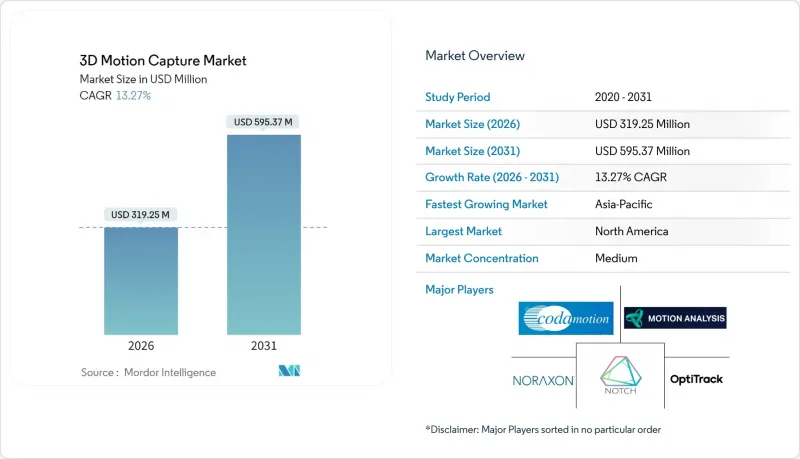
這一成長表明,3D動作捕捉市場正持續從小眾娛樂應用領域轉型為醫療保健、體育分析和工業自動化等領域的廣泛應用。邊緣設備上更快的AI推理速度、不斷下降的相機成本以及更精準的無標記演算法正在擴大基本客群。隨著工作室和診所對更高影格速率的需求,硬體更新換代週期依然活躍。同時,基於訂閱的軟體模式使小規模團隊能夠以較低的前期成本使用高級功能。隨著現有企業專注於無標記產品,而新參與企業則透過整合雲端邊緣工作流程來脫穎而出,市場競爭日益激烈。
全球3D動作捕捉市場趨勢與洞察
無標記運動捕捉技術在遠距復健和遠距物理治療的快速應用
醫療機構越來越依賴基於攝影機的系統,這些系統能夠以小於10°的平均絕對誤差測量關節角度,並將數據安全地傳輸給臨床醫生。這種方法減少了患者的出行,縮短了治療週期,並有助於追蹤客觀的治療效果。隨著遠端動作捕捉評估被納入健保報銷範圍,支付方的覆蓋範圍也不斷擴大。供應商也積極回應,推出了簡化的校準流程,使治療師能夠在狹小的空間內設置單一攝影機套件。隨著臨床有效性的不斷檢驗,無標記動作捕捉技術正在為新興的數位醫療服務提供支持,並加速3D動作捕捉市場的發展勢頭。
在媒體和娛樂製作流程中日益普及
工作室正將動作捕捉技術與LED幕牆和遊戲引擎渲染相結合,在拍攝過程中可視化最終場景,從而減少40%的後製工作。 Vicon進軍無標記技術領域,凸顯了這一轉變,因為傳統的光學專家正努力保護其收入來源。其為虛幻引擎開發的即時插件,使動畫團隊能夠即時迭代鏡頭設計,縮短回饋週期。成本的下降正在加速多角色體積技術的應用,而這項技術過去需要巨額預算才能實現,如今獨立電影製作人和虛擬製作公司也紛紛採用。由此帶來的生產力提升,持續推動3D動作捕捉市場維持強勁成長動能。
高精準度3D動作捕捉生態系的前期投入成本很高
專業光學系統通常售價超過10萬美元,這限制了其普及,只有財力雄厚的攝影棚、研究實驗室和頂級運動隊伍才能負擔得起。即使是穿戴式慣性套件,硬體起價約為4,590美元,永久授權軟體起價約為3,790美元。訂閱模式和低成本的單攝影機解決方案降低了准入門檻,但並不能完全消除小規模營運商的資金障礙。除非價格進一步下降或資金籌措管道更加暢通,否則高昂的進入成本可能會限制3D動作捕捉市場某些細分領域的普及。
細分市場分析
到2025年,硬體將佔3D動作捕捉市場46.10%的佔有率,凸顯了攝影機、深度感測器和慣性測量單元在所有安裝應用中的重要性。影格速率、解析度和裝置內AI處理的持續改進推動了更新換代。該領域也受惠於跨產業需求,涵蓋娛樂、醫療保健等多個領域。服務領域雖然規模較小,但預計將以15.06%的複合年成長率成長,這主要得益於用戶傾向於將校準、維護和分析外包。軟體收入介於兩者之間,這得益於定期更新、雲端部署以及與內容製作流程的緊密整合。
隨著硬體效能的提升,工作室為了保持競爭力,不得不升級設備,而新參與企業則將NVIDIA Jetson等人工智慧加速器直接嵌入感測器模組。服務成長與市場成熟同步,客戶越來越重視能夠節省時間的專業技術。雲端原生軟體即服務(SaaS)使小規模的團隊能夠在投入資金之前測試無標記工作流程,從而擴大了3D動作捕捉市場的用戶群。
到2025年,光學平台將佔據3D動作捕捉市場62.90%的佔有率。目前,電影公司仍依賴多機位拍攝來捕捉高預算電影的表演,精確度可達亞毫米級。研究機構和精英運動項目也傾向於使用光學鑽機進行詳細的動態研究。同時,以慣性穿戴裝置為代表的非光學系統,由於其便攜性和易於安裝的特點,預計將以14.28%的複合年成長率成長,使其適用於現場訓練和遠端醫療。
混合架構融合了光學和慣性技術,兼具兩者的優勢:絕對的精度和不受遮蔽的影響。供應商提供跨多個感測器流的同步時間戳,誤差小於150微秒,從而實現無縫資料融合。這種融合正在拓展3D運動捕捉市場的應用範圍,使其能夠應用於純光學或慣性解決方案無法勝任的領域。
區域分析
預計到2025年,北美將佔據39.95%的收入佔有率,這主要得益於好萊塢製片廠、大學體育項目以及遠距遠端醫療的蓬勃發展。創業投資資金以及完善的中間件供應商生態系統,為早期原型製作和大規模部署提供了支援。該地區受益於清晰的FDA核准途徑,降低了醫療應用監管的不確定性。此外,各公司也正在投資身臨其境型培訓和虛擬製作,進一步鞏固了主導地位。
預計亞太地區在2026年至2031年間將以15.62%的複合年成長率成長。 NAVER D2SF對韓國Start-UpsMOVIN的投資等資本注入,反映出市場對該地區日益成長的興趣。諸如2024年歐洲盃等大型體育賽事展示了先進的分析流程,推動了國內聯賽採用類似工具。製造業基礎設施的完善降低了硬體成本,促進了娛樂、機器人和醫療保健等行業的快速部署。政府對工業數位化的支持進一步拓展了3D動作捕捉市場的機會。
歐洲正透過整合研究主導創新和公共衛生,穩步推進相關工作。諸如瑞典皇家理工學院(KTH)等機構的計劃正在展示符合嚴格隱私法的先進攝影機復健工具。 GDPR正在塑造以邊緣運算為中心的架構,使提供本地分析服務的供應商受益。中東、非洲和拉丁美洲的需求正在湧現,尤其是在運動表現和遠端醫療領域。在遠端醫療領域,動作捕捉技術正在幫助緩解醫療人員短缺的問題。隨著設備價格的下降,預計這些地區將對3D動作捕捉市場產生新的需求。
其他福利:
- Excel格式的市場預測(ME)表
- 分析師支持(3個月)
目錄
第1章 引言
- 研究假設和市場定義
- 調查範圍
第2章調查方法
第3章執行摘要
第4章 市場情勢
- 市場概覽
- 市場促進因素
- 不斷創造更逼真的虛擬實境體驗
- 電腦視覺在職業運動分析的應用日益廣泛
- 在媒體和娛樂製作流程中日益普及
- 與人工智慧驅動的數位人體建模整合,以實現符合人體工學的兼容性
- 無標記運動捕捉技術在遠距復健和遠距物理治療的快速應用
- 對用於訓練自主機器人的高精度運動資料集的需求
- 市場限制
- 高精準度3D動作捕捉生態系的初始准入成本很高
- 大型動態影像庫中內容擁有者的智慧財產權和隱私權問題
- 缺乏開放的交換標準限制了跨平台工作流程。
- 高速影像感測器和慣性測量單元供應鏈的變異性
- 產業價值鏈分析
- 監管環境
- 技術展望
- 宏觀經濟因素如何影響市場
- 波特五力分析
- 供應商的議價能力
- 買方的議價能力
- 新進入者的威脅
- 替代品的威脅
- 競爭對手之間的競爭
第5章 市場規模與成長預測
- 按類型
- 硬體
- 相機
- 感應器
- 配件
- 軟體
- 服務
- 硬體
- 按系統
- 光學3D運動捕捉系統
- 主動光學
- 被動光學
- 非光學3D運動捕捉系統
- 慣性
- 電磁學
- 馬達驅動
- 光學3D運動捕捉系統
- 透過捕獲技術
- 標記底座
- 無標記
- 透過使用
- 動態研究與醫學
- 媒體與娛樂
- 工程與工業
- 教育
- 其他用途
- 透過部署模式
- 本地部署
- 基於雲端的
- 按地區
- 北美洲
- 美國
- 加拿大
- 墨西哥
- 南美洲
- 巴西
- 阿根廷
- 其他南美洲
- 歐洲
- 德國
- 法國
- 英國
- 義大利
- 西班牙
- 其他歐洲地區
- 亞太地區
- 中國
- 日本
- 印度
- 韓國
- 澳洲
- 亞太其他地區
- 中東和非洲
- 中東
- 沙烏地阿拉伯
- 阿拉伯聯合大公國
- 土耳其
- 其他中東地區
- 非洲
- 南非
- 埃及
- 奈及利亞
- 其他非洲地區
- 中東
- 北美洲
第6章 競爭情勢
- 市場集中度
- 策略趨勢
- 市佔率分析
- 公司簡介
- Vicon Motion Systems Ltd.
- Leyard Optoelectronic Co. Ltd.(NaturalPoint Inc./OptiTrack)
- Motion Analysis Corporation
- Qualisys AB
- Xsens Technologies BV
- Codamotion-Charnwood Dynamics Ltd.
- Noraxon USA Inc.
- PhaseSpace Inc.
- Phoenix Technologies Inc.
- AIQ Synertial Ltd.
- Notch Interfaces Inc.
- Perception Neuron-Noitom Ltd.
- Rokoko Electronics ApS
- STT Systems SL
- Simi Reality Motion Systems GmbH
- Animazoo-Synertial Limited
- QualiSense Motion Inc.
- Perception Digital Ltd.
- Organic Motion Inc.
- AI-Driven Solesense Corp.
第7章 市場機會與未來展望
The 3D motion capture market is expected to grow from USD 281.85 million in 2025 to USD 319.25 million in 2026 and is forecast to reach USD 595.37 million by 2031 at 13.27% CAGR over 2026-2031.
This growth underscores how the 3D motion capture market is continuing to shift from niche entertainment use to wider adoption in healthcare, sports analytics, and industrial automation. Faster artificial intelligence inference on edge devices, falling camera costs, and more accurate marker-less algorithms are broadening the customer base. Hardware refresh cycles remain brisk as studios and clinics seek higher frame rates, while subscription-based software models enable smaller teams to access premium features without incurring large upfront costs. Competitive intensity is increasing as incumbents pivot toward marker-less offerings and new entrants differentiate through integrated cloud-edge workflows.
Global 3D Motion Capture Market Trends and Insights
Rapid Uptake of Marker-Less MoCap in Tele-Rehabilitation and Remote Physiotherapy
Healthcare providers are increasingly relying on camera-based systems that report joint angles with a mean absolute error of below 10° and stream data securely to clinicians. The approach reduces travel burdens for patients, shortens therapy cycles, and supports objective outcome tracking. Reimbursement frameworks now recognize remote motion capture assessments, expanding payer coverage. Vendors respond with simplified calibration flows that let therapists install single-camera kits in smaller spaces. As clinical validation broadens, marker-less motion capture underpins new digital health services, fueling momentum in the 3D motion capture market.
Growing Adoption in Media and Entertainment Production Pipelines
Studios combine motion capture with LED walls and game-engine rendering to visualize final scenes during filming, cutting post-production labor by 40%. Vicon's entry into marker-less technology validates the shift as legacy optical specialists seek to protect revenue streams. Real-time plugins for Unreal Engine allow animation teams to iterate shot design live, shrinking feedback loops. Cost declines encourage indie filmmakers and virtual production agencies to adopt multi-actor volumes that once required blockbuster budgets. The resulting productivity gains keep the 3D motion capture market on a strong expansion track.
High Upfront Cost of Precision 3D MoCap Ecosystems
Professional optical installations often exceed USD 100,000, restricting adoption to well-funded studios, labs, and elite sports franchises. Even body-worn inertial kits start around USD 4,590 for hardware and USD 3,790 for perpetual software licenses. Subscription models and low-cost single-camera offerings lower barriers but do not fully remove capital hurdles for small agencies. Until price points fall further or financing options expand, elevated acquisition costs will temper the pace of adoption for certain customer segments inside the 3D motion capture market.
Other drivers and restraints analyzed in the detailed report include:
- Rise in Creation of More Realistic Virtual Reality Experiences
- Demand for High-Fidelity Motion Datasets to Train Autonomous Robots
- Supply-Chain Volatility for High-Speed Image Sensors and IMUs
For complete list of drivers and restraints, kindly check the Table Of Contents.
Segment Analysis
Hardware accounted for 46.10% of the 3D motion capture market in 2025, underscoring the importance of cameras, depth sensors, and inertial units in every installation. Continuous improvements in frame rate, resolution, and on-device AI processing stimulate replacement cycles. This segment also benefits from cross-industry demand that spans entertainment and healthcare. Services, while smaller, are forecast to post a 15.06% CAGR as users outsource calibration, maintenance, and analytics. Software revenue sits between the two, lifted by regular updates, cloud deployment, and tight integration with content pipelines.
Rising hardware performance prompts studios to refresh their rigs to stay competitive, and new entrants bundle AI accelerators, such as NVIDIA Jetson, directly into sensor modules. Services growth aligns with market maturation, where customers value time-saving expertise. Cloud-native software-as-a-service lets small teams test marker-less workflows before committing capital, broadening the 3D motion capture market user base.
Optical platforms held 62.90% share of the 3D motion capture market size in 2025. Studios still rely on multi-camera volumes to capture high-budget cinematic performances at sub-millimeter accuracy. Research labs and elite sports programs also favor optical rigs for detailed biomechanical studies. In parallel, non-optical systems led by inertial wearables are expected to grow 14.28% CAGR, thanks to portability and easy setup that suit field training and tele-health.
Hybrid architectures mix optical and inertial technologies to combine the best of both worlds: absolute accuracy and freedom from occlusion. Suppliers offer synchronized time-stamping across sensor streams under 150 microseconds, enabling seamless data fusion. This convergence expands the 3D motion capture market footprint into environments where pure optical or pure inertial solutions fall short.
The 3D Motion Capture Market Report is Segmented by Type (Hardware, Software, and Services), System (Optical 3D MoCap Systems, and Non-Optical 3D MoCap Systems), Capture Technology (Marker-Based, and Marker-Less), Application (Biomechanical Research and Medical, Media and Entertainment, and More), Deployment Mode (On-Premise, and Cloud-Based), and Geography. The Market Forecasts are Provided in Terms of Value (USD).
Geography Analysis
North America held 39.95% revenue share in 2025, anchored by Hollywood studios, collegiate sports programs, and robust tele-health adoption. Venture funding, combined with a deep ecosystem of middleware suppliers, supports early prototyping and large-scale deployment. The region benefits from clear FDA pathways that reduce regulatory ambiguity for medical applications. Enterprises also invest in immersive training and virtual production, reinforcing North America's leadership in the 3D motion capture market.
Asia-Pacific is projected to grow at a 15.62% CAGR between 2026 and 2031. Capital infusions such as NAVER D2SF's backing of Korean start-up MOVIN reflect rising regional interest. Major sporting events, such as EURO 2024, showcased advanced analytics pipelines that inspire domestic leagues to adopt similar tools. The manufacturing base lowers hardware costs, encouraging fast rollouts across entertainment, robotics, and healthcare. Government support for industrial digitalization further amplifies opportunity across the 3D motion capture market.
Europe posts steady gains through research-driven innovation and the integration of public health. Projects at institutions like KTH demonstrate deep camera-based rehabilitation tools compliant with strict privacy laws.GDPR shapes edge-heavy architectures, benefiting local software vendors offering on-premise analytics. Middle East and Africa and Latin America present emerging demand, primarily in sports performance and tele-medicine where motion capture bridges clinician shortages. As equipment prices fall, these regions will add incremental volume to the 3D motion capture market.
- Vicon Motion Systems Ltd.
- Leyard Optoelectronic Co. Ltd. (NaturalPoint Inc./OptiTrack)
- Motion Analysis Corporation
- Qualisys AB
- Xsens Technologies B.V.
- Codamotion - Charnwood Dynamics Ltd.
- Noraxon USA Inc.
- PhaseSpace Inc.
- Phoenix Technologies Inc.
- AIQ Synertial Ltd.
- Notch Interfaces Inc.
- Perception Neuron - Noitom Ltd.
- Rokoko Electronics ApS
- STT Systems S.L.
- Simi Reality Motion Systems GmbH
- Animazoo - Synertial Limited
- QualiSense Motion Inc.
- Perception Digital Ltd.
- Organic Motion Inc.
- AI-Driven Solesense Corp.
Additional Benefits:
- The market estimate (ME) sheet in Excel format
- 3 months of analyst support
TABLE OF CONTENTS
1 INTRODUCTION
- 1.1 Study Assumptions and Market Definition
- 1.2 Scope of the Study
2 RESEARCH METHODOLOGY
3 EXECUTIVE SUMMARY
4 MARKET LANDSCAPE
- 4.1 Market Overview
- 4.2 Market Drivers
- 4.2.1 Rise in creation of more realistic virtual reality experiences
- 4.2.2 Increased usage of computer vision in professional sports analytics
- 4.2.3 Growing adoption in media and entertainment production pipelines
- 4.2.4 Integration with AI-driven digital human modelling for ergonomic compliance
- 4.2.5 Rapid uptake of marker-less MoCap in tele-rehabilitation and remote physiotherapy
- 4.2.6 Demand for high-fidelity motion datasets to train autonomous robots
- 4.3 Market Restraints
- 4.3.1 High upfront cost of precision 3D MoCap ecosystems
- 4.3.2 Content-owner IP and privacy concerns for large-scale motion libraries
- 4.3.3 Absence of open interchange standards limiting cross-platform workflows
- 4.3.4 Supply-chain volatility for high-speed image sensors and IMUs
- 4.4 Industry Value Chain Analysis
- 4.5 Regulatory Landscape
- 4.6 Technological Outlook
- 4.7 Impact of Macroeconomic Factors on the Market
- 4.8 Porter's Five Forces Analysis
- 4.8.1 Bargaining Power of Suppliers
- 4.8.2 Bargaining Power of Buyers
- 4.8.3 Threat of New Entrants
- 4.8.4 Threat of Substitute Products
- 4.8.5 Intensity of Competitive Rivalry
5 MARKET SIZE AND GROWTH FORECASTS (VALUE)
- 5.1 By Type
- 5.1.1 Hardware
- 5.1.1.1 Cameras
- 5.1.1.2 Sensors
- 5.1.1.3 Accessories
- 5.1.2 Software
- 5.1.3 Services
- 5.1.1 Hardware
- 5.2 By System
- 5.2.1 Optical 3D MoCap Systems
- 5.2.1.1 Active Optical
- 5.2.1.2 Passive Optical
- 5.2.2 Non-optical 3D MoCap Systems
- 5.2.2.1 Inertial
- 5.2.2.2 Electromagnetic
- 5.2.2.3 Motorized
- 5.2.1 Optical 3D MoCap Systems
- 5.3 By Capture Technology
- 5.3.1 Marker-based
- 5.3.2 Marker-less
- 5.4 By Application
- 5.4.1 Biomechanical Research and Medical
- 5.4.2 Media and Entertainment
- 5.4.3 Engineering and Industrial
- 5.4.4 Education
- 5.4.5 Other Applications
- 5.5 By Deployment Mode
- 5.5.1 On-premise
- 5.5.2 Cloud-based
- 5.6 By Geography
- 5.6.1 North America
- 5.6.1.1 United States
- 5.6.1.2 Canada
- 5.6.1.3 Mexico
- 5.6.2 South America
- 5.6.2.1 Brazil
- 5.6.2.2 Argentina
- 5.6.2.3 Rest of South America
- 5.6.3 Europe
- 5.6.3.1 Germany
- 5.6.3.2 France
- 5.6.3.3 United Kingdom
- 5.6.3.4 Italy
- 5.6.3.5 Spain
- 5.6.3.6 Rest of Europe
- 5.6.4 Asia-Pacific
- 5.6.4.1 China
- 5.6.4.2 Japan
- 5.6.4.3 India
- 5.6.4.4 South Korea
- 5.6.4.5 Australia
- 5.6.4.6 Rest of Asia-Pacific
- 5.6.5 Middle East and Africa
- 5.6.5.1 Middle East
- 5.6.5.1.1 Saudi Arabia
- 5.6.5.1.2 United Arab Emirates
- 5.6.5.1.3 Turkey
- 5.6.5.1.4 Rest of Middle East
- 5.6.5.2 Africa
- 5.6.5.2.1 South Africa
- 5.6.5.2.2 Egypt
- 5.6.5.2.3 Nigeria
- 5.6.5.2.4 Rest of Africa
- 5.6.5.1 Middle East
- 5.6.1 North America
6 COMPETITIVE LANDSCAPE
- 6.1 Market Concentration
- 6.2 Strategic Moves
- 6.3 Market Share Analysis
- 6.4 Company Profiles (includes Global level Overview, Market level overview, Core Segments, Financials as available, Strategic Information, Market Rank/Share for key companies, Products and Services, and Recent Developments)
- 6.4.1 Vicon Motion Systems Ltd.
- 6.4.2 Leyard Optoelectronic Co. Ltd. (NaturalPoint Inc./OptiTrack)
- 6.4.3 Motion Analysis Corporation
- 6.4.4 Qualisys AB
- 6.4.5 Xsens Technologies B.V.
- 6.4.6 Codamotion - Charnwood Dynamics Ltd.
- 6.4.7 Noraxon USA Inc.
- 6.4.8 PhaseSpace Inc.
- 6.4.9 Phoenix Technologies Inc.
- 6.4.10 AIQ Synertial Ltd.
- 6.4.11 Notch Interfaces Inc.
- 6.4.12 Perception Neuron - Noitom Ltd.
- 6.4.13 Rokoko Electronics ApS
- 6.4.14 STT Systems S.L.
- 6.4.15 Simi Reality Motion Systems GmbH
- 6.4.16 Animazoo - Synertial Limited
- 6.4.17 QualiSense Motion Inc.
- 6.4.18 Perception Digital Ltd.
- 6.4.19 Organic Motion Inc.
- 6.4.20 AI-Driven Solesense Corp.
7 MARKET OPPORTUNITIES AND FUTURE OUTLOOK
- 7.1 White-space and unmet-need assessment

 3D動畫動作捕捉工具市場:全球市場預測,2026-2032年動作捕捉軟體系統市場:全球市場預測,2026-2032年
 動作捕捉數據手套市場報告:趨勢、預測和競爭分析(至2035年)
 3D動作捕捉市場規模、佔有率和趨勢分析報告:按組件、系統、最終用途、地區和細分市場預測(2026-2033年)
 動作捕捉服市場:按技術、應用和地區分類
 3D動作捕捉市場報告:按類型、應用、系統和地區分類(2026-2034)
 3D動作捕捉市場分析及預測(至2035年):依類型、產品、服務、技術、應用、組件、部署、最終使用者及流程分類
 全球無標記動作捕捉市場規模、佔有率、趨勢和成長分析報告(2026-2034)全矩陣擷取檢測器市場:按產品類型、應用、最終用戶和銷售管道- 全球預測 2026-2032 年動作感測器模組市場按技術、安裝類型、分銷管道、安裝方式、應用和最終用戶產業分類-2026-2032年全球預測