


 |
市場調查報告書
商品編碼
1939003
無菌包裝:市場佔有率分析、產業趨勢與統計、成長預測(2026-2031)Aseptic Packaging - Market Share Analysis, Industry Trends & Statistics, Growth Forecasts (2026 - 2031) |
||||||

※ 本網頁內容可能與最新版本有所差異。詳細情況請與我們聯繫。
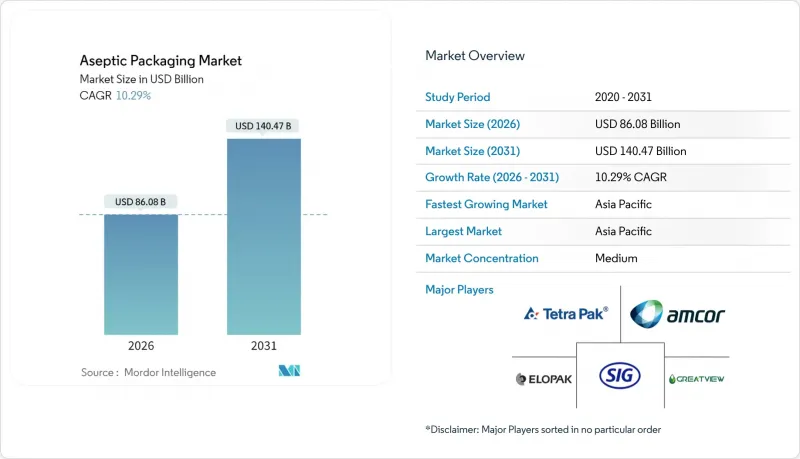
2025年無菌包裝市場價值為780.5億美元,預計到2031年將達到1,404.7億美元,高於2026年的860.8億美元。
預計在預測期(2026-2031 年)內,複合年成長率將達到 10.29%。
對常溫保存食品和飲料的需求不斷成長、食品安全法規日益嚴格以及降低低溫運輸成本的必要性,都提升了無菌和常溫配送方式的吸引力。品牌商正在擴大無菌生產線,以滿足缺乏冷藏基礎設施地區對即飲機能飲料和常溫保存乳製品日益成長的需求。同時,生物製藥製造和個人化療法的進步正在擴大製藥業在無菌包裝市場的收入基礎。材料科學的創新,例如無鋁阻隔性紙盒和不含PFAS的塗層,使製造商能夠在不影響無菌性的前提下滿足新的永續性要求。加工商和樹脂製造商之間的整合增強了他們在波動較大的聚合物市場中的購買力。此外,數位印刷技術能夠實現經濟高效的小批量生產,適用於日益增多的SKU(庫存單位)。
全球無菌包裝市場趨勢與洞察
即飲機能飲料的快速成長
功能性即飲飲料需要無菌解決方案,以在室溫下保存微量營養素、益生菌和植物成分長達 12 個月。品牌商正在使用高阻隔阻隔性紙盒和多層瓶,以阻隔氧氣、光線和紫外線,方便在便利商店進行最後一公里配送。美國、中國和泰國的飲料填充商正在安裝新的高速無菌生產線,產能超過每小時 48,000 瓶,以滿足新型運動營養、能量和植物蛋白飲料產品的產品推出。隨著食品級無菌和藥品級驗證之間的界限日益模糊,管瓶和小瓶供應商正致力於吸引那些尋求高階產品定位的飲料客戶。原料供應商指出,無菌加工實現的長保存期限允許減少防腐劑的使用,增加活性成分的含量,從而支持潔淨標示和更高的零售價格。
擴大常溫乳製品在亞洲新興市場的分銷
印度、越南和印尼正迅速從管控鬆散的冷藏供應鏈轉向無菌常溫牛奶和優格。都市區乳製品加工商正投資超高溫滅菌器和Brick包裝灌裝機,以服務電網不穩定導致冷藏成本居高不下的農村地區。在中國,2024年起禁止在常溫飲料中使用復原奶粉,這推動了對純牛奶無菌生產線的投資,進而帶動了對能夠耐受135度C高溫滅菌的低酸紙盒複合材料的需求。跨國品牌正與當地合作社成立合資企業,以確保原乳供應,並在農場附近安裝模組化無菌微型工廠,從而顯著降低道路運輸成本並防止牛奶變質。因此,無菌包裝市場正成為新興亞洲國家政府長期糧食安全政策的重要組成部分。
多層聚合物價格波動
2024年聚乙烯和聚丙烯價格每磅上漲5美分,擠壓了加工商的利潤空間,並導致季度附加費的增加。原料市場(例如石腦油和乙烷)的波動,使得紙箱吸嘴、瓶蓋和阻隔膜的預算編制變得更加複雜。大規模買家透過簽訂多年期合約對沖樹脂價格,而小規模填充商則受到現貨價格波動的影響,並且由於需要推遲將熱填充線更換為無菌設備,導致資本計劃延期。全球樹脂供應的結構性限制,包括裂解裝置意外停產和運輸瓶頸,可能會在可預見的未來繼續導致價格波動。
細分市場分析
在無菌包裝市場,紙盒包裝預計到2025年將佔銷售額的63.30%,主要得益於其在乳製品、果汁和即飲咖啡領域的高滲透率。紙盒的矩形設計最大限度地提高了托盤利用率和商店面積,而新型的無吸管瓶蓋也符合減少塑膠使用的目標。同時,受注射用生物製藥、疫苗和細胞療法廣泛應用的推動,管瓶和安瓿瓶預計到2031年將以12.98%的複合年成長率成長。管瓶和安瓿瓶的無菌包裝市場預計到2031年將達到109.4億美元,這反映了它們在人用和動物用藥品的廣泛應用。對於冰沙和風味牛奶等高黏度飲料而言,瓶裝仍然是重要的包裝選擇,可重複密封的大容量包裝提升了飲用的便利性。罐裝產品憑藉其高抗穿刺性,已在超高溫滅菌椰子水和高酸度食物泥等細分市場佔據一席之地,但鋁價波動和年輕消費者偏好紙質包裝限制了其成長。袋裝襯袋紙盒系統因其便於運輸和開封後保存期限長而受到餐飲服務商的青睞,而單份吸嘴袋則為嬰兒飲品和運動營養凝膠提供了便攜性。
減少碳足跡的努力正在推動產品層面的創新。 SIG公司計劃於2025年推出一款完全可回收、不含鋁的1升紙盒,該紙盒在室溫下可保持12個月的保存期限,並已被歐洲主要乳製品品牌率先採用。同時,管瓶製造商開發出聚合物包覆玻璃的複合容器,在保持惰性接觸面的同時,重量減輕了30%,有助於減少全球疫苗接種宣傳活動中的運輸排放。隨著新材料的不斷湧現,產品在阻隔性能、可回收性和填充速度方面的差異化將繼續塑造無菌包裝市場的競爭優勢。
區域分析
到2025年,亞太地區將佔全球銷售額的38.05%,其中中國、印度和印尼將引領這一市場。印度的國家營養計畫旨在2027年將包裝牛奶的普及率提高到15%以上,鼓勵公私部門投資無菌包裝產能。 SIG在古吉拉突邦新建的價值9000萬歐元的工廠將新增40億包的年產能,以供應當地的乳製品和飲用型優格市場。在中國,一項禁止將復原奶粉灌裝到超高溫滅菌(UHT)紙盒中的政策迫使加工商轉向更可靠的製造商,從而加強了價格管控並提高了利潤率。一家東南亞新興企業正在推出一款採用250毫升纖薄紙盒包裝的維生素強化茶,以吸引消費者隨時隨地飲用。
南美洲是成長最快的地區,預計到2031年將以14.02%的複合年成長率成長。在巴西,通膨壓力促使消費者偏好散裝和常溫保存產品,推動包裝食品市場到2024年達到1,136億美元。柴油和電力成本的上漲促使內陸物流中心加大投資,以優先運輸常溫保存產品。阿根廷乳製品出口商正在利用軟包裝袋線將無乳糖牛奶運往智利和秘魯,因此無需冷藏。北美和歐洲預計將實現中等個位數的成長,這主要得益於對永續性材料的轉向,而非銷售的擴張。歐盟對全氟烷基和多氟烷基物質(PFAS)的禁令正在推動基於氧化矽的紙盒阻隔材料的商業化,而美國填充商正在高風險地區應用機器人技術以應對勞動力短缺問題。儘管中東和非洲地區規模較小,但在人口成長和政府糧食安全戰略的推動下,該地區具有巨大的長期成長潛力。埃及工業區是 UFlex 公司投資 2 億美元興建的層壓板綜合體的位置,該綜合體旨在為該地區供應產品。
其他福利:
- Excel格式的市場預測(ME)表
- 3個月的分析師支持
目錄
第1章 引言
- 研究假設和市場定義
- 調查範圍
第2章調查方法
第3章執行摘要
第4章 市場情勢
- 市場概覽
- 市場促進因素
- 即飲機能飲料的快速成長
- 擴大常溫乳製品在亞洲新興地區的銷售
- 嚴格的食品安全法規推動了無菌包裝的普及
- 受通貨膨脹影響,物流方式從低溫運輸轉向常溫(通報不足)
- 轉向永續、輕量化的包裝至關重要。
- D2C品牌數位印刷短SKU的興起(報道不足)
- 市場限制
- 多層聚合物價格波動
- 無菌灌裝生產線需要較高的初始資本投入
- 鋁箔複合材料回收基礎設施有限(數據瞞報)
- 關於 PFAS 阻隔塗層的管制不確定性(未充分通報)
- 價值/供應鏈分析
- 監管環境
- 技術展望
- 波特五力分析
- 供應商的議價能力
- 買方的議價能力
- 新進入者的威脅
- 替代品的威脅
- 競爭對手之間的競爭
- 定價分析
- 飲料無菌包裝-需求洞察
第5章 市場規模與成長預測
- 依產品
- 紙盒
- 瓶子
- 罐頭
- 袋子和小袋
- 管瓶和安瓿
- 按材料組成
- 紙和紙板
- 塑膠(聚丙烯、聚乙烯、聚對苯二甲酸乙二醇酯)
- 玻璃
- 金屬(鋁、鋼)
- 複合層壓板
- 透過使用
- 飲料
- 即飲飲料
- 乳製品飲料
- 食物
- 加工食品
- 水果和蔬菜
- 乳製品
- 製藥
- 個人護理及化妝品
- 飲料
- 按地區
- 北美洲
- 美國
- 加拿大
- 墨西哥
- 歐洲
- 英國
- 德國
- 法國
- 義大利
- 其他歐洲地區
- 亞太地區
- 中國
- 日本
- 印度
- 韓國
- 亞太其他地區
- 中東
- 以色列
- 沙烏地阿拉伯
- 阿拉伯聯合大公國
- 土耳其
- 其他中東地區
- 非洲
- 南非
- 埃及
- 其他非洲地區
- 南美洲
- 巴西
- 阿根廷
- 其他南美洲
- 北美洲
第6章 競爭情勢
- 市場集中度
- 策略趨勢
- 市佔率分析
- 公司簡介
- Tetra Pak International SA
- SIG Combibloc Group
- Amcor PLC
- Elopak ASA
- IPI SRL(Coesia Group)
- DS Smith PLC
- Smurfit Kappa Group
- Mondi PLC
- Uflex Limited
- Schott AG
- Gerresheimer AG
- Toyo Seikan Group
- CDF Corporation
- BIBP Sp. z oo
- Nampak Ltd
- Greatview Aseptic Packaging
- Liqui-Box(Graphic Packaging)
- OPLATEK Group
- Sealed Air Corporation
- ProAmpac
第7章 市場機會與未來展望
The aseptic packaging market was valued at USD 78.05 billion in 2025 and estimated to grow from USD 86.08 billion in 2026 to reach USD 140.47 billion by 2031, at a CAGR of 10.29% during the forecast period (2026-2031).
Growing demand for shelf-stable foods and beverages, stricter food-safety rules, and the need to trim cold-chain costs are reinforcing the appeal of sterile, ambient-distribution formats. Brand owners are scaling aseptic lines to meet rising demand for ready-to-drink (RTD) functional beverages and for shelf-stable dairy in regions where refrigeration infrastructures remain patchy. At the same time, biologics manufacturing and personalized therapies are widening the pharmaceutical revenue base for the aseptic packaging market. Material science breakthroughs-such as aluminum-free high-barrier cartons and PFAS-free coatings-help manufacturers comply with new sustainability mandates without sacrificing sterility. Consolidation among converters and resin producers is bolstering purchasing leverage in a volatile polymer market, while digital printing is enabling cost-effective short runs that suit proliferating stock-keeping units.
Global Aseptic Packaging Market Trends and Insights
Rapid Growth of RTD Functional Beverages
Functional RTD drinks now demand aseptic solutions that lock in sensitive micronutrients, probiotics, and botanicals for up to 12 months at ambient temperatures. Brands are selecting high-barrier cartons and multilayer bottles that offer oxygen, light, and UV protection while easing last-mile distribution in convenience stores. Beverage fillers in the United States, China, and Thailand have installed new high-speed aseptic lines rated above 48,000 bottles per hour to serve sports-nutrition, energy-tea, and plant-based protein launches. The overlap between food-grade sterility and pharmaceutical-grade validation is narrowing, encouraging suppliers of vials & ampoules to court beverage customers seeking premium positioning. Ingredient suppliers note that the longer shelf life afforded by aseptic processing allows them to blend less preservative and more active compounds, supporting cleaner labels and higher retail prices.
Expansion of Ambient Dairy Distribution in Emerging Asia
India, Vietnam, and Indonesia are rapidly upgrading from loosely supervised chilled supply chains to aseptic shelf-stable milk and yogurt. Urban dairy processors are investing in UHT sterilizers and brick-pack fillers to reach rural districts where grid instability inflates refrigeration costs. In China, the 2024 decision to prohibit reconstituted milk powder in shelf-stable beverages elicited a wave of capex for pure-milk aseptic lines, driving demand for low-acid carton laminates that can withstand 135 °C sterilization. Multinational brands are forming joint ventures with local cooperatives to secure raw milk and deploy modular aseptic micro-plants close to farms, slashing road-haul costs and mitigating spoilage. As a result, the aseptic packaging market is becoming integral to the long-term food-security agendas of emerging Asian governments.
Volatility in Multilayer Polymer Prices
Polyethylene and polypropylene prices rose by 5 cents per pound in 2024, tightening converter margins and prompting quarterly surcharges. Fluctuating naphtha and ethane feedstock markets complicate budgeting for carton spouts, caps, and barrier films. While large purchasers hedge through multi-year resin contracts, small fillers experience spot-price pain that slows capital projects aimed at replacing hot-fill lines with aseptic equipment. Structural constraints in global resin supply, including unplanned outages at cracker complexes and shipping bottlenecks, signal that price volatility will persist for the near term.
Other drivers and restraints analyzed in the detailed report include:
- Stringent Food-Safety Regulations Pushing Sterile Packaging Adoption
- Inflation-Linked Shift From Cold-Chain to Shelf-Stable Logistics
- High Initial CAPEX for Aseptic Filling Lines
For complete list of drivers and restraints, kindly check the Table Of Contents.
Segment Analysis
Cartons secured 63.30% of 2025 revenue within the aseptic packaging market thanks to deep penetration in dairy, juice, and RTD coffee. Their rectangular footprint maximizes pallet efficiency and shelf facings, and new straw-less closures appeal to plastic-reduction goals. Meanwhile, vials & ampoules are expanding at a 12.98% CAGR through 2031 as injectable biologics, vaccines, and cell therapies proliferate. The aseptic packaging market size for vials & ampoules is projected to reach USD 10.94 billion by 2031, reflecting adoption in both human and veterinary medicine. Bottles remain important for high-viscosity drinks such as smoothies and for flavored milk where larger resealable formats enhance consumption convenience. Cans hold niche positions in UHT coconut water and high-acid fruit purees due to their robust puncture resistance, though growth is tempered by aluminum price swings and by younger consumers' preference for paper-based packs. Pouch-based bag-in-box systems attract food-service operators seeking compact shipping and extended post-opening shelf life; single-serve spouted pouches offer portability for early-childhood beverages and sports nutrition gels.
The pursuit of carbon-footprint cuts is stimulating product-level innovation. SIG's 2025 launch of a fully recyclable, aluminum-free 1 L carton that maintains a 12-month ambient shelf life won early adoption from leading European dairy brands. Separately, glass vial manufacturers have developed polymer-over-glass hybrid containers that reduce weight by 30% while retaining inert contact surfaces, easing freight emissions in global vaccine campaigns. As new materials emerge, product-level differentiation in barrier performance, recyclability, and filling speed will continue to shape competitive advantage within the aseptic packaging market.
Aseptic Packaging Market Report is Segmented by Product (Cartons, Bottles, Cans, Bags and Pouches, and More), Material Composition (Paper and Paperboard, Plastics, Glass, Metal, Composite Laminates), Application (Beverage, Food, Pharmaceuticals, Personal Care and Cosmetics), and Geography. The Market Forecasts are Provided in Terms of Value (USD).
Geography Analysis
Asia-Pacific held 38.05% of revenues in 2025, driven by China, India, and Indonesia. National nutrition programs in India aim to increase packaged milk penetration above 15% by 2027, catalyzing public-private investment in aseptic capacity. SIG's EUR 90 million green-field plant in Gujarat adds 4 billion pack annual output devoted to local dairy and drinkable yogurt. China's policy forbidding reconstituted milk powder in UHT cartons is pushing processors toward higher-integrity manufacturers, reinforcing price discipline and lifting margins. Southeast Asian start-ups are launching vitamin-fortified teas in 250 mL slim cartons to capture on-the-go consumption.
South America is the fastest growing region, projected to rise at 14.02% CAGR through 2031. Brazil's packaged-food market reached USD 113.6 billion in 2024 as inflationary pressures encouraged consumers to favor large-format, shelf-stable purchases. Investments in inland distribution centers favor ambient products due to high diesel and electricity costs. Argentina's dairy exporters are leveraging flexible pouch lines to ship lactose-free milk to Chile and Peru without refrigeration. North America and Europe show mid-single-digit growth, propelled by sustainability-driven material swaps rather than volume expansion. The EU PFAS ban stimulates the commercialization of silicon-oxide-based carton barriers, while US fillers adopt robotics in high-care zones to offset labor shortages. The Middle East and Africa, although smaller in value, present long-term upside tied to demographic growth and government food-security strategies. Egypt's industrial zones host UFlex's USD 200 million laminated-board complex aimed at regional supply
- Tetra Pak International SA
- SIG Combibloc Group
- Amcor PLC
- Elopak ASA
- IPI SRL (Coesia Group)
- DS Smith PLC
- Smurfit Kappa Group
- Mondi PLC
- Uflex Limited
- Schott AG
- Gerresheimer AG
- Toyo Seikan Group
- CDF Corporation
- BIBP Sp. z o.o.
- Nampak Ltd
- Greatview Aseptic Packaging
- Liqui-Box (Graphic Packaging)
- OPLATEK Group
- Sealed Air Corporation
- ProAmpac
Additional Benefits:
- The market estimate (ME) sheet in Excel format
- 3 months of analyst support
TABLE OF CONTENTS
1 INTRODUCTION
- 1.1 Study Assumptions and Market Definition
- 1.2 Scope of the Study
2 RESEARCH METHODOLOGY
3 EXECUTIVE SUMMARY
4 MARKET LANDSCAPE
- 4.1 Market Overview
- 4.2 Market Drivers
- 4.2.1 Rapid growth of RTD functional beverages
- 4.2.2 Expansion of ambient dairy distribution in emerging Asia
- 4.2.3 Stringent food-safety regulations pushing sterile packaging adoption
- 4.2.4 Inflation-linked shift from cold-chain to shelf-stable logistics (under-reported)
- 4.2.5 Shift toward sustainable, lightweight packaging mandates
- 4.2.6 Rise of digital?print-enabled short SKUs for D2C brands (under-reported)
- 4.3 Market Restraints
- 4.3.1 Volatility in multilayer polymer prices
- 4.3.2 High initial CAPEX for aseptic filling lines
- 4.3.3 Limited recycling infrastructure for aluminum-foil laminates (under-reported)
- 4.3.4 Regulatory uncertainty around PFAS barrier coatings (under-reported)
- 4.4 Value / Supply-Chain Analysis
- 4.5 Regulatory Landscape
- 4.6 Technological Outlook
- 4.7 Porter's Five Forces Analysis
- 4.7.1 Bargaining Power of Suppliers
- 4.7.2 Bargaining Power of Buyers
- 4.7.3 Threat of New Entrants
- 4.7.4 Threat of Substitutes
- 4.7.5 Intensity of Competitive Rivalry
- 4.8 Pricing Analysis
- 4.9 Aseptic Packaging for Beverages - Demand Insights
5 MARKET SIZE AND GROWTH FORECASTS (VALUE)
- 5.1 By Product
- 5.1.1 Cartons
- 5.1.2 Bottles
- 5.1.3 Cans
- 5.1.4 Bags and Pouches
- 5.1.5 Vials and Ampoules
- 5.2 By Material Composition
- 5.2.1 Paper and Paperboard
- 5.2.2 Plastics (PP, PE, PET)
- 5.2.3 Glass
- 5.2.4 Metal (Aluminum, Steel)
- 5.2.5 Composite Laminates
- 5.3 By Application
- 5.3.1 Beverage
- 5.3.1.1 Ready-to-drink (RTD) Beverages
- 5.3.1.2 Dairy-based Beverages
- 5.3.2 Food
- 5.3.2.1 Processed Food
- 5.3.2.2 Fruits and Vegetables
- 5.3.2.3 Dairy Food
- 5.3.3 Pharmaceuticals
- 5.3.4 Personal Care and Cosmetics
- 5.3.1 Beverage
- 5.4 By Geography
- 5.4.1 North America
- 5.4.1.1 United States
- 5.4.1.2 Canada
- 5.4.1.3 Mexico
- 5.4.2 Europe
- 5.4.2.1 United Kingdom
- 5.4.2.2 Germany
- 5.4.2.3 France
- 5.4.2.4 Italy
- 5.4.2.5 Rest of Europe
- 5.4.3 Asia-Pacific
- 5.4.3.1 China
- 5.4.3.2 Japan
- 5.4.3.3 India
- 5.4.3.4 South Korea
- 5.4.3.5 Rest of Asia-Pacific
- 5.4.4 Middle East
- 5.4.4.1 Israel
- 5.4.4.2 Saudi Arabia
- 5.4.4.3 United Arab Emirates
- 5.4.4.4 Turkey
- 5.4.4.5 Rest of Middle East
- 5.4.5 Africa
- 5.4.5.1 South Africa
- 5.4.5.2 Egypt
- 5.4.5.3 Rest of Africa
- 5.4.6 South America
- 5.4.6.1 Brazil
- 5.4.6.2 Argentina
- 5.4.6.3 Rest of South America
- 5.4.1 North America
6 COMPETITIVE LANDSCAPE
- 6.1 Market Concentration
- 6.2 Strategic Moves
- 6.3 Market Share Analysis
- 6.4 Company Profiles {(includes Global level Overview, Market level overview, Core Segments, Financials as available, Strategic Information, Market Rank/Share for key companies, Products and Services, and Recent Developments)}
- 6.4.1 Tetra Pak International SA
- 6.4.2 SIG Combibloc Group
- 6.4.3 Amcor PLC
- 6.4.4 Elopak ASA
- 6.4.5 IPI SRL (Coesia Group)
- 6.4.6 DS Smith PLC
- 6.4.7 Smurfit Kappa Group
- 6.4.8 Mondi PLC
- 6.4.9 Uflex Limited
- 6.4.10 Schott AG
- 6.4.11 Gerresheimer AG
- 6.4.12 Toyo Seikan Group
- 6.4.13 CDF Corporation
- 6.4.14 BIBP Sp. z o.o.
- 6.4.15 Nampak Ltd
- 6.4.16 Greatview Aseptic Packaging
- 6.4.17 Liqui-Box (Graphic Packaging)
- 6.4.18 OPLATEK Group
- 6.4.19 Sealed Air Corporation
- 6.4.20 ProAmpac
7 MARKET OPPORTUNITIES AND FUTURE OUTLOOK
- 7.1 White-space and Unmet-Need Assessment

 無菌包裝食品市場規模、佔有率和成長分析:按材料類型、包裝類型、應用、最終用途和地區分類-2026-2033年產業預測
 無菌包裝市場分析及預測(至2035年):依類型、產品類型、技術、材料類型、應用、組件、製程、最終用戶、功能分類
 2026年全球無菌包裝市場報告
 外科手術袋市場 - 全球產業規模、佔有率、趨勢、機會及預測(按袋類型、形狀、治療領域、最終用戶、地區和競爭格局分類,2021-2031年)
 無菌包裝市場規模、佔有率和成長分析(按材料、類型、應用和地區分類)—產業預測(2026-2033 年)
 無菌包裝市場預測至2032年:按包裝類型、材料、應用和地區分類的全球分析
 無菌包裝:全球市場佔有率和排名、總收入和需求預測(2025-2031年)無菌包裝市場-全球產業規模、佔有率、趨勢、機會與預測,按類型、材料、應用、地區和競爭細分,2020-2030 年
 2025-2033年無菌包裝市場報告(按類型、材料、應用和地區)
 滅菌包裝市場:按包裝類型、材料、應用和地區分類