


 |
市場調查報告書
商品編碼
1938985
高壓釜混凝土(AAC):市場佔有率分析、產業趨勢與統計、成長預測(2026-2031)Autoclaved Aerated Concrete (AAC) - Market Share Analysis, Industry Trends & Statistics, Growth Forecasts (2026 - 2031) |
||||||

※ 本網頁內容可能與最新版本有所差異。詳細情況請與我們聯繫。
預計高壓釜混凝土(AAC)市場將從 2025 年的 155.6 億美元成長到 2026 年的 165 億美元,到 2031 年將達到 221.1 億美元,2026 年至 2031 年的複合年成長率為 6.04%。
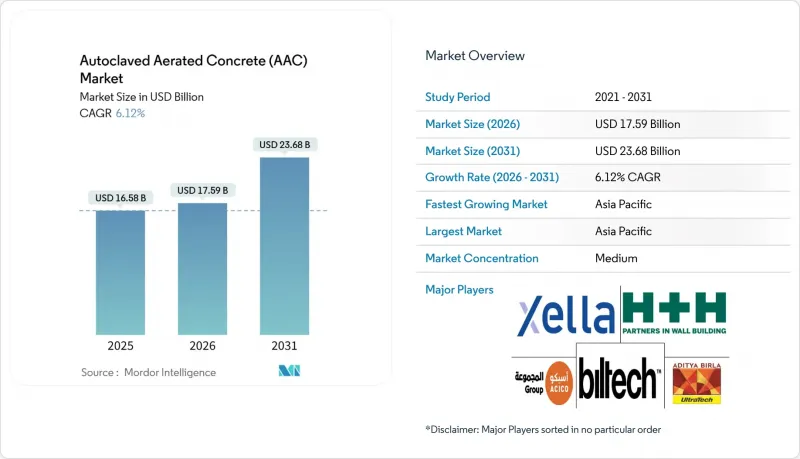
更嚴格的綠建築法規、對抗震結構日益成長的需求以及模組化建築的快速普及推動了加氣混凝土(AAC)市場的成長,這些因素都凸顯了AAC的輕質和節能特性。雖然砌塊仍然是傳統砌體結構的主要組成部分,但隨著預製構件加快施工速度,板材的應用正在迅速發展。亞太地區的需求量佔全球近一半,這主要得益於都市化和基礎設施投資;而北美和歐洲則受惠於其嚴格的能源和抗震規範。製造商正在擴大產能並實現工廠自動化,以滿足激增的需求、最佳化成本結構並加強區域供應鏈。
全球高壓釜混凝土(AAC)市場趨勢與洞察
新建和維修工程的需求不斷成長
隨著新興國家住宅和商業建築的快速成長,輕質建築材料對於降低地基荷載和縮短計劃週期至關重要。加氣混凝土(AAC)可減輕30-40%的重量,從而實現更輕的地基和更快的層間施工,這在人口密集的城市中心尤其重要。印度的住宅建設計劃凸顯了這一趨勢,其本土製造商BigBloc Construction正在擴大產能,以滿足都市區日益成長的住宅許可需求。加氣混凝土也是維修工程的首選材料,因為其精準的砌塊無需維修結構線,從而簡化了施工流程。其四小時的耐火性能提高了商業維修的合規性,而其防黴基體在潮濕氣候下尤其重要。這些因素共同推動了高壓釜混凝土市場的持續成長。
嚴格的綠建築標準和LEED認證正變得越來越普遍。
旨在減少蘊藏量排放的政策正在改變全球建築材料的選擇。美國政府為永續建築材料基準計畫提供的1.6億美元資金,無疑支持了加氣混凝土(AAC)的推廣應用。美國環保署(EPA)的2024年低碳標籤為製造商提供了量化其氣候優勢的明確途徑,從而增強了競標在公共工程項目中的競爭力。類似的轉型也正在歐洲發生,英國H+H公司致力於在2050年實現淨零排放運營,以符合歐盟的脫碳目標。厚度為200毫米、隔熱值R=1.43的加氣混凝土,透過摻入再生飛灰,可降低10-20%的運作能耗,並符合循環經濟標準。
與黏土/混凝土塊相比,初始成本較高
阻礙加氣混凝土(AAC)廣泛應用的一個因素是其價格溢價,因為建築商更重視採購價格而非全生命週期成本節約。然而,在印度主要都市區,傳統紅磚的價格已比加氣混凝土高出約20%,促使人們轉向更輕的替代材料。材料價格波動正在重塑比較標準。 2025年關稅政策已使鋼材價格上漲10-25%,混凝土價格上漲3-7%,削弱了加氣混凝土的成本優勢。在一些地區,由於當地工廠數量有限,交付價格也高出15-20%。宣傳活動強調加氣混凝土可節省30%的能源成本和減少勞動成本,這正逐步影響人們圍繞總擁有成本(TCO)所做的採購決策。
細分市場分析
到2025年,砌塊將佔總銷售額的54.10%,這反映了建築商數十年來對砌塊的熟悉程度以及其廣泛的分銷網路。同時,隨著建築商轉向預製外牆,板材市場到2031年將以7.55%的複合年成長率成長。板材市場的蓬勃發展反映了建設產業日益工業化的趨勢:工廠預製的模組可直接在現場使用,從而減少廢棄物並加快施工速度。開發商更傾向於在高層住宅大樓中使用板材,因為較少的接縫可以提高隔熱性能並減少熱量損失。
在低層住宅領域,砌塊結構仍佔據主導地位,尤其是在勞動力充足且現場施工技術盛行的市場。然而,板材技術的創新動能絲毫沒有減弱的跡象。鋼筋混凝土牆板可作為承重牆,而導熱係數僅為 0.11 W/mK 的屋頂模組則有助於實現零能耗建築的目標。自動化鋸切線和機器人搬運降低了板材的生產成本,推動了高壓釜混凝土(AAC)市場從手工砌塊鋪設轉向工業化板材組裝。
區域分析
到2025年,亞太地區將佔全球營收的46.40%,並在2031年之前以7.11%的複合年成長率加速成長。中國和印度將成為需求的中堅力量,這主要得益於大型住宅大型企劃和國家基礎設施規劃。政府對低碳建築方法的誘因進一步推動了加氣混凝土(AAC)規範的採用。日本和韓國因其抗震性能而採用加氣混凝土,而澳洲的住宅能源規範也支持其穩定推廣。亞太地區原料的高度自給自足以及不斷提高的自動化程度,使其單位成本保持競爭力,從而鞏固了亞太地區的優勢。
在北美,美國西部地區對建築防火性能的要求以及各氣候區日益嚴格的建築圍護結構法規,正推動著加氣混凝土(AAC)的重新流行。美國環保署(EPA)的低碳含量標籤促進了公共採購,而加拿大修訂後的《國家能源規範》也為其發展注入了動力。墨西哥的住宅獎勵策略與全部區域的趨勢相輔相成,共同推動了高壓釜混凝土市場的強勁成長。
嚴格的碳排放目標正在推動歐洲成熟市場的成長。德國和英國正積極維修建築改造,而北歐市場則加速向淨零能耗標準轉型。歐盟綠色交易的資金支持著工廠升級和新生產線的安裝。在中歐和東歐,物流設施和資料中心的建設熱潮帶動了對防火隔熱覆材的需求,創造了新的成長領域。
其他福利:
- Excel格式的市場預測(ME)表
- 3個月的分析師支持
目錄
第1章 引言
- 研究假設和市場定義
- 調查範圍
第2章調查方法
第3章執行摘要
第4章 市場情勢
- 市場概覽
- 市場促進因素
- 新建和維修工程的需求不斷成長
- 採用嚴格的綠建築標準和LEED認證
- 政府對低碳材料的激勵措施
- 模組化異地建造的興起
- 對具有優異抗震性能的輕質砌塊的需求
- 市場限制
- 初始成本高(與粘土磚和混凝土磚相比)
- 承重應用中的結構約束
- 鋁粉發泡供應及價格波動
- 價值鏈分析
- 波特五力模型
- 供應商的議價能力
- 買方的議價能力
- 新進入者的威脅
- 替代品的威脅
- 競爭程度
第5章 市場規模與成長預測
- 依產品類型
- 堵塞
- 控制板
- 楣
- 瓦
- 其他(U型磚、地板/屋頂材料)
- 透過施工方法
- 現場砌築工程
- 預製/模組化
- 透過使用
- 住宅
- 商業
- 產業
- 其他用途(道路、公用設施圍護結構、隔音屏障)
- 按地區
- 亞太地區
- 中國
- 印度
- 日本
- 韓國
- 澳洲和紐西蘭
- ASEAN
- 亞太其他地區
- 北美洲
- 美國
- 加拿大
- 墨西哥
- 歐洲
- 德國
- 英國
- 法國
- 義大利
- 西班牙
- 北歐國家
- 波蘭
- 荷蘭
- 羅馬尼亞
- 捷克共和國
- 其他歐洲地區
- 南美洲
- 巴西
- 阿根廷
- 哥倫比亞
- 其他南美洲
- 中東和非洲
- 沙烏地阿拉伯
- 以色列
- 卡達
- 南非
- 其他中東和非洲地區
- 亞太地區
第6章 競爭情勢
- 市場集中度
- 策略趨勢
- 市佔率分析
- 公司簡介
- ACICO Group
- AERCON AAC
- Asahi Kasei Corporation
- Bauroc AS
- Biltech Building Elements Limited
- BirlaNu Limited
- Eastland Building Materials Co., Ltd
- Eco Green
- Ecostone AAC
- H+H UK Limited
- JK Lakshmi Cement Ltd.
- Renacon
- SOLBET
- Starken AAC Sdn Bhd
- STT Turk Gazbeton
- Thomas Armstrong(Concrete Blocks)Ltd
- UAL Industries Limited
- UltraTech Cement Ltd.
- Xella International
第7章 市場機會與未來展望
The Autoclaved Aerated Concrete Market is expected to grow from USD 15.56 billion in 2025 to USD 16.5 billion in 2026 and is forecast to reach USD 22.11 billion by 2031 at 6.04% CAGR over 2026-2031.
Growth is fueled by tightening green-building mandates, rising demand for seismic-resilient structures, and the rapid adoption of modular construction, all of which highlight AAC's lightweight, energy-efficient profile. Blocks continue to dominate traditional masonry, yet panels are gaining momentum as prefabrication revamps project timelines. Asia-Pacific commands nearly half of global demand on the back of urbanization and infrastructure outlays, while North America and Europe capitalize on strict energy and seismic codes. Manufacturers are scaling capacity and automating plants to match demand spikes, improve cost structures, and strengthen regional supply chains.
Global Autoclaved Aerated Concrete (AAC) Market Trends and Insights
Growing Demand from New-Build & Renovation Construction
Surging residential and commercial starts in emerging economies have made lightweight materials indispensable because they lower foundation loads and shorten project cycles. AAC cuts dead weight by 30-40%, enabling slimmer foundations and quicker floor-to-floor progress, which is vital in dense city cores. India's housing drive illustrates the trend; domestic producer BigBloc Construction is expanding capacity to keep pace with elevated urban housing approvals. Renovation schemes also prefer AAC because its precision blocks streamline retrofits without reforging structure lines. Four-hour fire ratings boost compliance in commercial refurbishments, and its mold-proof matrix appeals in humid climates. Together, these factors underpin sustained Autoclaved Aerated Concrete market growth.
Stringent Green-Building Codes & LEED Adoption
Policies aimed at curbing embodied carbon are reshaping material selection worldwide. The US government's USD 160 million funding for sustainable-materials benchmarking explicitly encourages AAC uptake. EPA's 2024 low-carbon label gives manufacturers a clear route to quantify climate advantages, enhancing bid scores on public projects. Europe mirrors the shift; H+H UK is targeting net-zero operations by 2050, in line with EU decarbonization goals. With an R-value of 1.43 for 200 mm thickness, AAC delivers 10-20% operational energy savings and incorporates recycled fly ash, satisfying circular-economy criteria.
High Upfront Cost vs. Clay & Concrete Blocks
Perceptions of premium pricing hinder AAC's penetration where contractors prioritize purchase price over life-cycle savings. However, traditional red bricks recently became roughly 20% more expensive than AAC in key Indian metros, nudging buyers toward the lighter alternative. Material-price volatility is reshaping comparisons; 2025 tariffs elevated steel by 10-25% and concrete by 3-7%, eroding AAC's cost differential. Limited local plants in some regions still inflate delivered prices by 15-20%. Education campaigns stressing 30% energy-bill reductions and lower labor needs are gradually reframing procurement decisions around total cost of ownership.
Other drivers and restraints analyzed in the detailed report include:
- Government Incentives for Low-Carbon Materials
- Modular Off-Site Construction Uptake
- Volatile Supply & Price of Aluminum Powder Foaming Agent
For complete list of drivers and restraints, kindly check the Table Of Contents.
Segment Analysis
Blocks held 54.10% of 2025 revenue, reflecting decades of contractor familiarity and broad distribution networks. In parallel, panels are charting a 7.55% CAGR through 2031 as builders pivot toward prefabricated envelopes. The panel boom embodies the construction industry's industrialization push: factory-cut modules arrive field-ready, reducing waste and compressing schedules. Developers favor panels in tall residential towers because fewer joints mean tighter thermal envelopes and lower infiltration losses.
The blocks segment remains central to low-rise housing, especially in markets where labor is abundant and on-site techniques dominate. Yet panel innovation is relentless. Reinforced wall panels now handle load-bearing duties, and roof modules with thermal conductivity of 0.11 W/mK meet zero-energy-building targets. Automated saw lines and robotic handling have cut panel-fabrication costs, underpinning an Autoclaved Aerated Concrete market shift from craft-based block laying to industrial panel assembly.
The Autoclaved Aerated Concrete Market Report is Segmented by Product Type (Block, Panel, Lintel, Tile, Others), Construction Method (On-Site Masonry, Prefabricated/Modular), Application (Residential, Commercial, Industrial, Other Applications), and Geography (Asia-Pacific, North America, Europe, South America, Middle East and Africa). The Market Forecasts are Provided in Terms of Value (USD).
Geography Analysis
Asia-Pacific held 46.40% of global revenue in 2025 and is accelerating at 7.11% CAGR to 2031. China and India anchor demand, driven by housing mega-projects and state infrastructure pipelines. Government incentives for low-carbon building methods further tip specifications toward AAC. Japan and South Korea adopt AAC for seismic safety, while Australia's home-energy codes sustain steady uptake. High regional self-sufficiency in raw materials and rising automation keep unit costs competitive, cementing Asia-Pacific's dominance.
North America is experiencing a renaissance in AAC usage, propelled by wildfire resilience requirements in the western United States and stricter building envelopes across climate zones. The EPA's low-embodied-carbon label is catalyzing public procurement, and Canada's national energy code revision amplifies momentum. Mexico's housing stimulus complements the regional picture, leading to a robust Autoclaved Aerated Concrete market trajectory.
Europe's mature landscape benefits from stringent carbon targets: Germany and the UK aggressively retrofit buildings, while Nordic markets edge toward near-zero-energy codes. EU Green Deal financing supports plant upgrades and new lines. Central and Eastern Europe provide white-space growth as booming logistics and data-center construction seek fire-safe, thermally efficient shells.
- ACICO Group
- AERCON AAC
- Asahi Kasei Corporation
- Bauroc AS
- Biltech Building Elements Limited
- BirlaNu Limited
- Eastland Building Materials Co., Ltd
- Eco Green
- Ecostone AAC
- H+H UK Limited
- JK Lakshmi Cement Ltd.
- Renacon
- SOLBET
- Starken AAC Sdn Bhd
- STT Turk Gazbeton
- Thomas Armstrong (Concrete Blocks) Ltd
- UAL Industries Limited
- UltraTech Cement Ltd.
- Xella International
Additional Benefits:
- The market estimate (ME) sheet in Excel format
- 3 months of analyst support
TABLE OF CONTENTS
1 Introduction
- 1.1 Study Assumptions & Market Definition
- 1.2 Scope of the Study
2 Research Methodology
3 Executive Summary
4 Market Landscape
- 4.1 Market Overview
- 4.2 Market Drivers
- 4.2.1 Growing demand from new-build & renovation construction
- 4.2.2 Stringent green-building codes & LEED adoption
- 4.2.3 Government incentives for low-carbon materials
- 4.2.4 Modular off-site construction uptake
- 4.2.5 Demand for seismic-resilient lightweight blocks
- 4.3 Market Restraints
- 4.3.1 High upfront cost vs. clay & concrete blocks
- 4.3.2 Structural limitations in load-bearing applications
- 4.3.3 Volatile supply & price of aluminum powder foaming agent
- 4.4 Value Chain Analysis
- 4.5 Porter's Five Forces
- 4.5.1 Bargaining Power of Suppliers
- 4.5.2 Bargaining Power of Buyers
- 4.5.3 Threat of New Entrants
- 4.5.4 Threat of Substitutes
- 4.5.5 Degree of Competition
5 Market Size & Growth Forecasts (Value)
- 5.1 By Product Type
- 5.1.1 Block
- 5.1.2 Panel
- 5.1.3 Lintel
- 5.1.4 Tile
- 5.1.5 Others (U-blocks, floor/roof elements)
- 5.2 By Construction Method
- 5.2.1 On-site masonry
- 5.2.2 Prefabricated/modular
- 5.3 By Application
- 5.3.1 Residential
- 5.3.2 Commercial
- 5.3.3 Industrial
- 5.3.4 Other Applications (roads, utility enclosures, noise-barrier walls)
- 5.4 By Geography
- 5.4.1 Asia-Pacific
- 5.4.1.1 China
- 5.4.1.2 India
- 5.4.1.3 Japan
- 5.4.1.4 South Korea
- 5.4.1.5 Australia and New Zealand
- 5.4.1.6 ASEAN
- 5.4.1.7 Rest of Asia-Pacific
- 5.4.2 North America
- 5.4.2.1 United States
- 5.4.2.2 Canada
- 5.4.2.3 Mexico
- 5.4.3 Europe
- 5.4.3.1 Germany
- 5.4.3.2 United Kingdom
- 5.4.3.3 France
- 5.4.3.4 Italy
- 5.4.3.5 Spain
- 5.4.3.6 Nordic Countries
- 5.4.3.7 Poland
- 5.4.3.8 Netherlands
- 5.4.3.9 Romania
- 5.4.3.10 Czech Republic
- 5.4.3.11 Rest of Europe
- 5.4.4 South America
- 5.4.4.1 Brazil
- 5.4.4.2 Argentina
- 5.4.4.3 Colombia
- 5.4.4.4 Rest of South America
- 5.4.5 Middle East and Africa
- 5.4.5.1 Saudi Arabia
- 5.4.5.2 Israel
- 5.4.5.3 Qatar
- 5.4.5.4 South Africa
- 5.4.5.5 Rest of Middle East and Africa
- 5.4.1 Asia-Pacific
6 Competitive Landscape
- 6.1 Market Concentration
- 6.2 Strategic Moves
- 6.3 Market Share Analysis
- 6.4 Company Profiles (includes Global level Overview, Market level overview, Core Segments, Financials as available, Strategic Information, Market Rank/Share for key companies, Products & Services, and Recent Developments)
- 6.4.1 ACICO Group
- 6.4.2 AERCON AAC
- 6.4.3 Asahi Kasei Corporation
- 6.4.4 Bauroc AS
- 6.4.5 Biltech Building Elements Limited
- 6.4.6 BirlaNu Limited
- 6.4.7 Eastland Building Materials Co., Ltd
- 6.4.8 Eco Green
- 6.4.9 Ecostone AAC
- 6.4.10 H+H UK Limited
- 6.4.11 JK Lakshmi Cement Ltd.
- 6.4.12 Renacon
- 6.4.13 SOLBET
- 6.4.14 Starken AAC Sdn Bhd
- 6.4.15 STT Turk Gazbeton
- 6.4.16 Thomas Armstrong (Concrete Blocks) Ltd
- 6.4.17 UAL Industries Limited
- 6.4.18 UltraTech Cement Ltd.
- 6.4.19 Xella International
7 Market Opportunities & Future Outlook
- 7.1 White-space & unmet-need assessment

 高壓釜發泡混凝土市場-全球產業規模、佔有率、趨勢、機會、預測:按產品類型、最終用戶、應用、地區和競爭格局分類,2021-2031年
 高壓釜養護加氣混凝土市場報告:按類型、應用、最終用戶和地區分類(2026-2034 年)
 2026年全球發泡混凝土市場報告2026年全球高壓釜養護輕質混凝土(ALC)市場報告
 蒸壓加氣混凝土市場(至 2035 年):依產品類型、應用、公司規模和地區劃分的產業趨勢和全球預測
 高壓釜輕質混凝土市場分析及預測(至2035年):類型、產品、服務、技術、應用、形式、材質類型、製造流程、最終用戶、安裝類型2026年全球高壓釜氣混凝土市場報告
 2025-2029年全球高壓釜加氣混凝土(AAC)市場
 AAC生產線市場按產品類型、原料、產能、自動化程度、設備類型和最終用戶分類 - 全球預測 2026-2032
 高壓釜加氣混凝土(AAC)市場規模、佔有率和成長分析(按類型、供應模式、成分、最終用途產業和地區分類)-產業預測,2026-2033年