


 |
市場調查報告書
商品編碼
1937378
苯、甲苯和二甲苯(BTX):市場佔有率分析、行業趨勢和統計數據、成長預測(2026-2031)Benzene-Toluene-Xylene (BTX) - Market Share Analysis, Industry Trends & Statistics, Growth Forecasts (2026 - 2031) |
||||||

※ 本網頁內容可能與最新版本有所差異。詳細情況請與我們聯繫。
預計到 2026 年,苯、甲苯和二甲苯 (BTX) 的市場規模將達到 1.4882 億噸。
這意味著產量將從 2025 年的 1.4311 億噸成長到 2031 年的 1.8099 億噸,2026 年至 2031 年的複合年成長率為 3.99%。
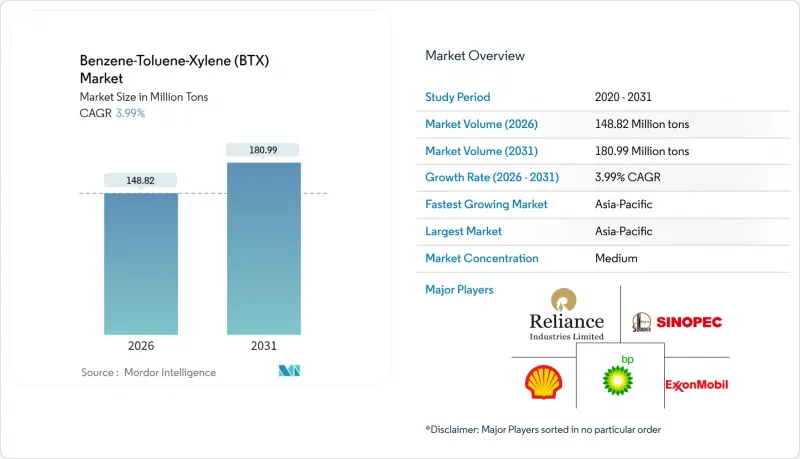
下游對塑膠、合成纖維和特種化學品的強勁需求支撐著全球芳烴聯合裝置的高運轉率。同時,亞太地區新增產能正在改變貿易格局,加劇競爭壓力。對PET生產所需的對二甲苯需求不斷成長,聚氨酯泡棉生產中甲苯二異氰酸酯需求復甦,以及生質能和熱塑製程的商業化,都推動了BTX市場規模的穩定擴張。區域發展不平衡顯而易見:亞太地區利用成本優勢的原料和一體化工廠;北美地區則面臨生產成本上升和進口增加的雙重挑戰;而歐洲則為應對日益嚴格的環境法規而精簡生產。高成本企業在價格波動的環境下尋求抗風險能力,推動競爭朝向原料整合、技術現代化和選擇性整合的方向發展。
全球苯、甲苯和二甲苯 (BTX) 市場趨勢及洞察
亞洲和中東新建芳烴聯合裝置的資本投資激增
亞太地區計劃在2030年新增545萬噸苯產能,其中329萬噸將位於印度。這得歸功於煉油廠的升級改造和麵向出口貿易的新計畫。沙烏地阿拉伯的下游一體化發展也遵循著類似的軌跡。沙烏地阿美、中石化和亞斯瑞夫三方合作架構計畫建造一座年產150萬噸芳烴聯合裝置和一座年產180萬噸混合原料裂解裝置,以最大限度地發揮原料協同效應。這項投資熱潮的促進因素包括規模經濟、有利的石腦油和冷凝油供應以及接近性不斷成長的亞洲需求。產能擴張雖然提高了該地區的自給自足能力,但也增加了歐洲和北美生產的商品苯和混合二甲苯供應過剩的風險。這種成本曲線的變化有利於擁有原料優勢的一體化企業,並給高成本的獨立煉油廠帶來壓力。
由於PET需求快速成長,對二甲苯的供需仍緊張。
2023年,全球對二甲苯產量將超過5,700萬噸,這主要得益於中國寶特瓶樹脂和纖維用對二甲苯產能的快速擴張。儘管永續性法規正在推動成熟市場採用再生PET,但在人口稠密、回收基礎設施有限的經濟體中,對二甲苯的新需求仍在持續成長。供需緊張使得對二甲苯的價格高於混合二甲苯原料,從而抵消了苯和甲苯行業利潤率的下降。對二甲苯與PET之間的關聯性有利於生產商的經濟效益,並有助於煉油廠和一體化聚酯產業鏈之間簽訂長期合約。
基於致癌性的職業接觸法規
苯被列為1類致癌性,導致職場暴露限值提高,例如歐盟某些表面處理流程中的限值已降至20 mg/m³。為符合相關規定,企業需要實施連續監測、蒸氣回收設備和活性碳吸附系統,增加了生產、儲存和運輸等各環節的營運成本。石化企業正在投資建造封閉式裝卸臂、氮氣惰性氣體保護裝置和先進的個人防護設備,以確保工人安全。雖然這些措施需要大量資金投入,但它們可以降低事故風險和潛在的法律責任,因此是參與BTX市場運作的必要前提。
細分市場分析
由於苯深度融入苯乙烯、尼龍和酚等價值鏈,支撐了包裝、汽車和建築行業的需求,預計到2025年,苯在BTX市場仍將佔據38.21%的佔有率。儘管選擇性甲苯歧化、甲醇烷基化和催化重整等製程確保了苯的穩定供應,但其成本結構仍容易受到輕石腦油裂解價格和區域採購差異的影響。預計2024年北美運轉率將徘徊在72%左右,並可能因利潤率預期下降而在2025年降至70%以下。截至2024年10月,受暫時套利機會的驅動,來自亞洲的進口占美國苯流入量的60%以上。然而,隨著價格差異的縮小,預計這些進口量將會下降。轉換柔軟性允許煉油廠在苯和對二甲苯生產之間切換,但重整裝置產品品質的物理限制制約了這種切換。
儘管甲苯產量較低,但預計到2031年,其複合年成長率將達到4.44%,成為成長最快的化學品之一,這主要得益於TDI的復甦和溶劑需求的不斷成長。諸如UOP的Tatoray和中石化的MST等歧化技術旨在利用苯與甲苯有利的價差,將過量的甲苯轉化為高價值的苯和對二甲苯。催化劑壽命的延長和氫氣消耗量的降低提高了製程的經濟性,刺激了中東地區煉油廠改造現有設施的興趣,以確保其下游擴建所需的苯供應來源。二甲苯異構體是連接苯和甲苯的重要紐帶。對二甲苯滿足了PET日益成長的需求,鄰二甲苯是PVC塑化劑鄰鄰苯二甲酐的原料,而間二甲苯則滿足了間苯二甲酸樹脂的需求。二甲苯的供應取決於重整裝置的產量和重整裝置的餾分收率,但缺口正透過機會主義進口來彌補,這表明BTX市場日益全球化。
苯、甲苯和二甲苯 (BTX) 市場報告按類型(苯、甲苯、二甲苯)、應用(乙苯、環己烷、烷基苯、異丙苯、硝基苯、油漆和塗料、黏合劑、化學中間體、溶劑、單體)和地區(北美、南美、歐洲、亞太、中東和非洲)進行細分。市場預測以噸為單位。
區域分析
亞太地區在2025年佔據了BTX市場62.35%的主導佔有率,並在2031年之前保持4.12%的最快複合年成長率,這主要得益於中國、印度和韓國的煉油和石化一體化中心的發展。光是中國就計劃在2025年下半年運作308.8萬噸新的二甲苯產能,主要用於生產對二甲苯,以滿足其PET生產線的需求。印度已宣佈到2030年將運作329萬噸的苯產能,使其成為通用級苯產品的出口國。儘管亞太地區擁有規模優勢,但由於多個新計畫同時運作,該地區仍面臨供應過剩的風險。 HD Hyundai Cosmo在持續遭受中國競爭對手的虧損後,以1.04億美元收購該公司便印證了這一點。然而,電子商務主導的包裝需求成長、強勁的汽車生產以及基礎設施項目將支撐穩定的市場需求吸收。
由於薩尼亞和俄亥俄州的單辛烯生產設施關閉,北美BTX(苯、甲苯、甲苯、二甲苯)供應結構正在萎縮。這降低了該地區的苯自給率,並增加了對亞洲和中東進口的依賴。天然氣基乙烷裂解製取的重整芳烴產量不斷增加,在下游需求疲軟的市場環境下,苯供應面臨壓力。歐洲正在進行持續的合理化調整,計畫從2023年起削減1,400萬噸芳烴和裂解產能。由於被迫升級改造以符合碳定價和VOC(揮發性有機化合物)指令,營運商的盈利正在下降。政策主導的能源成本上漲進一步削弱了競爭力,導致資產轉換和關閉。
中東地區擁有豐富的石腦油和冷凝油供應,這使得該地區能夠以較低的現金成本生產苯並噻吩(BTX),並與延布等地新建的混合原料裂解裝置相結合。中東的出口導向使其能夠很好地滿足非洲和南亞的需求缺口,同時其與亞洲的地理位置接近性也使其擁有廣泛的運輸選擇。南美和非洲的需求規模小規模,但隨著汽車組裝產能的提升和因疫情而延誤的建設計劃逐步恢復,它們的重要性日益凸顯。將苯並噻吩的生產重新佈局到有利地區可能會重塑貿易格局,並減少歷史上平衡全球供需缺口的套利機會。
其他福利:
- Excel格式的市場預測(ME)表
- 分析師支持(3個月)
目錄
第1章 引言
- 研究假設和市場定義
- 調查範圍
第2章調查方法
第3章執行摘要
第4章 市場情勢
- 市場概覽
- 市場促進因素
- 亞洲和中東新建芳烴聯合裝置的資本投資激增
- 由於PET需求快速成長,對二甲苯的供需平衡仍然緊張。
- 汽車和建設業的復甦將提振對TDI和油漆溶劑的需求。
- 透過煉油和石化一體化實現BTX內部萃取
- 透過熱解塑膠和生質能途徑實現直接替代BTX的商業化
- 市場限制
- 基於致癌性的職業接觸法規
- 塗料和黏合劑中的揮發性有機化合物(VOC)法規推動了低芳香族混合物的使用。
- E10 引入後,汽油市場中辛烷值和芳烴含量之間存在權衡關係。
- 價值鏈分析
- 波特五力模型
- 供應商的議價能力
- 買方的議價能力
- 新進入者的威脅
- 替代品的威脅
- 競爭程度
第5章 市場規模與成長預測
- 按類型
- 苯
- 甲苯
- 二甲苯
- 鄰二甲苯
- 間二甲苯
- 對二甲苯
- 透過使用
- 苯
- 乙苯
- 環己烷
- 烷基苯
- 異丙苯
- 硝基苯
- 其他用途
- 甲苯
- 油漆和塗料
- 黏合劑和油墨
- 霹靂
- 化學中間體
- 二甲苯
- 溶劑
- 單體
- 其他用途
- 苯
- 按地區
- 亞太地區
- 中國
- 印度
- 日本
- 韓國
- 亞太其他地區
- 北美洲
- 美國
- 加拿大
- 墨西哥
- 歐洲
- 德國
- 英國
- 義大利
- 法國
- 其他歐洲地區
- 南美洲
- 巴西
- 阿根廷
- 其他南美洲
- 中東和非洲
- 沙烏地阿拉伯
- 南非
- 其他中東和非洲地區
- 亞太地區
第6章 競爭情勢
- 市場集中度
- 策略趨勢
- 市佔率(%)/排名分析
- 公司簡介
- BASF
- BP plc
- Chevron Phillips Chemical Company LLC
- China Petrochemical Corporation
- China National offshore Oil Corporation(CNOOC)
- Dow
- ENEOS Corporation
- Exxon Mobil Corporation
- Formosa Plastics Group.
- GS Caltex Corporation
- INEOS
- IRPC Public Company Limited
- JFE Chemical Corporation
- JX Nippon Oil & Gas Exploration Corporation(ENEOS)
- Mitsubishi Gas Chemical Trading, Inc.
- MOLGROUP
- OCI COMPANY Ltd.
- Reliance Industries Limited
- SABIC
- Shell plc
- S-OIL CORPORATION
- TotalEnergies
- YEOCHUN NCC CO., LTD.
第7章 市場機會與未來展望
Benzene-Toluene-Xylene (BTX) market size in 2026 is estimated at 148.82 Million tons, growing from 2025 value of 143.11 Million tons with 2031 projections showing 180.99 Million tons, growing at 3.99% CAGR over 2026-2031.
Robust downstream demand for plastics, synthetic fibers and specialty chemicals keeps global aromatics complexes operating at high utilization rates, while new capacity in Asia-Pacific shifts trade flows and intensifies competitive pressure. Accelerating para-xylene off-take for PET, resurging toluene di-isocyanate demand from polyurethane foam, and the commercialization of biomass- and pyro-plastic routes collectively reinforce a steady, volume-based expansion of the BTX market. Regional imbalances are pronounced: Asia-Pacific secures cost-advantaged feedstocks and leverages integrated complexes, North America wrestles with elevated production costs and rising imports, and Europe undergoes rationalization in response to tightening environmental regulation. Competitive behavior gravitates toward feedstock integration, technology modernization and selective consolidation as high-cost players seek resilience in a cyclical pricing environment.
Global Benzene-Toluene-Xylene (BTX) Market Trends and Insights
CAPEX boom in new aromatics complexes (Asia and Middle-East)
The Asia-Pacific plans to add 5.45 million tons of additional benzene capacity by 2030, including 3.29 million tons in India, underpinned by refinery upgrades and grassroots projects tailored for export-oriented trade. Saudi downstream integration follows a similar trajectory: the Aramco-Sinopec-Yasref framework targets a 1.5 million-ton aromatics complex colocated with a 1.8 million-ton mixed-feed cracker to maximize feedstock synergy. Economies of scale, advantaged naphtha and condensate streams, and proximity to rising Asian demand underpin this investment wave. While the capacity infusion will deepen regional self-sufficiency, it raises the risk of oversupply for commodity benzene and mixed xylene grades produced in Europe and North America. Cost-curve displacement, therefore, favors integrated, feedstock-advantaged operators and pressures independent, higher-cost refiners.
Surging PET demand keeps para-xylene balances tight
Global para-xylene output topped 57 million tons in 2023 on the back of China's rapid capacity build-out devoted to PET bottle resin and textile filament. Sustainability legislation drives the adoption of recycled PET in mature markets, yet virgin para-xylene volumes continue to rise in populous economies with limited collection infrastructure. Tight balances have sustained para-xylene premiums over mixed xylene feedstocks, offsetting margin weakness in benzene and toluene pools. Producer economics benefit from the para-xylene-PET linkage, and the dynamic supports long-range contracts between refineries and integrated polyester chains.
Carcinogenicity-driven occupational exposure curbs
Benzene's classification as a Group 1 carcinogen underpins workplace exposure limits that tighten to as low as 20 mg/m3 for certain surface-treatment operations in the European Union. Compliance requires continuous monitoring, vapor recovery units, and active-carbon adsorption systems, adding operating costs across production, storage, and transport. Petrochemical sites invest in hermetic loading arms, nitrogen inerting, and advanced personal protective equipment to safeguard workers. Although capital-intensive, these measures reduce incident risk and potential liabilities, making compliance an essential prerequisite for operating in the BTX market.
Other drivers and restraints analyzed in the detailed report include:
- Automotive and construction rebound lifts TDI/paints solvent demand
- Refinery-petchem integration unlocking captive BTX extraction
- Paints/adhesives VOC regulations favor low-aromatic blends
For complete list of drivers and restraints, kindly check the Table Of Contents.
Segment Analysis
Benzene retained a 38.21% BTX market share in 2025, supported by deep integration into styrenics, nylon, and phenolics value chains that anchor demand across packaging, automotive, and construction. Selective toluene disproportionation, hydrodealkylation, and catalytic reforming ensure a steady supply, yet benzene's cost structure remains vulnerable to light-naphtha cracks and regional sourcing disparities. North American operating rates drifted near 72% in 2024, and forecast margin compression could push utilization below 70% in 2025. Imports from Asia supplied more than 60% of U.S. benzene inflows through October 2024 as arbitrage windows briefly opened; parity pricing is expected to narrow those inflows. Conversion flexibility allows refiners to swing between benzene and para-xylene, but physical constraints on reformate quality impose limits.
Toluene, although representing a smaller volume base, exhibits the fastest 4.44% CAGR through 2031, driven by the recovery of TDI and the evolution of solvent demand. Disproportionation technologies such as UOP's Tatoray and Sinopec's MST aim to exploit favorable benzene-toluene spreads by converting surplus toluene into high-value benzene and para-xylene. Improved catalyst lifetimes and lower hydrogen consumption enhance process economics, prompting retrofit interest among Middle Eastern complexes targeting captive benzene supply for downstream expansions. Xylene isomers collectively bridge the benzene and toluene pools: para-xylene captures PET growth, ortho-xylene feeds phthalic anhydride for PVC plasticizers, and meta-xylene underpins isophthalic resin demand. Although xylene availability follows reformer severity and reformate fractionation yields, opportunistic imports accommodate shortfalls, underscoring the increasingly globalized BTX market.
The Benzene-Toluene-Xylene (BTX) Market Report is Segmented by Type (Benzene, Toluene, and Xylene), Application (Ethylbenzene, Cyclohexane, Alkylbenzene, Cumene, Nitrobenzene, Paints and Coatings, Adhesives and Inks, Explosives, Chemical Intermediates, Solvents, Monomer), and Geography (North America, South America, Europe, Asia-Pacific, and Middle East and Africa). The Market Forecasts are Provided in Terms of Volume (Tons).
Geography Analysis
The Asia-Pacific region held a commanding 62.35% BTX market share in 2025 and sustained the fastest 4.12% CAGR to 2031, driven by integrated refinery-petrochemical hubs in China, India, and South Korea. China alone plans to schedule 3.088 million tons of new xylene capacity for H2 2025, primarily targeting para-xylene for captive PET lines. India's 3.29 million tons of benzene capacity announced for start-up by 2030 positions the country as a rising exporter of merchant grades. Despite its scale advantages, the region faces an oversupply risk as multiple grassroots projects come online concurrently, as evidenced by HD Hyundai Cosmo's acquisition for USD 104 million, following sustained losses attributed to Chinese competition. Nonetheless, e-commerce-led packaging growth, resilient automotive output, and infrastructure programs underpin steady volume absorption.
North America's BTX supply landscape contracts as styrene monomer units in Sarnia and Ohio shut down, lowering regional benzene self-sufficiency and increasing import reliance from Asia and the Middle East. Elevated natural-gas-based ethane cracking caps reformate aromatics output, squeezing benzene supply in a market already challenged by flat downstream demand. Europe continues a rationalization pathway that removed 14 million tons of aromatics and cracker capacity since 2023; operators confront carbon-pricing schemes and VOC directives requiring plant upgrades that strain return profiles. Policy-driven energy costs further erode competitiveness, prompting asset swaps or closures.
The Middle East rests on advantaged naphtha and condensate streams, enabling low cash-cost BTX production integrated with new mixed-feed crackers at sites such as Yanbu. Export orientation suits emerging deficits in Africa and South Asia, while proximity to Asia keeps freight optionality wide open. South America and Africa comprise smaller demand centers but gain relevance as automotive assembly lines ramp up and building projects resume following pandemic-delayed timelines. The geographic restructuring of BTX production toward advantaged regions reshapes trade patterns and might compress arbitrage windows that historically balanced global deficits.
- BASF
- BP p.l.c.
- Chevron Phillips Chemical Company LLC
- China Petrochemical Corporation
- China National offshore Oil Corporation (CNOOC)
- Dow
- ENEOS Corporation
- Exxon Mobil Corporation
- Formosa Plastics Group.
- GS Caltex Corporation
- INEOS
- IRPC Public Company Limited
- JFE Chemical Corporation
- JX Nippon Oil & Gas Exploration Corporation (ENEOS)
- Mitsubishi Gas Chemical Trading, Inc.
- MOLGROUP
- OCI COMPANY Ltd.
- Reliance Industries Limited
- SABIC
- Shell plc
- S-OIL CORPORATION
- TotalEnergies
- YEOCHUN NCC CO., LTD.
Additional Benefits:
- The market estimate (ME) sheet in Excel format
- 3 months of analyst support
TABLE OF CONTENTS
1 Introduction
- 1.1 Study Assumptions and Market Definition
- 1.2 Scope of the Study
2 Research Methodology
3 Executive Summary
4 Market Landscape
- 4.1 Market Overview
- 4.2 Market Drivers
- 4.2.1 CAPEX boom in new aromatics complexes (Asia and Middle-East)
- 4.2.2 Surging PET demand keeps para-xylene balances tight
- 4.2.3 Automotive and construction rebound lifts TDI/paints solvent demand
- 4.2.4 Refinery-petchem integration unlocking captive BTX extraction
- 4.2.5 Pyro-plastic and biomass routes commercialising drop-in BTX
- 4.3 Market Restraints
- 4.3.1 Carcinogenicity-driven occupational exposure curbs
- 4.3.2 Paints/adhesives VOC regulations favour low-aromatic blends
- 4.3.3 Octane-for-aromatics trade-off in gasoline pool after E10 rollout
- 4.4 Value Chain Analysis
- 4.5 Porter's Five Forces
- 4.5.1 Bargaining Power of Suppliers
- 4.5.2 Bargaining Power of Buyers
- 4.5.3 Threat of New Entrants
- 4.5.4 Threat of Substitutes
- 4.5.5 Degree of Competition
5 Market Size and Growth Forecasts (Volume)
- 5.1 By Type
- 5.1.1 Benzene
- 5.1.2 Toluene
- 5.1.3 Xylene
- 5.1.3.1 Ortho-xylene
- 5.1.3.2 Meta-xylene
- 5.1.3.3 Para-xylene
- 5.2 By Application
- 5.2.1 Benzene
- 5.2.1.1 Ethylbenzene
- 5.2.1.2 Cyclohexane
- 5.2.1.3 Alkylbenzene
- 5.2.1.4 Cumene
- 5.2.1.5 Nitrobenzene
- 5.2.1.6 Other Applications
- 5.2.2 Toluene
- 5.2.2.1 Paints and Coatings
- 5.2.2.2 Adhesives and Inks
- 5.2.2.3 Explosives
- 5.2.2.4 Chemical Intermediates
- 5.2.3 Xylenes
- 5.2.3.1 Solvents
- 5.2.3.2 Monomer
- 5.2.3.3 Other Applications
- 5.2.1 Benzene
- 5.3 By Geography
- 5.3.1 Asia-Pacific
- 5.3.1.1 China
- 5.3.1.2 India
- 5.3.1.3 Japan
- 5.3.1.4 South Korea
- 5.3.1.5 Rest of Asia-Pacific
- 5.3.2 North America
- 5.3.2.1 United States
- 5.3.2.2 Canada
- 5.3.2.3 Mexico
- 5.3.3 Europe
- 5.3.3.1 Germany
- 5.3.3.2 United Kingdom
- 5.3.3.3 Italy
- 5.3.3.4 France
- 5.3.3.5 Rest of Europe
- 5.3.4 South America
- 5.3.4.1 Brazil
- 5.3.4.2 Argentina
- 5.3.4.3 Rest of South America
- 5.3.5 Middle East and Africa
- 5.3.5.1 Saudi Arabia
- 5.3.5.2 South Africa
- 5.3.5.3 Rest of Middle East and Africa
- 5.3.1 Asia-Pacific
6 Competitive Landscape
- 6.1 Market Concentration
- 6.2 Strategic Moves
- 6.3 Market Share (%)/Ranking Analysis
- 6.4 Company Profiles (includes Global level Overview, Market level overview, Core Segments, Financials as available, Strategic Information, Market Rank/Share, Products and Services, Recent Developments)
- 6.4.1 BASF
- 6.4.2 BP p.l.c.
- 6.4.3 Chevron Phillips Chemical Company LLC
- 6.4.4 China Petrochemical Corporation
- 6.4.5 China National offshore Oil Corporation (CNOOC)
- 6.4.6 Dow
- 6.4.7 ENEOS Corporation
- 6.4.8 Exxon Mobil Corporation
- 6.4.9 Formosa Plastics Group.
- 6.4.10 GS Caltex Corporation
- 6.4.11 INEOS
- 6.4.12 IRPC Public Company Limited
- 6.4.13 JFE Chemical Corporation
- 6.4.14 JX Nippon Oil & Gas Exploration Corporation (ENEOS)
- 6.4.15 Mitsubishi Gas Chemical Trading, Inc.
- 6.4.16 MOLGROUP
- 6.4.17 OCI COMPANY Ltd.
- 6.4.18 Reliance Industries Limited
- 6.4.19 SABIC
- 6.4.20 Shell plc
- 6.4.21 S-OIL CORPORATION
- 6.4.22 TotalEnergies
- 6.4.23 YEOCHUN NCC CO., LTD.
7 Market Opportunities and Future Outlook
- 7.1 White-space and Unmet-need Assessment

 基礎石化產品市場報告:趨勢、預測及競爭分析(至2035年)
 石油化學市場:2026-2032年全球市場預測(依產品類型、原料、技術、應用及最終用途產業分類)
 石油化工泵市場商機、成長要素、產業趨勢分析及2026-2035年預測。
 2026-2034年全球煤油市場規模、佔有率、趨勢和成長分析報告
 C5 石化產品市場:區域與應用分析與預測(至 2034 年)石油化學品市場規模、佔有率、成長率及全球產業分析:按類型、應用和地區的洞察,2026-2034年的預測石油化學泵浦市場:按泵浦類型、材質、流量、壓力範圍、應用和最終用戶分類,全球預測(2026-2032年)
 基礎石油化學產品市場分析及預測(至2035年):類型、產品、應用、技術、終端用戶、製程、材料類型、組件和功能石油化學市場分析及預測(至2035年):依類型、產品類型、應用、技術、最終用戶、組件、製程、材料類型、安裝類型分類
 石油化學市場報告:按類型、應用、最終用途行業和地區分類(2026-2034年)