


 |
市場調查報告書
商品編碼
1937363
中國豪華乙烯基瓷磚(LVT):市場佔有率分析、產業趨勢與統計、成長預測(2026-2031)China Luxury Vinyl Tile (LVT) - Market Share Analysis, Industry Trends & Statistics, Growth Forecasts (2026 - 2031) |
||||||

※ 本網頁內容可能與最新版本有所差異。詳細情況請與我們聯繫。
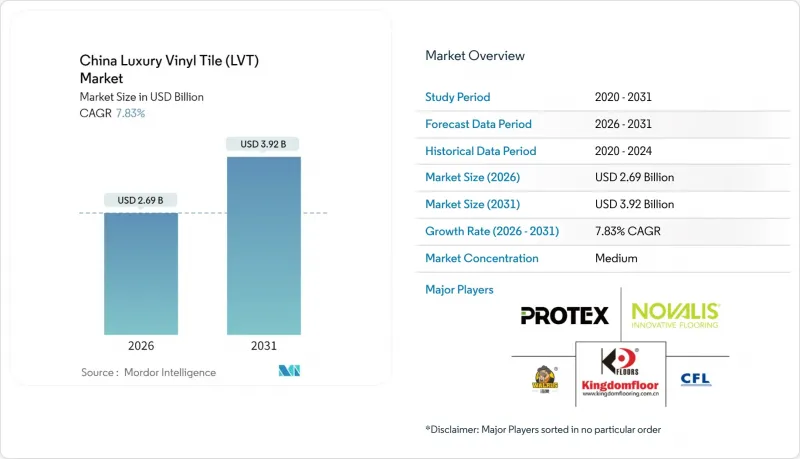
中國豪華乙烯基瓷磚市場預計將從 2025 年的 24.9 億美元成長到 2026 年的 26.9 億美元,預計到 2031 年將達到 39.2 億美元,2026 年至 2031 年的複合年成長率為 7.83%。
二、三線城市的大規模維修熱潮,以及全國範圍內的基礎設施建設,支撐了對硬芯材產品的持續需求。公共,例如投資超過2.6兆元人民幣用於6.6萬個城市更新計劃,正在拓展市場機遇,並增加陶瓷和實木地板等經濟型地板材料替代品的採購管道。國內SPC(人造石材地板材料)和WPC(複合材料)產能的擴大正在降低單價,而更嚴格的低VOC排放法規則推動了對高階環保產品的購買。數位零售平台正在提升沿海地區以外消費者對產品的認知度,使中國中小型城市的一般家庭更容易接觸到高階PVC地板市場。
中國豪華乙烯基瓷磚(LVT)市場趨勢與洞察
區域城市維修熱潮
中國的城市更新策略催生了區域城市前所未有的維修活動,住宅負擔能力壓力和基礎設施現代化需求推動了LVT地板的普及。國家發展和改革委員會2024年報告預測,GDP成長率約為5.03%,這意味著住宅和住宅裝飾領域將迎來大規模投資。這個政策框架直接惠及LVT地板生產商,因為地方政府優先考慮既經濟實惠又美觀的地板材料解決方案,同時避免了傳統材料的高昂價格。擁有區域倉庫的生產商能夠縮短交貨時間並提高市場佔有率。可支配收入的成長進一步強化了對符合國家生活水準目標的現代室內裝潢的需求。
透過「老舊建築維修」政策促進商業設施維修
國務院的《既有資產最佳化框架》已將重點從先前的新建設轉移到了現有資產。公共支出主要集中在醫療、教育和文化設施,要求加快維修進度,因此卡扣式硬體LVT地板成為合理的選擇。設施管理人員優先考慮能夠支援中國碳排放和碳中和目標的材料,而LVT地板的可回收特性恰好滿足了這項要求。重慶和廣州的示範計劃表明,耐磨地板有助於提高零售店的客流量。長期的實施週期也使供應商能夠了解多年的採購計畫。
PVC樹脂價格波動對利潤率帶來壓力
PVC樹脂價格波動是LVT(豪華乙烯基瓷磚)生產商盈利面臨的最緊迫挑戰,而中國將於2025年1月起將進口關稅從1%提高至5.5%,這加劇了整個供應鏈的成本壓力。依賴海外原料的生產商面臨更高的成本,而在這個價格敏感的市場中,這些成本難以轉嫁。擁有後向整合樹脂生產能力的公司能夠更好地緩衝這種衝擊,但小規模的加工商則面臨利潤率壓縮。外匯波動又增加了另一層波動性,使採購計畫更加複雜。避險策略和供應商多元化是重要的風險管理工具。
細分市場分析
2025年,硬質LVT(SPC)將佔據中國高階PVC地磚市場67.45%的佔有率,預計到2031年將以9.95%的複合年成長率成長。其礦物填充芯材結構可降低熱膨脹係數,使其適用於溫差較大的地區。 WPC(木塑複合材料)產品兼具舒適性和隔音性,在高階住宅維修佔據獨特地位。柔軟性LVT在需要高度適應不平整基材的領域仍保持一定的市場佔有率,但其市場佔有率持續下降。為符合旨在減少排放和溫室氣體排放的“雙重碳指令”,製造商正加強研發不含PVC的芯材,這標誌著產品差異化進入了一個新的階段。
第二代硬地板採用數位印刷技術,增強了視覺真實感,並拓展了款式選擇。工廠預塗抗菌塗層正推動其在醫療保健和養老機構的應用。當地企業利用其接近性石化產業叢集的優勢,快速取得樹脂,從而增強了成本競爭力。與設計機構的合作打造出符合都會都市區美感的潮流色彩。連續印刷技術提高了生產效率,縮短了前置作業時間,並保持了該領域的銷售領先地位。
2025年,卡扣式地板材料在中國高階PVC地板市場佔有41.38%的佔有率,預計到2031年將以8.55%的複合年成長率成長。其無需工具的組裝方式深受DIY愛好者和專業安裝團隊的青睞。其浮動結構允許即時行走,使其成為短期維修的理想選擇。在人流量大的走廊等需要永久黏合強度的區域,膠合安裝仍然適用;而免膠鋪裝方案則適用於快閃店和臨時展覽。
改良的型材形狀提升了接縫黏合力和防水性能,消除了傳統接縫的弱點。製造商正在發布培訓模組,以規範安裝質量,確保其承包商網路的一致性。提供綠色金融計畫的金融機構已將ClickLock SPC認證為符合其能源效率標準的合格材料,從而促進其在公共工程項目中的應用。隨著物流成本的上升,可堆疊的紙板設計最佳化了貨櫃利用率,降低了交付成本。這種包裝形式在安裝速度和可靠性之間實現了完美平衡,鞏固了其作為領先安裝方式的地位。
其他福利:
- Excel格式的市場預測(ME)表
- 3個月的分析師支持
目錄
第1章 引言
- 研究假設和市場定義
- 調查範圍
第2章調查方法
第3章執行摘要
第4章 市場情勢
- 市場概覽
- 市場促進因素
- 區域城市翻新需求日益成長
- 透過「舊建築維修」政策促進商業設施的維修。
- 由於成本和耐用性方面的考慮,人們開始從陶瓷/實木地板轉向硬芯LVT地板。
- 由於國內SPC/WPC產能擴張,價格下降
- 低VOC標準推動了對優質綠色LVT的需求。
- 抗菌LVT在醫療和教育領域的應用
- 市場限制
- PVC樹脂價格波動對利潤率帶來壓力
- 住宅建設長期低迷
- 「排放與溫室氣體減量雙重排放」政策下的廢棄物處理與回收問題
- 關稅導致的出口不確定性抑制了大規模投資。
- 價值/供應鏈分析
- 監管環境
- 技術展望
- 波特五力模型
- 新進入者的威脅
- 買方的議價能力
- 供應商的議價能力
- 替代品的威脅
- 競爭對手之間的競爭
第5章 市場規模及成長預測(以金額為準,2020-2030 年)
- 依產品類型
- 剛性LVT
- SPC(石塑複合材料)
- WPC(木塑複合材料)
- 軟性LVT
- 剛性LVT
- 按安裝類型
- 點擊鎖定/浮動
- 黏合劑類型
- 鬆散地
- 最終用戶
- 住宅
- 商業
- 飯店及休閒
- 零售商店和購物中心
- 醫療設施
- 教育
- 公司總部
- 公共和政府設施
- 其他商業用戶
- 依建築類型
- 新建工程
- 維修和維修工程
- 透過分銷管道
- B2C/零售消費者
- 家居建材商店
- 專業地板商店
- 線上
- 其他分銷管道
- B2B/承包商/建築商
- B2C/零售消費者
- 按地區
- 華東地區
- 中國西南地區
- 華北地區
- 中國中南部
- 中國東北
- 中國西北地區
第6章 競爭情勢
- 市場集中度
- 策略趨勢
- 市佔率分析
- 公司簡介
- CFL Flooring
- Novalis Innovative Flooring
- Zhejiang Kingdom Flooring
- Zhejiang Walrus New Material
- Protex Flooring
- Zhejiang Dajulong
- Zhejiang GIMIG
- Zhejiang Fudeli
- Haining Taomei
- LG Hausys
- Tarkett
- Gerflor
- Armstrong Flooring
- Mohawk Industries
- Shaw Industries
- Mannington Mills
- Debo Flooring
- Anhui Sentai WPC
- Zhejiang Licheer
第7章 市場機會與未來展望
The China luxury vinyl tile market is expected to grow from USD 2.49 billion in 2025 to USD 2.69 billion in 2026 and is forecast to reach USD 3.92 billion by 2031 at 7.83% CAGR over 2026-2031.
A renovation wave across Tier-2 and Tier-3 cities, combined with nationwide infrastructure upgrades, underpins sustained demand for rigid-core products. Public policies that channel more than CNY 2.6 trillion into 66,000 active urban renewal projects widen the opportunity set and intensify procurement of cost-effective flooring that substitutes ceramic and hardwood. Domestic SPC and WPC capacity expansion lowers unit costs, while stricter low-VOC regulations steer purchasing toward premium green lines. Digital retail platforms amplify product visibility beyond coastal hubs, making the Chinese luxury vinyl tile market more accessible to household buyers in smaller municipalities
China Luxury Vinyl Tile (LVT) Market Trends and Insights
Renovation Boom in Tier-2 & Tier-3 Cities
China's urban renewal strategy has catalyzed unprecedented renovation activity across secondary and tertiary cities, where housing affordability pressures and infrastructure modernization needs converge to drive LVT adoption. The National Development and Reform Commission's 2024 report projects GDP growth of around 5.03%, with significant investments channeled toward the housing and home furnishing sectors. This policy framework directly benefits LVT manufacturers as municipalities prioritize cost-effective flooring solutions that deliver aesthetic appeal without the premium pricing of traditional materials. Manufacturers with regional warehouses shorten delivery cycles and capture incremental share. Rising disposable incomes further reinforce demand for modern interior finishes that align with national living-standard goals.
Commercial Refurbishment Push from "Old Building Revamp" Policy
The State Council's framework for optimizing existing assets replaces the previous focus on new builds. Public spending targets healthcare, education and cultural venues that stipulate quick-turn renovation schedules, making click-lock rigid LVT a logical choice. Facility managers favor materials that support China's dual-carbon targets, and LVT's recyclable content meets these specifications. Demonstration projects in Chongqing and Guangzhou showcase traffic-resistant installations that boost retail footfall. The long implementation window ensures multi-year procurement visibility for suppliers.
Volatile PVC Resin Prices Squeezing Margins
PVC resin price volatility presents the most immediate challenge to LVT manufacturers' profitability, with China's import tariff increase from 1% to 5.5% effective January 2025 exacerbating cost pressures across the supply chain. Manufacturers reliant on overseas feedstocks confront cost inflation that is difficult to pass through in a price-sensitive market. Firms with backward-integrated resin capacity cushion the shock, but smaller converters face margin compression. Currency swings add another layer of volatility, complicating procurement planning. Hedging strategies and diversified supplier bases become critical risk-management tools.
Other drivers and restraints analyzed in the detailed report include:
- Shift from Ceramic / Hardwood to Rigid-Core LVT for Cost & Durability
- Domestic SPC/WPC Capacity Expansion Lowering Prices
- Prolonged Slowdown in New Residential Construction
For complete list of drivers and restraints, kindly check the Table Of Contents.
Segment Analysis
Rigid LVT (SPC) accounted for 67.45% of China's luxury vinyl tile market share in 2025 and is projected to grow at a 9.95% CAGR through 2031. The format's mineral-filled core minimizes expansion under thermal stress, supporting installations in temperature-fluctuating zones. WPC variants add comfort and acoustic buffering, carving a niche in premium residential refurbishments. Flexible LVT retains a foothold where uneven subfloors demand high conformability, though share erosion persists. Manufacturers intensify R&D on PVC-free cores to align with dual-carbon directives, signalling the next frontier of product differentiation.
Second-generation rigid planks incorporate digital printing that elevates visual realism and widens style assortments. Factory-applied antimicrobial coatings broaden adoption in healthcare and aged-care settings. Local firms leverage proximity to petrochemical clusters for fast resin sourcing, reinforcing competitive cost positions. Partnerships with design institutes yield trend-forward color palettes that resonate with urban consumers. Continuous press technologies raise throughput and shorten lead times, sustaining the category's volume leadership.
Click-lock floors held 41.38% share of the China luxury vinyl tile market size in 2025 and are expected to expand at 8.55% CAGR up to 2031. Their tool-free assembly appeals to DIY enthusiasts and professional crews alike. Floating structures permit immediate foot traffic, an advantage in quick-turn refurbishments. Glue-down alternatives stay relevant for heavy-load corridors where permanent bond strength is vital, while loose-lay solutions cater to pop-up stores and temporary exhibitions.
Advances in profile geometry enhance joint tightness and water resistance, solving earlier seam weaknesses. Manufacturers release training modules that standardize installation quality across contractor networks. Lenders offering green financing programs now regard click-lock SPC as an eligible material under energy-efficiency criteria, encouraging adoption in public projects. As logistics costs climb, stackable carton designs optimize container utilization and lower delivered prices. The format's balance of speed and reliability secures its trajectory as the preferred installation method.
The China Luxury Vinyl Tile Market Report is Segmented by Product Type (Rigid LVT SPC, Rigid LVT WPC, and More), Installation Type (Click-Lock/Floating, Glue-Down, and More), End-User (Residential, Commercial), Construction Type (New Construction, Remodeling/Retrofit), Distribution Channel (Offline, Online/E-commerce), and Geography (East China, North China, and More). The Market Forecasts are Provided in Terms of Value (USD).
List of Companies Covered in this Report:
- CFL Flooring
- Novalis Innovative Flooring
- Zhejiang Kingdom Flooring
- Zhejiang Walrus New Material
- Protex Flooring
- Zhejiang Dajulong
- Zhejiang GIMIG
- Zhejiang Fudeli
- Haining Taomei
- LG Hausys
- Tarkett
- Gerflor
- Armstrong Flooring
- Mohawk Industries
- Shaw Industries
- Mannington Mills
- Debo Flooring
- Anhui Sentai WPC
- Zhejiang Licheer
Additional Benefits:
- The market estimate (ME) sheet in Excel format
- 3 months of analyst support
TABLE OF CONTENTS
1 Introduction
- 1.1 Study Assumptions and Market Definition
- 1.2 Scope of the Study
2 Research Methodology
3 Executive Summary
4 Market Landscape
- 4.1 Market Overview
- 4.2 Market Drivers
- 4.2.1 Renovation boom in Tier-2 and Tier-3 cities
- 4.2.2 Commercial refurbishment push from "Old Building Revamp" policy
- 4.2.3 Shift from ceramic / hardwood to rigid-core LVT for cost & durability
- 4.2.4 Domestic SPC/WPC capacity expansion lowering prices
- 4.2.5 Low-VOC standards driving premium green LVT demand
- 4.2.6 Antimicrobial-treated LVT adoption in healthcare & education
- 4.3 Market Restraints
- 4.3.1 Volatile PVC resin prices squeezing margins
- 4.3.2 Prolonged slowdown in new residential construction
- 4.3.3 Disposal & recycling challenges under "dual-carbon" policy
- 4.3.4 Tariff-driven export uncertainty dampening large-scale investment
- 4.4 Value / Supply-Chain Analysis
- 4.5 Regulatory Landscape
- 4.6 Technological Outlook
- 4.7 Porter's Five Forces
- 4.7.1 Threat of New Entrants
- 4.7.2 Bargaining Power of Buyers
- 4.7.3 Bargaining Power of Suppliers
- 4.7.4 Threat of Substitutes
- 4.7.5 Competitive Rivalry
5 Market Size & Growth Forecasts (Value, 2020-2030)
- 5.1 By Product Type
- 5.1.1 Rigid LVT
- 5.1.1.1 Stone Plastic Composite
- 5.1.1.2 Wood Plastic Composite
- 5.1.2 Flexible LVT
- 5.1.1 Rigid LVT
- 5.2 By Installation Type
- 5.2.1 Click-Lock / Floating
- 5.2.2 Glue-Down
- 5.2.3 Loose-Lay
- 5.3 By End User
- 5.3.1 Residential
- 5.3.2 Commercial
- 5.3.2.1 Hospitality and Leisure
- 5.3.2.2 Retail and Shopping Centers
- 5.3.2.3 Healthcare Facilities
- 5.3.2.4 Education
- 5.3.2.5 Corporate Offices
- 5.3.2.6 Public and Government Buildings
- 5.3.2.7 Other Commercial Users
- 5.4 By Construction Type
- 5.4.1 New Construction
- 5.4.2 Remodeling / Retrofit
- 5.5 By Distribution Channel
- 5.5.1 B2C/Retail Consumers
- 5.5.1.1 Home Centers
- 5.5.1.2 Specialty Flooring Stores
- 5.5.1.3 Online
- 5.5.1.4 Other Distribution Channels
- 5.5.2 B2B/Contractors/Builders
- 5.5.1 B2C/Retail Consumers
- 5.6 By Geography
- 5.6.1 East China
- 5.6.2 Southwestern China
- 5.6.3 North China
- 5.6.4 South Central China
- 5.6.5 Northeast China
- 5.6.6 Northwestern China
6 Competitive Landscape
- 6.1 Market Concentration
- 6.2 Strategic Moves
- 6.3 Market Share Analysis
- 6.4 Company Profiles (includes Global level Overview, Market level overview, Core Segments, Financials as available, Strategic Information, Market Rank/Share for key companies, Products & Services, and Recent Developments)
- 6.4.1 CFL Flooring
- 6.4.2 Novalis Innovative Flooring
- 6.4.3 Zhejiang Kingdom Flooring
- 6.4.4 Zhejiang Walrus New Material
- 6.4.5 Protex Flooring
- 6.4.6 Zhejiang Dajulong
- 6.4.7 Zhejiang GIMIG
- 6.4.8 Zhejiang Fudeli
- 6.4.9 Haining Taomei
- 6.4.10 LG Hausys
- 6.4.11 Tarkett
- 6.4.12 Gerflor
- 6.4.13 Armstrong Flooring
- 6.4.14 Mohawk Industries
- 6.4.15 Shaw Industries
- 6.4.16 Mannington Mills
- 6.4.17 Debo Flooring
- 6.4.18 Anhui Sentai WPC
- 6.4.19 Zhejiang Licheer
7 Market Opportunities & Future Outlook
- 7.1 Integration of Digital Printing for Custom LVT Designs
- 7.2 Expansion of Eco-Friendly and Recyclable LVT Products

 2026年全球高階乙烯基瓷磚(LVT)地板材料市場報告
 豪華乙烯基瓷磚地板市場(按產品類型、安裝類型、應用、最終用戶和分銷管道)—2025-2030 年全球預測豪華乙烯基瓷磚市場(按產品類型、安裝方式、最終用途、應用和分銷管道)—2025-2030 年全球預測
 豪華乙烯基瓷磚市場 - 全球行業規模、佔有率、趨勢、機會和預測,按產品類型、按安裝類型(膠粘、點擊、松鋪)、按最終用戶、按地區和競爭情況細分,2020-2030 年
 全球木塑複合材料(WPC)豪華乙烯基瓷磚市場
 全球豪華乙烯基瓷磚(LVT)市場按類型、產品類型、分銷管道、最終用途領域和地區分類 - 預測至 2030 年
 LVT 地板市場規模及預測 2021 - 2031 年,全球及地區佔有率、趨勢及成長機會分析報告範圍:按類型(剛性和軟性)、最終用戶(住宅、商業、工業和機構)和地理分類
 高級乙烯樹脂瓷磚市場:現狀分析與未來預測 (2024年~2032年)
 北美豪華乙烯基瓷磚 (LVT) 市場:市場佔有率分析、行業趨勢和統計、成長預測(2025-2030 年)
 高級乙烯樹脂瓷磚市場:各類型,各用途,各終端用戶,各銷售管道,各地區,機會,預測,2017年~2031年