


 |
市場調查報告書
商品編碼
1937335
二甲醚:市佔率分析、產業趨勢與統計、成長預測(2026-2031)Dimethyl Ether - Market Share Analysis, Industry Trends & Statistics, Growth Forecasts (2026 - 2031) |
||||||

※ 本網頁內容可能與最新版本有所差異。詳細情況請與我們聯繫。
二甲醚市場預計將從 2025 年的 795 萬噸成長到 2026 年的 843 萬噸,到 2031 年達到 1,128 萬噸,2026 年至 2031 年的複合年成長率為 6.00%。
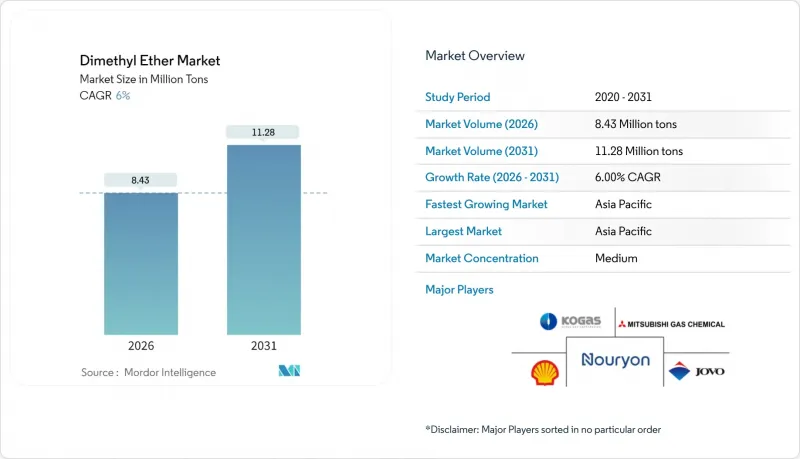
監管趨勢向超低硫要求邁進、向碳中和目標轉變,以及二甲醚(DME)能夠無縫融入現有液化石油氣(LPG)物流網路,這些因素共同構成了強勁需求成長的基礎。亞太地區將引領成長,充分利用中國煤炭氣化網路和成本優勢;而日本和韓國正在採用DME來實現能源安全多元化。儘管目前天然氣衍生DME生產佔據主導地位,但生物基DME生產路線的快速技術進步預示著原料結構將發生轉變,這可能會重新平衡長期供應曲線。市場競爭仍然適中,隨著綠氫供應的擴大,擁有傳統甲醇脫水技術和新興二氧化碳加氫技術的生產商將擁有更多選擇。
全球二甲醚市場趨勢及洞察
液化石油氣摻混需求不斷成長
印尼、馬來西亞和泰國的家庭能源計畫正在推動液化石油氣(LPG)替代目標的實現,直接提振了對二甲醚(DME)的需求。光是印尼15%的LPG替代方案就能減少3.88億美元的進口成本,而DME可直接取代現有爐灶和氣瓶,使其成為極具吸引力的選擇。這種替代方案既能降低丙烷價格波動帶來的財務風險,也能讓公共產業延後昂貴的設備維修。生產商受益於現有基本客群,這些客戶更重視燃料成本的穩定性而非邊際效率提升。同時,利用棕櫚油廢棄物和稻殼生產DME的生質能試點計畫符合當地的循環經濟政策,並有助於提高農村收入。這些因素共同支撐了強勁的本地需求,即使在原油價格波動的情況下也是如此。
交通運輸部門和工業鍋爐的燃料需求不斷成長
隨著全球重型車輛排放標準的日益嚴格,車隊管理者正在尋找既能保持柴油性能又能消除顆粒物排放的燃料。二甲醚(DME)的十六烷值在55-60之間,幾乎不產生煙塵,因此可以透過燃料轉換而非維修後處理系統來實現合規。在中國,礦場、港口和農業合作社已經開始將DME摻入當地的柴油燃料池中,以滿足省級顆粒物排放法規的要求。工業鍋爐也呈現類似的趨勢。安裝低氮氧化物燃燒器的製造商發現,DME能夠以可接受的成本進一步減少二氧化碳排放,因為它可以利用現有的液化石油氣(LPG)儲存槽。因此,隨著政策制定者實施更嚴格的空氣品質標準,二甲醚市場在交通運輸和製程熱應用領域擁有不斷擴大的潛力。
大規模合成和脫水製程需要高額的資本投資和營運成本。
建造一座以甲醇為原料生產二甲醚的一體化工廠需要專用反應器和高層蒸餾塔,這使得該項目資本密集,每噸年產能的投資額超過18,000美元,並在利潤率較低的燃料市場中給盈利帶來壓力。營運成本對公用設施價格非常敏感,雖然採用隔板蒸餾塔最佳化蒸氣需求可以降低成本44.5%,但商業性案例仍有限。新興市場新計畫的資金籌措難度較大,借貸成本超過10%。因此,投資者更傾向於維修現有設施或採用模組化撬裝設備,這可能會導致大型工廠專案公告減少,並減緩二甲醚市場的擴張速度。
細分市場分析
到2025年,天然氣將佔二甲醚產量的64.10%,這得益於北美、中東和俄羅斯現有的蒸氣重組裝置,使其保持成本優勢。由於這些裝置與現有的甲醇裝置相連,新增脫水生產線的現金成本損益平衡點低於每噸350美元,維持了天然氣製二甲醚的市場優勢。煤炭氣化製程是中國二甲醚生產的基礎,但由於環境法規和碳市場的影響,其利潤率正在逐步下降。
向可再生能源的轉型趨勢顯而易見,生物基二甲醚(bio-DME)的複合年成長率高達8.42%。規模化生產的實例包括:Oberon Fuels計畫將其在美國的產能擴大至每年2億加侖以上;以及歐盟財團正在開發的木質生質能氣化技術。加州低碳燃料標準(LCFS)和歐盟可再生能源指令II提供的碳權額度為每噸85至190美元,這有利於生物基二甲醚計劃的經濟效益。隨著電解槽成本的下降,直接二氧化碳加氫技術可能會進一步挑戰化石原料的現有地位,並重塑二甲醚市場的供應模式。
二甲醚市場報告按原料(天然氣、煤炭、生物基產品)、應用(推進劑、液化石油氣混合物、燃料、其他應用)和地區(亞太地區、北美地區、歐洲地區、南美地區、中東和非洲地區)進行細分。市場預測以公噸為單位。
區域分析
到2025年,亞太地區將佔全球二甲醚產量的86.20%,維持6.10%的最高區域複合年成長率。中國在陝西和內蒙古擁有年產超過100萬噸的煤製二甲醚聯合裝置,使其在成本上保持優勢。省級政府透過與空氣品質績效掛鉤的補貼政策,在國家層級碳定價體係不斷加強的同時,也保障了企業的利潤率。日本和韓國正在深化燃料多元化策略。東京的氫能發展藍圖將二甲醚等液態燃料列入船舶加註燃料的清單,而韓國煉油廠正在液化石油氣進口碼頭引進混合泵浦。這些都是影響二甲醚市場格局的關鍵發展。
北美在二甲醚(DME)產量方面遠遠落後於其他地區,但在可再生二甲醚技術方面卻處於世界領先地位。加州的再生燃料信用計畫(可再生 Fuel Credit Program)結合了聯邦再生燃料識別碼(RINs)和州級低碳燃料標準(LCFS)激勵措施,為低碳強度產品每噸帶來超過1400美元的淨收益,從而刺激了資金流入中央谷地酪農廢棄物為原料的二甲醚產業叢集。加拿大正在透過其無污染燃料法規評估政策公平性,這表明存在跨境協調的潛力,並有可能擴大能夠運輸這些燃料的卡車車隊規模。墨西哥正在探索將二甲醚與柴油混合用於農業,但基礎設施資金籌措的障礙阻礙了其推廣應用。
歐洲正將二甲醚(DME)的推廣應用與綠色交易的各項要求相契合。瑞典的生物二甲醚(BioDME)示範計劃展示了一種木質纖維素途徑,而丹麥的「電力製氫藍圖」(Power-to-X)則明確指出二甲醚可用於二氧化碳負排放航運。德國機構正支持洪堡研究所進行研究,開發用於燃料電池卡車二甲醚制氫的聚合物電解質膜重整器,展現了價值鏈上的創新。中東的天然氣生產國正在探索二甲醚出口作為一種獲利方式,以避免投資液化天然氣(LNG)液化設施。同時,非洲市場關注的是液化石油氣(LPG)家用價格的可負擔性,這意味著需要依賴補貼才能逐步普及。這些因素正在影響二甲醚市場的區域發展趨勢。
其他福利:
- Excel格式的市場預測(ME)表
- 3個月的分析師支持
目錄
第1章 引言
- 研究假設和市場定義
- 調查範圍
第2章調查方法
第3章執行摘要
第4章 市場情勢
- 市場概覽
- 市場促進因素
- 液化石油氣摻混需求不斷成長
- 交通運輸部門和工業鍋爐的燃料需求增加
- 政府對超低硫國產燃料的獎勵措施
- 利用綠色氫氣和捕獲的二氧化碳的模組化生物二甲醚工廠
- 二甲醚作為氫載體在長途燃料電池物流的應用
- 市場限制
- 大規模合成和脫水製程需要高額的資本支出(CAPEX)/營運支出(OPEX)。
- 液化天然氣、液化石油氣和綠色甲醇之間的競爭
- 電子甲醇熱潮期間甲醇原料價格波動。
- 價值鏈分析
- 波特五力模型
- 供應商的議價能力
- 買方的議價能力
- 新進入者的威脅
- 替代品的威脅
- 現有競爭對手之間的競爭
第5章 市場規模與成長預測
- 按原料
- 天然氣
- 煤炭
- 生物基產品
- 透過使用
- 推進劑
- 液化石油氣混合物
- 燃料
- 其他用途
- 按地區
- 亞太地區
- 中國
- 日本
- 印度
- 韓國
- 印尼
- 泰國
- 越南
- 馬來西亞
- 亞太其他地區
- 北美洲
- 美國
- 加拿大
- 墨西哥
- 歐洲
- 德國
- 英國
- 法國
- 義大利
- 西班牙
- 俄羅斯
- 北歐國家
- 土耳其
- 其他歐洲地區
- 南美洲
- 巴西
- 阿根廷
- 哥倫比亞
- 其他南美洲
- 中東和非洲
- 沙烏地阿拉伯
- 阿拉伯聯合大公國
- 卡達
- 埃及
- 奈及利亞
- 南非
- 其他中東和非洲地區
- 亞太地區
第6章 競爭情勢
- 市場集中度
- 策略趨勢
- 市佔率(%)/排名分析
- 公司簡介
- Biofriends Inc.
- DME-Aerosol LLC
- Dongguan Jovo Warehousing Services Co., Ltd.
- GRILLO-Werke AG
- Gruppo SIAD
- Korea Gas Corporation
- Mitsubishi Gas Chemical Company, Inc.
- Nouryon
- Oberon Fuels, Inc.
- Shell PLC
- Sichuan Lutianhua Co., Ltd.
- The Chemours Company
第7章 市場機會與未來展望
The Dimethyl Ether market is expected to grow from 7.95 million tons in 2025 to 8.43 million tons in 2026 and is forecast to reach 11.28 million tons by 2031 at 6.00% CAGR over 2026-2031.
Regulatory moves toward ultra-low-sulfur requirements, the pivot to carbon-neutral targets, and dimethyl ether's (DME) seamless fit in existing LPG logistics create a strong demand runway. Asia-Pacific anchors momentum, leveraging China's coal gasification network and cost advantage, while Japan and Korea deploy DME for energy-security diversification. Natural-gas-based output dominates volumes today, yet rapid technology gains in bio-DME routes point to a structural feedstock shift that could recalibrate long-term supply curves. Competitive intensity stays moderate; producers with both conventional methanol-dehydration and emerging CO2 hydrogenation know-how secure optionality as green-hydrogen availability scales.
Global Dimethyl Ether Market Trends and Insights
Growing Demand from LPG Blending Applications
Household energy programs across Indonesia, Malaysia, and Thailand push LPG substitution targets that directly lift volumes in the dimethyl ether market. Indonesia's 15% LPG replacement plan alone could save USD 388 million in import costs and make DME politically attractive due to drop-in compatibility with existing stoves and cylinders. The substitution pathway reduces fiscal exposure to volatile propane prices while letting utilities defer expensive appliance retrofits. Producers benefit from a ready customer base that values fuel cost stability more than marginal efficiency gains. Parallel biomass-to-DME pilots using palm-oil waste and rice husks align with local circular-economy mandates and strengthen rural incomes. These converging factors underpin resilient regional demand even if oil price swings occur.
Increasing Fuel Demand from Transportation and Industrial Boilers
Emission standards for heavy-duty vehicles tighten globally, prompting fleet managers to explore fuels that match diesel performance without diesel's particulate profile. DME offers a 55-60 cetane score and produces virtually no soot, allowing compliance upgrades through fuel switching rather than after-treatment retrofits. Mines, ports and agricultural cooperatives in China already blend DME into on-site diesel pools to meet provincial PM limits. Industrial boilers follow a similar arc; manufacturers installing low-NOx burners find that DME delivers incremental CO2 reductions at acceptable cost because it leverages installed LPG storage tanks. The dimethyl ether market therefore enjoys an expanding total addressable volume across transport and process-heat end-uses while policy-makers enforce stricter air-quality benchmarks.
High Capex/OPEX for Large-Scale Synthesis and Dehydration
Building methanol-to-DME complexes demands specialized reactors and tall distillation columns that lift capital intensity beyond USD 18,000 per ton per year of capacity, squeezing returns in low-margin fuel markets. Operating expenditure remains sensitive to utility prices; steam-demand optimization via dividing-wall columns can trim costs by 44.5%, but commercial references stay limited. Financing hurdles are more acute for greenfield projects in emerging economies where borrowing costs exceed 10%. Investors therefore favor brownfield retrofits or modular skids, tempering mega-plant announcements and potentially slowing the dimethyl ether market expansion rate.
Other drivers and restraints analyzed in the detailed report include:
- Government Incentives for Ultra-Low-Sulfur Household Fuels
- Modular Bio-DME Plants Leveraging Green H2 and Captured CO2
- Competition from LNG, LPG and Green Methanol
For complete list of drivers and restraints, kindly check the Table Of Contents.
Segment Analysis
Natural-gas feedstock generated 64.10% of 2025 output, and retained cost superiority through established steam-reforming assets in North America, the Middle East, and Russia. Because these assets piggyback on legacy methanol units, incremental dehydration lines reach cash-cost breakeven below USD 350 per ton, sustaining natural-gas leadership in the dimethyl ether market. Coal-gasification pathways underpin China's production clusters, but environmental penalties and carbon-market exposure gradually compress margins.
The renewable pivot is unmistakable: bio-DME grows at 8.42% CAGR. Scale-ups include Oberon Fuels' plan to lift U.S. capacity beyond 200 million gallons per year and EU consortia targeting woody-biomass gasification. Credits under California's Low Carbon Fuel Standard and the EU's Renewable Energy Directive II deliver monetizable carbon premiums of USD 85-190 per ton, tipping project economics in favor of bio-routes. As electrolyzer costs fall, direct CO2 hydrogenation could further challenge fossil feedstock incumbency, reshaping supply-side dynamics in the dimethyl ether market.
The Dimethyl Ether Report is Segmented by Source (Natural Gas, Coal, and Bio-Based Products), Application (Propellants, LPG Blending, Fuel, and Other Applications), and Geography (Asia-Pacific, North America, Europe, South America, and Middle-East and Africa). The Market Forecasts are Provided in Terms of Volume (Tons).
Geography Analysis
Asia-Pacific commanded 86.20% of global volume in 2025, sustaining the highest regional CAGR at 6.10%. China retains a cost advantage through coal-to-DME complexes in Shaanxi and Inner Mongolia, each exceeding 1 million tons per year. Provincial subsidies tied to air-quality attainment credits shield margins even as national carbon pricing tightens. Japan and Korea deepen fuel diversification efforts; Tokyo's hydrogen roadmap cites liquid carriers like DME for maritime bunkering, while Korean refiners deploy blend pumps at LPG import terminals-key developments shaping the dimethyl ether market.
North America trails distantly but leads the technology curve in renewable DME. California's renewable-fuel credit stack, layering federal RINs with state LCFS advantages, yields netbacks over USD 1,400 per ton for low-CI product, drawing capital toward dairy-waste-to-DME clusters in the Central Valley. Canada evaluates policy parity via its Clean Fuel Regulations, signaling cross-border harmonization potential that could enlarge addressable truck-fleet volumes. Mexico explores DME-diesel blends for agriculture, but infrastructure finance hurdles slow uptake.
Europe aligns DME adoption with Green Deal imperatives. Sweden's BioDME demonstration confirmed lignocellulosic pathways, and Denmark's Power-to-X roadmap lists DME for CO2-negative shipping routes. German agencies sponsor Fraunhofer research on polymer-electrolyte-membrane reformers that reconvert DME to hydrogen on board fuel-cell trucks, illustrating deep value-chain innovation. Middle East gas-rich producers weigh DME export options as a monetization lever that avoids LNG liquefaction capital, while African markets focus on household LPG affordability, implying gradual, subsidy-dependent entry pathways-factors guiding regional trajectories in the dimethyl ether market.
- Biofriends Inc.
- DME-Aerosol LLC
- Dongguan Jovo Warehousing Services Co., Ltd.
- GRILLO-Werke AG
- Gruppo SIAD
- Korea Gas Corporation
- Mitsubishi Gas Chemical Company, Inc.
- Nouryon
- Oberon Fuels, Inc.
- Shell PLC
- Sichuan Lutianhua Co., Ltd.
- The Chemours Company
Additional Benefits:
- The market estimate (ME) sheet in Excel format
- 3 months of analyst support
TABLE OF CONTENTS
1 Introduction
- 1.1 Study Assumptions and Market Definition
- 1.2 Scope of the Study
2 Research Methodology
3 Executive Summary
4 Market Landscape
- 4.1 Market Overview
- 4.2 Market Drivers
- 4.2.1 Growing Demand from LPG Blending Applications
- 4.2.2 Increasing Fuel Demand from Transportation and Industrial Boilers
- 4.2.3 Government Incentives for Ultra-Low-Sulfur Household Fuels
- 4.2.4 Modular Bio-DME Plants Leveraging Green H2 and Captured CO2
- 4.2.5 DME as a Hydrogen Carrier for Long-Haul Fuel-Cell Logistics
- 4.3 Market Restraints
- 4.3.1 High Capex/OPEX For Large-Scale Synthesis and Dehydration
- 4.3.2 Competition from LNG, LPG, and Green Methanol
- 4.3.3 Methanol Feedstock Price Volatility Amid E-Methanol Boom
- 4.4 Value Chain Analysis
- 4.5 Porter's Five Forces
- 4.5.1 Bargaining Power of Suppliers
- 4.5.2 Bargaining Power of Buyers
- 4.5.3 Threat of New Entrants
- 4.5.4 Threat of Substitutes
- 4.5.5 Rivalry Among Existing Competitors
5 Market Size and Growth Forecasts (Volume)
- 5.1 By Source
- 5.1.1 Natural Gas
- 5.1.2 Coal
- 5.1.3 Bio-based Products
- 5.2 By Application
- 5.2.1 Propellants
- 5.2.2 LPG Blending
- 5.2.3 Fuel
- 5.2.4 Other Applications
- 5.3 By Geography
- 5.3.1 Asia-Pacific
- 5.3.1.1 China
- 5.3.1.2 Japan
- 5.3.1.3 India
- 5.3.1.4 South Korea
- 5.3.1.5 Indonesia
- 5.3.1.6 Thailand
- 5.3.1.7 Vietnam
- 5.3.1.8 Malaysia
- 5.3.1.9 Rest of Asia-Pacific
- 5.3.2 North America
- 5.3.2.1 United States
- 5.3.2.2 Canada
- 5.3.2.3 Mexico
- 5.3.3 Europe
- 5.3.3.1 Germany
- 5.3.3.2 United Kingdom
- 5.3.3.3 France
- 5.3.3.4 Italy
- 5.3.3.5 Spain
- 5.3.3.6 Russia
- 5.3.3.7 Nordic Countries
- 5.3.3.8 Turkey
- 5.3.3.9 Rest of Europe
- 5.3.4 South America
- 5.3.4.1 Brazil
- 5.3.4.2 Argentina
- 5.3.4.3 Colombia
- 5.3.4.4 Rest of South America
- 5.3.5 Middle-East and Africa
- 5.3.5.1 Saudi Arabia
- 5.3.5.2 United Arab Emirates
- 5.3.5.3 Qatar
- 5.3.5.4 Egypt
- 5.3.5.5 Nigeria
- 5.3.5.6 South Africa
- 5.3.5.7 Rest of Middle-East and Africa
- 5.3.1 Asia-Pacific
6 Competitive Landscape
- 6.1 Market Concentration
- 6.2 Strategic Moves
- 6.3 Market Share (%)/Ranking Analysis
- 6.4 Company Profiles (includes Global level Overview, Market level overview, Core Segments, Financials as available, Strategic Information, Market Rank/Share for key companies, Products and Services, and Recent Developments)
- 6.4.1 Biofriends Inc.
- 6.4.2 DME-Aerosol LLC
- 6.4.3 Dongguan Jovo Warehousing Services Co., Ltd.
- 6.4.4 GRILLO-Werke AG
- 6.4.5 Gruppo SIAD
- 6.4.6 Korea Gas Corporation
- 6.4.7 Mitsubishi Gas Chemical Company, Inc.
- 6.4.8 Nouryon
- 6.4.9 Oberon Fuels, Inc.
- 6.4.10 Shell PLC
- 6.4.11 Sichuan Lutianhua Co., Ltd.
- 6.4.12 The Chemours Company
7 Market Opportunities and Future Outlook
- 7.1 White-space and Unmet-Need Assessment

 碳酸二乙酯市場-全球產業規模、佔有率、趨勢、機會、預測:銷售管道、最終用途、地區及競爭格局分類,2021-2031年
 二甲醚市場規模、佔有率和成長分析:按原料、應用和地區分類-2026-2033年產業預測
 二甲醚市場:依生產技術、產品類型、純度、應用和最終用途產業分類-2026-2032年全球市場預測
 二甲醚市場:按產品類型、應用和地區分類
 二甲醚市場規模、佔有率、成長及全球產業分析:按類型和應用分類,區域洞察及2026-2034年預測丙二醇單甲醚乙酸酯市場依包裝類型、純度等級、應用、終端用戶產業及通路分類,全球預測,2026-2032年
 二甲醚市場規模、佔有率、趨勢及預測(依原料、應用、終端用戶產業及地區分類),2026-2034年
 2026年全球二氧化碳(CO2)合成二甲醚(DME)市場報告二甲醚全球市場報告(2026年)
 丙酯市場規模、佔有率及成長分析(按應用、終端用戶產業、等級、通路、黏度及地區分類)-2026-2033年產業預測