


 |
市場調查報告書
商品編碼
1937311
生物基聚合物:市場佔有率分析、產業趨勢與統計、成長預測(2026-2031)Bio-based Polymers - Market Share Analysis, Industry Trends & Statistics, Growth Forecasts (2026 - 2031) |
||||||

※ 本網頁內容可能與最新版本有所差異。詳細情況請與我們聯繫。
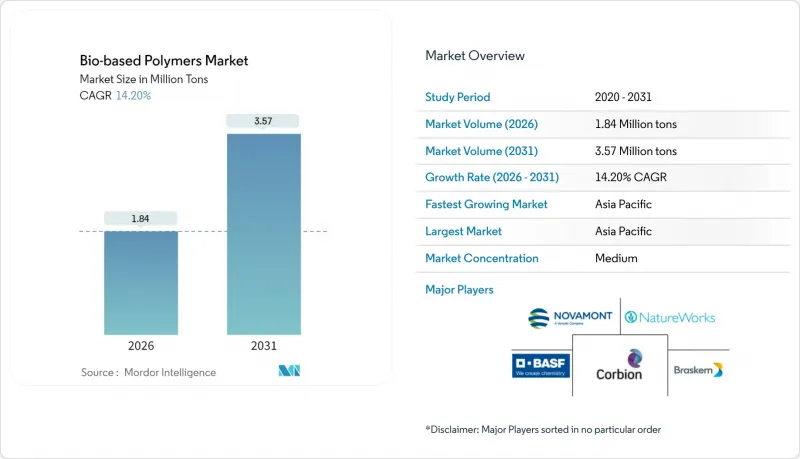
預計生物基聚合物市場將從 2025 年的 161 萬噸成長到 2026 年的 184 萬噸,到 2031 年達到 357 萬噸,2026 年至 2031 年的複合年成長率為 14.2%。
這項快速成長得益於一次性塑膠的強制性禁令、生物精煉技術的快速成熟以及物料平衡認證,後者使得現有設施能夠直接使用新樹脂進行分銷。生產商正與追求淨零排放目標的全球品牌簽署長期承購協議,這為相關人員提供了支持新資本投資的信心。從區域來看,亞太地區將佔據新增產量的大部分,這主要得益於農業殘餘物提供的低成本原料以及鼓勵可再生材料的區域政策。耐熱性和生物相容性的提高正使生物基聚合物的應用範圍從通用包裝擴展到醫療、汽車和電子等高階領域。
全球生物基聚合物市場趨勢與洞察
監管主導的一次性塑膠禁令
澳洲於2024年擴大了塑膠禁令範圍,禁止使用厚購物袋和聚苯乙烯食品容器,並要求零售商改用經認證的可堆肥材料。歐盟目前正在實施生產者延伸責任制,將廢棄物成本轉嫁到每個包裝的價格中,從而縮小與生物基聚合物市場的成本差距。加拿大於2024年底實施了聯邦塑膠禁令,為可再生包裝在北美創造了一個完整的市場。中國在禁止進口廢棄塑膠後,加強了國內監管,強制國內加工商採購符合規定的材料。領先實施案例表明,一旦禁令生效,由於合規風險超過了價格溢價,需求會迅速轉變。
消費者對永續材料的需求日益成長
一項全球調查發現,73%的消費者在購買決策中會考慮永續性聲明,並且願意為經過認證的可再生材料支付15-20%的溢價。品牌所有者正在透過實施優先採購品質平衡認證材料的採購規則來應對這一趨勢,從而保護生物基聚合物市場的利潤率。連鎖餐廳正在透過從傳統塗層轉向可堆肥薄膜來滿足顧客減少廢棄物的期望。 B2B買家正在將碳強度評分納入供應商評分卡,提高了化石基塑膠的進入門檻。這種不斷成長的需求也蔓延到電子和服裝產業,在這些產業中,生活風格品牌正日益將可再生材料作為品質的象徵。
與石油基塑膠的成本比較
由於小規模工廠缺乏規模經濟,生物基化學品的售價比化石基化學品高出20%至50%。雖然工廠與現有化工基地共用公用設施可以降低生產成本,但高資本密集度會延緩價格趨於一致。原油價格上漲會暫時縮小價格差距,但無法消除結構性差異。醫療設備等特殊應用領域能夠接受溢價,因為生物分解性可以減輕監管負擔。要實現更廣泛的價格趨於一致,需要將現有產能翻番,並將固定成本分攤到更大的產量上。
細分市場分析
到2025年,其他產品類型(主要是聚丁二酸丁二醇酯和Polybutylene Adipate Terephthalate)將佔生物基聚合物市場佔有率的44.12%。由於該樹脂具有可堆肥性和良好的熱封強度,生產商正擴大將其應用於地膜和軟包裝袋領域。這一大規模的市場基礎正在推動特種級生物基聚合物市場的整體規模成長,並支持逐步消除瓶頸的計劃。亞洲企業正在將丁二酸和己二酸整合到本地原料中,降低運輸成本和外匯風險,並提高供應穩定性。
到2031年,聚乳酸(PLA)將以18.22%的複合年成長率持續成長。該行業受益於耐熱等級PLA的推出,這些等級拓展了PLA在電子產品機殼和汽車內裝等領域的應用。醫療創新者正利用PLA的生物可吸收特性,設計出癒合後可溶解的螺絲和鋼板,以避免二次手術。阿拉伯聯合大公國和泰國產能的擴張將擴大PLA的生產規模,降低成本,並擴大PLA應用領域的生物基聚合物市場。先前僅限於一兩家公司的技術許可預計將隨著新進入者的出現而加劇市場競爭。
生物基聚合物報告按產品類型(可生物分解澱粉混合物、生物聚乙烯 (bio-PE)、生物聚對苯二甲酸乙二醇酯 (bio-PET) 等)、終端用戶行業(農業、醫療保健、包裝、汽車及運輸、紡織等)和地區(亞太地區、北美地區、歐洲地區、世界其他地區)進行細分。市場預測以噸為單位。
區域分析
到2025年,亞太地區將佔全球生物基聚合物市場規模的44.02%,並在2031年之前以16.63%的複合年成長率持續成長。中國正透過稅收優惠、綠色貸款以及中糧等公司營運的玉米製聚合物一體化項目,鞏固其在該地區主導地位。泰國為生物化學投資提供長達八年的免稅期,吸引合資企業將糖廠與聚合物生產設施結合。印度正利用剩餘的甘蔗渣滿足國內聚合物需求,同時也向跨國公司提供出口信貸。
歐洲擁有成熟的政策組合來支持需求,將一次性塑膠指令與生產者延伸責任制結合。德國和法國已將回收成本內部化,提高了化石基塑膠的相對成本,並鼓勵加工商轉向使用經認證的可生物分解材料。歐洲擁有超過3500家工業堆肥廠,使真正的循環經濟成為可能。區域回收協議允許供應商鎖定多年價格,從而穩定生物基聚合物市場,使其免受原料價格波動的影響。
在北美,各州層級的法規,例如加州的SB54法案(該法案要求在2032年將一次性塑膠包裝減少65%),正在加速這一進程。加拿大的聯邦禁令正在協調各省的產品規格,並建立一個涵蓋整個北美大陸的投資基礎。企業買家正在將可再生碳配額納入供應契約,以確保供應的穩定性。在其他地區,新興的拉丁美洲糖業經濟體和一些非洲國家正在複製相關政策模式,以加速在農業廢棄物豐富的地區推廣應用。
其他福利:
- Excel格式的市場預測(ME)表
- 3個月的分析師支持
目錄
第1章 引言
- 研究假設和市場定義
- 調查範圍
第2章調查方法
第3章執行摘要
第4章 市場情勢
- 市場概覽
- 市場促進因素
- 監管主導的一次性塑膠禁令
- 消費者對永續材料的需求日益成長
- 企業淨零排放與可再生碳採購承諾
- 推出物料平衡認證的即用型樹脂
- 擴大二氧化碳和農業廢棄物生物精煉
- 市場限制
- 與石油基塑膠相比,成本較高
- 缺乏堆肥和回收基礎設施
- 生質燃料強制令導致原料價格波動
- 價值鏈分析
- 波特五力模型
- 供應商的議價能力
- 買方的議價能力
- 新進入者的威脅
- 替代品的威脅
- 競爭程度
第5章 市場規模與成長預測
- 依產品類型
- 可生物分解澱粉混合物
- 生物聚乙烯(Bio-PE)
- 生物基聚對苯二甲酸乙二酯(Bio-PET)
- 聚乳酸(PLA)
- 聚羥基烷酯(PHAs)
- 其他產品類型(例如,聚丁二酸丁二醇酯(PBS)、Polybutylene Adipate Terephthalate(PBAT))
- 按最終用戶行業分類
- 農業
- 醫療保健
- 包裝
- 汽車和運輸設備
- 紡織業
- 其他終端用戶產業
- 按地區
- 亞太地區
- 中國
- 印度
- 日本
- 韓國
- 亞太其他地區
- 北美洲
- 美國
- 加拿大
- 墨西哥
- 歐洲
- 德國
- 英國
- 法國
- 義大利
- 其他歐洲
- 世界其他地區
- 南美洲
- 中東和非洲
- 亞太地區
第6章 競爭情勢
- 市場集中度
- 策略趨勢
- 市佔率(%)/排名分析
- 公司簡介
- BASF
- Biome Bioplastics
- BIOTEC Biologische Naturverpackungen GmbH & Co. KG.
- Braskem
- Cardia Bioplastics
- CJ CHEIL JEDANG CORP.
- Corbion
- Covestro AG
- Danimer Scientific
- Eastman Chemical Company
- Emirates Biotech
- FKuR
- Futerro
- Mitsubishi Chemical Group Corporation
- NatureWorks LLC
- Novamont SpA
- Rodenburg Biopolymers
- Sulzer Ltd.
- Ukhi India Pvt. Ltd.
- Yield10 Bioscience, Inc.
第7章 市場機會與未來展望
The Bio-based Polymers Market is expected to grow from 1.61 million tons in 2025 to 1.84 million tons in 2026 and is forecast to reach 3.57 million tons by 2031 at 14.2% CAGR over 2026-2031.
The sharp expansion comes from mandatory single-use plastic bans, fast-maturing bio-refinery technologies, and mass-balance certification that allows drop-in resins to flow through existing assets. Producers lock in long-term offtake agreements with global brands pursuing net-zero timelines, giving financiers visibility to support new capacity. Regionally, Asia-Pacific captures much of the incremental tonnage because agricultural residues supply low-cost feedstock and local policies encourage renewable materials. Premium segments open in medical, automotive, and electronics as improved heat resistance and biocompatibility formulations move bio-based polymers beyond commodity packaging.
Global Bio-based Polymers Market Trends and Insights
Regulation-led Bans on Single-use Plastics
Australia widened its plastics prohibition in 2024 to ban heavyweight shopping bags and polystyrene food containers, pushing retailers toward certified compostable options. The European Union now enforces extended producer responsibility that prices end-of-life costs into each package, narrowing the cost gap with the bio-based polymers market. Canada implemented a federal plastics prohibition in late 2024, creating a contiguous North American market for renewable packaging. China tightened domestic restrictions after banning waste plastic imports, forcing local converters to source compliant materials. Early adopters show that once bans enter force, demand shifts quickly because compliance risk outweighs price premiums.
Rising Consumer Demand for Sustainable Materials
Global surveys show that 73% of shoppers weigh sustainability claims in purchase decisions and will pay 15-20% more for verified renewable content. Brand owners translate this signal into procurement rules that favor mass-balance certified feedstocks, protecting margins in the bio-based polymers market. Food service chains swap conventional coatings for compostable films to meet customer expectations on waste reduction. B2B buyers embed carbon intensity scores in supplier scorecards, raising entry barriers for fossil plastics. The demand pull spreads to electronics and apparel as lifestyle brands position renewable materials as a marker of quality.
Higher Cost vs. Petro-plastics
Bio-based grades sell at 20-50% premiums compared with fossil alternatives because smaller plants lack scale efficiencies. Production costs ease when plants share utilities with existing chemical hubs, yet capital intensity delays parity. Price spikes in crude oil narrow the gap temporarily but do not erase structural differences. Specialty uses such as medical devices absorb premiums because biodegradability trims regulatory burdens. Broader parity depends on doubling current capacity so fixed costs spread across more tons.
Other drivers and restraints analyzed in the detailed report include:
- Corporate Net-zero and Renewable-carbon Sourcing Pledges
- Scale-up of CO2- and Agri-waste-based Biorefineries
- Limited Composting and Recycling Infrastructure
For complete list of drivers and restraints, kindly check the Table Of Contents.
Segment Analysis
Other product types, dominated by polybutylene succinate and polybutylene adipate terephthalate, accounted for 44.12% of bio-based polymers market share in 2025. Producers win adoption in mulch films and flexible pouches because these resins combine compostability with heat-seal strength. Their large base lifts the overall bio-based polymers market size for specialty grades and supports incremental debottlenecking projects. Supply security improves as Asian firms integrate succinic acid and adipic acid back to local feedstock, trimming freight and currency risk.
Polylactic acid leads growth at an 18.22% CAGR to 2031. The segment benefits from recent heat-stable grades that unlock electronics housings and automotive trim. Medical innovators exploit PLA's bioresorption to design screws and plates that dissolve after healing, avoiding secondary surgeries. Capacity expansions in the UAE and Thailand add scale and lower cost floors, which enlarges the bio-based polymers market size for PLA applications. Competitive intensity rises as new entrants license technology that had been confined to one or two players.
The Bio-Based Polymers Report is Segmented by Product Type (Biodegradable Starch Blends, Bio Polyethylene (Bio-PE), Bio-Polyethylene Terephthalate (Bio-PET), and More), End-User Industry (Agriculture, Medical and Healthcare, Packaging, Automotive and Transportation, Textiles, and Others), and Geography (Asia-Pacific, North America, Europe, and Rest of World). The Market Forecasts are Provided in Terms of Volume (Tons).
Geography Analysis
Asia-Pacific captured 44.02% of the bio-based polymers market size in 2025 and is expanding at a 16.63% CAGR to 2031. China anchors regional leadership through tax rebates, green loans, and integrated corn-to-polymer complexes run by COFCO and peers. Thailand grants eight-year tax holidays on bio-chemical investments, luring joint ventures that colocate sugar mills with polymer units. India leverages surplus bagasse to backfill domestic polymer demand while exporting credits to multinationals.
Europe supports demand with a mature policy mix that combines the Single-Use Plastics Directive and mandatory extended producer responsibility. Germany and France internalize collection fees that make fossil plastics relatively more expensive, steering converters toward certified compostables. Industrial composting coverage surpasses 3,500 sites, enabling true circularity claims. Regional offtake agreements let suppliers lock multi-year prices, stabilizing the bio-based polymers market against feedstock swings.
North America accelerates through state-level laws such as California's SB 54 that requires a 65% cut in single-use plastic packaging by 2032. Canada's federal ban synchronizes product specifications across provinces, creating a continental platform for investment. Corporate buyers formalize renewable-carbon quotas in supplier contracts, delivering predictable tonnage. Elsewhere, emerging Latin American sugar economies and selected African nations replicate policy templates that fast-track adoption where agricultural residues are plentiful.
- BASF
- Biome Bioplastics
- BIOTEC Biologische Naturverpackungen GmbH & Co. KG.
- Braskem
- Cardia Bioplastics
- CJ CHEIL JEDANG CORP.
- Corbion
- Covestro AG
- Danimer Scientific
- Eastman Chemical Company
- Emirates Biotech
- FKuR
- Futerro
- Mitsubishi Chemical Group Corporation
- NatureWorks LLC
- Novamont S.p.A.
- Rodenburg Biopolymers
- Sulzer Ltd.
- Ukhi India Pvt. Ltd.
- Yield10 Bioscience, Inc.
Additional Benefits:
- The market estimate (ME) sheet in Excel format
- 3 months of analyst support
TABLE OF CONTENTS
1 Introduction
- 1.1 Study Assumptions and Market Definition
- 1.2 Scope of the Study
2 Research Methodology
3 Executive Summary
4 Market Landscape
- 4.1 Market Overview
- 4.2 Market Drivers
- 4.2.1 Regulation-led bans on single-use plastics
- 4.2.2 Rising consumer demand for sustainable materials
- 4.2.3 Corporate net-zero and renewable-carbon sourcing pledges
- 4.2.4 Mass-balance certified drop-in resins adoption
- 4.2.5 Scale-up of CO2- and agri-waste-based biorefineries
- 4.3 Market Restraints
- 4.3.1 Higher cost vs. petro-plastics
- 4.3.2 Limited composting and recycling infrastructure
- 4.3.3 Feedstock price volatility from biofuel mandates
- 4.4 Value Chain Analysis
- 4.5 Porter's Five Forces
- 4.5.1 Bargaining Power of Suppliers
- 4.5.2 Bargaining Power of Buyers
- 4.5.3 Threat of New Entrants
- 4.5.4 Threat of Substitutes
- 4.5.5 Degree of Competition
5 Market Size and Growth Forecasts (Volume)
- 5.1 By Product Type
- 5.1.1 Biodegradable Starch Blends
- 5.1.2 Bio Polyethylene (Bio-PE)
- 5.1.3 Bio-Polyethylene Terephthalate (Bio-PET)
- 5.1.4 Polylactic Acid (PLA)
- 5.1.5 Polyhydroxyalkanoate (PHA)
- 5.1.6 Other Product Types (Polybutylene Succinate (PBS), Polybutylene Adipate Terephthalate (PBAT), etc.)
- 5.2 By End-user Industry
- 5.2.1 Agriculture
- 5.2.2 Medical and Healthcare
- 5.2.3 Packaging
- 5.2.4 Automotive and Transportation
- 5.2.5 Textiles
- 5.2.6 Other End-user Industries
- 5.3 By Geography
- 5.3.1 Asia-Pacific
- 5.3.1.1 China
- 5.3.1.2 India
- 5.3.1.3 Japan
- 5.3.1.4 South Korea
- 5.3.1.5 Rest of Asia-Pacific
- 5.3.2 North America
- 5.3.2.1 United States
- 5.3.2.2 Canada
- 5.3.2.3 Mexico
- 5.3.3 Europe
- 5.3.3.1 Germany
- 5.3.3.2 United Kingdom
- 5.3.3.3 France
- 5.3.3.4 Italy
- 5.3.3.5 Rest of Europe
- 5.3.4 Rest of the World
- 5.3.4.1 South America
- 5.3.4.2 Middle East and Africa
- 5.3.1 Asia-Pacific
6 Competitive Landscape
- 6.1 Market Concentration
- 6.2 Strategic Moves
- 6.3 Market Share (%)/Ranking Analysis
- 6.4 Company Profiles (includes Global-level Overview, Market-level Overview, Core Segments, Financials, Strategic Info, Market Rank/Share, Products and Services, Recent Developments)
- 6.4.1 BASF
- 6.4.2 Biome Bioplastics
- 6.4.3 BIOTEC Biologische Naturverpackungen GmbH & Co. KG.
- 6.4.4 Braskem
- 6.4.5 Cardia Bioplastics
- 6.4.6 CJ CHEIL JEDANG CORP.
- 6.4.7 Corbion
- 6.4.8 Covestro AG
- 6.4.9 Danimer Scientific
- 6.4.10 Eastman Chemical Company
- 6.4.11 Emirates Biotech
- 6.4.12 FKuR
- 6.4.13 Futerro
- 6.4.14 Mitsubishi Chemical Group Corporation
- 6.4.15 NatureWorks LLC
- 6.4.16 Novamont S.p.A.
- 6.4.17 Rodenburg Biopolymers
- 6.4.18 Sulzer Ltd.
- 6.4.19 Ukhi India Pvt. Ltd.
- 6.4.20 Yield10 Bioscience, Inc.
7 Market Opportunities and Future Outlook
- 7.1 White-space and Unmet-need Assessment

 生物聚合物創新市場預測至2034年:按聚合物類型、原料、應用和地區分類的全球分析
 蓖麻油衍生生物聚合物市場:2026-2032年全球市場預測(按聚合物類型、製造流程、形態和應用分類)生物聚合物薄膜市場:按材料、薄膜類型、應用和最終用途產業分類-2026-2032年全球市場預測
 永續晶圓回收市場分析及預測(至2035年):依類型、產品、服務、技術、組件、應用、材料類型、製程、最終用戶及功能分類自消毒表面市場分析及預測(至2035年):依類型、產品類型、技術、應用、材質、最終用戶、製程、部署類型、設備及解決方案分類
 永續生物聚合物:全球市場
 2026年全球生物聚合物市場報告
 生物聚合物市場-2026-2031年預測
 電氣和電子生物聚合物市場-全球產業規模、佔有率、趨勢、機會、預測:按類型、應用、地區和競爭格局分類,2021-2031年D,L-聚乳酸市場按形態、類型、生產製程、分子量和最終用途產業分類-2026-2032年全球預測