


 |
市場調查報告書
商品編碼
1937281
印度汽車產業:市場佔有率分析、產業趨勢與統計、成長預測(2026-2031)India Automobile Industry - Market Share Analysis, Industry Trends & Statistics, Growth Forecasts (2026 - 2031) |
||||||

※ 本網頁內容可能與最新版本有所差異。詳細情況請與我們聯繫。
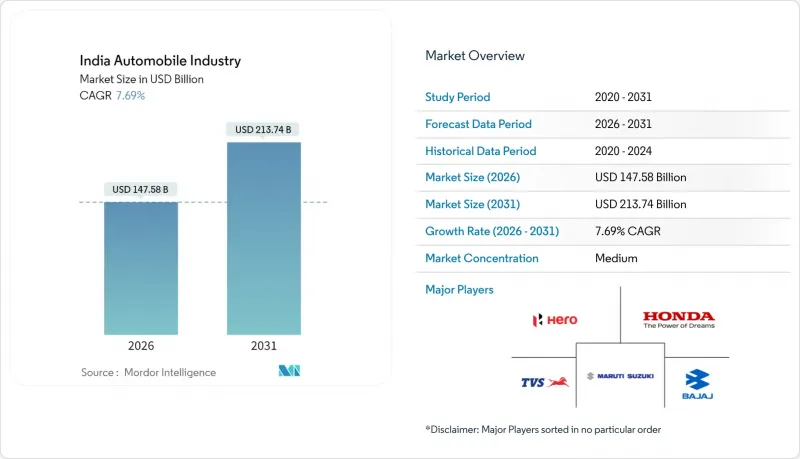
印度汽車市場預計將從 2025 年的 1,370.6 億美元成長到 2026 年的 1,475.8 億美元,預計到 2031 年將達到 2,137.4 億美元,2026 年至 2031 年的複合年成長率為 7.69%。
人口成長、家庭收入提高、推動電氣化的政策支持以及製造業基礎(2024會計年度產量達2843萬輛)共同支撐了不斷成長的消費需求。二輪車、乘用車、商用車和三輪車的持續生產保持了行業的韌性,而諸如“總理鄉村道路計劃”(Pradhan Mantri Gram Sadak Yojana)等基礎設施項目則擴大了其地理覆蓋範圍。儘管競爭依然激烈,但電動車、訂閱式所有權和企業車隊脫碳等領域仍蘊藏著許多機會。預計未來十年,半導體自給率的提高、更密集的農村道路網路以及數位化零售的發展,將成為印度汽車市場的新驅動力。
印度汽車產業趨勢與洞察
可支配所得增加和快速都市化
收入的成長使汽車擁有更具吸引力,尤其是在土地資源豐富、交通堵塞較少的區域性城市(二、三線城市),這擴大了印度汽車市場的消費群。 65%的人口年齡在35歲以下,首次購車者正值收入高峰期。農村人口遷移刺激了雙重需求:一方面,都市區購車者追求出行便利;另一方面,匯款也用於轉換返鄉生活。就業向郊區轉移減少了人們對公共交通的依賴,從而支撐了對二輪車和小型汽車的需求。訂閱模式透過避免高額首付擴大了購車管道,進一步推動了汽車的普及。
政府電動車與FAME-II獎勵
印度於2019年啟動的FAME(混合動力汽車和電動汽車燃料採用與製造)第二階段計劃,五年預算高達1150億盧比(約13.1億美元)。該計劃旨在促銷電動車,包括電動二輪車(e-2W)、電動三輪車(e-3W)和電動四輪車(e-4W)。泰米爾納德邦和古吉拉突邦的額外補貼加劇了區域差距,而計劃中的FAME-III修訂版旨在擴大對更大型車輛的支援。這些激勵措施縮短了投資回收期,並鼓勵私人買家和車隊營運商轉向零排放車型。
監管變化、安全標準和商品及服務稅過渡
隨著印度實施BS-VII排放標準並強制要求安全配置,中小型組裝組裝商正面臨高成本的動力傳動系統升級和認證成本,這給車型利潤率帶來了壓力。這些升級需要大量的研發投入和嚴格的測試才能符合法規標準。同時,零件商品及服務稅(GST)的調整造成了價格的不確定性,並影響了製造商的整體成本結構。雪上加霜的是,各邦道路稅制度的差異也使合規變得更加複雜,製造商需要應對不同地區的稅收制度。這些因素可能大幅推高消費者的購車成本,導致消費者延後購車,並降低印度汽車市場的即時需求。此外,成本上漲可能會促使製造商探索其他策略,例如在地採購,以減輕財務負擔。
細分市場分析
二輪車在印度汽車市場佔據主導地位,市佔率高達73.64%。這一主導地位凸顯了印度消費者對二輪車的偏好,因為它們價格實惠、燃油效率高,且在擁擠的都市區易於操控。乘用車雖然規模較小,但其複合年成長率(CAGR)最高,達到8.84%,這主要得益於SUV和跨界車的推出,滿足了中產階級的需求。Scooter銷量成長了21%,而摩托車銷量僅成長了10%,凸顯了消費者對自動變速箱和在都市區便利操控的偏好。
隨著電動二輪車進入主流價格區間,以及金融機構向首次購車者提供長期貸款,成長動能持續強勁。同時,商用車受制於基礎設施預算和工業生產週期,但正受益於正在進行的高速公路建設。三輪車在農村地區的「最後一公里」貨運和客運中仍然發揮著重要作用。日益嚴格的排放氣體標準正推動模組化平台的投資,預計將提升印度汽車市場現有企業的規模經濟效益。
截至2025年,汽油引擎在印度汽車市場仍佔59.27%的佔有率,這主要得益於煉油產能和相對於柴油的採購價格優勢。純電動車(BEV)雖然銷量較低,但由於稅收優惠、FAME-II補貼以及鋰離子電池成本下降,其複合年成長率(CAGR)仍達到10.02%。混合動力汽車汽車消除了里程焦慮,並在不依賴新能源基礎設施的情況下提高了效率。
在政府對國內發電的政策承諾和嚴格的燃油效率標準的推動下,汽車製造商正逐步將其產品系列組合轉向電動驅動系統。為降低營運成本,液化石油氣/壓縮天然氣的使用在尋求降低營運成本的商用車隊中日益普及。同時,由於氫氣供應短缺,燃料電池技術仍處於試點階段。儘管充電網路和電池更換試點計畫的推進將決定其普及速度,但印度汽車市場已顯現出各細分市場消費者接受度加速提升的徵兆。
其他福利:
- Excel格式的市場預測(ME)表
- 3個月的分析師支持
目錄
第1章 引言
- 研究假設和市場定義
- 調查範圍
第2章調查方法
第3章執行摘要
第4章 市場情勢
- 市場概覽
- 市場促進因素
- 可支配所得增加和快速都市化
- 政府電動車與FAME-II獎勵
- 國家和地方公路網的擴建
- 訂閱所有權和租賃模式
- 區域半導體製造投資
- 企業車隊脫碳需求
- 市場限制
- 監管變化、安全標準和商品及服務稅過渡
- 全球半導體供應鏈的波動性
- 由於都市區擁擠而導致的使用限制
- 與車載資訊系統相關的保險費上漲
- 價值/供應鏈分析
- 監管環境
- 技術展望
- 波特五力模型
- 新進入者的威脅
- 買方的議價能力
- 供應商的議價能力
- 替代品的威脅
- 競爭對手之間的競爭
第5章 市場規模及成長預測(金額)
- 按車輛類型
- 摩托車
- 三輪車
- 搭乘用車
- 商用車輛
- 按燃料類型
- 汽油
- 柴油引擎
- LPG/CNG
- 電池電動車
- 油電混合車
- 插電式混合動力電動車
- 燃料電池電動車
- 按銷售管道
- 原廠授權經銷商
- 線上
- 依所有權類型
- 個人使用
- 商業用途
- 按地區
- 印度北部
- 南印度
- 東印度
- 西印度群島
第6章 競爭情勢
- 市場集中度
- 策略趨勢
- 市佔率分析
- 公司簡介
- TVS Motor Company
- Hero MotoCorp
- Honda Motorcycle
- Royal Enfield
- Bajaj Auto
- Suzuki Motorcycle India
- Maruti Suzuki India
- Tata Motors
- Hyundai Motor India
- Mahindra & Mahindra
- MG Motor India
- Volkswagen India
- Renault-Nissan Alliance
- Honda Cars India
- BYD India
- BMW Group India
- Mercedes-Benz India
- Kia India
- Ashok Leyland
- Eicher Motors(VE Commercial)
- Atul Auto
- Piaggio Vehicles
- Kinetic Green
第7章 市場機會與未來展望
The India automobile market is expected to grow from USD 137.06 billion in 2025 to USD 147.58 billion in 2026 and is forecast to reach USD 213.74 billion by 2031 at 7.69% CAGR over 2026-2031.
Demand is buoyed by population-led consumption, rising household incomes, policy-backed electrification, and a manufacturing base that produced 28.43 million vehicles in FY 2024. Sustained output across two-wheelers, passenger cars, commercial vehicles, and three-wheelers keeps the sector resilient, while infrastructure programs such as Pradhan Mantri Gram Sadak Yojana widen geographic reach. Competitive dynamics remain intense, yet opportunities persist in electric models, subscription ownership, and corporate fleet decarbonization. Semiconductor self-reliance, rural road density, and digital retail are additional levers set to lift the India automobile market through the decade.
India Automobile Industry Trends and Insights
Rising Disposable Incomes and Rapid Urbanization
Income growth is enlarging the consumer base for the Indian automobile market, especially in Tier-2 and Tier-3 cities, where land availability and lower congestion make vehicle ownership attractive. Sixty-five percent of the population is under 35, aligning prime earning years with first-time purchases. Migration from rural districts stimulates dual demand, urban buyers seek mobility, while remittances finance upgrades back home. The spread of suburban employment hubs reduces dependence on mass transit and supports two-wheelers and compact cars. Subscription programs extend access by sidestepping hefty down payments, further deepening penetration.
Government EV and FAME-II Incentives
India's FAME (Faster Adoption and Manufacturing of Hybrid & Electric Vehicles) Scheme Phase-II, launched in 2019, comes with a hefty budget of INR 11,500 crore (USD 1.31 billion), set to span five years. This initiative aims to boost the sales of electric vehicles, covering e-2Ws, e-3Ws, and e-4Ws. . State add-ons in Tamil Nadu and Gujarat enhance regional differentials, while the planned FAME-III revision aims to broaden support into heavier segments. These incentives shorten payback periods, encouraging personal buyers and fleet operators to pivot toward zero-emission models.
Regulatory Changes, Safety Standards and GST Shifts
As India implements BS-VII norms and mandates safety gear, small assemblers grapple with costly powertrain upgrades and validations, squeezing their model margins. These upgrades require significant research and development investments and rigorous testing to meet compliance standards. Meanwhile, GST realignments on components introduce pricing uncertainties, impacting the overall cost structure for manufacturers. Adding to the challenge, varying state road-tax regimes complicate compliance, as manufacturers must navigate differing tax policies across regions. These factors lead to noticeable price hikes for consumers, potentially delaying their purchases and dampening immediate demand in the Indian automobile market. Additionally, the increased costs may push manufacturers to explore alternative strategies, such as the localization of components, to mitigate the financial burden.
Other drivers and restraints analyzed in the detailed report include:
- Expansion of National Highway and Rural Road Network
- Subscription-Based Ownership and Leasing Models
- Global Semiconductor Supply-Chain Volatility
For complete list of drivers and restraints, kindly check the Table Of Contents.
Segment Analysis
In the Indian auto market, two-wheelers reign supreme, commanding a significant 73.64% share. This dominance highlights the preference for two-wheelers among Indian consumers, driven by factors such as affordability, fuel efficiency, and ease of navigation in congested urban areas. Although smaller, passenger cars are posting the swiftest 8.84% CAGR on the back of SUV and crossover launches tuned to aspirational middle-class tastes. Scooter sales climbed 21% versus the motorcycle segment's 10% gain, highlighting urban preference for automatic transmissions and ease of use.
Growth momentum continues as electric two-wheelers enter mainstream price points and as financiers extend longer tenures to first-time buyers. Conversely, commercial vehicles hinge on infrastructure budgets and industrial output cycles but benefit from ongoing highway upgrades. Three-wheelers retain relevance for last-mile goods and passenger movement in Tier-2 centers. Regulatory emission upgrades funnel investments toward modular platforms, potentially elevating scale efficiencies for incumbents in the Indian automobile market.
Petrol engines retained 59.27% of the India automobile market share in 2025, buoyed by refinery capacity and lower purchase prices relative to diesel. Battery electric vehicles, though smaller in volume, are advancing at a 10.02% CAGR thanks to tax rebates, FAME-II subsidies and falling lithium-ion cell costs. Hybrids bridge range-anxiety gaps, offering efficiency gains without new-energy infrastructure dependence.
Policy commitments to domestic power generation and stricter fuel-economy norms will gradually shift OEM portfolios toward electrified drivetrains. LPG/CNG use expands in commercial fleets seeking operating-cost relief. Meanwhile, fuel-cell technology remains exploratory due to hydrogen supply gaps. Charging-network rollouts and battery-swapping pilots dictate adoption pace but indicators already point to accelerating consumer acceptance across segments in the India automobile market.
The India Automobile Market Report is Segmented by Vehicle Type (Two-Wheelers, Three-Wheelers and More), Fuel Type (Petrol/Gasoline, Diesel, LPG/CNG, and More), Sales Channel (OEM-Authorized Dealers and Online), Ownership Type (Personal Use and Commercial Use), and by Region (North India, South India, East India, West India). The Market Forecasts are Provided in Terms of Value (USD).
List of Companies Covered in this Report:
- TVS Motor Company
- Hero MotoCorp
- Honda Motorcycle
- Royal Enfield
- Bajaj Auto
- Suzuki Motorcycle India
- Maruti Suzuki India
- Tata Motors
- Hyundai Motor India
- Mahindra & Mahindra
- MG Motor India
- Volkswagen India
- Renault-Nissan Alliance
- Honda Cars India
- BYD India
- BMW Group India
- Mercedes-Benz India
- Kia India
- Ashok Leyland
- Eicher Motors (VE Commercial)
- Atul Auto
- Piaggio Vehicles
- Kinetic Green
Additional Benefits:
- The market estimate (ME) sheet in Excel format
- 3 months of analyst support
TABLE OF CONTENTS
1 Introduction
- 1.1 Study Assumptions & Market Definition
- 1.2 Scope of the Study
2 Research Methodology
3 Executive Summary
4 Market Landscape
- 4.1 Market Overview
- 4.2 Market Drivers
- 4.2.1 Rising Disposable Incomes and Rapid Urbanization
- 4.2.2 Government EV and FAME-II Incentives
- 4.2.3 Expansion of National Highway and Rural Road Network
- 4.2.4 Subscription-Based Ownership and Leasing Models
- 4.2.5 Local Semiconductor Fabrication Investments
- 4.2.6 Corporate Fleet-Decarbonization Mandates
- 4.3 Market Restraints
- 4.3.1 Regulatory Changes, Safety Standards and GST Shifts
- 4.3.2 Global Semiconductor Supply-Chain Volatility
- 4.3.3 Urban Congestion-Driven Usage Restrictions
- 4.3.4 Rising Telematics-Linked Insurance Premiums
- 4.4 Value / Supply-Chain Analysis
- 4.5 Regulatory Landscape
- 4.6 Technological Outlook
- 4.7 Porter's Five Forces
- 4.7.1 Threat of New Entrants
- 4.7.2 Bargaining Power of Buyers
- 4.7.3 Bargaining Power of Suppliers
- 4.7.4 Threat of Substitutes
- 4.7.5 Intensity of Competitive Rivalry
5 Market Size & Growth Forecasts (Value, USD billion)
- 5.1 By Vehicle Type
- 5.1.1 Two-wheelers
- 5.1.2 Three-wheelers
- 5.1.3 Passenger Cars
- 5.1.4 Commercial Vehicles
- 5.2 By Fuel Type
- 5.2.1 Petrol / Gasoline
- 5.2.2 Diesel
- 5.2.3 LPG / CNG
- 5.2.4 Battery Electric Vehicles
- 5.2.5 Hybrid Electric Vehicles
- 5.2.6 Plug-in Hybrid Electric Vehicles
- 5.2.7 Fuel-Cell Electric Vehicles
- 5.3 By Sales Channel
- 5.3.1 OEM-Authorised Dealers
- 5.3.2 Online
- 5.4 By Ownership Type
- 5.4.1 Personal Use
- 5.4.2 Commercial Use
- 5.5 By Region
- 5.5.1 North India
- 5.5.2 South India
- 5.5.3 East India
- 5.5.4 West India
6 Competitive Landscape
- 6.1 Market Concentration
- 6.2 Strategic Moves
- 6.3 Market Share Analysis
- 6.4 Company Profiles (Includes Global level Overview, Market level overview, Core Segments, Financials as available, Strategic Information, Market Rank/Share for key companies, Products & Services, and Recent Developments)
- 6.4.1 TVS Motor Company
- 6.4.2 Hero MotoCorp
- 6.4.3 Honda Motorcycle
- 6.4.4 Royal Enfield
- 6.4.5 Bajaj Auto
- 6.4.6 Suzuki Motorcycle India
- 6.4.7 Maruti Suzuki India
- 6.4.8 Tata Motors
- 6.4.9 Hyundai Motor India
- 6.4.10 Mahindra & Mahindra
- 6.4.11 MG Motor India
- 6.4.12 Volkswagen India
- 6.4.13 Renault-Nissan Alliance
- 6.4.14 Honda Cars India
- 6.4.15 BYD India
- 6.4.16 BMW Group India
- 6.4.17 Mercedes-Benz India
- 6.4.18 Kia India
- 6.4.19 Ashok Leyland
- 6.4.20 Eicher Motors (VE Commercial)
- 6.4.21 Atul Auto
- 6.4.22 Piaggio Vehicles
- 6.4.23 Kinetic Green


