


 |
市場調查報告書
商品編碼
1937254
建築塗料:市場佔有率分析、產業趨勢與統計、成長預測(2026-2031)Architectural Coatings - Market Share Analysis, Industry Trends & Statistics, Growth Forecasts (2026 - 2031) |
||||||

※ 本網頁內容可能與最新版本有所差異。詳細情況請與我們聯繫。
預計到 2026 年,建築塗料市場規模將達到 955.7 億美元,高於 2025 年的 916.2 億美元。
預計到 2031 年,市場規模將達到 1,179.8 億美元,2026 年至 2031 年的複合年成長率為 4.3%。
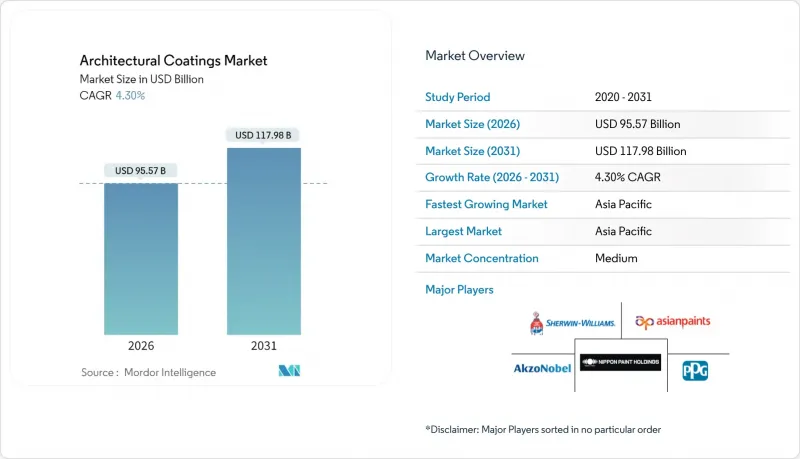
低VOC配方法規的要求、水性塗料技術的加速普及以及老舊住宅存量維修的需求,共同支撐著這一穩步成長的趨勢。美國炎熱氣候州強制性的「冷屋頂」法規推動了反射塗料的普及,而中國二、三線城市正迅速轉向水性塗料,推動全球產品結構向永續化學技術轉型。同時,勞動力短缺和環氧樹脂原料價格波動擠壓了利潤空間,促使企業投資於省力施工工具和智慧塗料技術。
全球建築塗料市場趨勢及展望
美國老舊住宅存量的維修需求激增
由於房屋抵押貸款居高不下,住宅更傾向於維修房屋而非搬遷,這推動了對符合加州第24號法規規定的具有冷屋頂的優質外牆塗料的需求。由於塗料的使用已納入建築許可流程,而非可選項,因此合規性帶來了可預測的需求。洛杉磯的綠色建築規範規定了太陽反射率指數(SRI)閾值,當地公共產業也提供每平方英尺0.20美元的補貼,鼓勵計劃預算轉向更高價值的配方。人口老化加劇,越來越多的人選擇居家養老,延長了重新粉刷的周期,並促使人們投資於能夠減少長期維護的長壽命系統。與新建項目相比,維修支出波動較小,製造商可以從中受益,從而能夠制定更穩定的生產計畫。專業供應商正利用這一轉變,將色彩視覺化應用程式和承包商配對服務相結合,以簡化消費者的決策過程。
美國炎熱氣候州強制實施冷屋頂標準
加州和國際節能規範 (IECC) 要求 1-3 區的低坡度屋頂在老化後太陽反射率達到 0.55 或更高,熱輻射率達到 0.75 或更高,這鼓勵建築商採用中車 (CRRC) 認證的產品。此認證項目縮小了競爭格局,並鼓勵研發高反射顏料和耐用彈性黏合劑。由於與許可證申請掛鉤,供應商能夠更準確地預測需求並協商長期原料合約。空氣間隔屋頂結構的例外情況可能會影響建築設計,並鼓勵採用將塗料與透氣基材結合的混合系統。德克薩斯州和亞利桑那州等州也在修訂其標準,加速了全國的推廣應用。
由於歐盟加強了除生物劑的監管,罐頭內防腐劑的使用受到限制。
2023年生效的法規限制了二異氰酸酯的含量並限制了全氟烷基和多氟烷基物質(PFAS)的使用,迫使歐洲製造商重新設計其硬化劑和防污劑的化學配方。雖然具有類似貨架穩定性的替代品正在研發中,但配方調整的成本卻在上升。農業領域禁用雜酚油進一步限制了木材防腐劑的選擇,並提高了泛歐產品線的技術門檻。跨國公司推動規範統一的措施正在產生全球連鎖反應,導致合規投資增加和產品開發週期延長。
細分市場分析
到2025年,水性塗料將佔據建築塗料市場52.02%的佔有率,年複合成長率(CAGR)為4.70%,這主要得益於從上海到深圳等地政府對揮發性有機化合物(VOC)排放的限制以及對含溶劑產品的禁令。這些措施表明,與溶劑型產品相比,水性塗料的VOC含量降低了50%以上,鞏固了其市場主導地位。儘管溶劑型塗料在一些需要滲透性和極強防潮性能的特定應用領域仍然佔據一席之地,但粉末塗料和輻射固化塗料技術正在工廠預塗飾面領域取得穩步進展。水性塗料的快速普及使其成為建築塗料市場的技術基礎,供應商正在擴大產能並完善本地化配方基礎設施,以滿足監管主導的需求激增。
歐盟和北美地區監管的持續收緊將加速水性塗料技術在中端和入門級價格市場的滲透,縮小其與溶劑型塗料之間長期存在的成本差距。為了滿足環境、社會和治理(ESG)報告要求並降低未來的合規風險,原始設備製造商(OEM)和承包商擴大指定使用水性塗料生產線。因此,大型製造商正在投資水性樹脂反應器,而中型企業則在探索授權協議和合資企業,以獲取專有的聚合物平台。隨著規模經濟效應導致每公升成本下降,水性塗料的普及形成良性循環,鞏固了其在建築塗料市場整體成長的核心地位。
建築塗料報告按技術(水性、溶劑型及其他)、樹脂類型(丙烯酸、醇酸、環氧樹脂、聚酯、聚氨酯及其他樹脂類型)、應用領域(住宅、商業)和地區(亞太、北美、歐洲、南美、中東和非洲)進行細分。市場預測以美元以金額為準。
區域分析
到2025年,亞太地區將佔全球建築塗料收入的46.10%,年複合成長率達5.52%,這主要得益於都市化的快速發展、智慧城市投資的增加以及住宅的蓬勃發展。中國水性塗料強制令的實施正在推動大規模的技術變革,而DIFM(自行施工、安裝和維護)服務模式以及可支配收入的成長則推動了東南亞國協對高品質塗料的採用。
北美市場在維修週期和法規主導的對冷屋頂的需求推動下保持穩定成長。加州第24號法規和IECC法規為高反射塗料創造了穩定的需求,即使整體住宅開工量依然低迷。然而,熟練油漆工短缺和人事費用上漲限制了近期成長,促使企業採用省力噴塗設備和快乾塗料來維持施工能力。
在歐洲成熟市場,企業面臨日益複雜的營運環境,揮發性有機化合物 (VOC)、殺菌劑和全氟烷基物質 (PFAS) 的監管標準不斷收緊。儘管配方調整成本給盈利帶來挑戰,但該地區對永續性和循環經濟原則的承諾正在推動高階低 VOC 水基解決方案的發展。東歐在基礎設施計劃和維修補貼的推動下實現了高於平均水平的成長,而西歐則專注於高性能外牆維修,以實現碳減排目標。拉丁美洲和中東及非洲市場規模仍然小規模,但經濟多元化和大型住宅項目帶來的成長潛力吸引了策略性收購,例如聖戈班收購墨西哥 Ovnivel 集團。
其他福利:
- Excel格式的市場預測(ME)表
- 分析師支持(3個月)
目錄
第1章 引言
- 研究假設和市場定義
- 調查範圍
第2章調查方法
第3章執行摘要
第4章 市場情勢
- 市場概覽
- 市場促進因素
- 美國老舊住宅存量維修需求激增
- 美國炎熱氣候州強制執行「冷屋頂」標準
- 中國二、三線城市迅速轉向水基技術
- 東協地區「DIFM(直接檢驗和正式塗裝服務)」網路的快速發展
- 智慧著色自清潔外牆塗料
- 市場限制
- 環氧樹脂原料價格上漲/2024年起供應中斷
- 由於歐盟加強了對除生物劑的監管,罐頭內防腐劑的使用受到限制。
- 北美熟練油漆工短缺
- 價值鏈分析
- 波特五力模型
- 供應商的議價能力
- 買方的議價能力
- 新進入者的威脅
- 替代品的威脅
- 競爭程度
第5章 市場規模與成長預測
- 透過技術
- 水系統
- 溶劑型
- 其他
- 依樹脂類型
- 丙烯酸纖維
- 醇酸樹脂
- 環氧樹脂
- 聚酯纖維
- 聚氨酯
- 其他樹脂類型
- 按最終用途
- 住宅
- 商業的
- 按地區
- 亞太地區
- 中國
- 印度
- 日本
- 韓國
- 印尼
- 越南
- 泰國
- 菲律賓
- 新加坡
- 澳洲和紐西蘭
- 亞太其他地區
- 北美洲
- 美國
- 加拿大
- 墨西哥
- 歐洲
- 德國
- 英國
- 法國
- 義大利
- 西班牙
- 波蘭
- 北歐國家
- 俄羅斯
- 其他歐洲
- 南美洲
- 巴西
- 阿根廷
- 南美洲其他地區
- 中東和非洲
- 沙烏地阿拉伯
- 南非
- 其他中東和非洲地區
- 亞太地區
第6章 競爭情勢
- 市場集中度
- 策略趨勢
- 市佔率(%)/排名分析
- 公司簡介
- 3 TREES Group
- AkzoNobel NV
- Asian Paints
- BASF
- Beckers Group
- Benjamin Moore and Company
- Berger Paints India Ltd.
- Brillux GmbH and Co. KG
- CIN SA
- DAW SE
- Flugger group AS
- Hempel A/S
- Jotun
- Kansai Paint Co., Ltd.
- Masco Corporation
- Nippon Paint Holdings Co., Ltd
- PPG Industries Inc.
- RPM International Inc.
- Sniezka SA
- The Sherwin-Williams Company
第7章 市場機會與未來展望
Architectural Coatings market size in 2026 is estimated at USD 95.57 billion, growing from 2025 value of USD 91.62 billion with 2031 projections showing USD 117.98 billion, growing at 4.3% CAGR over 2026-2031.
Regulatory mandates for low-VOC formulations, rapid water-borne technology adoption, and renovation-led demand in mature housing stocks underpin this steady trajectory. Mandatory cool-roof codes in U.S. hot-climate states are accelerating reflective-coating uptake, while China's Tier-2 and Tier-3 cities are fast-tracking water-borne conversions that shift global product mix toward sustainable chemistries. At the same time, labor shortages and epoxy-raw-material volatility are tightening margins, fostering investment in labor-saving application tools and smart-coating technologies.
Global Architectural Coatings Market Trends and Insights
Surging Renovation Demand in Aging U.S. Housing Stock
Homeowners are choosing upgrades over relocation as high mortgage rates persist, lifting volumes of premium exterior paints with cool-roof properties mandated by California Title 24. Compliance drives predictable demand because coatings are embedded in building-permit workflows rather than discretionary cycles. Los Angeles' Green Building Code stipulates Solar Reflectance Index thresholds, while local utilities pay USD 0.20 per ft2 rebates that widen project budgets for higher-value formulations. Aging-in-place preferences extend repaint cycles, increasing willingness to invest in long-life systems that curb long-term maintenance. Manufacturers benefit as renovation spending is less volatile than new-build activity, allowing steadier production planning. Specialty suppliers leverage the shift by bundling color-visualization apps and contractor-matching services that streamline consumer decisions.
Mandatory Cool-Roof Codes in Hot-Climate U.S. States
California and the International Energy Conservation Code now require aged solar-reflectance levels more than or equal to 0.55 and thermal-emittance more than or equal to 0.75 for low-slope roofs in zones 1-3, compelling builders to select CRRC-listed products. Certification narrows the competitive field and pushes formulation research and development toward high-reflectance pigments and durable elastomeric binders. Compliance linkage to permitting enables suppliers to forecast volume more accurately and negotiate longer-term raw-material contracts. Exception pathways for air-gap roof assemblies influence architectural design and may spur hybrid systems combining coatings with vented substrates. States such as Texas and Arizona are amending codes, escalating nationwide adoption momentum.
Stricter EU Biocide Rules Limiting In-Can Preservatives
Regulations enacted in 2023 cap diisocyanate content and restrict PFAS, forcing European producers to redesign hardeners and stain-repellent chemistries. Reformulation costs rise as suppliers search for drop-in alternatives with equivalent shelf stability. Creosote bans in agriculture further squeeze wood-preservative ranges, raising technical hurdles for pan-European lines. The ripple extends globally as multinationals harmonize specifications, increasing compliance investments and elongating product-development cycles.
Other drivers and restraints analyzed in the detailed report include:
- Rapid Shift to Water-Borne Technologies in China's Tier-2 and Tier-3 Cities
- Smart-Pigmented Self-Cleaning Facade Coatings
- Skilled-Painter Shortages in North America
For complete list of drivers and restraints, kindly check the Table Of Contents.
Segment Analysis
Water-borne systems generated 52.02% of the architectural coatings market share in 2025 and are growing at a 4.70% CAGR as regulators curb VOC emissions and municipalities from Shanghai to Shenzhen outlaw solvent-rich products. These advances, combined with demonstrated VOC reductions of more than 50% versus solvent lines, cement water-borne leadership. Solvent-borne coatings persist in niche uses requiring penetration or extreme moisture tolerance, whereas powder and radiation-curable technologies make incremental gains in factory-applied finishes. Adoption momentum positions water-borne as the technology backbone of the architectural coatings market, with suppliers scaling capacity and localized tinting infrastructure to meet code-driven demand surges.
Continued legislative tightening in the EU and North America will accelerate the technology's penetration into mid-tier and entry-level price points, narrowing historical cost gaps with solvent alternatives. OEM and contract applicators increasingly specify water-borne lines to align with ESG reporting and to mitigate future compliance liabilities. Consequently, tier-one producers channel capital toward water-borne resin reactors, while second-tier firms explore licensing or joint ventures to access proprietary polymer platforms. As economies of scale lower per-liter costs, water-borne adoption becomes self-reinforcing, underpinning its central role in overall architectural coatings market growth.
The Architectural Coatings Report is Segmented by Technology (Water-Borne, Solvent-Borne, Others), Resin Type (Acrylic, Alkyd, Epoxy, Polyester, Polyurethane, and Other Resin Types), End-Use (Residential and Commercial), and Geography (Asia-Pacific, North America, Europe, South America, and Middle-East and Africa). The Market Forecasts are Provided in Terms of Value (USD).
Geography Analysis
Asia-Pacific generated 46.10% of worldwide architectural coatings revenue in 2025 and is climbing at a 5.52% CAGR, powered by urbanization, smart-city investments, and rapid residential construction. China's enforcement of water-borne mandates is propelling large-scale technology switching, while ASEAN nations leverage DIFM service models and rising disposable incomes to adopt higher-quality finishes.
North America delivers steady growth through renovation cycles and regulatory-driven cool-roof demand. California Title 24 and IECC provisions convert code compliance into steady volumes of high-reflectance coatings, even as overall housing starts moderate. However, skilled-painter shortages and escalating labor rates temper near-term expansion, prompting uptake of labor-saving spray rigs and quick-set formulations to sustain application capacity
Europe's mature market navigates a complex regulatory environment that tightens VOC, biocide, and PFAS thresholds. Reformulation costs challenge profitability, yet the region's commitment to sustainability and circular-economy principles favors premium, low-VOC water-borne solutions. Eastern European infrastructure projects and renovation subsidies offer pockets of above-average growth, while Western Europe focuses on high-performance envelope upgrades to meet carbon-reduction targets. Latin America, the Middle East, and Africa remain smaller segments but present upside tied to economic diversification and large-scale housing initiatives, attracting strategic acquisitions such as Saint-Gobain's purchase of Mexico's Ovniver Group .
- 3 TREES Group
- AkzoNobel N.V.
- Asian Paints
- BASF
- Beckers Group
- Benjamin Moore and Company
- Berger Paints India Ltd.
- Brillux GmbH and Co. KG
- CIN S.A.
- DAW SE
- Flugger group AS
- Hempel A/S
- Jotun
- Kansai Paint Co., Ltd.
- Masco Corporation
- Nippon Paint Holdings Co., Ltd
- PPG Industries Inc.
- RPM International Inc.
- Sniezka SA
- The Sherwin-Williams Company
Additional Benefits:
- The market estimate (ME) sheet in Excel format
- 3 months of analyst support
TABLE OF CONTENTS
1 Introduction
- 1.1 Study Assumptions and Market Definition
- 1.2 Scope of the Study
2 Research Methodology
3 Executive Summary
4 Market Landscape
- 4.1 Market Overview
- 4.2 Market Drivers
- 4.2.1 Surging Renovation Demand in Aging U.S. Housing Stock
- 4.2.2 Mandatory "Cool-Roof" Codes in Hot-Climate U.S. States
- 4.2.3 Rapid Shift to Water-Borne Technologies in China's Tier-2 And Tier-3 Cities
- 4.2.4 Booming Do-It-For-Me (DIFM) Trade Painter Networks in ASEAN
- 4.2.5 Smart-Pigmented Self-Cleaning Facade Coatings
- 4.3 Market Restraints
- 4.3.1 Epoxy Raw-Material Price Spikes Post-2024 Supply Disruptions
- 4.3.2 Stricter EU Biocide Rules Limiting In-Can Preservatives
- 4.3.3 Skilled-Painter Shortages in North America
- 4.4 Value Chain Analysis
- 4.5 Porter's Five Forces
- 4.5.1 Bargaining Power of Suppliers
- 4.5.2 Bargaining Power of Buyers
- 4.5.3 Threat of New Entrants
- 4.5.4 Threat of Substitutes
- 4.5.5 Degree of Competition
5 Market Size and Growth Forecasts (Value)
- 5.1 By Technology
- 5.1.1 Water-borne
- 5.1.2 Solvent-borne
- 5.1.3 Others
- 5.2 By Resin Type
- 5.2.1 Acrylic
- 5.2.2 Alkyd
- 5.2.3 Epoxy
- 5.2.4 Polyester
- 5.2.5 Polyurethane
- 5.2.6 Other Resin Types
- 5.3 By End-Use
- 5.3.1 Residential
- 5.3.2 Commercial
- 5.4 By Geography
- 5.4.1 Asia-Pacific
- 5.4.1.1 China
- 5.4.1.2 India
- 5.4.1.3 Japan
- 5.4.1.4 South Korea
- 5.4.1.5 Indonesia
- 5.4.1.6 Vietnam
- 5.4.1.7 Thailand
- 5.4.1.8 Philippines
- 5.4.1.9 Singapore
- 5.4.1.10 Vietnam
- 5.4.1.11 Australia and Newzealand
- 5.4.1.12 Rest of Asia-Pacific
- 5.4.2 North America
- 5.4.2.1 United States
- 5.4.2.2 Canada
- 5.4.2.3 Mexico
- 5.4.3 Europe
- 5.4.3.1 Germany
- 5.4.3.2 United Kingdom
- 5.4.3.3 France
- 5.4.3.4 Italy
- 5.4.3.5 Spain
- 5.4.3.6 Poland
- 5.4.3.7 Nordic Countries
- 5.4.3.8 Russia
- 5.4.3.9 Rest of Europe
- 5.4.4 South America
- 5.4.4.1 Brazil
- 5.4.4.2 Argentina
- 5.4.4.3 Rest of South America
- 5.4.5 Middle-East and Africa
- 5.4.5.1 Saudi Arabia
- 5.4.5.2 South Africa
- 5.4.5.3 Rest of Middle-East and Africa
- 5.4.1 Asia-Pacific
6 Competitive Landscape
- 6.1 Market Concentration
- 6.2 Strategic Moves
- 6.3 Market Share (%)/Ranking Analysis
- 6.4 Company Profiles (includes Global level Overview, Market level overview, Core Segments, Financials as available, Strategic Information, Market Rank/Share, Products and Services, Recent Developments)
- 6.4.1 3 TREES Group
- 6.4.2 AkzoNobel N.V.
- 6.4.3 Asian Paints
- 6.4.4 BASF
- 6.4.5 Beckers Group
- 6.4.6 Benjamin Moore and Company
- 6.4.7 Berger Paints India Ltd.
- 6.4.8 Brillux GmbH and Co. KG
- 6.4.9 CIN S.A.
- 6.4.10 DAW SE
- 6.4.11 Flugger group AS
- 6.4.12 Hempel A/S
- 6.4.13 Jotun
- 6.4.14 Kansai Paint Co., Ltd.
- 6.4.15 Masco Corporation
- 6.4.16 Nippon Paint Holdings Co., Ltd
- 6.4.17 PPG Industries Inc.
- 6.4.18 RPM International Inc.
- 6.4.19 Sniezka SA
- 6.4.20 The Sherwin-Williams Company
7 Market Opportunities and Future Outlook
- 7.1 White-space and Unmet-need Assessment

 建築翻新塗裝市場:依產品類型、應用方法、塗裝技術及最終用戶分類-2026-2032年全球預測
 建築塗料市場分析及預測(至2035年):依類型、產品類型、技術、應用、材質、製程、最終用戶、功能、應用方法及解決方案分類
 2026年全球含鋅底漆市場報告2026年全球外牆塗料市場報告2026年全球富鋅塗料市場報告2026年全球建築塗料市場報告
 建築塗料市場-全球產業規模、佔有率、趨勢、機會與預測(2021-2031)唇釉市場按分銷管道、產品類型、配方和包裝類型分類,全球預測(2026-2032年)壓克力外牆塗料市場:依技術、色彩、應用、最終用途及通路分類-2026-2032年全球預測
 建築塗料市場-2026-2031年預測