


 |
市場調查報告書
商品編碼
1937252
汽車內裝:市場佔有率分析、產業趨勢與統計、成長預測(2026-2031)Automotive Interior - Market Share Analysis, Industry Trends & Statistics, Growth Forecasts (2026 - 2031) |
||||||

※ 本網頁內容可能與最新版本有所差異。詳細情況請與我們聯繫。
預計到 2026 年,汽車內裝市場規模將達到 1,751.4 億美元,高於 2025 年的 1,681.1 億美元,預計到 2031 年將達到 2,149.6 億美元。
預計從 2026 年到 2031 年,其複合年成長率將達到 4.18%。
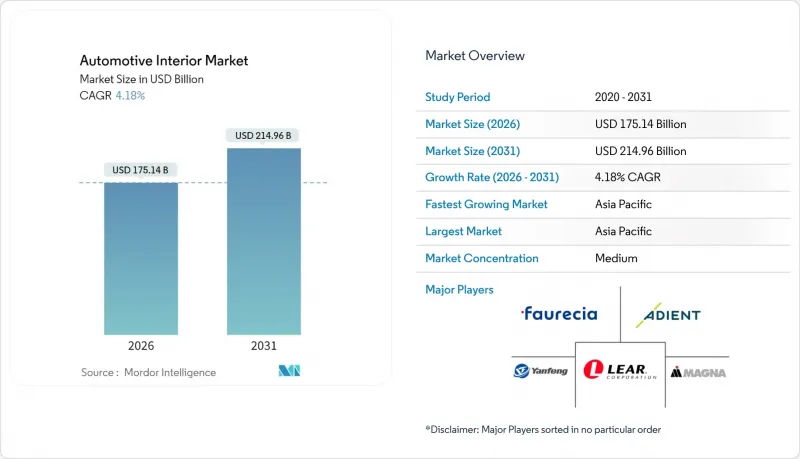
在這穩步擴張的背後,是更深層的變革。諸如軟體定義駕駛座、生物識別監控和永續材料等技術正從利基選擇走向主流應用。汽車製造商正圍繞高密度顯示器和中央運算單元重新設計座艙佈局,而供應商則在拓展與空中升級功能相關的訂閱收入。在電動車平台上,隨著靜音車輛配置的日益完善,高階表面處理、環境照明和健康功能的重要性也與日俱增。亞太地區已引領這些升級的步伐,其規模優勢促進了本地快速改裝。同時,售後市場需求仍然強勁,車隊營運商和零售商持續用長壽命、可數位化升級的模組替換磨損的裝飾件,緩解了人們對共享出行會縮短更換週期的擔憂。
全球汽車內裝市場趨勢與洞察
向軟體定義汽車和高清顯示器的轉變
以軟體為中心的設計將座艙功能與固定硬體分離,並透過安全的空中昇級實現持續升級。大陸集團目前提供的駕駛座解決方案配備三個或更多超高解析度顯示螢幕,並由性能超過 1000 DMIPS 的處理器驅動。高通驍龍數位底盤為眾多車型提供動力,展現了半導體製造商對座艙電子設備的影響力。將電子元件、軟體和使用者體驗設計結合的供應商,即使在產品停產後也能透過新功能獲得收益,從而將成本加成合約轉變為持續收入模式。預測性維護和基於使用量的保險是基於相同數據基礎,進一步拓展了車內感測器套件的商業價值。傳統的純零件公司若不與數位人才合作或收購數位人才,可能面臨失去競爭優勢的風險。
中國和東協對高階和電動SUV的需求不斷成長
在中國銷售的高階電動SUV的內裝組件成本比內燃機(ICE)車型高出約20%。這主要是由於環境照明、多螢幕資訊娛樂系統和先進的監控系統等因素造成的。蔚來和小鵬等公司甚至在中階車型上也開始標配生物識別感測器,這促使全球供應商在常州、武漢和羅勇等地建立先進模組的本地生產基地。泰國快速成長的電動車出口基地吸引了座椅、內裝和駕駛座製造商落腳東南亞,幫助日本、韓國和西方的汽車製造商透過本地組裝縮短前置作業時間。東協地區的中等收入家庭在購買首款SUV時越來越重視車內體驗,這促使當地一級供應商在曼谷和胡志明市附近建立色彩、材料和飾面工作室。高階內裝的高毛利率降低了價格敏感性,使供應商能夠更快地收回研發成本。本地化還可以保護供應商免受跨境零件可能面臨的地緣政治關稅的影響。
車載資訊娛樂系統晶片組持續短缺
汽車處理器的前置作業時間仍維持在26至52週之間,這對內裝生產計畫造成了不利影響。這迫使汽車製造商優先考慮安全控制設備,而非資訊娛樂主機。雖然採用晶片無關架構的一級供應商可以降低部分風險,但規模較小的供應商在與大型消費性電子公司談判時處於劣勢。供應商也以現貨價格高峰囤積半導體元件,佔用營運資金並擠壓利潤空間。在新興市場,注重成本的汽車製造商正在簡化內裝規格,並推遲多攝影機監控系統的引入。這種短缺正在加速垂直整合,像大陸集團和採埃孚這樣的公司正在增加內部ASIC設計,以確保策略性元件的供應。在亞利桑那州、薩克森州和檳城的新工廠全面運作之前,顯示器密集型內飾的短期成長可能仍將受到限制。
細分市場分析
到2025年,乘用車將佔總收入的66.13%,這表明該細分市場在汽車內裝市場中佔據主導地位。電動乘用車是成長最快的細分市場,複合年成長率達4.21%,這得益於車載技術的進步提升了單車價值。電動車內裝市場規模的成長得益於諸多優勢,例如寬敞平坦的地板釋放了儲物空間、舒適的座椅以及全景顯示器。輕型商用車的成長與宅配的擴張密切相關,但其駕駛室的改進側重於實用性,因此成長要素主要由強制性的駕駛員監控系統而非豪華配置驅動。由於中型和重型卡車更容易運作,供應商正在向車隊採購商提案耐用布料和抗菌表面。
電氣化浪潮使得供應商能夠推出一些先前成本高昂的健康功能,例如主動降噪和空氣離子產生器。雖然特斯拉在極簡主義佈局方面引領潮流,但老牌汽車製造商已經證明,市場對配備多螢幕叢集的堅固耐用的開關設備仍然有需求。歐盟新規強制要求重型卡車安裝車內監視錄影機,這進一步推高了對乘員監控套件的需求。隨著時間的推移,車廂內部的差異化將從機械工藝轉向軟體驅動的個人化客製化,並在車輛的整個生命週期內持續更新,從而拓展售後市場的可能性,甚至惠及商用車隊。
即使到了2025年,內燃機汽車仍將繼續主導整個汽車內裝市場,佔72.47%的銷售佔有率。然而,電動車車型將維持4.27%的年成長率,並憑藉先進的設計語言主導。隨著電池佈局的改進,無需再設置傳動軸通道,因此,安裝在地板上的感測器模組和帶照明的儲物格將變得越來越重要。車內噪音的降低將使乘客更容易察覺到異響和麵板縫隙,從而對製造公差提出更高的要求,進而擴大電動車專用內裝組件的市場佔有率。混合動力汽車屬於過渡產品,儘管純電動續航里程有限,但通常會透過更大的顯示器和更高級的布料來為其更高的價格辯護。
電動車架構推動了對即時能量視覺化的需求,促使供應商重新設計叢集圖形和中控台用戶體驗,以顯示充電數據。車廂靜謐性凸顯了聲學品質的重要性,促使汽車製造商指定使用高功率揚聲器和隔振墊,進一步增加了每輛車的設備配置。電池壽命的溫度控管影響暖通空調管道系統,這為在雙區和三區自動空調方面擁有經驗的供應商提供了競爭優勢。
區域分析
預計到2025年,亞太地區將佔全球營收的37.43%,並保持最快成長速度,到2031年複合年成長率將達到4.31%。中國本土品牌甚至在緊湊型SUV中也配備了多螢幕駕駛座和健康座椅,提高了消費者在內飾方面的平均支出水平。中國當地不斷擴大的產能和區域自由貿易區的設立,促使延鋒、麥格納和福比亞等公司加大本地研發投入,並在OEM設計中心附近建立材料研究實驗室。泰國正在擴大面向澳洲和中東市場的電動車組裝,這促進了座椅框架、內飾和螢幕等二級供應商集群的形成。日本和韓國正擴大採用先進的感測器演算法進行乘員監控,並在全球授權軟體。印尼和越南消費者可支配收入的成長推動了對舒適性配置的需求,即使在宏觀經濟波動的情況下,也保持了成長勢頭。
北美被視為第二大收入來源。在美國,隨著聯邦機動車輛安全標準 (FMVSS) 覆蓋範圍的擴大,駕駛監控要求也隨之提高,感測器整合標準也隨之提高。皮卡和SUV的流行擴大了車內面積,刺激了高利潤的座椅翻新和資訊娛樂系統升級。加拿大嚴酷的冬季促使方向盤和座椅加熱功能普及,進一步推動了車輛配置的成長。墨西哥具有競爭力的人事費用和美墨加協定 (USMCA) 的原產地規則,使得汽車內飾製造業蓬勃發展,既滿足了本地市場需求,也促進了出口。
嚴格的環境和安全法規將維持歐洲的適度成長。歐盟通用安全法規要求所有新車自2026年起必須配備被動式駕駛員監控系統,這將確保對車內攝影機的需求。德國高階品牌在高解析度OLED叢集和再生複合材料的試驗方面主導,這些技術使得在東歐大規模生產車型的組裝更具成本效益。監管機構對循環經濟的關注正迫使供應商採用閉合迴路材料流。英國脫歐後的供應鏈重組將為那些能夠無關稅風險地向英國工廠供貨的歐洲大陸製造商創造市場佔有率機會。
其他福利:
- Excel格式的市場預測(ME)表
- 3個月的分析師支持
目錄
第1章 引言
- 研究假設和市場定義
- 調查範圍
第2章調查方法
第3章執行摘要
第4章 市場情勢
- 市場概覽
- 市場促進因素
- 向軟體定義汽車和高清顯示器的轉變
- 中國和東協地區對高階SUV和電動SUV的需求不斷成長
- 可透過空中昇級的駕駛座架構
- 汽車製造商的碳排放目標要求使用輕質、永續材料
- 採用車載健康、安全和生物識別法規(GSR-EU、NCAP)
- 固態連續照明作為品牌差異化優勢
- 市場限制
- 車載資訊娛樂系統晶片組持續短缺
- 共享出行車隊更新周期的縮短給售後市場帶來了壓力。
- 聚氨酯和生物基聚合物原料價格上漲
- 人機介面軟體堆疊中知識產權的碎片化和標準化問題
- 價值/供應鏈分析
- 監管環境
- 技術展望
- 波特五力分析
- 新進入者的威脅
- 買方的議價能力
- 供應商的議價能力
- 替代品的威脅
- 競爭對手之間的競爭
第5章 市場規模及成長預測(價值(美元))
- 按車輛類型
- 搭乘用車
- 輕型商用車
- 中型和重型商用車輛
- 依推進類型
- 內燃機(ICE)
- 電動車(EV)
- 依組件類型
- 儀表板和駕駛座模組
- 資訊娛樂和連網顯示器
- 座椅系統
- 室內照明(間接照明、功能性照明)
- 車門和車身裝飾板
- 暖通空調和熱舒適性
- 內部裝潢建材/表面材料
- 駕駛員/乘客監控系統
- 其他部分
- 依材料類型
- 合成皮革(PU、PVC)
- 真皮
- 織物和紡織品
- 塑膠和複合材料
- 天然及可回收材料
- 按銷售管道
- OEM
- 售後市場
- 按地區
- 北美洲
- 美國
- 加拿大
- 北美其他地區
- 南美洲
- 巴西
- 阿根廷
- 其他南美洲
- 歐洲
- 德國
- 英國
- 法國
- 俄羅斯
- 其他歐洲地區
- 亞太地區
- 中國
- 日本
- 印度
- 韓國
- 亞太其他地區
- 中東和非洲
- 阿拉伯聯合大公國
- 沙烏地阿拉伯
- 土耳其
- 埃及
- 南非
- 其他中東和非洲地區
- 北美洲
第6章 競爭情勢
- 市場集中度
- 策略趨勢
- 市佔率分析
- 公司簡介
- Adient plc
- Faurecia SE
- Lear Corporation
- Magna International Inc.
- Yanfeng Automotive Interiors
- Grupo Antolin
- Toyota Boshoku Corp.
- Hyundai Mobis Co.
- Panasonic Holdings Corp.
- Robert Bosch GmbH
- Continental AG
- DENSO Corp.
- Valeo SA
- JVCKENWOOD Corp.
- Pioneer Corp.
- Visteon Corp.
- Grammer AG
- Haartz Corporation
- Huayu Automotive Systems(HASCO)
- Seoyon E-Hwa
第7章 市場機會與未來展望
Automotive Interior Market size in 2026 is estimated at USD 175.14 billion, growing from 2025 value of USD 168.11 billion with 2031 projections showing USD 214.96 billion, growing at 4.18% CAGR over 2026-2031.
This measured expansion conceals a more profound transformation as software-defined cockpits, biometric monitoring, and sustainable materials move from niche options to mainstream specifications. Automotive OEMs re-engineer cabin layouts around high-density displays and centralized compute units, while suppliers explore subscription revenue tied to over-the-air feature upgrades. Electric vehicle platforms add further content per car because silent cabins heighten the importance of premium surfaces, ambient lighting, and wellness features. The Asia-Pacific region already sets the pace for these upgrades, and its volume advantage encourages fast local iteration. Simultaneously, aftermarket demand stays resilient because fleet operators and retail owners keep refreshing worn trim with longer-life, digitally upgradable modules, dampening fears that shared mobility would erode replacement cycles.
Global Automotive Interior Market Trends and Insights
Shift Toward Software-Defined Vehicles & HD Displays
Software-centric design decouples cabin functions from fixed hardware and allows continuous upgrades through secure over-the-air patches. Continental now delivers cockpit domains that host three or more ultra-high-resolution displays driven by processors exceeding 1,000 DMIPS . Qualcomm's Snapdragon Digital Chassis powers numerous vehicle models and underscores how semiconductor players influence cabin electronics . Suppliers that blend electronics, software, and user-experience design monetize new features long after production, reshaping cost-plus contracts into recurring revenue frameworks. Predictive maintenance and usage-based insurance ride on the same data backbone, expanding the business case for interior sensor suites. Traditional component-only firms risk erosion unless they partner or acquire digital talent.
Rising Demand for Premium & Electric SUVs in China & ASEAN
Electric premium SUVs sold in China carry a one-fifth higher interior bill-of-materials than their ICE peers, mainly due to ambient lighting, multi-screen infotainment, and advanced monitoring. Companies like NIO and XPeng have normalized biometric sensing even in mid-range trims, prompting global suppliers to localize advanced modules in Changzhou, Wuhan, and Rayong. Thailand's fast-growing EV export base pulls seat, trim, and cockpit makers into Southeast Asia, lowering lead times for Japanese, Korean, and Western OEMs that assemble there. ASEAN's middle-income families increasingly weigh the in-cabin experience when buying a first SUV, so local Tier-1s invest in color, material, and finish studios close to Bangkok and Ho Chi Minh City. The high gross margins on premium interiors soften price sensitivity, letting suppliers recoup R&D more quickly. Localization further shields vendors from potential geopolitical tariffs on cross-border components.
Persistent Chipset Shortages in the Infotainment Domain
Lead times for automotive-grade processors still range from 26 to 52 weeks, hurting interior build schedules and forcing OEMs to prioritize safety controllers over infotainment head units. Tier-1s that adopt chip-agnostic architectures buffer some risk, yet smaller players lose allocation clout against consumer electronics giants. Margins narrow because suppliers stockpile semiconductors at peak spot prices, tying up working capital. In emerging markets, cost-sensitive OEMs downgrade cabin specs or postpone rollouts of multi-camera monitoring. The shortage accelerates vertical integration as Continental, ZF, and others add internal ASIC design to secure strategic components. Until new fabs in Arizona, Saxony, and Penang ramp, the constraint will continue to clip near-term upside for display-heavy interiors.
Other drivers and restraints analyzed in the detailed report include:
- Over-The-Air Upgradable Cockpit Architectures
- Lightweight Sustainable Materials Mandated by OEM Carbon Targets
- High Raw-Material Volatility for PU & Bio-Based Polymers
For complete list of drivers and restraints, kindly check the Table Of Contents.
Segment Analysis
Passenger cars sustained 66.13% of overall revenue in 2025, showing the segment's scale advantage in the automotive interior market. Electric passenger cars represent the fastest growing slice at a 4.21% CAGR as higher in-cabin technology density lifts basket value per unit. The automotive interior market size for electric cars benefits from wide, flat floors that free up storage modules, lounge-style seating, and panoramic display surfaces. Light commercial vehicles track parcel delivery expansion, but cabin upgrades stay utilitarian, so growth stems mainly from mandated driver monitoring rather than luxury trim. Medium and heavy trucks remain sensitive to downtime; therefore, suppliers pitch durable fabrics and antimicrobial surfaces to fleet buyers.
The electrification wave lets suppliers insert wellness functions such as active noise cancellation and air ionizers that were previously cost-prohibitive. Tesla sparked minimalist layouts, yet legacy OEMs show there is still an appetite for robust switchgear coupled with multi-screen clusters. New EU rules that require inward-facing cameras on heavy trucks generate incremental demand for occupant monitoring kits. Over time, cabin differentiation shifts from mechanical craftsmanship to software-driven personalization that updates throughout the vehicle's life, extending aftermarket potential even in commercial fleets.
Internal combustion vehicles still accounted for 72.47% revenue in 2025, anchoring volumes across the automotive interior market. Nonetheless, electric models grow 4.27% annually and dictate forward design language. Battery layouts remove transmission tunnels, so floor-mounted sensor pods and illuminated storage compartments gain prominence. The automotive interior market share for EV-specific components expands as low cabin noise raises occupant awareness of rattles and panel gaps, forcing tighter manufacturing tolerances. Hybrids serve as transition products and often bundle larger displays and premium fabrics to justify higher price tags despite modest pure-electric range.
EV architecture increases demand for real-time energy visualizations, prompting suppliers to reconfigure cluster graphics and center-stack UX to display charging data. Silence inside the cabin accentuates audio quality and encourages OEMs to specify higher wattage speakers and vibration-damping mats, further boosting content per car. Thermal management for battery longevity influences HVAC routing, giving suppliers experienced in dual-zone and tri-zone climate control a competitive edge.
The Automotive Interior Market Report is Segmented by Vehicle Type (Passenger Cars and More), Propulsion Type (Internal-Combustion Engine and Electric Vehicle), Component Type (Instrument Panels & Cockpit Modules and More), Material Type (Synthetic Leather, Genuine Leather, Fabrics & Textiles, and More), Sales Channel (OEM and Aftermarket), and Geography. The Market Forecasts are Provided in Terms of Value (USD).
Geography Analysis
Asia-Pacific delivered 37.43% of global revenue in 2025 and will post the fastest 4.31% CAGR through 2031. China's indigenous brands fit multi-screen cockpits and wellness seats even on compact SUVs, lifting average interior spend. Mainland volume plus regional free-trade zones entice Yanfeng, Magna, and FORVIA to localize R&D and build material labs close to OEM design centers. Thailand scales EV assembly for export to Australia and the Middle East, catalyzing new Tier-2 clusters that supply seat frames, trims, and screens. Japan and South Korea use advanced sensor algorithms for occupant monitoring, often licensing software globally. Rising disposable incomes across Indonesia and Vietnam elevate demand for comfort features, sustaining growth even if macroeconomics fluctuate.
North America stands as the second-largest revenue pool. The United States pushes driver-monitoring requirements through the expanding FMVSS docket, raising baseline sensor content. Pickup and SUV popularity inflates cabin surface area, which favors high-margin upholstery and infotainment upgrades. Canada's harsh winters boost heated steering wheel usage and seat usage, further enlarging vehicle content. Mexico's competitive labor costs and USMCA rules-of-origin keep interior manufacturing vibrant for regional and export volumes.
Europe maintains moderate growth backed by stringent green and safety mandates. The EU General Safety Regulation obliges all new cars to include passive driver monitoring from 2026, guaranteeing demand for inward-facing cameras. Germany's premium marques lead experimentation with high-resolution OLED clusters and recycled composites, while Eastern Europe offers cost-effective assembly for volume models. Regulatory focus on circularity pushes suppliers to adopt closed-loop material flows. Supply-chain rerouting post-Brexit opens share opportunities for continental producers who can supply UK plants without tariff risk.
- Adient plc
- Faurecia SE
- Lear Corporation
- Magna International Inc.
- Yanfeng Automotive Interiors
- Grupo Antolin
- Toyota Boshoku Corp.
- Hyundai Mobis Co.
- Panasonic Holdings Corp.
- Robert Bosch GmbH
- Continental AG
- DENSO Corp.
- Valeo SA
- JVCKENWOOD Corp.
- Pioneer Corp.
- Visteon Corp.
- Grammer AG
- Haartz Corporation
- Huayu Automotive Systems (HASCO)
- Seoyon E-Hwa
Additional Benefits:
- The market estimate (ME) sheet in Excel format
- 3 months of analyst support
TABLE OF CONTENTS
1 Introduction
- 1.1 Study Assumptions & Market Definition
- 1.2 Scope of the Study
2 Research Methodology
3 Executive Summary
4 Market Landscape
- 4.1 Market Overview
- 4.2 Market Drivers
- 4.2.1 Shift Toward Software-Defined Vehicles & HD Displays
- 4.2.2 Rising Demand For Premium & Electric SUVs In China & Asean
- 4.2.3 Over-The-Air Upgradable Cockpit Architectures
- 4.2.4 Lightweight Sustainable Materials Mandated By OEM Carbon Targets
- 4.2.5 Adoption Of In-Cabin Health, Safety & Biometrics Regulations (GSR-EU, NCAP)
- 4.2.6 Solid-State Ambient Lighting As A Brand Differentiator
- 4.3 Market Restraints
- 4.3.1 Persistent Chipset Shortages In Infotainment Domain
- 4.3.2 Lower Refresh-Cycle In Shared-Mobility Fleets Squeezing Aftermarket
- 4.3.3 High Raw-Material Volatility For PU & Bio-Based Polymers
- 4.3.4 IP- & Standards-Fragmentation For HMI Software Stacks
- 4.4 Value / Supply-Chain Analysis
- 4.5 Regulatory Landscape
- 4.6 Technological Outlook
- 4.7 Porter's Five Forces Analysis
- 4.7.1 Threat of New Entrants
- 4.7.2 Bargaining Power of Buyers
- 4.7.3 Bargaining Power of Suppliers
- 4.7.4 Threat of Substitutes
- 4.7.5 Intensity of Competitive Rivalry
5 Market Size & Growth Forecasts (Value (USD))
- 5.1 By Vehicle Type
- 5.1.1 Passenger Cars
- 5.1.2 Light Commercial Vehicles
- 5.1.3 Medium and Heavy Commercial Vehicles
- 5.2 By Propulsion Type
- 5.2.1 Internal-Combustion Engine (ICE)
- 5.2.2 Electric Vehicle (EV)
- 5.3 By Component Type
- 5.3.1 Instrument Panels & Cockpit Modules
- 5.3.2 Infotainment & Connected Displays
- 5.3.3 Seating Systems
- 5.3.4 Interior Lighting (Ambient, Functional)
- 5.3.5 Door & Body Trim Panels
- 5.3.6 HVAC & Thermal Comfort
- 5.3.7 Upholstery & Surface Materials
- 5.3.8 Driver / Occupant Monitoring Systems
- 5.3.9 Other Components
- 5.4 By Material Type
- 5.4.1 Synthetic Leather (PU, PVC)
- 5.4.2 Genuine Leather
- 5.4.3 Fabrics & Textiles
- 5.4.4 Plastics & Composites
- 5.4.5 Natural & Recycled Materials
- 5.5 By Sales Channel
- 5.5.1 OEM
- 5.5.2 Aftermarket
- 5.6 By Geography
- 5.6.1 North America
- 5.6.1.1 United States
- 5.6.1.2 Canada
- 5.6.1.3 Rest of North America
- 5.6.2 South America
- 5.6.2.1 Brazil
- 5.6.2.2 Argentina
- 5.6.2.3 Rest of South America
- 5.6.3 Europe
- 5.6.3.1 Germany
- 5.6.3.2 United Kingdom
- 5.6.3.3 France
- 5.6.3.4 Russia
- 5.6.3.5 Rest of Europe
- 5.6.4 Asia-Pacific
- 5.6.4.1 China
- 5.6.4.2 Japan
- 5.6.4.3 India
- 5.6.4.4 South Korea
- 5.6.4.5 Rest of Asia-Pacific
- 5.6.5 Middle-East and Africa
- 5.6.5.1 United Arab Emirates
- 5.6.5.2 Saudi Arabia
- 5.6.5.3 Turkey
- 5.6.5.4 Egypt
- 5.6.5.5 South Africa
- 5.6.5.6 Rest of Middle-East and Africa
- 5.6.1 North America
6 Competitive Landscape
- 6.1 Market Concentration
- 6.2 Strategic Moves
- 6.3 Market Share Analysis
- 6.4 Company Profiles (includes Global Level Overview, Market Level Overview, Core Segments, Financials as Available, Strategic Information, Market Rank/Share for Key Companies, Products and Services, SWOT Analysis, and Recent Developments)
- 6.4.1 Adient plc
- 6.4.2 Faurecia SE
- 6.4.3 Lear Corporation
- 6.4.4 Magna International Inc.
- 6.4.5 Yanfeng Automotive Interiors
- 6.4.6 Grupo Antolin
- 6.4.7 Toyota Boshoku Corp.
- 6.4.8 Hyundai Mobis Co.
- 6.4.9 Panasonic Holdings Corp.
- 6.4.10 Robert Bosch GmbH
- 6.4.11 Continental AG
- 6.4.12 DENSO Corp.
- 6.4.13 Valeo SA
- 6.4.14 JVCKENWOOD Corp.
- 6.4.15 Pioneer Corp.
- 6.4.16 Visteon Corp.
- 6.4.17 Grammer AG
- 6.4.18 Haartz Corporation
- 6.4.19 Huayu Automotive Systems (HASCO)
- 6.4.20 Seoyon E-Hwa
7 Market Opportunities & Future Outlook
- 7.1 White-space & Unmet-Need Assessment

 座椅控制開關市場規模、佔有率和成長分析:按開關類型、車輛類型、應用、銷售管道、驅動類型和地區分類 - 產業預測,2026-2033 年
 環保隔熱材料市場分析及預測(至 2035 年):按類型、產品、技術、組件、應用、材料類型、最終用戶和安裝類型分類。
 汽車內裝零件市場:2026-2032年全球市場預測(按零件類型、材料類型、驅動系統、車輛類型和銷售管道)
 汽車生質塑膠市場規模、佔有率和成長分析:按材料、應用、車輛類型、分銷管道和地區分類-2026-2033年產業預測
 汽車內裝市場報告:按組件、材料、車輛類型和地區分類(2026-2034 年)
 2026年全球汽車內裝市場報告
 全球及中國汽車產業消費後樹脂(PCR)產業調查及「十五」規分類析報告(2026-2032年)
 汽車內裝市場-全球產業規模、佔有率、趨勢、機會及預測(依車輛類型、零件、地區及競爭格局分類,2021-2031年)汽車開關按鈕市場按產品類型、操作模式、應用、最終用途和分銷管道分類-全球預測,2026-2032年
 汽車絨面革材料:全球市佔率排名、總銷售量與需求預測(2025-2031年)