


 |
市場調查報告書
商品編碼
1934879
瓶型吹塑成型機:市佔率分析、產業趨勢與統計、成長預測(2026-2031)Bottle Blowing Machine - Market Share Analysis, Industry Trends & Statistics, Growth Forecasts (2026 - 2031) |
||||||

※ 本網頁內容可能與最新版本有所差異。詳細情況請與我們聯繫。
2025年,瓶子吹塑成型機市值為24.1億美元,預計到2031年將達到31.5億美元,高於2026年的25.2億美元。
預計在預測期(2026-2031 年)內,複合年成長率將達到 4.57%。
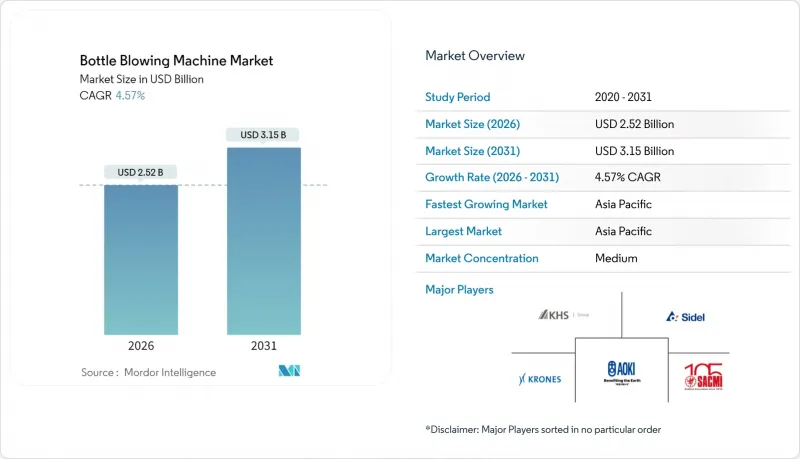
飲料、醫藥和消費品產業的持續需求,以及節能電氣系統的快速發展和再生PET的日益普及,都支撐著這一成長。拉伸吹塑成型仍然是大批量碳酸飲料生產的主要技術,而注塑吹塑成型則在小批量藥品包裝領域不斷擴大市場佔有率。製造商正在採用數位雙胞胎控制和預測分析技術來提高產能運轉率、縮短換線時間並降低能耗。競爭的焦點正轉向輕量化能力、再生材料加工技術和端到端自動化,主要供應商正積極尋求收購以拓展產品組合。 PET價格波動、產業普遍存在的人才短缺以及高資本密集度仍然是不利因素,但政府對節能生產線的稅收優惠以及現場微型瓶生產的興起,正帶來新的成長機會。
全球瓶吹塑成型機市場趨勢及洞察
碳酸飲料領域對輕質寶特瓶的需求快速成長
碳酸飲料品牌正在努力減輕容器重量,以降低樹脂成本和排放。可口可樂計劃在2024年重新設計其20盎司(約590毫升)的瓶子,重量將從21克減少到18.5克。這將節省8億個瓶子的材料,同時保持碳酸飲料的碳酸化效果,這需要吹塑成型機具備更精確的加熱能力。可口可樂在印度同步推出的產品將使用100%回收PET材料,將輕量化與循環經濟訊息結合。這些變化迫使設備製造商提供能夠處理更薄瓶坯且壁厚穩定、底部不變形的拉伸吹塑系統,從而鎖定對先進紅外線加熱、伺服拉伸桿和模內壓力控制的需求。
單劑量藥瓶越來越受歡迎
監管機構和製藥公司正轉向使用單劑量包裝容器以提高患者依從性,從而持續推動對5毫升至100毫升、表面光潔度達到醫藥級標準的容器的需求。射出式吹塑成型因其尺寸精度高、顆粒產生量少而備受青睞,是目前主流的製造流程。設備供應商正在整合層流罩、HEPA過濾氣刀和全腔稱重系統,以滿足美國食品藥物管理局(FDA)嚴格的可追溯性法規要求。智慧瓶蓋和嵌入式RFID技術的普及進一步強化了模具製造商在不影響阻隔性能或無菌性的前提下整合電子元件的需求,推動了對無菌相容型全電動機械設備的採購。
大型拉伸吹塑成型機需要昂貴的資本投資
每小時產量超過1萬瓶的旋轉拉伸系統,每條生產線的成本可能超過400萬美元,這對於信貸緊縮的市場中的中型飲料生產商來說構成了一道准入門檻。高企的樹脂價格正在擠壓利潤空間,當需求預測受消費者情緒波動影響時,投資回收期會更長。供應商正在推廣模組化升級方案,透過逐步增加模腔、加熱裝置和吹塑站來降低資本成本,並將折舊免稅額分攤到多個財政年度。雖然一些供應商正在與財務部門合作,爭取租賃或計量收費模式,但許多小規模業者仍在推遲擴張計劃,從而抑制了近期對高速設備的需求。
細分市場分析
到2025年,擠出吹塑成型成型將佔據52.98%的市場佔有率,這主要得益於飲料業對耐壓透明容器的需求,其次是拉伸吹塑成型。該工藝在輕量化方面表現出色,這在品牌競相尋求低碳解決方案的背景下成為關鍵優勢。注塑吹塑成型雖然在複合年成長率方面仍處於小眾市場,但在製藥行業正逐漸獲得認可,因為該行業需要精確的瓶頸尺寸和無菌的內表面。擠出吹塑成型仍然是帶有把手水壺和特殊形狀清潔劑瓶的首選技術。一些新型系統正在湧現,它們結合了射出成型的精度和拉伸成型的生產力,例如每小時可生產13,000個瓶子的旋轉壓縮吹塑機。隨著品牌將產品組合擴展到機能飲料和高階果汁領域,混合技術正日益受到關注,但拉伸吹塑成型現有的基礎設施和對模具技術的熟悉程度將確保其繼續保持吹塑成型機市場的核心地位。
在容量低於100毫升的情況下,射出式吹塑成型憑藉其醫藥級精度和低顆粒含量,展現出顯著優勢。隨著對兒童安全滴管、滴鼻劑和眼藥水的需求不斷成長,買家越來越傾向於選擇配備整合洩漏檢測功能的全電動8至12腔系統。儘管該細分市場在整體瓶型吹塑成型機市場中所佔佔有率不大,但其利潤率高,並推動了售後模具收入的成長。隨著個人化療法的拓展,提供承包潔淨室系統、驗證文件和GMP培訓的供應商在契約製造(CMO)中市場佔有率不斷擴大。
到了2025年,由於勞動力短缺促使工廠轉向無人操作,全自動吹塑成型機佔71.55%的市場佔有率。即時OEE儀錶板和伺服驅動的模具更換技術使關鍵系統的人工勞動減少了80%。雖然半自動機型仍在試生產線、特種化妝品生產線和研發實驗室中應用,但其3.72%的複合年成長率落後於全自動機型。製造商目前正在將預測性維護訂閱服務打包銷售,使技術人員僅在人工智慧檢測到異常情況時才被派遣,從而降低擁有成本並緩解技術純熟勞工短缺的問題。
政府對智慧製造的支持進一步刺激了對互聯機械的投資,這些機械能夠將生產數據與業務線系統和碳排放報告平台連接起來。供應商透過發布可連接功能的 OPC UA 介面和網路安全認證來凸顯自身優勢,從而簡化企業的 IT核准流程。能源價格上漲加速了高規格自動化的轉型,買家更青睞能夠回收煞車能量並降低每瓶能耗的電動伺服鼓風機。自動化設備已穩固確立其在吹塑成型機市場的核心價值驅動力地位。
區域分析
預計到2025年,亞太地區將以39.55%的營收佔有率領先全球,年複合成長率達7.62%,主要得益於中國、印度和越南等國可支配收入的成長以及新建大規模飲料廠的興建。政府對高效機械設備的激勵措施以及不斷擴大的製藥生產基地也為資本投資提供了支持。可口可樂歐洲太平洋合作夥伴公司在巴布亞紐幾內亞建設的每小時36,000瓶PET瓶裝生產線,便是跨國公司如何利用尖端拉伸吹塑技術深入滲透新興市場的典型例證。
北美地區的替換需求穩定成長,稅收優惠政策加速了全電動生產線的維修和微型工廠的建立。歐洲市場雖然成熟,但由於再生材料強制使用和節能目標的實施,其替換需求也在增加。化學品回收政策的不確定性導致企業在製定長期資本投資計畫時採取謹慎態度。拉丁美洲、中東和非洲的成長率約為5%,但政治不穩定和外匯波動帶來了資金籌措挑戰。供應商正尋求透過縮短前置作業時間、建立服務中心合資企業和設立本地模具維修設施來降低風險,並以此建立客戶忠誠度。
隨著數位雙胞胎功能的機器裝置量不斷成長,售後市場也湧現出軟體訂閱和人工智慧分析等收入來源,使得該市場對所有地區的跨國公司都具有同等吸引力。全球瓶型吹塑成型機市場呈現不同的區域重點:新參與企業將目光投向亞太地區以追求銷量,歐洲以永續性創新為目標,而北美則以高階機器翻新業務為導向。
其他福利:
- Excel格式的市場預測(ME)表
- 分析師支持(3個月)
目錄
第1章 引言
- 研究假設和市場定義
- 調查範圍
第2章調查方法
第3章執行摘要
第4章 市場情勢
- 市場概覽
- 市場促進因素
- 碳酸飲料領域對輕質寶特瓶的需求激增
- 一次性藥瓶的需求不斷成長
- 向全電動和節能型機器的轉變
- 針對低IV變異性最佳化的再生PET預成型體
- 飲料微型工廠的現場容器製造
- 利用數位雙胞胎實現快速轉型可享有稅收優惠
- 市場限制
- 大型拉伸吹塑成型機的資本投資成本高昂
- PET樹脂價格波動
- 伺服液壓調節技術人員短缺
- 歐盟化學品回收政策的不確定性
- 供應鏈分析
- 監管環境
- 技術展望
- 波特五力分析
- 新進入者的威脅
- 供應商的議價能力
- 買方的議價能力
- 替代品的威脅
- 產業間競爭
第5章 市場規模與成長預測
- 透過技術
- 拉伸吹塑成型
- 擠出吹塑成型
- 注塑吹塑成型
- 按模型
- 自動的
- 半自動
- 按貨櫃容量
- 最多 2 公升
- 2-10 L
- 10公升或以上
- 按最終用戶行業分類
- 飲料
- 食物
- 製藥
- 個人護理及化妝品
- 家用化學品
- 其他終端用戶產業
- 按地區
- 北美洲
- 美國
- 加拿大
- 墨西哥
- 歐洲
- 德國
- 英國
- 法國
- 義大利
- 西班牙
- 荷蘭
- 俄羅斯
- 其他歐洲
- 亞太地區
- 中國
- 日本
- 印度
- 韓國
- 澳洲和紐西蘭
- ASEAN
- 亞太其他地區
- 中東和非洲
- 中東
- 沙烏地阿拉伯
- 阿拉伯聯合大公國
- 土耳其
- 其他中東地區
- 非洲
- 南非
- 奈及利亞
- 埃及
- 其他非洲地區
- 中東
- 南美洲
- 巴西
- 阿根廷
- 南美洲其他地區
- 北美洲
第6章 競爭情勢
- 市場集中度
- 策略趨勢
- 市佔率分析
- 公司簡介
- Krones AG
- Sidel Group(Tetra Laval International SA)
- KHS GmbH
- Sacmi Imola SC
- AOKI Technical Laboratory, Inc.
- Nissei ASB Machine Co., Ltd.
- SIPA SpA
- Zhejiang Tonva Plastics Machine Co., Ltd.
- Tech-Long Packaging Machinery Co., Ltd.
- Jagmohan Pla-Mach Pvt Ltd
- Jomar Corporation
- SMF Maschinenfabrik Germany GmbH
- Guangzhou Shine Plastic Machinery Co., Ltd.
- Meccanoplastica Srl
- Bekum Maschinenfabriken GmbH
- Magic MP SpA
- Pet All Manufacturing Inc.
- Parker Plastic Machinery Co., Ltd.
- Chia Ming Machinery Co., Ltd.
- Uniloy Inc.
- Electra Form Industries, Inc.
- Kautex Maschinenbau GmbH
第7章 市場機會與未來展望
The bottle blowing machine market was valued at USD 2.41 billion in 2025 and estimated to grow from USD 2.52 billion in 2026 to reach USD 3.15 billion by 2031, at a CAGR of 4.57% during the forecast period (2026-2031).
Continued beverage, pharmaceutical, and consumer-goods demand, coupled with rapid progress in energy-efficient electric systems and greater use of recycled PET, underpins this expansion. Stretch blow molding retains its role as the high-volume workhorse for carbonated soft drinks, while injection blow molding gains ground in pharmaceutical small-volume formats. Manufacturers are embedding digital-twin controls and predictive analytics to improve uptime, compress changeover windows, and reduce energy consumption. Competition now centers on lightweighting capability, recycled-content processing, and end-to-end automation, with leading vendors pursuing targeted acquisitions to broaden their portfolios. Volatile PET pricing, an industry-wide technical talent shortage, and high capital intensity remain headwinds, yet government tax credits for energy-saving production lines and the rise of on-site micro-factory bottle production offer new growth levers.
Global Bottle Blowing Machine Market Trends and Insights
Surging Demand for Lightweight PET Bottles in CSD Segment
Carbonated-soft-drink brands are stripping gram weight from containers to cut resin costs and emissions. Coca-Cola's 2024 redesign trimmed the 20-oz bottle from 21 g to 18.5 g, eliminating material equal to 800 million bottles while requiring blow molders with higher heating precision to maintain carbonation performance. Parallel launches in India employ 100% recycled PET, pairing lightweighting with circular-economy messaging. These shifts compel equipment makers to deliver stretch blow systems that tolerate thinner preforms without wall-thickness variance or base deformation, locking in demand for advanced infrared heating, servo stretch rods, and in-mold pressure control.
Growing Uptake of Single-Serve Pharma Bottles
Regulators and drug makers are converging on unit-dose formats to improve patient adherence, spawning sustained demand for 5 ml - 100 ml containers with a pharmaceutical-grade surface finish. Injection blow molding, prized for dimensional accuracy and low particulate generation, is the process of record. Equipment suppliers now integrate laminar-flow enclosures, HEPA-filtered air knives, and full cavity-by-cavity weighing systems to satisfy stringent FDA traceability rules. The rise of smart caps and embedded RFID further anchors the need for molders that can house electronics without compromising barrier integrity or sterility, steering procurement toward aseptic, all-electric machines.
High CAPEX for Large-Scale Stretch Blow Molders
Rotary stretch systems exceeding 10,000 bph can top USD 4 million per line, a hurdle for mid-tier beverage firms in markets with restricted credit availability. Payback periods stretch further when resin spikes erode margins and when demand forecasts hinge on volatile consumer sentiment. Suppliers promote modular upgrades-adding cavities, heating banks, or blow stations in phases-to lower the entry ticket and spread depreciation across multiple fiscal years. Some vendors partner with finance arms to underwrite leasing or pay-per-use models, yet many smaller players still defer expansion, tempering near-term demand for top-speed equipment.
Other drivers and restraints analyzed in the detailed report include:
- Shift Toward Fully-Electric, Energy-Efficient Machines
- Recycled-PET Preforms Optimized for Low IV Scatter
- Volatility in PET Resin Prices
For complete list of drivers and restraints, kindly check the Table Of Contents.
Segment Analysis
The extrusion blow molding segment captured 52.98% of the market, followed by stretch blow molding in 2025, anchored by beverages that require pressure-resistant, clear containers. The process excels at lightweighting, a key advantage as brands race for lower carbon footprints. Injection blow molding, though niche at CAGR, attracts pharmaceuticals needing precise neck finish and sterile interiors. Extrusion blow remains the go-to for handled jugs and odd-shaped detergent bottles. New systems, such as rotary compression-blow units producing up to 13,000 bph, merge injection precision with stretch throughput. As brands diversify portfolios into functional shots and premium juices, hybrid technologies gain attention, but stretch blow's installed base and tooling familiarity keep it the anchor of the bottle blowing machine market.
Pharmaceutical-grade accuracy and low particulate levels give injection blow an edge in volumes under 100 ml. Demand for child-resistant droppers, nasal sprays, and ophthalmic doses pulls buyers toward fully-electric eight-to-twelve-cavity systems with integrated leak detection. Although its contribution to the overall bottle blowing machine market size is modest, the segment commands higher margins and drives aftermarket mold revenue. Vendors that package turnkey cleanroom systems, validation documents, and GMP training capture share among drug-contract manufacturers scaling personalized therapies.
Automatic machines held 71.55% of the bottle blowing machine market share in 2025 as talent shortages pushed factories toward lights-out operations. Real-time OEE dashboards and servo-driven mold changes cut manual touches by 80% on leading systems. Semi-automatic models survive in pilot lines, specialty cosmetics, and R&D labs, but their 3.72% CAGR lags fully automated peers. Manufacturers now bundle predictive-maintenance subscriptions, allowing them to dispatch technicians only when AI-detected anomalies emerge, lowering ownership cost and mitigating the skilled labor deficit.
Government stimulus for smart manufacturing further tilts spending to connected machines that feed production data into enterprise resource planning and carbon-reporting platforms. Vendors differentiate by publishing ready-to-connect OPC UA interfaces and cybersecurity certifications, easing corporate IT approvals. As energy prices rise, buyers favor electric servo blowers that recover braking energy and cut kWh per bottle, reinforcing the shift to high-spec automation and cementing automatic equipment as the value core of the bottle blowing machine market.
The Bottle Blowing Machine Market Report is Segmented by Technology (Stretch Blow Molding, Extrusion Blow Molding, and Injection Blow Molding), Machine Type (Automatic, Semi-Automatic), Container Volume (Up To 2 L, 2-10 L, and Above 10 L), End-User Industry (Beverage, Food, Pharmaceuticals, Personal Care and Cosmetics, and More), and Geography. The Market Forecasts are Provided in Terms of Value (USD).
Geography Analysis
Asia-Pacific led with 39.55% revenue share in 2025 and is projected to clock 7.62% CAGR, driven by rising disposable income and large new beverage plants in China, India, and Vietnam. Government incentives for high-efficiency machinery and an expanding pharmaceutical manufacturing base sustain capital investment. Coca-Cola Europacific Partners' 36,000 bph PET line in Papua New Guinea exemplifies multinationals pushing state-of-the-art stretch blow capability deeper into developing markets.
North America shows stable replacement demand, with tax credits accelerating all-electric line retrofits and micro-factory installations. Europe, though mature, experiences equipment churn tied to recycled-content mandates and energy-efficiency targets; uncertainty over chemical-recycling policy tempers some long-horizon commitments. Latin America and the Middle East and Africa register mid-single-digit growth, but political volatility and foreign-exchange swings pose financing challenges. Suppliers mitigate risk by offering service-center joint ventures and local mold refurbishment hubs to shorten lead times and build customer stickiness.
A broadening installed base of digital-twin-enabled machines creates aftermarket revenue streams for software subscriptions and AI analytics, equally attractive to multinationals across all regions. Market entrants eye Asia-Pacific for volume, Europe for sustainability innovation, and North America for premium machinery retrofits - confirming differentiated regional priorities within the global bottle blowing machine market.
- Krones AG
- Sidel Group (Tetra Laval International S.A.)
- KHS GmbH
- Sacmi Imola S.C.
- AOKI Technical Laboratory, Inc.
- Nissei ASB Machine Co., Ltd.
- SIPA S.p.A.
- Zhejiang Tonva Plastics Machine Co., Ltd.
- Tech-Long Packaging Machinery Co., Ltd.
- Jagmohan Pla-Mach Pvt Ltd
- Jomar Corporation
- SMF Maschinenfabrik Germany GmbH
- Guangzhou Shine Plastic Machinery Co., Ltd.
- Meccanoplastica Srl
- Bekum Maschinenfabriken GmbH
- Magic MP S.p.A.
- Pet All Manufacturing Inc.
- Parker Plastic Machinery Co., Ltd.
- Chia Ming Machinery Co., Ltd.
- Uniloy Inc.
- Electra Form Industries, Inc.
- Kautex Maschinenbau GmbH
Additional Benefits:
- The market estimate (ME) sheet in Excel format
- 3 months of analyst support
TABLE OF CONTENTS
1 INTRODUCTION
- 1.1 Study Assumptions and Market Definition
- 1.2 Scope of the Study
2 RESEARCH METHODOLOGY
3 EXECUTIVE SUMMARY
4 MARKET LANDSCAPE
- 4.1 Market Overview
- 4.2 Market Drivers
- 4.2.1 Surging demand for lightweight PET bottles in CSD segment
- 4.2.2 Growing uptake of single-serve pharma bottles
- 4.2.3 Shift toward fully-electric, energy-efficient machines
- 4.2.4 Recycled-PET preforms optimized for low IV scatter
- 4.2.5 On-site container manufacturing at beverage micro-factories
- 4.2.6 Tax incentives for digital-twin-enabled rapid changeovers
- 4.3 Market Restraints
- 4.3.1 High CAPEX for large-scale stretch blow molders
- 4.3.2 Volatility in PET resin prices
- 4.3.3 Shortage of servo-hydraulic calibration technicians
- 4.3.4 EU chemical-recycling policy uncertainty
- 4.4 Supply-Chain Analysis
- 4.5 Regulatory Landscape
- 4.6 Technological Outlook
- 4.7 Porter's Five Forces Analysis
- 4.7.1 Threat of New Entrants
- 4.7.2 Bargaining Power of Suppliers
- 4.7.3 Bargaining Power of Buyers
- 4.7.4 Threat of Substitutes
- 4.7.5 Industry Rivalry
5 MARKET SIZE AND GROWTH FORECASTS (VALUE)
- 5.1 By Technology
- 5.1.1 Stretch Blow Molding
- 5.1.2 Extrusion Blow Molding
- 5.1.3 Injection Blow Molding
- 5.2 By Machine Type
- 5.2.1 Automatic
- 5.2.2 Semi-automatic
- 5.3 By Container Volume
- 5.3.1 Up to 2 L
- 5.3.2 2 - 10 L
- 5.3.3 Above 10 L
- 5.4 By End-user Industry
- 5.4.1 Beverage
- 5.4.2 Food
- 5.4.3 Pharmaceuticals
- 5.4.4 Personal Care and Cosmetics
- 5.4.5 Household Chemicals
- 5.4.6 Other End-user Industry
- 5.5 By Geography
- 5.5.1 North America
- 5.5.1.1 United States
- 5.5.1.2 Canada
- 5.5.1.3 Mexico
- 5.5.2 Europe
- 5.5.2.1 Germany
- 5.5.2.2 United Kingdom
- 5.5.2.3 France
- 5.5.2.4 Italy
- 5.5.2.5 Spain
- 5.5.2.6 Netherlands
- 5.5.2.7 Russia
- 5.5.2.8 Rest of Europe
- 5.5.3 Asia-Pacific
- 5.5.3.1 China
- 5.5.3.2 Japan
- 5.5.3.3 India
- 5.5.3.4 South Korea
- 5.5.3.5 Australia and New Zealand
- 5.5.3.6 ASEAN
- 5.5.3.7 Rest of Asia-Pacific
- 5.5.4 Middle East and Africa
- 5.5.4.1 Middle East
- 5.5.4.1.1 Saudi Arabia
- 5.5.4.1.2 United Arab Emirates
- 5.5.4.1.3 Turkey
- 5.5.4.1.4 Rest of Middle East
- 5.5.4.2 Africa
- 5.5.4.2.1 South Africa
- 5.5.4.2.2 Nigeria
- 5.5.4.2.3 Egypt
- 5.5.4.2.4 Rest of Africa
- 5.5.4.1 Middle East
- 5.5.5 South America
- 5.5.5.1 Brazil
- 5.5.5.2 Argentina
- 5.5.5.3 Rest of South America
- 5.5.1 North America
6 COMPETITIVE LANDSCAPE
- 6.1 Market Concentration
- 6.2 Strategic Moves
- 6.3 Market Share Analysis
- 6.4 Company Profiles (includes Global level Overview, Market level overview, Core Segments, Financials as available, Strategic Information, Market Rank/Share for key companies, Products and Services, and Recent Developments)
- 6.4.1 Krones AG
- 6.4.2 Sidel Group (Tetra Laval International S.A.)
- 6.4.3 KHS GmbH
- 6.4.4 Sacmi Imola S.C.
- 6.4.5 AOKI Technical Laboratory, Inc.
- 6.4.6 Nissei ASB Machine Co., Ltd.
- 6.4.7 SIPA S.p.A.
- 6.4.8 Zhejiang Tonva Plastics Machine Co., Ltd.
- 6.4.9 Tech-Long Packaging Machinery Co., Ltd.
- 6.4.10 Jagmohan Pla-Mach Pvt Ltd
- 6.4.11 Jomar Corporation
- 6.4.12 SMF Maschinenfabrik Germany GmbH
- 6.4.13 Guangzhou Shine Plastic Machinery Co., Ltd.
- 6.4.14 Meccanoplastica Srl
- 6.4.15 Bekum Maschinenfabriken GmbH
- 6.4.16 Magic MP S.p.A.
- 6.4.17 Pet All Manufacturing Inc.
- 6.4.18 Parker Plastic Machinery Co., Ltd.
- 6.4.19 Chia Ming Machinery Co., Ltd.
- 6.4.20 Uniloy Inc.
- 6.4.21 Electra Form Industries, Inc.
- 6.4.22 Kautex Maschinenbau GmbH
7 MARKET OPPORTUNITIES AND FUTURE OUTLOOK
- 7.1 White-space and Unmet-need Assessment

 吹火炬市場規模、佔有率和成長分析:按燃料類型、產品類型、應用、最終用戶、點火方式和地區分類 - 產業預測,2026-2033 年
 吹塑成型市場-2026-2032年全球市場預測吹塑成型市場-2026-2032年全球市場預測瓶型吹塑成型機市場:按型號、材料、自動化程度、驅動系統和最終用途產業分類-2026-2032年全球市場預測
 火炬燃燒器市場:市場機會、成長要素、產業趨勢分析及2026-2035年預測吹塑成型機市場:依機器類型、塑膠類型、自動化程度、產能和終端用戶產業分類-2026-2032年全球市場預測
 吹塑成型全球市場規模、佔有率、趨勢和成長分析報告(2026-2034)全球吹塑成型機市場規模、佔有率、趨勢及成長分析報告(2026-2034)注塑吹塑成型一體機市場(依樹脂類型、機器類型、產能和應用分類)-2026-2032年全球預測
 瓶裝吹塑成型機市場規模、佔有率及成長分析(按機器類型、原料、產能、最終用途及地區分類)-2026-2033年產業預測