


 |
市場調查報告書
商品編碼
1934876
接線端子:市場佔有率分析、產業趨勢與統計、成長預測(2026-2031)Terminal Block - Market Share Analysis, Industry Trends & Statistics, Growth Forecasts (2026 - 2031) |
||||||

※ 本網頁內容可能與最新版本有所差異。詳細情況請與我們聯繫。
2025 年接線端子市場價值為 57.5 億美元,預計到 2031 年將達到 83.5 億美元,高於 2026 年的 61.2 億美元。
預計在預測期(2026-2031 年)內,複合年成長率將達到 6.42%。
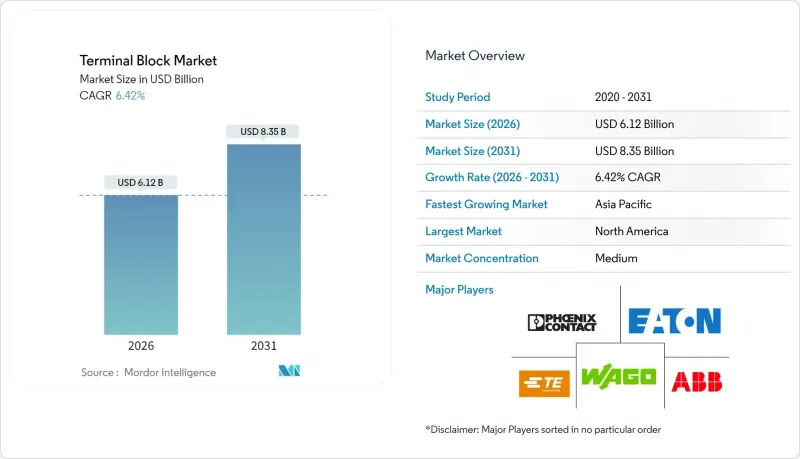
工業自動化的快速普及、可再生能源基礎設施的擴張以及建築電氣化項目的加速推進,都為這一成長提供了支撐,使接線端子市場成為全球電氣化趨勢的主要受益者。模組化佈線架構與感測器密集生產環境的融合,推動了對高密度直通式接線端子和感測器/致動器接線端子的需求。可再生能源應用推動了額定電壓為1500V的高壓直流接線端子的普及,而北美和歐洲的建築自動化維修則傾向於採用緊湊型DIN導軌解決方案,以縮短安裝時間並簡化維護。然而,銅鋁價格的波動以及假冒偽劣產品的風險限制了現有供應商的利潤成長。儘管如此,知名品牌仍在不斷創新,推出推入式和插入式設計,以減少佈線工作量並支援智慧工廠的可重構性,從而在接線端子市場保持競爭優勢。
全球接線端子市場趨勢與洞察
工業4.0推動模組化佈線需求
製造商正在重新設計生產線,以實現更柔軟性、感測器密集的操作,這需要快速更換線路。菲尼克斯電氣已投資1億歐元用於自動化物流,以支援這些智慧工廠的實施。魏德米勒的模組化側入式推入式接線端子可將連接時間縮短50%,並支援生產線無停機重新配置。控制櫃製造商受益於更短的組裝週期和更少的熟練勞動力需求,這鞏固了接線端子市場作為工業4.0架構核心驅動力的地位。 IO-Link和其他設備級網路進一步增加了每個控制櫃的I/O點數量,從而推動了感測器/致動器模組的訂單。隨著自動化工廠在亞太和歐洲的日益普及,模組化佈線密度的需求仍將是關鍵促進因素。
穩健的電力分配對於擴大可再生能源至關重要。
全球太陽能和風能發電設施的興起,對能夠承受紫外線、振動和劇烈溫度變化的接線端子提出了更高的要求。 TE Connectivity 收購 Hager 後,擴展了其能源產品線,為這些設施提供防雷和接地解決方案。電池能源儲存系統需要高壓直流模組來防止極性反轉。菲尼克斯電氣的極化連接器可滿足 1500V 陣列的這項要求。電網營運商也開始指定使用整合電流感測功能的智慧接線端子,以最佳化間歇性發電的電力傳輸。這種不斷成長的基礎設施將擴大堅固耐用、可監控的連接硬體的裝置量,從而增強接線端子市場的收入前景。
銅鋁價格波動
2025年初,銅價突破每噸1萬美元,擠壓了大量消耗這種導電金屬的模組製造商的利潤空間。鋁價飆升也給大截面電源模組帶來了額外壓力。雖然合約中的金屬定價條款會將部分成本轉嫁給買家,但競標限制了成本的完全回收,從而抑制了整個接線端子市場的淨利率。供應商正在探索銅包鋁和輕量化導體設計以降低風險,但認證週期的延遲阻礙了這些技術的快速應用。
細分市場分析
至2025年,直通式接線端子將佔接線端子市場規模的35.92%,成為工廠和機械設備配電的基礎連接器。其堅固的螺絲夾緊設計使其能夠相容於各種尺寸的導線,從而鞏固其作為OEM標準產品目錄產品的地位。同時,感測器/致動器接線端子將以8.28%的複合年成長率實現最快的成長,這主要得益於分散式I/O在狀態監測和預測性維護領域的應用。其單位長度內的高接點密度符合機櫃小型化的目標。柵欄式和麵板式接線端子滿足能源和鐵路應用的高壓和安全要求,而熔斷器式和隔離式接線端子則整合了電路保護功能,並將連接性進一步融入保護功能中。熱電偶和LED狀態指示燈接線端子則代表著向應用特定設計方向的轉變,這種設計將訊號處理和佈線功能結合。
儘管直通式端子仍將佔據主導地位,但隨著工業物聯網 (IIoT) 的普及,感測器點數量增加,其市場佔有率預計將略有下降。因此,製造商正在擴展產品線,推出多級可拆卸感測器模組,兼顧節省空間和快速更換的優點。這一趨勢正在推動產品組合的變化,從而推高階子模組市場的平均售價和收入成長。
到2025年,DIN導軌式接線端子將佔據54.78%的接線端子市場佔有率,這主要得益於全球標準化和現場服務的便利性。其卡扣式設計簡化了改造和擴展,並保持了面板製造商之間庫存的通用。 PCB安裝解決方案目前正以7.16%的複合年成長率成長,以滿足驅動器、電源和物聯網邊緣節點中小批量、小型化組件的需求。貼片機相容性支援高速SMT生產線,從而降低了產品總成本,但同時也提高了單位成本。需要隔振和大電流接線片的重型機殼仍普遍採用面板安裝和直接元件安裝方式。
電子元件整合度的不斷提高推動了PCB設計在規模和複雜性上的擴展,越來越多的混合訊號模組被整合到基板。然而,由於停機風險和佈線複雜性,維修工程師仍然偏好DIN導軌佈局,模組化設計更具優勢。這種共生關係促進了接線端子市場健康的細分市場多樣性。
區域分析
到2025年,北美將佔據接線端子市場41.38%的佔有率,這得益於其在航太、汽車和製程工業領域成熟的製造基地。電網現代化和墨西哥的近岸外包將確保接線端子櫃需求的穩定。 UL 1059標準的實施將增強消費者對高階認證接線端子的偏好,從而維持平均價格。然而,隨著現有設備的成熟,市場成長速度正在放緩,促使供應商將重心轉向維修主導和智慧接線端子櫃解決方案。
預計到2031年,亞太地區將以7.05%的複合年成長率成長,這主要得益於中國的電子產品生產和該地區的電氣化進程。儘管中國本土製造商能夠提供具有成本競爭力的PCB模組,但全球OEM廠商在可靠性要求高的領域仍保持著品質優勢。印度和東協地區基礎設施的不斷改進正在推動DIN導軌在配電和工廠自動化領域的應用。然而,該地區假冒產品的氾濫給智慧財產權保護帶來了挑戰,並加劇了低階端子模組市場的價格壓力。
在德國工業4.0計劃的推動下,歐洲保持其技術領先地位。綠色交易下對風能、太陽能和儲能的投資正在推動對惡劣環境端子塊的需求。魏德米勒11.02億歐元的銷售額及其在中國產能的擴張,凸顯了歐洲在全球化世界中的競爭力。東歐蘊藏新增產能的潛力,英國脫歐則讓英國的物流變得更加複雜。儘管中東和非洲地區的規模較小,但智慧電網和產業多元化被視為推動其穩步應用的催化劑,並使其端子塊市場拓展至新興基礎設施計劃。
其他福利:
- Excel格式的市場預測(ME)表
- 3個月的分析師支持
目錄
第1章 引言
- 研究假設和市場定義
- 調查範圍
第2章調查方法
第3章執行摘要
第4章 市場情勢
- 市場概覽
- 市場促進因素
- 工業4.0推動模組化佈線需求
- 擴大可再生能源的規模需要強大的電網。
- 成熟經濟體的建築自動化/暖通空調維修
- 由於面積且易於維護,DIN導軌解決方案是首選。
- 小型化物聯網設備需要尺寸小於 3.5 毫米的 PCB 模組。
- 電動車快速充電器安全標準推動高電流阻斷
- 市場限制
- 銅鋁價格波動
- 低成本仿冒品的氾濫
- 網路安全回應遲緩會減緩「智慧」模組的普及。
- 精密彈簧鋼短缺限制了產能。
- 監管環境
- 技術展望
- 波特五力分析
- 新進入者的威脅
- 供應商的議價能力
- 買方的議價能力
- 替代品的威脅
- 競爭對手之間的競爭
第5章 市場規模與成長預測
- 依產品類型
- 直通式接線端子
- 隔離柵/面板接線端子
- 接地塊
- 保險絲和斷路器模組
- 感測器/致動器及其他類型
- 其他產品類型
- 透過安裝方法
- DIN導軌安裝型
- 印刷基板安裝
- 面板/底盤安裝
- 其他安裝方法
- 透過連接技術
- 螺絲夾
- 彈簧夾
- 推入式/插入式
- 其他連接技術
- 按最終用戶行業分類
- 工業控制與自動化
- 電力和能源
- 建築/施工(暖通空調/建築管理系統)
- 交通運輸(鐵路、電動車充電)
- 電訊和資料通訊
- 其他終端用戶產業
- 按地區
- 北美洲
- 美國
- 加拿大
- 墨西哥
- 南美洲
- 巴西
- 阿根廷
- 其他南美洲
- 歐洲
- 德國
- 英國
- 法國
- 義大利
- 西班牙
- 俄羅斯
- 其他歐洲地區
- 亞太地區
- 中國
- 日本
- 印度
- 韓國
- 亞太其他地區
- 中東和非洲
- 中東
- 沙烏地阿拉伯
- 阿拉伯聯合大公國
- 其他中東地區
- 非洲
- 南非
- 埃及
- 其他非洲地區
- 中東
- 北美洲
第6章 競爭情勢
- 市場集中度
- 策略趨勢
- 市佔率分析
- 公司簡介
- Phoenix Contact GmbH & Co. KG
- WAGO Kontakttechnik GmbH & Co. KG
- Weidmuller Interface GmbH & Co. KG
- TE Connectivity Ltd.
- Wieland Electric GmbH
- Eaton Corporation plc
- Omron Corporation
- ABB Ltd
- Rockwell Automation, Inc.
- Siemens Aktiengesellschaft(Siemens AG)
- Schneider Electric SE
- Molex, LLC
- Amphenol Corporation
- On Shore Technology, Inc.
- Dinkle International Co., Ltd.
- Klemsan Elektrik Elektronik Sanayi ve Ticaret Anonim Sirketi
- Marathon Special Products Corporation
- Camden Boss Limited
- CONTA-CLIP Verbindungstechnik GmbH
- Ningbo Degson Electronics Co., Ltd.
- Hubbell Incorporated
- Luetze International GmbH
- Phoenix Mecano AG
- WECO Electrical Connectors Inc.
- SwitchLab Inc.
第7章 市場機會與未來展望
The terminal block market was valued at USD 5.75 billion in 2025 and estimated to grow from USD 6.12 billion in 2026 to reach USD 8.35 billion by 2031, at a CAGR of 6.42% during the forecast period (2026-2031).
Rapid adoption of industrial automation, expanding renewable-energy infrastructure, and accelerating building electrification programs underpin this advance, positioning the terminal block market as a core beneficiary of global electrification trends. Convergence of modular wiring architectures with sensor-rich production environments is lifting demand for high-density feed-through and sensor/actuator blocks. Renewable-energy applications are fuelling the uptake of high-voltage DC blocks rated to 1,500 V, while building-automation retrofits in North America and Europe favour compact DIN-rail solutions that shorten installation time and ease servicing. At the same time, copper and aluminium price swings and counterfeit component risks temper margin expansion for established suppliers. Nonetheless, established brands continue to innovate with push-in and pluggable designs that cut wiring labour and support smart-factory re-configurability, sustaining competitiveness within the terminal block market.
Global Terminal Block Market Trends and Insights
Industry 4.0-driven Demand for Modular Wiring
Manufacturers are re-engineering production lines for flexible, sensor-rich operations that demand fast-change wiring. Phoenix Contact invested EUR 100 million in automated logistics to support such smart-factory deployments. Modular side-entry push-in blocks introduced by Weidmuller cut connection time by 50%, allowing line re-configuration without downtime. Control-cabinet builders gain from shorter assembly cycles and reduced skilled-labour requirements, strengthening the terminal block market as a core enabler of Industry 4.0 architectures. IO-Link and other device-level networks further raise the number of I/O points per cabinet, boosting orders for sensor/actuator blocks. As automated plants proliferate across APAC and Europe, demand for modular wiring connection density will remain a primary catalyst.
Renewable-energy Build-out Needs Robust Power Distribution
Rising global solar and wind installations require terminal blocks rated for UV, vibration, and wide temperature exposure. TE Connectivity broadened its energy portfolio via the Harger acquisition to address lightning protection and grounding for these assets. Battery-energy-storage systems need high-voltage DC blocks that prevent polarity reversal; Phoenix Contact's pole connectors meet that requirement for 1,500 V arrays. Grid operators also specify smart terminal blocks with integrated current sensing to optimise dispatch from intermittent generation. This infrastructure push multiplies install-base growth for rugged, monitored connection hardware, reinforcing revenue visibility for the terminal block market.
Copper and Aluminium Price Volatility
Copper prices exceeded USD 10,000 per ton in early 2025, squeezing margins for block makers who consume tonnes of conductive metal. Aluminium cost spikes add pressure on large cross-section power blocks. While metal clauses in contracts pass some costs to buyers, competitive bidding limits full recovery, curbing net profitability across the terminal block market. Suppliers explore copper-clad aluminium and reduced conductor mass designs to mitigate exposure, though qualification cycles slow rapid adoption.
Other drivers and restraints analyzed in the detailed report include:
- Building-Automation/HVAC Retrofits in Mature Economies
- Preference for DIN-rail Solutions for Footprint and Serviceability
- Proliferation of Low-cost Counterfeits
For complete list of drivers and restraints, kindly check the Table Of Contents.
Segment Analysis
Feed-through blocks accounted for 35.92% of the terminal block market size in 2025, acting as foundational connectors for power distribution across factories and machinery. Sturdy screw-clamp designs allow versatile conductor sizes, preserving their status as baseline catalogue items for OEMs. Sensor/actuator blocks, however, record the fastest 8.28% CAGR as users add distributed I/O to achieve condition monitoring and predictive maintenance. Higher contact density per unit length aligns with cabinet downsizing goals. Barrier and panel blocks fulfill high-voltage and safety mandates in energy and rail applications, while fuse and disconnect variants integrate circuit protection, further embedding connectivity within protective functions. Thermocouple and LED status blocks illustrate the transition toward application-specific designs that merge signal processing with wiring.
Feed-through dominance will persist but marginally erode as IIoT deployments multiply sensor points. Producers therefore broaden lines with multi-level and pluggable sensor blocks that combine space savings with quick swap-out. These dynamics reinforce a product-mix shift that elevates average selling prices and supports revenue growth across the terminal block market.
DIN-rail blocks contributed 54.78% of the terminal block market share in 2025 thanks to global standardisation and field-service convenience. Their snap-on design simplifies retrofits and expansions, keeping inventory commonality across panel builders. PCB-mount solutions, though smaller at present, are climbing at a 7.16% CAGR to address miniaturised assemblies in drives, power supplies, and IoT edge nodes. Pick-and-place compatibility enables high-speed SMT lines, shrinking total product cost despite premium unit pricing. Panel-mounted and direct-component variants continue in heavy-duty enclosures where vibration isolation or high-current lugs are needed.
Continued electronics convergence means PCB designs will gain both volume and complexity, pulling more mixed-signal blocks onto boards. However, service engineers still favour DIN-rail layouts where downtime risk and wiring complexity justify modularity. This coexistence supports healthy segment diversity inside the terminal block market.
The Terminal Block Market Report is Segmented by Product Type (Feed-Through Terminal Blocks, Barrier/Panel Terminal Blocks, and More), Mounting Method (DIN-Rail Mounted, PCB-Mounted, and More), Connection Technology (Screw Clamp, Spring Clamp, and More), End-User Industry (Industrial Controls and Automation, Power and Energy, Telecom and Data-Com, and More), and Geography. The Market Forecasts are Provided in Terms of Value (USD).
Geography Analysis
North America held 41.38% of terminal block market revenue in 2025, anchored by established manufacturing in aerospace, automotive, and process industries. Grid-modernisation and near-shoring to Mexico secure stable cabinet demand. UL 1059 standards reinforce preference for premium certified blocks, sustaining average prices. Growth nonetheless moderates as the installed base matures, so vendors focus on retrofit-driven upgrades and smart-cabinet solutions.
Asia-Pacific is projected to grow at a 7.05% CAGR through 2031, benefiting from Chinese electronics production and regional electrification programs. Local makers in China supply cost-competitive PCB blocks, but global OEMs maintain quality leadership in segments demanding reliability. India and ASEAN infrastructure drives DIN-rail adoption in power distribution and factory automation. The region's counterfeit prevalence, however, challenges intellectual-property protection and compresses pricing in lower tiers of the terminal block market.
Europe remains technologically advanced, led by Germany's Industry 4.0 rollouts. EU Green Deal investments in wind, solar, and energy storage raise demand for harsh-environment blocks. Weidmuller's EUR 1.102 billion turnover and China capacity expansion underline globalised European competitiveness. Eastern Europe offers fresh capacity-build potential, while Brexit complicates UK logistics. The Middle East and Africa, though smaller, view smart-grid and industrial diversification as catalysts for steady adoption, extending the reach of the terminal block market into emerging infrastructure projects.
- Phoenix Contact GmbH & Co. KG
- WAGO Kontakttechnik GmbH & Co. KG
- Weidmuller Interface GmbH & Co. KG
- TE Connectivity Ltd.
- Wieland Electric GmbH
- Eaton Corporation plc
- Omron Corporation
- ABB Ltd
- Rockwell Automation, Inc.
- Siemens Aktiengesellschaft (Siemens AG)
- Schneider Electric SE
- Molex, LLC
- Amphenol Corporation
- On Shore Technology, Inc.
- Dinkle International Co., Ltd.
- Klemsan Elektrik Elektronik Sanayi ve Ticaret Anonim ?irketi
- Marathon Special Products Corporation
- Camden Boss Limited
- CONTA-CLIP Verbindungstechnik GmbH
- Ningbo Degson Electronics Co., Ltd.
- Hubbell Incorporated
- Luetze International GmbH
- Phoenix Mecano AG
- WECO Electrical Connectors Inc.
- SwitchLab Inc.
Additional Benefits:
- The market estimate (ME) sheet in Excel format
- 3 months of analyst support
TABLE OF CONTENTS
1 INTRODUCTION
- 1.1 Study Assumptions and Market Definition
- 1.2 Scope of the Study
2 RESEARCH METHODOLOGY
3 EXECUTIVE SUMMARY
4 MARKET LANDSCAPE
- 4.1 Market Overview
- 4.2 Market Drivers
- 4.2.1 Industry 4.0-driven demand for modular wiring
- 4.2.2 Renewable-energy build-out needs robust power distribution
- 4.2.3 Building-automation/HVAC retrofits in mature economies
- 4.2.4 Preference for DIN-rail solutions for footprint and serviceability
- 4.2.5 Miniaturised IoT devices require sub-3.5 mm PCB blocks
- 4.2.6 EV fast-charger safety specs push high-amp blocks
- 4.3 Market Restraints
- 4.3.1 Copper and aluminium price volatility
- 4.3.2 Proliferation of low-cost counterfeits
- 4.3.3 Cyber-security compliance delays "smart" blocks
- 4.3.4 Precision spring-steel shortages constrain capacity
- 4.4 Regulatory Landscape
- 4.5 Technological Outlook
- 4.6 Porter's Five Forces Analysis
- 4.6.1 Threat of New Entrants
- 4.6.2 Bargaining Power of Suppliers
- 4.6.3 Bargaining Power of Buyers
- 4.6.4 Threat of Substitutes
- 4.6.5 Intensity of Competitive Rivalry
5 MARKET SIZE AND GROWTH FORECASTS (VALUE)
- 5.1 By Product Type
- 5.1.1 Feed-through Terminal Blocks
- 5.1.2 Barrier/Panel Terminal Blocks
- 5.1.3 Grounding/Earthing Blocks
- 5.1.4 Fuse and Disconnect Blocks
- 5.1.5 Sensor/Actuator and Other Types
- 5.1.6 Other Product Types
- 5.2 By Mounting Method
- 5.2.1 DIN-Rail Mounted
- 5.2.2 PCB-Mounted
- 5.2.3 Panel/Chassis Mounted
- 5.2.4 Other Mounting Methods
- 5.3 By Connection Technology
- 5.3.1 Screw Clamp
- 5.3.2 Spring Clamp
- 5.3.3 Push-in/Pluggable
- 5.3.4 Other Connection Technologies
- 5.4 By End-user Industry
- 5.4.1 Industrial Controls and Automation
- 5.4.2 Power and Energy
- 5.4.3 Building and Construction (HVAC/BMS)
- 5.4.4 Transportation (Rail, EV Charging)
- 5.4.5 Telecom and Data-com
- 5.4.6 Other End-user Industries
- 5.5 By Geography
- 5.5.1 North America
- 5.5.1.1 United States
- 5.5.1.2 Canada
- 5.5.1.3 Mexico
- 5.5.2 South America
- 5.5.2.1 Brazil
- 5.5.2.2 Argentina
- 5.5.2.3 Rest of South America
- 5.5.3 Europe
- 5.5.3.1 Germany
- 5.5.3.2 United Kingdom
- 5.5.3.3 France
- 5.5.3.4 Italy
- 5.5.3.5 Spain
- 5.5.3.6 Russia
- 5.5.3.7 Rest of Europe
- 5.5.4 Asia-Pacific
- 5.5.4.1 China
- 5.5.4.2 Japan
- 5.5.4.3 India
- 5.5.4.4 South Korea
- 5.5.4.5 Rest of Asia-Pacific
- 5.5.5 Middle East and Africa
- 5.5.5.1 Middle East
- 5.5.5.1.1 Saudi Arabia
- 5.5.5.1.2 United Arab Emirates
- 5.5.5.1.3 Rest of Middle East
- 5.5.5.2 Africa
- 5.5.5.2.1 South Africa
- 5.5.5.2.2 Egypt
- 5.5.5.2.3 Rest of Africa
- 5.5.5.1 Middle East
- 5.5.1 North America
6 COMPETITIVE LANDSCAPE
- 6.1 Market Concentration
- 6.2 Strategic Moves
- 6.3 Market Share Analysis
- 6.4 Company Profiles (includes Global level Overview, Market level overview, Core Segments, Financials as available, Strategic Information, Market Rank/Share for key companies, Products and Services, and Recent Developments)
- 6.4.1 Phoenix Contact GmbH & Co. KG
- 6.4.2 WAGO Kontakttechnik GmbH & Co. KG
- 6.4.3 Weidmuller Interface GmbH & Co. KG
- 6.4.4 TE Connectivity Ltd.
- 6.4.5 Wieland Electric GmbH
- 6.4.6 Eaton Corporation plc
- 6.4.7 Omron Corporation
- 6.4.8 ABB Ltd
- 6.4.9 Rockwell Automation, Inc.
- 6.4.10 Siemens Aktiengesellschaft (Siemens AG)
- 6.4.11 Schneider Electric SE
- 6.4.12 Molex, LLC
- 6.4.13 Amphenol Corporation
- 6.4.14 On Shore Technology, Inc.
- 6.4.15 Dinkle International Co., Ltd.
- 6.4.16 Klemsan Elektrik Elektronik Sanayi ve Ticaret Anonim ?irketi
- 6.4.17 Marathon Special Products Corporation
- 6.4.18 Camden Boss Limited
- 6.4.19 CONTA-CLIP Verbindungstechnik GmbH
- 6.4.20 Ningbo Degson Electronics Co., Ltd.
- 6.4.21 Hubbell Incorporated
- 6.4.22 Luetze International GmbH
- 6.4.23 Phoenix Mecano AG
- 6.4.24 WECO Electrical Connectors Inc.
- 6.4.25 SwitchLab Inc.
7 MARKET OPPORTUNITIES AND FUTURE OUTLOOK
- 7.1 White-space and Unmet-need Assessment

 分段式接線端子市場規模、佔有率和成長分析:按產品類型、安裝方式、額定電壓、最終用戶和地區分類-2026-2033年產業預測
 感測器接線盒市場:按類型、連接器類型、防護等級、材料、電纜入口、應用和最終用戶產業分類-全球預測,2026-2032年
 接線端子市場分析及預測(至2035年):依類型、產品類型、技術、組件、應用、材質、功能、安裝類型及最終用戶分類
 2026年全球接線端子市場報告絕緣刀片端子市場(按終端用戶產業、產品類型、導體尺寸、絕緣材料和分銷管道分類)-2026-2032年全球預測非絕緣刀片式端子市場按端接方式、材料、終端用戶產業和分銷管道分類 - 全球預測(2026-2032 年)
 接線端子市場規模、佔有率和成長分析(按應用、類型、安裝方式、端子數量和地區分類)-2026-2033年產業預測