


 |
市場調查報告書
商品編碼
1934874
軟性技能培訓:市場佔有率分析、產業趨勢與統計、成長預測(2026-2031)Soft Skills Training - Market Share Analysis, Industry Trends & Statistics, Growth Forecasts (2026 - 2031) |
||||||

※ 本網頁內容可能與最新版本有所差異。詳細情況請與我們聯繫。
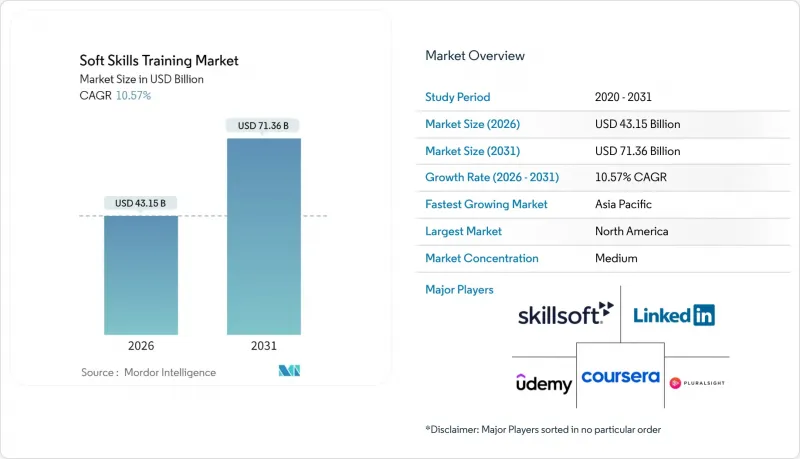
2025年軟性技能培訓市場價值為390.2億美元,預計到2031年將達到713.6億美元,高於2026年的431.5億美元。
預計在預測期(2026-2031 年)內,複合年成長率將達到 10.57%。
混合型勞動力的日益複雜化、日益嚴格的ESG資訊揭露要求以及政府廣泛的技能培訓津貼,正在加速企業對結構化情緒智商、協作和領導力培訓計畫的需求。同時,各組織正在將人工智慧驅動的個人化引擎融入其學習生態系統,使員工能夠獲得即時、情境化的輔導,而非固定的研討會。能夠將取得專利的行為分析技術與產業專用的內容相結合的供應商正在收取高價,而監管機構對人力資本報告的關注也促使落後企業將培訓預算納入正規化。模組化且價格合理的訂閱模式,使得那些瞄準服務不足的中小企業的新興參與企業,能夠在持續的成本限制下,開發新的收入來源。
全球軟性技能培訓市場趨勢與洞察
混合辦公模式及領導力的重要性
分散式團隊依賴高階協作、同理心和包容性技能,而這些技能僅靠技術培訓無法獲得。新加坡的一項調查發現,68%的員工渴望擔任管理職位,以便管理混合團隊。 LinkedIn Learning的「遠距領導」和麻省理工學院的「遠距環境下的領導」等課程,為管理者提供了有效遠距管理所需的韌性和結構化溝通技巧。醫療保健系統尤其凸顯了這個問題的迫切性,因為溝通不良導致的醫療事故促使相關機構引入了強制性的溝通技巧培訓模組。正在向工業4.0轉型的製造業也增加了專注於人機協作的領導力發展項目。
行動學習、微學習和人工智慧驅動的個人化
透過智慧型手機提供的短課程使員工能夠在工作流程中學習,從而降低生產環境中的機會成本。以製造業為導向的互聯員工平台會在員工在車間遇到人際互動挑戰時推送客製化的提示。 Skillsoft 的 CAISY 模擬器透過分析語調、用詞和反應速度來產生基於場景的回饋。 Udemy 的 Career Accelerator 將人工智慧策劃的學習路徑與訂閱模式結合,旨在讓價格敏感型學習者也能獲得學習機會。
中小企業面臨的預算限制與價格壓力
現金流有限意味著許多小型企業無法承擔促進者費用或員工停工損失。英國針對中型企業的補助計畫上限為1萬英鎊,這反映了資金籌措缺口。儘管成本高昂,仍有46%的日本企業傾向面對面培訓,顯示他們對數位化有抵觸情緒。免費的MOOC(大型開放式網路課程)進一步加劇了入門內容的商品化,提高了發展中地區對價格的敏感度。
細分市場分析
由人工智慧驅動的引擎驅動的自主數位學習,能夠根據學習者的熟練程度、工作角色和偏好形式調整學習路徑,預計將以12.86%的複合年成長率快速成長。然而,到2025年,線下研討會仍將佔據軟性技能市場37.68%的佔有率。這主要歸功於線下研討會能夠提高知識保留率,尤其是在高階主管風範、衝突解決和積極傾聽等培訓中,學員可以透過促進者的即時回饋來提升知識留存率。線上線下模式的並存表明,學習模式的選擇取決於目標能力的認知負荷和情緒差異。混合式課程設計將認知知識的傳遞分解為非同步模組,並將角色扮演和同儕輔導限制在即時課程中,從而在不影響學員參與度的前提下提高了成本效益。
與完全採用數位化的機構相比,試驗情境式教學方法的機構獲得了更高的完成率和行為改變指標。微軟在將基礎內容轉移到線上後,降低了人均培訓成本,同時仍為高階主管提供高品質的講師主導訓練營。日本企業仍保持謹慎,46.1% 的企業繼續沿用傳統的課堂教學模式。供應商可以透過將體驗式練習轉化為身臨其境型混合實境模擬來釋放潛在需求。隨著企業根據混合辦公的實際情況重新評估差旅預算,混合式學習軟性技能培訓的市場規模預計將會加速成長。
到2025年,通訊和演示行業將佔總收入的20.72%,鞏固其在所有職業和行業中的基礎地位。然而,情緒智商(EQ)和同理心培訓將以12.41%的複合年成長率成長,同時保持高利潤率,因為它能夠應對自動化和遠端協作加劇的複雜人際挑戰。醫療保健系統體現了這種緊迫性,專注於醫病溝通的研討會表明,同理心與診斷準確性和患者滿意度指標直接相關。這種快速成長與人工智慧(AI)的普及趨勢不謀而合,在人工智慧領域,演算法將接管日常分析工作,而人類工作者則透過同理心、創造力和批判性思維脫穎而出。
在繼任計畫週期中,領導力和管理課程持續吸引穩定的資金投入。適應性和韌性培訓曾經是小眾領域,如今在製造業企業中逐漸成為主流,因為互聯互通的員工計畫要求員工不斷提陞技能。批判性思維模組等軟性技能培訓市場的規模,與企業為降低演算法偏見風險而採取的舉措不謀而合,這些舉措旨在讓員工嚴格檢驗人工智慧的輸出結果。
區域分析
受美國證券交易委員會(SEC)報告要求以及聯邦政府數十億美元的勞動力津貼(用於支持技術和人際交往技能發展)的推動,北美地區預計在2025年將佔總收入的31.88%。企業買家青睞能夠將行為數據與人才管理儀錶板連接起來的人工智慧整合平台,促使領先供應商(例如為60%的財富1000強企業提供服務的Skillsoft)進行整合。
亞太地區是成長最快的地區,預計到2031年複合年成長率將達到11.52%。新加坡的智慧國家計畫和企業稅收優惠政策將協助當地線上數位學習市場在2027年達到22.3億美元,84%的專業表示迫切需要提陞技能。日本企業已將人力資本預算增加了30%,並與內容專家合作推出了企業影片學習庫。注重持續改善的本土文化正在推動製造業和服務業採用線上學習技術。
歐洲正經歷著由合規主導的穩定擴張。歐盟人工智慧法將於2025年2月生效,該法將要求企業確保與演算法系統打交道的員工具備人工智慧素養,間接刺激了對溝通和變革管理技能的需求。 《企業永續發展報告指令》擴大了相關人員資訊揭露的範圍,並鼓勵企業提供透明數據敘事的培訓。公共部門旨在規範培訓品質的計畫進一步推動了軟性技能模組在青年就業途徑中的製度化。
其他福利:
- Excel格式的市場預測(ME)表
- 3個月的分析師支持
目錄
第1章 引言
- 研究假設和市場定義
- 調查範圍
第2章調查方法
第3章執行摘要
第4章 市場情勢
- 市場概覽
- 市場促進因素
- 混合型勞動力對協作的需求
- 企業領導力發展重點
- 行動學習與微學習平台的興起
- 政府資助的技能提升措施
- 透過人工智慧驅動的行為分析實現個人化
- 與環境、社會及公司治理 (ESG) 相關的人力資本資訊揭露義務
- 市場限制
- 中小企業的預算限制
- 衡量軟性技能投資收益(ROI) 的難度
- 語言和本地化複雜性
- 免費MOOC課程加劇了定價壓力
- 產業價值鏈分析
- 技術展望
- 監管環境
- 波特五力分析
- 新進入者的威脅
- 買方的議價能力
- 供應商的議價能力
- 替代品的威脅
- 競爭對手之間的競爭
第5章 市場規模與成長預測
- 透過供應方法
- 線上教師指導
- 自主數位學習
- 混合式學習
- 線下/研討會/課程
- 依技能類型
- 領導與管理
- 溝通與表達
- 協作與團隊合作
- 時間和生產力
- 創造力和批判性思維
- 情緒智商和同理心
- 適應性和韌性
- 按認證狀態
- 認證課程
- 非認證/認知課程
- 按行業
- 資訊科技和電信
- BFSI
- 醫療保健和生命科學
- 製造業和工業
- 零售與電子商務
- 教育
- 飯店和旅遊業
- 其他行業部門
- 按地區
- 北美洲
- 美國
- 加拿大
- 墨西哥
- 歐洲
- 德國
- 英國
- 法國
- 義大利
- 西班牙
- 其他歐洲地區
- 亞太地區
- 中國
- 日本
- 韓國
- 印度
- 澳洲
- 亞太其他地區
- 南美洲
- 巴西
- 阿根廷
- 智利
- 哥倫比亞
- 其他南美洲
- 中東和非洲
- 中東
- 沙烏地阿拉伯
- 阿拉伯聯合大公國
- 其他中東地區
- 非洲
- 南非
- 奈及利亞
- 肯亞
- 其他非洲地區
- 中東
- 北美洲
第6章 競爭情勢
- 市場集中度
- 策略趨勢
- 市佔率分析
- 公司簡介
- Skillsoft Corporation
- LinkedIn Corporation
- Coursera Inc.
- Udemy Inc.
- Pluralsight Inc.
- NIIT Limited
- D2L Corporation
- Franklin Covey Co.
- Cegos Group
- BTS Group AB
- Korn Ferry
- GP Strategies Corporation
- Hemsley Fraser Group Ltd.
- Dale Carnegie and Associates Inc.
- Pearson plc(CrossKnowledge)
- Mind Gym plc
- John Wiley and Sons Inc.
- Simplilearn Solutions Pvt. Ltd.
- City and Guilds Group
- Interaction Associates Inc.
第7章 市場機會與未來展望
The soft skills training market was valued at USD 39.02 billion in 2025 and estimated to grow from USD 43.15 billion in 2026 to reach USD 71.36 billion by 2031, at a CAGR of 10.57% during the forecast period (2026-2031).
Heightened hybrid-workforce complexity, ESG-linked disclosure mandates, and widespread government upskilling grants are accelerating corporate demand for structured emotional-intelligence, collaboration, and leadership programs. Organizations are simultaneously embedding AI-driven personalization engines into learning ecosystems so that employees receive real-time, context-specific coaching instead of periodic workshops. Vendors able to combine patented behavioral-analytics technology with industry-specific content are capturing premium pricing, while regulatory attention on human-capital reporting is pushing late adopters to formalize training budgets. Market entrants that target underserved small-and-medium enterprises (SMEs) with modular, affordable subscription models can unlock incremental revenue pools despite persistent cost constraints.
Global Soft Skills Training Market Trends and Insights
Hybrid-Work and Leadership Imperatives
Distributed teams rely on advanced collaboration, empathy, and inclusion skills that cannot be developed through technical training alone. Singapore research shows 68% of employees pursue managerial roles specifically to manage hybrid teams. Courses like LinkedIn Learning's "Remote Leadership" and MIT's "Leading in a Remote Environment" are empowering managers with the resilience and structured communication skills essential for effective remote oversight. Healthcare systems underscore the urgency; communication lapses have been linked to clinical errors, prompting the implementation of mandatory conversation-skills modules. Manufacturers transitioning to Industry 4.0 add leadership-development tracks focused on human-machine collaboration.
Mobile, Micro-Learning, and AI Personalization
Bite-sized lessons delivered via smartphones allow learning in the flow of work, reducing opportunity costs in production environments. Connected-worker platforms in manufacturing push tailored prompts when employees confront interpersonal challenges on the line. Skillsoft's CAISY simulator generates scenario-based feedback by analyzing tone, word choice, and response speed. Udemy's Career Accelerators combine AI-curated pathways with subscription economics to broaden access for price-sensitive learners.
SME Budget Limitations and Price Pressure
Limited cash flow leaves many SMEs unable to absorb facilitator fees or employee downtime. The UK's subsidy program caps grants at GBP 10,000 (USD 12,400) for medium-sized firms, reflecting financing gaps. Forty-six percent of Japanese companies still prefer face-to-face training despite higher costs, illustrating resistance to digital displacement. Free massive open online courses further commoditize entry-level content, increasing price sensitivity in developing regions.
Other drivers and restraints analyzed in the detailed report include:
- Government Upskilling and ESG Mandates
- Behavioral Analytics for Real-Time Coaching
- ROI Measurement and Localization Barriers
For complete list of drivers and restraints, kindly check the Table Of Contents.
Segment Analysis
Self-paced e-learning is the fastest growing channel at a 12.86% CAGR, supported by AI-driven engines that adapt pathways to learner proficiency, job role, and preferred format. Offline workshops nevertheless maintained 37.68% of the soft skills training market share in 2025 because executive presence, conflict resolution, and active-listening drills achieve higher knowledge-retention when participants receive immediate feedback from facilitators. The coexistence of digital and physical formats signals an ecosystem in which modality selection depends on the cognitive load and emotional nuance of the target competency. Hybrid course designs now segment cognitive-knowledge transfer to asynchronous modules while reserving role-play and peer coaching for live sessions, enhancing cost-efficiency without eroding engagement.
Organizations experimenting with contextual delivery observe higher completion and behavior-change metrics than those pursuing full digitization. Microsoft documented reductions in per-capita training costs after shifting foundational content online, while maintaining premium instructor-led bootcamps for senior leadership. Japanese enterprises remain cautious, with 46.1% retaining traditional classroom models; vendors translating experiential exercises into immersive, mixed-reality simulations may unlock latent demand. The soft skills training market size for blended learning formats is expected to accelerate as firms reevaluate travel budgets against hybrid-work realities.
Communication and presentation held 20.72% of 2025 revenue, cementing its status as foundational across roles and industries. Yet, emotional intelligence and empathy courses, expanding at a 12.41% CAGR, command premium margins because they tackle complex interpersonal issues magnified by automation and remote collaboration. Healthcare systems exemplify urgency; dedicated clinician-patient communication workshops directly link empathy to diagnostic accuracy and patient-satisfaction metrics. The surge also mirrors AI adoption trends; as algorithms assume routine analytics, human workers differentiate on empathy, creativity, and critical thinking.
Leadership and management curricula continue to draw stable spend amid succession-planning cycles. Adaptability and resilience tracks, once niche, are moving mainstream in manufacturing hubs where connected-worker programs demand constant upskilling. The soft skills training market size for critical-thinking modules aligns with enterprise initiatives to mitigate algorithmic-bias risks by teaching employees to interrogate AI outputs rigorously.
The Soft Skills Training Market Report is Segmented by Delivery Mode (Online Instructor-Led, and More), Skill Type (Leadership and Management, Communication and Presentation, and More), Certification Status (Certification-Oriented Courses, and Non-Certification/Awareness Courses), Industry Vertical (IT and Telecom, Healthcare and Life Sciences, and More), and Geography. The Market Forecasts are Provided in Terms of Value (USD).
Geography Analysis
North America commanded 31.88% of 2025 revenue, anchored by SEC reporting requirements and multibillion-dollar federal workforce grants that subsidize both technical and interpersonal development. Corporate buyers favor AI-infused platforms capable of linking behavioral data to talent-management dashboards, reinforcing vendor consolidation among large providers such as Skillsoft, which serves 60% of Fortune 1000 enterprises.
Asia-Pacific is the fastest growing region with an 11.52% CAGR through 2031. Singapore's Smart Nation program and corporate tax incentives have propelled the local e-learning segment toward USD 2.23 billion by 2027, with 84% of professionals citing upskilling urgency. Japanese corporates increased human-capital budgets by 30% and partnered with content specialists to launch enterprise video-learning libraries. The regional culture of continuous improvement amplifies adoption across manufacturing and services.
Europe shows steady, compliance-driven expansion. The EU AI Act effective February 2025 obliges firms to ensure AI literacy for employees interfacing with algorithmic systems, indirectly driving demand for communication and change-management skills. The Corporate Sustainability Reporting Directive widens the scope of stakeholder-engagement disclosures, nudging companies to train staff on transparent data storytelling. Public-sector programs that standardize traineeship quality further institutionalize soft-skills modules in youth employment pathways.
- Skillsoft Corporation
- LinkedIn Corporation
- Coursera Inc.
- Udemy Inc.
- Pluralsight Inc.
- NIIT Limited
- D2L Corporation
- Franklin Covey Co.
- Cegos Group
- BTS Group AB
- Korn Ferry
- GP Strategies Corporation
- Hemsley Fraser Group Ltd.
- Dale Carnegie and Associates Inc.
- Pearson plc (CrossKnowledge)
- Mind Gym plc
- John Wiley and Sons Inc.
- Simplilearn Solutions Pvt. Ltd.
- City and Guilds Group
- Interaction Associates Inc.
Additional Benefits:
- The market estimate (ME) sheet in Excel format
- 3 months of analyst support
TABLE OF CONTENTS
1 INTRODUCTION
- 1.1 Study Assumptions and Market Definition
- 1.2 Scope of the Study
2 RESEARCH METHODOLOGY
3 EXECUTIVE SUMMARY
4 MARKET LANDSCAPE
- 4.1 Market Overview
- 4.2 Market Drivers
- 4.2.1 Hybrid-workforce collaboration demand
- 4.2.2 Corporate leadership-development priorities
- 4.2.3 Rise of mobile and micro-learning platforms
- 4.2.4 Government-funded upskilling initiatives
- 4.2.5 AI-driven behavioural analytics for personalisation
- 4.2.6 ESG-linked human-capital disclosure mandates
- 4.3 Market Restraints
- 4.3.1 Budget constraints in SMEs
- 4.3.2 Difficulty measuring soft-skill ROI
- 4.3.3 Language and localisation complexity
- 4.3.4 Free MOOCs intensifying price pressure
- 4.4 Industry Value Chain Analysis
- 4.5 Technological Outlook
- 4.6 Regulatory Landscape
- 4.7 Porter's Five Forces Analysis
- 4.7.1 Threat of New Entrants
- 4.7.2 Bargaining Power of Buyers
- 4.7.3 Bargaining Power of Suppliers
- 4.7.4 Threat of Substitutes
- 4.7.5 Competitive Rivalry
5 MARKET SIZE AND GROWTH FORECASTS (VALUE)
- 5.1 By Delivery Mode
- 5.1.1 Online Instructor-Led
- 5.1.2 Self-Paced E-learning
- 5.1.3 Blended Learning
- 5.1.4 Offline / Workshop / Classroom
- 5.2 By Skill Type
- 5.2.1 Leadership and Management
- 5.2.2 Communication and Presentation
- 5.2.3 Collaboration and Teamwork
- 5.2.4 Time and Productivity
- 5.2.5 Creativity and Critical Thinking
- 5.2.6 Emotional Intelligence and Empathy
- 5.2.7 Adaptability and Resilience
- 5.3 By Certification Status
- 5.3.1 Certification-Oriented Courses
- 5.3.2 Non-Certification / Awareness Courses
- 5.4 By Industry Vertical
- 5.4.1 IT and Telecom
- 5.4.2 BFSI
- 5.4.3 Healthcare and Life Sciences
- 5.4.4 Manufacturing and Industrial
- 5.4.5 Retail and E-commerce
- 5.4.6 Education
- 5.4.7 Hospitality and Tourism
- 5.4.8 Other Industry Verticals
- 5.5 By Geography
- 5.5.1 North America
- 5.5.1.1 United States
- 5.5.1.2 Canada
- 5.5.1.3 Mexico
- 5.5.2 Europe
- 5.5.2.1 Germany
- 5.5.2.2 United Kingdom
- 5.5.2.3 France
- 5.5.2.4 Italy
- 5.5.2.5 Spain
- 5.5.2.6 Rest of Europe
- 5.5.3 Asia-Pacific
- 5.5.3.1 China
- 5.5.3.2 Japan
- 5.5.3.3 South Korea
- 5.5.3.4 India
- 5.5.3.5 Australia
- 5.5.3.6 Rest of Asia-Pacific
- 5.5.4 South America
- 5.5.4.1 Brazil
- 5.5.4.2 Argentina
- 5.5.4.3 Chile
- 5.5.4.4 Colombia
- 5.5.4.5 Rest of South America
- 5.5.5 Middle East and Africa
- 5.5.5.1 Middle East
- 5.5.5.1.1 Saudi Arabia
- 5.5.5.1.2 United Arab Emirates
- 5.5.5.1.3 Rest of Middle East
- 5.5.5.2 Africa
- 5.5.5.2.1 South Africa
- 5.5.5.2.2 Nigeria
- 5.5.5.2.3 Kenya
- 5.5.5.2.4 Rest of Africa
- 5.5.5.1 Middle East
- 5.5.1 North America
6 COMPETITIVE LANDSCAPE
- 6.1 Market Concentration
- 6.2 Strategic Moves
- 6.3 Market Share Analysis
- 6.4 Company Profiles (includes Global level Overview, Market level overview, Core Segments, Financials as available, Strategic Information, Market Rank/Share for key companies, Products and Services, and Recent Developments)
- 6.4.1 Skillsoft Corporation
- 6.4.2 LinkedIn Corporation
- 6.4.3 Coursera Inc.
- 6.4.4 Udemy Inc.
- 6.4.5 Pluralsight Inc.
- 6.4.6 NIIT Limited
- 6.4.7 D2L Corporation
- 6.4.8 Franklin Covey Co.
- 6.4.9 Cegos Group
- 6.4.10 BTS Group AB
- 6.4.11 Korn Ferry
- 6.4.12 GP Strategies Corporation
- 6.4.13 Hemsley Fraser Group Ltd.
- 6.4.14 Dale Carnegie and Associates Inc.
- 6.4.15 Pearson plc (CrossKnowledge)
- 6.4.16 Mind Gym plc
- 6.4.17 John Wiley and Sons Inc.
- 6.4.18 Simplilearn Solutions Pvt. Ltd.
- 6.4.19 City and Guilds Group
- 6.4.20 Interaction Associates Inc.
7 MARKET OPPORTUNITIES AND FUTURE OUTLOOK
- 7.1 White-space and Unmet-Need Assessment

 2026-2030年全球軟性技能培訓市場
 社交技能發展平台市場預測至2034年-全球分析(按組件、平台類型、技能類型、部署模式、應用、最終用戶和地區分類)未來技能發展市場:預測(至2034年)-按組件、技能類別、部署方式、技術、最終用戶和地區分類的全球分析
 2026年全球軟性技能管理市場報告
 企業領導力培訓市場規模、佔有率、成長及全球產業分析:按類型、應用和地區分類的洞察,2026-2034 年預測
 2026-2030年全球軟性技能評測軟體市場
 軟性技能培訓市場規模、佔有率、趨勢和預測:軟性技能類型、交付管道、通路提供者、交付形式、最終用戶行業和地區分類,2026-2034 年
 2026-2030年全球企業領導力培訓市場線上企業領導力培訓市場規模、佔有率、成長及全球產業分析:按類型、應用和地區分類的洞察,2026-2034 年預測
 企業領導力培訓市場-全球產業規模、佔有率、趨勢、機會與預測:按應用程式、最終用戶、地區和競爭對手分類,2021-2031年