


 |
市場調查報告書
商品編碼
1934862
汽車半導體記憶體:市場佔有率分析、產業趨勢與統計、成長預測(2026-2031)Semiconductor Memory For Automotive - Market Share Analysis, Industry Trends & Statistics, Growth Forecasts (2026 - 2031) |
||||||

※ 本網頁內容可能與最新版本有所差異。詳細情況請與我們聯繫。
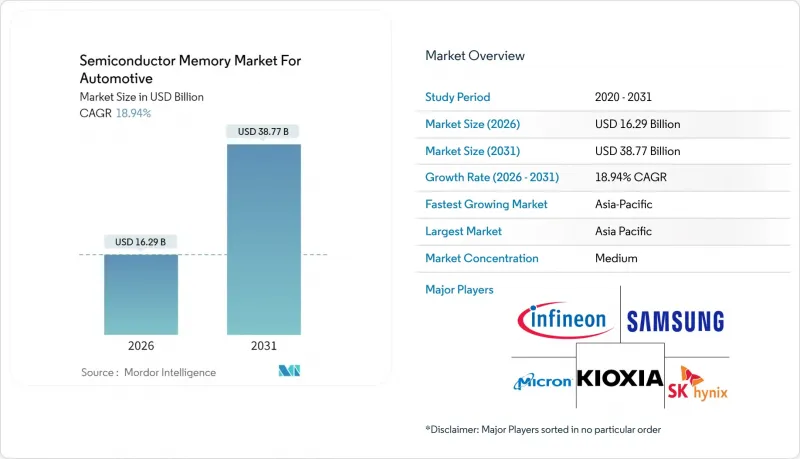
預計汽車半導體記憶體市場將從 2025 年的 137 億美元成長到 2026 年的 162.9 億美元,到 2031 年將達到 387.7 億美元,2026 年至 2031 年的複合年成長率為 18.94%。
這種快速成長是由向軟體定義汽車的轉變所驅動的,軟體定義汽車將數十種電子功能整合到一個集中式運算區域,顯著提高了每輛車的記憶體密度和頻寬需求。中國、美國和歐盟支持L2+以上等級駕駛輔助系統的監管舉措,正在加速對符合功能安全標準的千兆級工作記憶體的需求。同時,成本最佳化的3D NAND和即將推出的MRAM選項正在擴大可尋址的應用範圍,使汽車製造商能夠更有效地平衡性能和組件成本。美國和歐洲供應鏈本地化的不斷推進也促使籌資策略,這提高了對快閃記憶體容量的需求,並為下一代模組建立了持久的更換週期。
汽車半導體記憶體市場趨勢與展望
軟體定義汽車的興起
汽車製造商正將車輛轉型為行動資料中心,這依賴持續的軟體更新和功能部署。特斯拉的硬體4.0透過整合多個LPDDR5堆疊,即時處理12個相機影像和雷達輸入,顯著提升了記憶體密度。集中式設計將100多個ECU網路整合到幾個高效能網域控制器中,將車載DRAM容量從兆位元組擴展到數GB。高階車型已配備總合內存,預計主流車型到2027年也將達到類似容量。這種升級路徑,加上更長的軟體維護週期,確保了對高頻寬AEC-Q100 1級模組的持續需求。
集中式/分區式EE架構
BMW即將推出的下一代iDrive系統採用分區設計,而非為每個子系統分配獨立模組,從而實現了更有效率的記憶體資源分配。這種整合方式消除了冗餘,並將組件數量減少了高達30%。然而,每個模組都必須提供更高的吞吐量並承受更大的熱負荷。因此,資訊娛樂和ADAS領域正朝著64位元DRAM介面和接近6 Gb/s的更快存取速度發展。一級供應商正透過將記憶體和處理器整合到高密度基板上來應對這一趨勢,這一趨勢有利於擁有10奈米以下先進技術的供應商。雖然這種架構最初應用於高階車型,但預計將在四年內滲透到大眾市場。
供應鏈波動
2024年台灣地震暴露了地理位置集中的晶圓廠的脆弱性,擾亂了控制器生產,並將一級記憶體的前置作業時間延長了20週。汽車晶圓需求量佔比不到10%,因此在供不應求時,供應商往往會降低汽車晶圓的優先順序。結果,原始設備製造商(OEM)在韓國和美國之間採取雙重採購策略,由於認證週期延長,預計這種做法至少會持續到2026年。出口法規的差異和地緣政治的不確定性可能會使近期經濟成長下降100-150個基點。
細分市場分析
工作記憶體將繼續保持主導地位,到2025年將佔據半導體記憶體市場38.72%的佔有率,這主要得益於高級駕駛輔助系統(ADAS)和資訊娛樂系統對即時處理的高負載需求。高階電動車(EV)將配備高達32GB的LPDDR5記憶體用於集中式運算叢集,而預計到2027年,16GB記憶體將成為量產車型的主流配置。雖然韌體容量的代碼儲存已穩定在8-16GB,但數據儲存正以20.02%的複合年成長率快速成長,因為越來越多的車輛收集Terabyte感測器數據用於邊緣分析。半導體記憶體市場規模與資料儲存密切相關,這將推動對高容量3D NAND元件的長期需求。
工作記憶體領域的發展因分區架構的出現而進一步推動,這些架構實現了安全、駕駛座和動力傳動系統系統等領域共用記憶體池的標準化。這種整合要求更高的單模組性能,並促進了寬I/O介面和內建ECC引擎的應用。隨著OEM廠商尋求簡化認證流程,提供DRAM-NAND雙用途組合的供應商可望抓住市場佔有率機會。正在評估中的HBM-Lite概念如果能夠解決散熱難題,預計從2028年起投入使用,並可能在半導體記憶體市場開闢新的收入來源。
到2025年,DRAM將佔總收入的31.85%,繼續在感測器融合和車輛動力學等對延遲要求極高的工作負載領域保持主導地位;而3D NAND將以19.25%的速度成長,這主要得益於每比特成本的下降和AEC-Q100標準的日益普及。讀取速度高達4200MB/s的汽車級UFS 4.1快閃記憶體正在成為資料記錄器和空中韌體庫的標準儲存解決方案。
NOR快閃記憶體繼續承擔啟動和恢復任務,但容量限制限制了其年成長。諸如MRAM之類的新興非揮發性記憶體(NVM)正在故障安全記錄和即時啟動儀表板等細分領域站穩腳跟。整體趨勢清晰可見:DRAM為運算密集型AI模組提供動力,而3D NAND則滿足日益成長的持久儲存需求,二者相輔相成,構成半導體記憶體市場的核心力量。
汽車半導體記憶體市場報告按技術角色(例如,代碼儲存、工作記憶體)、記憶體類型(例如,DRAM、 NAND快閃記憶體)、應用(例如,ADAS和自動駕駛、數位駕駛座)、車輛類型(例如,乘用車、輕型商用車)和地區(例如,北美、南美、歐洲)進行細分。市場預測以美元以金額為準。
區域分析
預計到2025年,亞太地區將以37.95%的市佔率引領半導體記憶體市場,並以19.88%的複合年成長率擴大領先優勢,這主要得益於中國積極的電動車普及目標和韓國強大的製造業基礎。中國在亞太全部區域中佔相當大的佔有率,但由於先進製程節點的出口管制措施,中國仍面臨持續的挑戰。韓國憑藉其垂直整合的主要企業——三星和SK海力士,與全球一級供應商簽訂了長期合約。同時,日本記憶體代工廠與汽車零件供應商之間的緊密合作,縮短了產品認證前置作業時間。
北美位居第二,這得益於《晶片法案》(CHIPS Act)提供的520億美元撥款,用於半導體製造業回流,包括在德克薩斯州、亞利桑那州和印第安納州建設專用汽車生產線。特斯拉的垂直整合模式和底特律的Ultium純電動車平台是關鍵因素,推動了國內對1級LPDDR5-X和高循環固態硬碟的需求。加拿大和墨西哥分別透過電池模組組裝和經濟高效的電子整合,為該地區提供補充,從而增強了三方供應鏈的韌性。
歐洲正透過價值430億歐元的《歐洲晶片法案》建構戰略自主性,並以德國汽車製造商和記憶體製造商為核心組建了一個聯盟,旨在實現部分供應鏈的本地化。監管機構對ISO 26262和ISO/SAE 21434標準的重視,正在推動對認證記憶體解決方案的需求。同時,中東和非洲地區雖然在絕對銷量上落後,但由於阿拉伯聯合大公國和南非的電動車製造激勵政策,該地區正迅速發展,並有望在本十年末成為半導體記憶體市場的新興前沿陣地。
其他福利:
- Excel格式的市場預測(ME)表
- 3個月的分析師支持
目錄
第1章 引言
- 研究假設和市場定義
- 調查範圍
第2章調查方法
第3章執行摘要
第4章 市場情勢
- 市場概覽
- 市場促進因素
- 介紹軟體定義車輛(SDV)
- 集中式/分區式EE架構
- 整合到微控制器中的特定領域人工智慧加速器
- 二級以上ADAS ECU的記憶體容量增加
- 汽車製造商擴大採用空中升級 (OTA) 週期
- 降低汽車用3D NAND的成本
- 市場限制
- 汽車矽供應鏈的波動性
- 與消費性記憶體價格差異龐大
- 功能安全認證前置作業時間
- 高密度組件的溫度控管局限性
- 宏觀經濟因素如何影響市場
- 產業價值鏈分析
- 監管環境
- 技術展望
- 波特五力分析
- 新進入者的威脅
- 買方的議價能力
- 供應商的議價能力
- 替代品的威脅
- 競爭對手之間的競爭
第5章 市場規模與成長預測
- 按技術角色
- 程式碼儲存
- 工作記憶
- 資料儲存
- 其他角色(例如啟動、日誌記錄等)
- 按記憶體類型
- DRAM
- NAND快閃記憶體
- NOR Flash
- MRAM 和新興的非揮發性記憶體
- 透過使用
- 高級駕駛輔助系統和自動駕駛
- 數位駕駛座
- 動力傳動系統
- 底盤和安全裝置
- 身體和舒適度
- 按車輛類型
- 搭乘用車
- 輕型商用車
- 大型商用車輛
- 按地區
- 北美洲
- 美國
- 加拿大
- 墨西哥
- 南美洲
- 巴西
- 阿根廷
- 其他南美洲
- 歐洲
- 德國
- 英國
- 法國
- 義大利
- 西班牙
- 其他歐洲地區
- 亞太地區
- 中國
- 日本
- 印度
- 韓國
- 東南亞
- 亞太其他地區
- 中東和非洲
- 中東
- 沙烏地阿拉伯
- 阿拉伯聯合大公國
- 其他中東地區
- 非洲
- 南非
- 埃及
- 其他非洲地區
- 中東
- 北美洲
第6章 競爭情勢
- 市場集中度
- 策略趨勢
- 市佔率分析
- 公司簡介
- Samsung Electronics Co., Ltd.
- Micron Technology, Inc.
- SK hynix Inc.
- Kioxia Holdings Corporation
- Infineon Technologies AG
- Renesas Electronics Corporation
- NXP Semiconductors NV
- Winbond Electronics Corporation
- Macronix International Co., Ltd.
- GigaDevice Semiconductor Inc.
- Integrated Silicon Solution, Inc.(ISSI)
- Everspin Technologies, Inc.
- Powerchip Technology Corporation
- Transcend Information, Inc.
- Kingston Technology Corporation
- Swissbit AG
- Virtium LLC
- Alliance Memory, Inc.
- AP Memory Technology Corp.
- Semiconductor Manufacturing International Corp.(SMIC)
- Tower Semiconductor Ltd.
- Yangtze Memory Technologies Co.(YMTC)
- Western Digital Corporation
第7章 市場機會與未來展望
The semiconductor memory market for automotive is expected to grow from USD 13.7 billion in 2025 to USD 16.29 billion in 2026 and is forecast to reach USD 38.77 billion by 2031 at 18.94% CAGR over 2026-2031.
The surge is fueled by the shift toward software-defined vehicles, which bundle dozens of electronic functions into centralized compute domains, sharply increasing memory density and bandwidth requirements per car. Regulatory momentum behind Level 2+ driver assistance in China, the United States, and the European Union is accelerating demand for gigabyte-scale working memory that can meet functional-safety standards. Meanwhile, cost-optimized 3D NAND and upcoming MRAM options are expanding the addressable base of applications, letting automakers balance performance and bill-of-materials pressures more effectively. Intensifying supply-chain localization in the United States and Europe is also steering procurement strategies toward multi-sourced, automotive-qualified memory, reducing overreliance on any single region. Finally, premium vehicle programs are pioneering over-the-air software strategies that multiply flash capacity requirements and build a durable replacement cycle for next-generation modules.
Insights and Trends of Semiconductor Memory Market For Automotive
Software-Defined Vehicle Adoption
Automakers are transforming cars into rolling data centers that rely on continuous software updates and feature deployment. Tesla's Hardware 4.0 showcases a significant leap in memory intensity by integrating multiple LPDDR5 stacks, which stream 12 camera feeds and radar inputs in real-time. Centralized designs slash the traditional network of more than 100 ECUs to a handful of high-performance domain controllers, raising installed DRAM from megabyte ranges to multi-gigabyte footprints. Luxury trims are already equipped with 32 GB of total memory, and mainstream models are expected to trend toward similar capacities by 2027. The upgrade path aligns with longer software maintenance cycles, ensuring recurring demand for high-bandwidth, AEC-Q100 Grade 1 modules.
Centralized/Zonal E-E Architecture
BMW's forthcoming iDrive generation demonstrates how zonal designs allocate memory resources efficiently, rather than assigning discrete modules to each subsystem. Consolidation eliminates duplication, reducing part counts by up to 30%. However, each surviving module must deliver higher throughput and withstand heavier thermal loads. The net effect is a shift in demand toward 64-bit-wide DRAM interfaces and faster access speeds, approaching 6 Gb/s, particularly in the infotainment and ADAS domains. Tier-1 suppliers are adapting by co-packaging memory and processors on high-density substrates, a trend that favors vendors with advanced capabilities at the 10 nm node and below. The architecture is rolling out first in premium nameplates but is expected to penetrate mass-market segments within four years.
Supply-Chain Volatility
The 2024 Taiwan earthquake exposed the fragility of geographically concentrated fabs, disrupting controller output and inflating lead times for Grade-1 memory by 20 weeks. Automotive lines, which account for under 10% of total wafer demand, often drop in supplier priority when shortages occur. OEMs are therefore dual-sourcing between South Korea and the United States, but qualification cycles extend this mitigation effort to at least 2026. Divergent export-control regimes and geopolitical uncertainty could shave 100-150 basis points off near-term growth.
Other drivers and restraints analyzed in the detailed report include:
- Domain-Specific AI Accelerators in MCUs
- Growing Memory Content per Level-2+ ADAS ECU
- High Automotive Selling Price (ASP) Premium
For complete list of drivers and restraints, kindly check the Table Of Contents.
Segment Analysis
Working memory dominated the semiconductor memory market, accounting for a 38.72% share in 2025, due to the high real-time processing loads in ADAS and infotainment units. Luxury EVs now integrate up to 32 GB of LPDDR5 for centralized compute clusters, while mass-market models are expected to trend toward 16 GB by 2027. Code storage remains stable as firmware footprints plateau around 8-16 GB, while data storage rockets at a 20.02% CAGR as vehicles harvest terabytes of sensor data for edge analytics. The semiconductor memory market size is tied to data storage, reinforcing long-term demand for high-capacity 3D NAND devices.
The outlook for working memory is further buoyed by the arrival of zonal architectures that standardize memory pools shared across safety, cockpit, and powertrain domains. This consolidation demands higher per-module performance, driving a pivot toward wide-I/O interfaces and built-in ECC engines. Suppliers offering dual-purpose DRAM-NAND combinations are poised to capture incremental market share among OEMs seeking to streamline their qualification pipelines. HBM-Lite concepts under evaluation could emerge after 2028 if thermal hurdles are resolved, potentially opening an adjacent revenue stream within the semiconductor memory market.
DRAM delivered 31.85% of 2025 revenue, maintaining its leading position in latency-critical workloads, such as sensor fusion and vehicle dynamics. Simultaneously, 3D NAND is advancing at a 19.25% growth pace, driven by declining cost-per-bit and broader AEC-Q100 coverage. Automotive-grade UFS 4.1 drives, which offer 4,200 MB/s read speeds, are emerging as the default storage solutions for data recorders and over-the-air firmware repositories.
NOR flash continues to fulfill boot and recovery tasks, but density limitations restrict its annual expansion. MRAM and other emerging NVMs are carving niche footholds in fail-safe logging and instant-on dashboards. The overarching dynamic is clear: DRAM feeds compute-intensive AI blocks, while 3D NAND underpins the escalating appetite for persistent storage, forming a complementary duo at the heart of the semiconductor memory market.
The Semiconductor Memory Market for Automotive Report is Segmented by Technology Role (Code Storage, Working Memory, and More), Memory Type (DRAM, NAND Flash, and More), Application (ADAS and Automated Driving, Digital Cockpit, and More), Vehicle Type (Passenger Cars, Light Commercial Vehicles, and More), and Geography (North America, South America, Europe, and More). The Market Forecasts are Provided in Terms of Value (USD).
Geography Analysis
Asia-Pacific led with 37.95% semiconductor memory market share in 2025 and is expected to broaden its lead at a 19.88% CAGR, buoyed by China's aggressive EV penetration targets and South Korea's manufacturing depth. China alone represents a significant share of regional volume but faces continuing headwinds from export-control measures on advanced nodes. South Korea leverages its vertically integrated champions, Samsung and SK Hynix, to secure long-term contracts with global Tier-1s, while Japan's close collaboration between memory fabs and automotive suppliers compresses qualification lead times.
North America ranks second, backed by USD 52 billion CHIPS Act subsidies aimed at reshoring semiconductor output, including dedicated automotive lines in Texas, Arizona, and Indiana. Tesla's vertically integrated model and Detroit's Ultium BEV platform are major off-takers, pushing domestic demand for Grade-1 LPDDR5-X and high-cycle SSDs. Canada and Mexico complement the region through battery-module assembly and cost-efficient electronics integration, respectively, fostering trilateral supply resiliency.
Europe is carving strategic autonomy via the EUR 43 billion European Chips Act, with consortia forming around German OEMs and memory makers to localize parts of the supply chain. The regulatory emphasis on ISO 26262 and ISO/SAE 21434 has elevated the demand for certified memory solutions. Meanwhile, the Middle East and Africa trail in absolute volume but are gaining traction through EV manufacturing incentives in the United Arab Emirates and South Africa, signaling an emerging frontier for the semiconductor memory market by the end of the decade.
- Samsung Electronics Co., Ltd.
- Micron Technology, Inc.
- SK hynix Inc.
- Kioxia Holdings Corporation
- Infineon Technologies AG
- Renesas Electronics Corporation
- NXP Semiconductors N.V.
- Winbond Electronics Corporation
- Macronix International Co., Ltd.
- GigaDevice Semiconductor Inc.
- Integrated Silicon Solution, Inc. (ISSI)
- Everspin Technologies, Inc.
- Powerchip Technology Corporation
- Transcend Information, Inc.
- Kingston Technology Corporation
- Swissbit AG
- Virtium LLC
- Alliance Memory, Inc.
- AP Memory Technology Corp.
- Semiconductor Manufacturing International Corp. (SMIC)
- Tower Semiconductor Ltd.
- Yangtze Memory Technologies Co. (YMTC)
- Western Digital Corporation
Additional Benefits:
- The market estimate (ME) sheet in Excel format
- 3 months of analyst support
TABLE OF CONTENTS
1 INTRODUCTION
- 1.1 Study Assumptions and Market Definition
- 1.2 Scope of the Study
2 RESEARCH METHODOLOGY
3 EXECUTIVE SUMMARY
4 MARKET LANDSCAPE
- 4.1 Market Overview
- 4.2 Market Drivers
- 4.2.1 Software-Defined Vehicle (SDV) adoption
- 4.2.2 Centralized/Zonal E-E Architecture
- 4.2.3 Domain-specific AI accelerators inside MCUs
- 4.2.4 Growing memory content per Level-2+ ADAS ECU
- 4.2.5 Wider OEM use of over-the-air (OTA) update cycles
- 4.2.6 Automotive-qualified 3D NAND cost decline
- 4.3 Market Restraints
- 4.3.1 Volatility in automotive silicon supply chain
- 4.3.2 High ASP gap vs. consumer-grade memory
- 4.3.3 Functional-safety certification lead-times
- 4.3.4 Thermal-management limits in high-density modules
- 4.4 Impact of Macroeconomic Factors on the Market
- 4.5 Industry Value Chain Analysis
- 4.6 Regulatory Landscape
- 4.7 Technological Outlook
- 4.8 Porter's Five Forces Analysis
- 4.8.1 Threat of New Entrants
- 4.8.2 Bargaining Power of Buyers
- 4.8.3 Bargaining Power of Suppliers
- 4.8.4 Threat of Substitute Products
- 4.8.5 Intensity of Competitive Rivalry
5 MARKET SIZE AND GROWTH FORECASTS (VALUE)
- 5.1 By Technology Role
- 5.1.1 Code Storage
- 5.1.2 Working Memory
- 5.1.3 Data Storage
- 5.1.4 Other Roles (e.g., Boot, Logs)
- 5.2 By Memory Type
- 5.2.1 DRAM
- 5.2.2 NAND Flash
- 5.2.3 NOR Flash
- 5.2.4 MRAM and Emerging NVM
- 5.3 By Application
- 5.3.1 ADAS and Automated Driving
- 5.3.2 Digital Cockpit
- 5.3.3 Powertrain
- 5.3.4 Chassis and Safety
- 5.3.5 Body and Comfort
- 5.4 By Vehicle Type
- 5.4.1 Passenger Cars
- 5.4.2 Light Commercial Vehicles
- 5.4.3 Heavy Commercial Vehicles
- 5.5 By Geography
- 5.5.1 North America
- 5.5.1.1 United States
- 5.5.1.2 Canada
- 5.5.1.3 Mexico
- 5.5.2 South America
- 5.5.2.1 Brazil
- 5.5.2.2 Argentina
- 5.5.2.3 Rest of South America
- 5.5.3 Europe
- 5.5.3.1 Germany
- 5.5.3.2 United Kingdom
- 5.5.3.3 France
- 5.5.3.4 Italy
- 5.5.3.5 Spain
- 5.5.3.6 Rest of Europe
- 5.5.4 Asia-Pacific
- 5.5.4.1 China
- 5.5.4.2 Japan
- 5.5.4.3 India
- 5.5.4.4 South Korea
- 5.5.4.5 South-East Asia
- 5.5.4.6 Rest of Asia-Pacific
- 5.5.5 Middle East and Africa
- 5.5.5.1 Middle East
- 5.5.5.1.1 Saudi Arabia
- 5.5.5.1.2 United Arab Emirates
- 5.5.5.1.3 Rest of Middle East
- 5.5.5.2 Africa
- 5.5.5.2.1 South Africa
- 5.5.5.2.2 Egypt
- 5.5.5.2.3 Rest of Africa
- 5.5.5.1 Middle East
- 5.5.1 North America
6 COMPETITIVE LANDSCAPE
- 6.1 Market Concentration
- 6.2 Strategic Moves
- 6.3 Market Share Analysis
- 6.4 Company Profiles (includes Global level Overview, Market level overview, Core Segments, Financials as available, Strategic Information, Market Rank/Share for key companies, Products and Services, and Recent Developments)
- 6.4.1 Samsung Electronics Co., Ltd.
- 6.4.2 Micron Technology, Inc.
- 6.4.3 SK hynix Inc.
- 6.4.4 Kioxia Holdings Corporation
- 6.4.5 Infineon Technologies AG
- 6.4.6 Renesas Electronics Corporation
- 6.4.7 NXP Semiconductors N.V.
- 6.4.8 Winbond Electronics Corporation
- 6.4.9 Macronix International Co., Ltd.
- 6.4.10 GigaDevice Semiconductor Inc.
- 6.4.11 Integrated Silicon Solution, Inc. (ISSI)
- 6.4.12 Everspin Technologies, Inc.
- 6.4.13 Powerchip Technology Corporation
- 6.4.14 Transcend Information, Inc.
- 6.4.15 Kingston Technology Corporation
- 6.4.16 Swissbit AG
- 6.4.17 Virtium LLC
- 6.4.18 Alliance Memory, Inc.
- 6.4.19 AP Memory Technology Corp.
- 6.4.20 Semiconductor Manufacturing International Corp. (SMIC)
- 6.4.21 Tower Semiconductor Ltd.
- 6.4.22 Yangtze Memory Technologies Co. (YMTC)
- 6.4.23 Western Digital Corporation
7 MARKET OPPORTUNITIES AND FUTURE OUTLOOK
- 7.1 White-space and Unmet-need Assessment

 汽車儲存半導體市場:依記憶體類型、車輛類型、應用、最終用戶、國家及地區分類-產業分析、市場規模、市場佔有率及2025年至2032年預測
 汽車儲存半導體市場機會、成長促進因素、產業趨勢分析及預測(2026-2035年)