


 |
市場調查報告書
商品編碼
1934840
歐洲紙業:市場佔有率分析、產業趨勢與統計、成長預測(2026-2031)Europe Paper - Market Share Analysis, Industry Trends & Statistics, Growth Forecasts (2026 - 2031) |
||||||

※ 本網頁內容可能與最新版本有所差異。詳細情況請與我們聯繫。
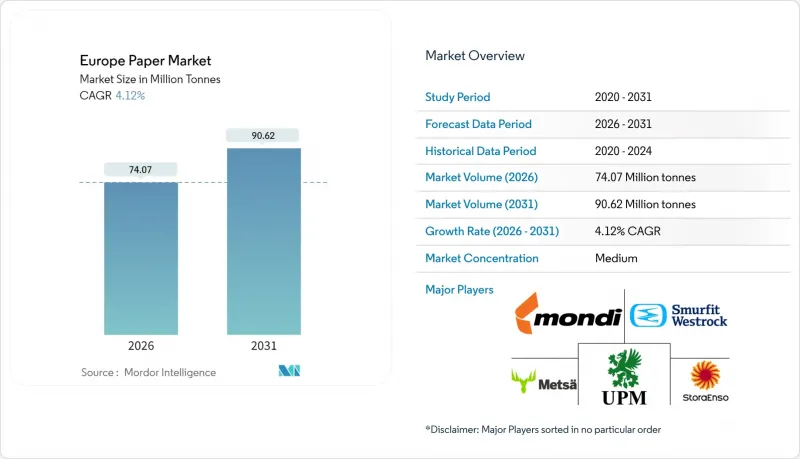
預計到 2026 年,歐洲紙張市場規模將達到 7,407 萬噸,高於 2025 年的 7,114 萬噸。
預計到 2031 年產量將達到 9,062 萬噸,2026 年至 2031 年的複合年成長率為 4.12%。
儘管能源成本面臨通膨壓力,且印刷用紙逐漸被數位化替代,但歐洲紙張市場仍在持續擴張,這主要得益於嚴格的循環經濟法規、電子商務包裝需求的成長以及疫情後紙巾消費量增加。再生纖維的加速應用降低了原料採購風險,並加強了該地區為確保資源主權而採取的策略性措施。同時,大型垂直整合企業正將其印刷用紙產能轉向利潤更高的包裝用紙,以維持盈利。在供應方面,瑞典木漿價格在2024年上漲30%,持續造成供應緊張,促使籌資策略更加重視長期合約和原物料來源多元化。
歐洲紙張市場趨勢與分析
擴大永續包裝材料的使用
歐盟第2025/40號法規規定的強制回收目標要求,到2030年,歐盟境內銷售的所有包裝都必須回收利用,這促使品牌所有者對纖維基包裝的需求急劇轉向纖維基包裝。 Mondi公司87%的收入來自可重複使用、可回收和可堆肥的解決方案,這表明合規性如何轉化為溢價價值提案。儘管宏觀經濟環境疲軟,瓦楞紙包裝加工商仍面臨訂單,這表明永續性在其採購標準中比成本更為重要。更多資金正轉向用於餐飲服務的模塑纖維托盤,這些托盤受益於各成員國的塑膠禁令。隨著原始設備製造商(OEM)競相獲得低碳認證,工廠可追溯性和再生材料含量的認證正成為獲得零售貨架空間的關鍵因素。
電子商務和餐飲業的需求不斷成長
線上零售每筆交易使用的瓦楞紙板數量是實體零售的三倍之多,推動了歐洲紙張市場噸位結構性成長。同時,外帶和配送需求的成長也帶動了對防油防潮包裝的需求。紙張生產商正積極回應,安裝按需柔版印刷和噴墨印刷生產線,以經濟高效的方式客製化小批量生產,從而降低電商的庫存風險。都市區的微型倉配中心正在採用簡化的折疊紙箱設計,以提高揀貨和包裝效率並減少空箱率。這些通路共同抵消了傳統商業印刷需求的下降,並凸顯了包裝在歐洲紙張市場韌性中發揮的穩定作用。
木漿和再生紙價格波動
預計到2024年,瑞典原木成本將上漲30%,這擠壓了造紙廠的利潤空間,並暴露了非一體化生產商在商品價格波動面前的脆弱性。地緣政治因素限制了俄羅斯和白俄羅斯纖維的進口,導致本地供應來源緊張,迫使造紙廠簽訂多年銷售合約或直接收購林業資產。由於司機短缺和柴油價格上漲,再生紙的收整合本也隨之上升,削弱了其相對於原生紙漿的價格優勢。垂直一體化如今已成為重要的對沖工具,斯道拉恩索公司透過出售部分林業資產並簽訂長期特許經營協議來抵銷價格波動,便是一個例證。由於商品化紙漿的定價能力有限,中小型獨立生產商在價格飆升期間面臨現金流風險,凸顯了原物料價格波動是其面臨的最嚴峻的營運挑戰之一。
細分市場分析
至2025年,紙箱材料將佔歐洲紙張市場佔有率的33.78%,成為支撐電子商務、食品和工業供應鏈的包裝基礎。瓦楞紙箱的生產吸引了印刷廠向下游轉移,無需前置作業時間工廠即可增加低成本產能。生產商正利用輕量化技術降低紙張重量,同時保持承重強度,並努力符合零售商的永續性評估標準。特種紙雖然小規模,到2025年僅892萬噸,但其複合年成長率將達到5.95%,主要成長動力來自食品阻隔塗層、安全基材和電子產品用技術層壓材料。這些細分市場為大型綜合製造商提供了極具吸引力的多元化策略,因為更高的價格可以抵消配方成本和相容性測試費用的增加。
儘管印刷用紙持續面臨結構性挑戰,但高階雜誌和藝術書籍對觸感的需求依然旺盛,超越了數位螢幕的局限,維持著一個雖已萎縮但仍具活力的細分市場。衛生和家庭用紙則受益於需求的防禦性以及人們衛生意識的持續提高。包裝紙和紙板正受益於零售商禁用塑膠袋和全通路零售包裝的重新設計。展望未來,諸如用於包裝材料的水性柔版印刷等工業印刷創新將帶來新的增值收入來源,並鞏固包裝材料在歐洲紙張市場的核心地位。
到2025年,再生纖維將佔歐洲紙張市場總量的52.64%,鞏固了該地區在閉合迴路材料循環利用領域的主導地位。在生產者延伸責任制的支持下,歐洲的回收系統使得其回收率高於大多數其他地區。隨著生態設計標準的不斷發展,加工商正在重新設計脫墨包裝和纖維保留工藝,從而加強了再生纖維的流通。在對感官純淨度和抗撕裂性要求極高的優質包裝領域,原生纖維的使用量將以4.34%的複合年成長率快速成長。綜合林業公司正利用其經認證的林業資產為這些細分市場提供原料,並擴大將原生紙漿與其他領域中再生纖維的使用相結合,以實現整體永續性目標。
儘管農業殘餘纖維仍處於起步階段,但由於小麥秸稈和芒草製漿的試點計畫旨在分散採購風險並降低碳排放強度,它們正日益受到關注。歐洲大陸政策中加強的林業可追溯性要求進一步提升了再生纖維和替代纖維的相對吸引力。同時,造紙廠的酵素脫墨試驗在提高再生纖維的白度方面取得了令人鼓舞的成果,拓展了其在高檔白紙中的應用範圍,並強化了支撐歐洲紙張市場的循環經濟模式。
歐洲紙張市場報告按產品類型(印刷用紙、紙箱材料、衛生及家庭用紙、包裝用紙、紙板、特種紙)、原料來源(原生纖維、再生纖維、農業廢棄物纖維)、紙張重量(低於和高於90克/平方米)、終端用戶行業(包裝和工業等)以及地區(德國等)進行分類。市場預測以噸為單位。
其他福利:
- Excel格式的市場預測(ME)表
- 3個月的分析師支持
目錄
第1章 引言
- 研究假設和市場定義
- 調查範圍
第2章調查方法
第3章執行摘要
第4章 市場情勢
- 市場概覽
- 市場促進因素
- 擴大永續包裝材料的使用
- 電子商務和餐飲服務業的需求不斷成長
- 歐盟循環經濟指令對紡織品包裝的要求
- 新冠疫情後衛生紙消耗量增加
- 3D模塑纖維包裝的商業化
- 推出按需噴墨瓦楞紙印刷服務
- 市場限制
- 木漿和再生紙價格波動
- 用數位媒體代替繪圖紙
- 能源和碳權價格上漲
- 對造紙廠用水量製定更嚴格的規定
- 產業供應鏈分析
- 監管環境
- 技術展望
- 波特五力分析
- 供應商的議價能力
- 買方的議價能力
- 新進入者的威脅
- 替代品的威脅
- 競爭對手之間的競爭
第5章 市場規模與成長預測
- 依產品類型
- 圖紙
- 報紙紙張
- 其他繪圖紙
- 案例材料
- 衛生用品/家居用品
- 包裝材料
- 紙板
- 特製紙張
- 圖紙
- 按原料來源
- 原生纖維
- 再生纖維
- 農業殘餘纖維
- 按紙張重量
- 小於90克/平方公尺(輕質)
- 90-200克/平方公尺(中等重量)
- 200公克/平方公尺或以上(重磅)
- 按最終用途行業分類
- 包裝/工業
- 印刷/出版
- 衛生和清潔
- 食品服務拋棄式
- 其他終端用戶產業
- 按國家/地區
- 德國
- 法國
- 瑞典
- 義大利
- 西班牙
- 其他歐洲地區
第6章 競爭情勢
- 市場集中度
- 策略趨勢
- 市佔率分析
- 公司簡介
- Stora Enso Group
- UPM-Kymmene Corporation
- Smurfit Westrock plc
- Mondi plc
- Metsa Group
- Holmen AB
- Svenska Cellulosa Aktiebolaget SCA
- Mayr-Melnhof Karton AG
- PRINZHORN HOLDING GmbH
- Norske Skog ASA
- Burgo Group SpA
- Lecta Group
- Reno de Medici SpA
- Sappi Limited
- Grigeo AB
- Iberpapel Gestion SA
- Heinzel Group
- Fedrigoni SpA
- Arctic Paper SA
第7章 市場機會與未來展望
Europe paper market size in 2026 is estimated at 74.07 million tonnes, growing from 2025 value of 71.14 million tonnes with 2031 projections showing 90.62 million tonnes, growing at 4.12% CAGR over 2026-2031.
Despite inflationary energy costs and digital substitution in graphic grades, the Europe paper market continues to expand on the back of strict circular-economy regulation, e-commerce packaging demand, and a post-pandemic rise in tissue consumption. Accelerated adoption of recycled fiber keeps material input risk in check and reinforces the bloc's strategic push for resource sovereignty. Meanwhile, vertically integrated leaders redirect graphic capacity toward higher-margin packaging grades to defend profitability. Supply-side dynamics remain tight as wood-pulp prices in Sweden jumped 30% in 2024, prompting procurement strategies that favor long-term contracts and diversified fiber sourcing.
Europe Paper Market Trends and Insights
Growth in Use of Sustainable Packaging
Mandatory recyclability targets under Regulation 2025/40 require all packaging sold in the bloc to be recyclable by 2030, pushing brand-owner demand sharply toward fiber-based formats. Mondi already derives 87% of revenue from reusable, recyclable, or compostable solutions, signalling how compliance has turned into a premium-priced value proposition. Corrugated converters report order backlogs even in a sluggish macro environment, indicating that sustainability now outweighs cost in purchasing criteria. Incremental capital has shifted toward molded-fiber trays for food service, a segment benefiting from plastic bans across member states. As OEMs scramble for low-carbon credentials, mill certifications around traceability and recycled content serve as gatekeepers to retail shelf space.
Expansion of E-commerce and Food-service Demand
Online retail requires up to three times more corrugated volume per transaction than store-based sales, adding structural tonnage growth to the Europe paper market. Parallel growth in takeaway and delivery meals inflates demand for grease- and moisture-resistant wraps. Mills have responded by installing on-demand flexo and ink-jet lines that cost-effectively customise small batches, lowering inventory risk for e-tailers. Urban micro-fulfilment hubs now specify easy-fold case designs that improve pick-pack efficiency and reduce void space. Together, these channels offset soft demand in legacy commercial print, underscoring packaging's role as the ballast of Europe paper market resilience.
Volatile Wood-Pulp and Recovered Paper Prices
Swedish roundwood cost inflation of 30% in 2024 eroded mill margins and exposed the vulnerability of non-integrated producers to commodity swings. Geopolitical constraints on Russian and Belarusian fiber imports have tightened the regional supply pool, pushing mills to secure multiyear offtake contracts or acquire forest assets outright. Recovered paper collection costs also escalated due to driver shortages and higher diesel prices, narrowing the price advantage versus virgin pulp. Vertical integration now confers a decisive hedge, illustrated by Stora Enso's partial forest divestiture balanced by long-term stumpage agreements. Without pricing power in commoditized grades, smaller independents risk negative cash flow during spikes, underscoring raw-material volatility as the most acute operational headwind.
Other drivers and restraints analyzed in the detailed report include:
- EU Circular-Economy Mandates on Fiber Packaging
- Rising Hygiene-Paper Consumption Post-COVID
- Digital Media Substitution of Graphic Papers
For complete list of drivers and restraints, kindly check the Table Of Contents.
Segment Analysis
Case Materials represented 33.78% of Europe paper market share in 2025, underpinning the packaging backbone that services e-commerce, food, and industrial supply chains. Corrugated case grades captured downstream migration from graphic mills, adding low-cost capacity without green-field lead times. Producers leveraged lightweighting technology to cut grammage while maintaining stacking strength, aligning with retailer sustainability scorecards. Specialty Papers, though just 8.92 million tonnes in 2025, deliver a 5.95% CAGR, buoyed by food-grade barrier coatings, security substrates, and technical laminates for electronics. These niches command price premiums that offset higher formulation costs and compliance testing, making them an attractive diversification play for large integrated houses.
The structural headwinds facing Graphic Papers remain unabated; nonetheless, premium magazines and art books continue to demand tactile quality beyond digital screens, preserving a viable albeit shrinking niche. Sanitary and Household papers benefit from defensive demand characteristics and ongoing hygiene awareness. Wrappings and Carton Board capitalise on retailer plastic-bag bans and omnichannel retail packaging redesigns. Looking ahead, industrial printing innovation such as water-based flexo for Case Materials introduces new value-added revenue streams, cementing the central role of Case Materials in the Europe paper market.
Recycled Fiber accounted for 52.64% of Europe paper market size in 2025, confirming the region's leadership in closed-loop material flows. Collection systems supported by Extended Producer Responsibility schemes achieve recovery rates that outpace most other regions. As eco-design criteria evolve, converters redesign packaging for de-inkability and fiber retention, reinforcing recycled fiber throughput. Virgin Fiber usage posts the fastest 4.34% CAGR, owing to premium packaging where organoleptic purity and tear resistance are non-negotiable. Integrated forest companies exploit certified forestry assets to supply these segments, often pairing primary pulp with increased recycled content elsewhere to meet overall sustainability targets.
Agro-Residue Fiber remains nascent but garners interest as mills pilot wheat-straw and miscanthus pulping to diversify procurement risk and lower carbon intensity. Continental policy that tightens deforestation traceability requirements further elevates recycled and alternative fibers' relative attractiveness. Meanwhile, mill trials on enzymatic de-inking show promise in lifting recycled-fiber brightness, expanding its applicability in premium white grades, and bolstering the circular narrative that underpins the Europe paper market.
The Europe Paper Market Report is Segmented by Product Type (Graphic Papers, Case Materials, Sanitary and Household, Wrappings, Carton Board, and Specialty Papers), Raw-Material Source (Virgin Fiber, Recycled Fiber, and Agro-Residue Fiber), Basis-Weight (Below 90 Gsm, and More), End-Use Industry (Packaging and Industrial, and More), and Geography (Germany, and More). The Market Forecasts are Provided in Terms of Volume (Tonnes).
List of Companies Covered in this Report:
- Stora Enso Group
- UPM-Kymmene Corporation
- Smurfit Westrock plc
- Mondi plc
- Metsa Group
- Holmen AB
- Svenska Cellulosa Aktiebolaget SCA
- Mayr-Melnhof Karton AG
- PRINZHORN HOLDING GmbH
- Norske Skog ASA
- Burgo Group S.p.A
- Lecta Group
- Reno de Medici S.p.A
- Sappi Limited
- Grigeo AB
- Iberpapel Gestion S.A
- Heinzel Group
- Fedrigoni SpA
- Arctic Paper S.A
Additional Benefits:
- The market estimate (ME) sheet in Excel format
- 3 months of analyst support
TABLE OF CONTENTS
1 INTRODUCTION
- 1.1 Study Assumptions and Market Definition
- 1.2 Scope of the Study
2 RESEARCH METHODOLOGY
3 EXECUTIVE SUMMARY
4 MARKET LANDSCAPE
- 4.1 Market Overview
- 4.2 Market Drivers
- 4.2.1 Growth in Use of Sustainable Packaging
- 4.2.2 Expansion of E-commerce and Food-service Demand
- 4.2.3 EU Circular-Economy Mandates on Fiber Packaging
- 4.2.4 Rising Hygiene-Paper Consumption Post-COVID
- 4.2.5 Commercialisation of 3-D Molded-Fiber Packaging
- 4.2.6 On-demand Ink-jet Corrugated Printing Adoption
- 4.3 Market Restraints
- 4.3.1 Volatile Wood-Pulp and Recovered Paper Prices
- 4.3.2 Digital Media Substitution of Graphic Papers
- 4.3.3 Energy and Carbon-credit Price Inflation
- 4.3.4 Tighter Water-Use Regulations for Mills
- 4.4 Industry Supply Chain Analysis
- 4.5 Regulatory Landscape
- 4.6 Technological Outlook
- 4.7 Porter's Five Forces Analysis
- 4.7.1 Bargaining Power of Suppliers
- 4.7.2 Bargaining Power of Buyers
- 4.7.3 Threat of New Entrants
- 4.7.4 Threat of Substitutes
- 4.7.5 Intensity of Competitive Rivalry
5 MARKET SIZE AND GROWTH FORECASTS (VOLUME)
- 5.1 By Product Type
- 5.1.1 Graphic Papers
- 5.1.1.1 Newsprint
- 5.1.1.2 Other Graphic Papers
- 5.1.2 Case Materials
- 5.1.3 Sanitary and Household
- 5.1.4 Wrappings
- 5.1.5 Carton Board
- 5.1.6 Specialty Papers
- 5.1.1 Graphic Papers
- 5.2 By Raw-Material Source
- 5.2.1 Virgin Fiber
- 5.2.2 Recycled Fiber
- 5.2.3 Agro-Residue Fiber
- 5.3 By Basis-Weight
- 5.3.1 Below 90 gsm (Lightweight)
- 5.3.2 90-200 gsm (Mediumweight)
- 5.3.3 Above 200 gsm (Heavyweight)
- 5.4 By End-use Industry
- 5.4.1 Packaging and Industrial
- 5.4.2 Printing and Publishing
- 5.4.3 Hygiene and Sanitary
- 5.4.4 Food-service Disposables
- 5.4.5 Other End-use Industries
- 5.5 By Country
- 5.5.1 Germany
- 5.5.2 France
- 5.5.3 Sweden
- 5.5.4 Italy
- 5.5.5 Spain
- 5.5.6 Rest of Europe
6 COMPETITIVE LANDSCAPE
- 6.1 Market Concentration
- 6.2 Strategic Moves
- 6.3 Market Share Analysis
- 6.4 Company Profiles (includes Global level Overview, Market level overview, Core Segments, Financials as available, Strategic Information, Market Rank/Share for key companies, Products and Services, and Recent Developments)
- 6.4.1 Stora Enso Group
- 6.4.2 UPM-Kymmene Corporation
- 6.4.3 Smurfit Westrock plc
- 6.4.4 Mondi plc
- 6.4.5 Metsa Group
- 6.4.6 Holmen AB
- 6.4.7 Svenska Cellulosa Aktiebolaget SCA
- 6.4.8 Mayr-Melnhof Karton AG
- 6.4.9 PRINZHORN HOLDING GmbH
- 6.4.10 Norske Skog ASA
- 6.4.11 Burgo Group S.p.A
- 6.4.12 Lecta Group
- 6.4.13 Reno de Medici S.p.A
- 6.4.14 Sappi Limited
- 6.4.15 Grigeo AB
- 6.4.16 Iberpapel Gestion S.A
- 6.4.17 Heinzel Group
- 6.4.18 Fedrigoni SpA
- 6.4.19 Arctic Paper S.A
7 MARKET OPPORTUNITIES AND FUTURE OUTLOOK
- 7.1 White-space and Unmet-need Assessment

 香蕉紙市場:全球市場預測,2026-2032年
 2026-2030年全球裝飾紙市場
 貼紙紙市場:按材料、產品類型、印刷技術、應用、黏合劑和地區分類。無塗布機械用紙市場:2026-2032年全球市場預測(依產品類型、製程、紡織原料、等級、銷售管道及最終用途分類)貼紙市場:按產品類型、黏合劑類型、印刷技術、應用和終端用戶產業分類-2026-2032年全球市場預測
 塗佈機械紙捲市場規模、佔有率和成長分析:按塗佈、紙張類型、表面處理/光澤度、最終用途和地區分類-2026-2033年產業預測咖啡濾紙市場:依材質、形狀、產品類型、尺寸、相容性、通路和最終用途分類-全球預測,2026-2032年
 2026年全球紙張、塑膠、橡膠、木材和紡織品市場報告全球氣流成網紙市場:按應用、產品類型、紙張重量、纖維成分和分銷管道分類 - 2026-2032 年預測全球素色裝飾紙市場(按產品類型、材料類型、應用和分銷管道分類)預測(2026-2032年)