


 |
市場調查報告書
商品編碼
1934837
輔助膠凝材料(SCM):市場佔有率分析、產業趨勢與統計、成長預測(2026-2031)Supplementary Cementitious Materials - Market Share Analysis, Industry Trends & Statistics, Growth Forecasts (2026 - 2031) |
||||||

※ 本網頁內容可能與最新版本有所差異。詳細情況請與我們聯繫。
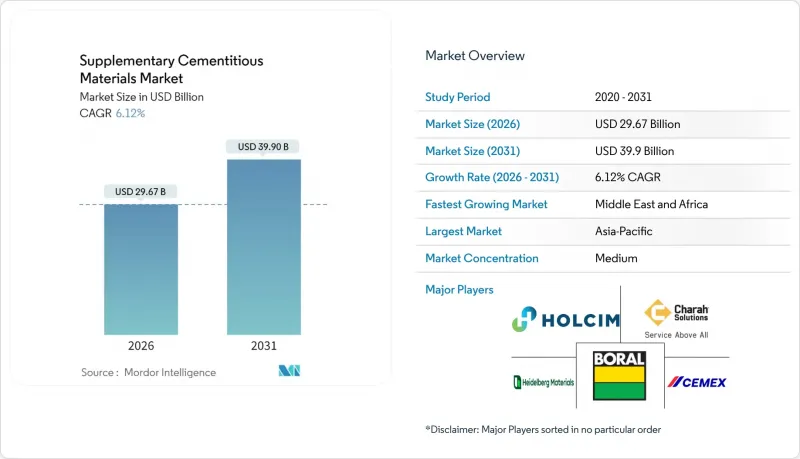
預計輔助膠凝材料 (SCM) 市場將從 2025 年的 279.6 億美元成長到 2026 年的 296.7 億美元,到 2031 年將達到 399 億美元,2026 年至 2031 年的複合年成長率為 6.12%。
這一成長反映了建設產業在政府實施碳定價機制和公共工程強制使用低碳混凝土後,正迅速向永續建築方法轉型。沙烏地阿拉伯耗資1.1兆美元的「2030願景」等加速基礎設施投資計劃,以及隨著燃煤替代能源的減少,水泥產業需要降低水泥熟料用量,共同推動了對輔助膠凝材料的持續需求。煅燒粘土、火山灰和石灰石混合水泥等供應側創新,緩解了飛灰和礦渣供應減少的問題;而快速煅燒技術則可將加工能耗降低高達40%,並擴大了可用原料的來源。
全球輔助膠凝材料(SCM)市場趨勢及展望
全球建築和基礎設施支出激增
大規模公共工程資金的投入正在推動輔助膠凝材料市場的發展。印度2023-2024會計年度的基礎建設資本支出成長了5.7倍,達到361億美元;沙烏地阿拉伯的「2030願景」投資額超過1.1兆美元;非洲的基礎建設支出平均每年達到930億美元。這些計劃都規定了提高混凝土中輔助膠凝材料(SCMs)的替代率。例如,雪梨地鐵的替代率達到了38%-52%,並在整個計劃中減少了12萬噸二氧化碳排放。因此,建築需求的激增使輔助膠凝材料的需求加倍,供應商得以獲得長期契約,從而有理由投資於閃速煅燒設備和最佳化物流。
更嚴格的二氧化碳排放法規和碳定價
監管壓力日益增加:法國的RE2020將蘊藏量建築的碳排放量限制在640-740公斤二氧化碳當量/平方米;歐盟的碳邊境調節機制對進口產品徵收碳價;美國的《清潔採購法》要求聯邦政府資助的混凝土採購必須提供環境產品聲明(EPD);加州對建築材料的碳定價政策則為高摻雜政策創造了MSC市場數據(MSCM這些法規使得脫碳混凝土成為一種經濟上有吸引力的選擇,並鞏固了對SCM的結構性需求,將其視為一種監管應對措施。
由於燃煤電廠和高爐煉鋼廠的減少,優質飛灰和爐渣的供應量下降。
自2010年以來,美國燃煤發電量下降了60%,導致優質飛灰供應量急劇減少。同時,隨著鋼鐵企業轉向電爐煉鋼,高爐礦渣供應量也減少。剩餘的粉煤灰庫存價格溢價40%至60%,且運輸距離更長,成本優勢逐漸喪失。因此,混凝土生產商必須重新設計混凝土配比,採用替代性膠凝材料,否則將面臨更高的原料成本,這將限制其在短期內的成長,直到新的供應來源成熟。
細分市場分析
儘管燃煤發電量下降,但飛灰憑藉其完善的物流網路和可預測的火山灰活性,預計到2025年仍將佔據水泥基外加劑市場41.72%的佔有率。礦渣水泥(GGBFS)緊隨其後,儘管高爐產量持續萎縮,仍將繼續供應高性能混凝土領域。同時,由於閃速煅燒爐的廣泛應用,煅燒黏土的複合年成長率(CAGR)達到6.88%,閃速煅燒爐降低了能源成本,使得經濟高效地加工高嶺土含量為15-25%的黏土成為可能。這種成長趨勢使煅燒黏土成為日益減少的煤基原料的重要替代品,重塑了該地區的供應結構,並吸引了擁有豐富礦床的新進者。
製造商正大力投資建造專用煅燒和研磨設備,以實現超精確的粒度控制,從而將火山灰反應活性指數提高到 800 mg Ca(OH)2/g 以上,進而獲得溢價。矽灰和高活性偏高嶺土在超高性能混凝土中繼續發揮其獨特的作用,而石灰石填料則促進了波特蘭石灰石水泥在全球範圍內的普及,並強化了逐步脫水泥熟料的途徑。總而言之,這些趨勢表明,輔助膠凝材料的生產策略正從對工業廢棄物的隨意利用轉向有計劃、可擴展的市場化生產。
補充膠凝材料報告按補充膠凝材料類型(飛灰、礦渣水泥、矽灰)、最終用戶(住宅建築、商業/公共、工業等)、材料形態(粉末、漿料/懸浮液等)和地區(亞太地區、北美地區、歐洲地區、南美地區、中東和非洲地區)進行細分。市場預測以美元以金額為準。
區域分析
預計亞太地區仍將是輔助膠凝材料(SCM)市場的中心,到2025年將佔據全球47.88%的市場。這主要得益於中國持續但成長放緩的建設活動,以及印度快速的基礎建設支出(預計在2023-2024會計年度將達到361億美元)。儘管煤灰和高爐礦渣的充足供應曾經支撐了低成本供應,但環保政策正在加速燃煤發電廠的淘汰,促使區域水泥巨頭優先考慮位於高嶺土礦床附近的煅燒粘土生產中心。東南亞國協正利用「一帶一路」計劃的資金建設交通走廊,這些走廊需要大量高摻量輔助膠凝材料混凝土;與此同時,日本和韓國正在為抗震和海洋基礎設施引入高品質的偏高嶺土外加劑。
預計中東和非洲地區將經歷最快的成長,到2031年複合年成長率將達到6.42%,這主要得益於沙烏地阿拉伯的NEOM和紅海計劃,以及該地區對低碳材料的強制性要求。阿拉伯聯合大公國的Estidama標準和埃及的綠色建築標準已將輔助膠凝材料(SCM)的使用標準納入法規,推動了東非火山灰加工和薩赫勒地區粘土燒製計劃的投資。物流挑戰和品質保證的缺乏阻礙了即時規模化生產,但豐富的礦產資源有望在加工基礎設施成熟後實現區域自給自足。在北美,燃煤發電量下降了60%,導致飛灰供應緊張,促使內華達州和猶他州加大對天然火山灰資源的探勘,並增加了從歐洲進口爐渣。聯邦清潔採購法規和州級稅額扣抵有利於早期採用高SCM配方的企業,儘管供應存在摩擦,但仍支撐了強勁的需求。在歐洲,成熟的碳定價機制和RE2020建築標準正在挑戰石灰石、煅燒粘土和再生細料在工業規模上應用的技術極限,鞏固了其作為脫碳試驗場的地位。南美洲雖然規模較小,但發展勢頭強勁,巴西的沿海韌性計劃和智利的礦業基礎設施都需要耐用、低碳的混凝土,當地的火山灰和稻殼灰企業也逐漸融入全球供應鏈。
其他福利:
- Excel格式的市場預測(ME)表
- 3個月的分析師支持
目錄
第1章 引言
- 研究假設和市場定義
- 調查範圍
第2章調查方法
第3章執行摘要
第4章 市場情勢
- 市場概覽
- 市場促進因素
- 全球建築和基礎設施投資快速成長
- 更嚴格的二氧化碳排放法規和碳定價
- 混合水泥和環保水泥(例如,PLC)的快速推廣
- 政府綠色採購獎勵
- 煅燒粘土和天然火山灰計劃激增,開闢了新的供應來源
- 市場限制
- 煤炭和高爐煉鋼的減少導致優質飛灰和爐渣的供應減少。
- 供應鏈管理品質和規格差異很大
- 來自新型低水泥熟料接合材料的競爭,繞過了傳統的供應鏈管理(SCM)鏈。
- 價值鏈分析
- 監管環境
- 波特五力模型
- 供應商的議價能力
- 買方的議價能力
- 新進入者的威脅
- 替代品的威脅
- 競爭程度
第5章 市場規模與成長預測
- 按類型分類的輔助膠凝材料 (SCM)
- 飛灰
- 礦渣水泥(細磨高爐礦渣)
- 矽灰
- 煅燒粘土/偏高嶺土
- 石灰石填料
- 其他產品
- 最終用戶
- 住宅
- 商業和公共設施
- 工業設施
- 交通基礎建設(公路、鐵路、港口、機場)
- 能源和公共產業基礎設施
- 按物質形式
- 粉末
- 漿液/懸浮液
- 顆粒
- 按地區
- 亞太地區
- 中國
- 印度
- 日本
- 韓國
- 東南亞國協
- 亞太其他地區
- 北美洲
- 美國
- 加拿大
- 墨西哥
- 歐洲
- 德國
- 英國
- 義大利
- 法國
- 北歐國家
- 其他歐洲地區
- 南美洲
- 巴西
- 阿根廷
- 其他南美洲
- 中東和非洲
- 沙烏地阿拉伯
- 南非
- 其他中東和非洲地區
- 亞太地區
第6章 競爭情勢
- 市場集中度
- 策略趨勢
- 市佔率/排名分析
- 公司簡介
- Advanced Cement Technologies LLC
- ArcelorMittal SA
- Bharathi Cement Corporation Private Limited
- BASF SE
- Boral Ltd.
- CEMEX SAB de CV
- CemGreen ApS
- Charah Solutions
- CR Minerals Company LLC
- Dangote Cement Plc.
- Ecocem
- Ferroglobe PLC
- HeidelberCement
- Hoffmann Green Cement Technologies
- Holcim Group
- JSW Cement Ltd.
- Tata Steel Ltd.
- TITAN
- UltraTech Cement Ltd.
- Votorantim Cimentos
第7章 市場機會與未來展望
The Supplementary Cementitious Materials market is expected to grow from USD 27.96 billion in 2025 to USD 29.67 billion in 2026 and is forecast to reach USD 39.9 billion by 2031 at 6.12% CAGR over 2026-2031.
This expansion reflects the construction sector's rapid shift toward sustainable building practices as governments enforce carbon-pricing schemes and public-sector projects embed low-carbon concrete mandates. Accelerating infrastructure investment programs-such as Saudi Arabia's USD 1.1 trillion Vision 2030 pipeline-collide with the cement industry's need to reduce clinker content amid dwindling coal-fired by-products, creating durable demand for SCMs. Supply-side innovation in calcined clay, volcanic pozzolans, and limestone-blended cements mitigates the shrinking availability of fly ash and slag, while flash-calcination technology lowers processing energy requirements by up to 40% and broadens the viable feedstock base.
Global Supplementary Cementitious Materials Market Trends and Insights
Boom in Global Construction and Infrastructure Spending
Massive public-works funding underpins the supplementary cementitious materials market, with India's infrastructure capital expenditure swelling 5.7 times to USD 36.1 billion in 2023-24, Saudi Arabia's Vision 2030 exceeding USD 1.1 trillion, and African infrastructure outlays averaging USD 93 billion each year. These programs specify higher SCM substitution in concrete-Sydney Metro achieved 38-52% replacement, resulting in a 120,000-tonne CO2-e reduction across projects . The construction surge, therefore, multiplies SCM demand, enabling suppliers to secure long-term contracts that justify investments in flash-calciner capacity and logistics optimization.
Stricter CO2-Emissions Regulations and Carbon-Pricing Schemes
Regulatory pressure is intensifying. France's RE2020 caps embodied carbon in new buildings at 640-740 kg CO2-e/m2, while the EU's Carbon Border Adjustment Mechanism prices imports on a carbon basis. US Buy Clean rules require Environmental Product Declarations for federally funded concrete, and California applies carbon pricing to construction materials, creating premium markets for high-SCM mixes. These regulations make decarbonized concrete economically attractive, locking in structural demand for SCMs as a compliance pathway.
Dwindling Supply of Quality Fly Ash and Slag as Coal and BF Steel Decline
Coal-power output in the U.S. has fallen 60% since 2010, slashing high-grade fly ash volumes, while blast-furnace slag shrinks as steel producers pivot to electric arc furnaces. Remaining ash stockpiles command a 40-60% price premium, and transport distances lengthen, eroding cost advantages. Concrete producers must therefore re-engineer mix designs around alternative SCMs or pay higher inputs, constraining short-term growth until new supply sources mature.
Other drivers and restraints analyzed in the detailed report include:
- Rapid Adoption of Blended/Green Cements
- Government Green-Procurement Incentives
- High Variability in SCM Quality/Specifications
For complete list of drivers and restraints, kindly check the Table Of Contents.
Segment Analysis
Fly ash held a 41.72% market share of the Supplementary Cementitious Materials market in 2025, supported by well-established logistics networks and predictable pozzolanic properties, despite declining coal generation. Slag cement (GGBFS) follows, supplying high-performance concrete segments even as blast-furnace output contracts. Calcined clay, however, is expanding at a 6.88% CAGR as flash-calciner units proliferate, lowering energy costs and enabling economic processing of clay with only 15-25% kaolinite. This trajectory positions calcined clay as the primary substitute for dwindling coal-derived sources, restructuring regional supply portfolios and inviting new entrants backed by mineral-rich deposits.
Manufacturers are funneling capital toward purpose-built calcination and grinding plants capable of ultraprecise particle-size control, raising pozzolanic reactivity indexes above 800 mg Ca(OH)2/g and drawing premium pricing. Silica fume and high-reactivity metakaolin maintain niche roles in ultra-high-performance concrete, while limestone filler underpins the global rollout of Portland Limestone Cement, reinforcing incremental de-clinkerization pathways. Collectively, these trends signal a pivot from opportunistic use of industrial waste toward deliberate, scalable supplementary cementitious materials market production strategies.
The Supplementary Cementitious Materials Report is Segmented by SCM Type (Fly Ash, Slag Cement, Silica Fume, and More), End User (Residential Construction, Commercial and Institutional, Industrial Facilities, and More), Material Form (Powder, Slurry/Suspension, and More), and Geography (Asia-Pacific, North America, Europe, South America, and Middle East and Africa). The Market Forecasts are Provided in Terms of Value (USD).
Geography Analysis
The Asia-Pacific region remains the epicenter of the supplementary cementitious materials market, capturing 47.88% of the 2025 value, driven by China's continued but moderating construction activities and India's surge in infrastructure expenditure to USD 36.1 billion during 2023-24. Ready access to coal ash and blast-furnace slag once underpinned low-cost supplies; however, environmental policies are accelerating coal retirements, prompting regional cement majors to prioritize calcined-clay hubs near kaolinite-rich deposits. ASEAN economies are leveraging Belt and Road funding to build transport corridors that require high-SCM concrete volumes, while Japan and South Korea are deploying premium metakaolin blends in seismic-resistant and marine infrastructure.
The Middle East & Africa is projected to post the fastest 6.42% CAGR through 2031, underwritten by Saudi Arabia's NEOM, the Red Sea Project, and regional mandates for low-carbon materials. UAE's Estidama and Egypt's green-building codes codify SCM thresholds, attracting investment in volcanic-ash processing in East Africa and calcined-clay projects throughout the Sahel. Logistics hurdles and quality assurance gaps impede immediate scale-up; however, mineral abundance positions the region for self-sufficiency once the processing infrastructure matures. North America faces a tightening fly-ash pipeline after 60% coal-generation decline, driving exploration of natural pozzolan sources in Nevada and Utah, alongside increased slag imports from Europe. Federal Buy Clean rules and state-level tax credits reward early adopters of high-SCM mixes, keeping demand buoyant despite supply friction. Europe, with mature carbon-pricing and RE2020 building codes, pushes technical boundaries by integrating limestone-calcined clay and recycled fines at industrial scale, cementing its role as a decarbonization laboratory. South America, though smaller, gains momentum as Brazil's coastal resilience projects and Chile's mining infrastructure demand durable, low-carbon concrete, stimulating regional pozzolan and rice-husk ash ventures that gradually connect into global supply chains.
- Advanced Cement Technologies LLC
- ArcelorMittal SA
- Bharathi Cement Corporation Private Limited
- BASF SE
- Boral Ltd.
- CEMEX S.A.B. de C.V.
- CemGreen ApS
- Charah Solutions
- CR Minerals Company LLC
- Dangote Cement Plc.
- Ecocem
- Ferroglobe PLC
- HeidelberCement
- Hoffmann Green Cement Technologies
- Holcim Group
- JSW Cement Ltd.
- Tata Steel Ltd.
- TITAN
- UltraTech Cement Ltd.
- Votorantim Cimentos
Additional Benefits:
- The market estimate (ME) sheet in Excel format
- 3 months of analyst support
TABLE OF CONTENTS
1 Introduction
- 1.1 Study Assumptions and Market Definition
- 1.2 Scope of the Study
2 Research Methodology
3 Executive Summary
4 Market Landscape
- 4.1 Market Overview
- 4.2 Market Drivers
- 4.2.1 Boom in global construction and infrastructure spending
- 4.2.2 Stricter CO2-emissions regulations and carbon-pricing schemes
- 4.2.3 Rapid adoption of blended/green cements (e.g., PLC)
- 4.2.4 Government green-procurement incentives
- 4.2.5 Surging projects in calcined clay and natural pozzolans unlocking new supply
- 4.3 Market Restraints
- 4.3.1 Dwindling supply of quality fly ash and slag as coal and BF steel decline
- 4.3.2 High variability in SCM quality/specifications
- 4.3.3 Competition from novel low-clinker binders that bypass traditional SCM chains
- 4.4 Value Chain Analysis
- 4.5 Regulatory Landscape
- 4.6 Porter's Five Forces
- 4.6.1 Bargaining Power of Suppliers
- 4.6.2 Bargaining Power of Buyers
- 4.6.3 Threat of New Entrants
- 4.6.4 Threat of Substitutes
- 4.6.5 Degree of Competition
5 Market Size & Growth Forecasts (Value)
- 5.1 By SCM Type
- 5.1.1 Fly Ash
- 5.1.2 Slag Cement (Ground-granulated Blast-Furnace Slag)
- 5.1.3 Silica Fume
- 5.1.4 Calcined Clay / Metakaolin
- 5.1.5 Limestone Filler
- 5.1.6 Other Products
- 5.2 By End User
- 5.2.1 Residential Construction
- 5.2.2 Commercial and Institutional
- 5.2.3 Industrial Facilities
- 5.2.4 Transport Infrastructure (roads, rail, ports, airports)
- 5.2.5 Energy and Utilities Infrastructure
- 5.3 By Material Form
- 5.3.1 Powder
- 5.3.2 Slurry/Suspension
- 5.3.3 Granulated Pellets
- 5.4 By Geography
- 5.4.1 Asia-Pacific
- 5.4.1.1 China
- 5.4.1.2 India
- 5.4.1.3 Japan
- 5.4.1.4 South Korea
- 5.4.1.5 ASEAN Countries
- 5.4.1.6 Rest of Asia-Pacific
- 5.4.2 North America
- 5.4.2.1 United States
- 5.4.2.2 Canada
- 5.4.2.3 Mexico
- 5.4.3 Europe
- 5.4.3.1 Germany
- 5.4.3.2 United Kingdom
- 5.4.3.3 Italy
- 5.4.3.4 France
- 5.4.3.5 Nordic Countries
- 5.4.3.6 Rest of Europe
- 5.4.4 South America
- 5.4.4.1 Brazil
- 5.4.4.2 Argentina
- 5.4.4.3 Rest of South America
- 5.4.5 Middle East and Africa
- 5.4.5.1 Saudi Arabia
- 5.4.5.2 South Africa
- 5.4.5.3 Rest of Middle East and Africa
- 5.4.1 Asia-Pacific
6 Competitive Landscape
- 6.1 Market Concentration
- 6.2 Strategic Moves
- 6.3 Market Share**/Ranking Analysis
- 6.4 Company Profiles (includes Global level Overview, Market level overview, Core Segments, Financials as available, Strategic Information, Market Rank/Share for key companies, Products & Services, and Recent Developments)
- 6.4.1 Advanced Cement Technologies LLC
- 6.4.2 ArcelorMittal SA
- 6.4.3 Bharathi Cement Corporation Private Limited
- 6.4.4 BASF SE
- 6.4.5 Boral Ltd.
- 6.4.6 CEMEX S.A.B. de C.V.
- 6.4.7 CemGreen ApS
- 6.4.8 Charah Solutions
- 6.4.9 CR Minerals Company LLC
- 6.4.10 Dangote Cement Plc.
- 6.4.11 Ecocem
- 6.4.12 Ferroglobe PLC
- 6.4.13 HeidelberCement
- 6.4.14 Hoffmann Green Cement Technologies
- 6.4.15 Holcim Group
- 6.4.16 JSW Cement Ltd.
- 6.4.17 Tata Steel Ltd.
- 6.4.18 TITAN
- 6.4.19 UltraTech Cement Ltd.
- 6.4.20 Votorantim Cimentos
7 Market Opportunities & Future Outlook
- 7.1 White-space and Unmet-need Assessment


