


 |
市場調查報告書
商品編碼
1934795
泰國潤滑油:市場佔有率分析、產業趨勢與統計、成長預測(2026-2031)Thailand Lubricants - Market Share Analysis, Industry Trends & Statistics, Growth Forecasts (2026 - 2031) |
||||||

※ 本網頁內容可能與最新版本有所差異。詳細情況請與我們聯繫。
預計泰國潤滑油市場將從 2025 年的 6.797 億公升成長到 2026 年的 6.9439 億公升,到 2031 年將達到 7.7267 億公升,2026 年至 2031 年的複合年成長率為 2.16%。
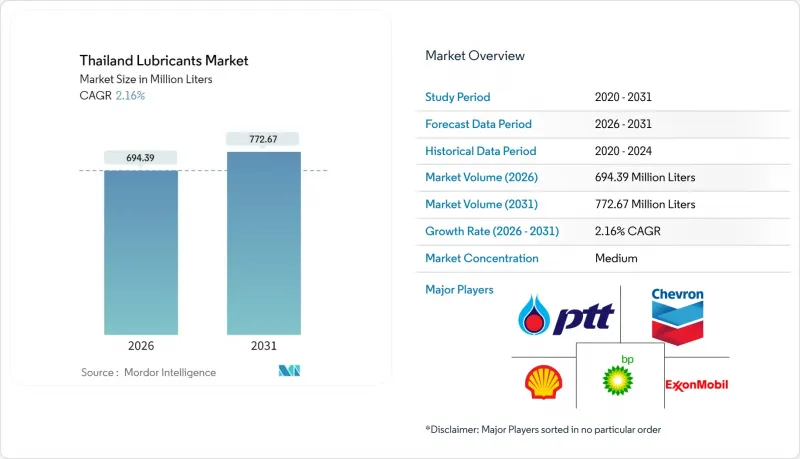
由於電氣化導致內燃機油需求下降,但泰國作為東南亞皮卡生產中心以及整車和零件區域配銷中心的地位,抵消了這一影響。持續的資料中心建設(投資額超過70億美元)以及對東部經濟走廊(EEC)的穩步投資,正在推動特種冷卻液和高性能工業油的消費。宏觀因素也在發揮作用,包括商品出口的復甦、物流業對GDP 0.4%的貢獻,以及歐5柴油品質標準的實施(該標準提高了產品規格,並促進了向合成油的轉型)。來自東協低成本進口產品的競爭壓力正在擠壓主流礦物油混合油的利潤空間,而電動車冷卻液、液體冷卻解決方案和甲醇相容型船用潤滑油的優質化機會正在擴大。
泰國潤滑油市場趨勢及展望
疫情後製造業及出口復甦
隨著供應鏈中斷的緩解,工廠使用率有所提高,使得泰國投資促進委員會 (BOI) 在 2024 年第一季的核准增加了 13%。其中,電子、汽車和機械相關產業尤其受到關注。金屬加工活動的活性化和運作的延長推動了精密加工生產線對油壓油、切削油和抗磨潤滑脂的需求。出口型企業對黏度公差的要求更為嚴格,更傾向半合成和全合成潤滑油。生產計劃的穩定也使潤滑油採購週期得以恢復,此前由於 2023 年的物流瓶頸而有所延誤。泰國潤滑油市場受益於國內成熟的供應商網路,這確保了跨國原始設備製造商 (OEM) 的穩定產品供應。
商用車車隊擴充與電子商務物流
預計到2024年,線上零售滲透率將超過零售總額的18%,將推動宅配公司和第三方物流公司擴大車隊規模。行駛里程的增加導致換油頻率增加,尤其是在都市區頻繁啟動的外送車上。營運商擴大採用SAE 10W-30合成機油來降低油耗並延長換油週期,以較低的初始潤滑油成本換取更低的營運總成本。雖然泰國政府4,500億泰銖的財政獎勵策略改善了農村道路,縮短了運輸時間,但平均車速卻有所提高,這給車軸和變速箱帶來了更大的熱應力。因此,市場對高油膜強度的齒輪油的需求也隨之增加。
電動車的快速普及導致內燃機潤滑油市場萎縮。
2022年至2024年間,在每輛車5萬至10萬泰銖的補助推動下,電池式電動車的註冊量預計將增加五倍,佔所有新輕型車輛的9%。電動車無需使用曲軸箱潤滑油,並減少了自動變速箱油的用量,從而縮小了汽車潤滑油的主要來源。曼谷的計程車和末端配送貨車正在逐步更換為電池式電動車車型,以充分利用充電基礎設施補貼。然而,電動橋、電池托盤和溫度控管子系統的製造也催生了對組裝潤滑脂和介電冷卻劑的新需求,部分抵消了電動車對泰國潤滑油市場的影響。
細分市場分析
預計到2025年,汽車機油將佔泰國潤滑油市場佔有率的46.89%,這反映了泰國每年超過200萬輛的汽車產量以及超過2,100萬輛轎車和皮卡的售後維護需求。與日本製造商簽訂的工廠灌裝協議確保了穩定的基準供應,而出口(主要針對澳洲和中東的皮卡)則推動了年底出貨高峰期的需求激增。
預計到2031年,潤滑脂將以3.17%的複合年成長率實現最高成長,殼牌公司在泰國的擴張(年產量1.5萬噸)將使泰國成為東南亞最大的潤滑脂供應中心。東部經濟走廊(EEC)包裝廠安裝的精密機器人和輸送機系統有利於鋰基複合潤滑脂的應用,因為這種潤滑脂具有良好的耐水沖刷性能。預計到2031年,潤滑脂在泰國潤滑油市場的銷售量將超過4.62萬噸,從而擴大其在特種產品收入中的市場佔有率。同時,隨著都市區乘用車自動變速箱的普及率接近95%,預計變速箱油的需求將保持穩定。
泰國潤滑油市場報告按產品類型(汽車引擎油、工業引擎油、變速箱油、齒輪油、煞車油、液壓油、潤滑脂等)、終端用戶產業(汽車、船舶、航太、重型機械等)和基礎油類型(礦物油基潤滑油、半合成潤滑油等)進行細分。市場預測以公升為單位。
其他福利:
- Excel格式的市場預測(ME)表
- 3個月的分析師支持
目錄
第1章 引言
- 研究假設和市場定義
- 調查範圍
第2章調查方法
第3章執行摘要
第4章 市場情勢
- 市場概覽
- 市場促進因素
- 疫情後製造業及出口復甦
- 商用車車隊擴充與電子商務物流
- 工業自動化推動了對高性能合成潤滑油的需求
- 資料中心擴張推動特種冷凍/發電機潤滑油需求成長
- 由於強制使用生質柴油(B20),引擎機油更換頻率增加。
- 市場限制
- 由於電動車的加速普及,內燃機潤滑油市場正在萎縮。
- 加強對礦物油廢棄物的監管
- 來自東協低成本進口商品的利潤壓力
- 價值鏈分析
- 法律規範
- 終端用戶趨勢
- 汽車產業
- 製造業
- 發電業
- 波特五力模型
- 供應商的議價能力
- 買方的議價能力
- 新進入者的威脅
- 替代品的威脅
- 競爭程度
第5章 市場規模與成長預測
- 依產品類型
- 汽車引擎油
- 工業機油
- 變速箱油
- 齒輪油
- 煞車油
- 油壓
- 潤滑脂
- 加工油(包括橡膠加工油和白油)
- 金屬加工油
- 渦輪機油
- 變壓器油
- 其他產品類型
- 按最終用戶行業分類
- 車
- 搭乘用車
- 商用車輛
- 摩托車
- 船
- 航太
- 重型機械
- 建造
- 礦業
- 農業
- 產業
- 發電
- 冶金/金屬加工
- 紡織品
- 石油和天然氣
- 其他終端用戶產業
- 車
- 依基本類型
- 礦物油性潤滑劑
- 合成潤滑油
- 半合成潤滑油
- 生物性潤滑劑
第6章 競爭情勢
- 市場集中度
- 策略趨勢
- 市佔率**(%)/排名分析
- 公司簡介
- Bangchak Corporation Public Company Limited
- BP plc
- Chevron Corporation
- ENEOS Corporation
- ExxonMobil Corporation
- FUCHS
- Idemitsu Kosan Co., Ltd.(Apollo(Thailand)Co., Ltd.)
- MOTUL(Thailand)Co., Ltd.
- PSP Specialties Public Company Limited
- PETRONAS Lubricants International
- PTT PUBLIC COMPANY LIMITED
- Shell Thailand
- Siam Pan Group Public Co., Ltd.
- Total Energies
- Valvoline
第7章 市場機會與未來展望
第8章:執行長面臨的關鍵策略挑戰
The Thailand Lubricants Market is expected to grow from 679.70 Million Liters in 2025 to 694.39 Million Liters in 2026 and is forecast to reach 772.67 Million Liters by 2031 at 2.16% CAGR over 2026-2031.
The softer demand for internal-combustion-engine (ICE) oils from electrification is balanced by Thailand's continued role as Southeast Asia's pickup-truck production hub and its position as a regional distribution center for finished vehicles and components. Ongoing data center construction valued at above USD 7 billion, along with steady investment in the Eastern Economic Corridor (EEC), drives the consumption of specialty cooling fluids and high-performance industrial oils. Macro factors, such as a rebound in merchandise exports, a 0.4% GDP contribution from logistics, and the enforcement of Euro 5 diesel quality standards, which tighten product specifications and support the shift toward synthetic formulations. Competitive pressure from lower-cost ASEAN imports keeps margins thin for mainstream mineral oil blends, yet premiumization opportunities in EV fluids, immersion-cooling solutions, and methanol-compatible marine lubricants are expanding.
Thailand Lubricants Market Trends and Insights
Post-pandemic rebound in manufacturing and exports
Factory utilization improved after supply-chain disruptions eased, and Board of Investment approvals rose 13% in value during Q1 2024, with a focus on electronics, automotive, and machinery ventures. Higher metalworking activity and longer operating hours raise demand for hydraulic oils, cutting fluids, and anti-wear greases in precision machining lines. Export-oriented firms specify tighter viscosity tolerances that favor semi-synthetic and full-synthetic blends. Production scheduling stability also restores lubricant procurement cycles that had been delayed during 2023's logistics bottlenecks. The Thailand lubricants market benefits from the country's established supplier network, which provides consistent product availability for multinational OEMs.
Expansion of commercial-vehicle fleet and e-commerce logistics
Online retail penetration exceeded 18% of total retail sales in 2024, prompting fleet additions among parcel carriers and third-party logistics firms. Vehicle-kilometer-traveled growth translates into higher oil drain frequency, particularly for delivery vans operating stop-start urban routes. Operators are increasingly adopting SAE 10W-30 synthetics to reduce fuel consumption and extend drain intervals, trading upfront lubricant costs for lower total operating expenses. Provincial road upgrades under Thailand's THB 450 billion fiscal stimulus reduce transit times but increase average speeds, elevating axle and transmission temperature loads that require high-film-strength gear oils.
Accelerated EV adoption shrinking ICE lubricant pool
Registrations of battery electric cars grew fivefold between 2022 and 2024, reaching 9% of all new light-duty vehicles, supported by subsidies of THB 50,000-100,000 per unit. EVs eliminate demand for crankcase oils and reduce automatic transmission-fluid volumes, shrinking the core automotive lubricant reservoir. Fleets in Bangkok are shifting taxis and last-mile delivery vans to battery electric models to capitalize on charging infrastructure grants. However, manufacturing of e-axles, battery trays, and thermal-management subsystems introduces new requirements for assembly greases and dielectric coolants, providing a partial offset for the Thailand lubricants market.
Other drivers and restraints analyzed in the detailed report include:
- Industrial automation boosting demand for high-performance synthetics
- Data-center buildouts driving specialty cooling and genset lubricants
- Stricter mineral-oil disposal regulations
For complete list of drivers and restraints, kindly check the Table Of Contents.
Segment Analysis
Automotive engine oil captured 46.89% of Thailand lubricants market share in 2025, reflecting annual vehicle output above 2 million units and a robust aftermarket servicing fleet that exceeds 21 million cars and pickups. Factory-fill contracts with Japanese OEMs ensure baseline volume stability, while pickup-centric exports to Australia and the Middle East create incremental demand spikes leading up to year-end shipping windows.
Greases deliver the highest 3.17% CAGR through 2031 as Shell's plant expansion to 15,000 tonnes per year turns Thailand into Southeast Asia's largest grease supply base. Precision robotics and conveyor systems installed in EEC packaging plants prefer lithium-complex greases tolerant to water washout. The Thailand lubricants market size for greases is projected to exceed 46,200 tonnes by 2031, accounting for a growing share of specialty product revenue. Concurrently, transmission-fluid demand holds steady, bolstered by automatic-gearbox penetration approaching 95% in urban passenger cars.
The Thailand Lubricants Market Report is Segmented by Product Type (Automotive Engine Oil, Industrial Engine Oil, Transmission Fluids, Gear Oil, Brake Fluids, Hydraulic Fluids, Greases, and More), End-User Industry (Automotive, Marine, Aerospace, Heavy Equipment, and More), and Base Stock Type (Mineral Oil-Based Lubricants, Semi-Synthetic Lubricants, and More). The Market Forecasts are Provided in Terms of Volume (Liters).
List of Companies Covered in this Report:
- Bangchak Corporation Public Company Limited
- BP p.l.c.
- Chevron Corporation
- ENEOS Corporation
- ExxonMobil Corporation
- FUCHS
- Idemitsu Kosan Co., Ltd. (Apollo (Thailand) Co., Ltd.)
- MOTUL ( Thailand ) Co., Ltd.
- P.S.P. Specialties Public Company Limited
- PETRONAS Lubricants International
- PTT PUBLIC COMPANY LIMITED
- Shell Thailand
- Siam Pan Group Public Co., Ltd.
- Total Energies
- Valvoline
Additional Benefits:
- The market estimate (ME) sheet in Excel format
- 3 months of analyst support
TABLE OF CONTENTS
1 Introduction
- 1.1 Study Assumptions and Market Definition
- 1.2 Scope of the Study
2 Research Methodology
3 Executive Summary
4 Market Landscape
- 4.1 Market Overview
- 4.2 Market Drivers
- 4.2.1 Post-pandemic Rebound in Manufacturing and Exports
- 4.2.2 Expansion of Commercial-vehicle Fleet and E-commerce Logistics
- 4.2.3 Industrial Automation Boosting Demand for High-performance Synthetics
- 4.2.4 Data-center Buildouts Driving Specialty Cooling/genset Lubricants
- 4.2.5 Biodiesel (B20) Mandate Raising Engine-oil Change Frequency
- 4.3 Market Restraints
- 4.3.1 Accelerated EV Adoption Shrinking ICE Lubricant Pool
- 4.3.2 Stricter Mineral-oil Disposal Regulations
- 4.3.3 Margin Pressure from Low-cost ASEAN Imports
- 4.4 Value Chain Analysis
- 4.5 Regulatory Framework
- 4.6 End-User Trends
- 4.6.1 Automotive Industry
- 4.6.2 Manufacturing Industry
- 4.6.3 Power Generation Industry
- 4.7 Porter's Five Forces
- 4.7.1 Bargaining Power of Suppliers
- 4.7.2 Bargaining Power of Buyers
- 4.7.3 Threat of New Entrants
- 4.7.4 Threat of Substitutes
- 4.7.5 Degree of Competition
5 Market Size and Growth Forecasts (Volume)
- 5.1 By Product Type
- 5.1.1 Automotive Engine Oil
- 5.1.2 Industrial Engine Oil
- 5.1.3 Transmission Fluids
- 5.1.4 Gear Oil
- 5.1.5 Brake Fluids
- 5.1.6 Hydraulic Fluids
- 5.1.7 Greases
- 5.1.8 Process Oil (Including Rubber Process Oil & White Oil)
- 5.1.9 Metalworking Fluids
- 5.1.10 Turbine Oil
- 5.1.11 Transformer Oil
- 5.1.12 Other Product Types
- 5.2 By End-user Industry
- 5.2.1 Automotive
- 5.2.1.1 Passenger Vehicles
- 5.2.1.2 Commercial Vehicles
- 5.2.1.3 Two-Wheelers
- 5.2.2 Marine
- 5.2.3 Aerospace
- 5.2.4 Heavy Equipment
- 5.2.4.1 Construction
- 5.2.4.2 Mining
- 5.2.4.3 Agriculture
- 5.2.5 Industrial
- 5.2.5.1 Power Generation
- 5.2.5.2 Metallurgy & Metalworking
- 5.2.5.3 Textiles
- 5.2.5.4 Oil and Gas
- 5.2.5.5 Other End-Use Industries
- 5.2.1 Automotive
- 5.3 By Base Stock Type
- 5.3.1 Mineral Oil-Based Lubricants
- 5.3.2 Synthetic Lubricants
- 5.3.3 Semi-Synthetic Lubricants
- 5.3.4 Bio-Based Lubricants
6 Competitive Landscape
- 6.1 Market Concentration
- 6.2 Strategic Moves
- 6.3 Market Share**(%)/Ranking Analysis
- 6.4 Company Profiles (includes Global level Overview, Market level overview, Core Segments, Financials as available, Strategic Information, Market Rank/Share, Products & Services, Recent Developments)
- 6.4.1 Bangchak Corporation Public Company Limited
- 6.4.2 BP p.l.c.
- 6.4.3 Chevron Corporation
- 6.4.4 ENEOS Corporation
- 6.4.5 ExxonMobil Corporation
- 6.4.6 FUCHS
- 6.4.7 Idemitsu Kosan Co., Ltd. (Apollo (Thailand) Co., Ltd.)
- 6.4.8 MOTUL ( Thailand ) Co., Ltd.
- 6.4.9 P.S.P. Specialties Public Company Limited
- 6.4.10 PETRONAS Lubricants International
- 6.4.11 PTT PUBLIC COMPANY LIMITED
- 6.4.12 Shell Thailand
- 6.4.13 Siam Pan Group Public Co., Ltd.
- 6.4.14 Total Energies
- 6.4.15 Valvoline
7 Market Opportunities and Future Outlook
- 7.1 White-space and Unmet-need Assessment
8 Key Strategic Questions for CEOs

 大豆油基潤滑劑市場:2026-2032年全球市場預測(依產品類型、包裝、應用、終端用戶產業及通路分類)紡織潤滑劑市場:依產品類型、劑型、應用及最終用途分類-2026年至2032年全球預測金屬切削潤滑劑市場:依產品類型、金屬類型、應用、終端用戶產業和通路分類-2026-2032年全球預測
 潤滑油過濾器市場規模、佔有率和成長分析:按過濾器類型、應用、材質、最終用戶和地區分類 - 2026-2033 年產業預測
 2026-2034年全球紗線潤滑劑市場規模、佔有率、趨勢和成長分析報告
 玻璃潤滑劑市場規模、佔有率和成長分析:按潤滑劑基礎類型、配方類型、應用方法、包裝類型、最終用戶產業和地區分類-2026-2033年產業預測自行車潤滑脂市場按產品類型、通路、濃稠度等級和應用分類-全球預測,2026-2032年
 Isododecane潤滑劑市場規模、佔有率和成長分析:按產品類型、應用、最終用戶和地區分類-2026-2033年產業預測
 潤滑油市場分析及預測(至2035年):依類型、產品、應用、技術、最終用戶、形態、功能、安裝類型及解決方案分類
 南美潤滑油:市場佔有率分析、產業趨勢與統計、成長預測(2026-2031)