


 |
市場調查報告書
商品編碼
1934687
越南農業機械:市場佔有率分析、產業趨勢與統計、成長預測(2026-2031)Vietnam Agricultural Machinery - Market Share Analysis, Industry Trends & Statistics, Growth Forecasts (2026 - 2031) |
||||||

※ 本網頁內容可能與最新版本有所差異。詳細情況請與我們聯繫。
預計到 2026 年,越南農業機械市場規模將達到 5.9975 億美元,高於 2025 年的 5.65 億美元。
預計到 2031 年將達到 8.0829 億美元,2026 年至 2031 年的複合年成長率為 6.15%。
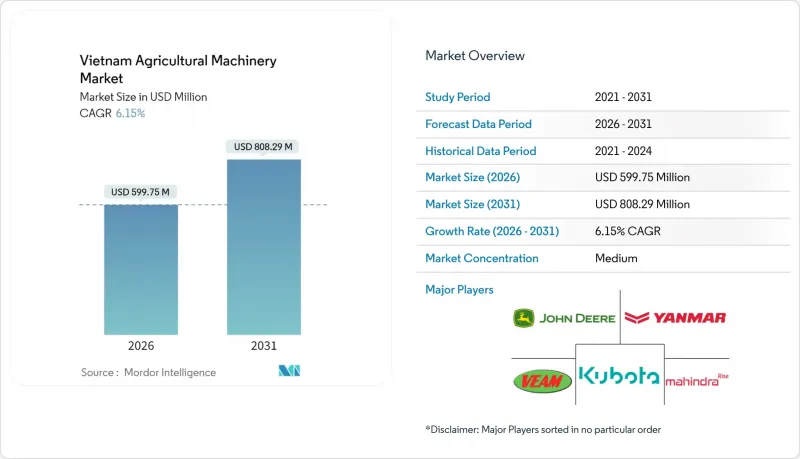
政府的機械化措施、農村勞動力減少以及融資管道的改善正在推動市場成長。頻繁的曳引機升級換代、透過「百萬公頃優質水稻」計畫推廣的精準播種設備以及完善的售後服務,都為市場擴張提供了支撐。不斷成長的米出口收入、合作機械共用系統的普及以及農村電氣化項目,也進一步促進了市場的持續成長。電動車、自主農業機器人和數據驅動型農業解決方案在市場中展現出巨大的潛力。目前,該行業仍由幾家成熟的企業佔據,集中度適中。
越南農業機械市場趨勢與展望
農業勞動力減少
隨著年輕一代不斷湧向都市區,越南的農業勞動力正逐漸老化。這種人口結構的變化推動了水稻、水果和經濟作物種植系統對機械化的需求。土地集約化程度的提高使得曳引機、收割機和機械播種機等農機設備更加經濟實惠。季節性人事費用的上升正在影響農民的利潤,尤其是在播種和收穫的高峰期。
加強機械化推廣措施
越南政府透過財政獎勵和政策改革支持農業機械化。政府為農民提供低利率貸款、稅收優惠以及示範農場的使用機會,鼓勵他們採用現代化設備。成立於2025年2月的農業與環境部旨在提高農業和農村部門的協調性和效率。農村智慧農場正在展示自動化灌溉和土壤分析系統的有效性。農民可以利用補貼信貸和低利率來取代老舊機械,從而促進先進農業機械的普及。
小規模農場的碎片化
越南農業以小規模為主,限制了機械化的經濟效益。 70%的農民耕種面積不足0.5公頃,降低了機械投資報酬率。土地零散不僅降低了曳引機的效率,也使得農機具在多塊地塊間的使用更加複雜。土地整合改革初期取得了一些成效,但人們對祖傳土地的文化依戀阻礙了改革的進展。合作社模式和客製化租賃服務透過資源共用提供了一些解決方案,但其有效性取決於強力的管治和協調。在土地整合得到更廣泛的應用和服務體係成熟之前,土地碎片化將繼續阻礙農業機械的普及,限制生產力的提升和農業部門的轉型。
細分市場分析
曳引機在越南農業機械市場規模中佔比高達54.40%,在土地耕作、運輸和殘茬管理等方面發揮關鍵作用。這一細分市場的重要性與越南的機械化目標和較高的土地耕作機械化率相符。小型曳引機在北部分散的農田中仍然很受歡迎,而中型曳引機則在南部集中的農業區得到越來越廣泛的應用。四輪驅動系統和精準轉向功能的整合,使得曳引機的更新換代需求旺盛,通常以改造現有設備的方式進行。曳引機仍然是越南農業機械化作業的基礎,能夠適應各種不同的地理條件和農場結構。
預計種植機械領域將以7.55%的複合年成長率達到最高成長,主要得益於農民從人工播種水稻轉向使用條播機和插秧機。這些技術提高了種子發芽率並降低了種子消耗,尤其有利於農業合作社。在國家政策的支持下,種植設備市場佔有率可望擴大。由於農業勞動力短缺和糧食品質標準日益嚴格,收割機械領域維持了穩定成長。牧場和飼料設備領域為北部高地的畜牧業提供支援。 「其他產品類型」市場正在擴張,各公司紛紛推出無人機、自主機器人和基於服務的模式,以降低資本投入,這預示著農業自動化未來的發展趨勢。久保田的多用途平台機器人引領多角色自動化的發展,能夠在單一任務中執行多種功能。
其他福利:
- Excel格式的市場預測(ME)表
- 分析師支持(3個月)
目錄
第1章 引言
- 研究假設和市場定義
- 調查範圍
第2章調查方法
第3章執行摘要
第4章 市場情勢
- 市場概覽
- 市場促進因素
- 農業勞動力減少
- 加強機械化推廣措施
- 優惠的貿易政策
- 與美國出口相關的現金流激增將足以支付設施更新的資本支出。
- 農業無人機服務合作社減少了農藥的使用
- 原廠配套融資計劃
- 市場限制
- 將土地分割成小規模農場
- 高昂的初始投資成本
- 農村地區電氣化率低阻礙了電動曳引機的普及。
- 配備遠端資訊處理系統的機器面臨日益嚴重的網路安全風險
- 監管環境
- 技術展望
- 波特五力分析
- 供應商的議價能力
- 買方的議價能力
- 新進入者的威脅
- 替代品的威脅
- 競爭對手之間的競爭
第5章 市場規模與成長預測
- 依產品類型
- 聯結機
- 引擎功率
- 不到15馬力
- 15-30馬力
- 31-45馬力
- 46-75馬力
- 超過75馬力
- 引擎功率
- 種植機械
- 收割機
- 乾草和飼料機械
- 其他產品類型
- 聯結機
第6章 競爭情勢
- 市場集中度
- 策略趨勢
- 市佔率分析
- 公司簡介
- Kubota Corporation
- Yanmar Holdings Co., Ltd.
- Vietnam Engine & Agricultural Machinery Corp(VEAM)
- Iseki & Co., Ltd.
- Truong Hai Group Corporation(THACO)
- Deere & Company(TTC Bien Hoa)
- Mahindra & Mahindra Ltd.
- Yamabiko Corporation
- LS Group
- Zetor Tractors as(HTC Investments)
- Zoomlion Heavy Industry Science and Technology Co., Ltd.
- Netafim Ltd.(Orbia)
第7章 市場機會與未來展望
The Vietnam agricultural machinery market size in 2026 is estimated at USD 599.75 million, growing from 2025 value of USD 565 million with 2031 projections showing USD 808.29 million, growing at 6.15% CAGR over 2026-2031.
Government mechanization initiatives, decreasing rural workforce availability, and improved financing options drive market growth. The market expansion is supported by frequent tractor upgrades, increased adoption of precision planting equipment through the "One Million Hectares of High-Quality Rice" program, and comprehensive after-sales services. The market's sustained growth is further supported by increased rice export revenues, growing adoption of cooperative machinery-sharing systems, and rural electrification programs. The market shows significant potential in electric vehicles, autonomous farming robots, and data-driven agricultural solutions. The industry remains moderately concentrated under these established companies.
Vietnam Agricultural Machinery Market Trends and Insights
Declining Agricultural Labor Availability
Vietnam's agricultural labor force continues to decline as younger generations migrate to urban areas, leaving an aging population of growers. This demographic shift increases the demand for mechanization across rice, fruit, and industrial crop systems. The consolidation of agricultural land makes tractors, harvesters, and mechanical planters more economically viable. Increasing seasonal labor costs impact farm margins, particularly during peak planting and harvesting periods.
Rising Mechanization Incentives
The Vietnamese government supports agricultural mechanization through financial incentives and policy reforms. Farmers receive soft loans, tax relief, and access to demonstration farms to encourage the adoption of modern equipment. The establishment of the Ministry of Agriculture and Environment in February 2025 aims to enhance coordination and efficiency in the agriculture and rural sector.Provincial smart farms demonstrate the effectiveness of automated irrigation and soil analytics systems. Farmers can access subsidized credit lines and reduced interest rates to replace outdated machinery, facilitating broader access to advanced agricultural equipment.
Small Farm-size Fragmentation
Vietnam's agricultural landscape is dominated by small farms, which limits the economic viability of mechanization. Seventy percent of farms operate on less than 0.5 hectares, weakening machinery payback ratios. The fragmented plots reduce tractor efficiency and complicate implement usage across multiple fields. While land consolidation reforms show early promise, cultural ties to ancestral land slow progress. Cooperative models and custom hire services offer partial solutions through resource pooling, but their effectiveness depends on strong governance and coordination. Until consolidation becomes more widespread and service ecosystems mature, fragmentation will continue to hinder agricultural machinery adoption, limiting productivity gains and sector transformation.
Other drivers and restraints analyzed in the detailed report include:
- Favorable Trade Policy
- Surge in Rice-export-linked Cashflows Funding Equipment Upgrades
- High Up-front Capex
For complete list of drivers and restraints, kindly check the Table Of Contents.
Segment Analysis
The tractor segment accounts for 54.40% of the Vietnam agricultural machinery market size, serving essential functions in land preparation, transportation, and residue management. The segment's prominence aligns with national mechanization objectives and high mechanized land preparation rates. While compact tractors remain prevalent in the fragmented northern farmlands, mid-range models see increasing adoption in the consolidated southern agricultural regions. The integration of four-wheel drive systems and precision steering capabilities, often as retrofits to existing equipment, maintains strong replacement demand. Tractors remain fundamental to Vietnam's mechanized farming operations, serving diverse geographical conditions and farm structures.
The planting machinery segment demonstrates the highest growth rate at 7.55% CAGR, as farmers transition from manual rice seed broadcasting to drill seeders and transplanters. These technologies improve germination rates and reduce seed consumption, particularly benefiting agricultural cooperatives. The market share for planting equipment is projected to increase, supported by national initiatives promoting efficient input usage. The harvesting machinery segment maintains steady growth due to agricultural labor shortages and stricter grain quality requirements. The haying and forage equipment segment supports livestock operations in the northern highlands. The market sees companies entering the other product types category with drones and autonomous robots, introducing service-based models that reduce capital requirements and indicate future trends in agricultural automation. Kubota's versatile platform robots preview multirole automation that can perform multiple functions in a single pass.
The Vietnam Agricultural Machinery Market Report is Segmented by Product Type (Tractors, Planting Machinery, Harvesting Machinery, Haying and Forage Machinery, and Other Product Types). The Market Forecasts are Provided in Terms of Value (USD).
List of Companies Covered in this Report:
- Kubota Corporation
- Yanmar Holdings Co., Ltd.
- Vietnam Engine & Agricultural Machinery Corp (VEAM)
- Iseki & Co., Ltd.
- Truong Hai Group Corporation (THACO)
- Deere & Company (TTC Bien Hoa)
- Mahindra & Mahindra Ltd.
- Yamabiko Corporation
- LS Group
- Zetor Tractors a.s. (HTC Investments)
- Zoomlion Heavy Industry Science and Technology Co., Ltd.
- Netafim Ltd. (Orbia)
Additional Benefits:
- The market estimate (ME) sheet in Excel format
- 3 months of analyst support
TABLE OF CONTENTS
1 Introduction
- 1.1 Study Assumptions and Market Definition
- 1.2 Scope of the Study
2 Research Methodology
3 Executive Summary
4 Market Landscape
- 4.1 Market Overview
- 4.2 Market Drivers
- 4.2.1 Declining Agricultural Labor Availability
- 4.2.2 Rising Mechanization Incentives
- 4.2.3 Favorable Trade Policy
- 4.2.4 Surge in Rice-export-linked Cashflows Funding Equipment Upgrades
- 4.2.5 Ag-drone Service Cooperatives Reducing Pesticide Spend
- 4.2.6 OEM Bundled-finance Programs
- 4.3 Market Restraints
- 4.3.1 Small Farm-size Fragmentation
- 4.3.2 High Up-front Capex
- 4.3.3 Low Rural Electrification Hindering Electric Tractors
- 4.3.4 Rising Cybersecurity Risk in Tele-matics-equipped Machines
- 4.4 Regulatory Landscape
- 4.5 Technological Outlook
- 4.6 Porter's Five Forces Analysis
- 4.6.1 Bargaining Power of Suppliers
- 4.6.2 Bargaining Power of Buyers
- 4.6.3 Threat of New Entrants
- 4.6.4 Threat of Substitutes
- 4.6.5 Intensity of Competitive Rivalry
5 Market Size and Growth Forecasts (Value)
- 5.1 By Product Type
- 5.1.1 Tractors
- 5.1.1.1 Engine Power
- 5.1.1.1.1 Less than 15 HP
- 5.1.1.1.2 15 to 30 HP
- 5.1.1.1.3 31 to 45 HP
- 5.1.1.1.4 46-75 HP
- 5.1.1.1.5 More than 75 HP
- 5.1.1.1 Engine Power
- 5.1.2 Planting Machinery
- 5.1.3 Harvesting Machinery
- 5.1.4 Haying and Forage Machinery
- 5.1.5 Other Product Types
- 5.1.1 Tractors
6 Competitive Landscape
- 6.1 Market Concentration
- 6.2 Strategic Moves
- 6.3 Market Share Analysis
- 6.4 Company Profiles (Includes Global Level Overview, Market Level Overview, Core Segments, Financials as Available, Strategic Information, Market Rank/Share for Key Companies, Products and Services, and Recent Developments)
- 6.4.1 Kubota Corporation
- 6.4.2 Yanmar Holdings Co., Ltd.
- 6.4.3 Vietnam Engine & Agricultural Machinery Corp (VEAM)
- 6.4.4 Iseki & Co., Ltd.
- 6.4.5 Truong Hai Group Corporation (THACO)
- 6.4.6 Deere & Company (TTC Bien Hoa)
- 6.4.7 Mahindra & Mahindra Ltd.
- 6.4.8 Yamabiko Corporation
- 6.4.9 LS Group
- 6.4.10 Zetor Tractors a.s. (HTC Investments)
- 6.4.11 Zoomlion Heavy Industry Science and Technology Co., Ltd.
- 6.4.12 Netafim Ltd. (Orbia)
7 Market Opportunities and Future Outlook

 2026-2030年全球機器人除草機市場
 羽毛去毛邊機市場規模、佔有率和成長分析:按類型、加工能力、應用、最終用途、分銷管道和地區分類-2026-2033年產業預測
 全球農業機械市場:按動力、設備類型、功能、推進方式、驅動類型、產品類型和地區分類-預測至2033年
 全球農業機械市場規模、佔有率、趨勢和成長分析報告(2026-2034年)
 農業機械設備市場:2026-2032年全球市場預測(按類型、功率輸出、引擎類型、變速箱類型、自動化程度、移動性、所有權類型、應用、最終用戶和銷售管道)
 農業機械市場機會、成長促進因素、產業趨勢分析及2026-2035年預測。
 農業切碎機市場-全球產業規模、佔有率、趨勢、機會和預測:按產品類型、自動化等級、商業模式、地區和競爭格局分類,2021-2031年
 2026年全球農業加長型堆高機市場報告
 農業及農業機械市場規模、佔有率及成長分析:依設備類型、產量、自動化程度、應用、驅動系統、最終用戶、銷售管道及地區分類-2026-2033年產業預測
 農業機械:市場佔有率分析、產業趨勢與統計、成長預測(2026-2031)