


 |
市場調查報告書
商品編碼
1934661
CMOS影像感測器:市場佔有率分析、產業趨勢與統計、成長預測(2026-2031年)CMOS Image Sensors - Market Share Analysis, Industry Trends & Statistics, Growth Forecasts (2026 - 2031) |
||||||

※ 本網頁內容可能與最新版本有所差異。詳細情況請與我們聯繫。
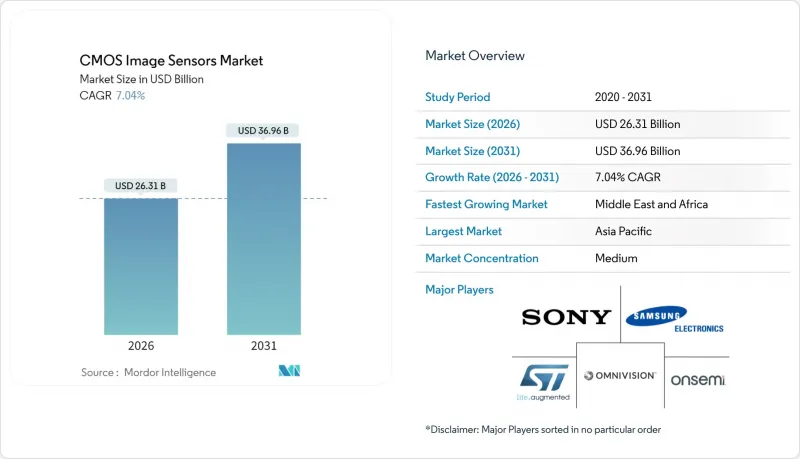
CMOS影像感測器市場預計將從2025年的245.8億美元成長到2026年的263.1億美元,並預計在2031年達到369.6億美元,2026年至2031年的複合年成長率為7.04%。
從智慧型手機相機到汽車安全、工業自動化和醫療診斷,CMOS影像感測器的需求正在不斷擴大,這反映出該技術相對於CCD設計的功能優勢日益凸顯。採用片上AI邏輯的背照式(BSI)架構在提升電力消耗的同時降低了功耗,從而增強了CMOS影像感測器在大批量電子產品市場的成本優勢。從區域來看,亞太地區以台灣晶圓代工廠為主導,而中東和非洲地區則憑藉智慧城市監控系統日益普及的推動,實現了兩位數的成長,正在迅速崛起。儘管中美出口限制和300毫米晶圓短缺帶來了供應鏈風險,但隨著傳統製造商出售產能併收購專業公司,行業整合正在進行中。
全球CMOS影像感測器市場趨勢與洞察
亞太地區OEM廠商在智慧型手機中安裝多鏡頭的進展
亞太地區的行動電話製造商正將多相機陣列的應用範圍從旗艦機型擴展到中階機型,從而推動高動態範圍影像感測器的持續成長。三星將於2024年發布的2億像素和5000萬像素ISOCELL設備清晰地展現了向計算攝影和高影格速率影片的轉變。 OmniVision的OV50X(具備110dB單次曝光HDR能力)則表明,高階智慧型手機正透過感測器性能而非單純的像素數量來實現差異化。SONY計劃於2025年量產的LYT-828晶片整合了混合幀HDR邏輯,無需外部ISP週期即可實現AI輔助的低光處理。高像素密度和片上運算的結合,在支援功能擴展的同時,也推高了先進組件的平均售價,從而增強了CMOS影像感測器市場的收入成長。
美國和歐洲對ADAS攝影機的監管要求
美國國家公路交通安全管理局 (NHTSA) 修訂後的新車評估專案 (NCAP) 將於 2024 年 12 月生效,屆時所有輕型車輛都必須配備基於攝影機的盲點偵測、車道維持輔助和自動緊急煞車系統,這將滿足對感測器的長期需求。全域百葉窗架構能夠有效減少運動偽影,這對安全關鍵型成像至關重要。斯巴魯的新一代 EyeSight 系統就充分體現了這一點,該系統採用了安森美半導體 (ON Semiconductor) 的 Hyperlux AR0823AT 感測器,符合 ASIL C 安全標準。歐盟的通用安全法規與美國的要求類似,規範的同步性使 CMOS 代工廠能夠預見未來十年汽車級產能的投資需求。
台灣及韓國先進300公厘CIS晶圓產能受限
人工智慧晶片訂單的激增導致台灣和韓國晶圓代工廠先進的300毫米生產線上的影像感測器產能捉襟見肘,前置作業時間從12-16週延長至20-24週。台積電位於亞利桑那州的擴建計畫將涉及1,650億美元的資本投資,但預計在2027年之前無法顯著緩解獨立國協地區的產能瓶頸。堆疊式背照式(BSI)製造的地理集中加劇了地緣政治風險,並顯著限制了CMOS影像感測器市場的短期供應彈性。
細分市場分析
到2025年,背照式感測器憑藉其卓越的靈敏度和高信噪比,佔據了CMOS影像感測器市場64.40%的佔有率。這一細分市場的崛起擴大了高階智慧型手機和車載攝影機等應用領域基於背照式(BSI)技術的CMOS影像感測器的市場規模。堆疊式BSI/3D感測器的複合年成長率(CAGR)為9.52%,其片上整合了可進行AI推理的邏輯層,進一步提升了每平方毫米的價值。
對於入門級物聯網攝影機等成本受限的產品,正面照明裝置仍將至關重要。全局百葉窗架構(大多基於FSI)正被工業自動化領域廣泛採用,以防止運動偽影。 3D玻璃基板技術是一項新興技術,預計將在2026年至2031年間得到應用,它將實現更緊湊的散熱性能和更高的互連密度,從而提升高階產品的差異化優勢。
到2025年,1,200萬至2,400萬像素頻寬將佔據CMOS影像感測器市場24.60%的佔有率,在主流智慧型手機中實現儲存容量和運算能力之間的平衡。雖然4,900萬像素及以上的設備仍屬於小眾市場,但由於監控、醫療和專業攝影領域對超強數位變焦的需求,其市場正以每年9.23%的速度成長。Canon的4.1億像素原型機展示了全片幅超高密度感測器的技術可行性,有望促進新型診斷顯像模式的開發。
像素低於1,200萬的產品在條碼掃描和行車記錄器等應用中依然需求旺盛,因為在這些應用中,影格速率比解析度更為重要。而2500萬至4800萬像素的中階感測器則供應給採用多幀計算的無反光鏡相機。像素數量的兩極化導致了CMOS影像感測器市場的價格細分,從而維持了分層利潤率。
區域分析
到2025年,亞太地區將佔全球收入的33.70%,這得益於其從晶圓代工到最終行動電話組裝的垂直整合生態系統。雖然台灣晶圓廠供應了大部分堆疊式背照式(BSI)晶圓,但中國當地仍然是全球最大的智慧型手機出口中心。在三星ISOCELL藍圖的推動下,韓國的創新使其在CMOS影像感測器市場保持技術領先地位。供應鏈集中化帶來了規模經濟效益,但也增加了其面臨的地震和地緣政治風險。
預計到2031年,中東和非洲地區將以9.55%的複合年成長率實現最快成長,海灣國家的智慧城市計畫需要連網監視錄影機和交通分析攝影機。配備高級駕駛輔助系統(ADAS)的車輛進口量不斷成長,將加速售後市場的更新換代,而非洲行動優先電子商務的蓬勃發展將推動對低光自拍攝影機的需求。公私合營的資金支持措施將加速本地系統整合,為CMOS影像感測器市場的擴張開闢新的途徑。
北美透過社群媒體平台的需求和嚴格的汽車安全法規影響著全球設計。內容創作生態系統優先考慮針對高影格速率8K 影片拍攝最佳化的感測器,促使國內無晶圓廠商進入高階細分市場。在歐洲,由於德國在工業 4.0 領域的投資,光電研發專注於高可靠性的工業和醫療應用。南美和南亞是尚未開發的市場,但價格敏感度促使他們選擇成熟的中階設計而非尖端感測器。
其他福利:
- Excel格式的市場預測(ME)表
- 3個月的分析師支持
目錄
第1章 引言
- 研究假設和市場定義
- 調查範圍
第2章調查方法
第3章執行摘要
第4章 市場情勢
- 市場概覽
- 市場促進因素
- 亞太地區OEM廠商多鏡頭智慧型手機的發展趨勢
- 美國和歐盟對ADAS攝影機的監管要求
- 北美以視訊為中心的社交媒體對 4K/8K 感測器的需求
- 日本和歐盟用於穿戴式醫療影像診斷的小型化感測器
- 中東地區智慧城市監控系統應用現狀
- 德國工業4.0對工業自動化用全局百葉窗的需求
- 市場限制
- 台灣及韓國先進的300公厘CIS晶圓產能受限
- 入門級智慧型手機的平均售價正在下降
- 高速攝影中的熱噪音和滾動百葉窗限制
- 美國和中國最先進的獨立國協出口管制措施
- 價值/供應鏈分析
- 監理與技術展望
- 波特五力分析
- 供應商的議價能力
- 買方的議價能力
- 新進入者的威脅
- 替代品的威脅
- 競爭對手之間的競爭
- 技術概覽(依通訊方式)
- 有線
- 無線的
- 投資分析
第5章 市場規模與成長預測
- 透過技術
- 前側照明(FSI)
- 背照式(BSI)
- 分層BSI/3D
- 世界百葉窗CMOS
- 通過決議
- 低於1200萬像素
- 1200萬至2400萬像素
- 2500萬至4800萬像素
- 4900萬像素或以上
- 頻譜
- 可見頻譜
- 不可見光(近紅外線、紫外線、短波紅外線)頻譜
- 依溝通類型
- 有線
- 無線的
- 按最終用戶行業分類
- 家用電子電器
- 汽車/運輸設備
- 工業和機器視覺
- 安全與監控
- 醫療保健和生命科學
- 計算和資料中心
- 航太/國防
- 按地區
- 北美洲
- 美國
- 加拿大
- 墨西哥
- 歐洲
- 英國
- 德國
- 法國
- 義大利
- 其他歐洲地區
- 亞太地區
- 中國
- 日本
- 印度
- 韓國
- 亞太其他地區
- 中東
- 以色列
- 沙烏地阿拉伯
- 阿拉伯聯合大公國
- 土耳其
- 其他中東地區
- 非洲
- 南非
- 埃及
- 其他非洲地區
- 南美洲
- 巴西
- 阿根廷
- 其他南美洲
- 北美洲
第6章 競爭情勢
- 策略趨勢
- 市佔率分析
- 公司簡介
- Sony Group Corporation
- Samsung Electronics Co., Ltd.
- OmniVision Technologies, Inc.
- onsemi Corporation
- STMicroelectronics NV
- Canon Inc.
- Panasonic Holdings Corporation
- SK Hynix Inc.
- Hamamatsu Photonics KK
- Teledyne Technologies Incorporated
- GalaxyCore Shanghai Limited Corporation
- SmartSens Technology Co., Ltd.
- PixArt Imaging Inc.
- Tower Semiconductor Ltd.
- ams-OSRAM AG
- Teledyne e2v(UK)Ltd.
- Himax Technologies, Inc.
- Siliconfile Technologies Inc.
- Sharp Corporation
- Caeleste CVBA
第7章 市場機會與未來展望
The CMOS image sensor market is expected to grow from USD 24.58 billion in 2025 to USD 26.31 billion in 2026 and is forecast to reach USD 36.96 billion by 2031 at 7.04% CAGR over 2026-2031.
Demand spreads from smartphone cameras to automotive safety, industrial automation and medical diagnostics, reflecting the technology's growing functionality advantages over CCD designs. Stacked backside-illuminated (BSI) architectures incorporating on-die AI logic raise performance while trimming power budgets, reinforcing the CMOS image sensor market's cost-leadership in mass-volume electronics. Regionally, Asia-Pacific anchors production through Taiwan's foundries, while Middle East and Africa outpace with double-digit expansion on smart-city surveillance deployments. Consolidation continues as legacy producers divest capacity and specialist acquisitions accelerate, even as U.S.-China export controls and 300 mm wafer shortages inject supply-chain risk.
Global CMOS Image Sensors Market Trends and Insights
Smartphone Multi-Camera Adoption by APAC OEMs
APAC handset makers are extending multi-camera arrays from flagships into mid-range lines, driving sustained unit growth for high-dynamic-range image sensors. Samsung's 2024 release of 200 MP and 50 MP ISOCELL devices underscored the pivot toward computational photography and higher frame-rate video. OmniVision's OV50X, offering 110 dB single-exposure HDR, illustrates how premium smartphones now differentiate on sensor capability rather than megapixel count alone. Sony's LYT-828, entering mass production in 2025, embeds Hybrid Frame-HDR logic on-die, allowing AI-assisted low-light processing without external ISP cycles. The combination of higher pixel densities and on-sensor compute supports feature expansion while raising average selling prices for advanced parts, reinforcing revenue growth for the CMOS image sensor market.
Regulatory Mandates for ADAS Cameras in US & EU
NHTSA's December 2024 New Car Assessment Program upgrade mandates camera-based blind-spot, lane-keeping and automatic emergency-braking systems across light vehicles, anchoring long-term sensor demand. Global-shutter architectures mitigate motion artifacts essential for safety-critical imaging, evident in Subaru's next-generation EyeSight system that selects onsemi's Hyperlux AR0823AT sensor meeting ASIL C safety standards. The EU's General Safety Regulation mirrors U.S. requirements, synchronizing specifications and giving CMOS foundry operators visibility for a decade of automotive-grade capacity investments.
Advanced 300 mm CIS Wafer Capacity Constraints in Taiwan & Korea
Surging AI-chip orders compete with image-sensor output for advanced 300 mm lines at Taiwanese and Korean foundries, extending lead times from 12-16 weeks to 20-24 weeks. TSMC's Arizona expansion, though capitalized at USD 165 billion, will not meaningfully relieve CIS bottlenecks before 2027. The geographic clustering of stacked BSI manufacturing heightens geopolitical exposure, significantly tempering near-term supply elasticity for the CMOS image sensor market.
Other drivers and restraints analyzed in the detailed report include:
- Video-Centric Social-Media Demand for 4K/8K Sensors in North America
- Miniaturized Sensors for Wearable Medical Imaging in Japan & EU
- ASP Erosion in Entry-Level Smartphones
For complete list of drivers and restraints, kindly check the Table Of Contents.
Segment Analysis
Backside-illuminated sensors captured 64.40% CMOS image sensor market share in 2025, reflecting superior sensitivity and higher signal-to-noise ratios. The segment's ascendancy lifted the BSI-based CMOS image sensor market size for premium smartphones and automotive cameras. Stacked BSI/3D sensors are advancing at 9.52% CAGR, integrating logic layers that execute AI inference in situ and further enlarge value per square millimeter.
Front-side-illuminated devices maintain relevance in cost-constrained SKUs such as entry-level IoT cameras. Global-shutter architectures, often FSI-based, gain adoption in industrial automation to thwart motion artefacts. Emerging glass-substrate 3D stacking, projected between 2026 and 2031, promises tighter thermal profiles and higher interconnect densities, widening high-end differentiation.
The 12-24 MP band accounted for 24.60% CMOS image sensor market share in 2025, balancing storage and compute overhead in mainstream handsets. >=49 MP devices, though niche, are growing 9.23% annually as surveillance, medical and professional photography favor extreme digital zoom. Canon's 410 MP prototype highlights technical viability of full-frame ultra-high-density sensors, potentially catalyzing new diagnostic imaging modalities.
Sub-12 MP parts endure in barcode scanning and dashcams where frame rate trumps definition. Mid-tier 25-48 MP sensors serve mirrorless cameras leveraging multi-frame computational overlays. The pixel-count bifurcation sharpens price segmentation across the CMOS image sensor market, preserving margin tiers.
The CMOS Image Sensor Market Report is Segmented by Technology (Front Side Illuminated, Backside-Illuminated, and More), Resolution ( Less Than 12 Megapixels, 12-24 Megapixels, and More ), Spectrum (Visible, Non-Visible), Communication Type (Wired, Wireless), End-User Industry (Consumer Electronics, Automotive, Industrial, and More), and Geography. The Market Forecasts are Provided in Terms of Value (USD).
Geography Analysis
Asia-Pacific holds 33.70% of 2025 revenue, benefiting from vertically integrated ecosystems spanning foundry silicon to final handset assembly. Taiwanese fabs supply the bulk of stacked-BSI wafers, while mainland China remains the world's largest smartphone export base. Korean innovation, led by Samsung's ISOCELL roadmap, sustains technology leadership inside the CMOS image sensor market. Supply-chain concentration confers scale economics yet elevates earthquake and geopolitical exposure.
Middle East and Africa present the fastest growth at 9.55% CAGR to 2031 as Gulf smart-city blueprints demand networked surveillance and traffic-analytics cameras. ADAS-equipped vehicle imports lift aftermarket replacement cycles, while Africa's mobile-first e-commerce boom drives low-light selfie camera volumes. Public-private funding incentives accelerate local system integration, creating an emerging corridor for CMOS image sensor market expansion.
North America influences global design through social-media platform demands and stringent automotive safety rules. Content-creator ecosystems prioritize sensors optimized for high-frame-rate 8K capture, pushing domestic fabless vendors toward premium niches. Europe, anchored by Germany's Industry 4.0 investments, channels photonics R&D into high-reliability industrial and medical segments. South America and South Asia represent untapped volume, though price sensitivity steers procurement toward established mid-tier designs rather than bleeding-edge sensors.
- Sony Group Corporation
- Samsung Electronics Co., Ltd.
- OmniVision Technologies, Inc.
- onsemi Corporation
- STMicroelectronics N.V.
- Canon Inc.
- Panasonic Holdings Corporation
- SK Hynix Inc.
- Hamamatsu Photonics K.K.
- Teledyne Technologies Incorporated
- GalaxyCore Shanghai Limited Corporation
- SmartSens Technology Co., Ltd.
- PixArt Imaging Inc.
- Tower Semiconductor Ltd.
- ams-OSRAM AG
- Teledyne e2v (UK) Ltd.
- Himax Technologies, Inc.
- Siliconfile Technologies Inc.
- Sharp Corporation
- Caeleste CVBA
Additional Benefits:
- The market estimate (ME) sheet in Excel format
- 3 months of analyst support
TABLE OF CONTENTS
1 INTRODUCTION
- 1.1 Study Assumptions and Market Definition
- 1.2 Scope of the Study
2 RESEARCH METHODOLOGY
3 EXECUTIVE SUMMARY
4 MARKET LANDSCAPE
- 4.1 Market Overview
- 4.2 Market Drivers
- 4.2.1 Smartphone Multi-Camera Adoption by APAC OEMs
- 4.2.2 Regulatory Mandates for ADAS Cameras in US and EU
- 4.2.3 Video-Centric Social Media Demand for 4K/8K Sensors in North America
- 4.2.4 Miniaturized Sensors for Wearable Medical Imaging in Japan and EU
- 4.2.5 Smart-City Surveillance Roll-outs in Middle East
- 4.2.6 Global-Shutter Demand for Industrial Automation in Germany's Industry 4.0
- 4.3 Market Restraints
- 4.3.1 Advanced 300-mm CIS Wafer Capacity Constraints in Taiwan and Korea
- 4.3.2 ASP Erosion in Entry-Level Smartphones
- 4.3.3 Thermal Noise and Rolling-Shutter Limits in High-Speed Cinematography
- 4.3.4 US-China Export Controls on Leading-Edge CIS
- 4.4 Value / Supply-Chain Analysis
- 4.5 Regulatory and Technological Outlook
- 4.6 Porter's Five Forces Analysis
- 4.6.1 Bargaining Power of Suppliers
- 4.6.2 Bargaining Power of Buyers
- 4.6.3 Threat of New Entrants
- 4.6.4 Threat of Substitutes
- 4.6.5 Intensity of Competitive Rivalry
- 4.7 Technology Snapshot (By Communication Type)
- 4.7.1 Wired
- 4.7.2 Wireless
- 4.8 Investment Analysis
5 MARKET SIZE AND GROWTH FORECASTS (VALUE)
- 5.1 By Technology
- 5.1.1 Front-Side Illuminated (FSI)
- 5.1.2 Backside-Illuminated (BSI)
- 5.1.3 Stacked BSI / 3-D
- 5.1.4 Global-Shutter CMOS
- 5.2 By Resolution
- 5.2.1 Less than 12 Megapixels
- 5.2.2 12-24 Megapixels
- 5.2.3 25-48 Megapixels
- 5.2.4 Greater than 49 Megapixels
- 5.3 By Spectrum
- 5.3.1 Visible Spectrum
- 5.3.2 Non-Visible (NIR, UV, SWIR) Spectrum
- 5.4 By Communication Type
- 5.4.1 Wired
- 5.4.2 Wireless
- 5.5 By End-user Industry
- 5.5.1 Consumer Electronics
- 5.5.2 Automotive and Transportation
- 5.5.3 Industrial and Machine Vision
- 5.5.4 Security and Surveillance
- 5.5.5 Healthcare and Life Sciences
- 5.5.6 Computing and Data-center
- 5.5.7 Aerospace and Defense
- 5.6 By Geography
- 5.6.1 North America
- 5.6.1.1 United States
- 5.6.1.2 Canada
- 5.6.1.3 Mexico
- 5.6.2 Europe
- 5.6.2.1 United Kingdom
- 5.6.2.2 Germany
- 5.6.2.3 France
- 5.6.2.4 Italy
- 5.6.2.5 Rest of Europe
- 5.6.3 Asia-Pacific
- 5.6.3.1 China
- 5.6.3.2 Japan
- 5.6.3.3 India
- 5.6.3.4 South Korea
- 5.6.3.5 Rest of Asia-Pacific
- 5.6.4 Middle East
- 5.6.4.1 Israel
- 5.6.4.2 Saudi Arabia
- 5.6.4.3 United Arab Emirates
- 5.6.4.4 Turkey
- 5.6.4.5 Rest of Middle East
- 5.6.5 Africa
- 5.6.5.1 South Africa
- 5.6.5.2 Egypt
- 5.6.5.3 Rest of Africa
- 5.6.6 South America
- 5.6.6.1 Brazil
- 5.6.6.2 Argentina
- 5.6.6.3 Rest of South America
- 5.6.1 North America
6 COMPETITIVE LANDSCAPE
- 6.1 Strategic Moves
- 6.2 Market Share Analysis
- 6.3 Company Profiles (includes Global level Overview, Market level overview, Core Segments, Financials as available, Strategic Information, Market Rank/Share for key companies, Products and Services, and Recent Developments)
- 6.3.1 Sony Group Corporation
- 6.3.2 Samsung Electronics Co., Ltd.
- 6.3.3 OmniVision Technologies, Inc.
- 6.3.4 onsemi Corporation
- 6.3.5 STMicroelectronics N.V.
- 6.3.6 Canon Inc.
- 6.3.7 Panasonic Holdings Corporation
- 6.3.8 SK Hynix Inc.
- 6.3.9 Hamamatsu Photonics K.K.
- 6.3.10 Teledyne Technologies Incorporated
- 6.3.11 GalaxyCore Shanghai Limited Corporation
- 6.3.12 SmartSens Technology Co., Ltd.
- 6.3.13 PixArt Imaging Inc.
- 6.3.14 Tower Semiconductor Ltd.
- 6.3.15 ams-OSRAM AG
- 6.3.16 Teledyne e2v (UK) Ltd.
- 6.3.17 Himax Technologies, Inc.
- 6.3.18 Siliconfile Technologies Inc.
- 6.3.19 Sharp Corporation
- 6.3.20 Caeleste CVBA
7 MARKET OPPORTUNITIES AND FUTURE OUTLOOK
- 7.1 White-Space and Unmet-Need Assessment

 CMOS影像感測器市場-全球及區域分析:按應用、技術、陣列類型和地區分類-分析與預測,2026-2035年
 CMOS影像感測器市場:全球市場預測,2026-2032年
 CMOS和sCMOS影像感測器市場規模、佔有率和成長分析:按感測器架構、頻譜類型、陣列解析度、應用和地區分類-2026-2033年產業預測CMOS相機模組市場:按產品類型、組件、解析度、感測器架構、百葉窗類型、頻譜類型、配置、應用和最終用戶分類 - 全球預測,2026-2032 年
 2026-2030年全球CMOS相機模組市場
 2026年互補金屬氧化物半導體(CMOS)影像感測器全球市場報告
 全球CMOS影像感測器市場規模、佔有率、趨勢和成長分析報告(2026-2034年)
 全球CMOS影像感測器市場:按頻譜、解析度、影像處理技術、最終用途、國家及地區分類-產業分析、市場規模、市場佔有率及2025-2032年未來預測
 主動像素感測器市場規模、佔有率和成長分析:按類型、應用、最終用戶和地區分類-2026-2033年產業預測
 先進CMOS感測器陣列市場分析及預測(至2035年):按類型、產品類型、服務、技術、組件、應用、材料類型、裝置及最終用戶分類