


 |
市場調查報告書
商品編碼
1934627
汽車空氣濾清器:市場佔有率分析、產業趨勢與統計、成長預測(2026-2031)Automotive Air Filter - Market Share Analysis, Industry Trends & Statistics, Growth Forecasts (2026 - 2031) |
||||||

※ 本網頁內容可能與最新版本有所差異。詳細情況請與我們聯繫。
2025年汽車空氣濾清器市值為51億美元,預計2031年將達到74.4億美元,高於2026年的54.3億美元。
預計在預測期(2026-2031 年)內,複合年成長率將達到 6.49%。
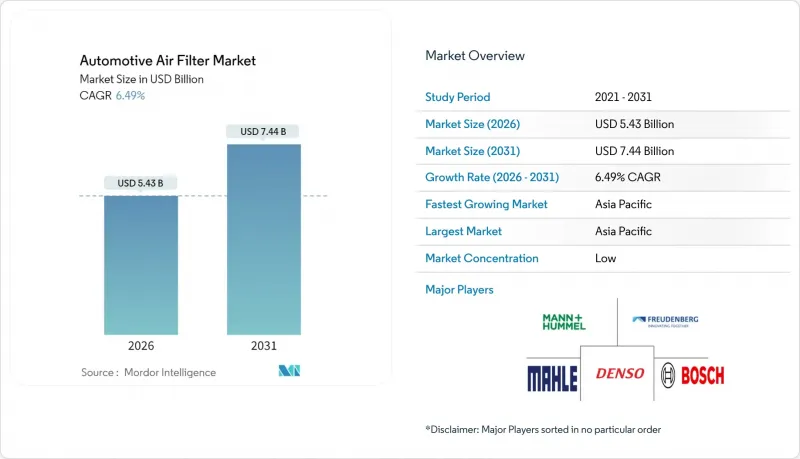
歐洲、北美和亞洲主要經濟體排放氣體法規,以及消費者對車內空氣品質日益成長的關注,共同支撐了強勁的市場需求。汽車原始設備製造商 (OEM) 正在擴大高效能空氣微粒過濾器 (HEPA) 系統和靜電奈米纖維濾材的應用,以滿足歐7排放標準、EPA 2027-2032多污染物排放標準以及印度第六階段排放標準。電動車 (EV) 平台進一步拓展了這個市場機遇,因為電池溫度控管系統和更安靜的車廂環境凸顯了不同濾材在過濾性能上的差異。同時,售後市場經銷商正利用預測性維修數據來推廣高階替換濾芯,並與合成濾材更長的維修週期競爭。
全球汽車空氣濾清器市場趨勢與洞察
嚴格的排放氣體法規和車廂空氣品質標準
主要汽車市場監管標準的趨同,正推動著對兼顧引擎保護和車廂空氣品質的先進過濾技術前所未有的需求。歐盟的歐盟7排放標準首次對輪胎和煞車磨損排放的顆粒物排放設定了上限,要求過濾系統能夠捕捉除傳統廢氣排放以外的顆粒物。同時,美國環保署(EPA)的Tier 4排放標準也相繼訂定,該標準要求汽油動力車輛配備顆粒物過濾器,使其顆粒物排放達到0.5毫克/英里,從根本上改變了過濾器的價值提案,使其從可選配置變為強制性法規要求。柬埔寨計劃在2030年前採用歐6/VI排放標準,顯示監管協調的趨勢正在已開發市場之外擴展,為過濾器供應商創造了全球機會。監管時間的壓縮迫使原始設備製造商(OEM)加快過濾技術的整合,由於合規期限的限制,人為地推高了市場需求,而擁有即用型解決方案的供應商則從中受益。加州的「先進清潔車 II 計畫」要求到 2035 年實現 100% 零排放車銷售,諷刺的是,由於電動車需要複雜的車廂空氣管理系統來維持電池的熱效率,這反而增加了對過濾器的需求。
全球汽車保有量增加,保養間隔里程延長
全球車輛保有量的擴張,尤其是在新興市場,正在催生持續的售後市場需求,其成長速度超過了新車產量的成長速度。由於合成潤滑油的普及和引擎耐久性的提升,保養週期得以延長,但這反而增加了濾清系統的壓力,因為濾清器必須在延長更換週期的同時保持效率標準。這一趨勢有利於高階濾清器製造商,他們可以透過生產符合原廠規格的長壽命產品來獲得高利潤。車隊營運商越來越意識到高階濾清器在降低整體擁有成本 (TCO) 方面的優勢,而預測性維護演算法能夠根據車輛狀態制定更換計劃,從而最佳化濾清器的利用率,同時防止引擎過早磨損。隨著商用車年行駛里程高於私家車,出行即服務 (MaaS) 模式的興起正在推動濾清器更換頻率的提高,這為售後市場供應商創造了更可預測、更盈利的更換週期。
長壽命合成介質可延長更換週期
先進的合成濾材技術雖然延長了使用壽命,超越了傳統的更換週期,但反而限制了市場成長。例如,霍林斯沃斯-沃斯公司(Hollingsworth & Vose)的奈米纖維塗層技術,能夠提升深度過濾和脈衝清洗性能,在延長濾芯使用壽命的同時,降低更換頻率。這項技術進步帶來了一個經典的創新者困境:卓越的產品性能雖然降低了更換頻率,但也縮小了潛在市場規模。豪華汽車製造商正擴大將長壽命過濾系統作為標準配置,以降低維護成本並提升客戶滿意度,這限制了售後市場的收入潛力。豪華電動車廣泛採用「終身」密封式車廂濾芯模組,徹底消除了售後市場的更換機會,迫使供應商在不依賴常規售後市場銷售的情況下,實現高額的OEM利潤。伊朗的貝哈蘭濾芯公司(Beharan Filter Company)已獲得首款基於奈米技術的汽車空氣濾芯「Nano Namad」的授權,這表明新興市場正迅速轉向能夠延長使用壽命的先進濾芯技術。過濾器製造商可能需要在創新和經營模式的永續性之間取得平衡,轉向基於訂閱的維護服務和增值監控系統,以產生不依賴物理過濾器更換頻率的經常性收入流。
細分市場分析
到2025年,進氣濾清器將佔據54.78%的市場佔有率,這反映了其對所有車型普遍適用性以及出於引擎保護要求而強制更換的特點。然而,受消費者健康意識增強和旨在改善車內空氣品質的監管要求推動,車內空氣濾清器預計將成為成長的主要驅動力,到2031年將以8.94%的複合年成長率成長。
博世推出的「FILTER+pro」車廂空氣濾清器,其抗菌層可有效對抗病毒、細菌和過敏原,這表明傳統供應商正透過創新在車廂過濾領域佔據高階市場。空氣品質法規的不斷完善,以及消費者健康意識的日益增強,持續推動著對更高性能車廂過濾系統的需求,促使汽車製造商擴大將HEPA級系統作為高階車型的標準配置。雖然由於引擎保護的需要,進氣濾清器的需求保持穩定,但由於技術成熟且更換週期固定,其成長速度落後於車廂濾清器。靜電和奈米纖維濾清器處於行業技術前沿,憑藉其超越傳統濾材的先進顆粒捕獲能力,供應商能夠獲得更高的產品價格。
由於纖維素成本低廉且製造商對其了解廣泛,截至2025年,其市佔率維持在43.75%。奈米纖維和HEPA介質汽車空氣過濾器市場規模預計將以11.12%的複合年成長率成長,這清楚地表明,優質高效的介質正在引領創新步伐。
奈米纖維層可實現深層集塵和高粉塵保持能力,同時保持低阻力,這對引擎性能和空調系統的能源效率至關重要。供應商正將專有的奈米塗層整合到傳統基材上,打造差異化產品,從而獲得顯著的溢價。活性碳製造商正投資於回收技術,以應對原料價格的波動,從而強化汽車製造商和監管機構所要求的性能和永續性雙重價值提案。
區域分析
亞太地區預計到2025年將佔據38.60%的市場佔有率,這主要得益於中國電動車的快速成長以及印度Bharat Stage VI排放標準的實施。該地區預計在預測期內將以6.28%的複合年成長率成長。本地供應商與全球品牌合作,獲得先進媒體技術的授權,而中國、泰國和越南等地的具成本效益製造地將支撐全球需求。澳洲實施的歐6d等效排放標準將進一步擴大受監管的市場。
歐洲7號排放標準將非廢氣顆粒物納入排放範圍,為輪胎磨損顆粒捕集器和煞車粉塵過濾器開闢了新的細分市場。德國汽車製造商在主導,他們通常與曼胡默爾(MANN+HUMMEL)等供應商合作。亨斯特(Hengst)位於羅馬尼亞的工廠表明,東歐的成本競爭力正在吸引新的產能。消費者將先進的過濾技術與健康和環保聯繫起來,支撐了其較高的價格。
美國環保署 (EPA) 2027-2032 年在北美實施的法規將確保對高效能引擎空氣和座艙系統的持續需求。加州的零排放車輛強制令將刺激對電動車專用溫度控管過濾器的需求。漢農系統公司在安大略省的電動車壓縮機工廠正是供應商為滿足區域電動車產量成長而投資的例證。完善的售後市場物流網路和濃厚的 DIY 文化將確保性能增強型零件的快速普及。
其他福利:
- Excel格式的市場預測(ME)表
- 3個月的分析師支持
目錄
第1章 引言
- 研究假設和市場定義
- 調查範圍
第2章調查方法
第3章執行摘要
第4章 市場情勢
- 市場概覽
- 市場促進因素
- 嚴格的排放氣體法規和車廂空氣品質標準
- 全球車輛保有量不斷增加,保養週期越來越長
- 空氣污染嚴重的大城市消費者的健康意識
- 電動車和高階OEM平台採用HEPA級過濾器
- 感應器激活式智慧暖通空調過濾器模組
- 預測性車隊維護演算法驅動過濾器變更
- 市場限制
- 長壽命合成介質可延長更換週期
- 不織布和活性碳的價格波動
- 豪華電動車(EV)中密封的「永久性」空調濾芯模組縮小了售後市場。
- 純電動車中超高效能介質的能量/重量損失
- 價值/價值鏈分析
- 波特五力模型
- 新進入者的威脅
- 買方的議價能力
- 供應商的議價能力
- 替代品的威脅
- 競爭強度
第5章 市場規模及成長預測(金額:美元 / 數量:單位)
- 依產品類型
- 空氣進氣過濾器
- 車廂空氣濾清器
- 混合/靜電奈米纖維過濾器
- 電增強型(ePM1)過濾器
- 透過過濾介質
- 纖維素
- 合成纖維/熔噴
- 活性碳複合複合材料
- 奈米纖維/HEPA等級
- 按車輛類型
- 搭乘用車
- 輕型商用車
- 中型和重型商用車輛
- 按銷售管道
- 相容原廠設備
- 售後市場
- 按地區
- 北美洲
- 美國
- 加拿大
- 北美其他地區
- 南美洲
- 巴西
- 阿根廷
- 其他南美洲
- 歐洲
- 德國
- 英國
- 法國
- 義大利
- 西班牙
- 俄羅斯
- 其他歐洲地區
- 亞太地區
- 中國
- 日本
- 印度
- 韓國
- 澳洲和紐西蘭
- 亞太其他地區
- 中東和非洲
- 海灣合作理事會國家
- 土耳其
- 南非
- 其他中東和非洲地區
- 北美洲
第6章 競爭情勢
- 市場集中度
- 策略性舉措(併購、合資、產能)
- 市佔率分析
- 公司簡介
- MANN+HUMMEL GmbH
- MAHLE GmbH
- Donaldson Company Inc.
- Robert Bosch GmbH
- Sogefi SpA
- Cummins Inc.
- DENSO Corporation
- Parker-Hannifin Corp.
- Ahlstrom-Munksjo
- Freudenberg & Co. KG
- Hengst SE
- K&N Engineering Inc.
- Champion Laboratories Inc.
- Fram Group LLC
- Hollingsworth & Vose Co.
第7章 市場機會與未來展望
The Automotive Air Filter Market was valued at USD 5.10 billion in 2025 and estimated to grow from USD 5.43 billion in 2026 to reach USD 7.44 billion by 2031, at a CAGR of 6.49% during the forecast period (2026-2031).
Tightening emission norms in Europe, North America, and key Asian economies, together with consumer attention to in-cabin air quality, sustain a robust demand pipeline. Original equipment manufacturers (OEMs) increasingly specify high-efficiency particulate air (HEPA) systems and electrostatic nano-fiber media to comply with Euro 7, EPA 2027-2032 multi-pollutant standards, and Bharat Stage VI rules. Electric-vehicle (EV) platforms amplify the opportunity because battery thermal systems and silent cabins highlight filtration performance differences. At the same time, aftermarket distributors leverage predictive maintenance data to position premium replacement filters, countering the lengthening service intervals delivered by synthetic media.
Global Automotive Air Filter Market Trends and Insights
Strict Emission & In-Cabin Air-Quality Mandates
Regulatory convergence across major automotive markets creates unprecedented demand for advanced filtration technologies that address engine protection and cabin air quality. The EU's Euro 7 regulation introduces particulate emissions limits from tire and brake wear for the first time, requiring filtration systems to capture particles beyond traditional exhaust emissions. This regulatory expansion coincides with the EPA's Tier 4 standards mandating gasoline particulate filters for vehicles achieving 0.5 mg/mi PM emissions, fundamentally altering the filtration value proposition from an optional comfort feature to a regulatory compliance necessity. Cambodia's adoption of Euro 6/VI standards by 2030 demonstrates regulatory harmonization extending beyond developed markets, creating global scale opportunities for filtration suppliers. The regulatory timeline compression forces OEMs to accelerate filtration technology integration, with compliance deadlines creating artificial demand spikes that benefit suppliers with ready-to-deploy solutions. California's Advanced Clean Cars II program mandating 100% zero-emission vehicle sales by 2035 paradoxically increases filtration demand as EVs require sophisticated cabin air management systems to maintain battery thermal efficiency.
Growing Global Vehicle Parc & Service-Interval Mileage
The expanding global vehicle fleet, particularly in emerging markets, creates sustained aftermarket demand that outpaces new vehicle production growth rates. Extended service intervals, driven by synthetic lubricant adoption and improved engine durability, paradoxically increase filtration system stress as filters must perform longer between replacements while maintaining efficiency standards. This dynamic benefits premium filter manufacturers who can command higher margins for extended-life products that meet OEM specifications. Fleet operators increasingly recognize the benefits of premium filtration for total cost of ownership, with predictive maintenance algorithms enabling condition-based replacement schedules that optimize filter utilization while preventing premature engine wear. The shift toward mobility-as-a-service models intensifies filter replacement frequency as commercial vehicles accumulate higher annual mileage than private passenger cars, creating a more predictable and lucrative replacement cycle for aftermarket suppliers.
Long-Life Synthetic Media Extending Replacement Intervals
Advanced synthetic filter media technologies paradoxically constrain market growth by extending service intervals beyond traditional replacement cycles. Nano-fiber coating technologies, such as Hollingsworth & Vose's NANOWEB system, enhance depth filtration and pulse-cleaning capabilities, enabling filters to maintain efficiency longer while reducing replacement frequency. This technological advancement creates a classic innovator's dilemma where superior product performance reduces total addressable market size by decreasing replacement frequency. Premium vehicle manufacturers increasingly specify long-life filtration systems as standard equipment to reduce maintenance costs and improve customer satisfaction scores, inadvertently constraining aftermarket revenue potential. The trend toward "lifetime" sealed cabin filter modules in luxury EVs eliminates aftermarket replacement opportunities entirely, forcing suppliers to capture higher margins during OEM fitment rather than relying on recurring aftermarket sales. Iran's Behran Filter Company, receiving the first "Nano Namad" license for nanotechnology-based car air filters, demonstrates how emerging markets are leapfrogging to advanced filtration technologies that extend service intervals. Filter manufacturers must balance technological advancement with business model sustainability, potentially requiring shift toward subscription-based maintenance services or value-added monitoring systems that generate recurring revenue streams independent of physical filter replacement frequency.
Other drivers and restraints analyzed in the detailed report include:
- Consumer Health Awareness in High-Pollution Megacities
- HEPA-Grade Filters Adopted by EV & Premium OEM Platforms
- Volatile Non-Woven & Activated-Carbon Prices
For complete list of drivers and restraints, kindly check the Table Of Contents.
Segment Analysis
Air-intake filters command 54.78% market share in 2025, reflecting their universal application across all vehicle types and mandatory replacement cycles driven by engine protection requirements. However, cabin air filters emerge as the growth catalyst with 8.94% CAGR through 2031, propelled by consumer health awareness and regulatory mandates for in-cabin air quality improvement.
Bosch's introduction of FILTER+pro cabin air filters with antimicrobial layers effective against viruses, bacteria, and allergens demonstrates how traditional suppliers innovate to capture premium pricing in the cabin filtration segment. The convergence of air quality regulations and consumer health consciousness creates sustained demand for cabin filtration upgrades, with OEMs increasingly specifying HEPA-grade systems as standard equipment in premium vehicle segments. Air-intake filters maintain steady demand driven by engine protection requirements, though growth rates lag cabin filters due to mature technology and established replacement cycles. The electrostatic and nano-fiber segments represent the industry's technological frontier, where suppliers command premium pricing for advanced particle capture capabilities that exceed traditional media performance.
Cellulose retained a 43.75% share in 2025 because it is inexpensive and well-understood by manufacturers. The automotive air filtration market size for nano-fiber and HEPA media is projected to expand at 11.12% CAGR, a clear indicator that premium, high-efficiency media sets the innovation pace.
Nanofiber layers add depth loading and high dust-holding capacity while maintaining low restriction, a critical benefit for engine performance and HVAC energy efficiency. Suppliers integrate proprietary nano-coatings into traditional substrates to create differentiated SKUs with significant price premiums. Activated-carbon producers invest in recycling technology to combat feedstock price swings, reinforcing the dual performance and sustainability value proposition demanded by automakers and regulators.
The Automotive Air Filter Market Report is Segmented by Product Type (Air-Intake Filters, Cabin Air Filters, Hybrid Filters, and More), Filter Media (Cellulose, Synthetic, Activated-Carbon Composite, and More), Vehicle Type (Passenger Cars, Light Commercial Vehicles, and More), Sales Channel (OEM Fitment and Aftermarket) and Geography. The Market Forecasts are Provided in Terms of Value (USD) and Volume (Units).
Geography Analysis
Asia-Pacific's 38.60% share in 2025 is backed by China's EV surge and India's Bharat Stage VI norms. The region is anticipated to grow with a 6.28% CAGR during the forecast period. Local suppliers collaborate with global brands to secure advanced media licenses, while cost-efficient manufacturing plants in China, Thailand, and Vietnam feed worldwide demand. Australia's adoption of Euro 6d-equivalent tailpipe limits further widens the regulatory addressable market.
Euro 7's inclusion of non-exhaust particles in Europe opens niches for tire-wear capture devices and brake-dust filters. German OEMs spearhead HEPA and sensor integration, often co-engineering with suppliers such as MANN+HUMMEL. Hengst's Romanian plant shows that Eastern Europe's cost base attracts new capacity. Consumers associate advanced filtration with wellness and environmental responsibility, supporting premium pricing.
The EPA's 2027-2032 rules in North America guarantee sustained demand for high-efficiency engine-air and cabin systems. California's zero-emission vehicle mandate stimulates demand for EV-specific thermal-management filters. Hanon Systems' Ontario EV compressor plant signals supplier investment to serve growing regional EV output. Well-developed aftermarket logistics and strong do-it-yourself cultures ensure rapid uptake of performance upgrades.
- MANN+HUMMEL GmbH
- MAHLE GmbH
- Donaldson Company Inc.
- Robert Bosch GmbH
- Sogefi SpA
- Cummins Inc.
- DENSO Corporation
- Parker-Hannifin Corp.
- Ahlstrom-Munksjo
- Freudenberg & Co. KG
- Hengst SE
- K&N Engineering Inc.
- Champion Laboratories Inc.
- Fram Group LLC
- Hollingsworth & Vose Co.
Additional Benefits:
- The market estimate (ME) sheet in Excel format
- 3 months of analyst support
TABLE OF CONTENTS
1 Introduction
- 1.1 Study Assumptions & Market Definition
- 1.2 Scope of the Study
2 Research Methodology
3 Executive Summary
4 Market Landscape
- 4.1 Market Overview
- 4.2 Market Drivers
- 4.2.1 Strict emission & in-cabin air-quality mandates
- 4.2.2 Growing global vehicle parc & service-interval mileage
- 4.2.3 Consumer health awareness in high-pollution megacities
- 4.2.4 HEPA-grade filters adopted by EV & premium OEM platforms
- 4.2.5 Sensor-activated smart HVAC filtration modules
- 4.2.6 Predictive fleet-maintenance algorithms driving filter turnover
- 4.3 Market Restraints
- 4.3.1 Long-life synthetic media extending replacement intervals
- 4.3.2 Volatile non-woven & activated-carbon prices
- 4.3.3 Sealed "lifetime" cabin-filter modules in luxury EVs reduce aftermarket
- 4.3.4 Energy/weight penalty of ultra-high-efficiency media in BEVs
- 4.4 Value/Supply-Chain Analysis
- 4.5 Porter's Five Forces
- 4.5.1 Threat of New Entrants
- 4.5.2 Bargaining Power of Buyers
- 4.5.3 Bargaining Power of Suppliers
- 4.5.4 Threat of Substitutes
- 4.5.5 Intensity of Rivalry
5 Market Size & Growth Forecasts (Value in USD and Volume in Units)
- 5.1 By Product Type
- 5.1.1 Air-Intake Filters
- 5.1.2 Cabin Air Filters
- 5.1.3 Hybrid / Electrostatic Nano-fiber Filters
- 5.1.4 Electrically-enhanced (ePM1) Filters
- 5.2 By Filter Media
- 5.2.1 Cellulose
- 5.2.2 Synthetic/Melt-blown
- 5.2.3 Activated-Carbon Composite
- 5.2.4 Nano-fiber/HEPA Grade
- 5.3 By Vehicle Type
- 5.3.1 Passenger Cars
- 5.3.2 Light Commercial Vehicles
- 5.3.3 Medium and Heavy Commercial Vehicles
- 5.4 By Sales Channel
- 5.4.1 OEM Fitment
- 5.4.2 Aftermarket
- 5.5 By Geography
- 5.5.1 North America
- 5.5.1.1 United States
- 5.5.1.2 Canada
- 5.5.1.3 Rest of North America
- 5.5.2 South America
- 5.5.2.1 Brazil
- 5.5.2.2 Argentina
- 5.5.2.3 Rest of South America
- 5.5.3 Europe
- 5.5.3.1 Germany
- 5.5.3.2 United Kingdom
- 5.5.3.3 France
- 5.5.3.4 Italy
- 5.5.3.5 Spain
- 5.5.3.6 Russia
- 5.5.3.7 Rest of Europe
- 5.5.4 Asia-Pacific
- 5.5.4.1 China
- 5.5.4.2 Japan
- 5.5.4.3 India
- 5.5.4.4 South Korea
- 5.5.4.5 Australia & New Zealand
- 5.5.4.6 Rest of Asia-Pacific
- 5.5.5 Middle East and Africa
- 5.5.5.1 GCC Countries
- 5.5.5.2 Turkey
- 5.5.5.3 South Africa
- 5.5.5.4 Rest of Middle East and Africa
- 5.5.1 North America
6 Competitive Landscape
- 6.1 Market Concentration
- 6.2 Strategic Moves (M&A, JV, and Capacity)
- 6.3 Market Share Analysis
- 6.4 Company Profiles (Includes Global level Overview, Market level overview, Core Segments, Financials as available, Strategic Information, Market Rank/Share for key companies, Products & Services, and Recent Developments)
- 6.4.1 MANN+HUMMEL GmbH
- 6.4.2 MAHLE GmbH
- 6.4.3 Donaldson Company Inc.
- 6.4.4 Robert Bosch GmbH
- 6.4.5 Sogefi SpA
- 6.4.6 Cummins Inc.
- 6.4.7 DENSO Corporation
- 6.4.8 Parker-Hannifin Corp.
- 6.4.9 Ahlstrom-Munksjo
- 6.4.10 Freudenberg & Co. KG
- 6.4.11 Hengst SE
- 6.4.12 K&N Engineering Inc.
- 6.4.13 Champion Laboratories Inc.
- 6.4.14 Fram Group LLC
- 6.4.15 Hollingsworth & Vose Co.
7 Market Opportunities & Future Outlook
- 7.1 White-space & Unmet-need Assessment

 2026年全球空氣碳弧氣刨服務市場報告
 汽車空氣濾清器市場規模、佔有率、成長及全球產業分析:按類型、應用和地區的洞察,2026-2034年的預測
 高效能空氣微粒過濾器(HEPA)市場:按濾材類型、過濾器類型、過濾等級、應用、最終用戶和分銷管道分類,全球預測(2026-2032年)2026-2034年全球汽車空氣濾清器市場規模、佔有率、趨勢和成長分析報告
 汽車空氣濾清器市場規模、佔有率、趨勢及預測(按類型、動力方式、車輛類型、銷售管道及地區分類),2026-2034年顆粒過濾器測試市場(按過濾器類型、過濾器材料、粒徑範圍、流速、終端用戶產業和應用分類)-全球預測,2026-2032年
 引擎空氣濾清器市場-全球產業規模、佔有率、趨勢、機會和預測,按產品類型(進氣濾清器和空調濾清器)、最終用途(乘用車和商用車)、地區和競爭格局分類,2020-2030年預測
 活性碳空氣過濾器:全球市佔率排名、總銷售額和需求預測(2025-2031年)
 2032年汽車引擎空氣濾清器市場預測:按類型、車輛類型、燃料類型、銷售管道、應用和地區進行全球分析
 全球汽車空氣過濾器市場