


 |
市場調查報告書
商品編碼
1934586
阻隔材料:市場佔有率分析、產業趨勢與統計、成長預測(2026-2031)Barrier Material - Market Share Analysis, Industry Trends & Statistics, Growth Forecasts (2026 - 2031) |
||||||

※ 本網頁內容可能與最新版本有所差異。詳細情況請與我們聯繫。
預計阻隔材料市場將從 2025 年的 34.6 億美元成長到 2026 年的 36.4 億美元,到 2031 年將達到 47.1 億美元,2026 年至 2031 年的複合年成長率為 5.26%。
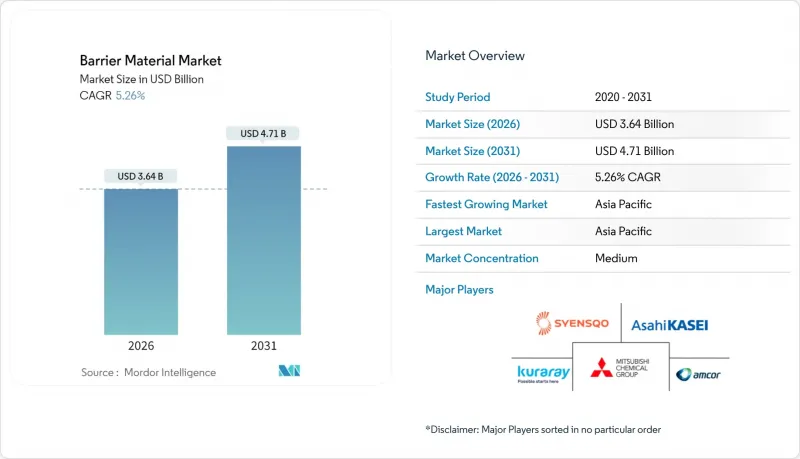
為延長食品保存期限,市場對多層薄膜的需求不斷成長;亞太地區藥品產能迅速擴張;以及監管機構加速逐步淘汰 PFAS 化學品,這些都是推動市場成長的關鍵因素。品牌所有者對循環經濟目標的承諾,促使他們投資於可回收的聚烯結構;而電子商務的快速發展,則鼓勵加工商開發更堅固、更耐穿刺的包裝形式,以確保在更長的供應鏈中保持阻隔性能。同時,鋁、乙烯和丙烯等原料供應趨緊,導致供應合約中成本轉嫁條款增多,並促使主要樹脂生產商進行垂直整合。競爭優勢正從絕對阻隔性能轉向在環境影響更小、檢驗規性文件符合多個司法管轄區要求的前提下,提供同等保護。
全球阻隔材料市場趨勢與洞察
包裝食品的保存期限要求
旨在減緩微生物生長和脂質氧化的氧氣和水蒸氣阻隔膜對於高水分烘焙食品、乳製品和蒸餾食品至關重要。採用香葉醇等植物來源活性成分配製的抗菌阻隔板可將麵包和酥皮點心的保存期限延長5至10天,同時將遷移量控制在符合全球食品接觸基準值的範圍內。調節氣體包裝袋的氧氣透過率低於0.1 cc/m²/天,有助於減少冷藏肉品中防腐劑的使用。韓國研究人員開發了一種可食用的幾丁聚醣-沒食子酸塗層,該塗層在不影響外觀的前提下,增加了紫外線防護和抗菌性能,開闢了一個高階市場,其價格比標準包裝材料高出20%至30%。延長保存期限與全球減少食物廢棄物的目標直接相關,使阻隔材料市場成為聯合國永續發展目標(SDG)12的關鍵驅動力。
亞太地區藥品泡殼需求
日本的《藥品接觸材料正面表列》(將於2025年6月生效)規定,吸濕性原料原料藥的透濕性必須低於0.05 g/m²/天,這將加速高品質PVDC和泡殼複合材料的應用。中國的GB 4806.7-2023和GB 43352-2023標準規定了低遷移限值,有利於擁有可靠分析數據和檢驗的無塵室薄膜的供應商。印度的藥品出口正以每年超過15%的速度成長,迫使泡殼包裝供應商同時滿足美國FDA、歐洲藥品管理局(EMA)和日本藥品和醫療設備管理局(PMDA)的要求。這些趨勢正促使全球加工商將薄膜生產在地化到亞太地區,從而增強區域供應安全並縮短前置作業時間。先進的阻隔結構也為生物相似藥製劑提供了支持,這類製劑需要氧氣含量低於1 ppm以維持蛋白質在運輸過程中的穩定性。
鋁環境法規
歐盟正考慮對鋁包裝徵收每公斤0.80歐元的包裝稅,以反映其相比聚合物替代品更高的碳排放強度。這項政策預計將抑制軟包裝食品中鋁箔的使用。品牌擁有者的生命週期評估模型顯示,與具有功能塗層的單層聚乙烯(PE)結構相比,鋁層會使包裝的二氧化碳排放增加高達300%,這迫使即使是先前已確立性能標準的金屬化薄膜也需要重新設計。雖然鋁箔在超高濕度藥品包裝中仍然不可替代,但對低碳冶煉製程和無縫回收途徑的探索正在加速進行。使用惰性陽極的電解測試表明,到2025年,每噸鋁的二氧化碳當量排放量將減少7噸,但實用化仍需五年時間。同時,儘管材料成本高昂,但在聚對苯二甲酸乙二醇酯(PET)上沉澱氧化鋁或二氧化矽塗層的多層結構正在獲得市場佔有率,並重塑高階糖果甜點和咖啡產品的包裝選擇標準。
細分市場分析
由於其卓越的水蒸氣和氧氣阻隔性能,PVDC在2025年仍將保持44.60%的阻隔材料市場佔有率,這對於對濕度敏感的藥品和高階加工肉品至關重要。面對環境監管機構對含氯聚合物日益嚴格的審查所帶來的結構性挑戰,加工商正在加速推進不含PVDC的結構試點,同時保持氧氣阻隔性能(<0.1 cc/m²/天)。 EVOH具有結晶質乙烯嵌段結構,由於其高透明度和優異的乾態氧氣阻隔性能,且保持完全的相容性,因此展現出顯著的成長勢頭,年複合成長率高達5.62%。
鋁箔在泡殼包裝蓋和殺菌袋仍然發揮著至關重要的作用,這些包裝對水蒸氣透過率的要求低於0.001 g/m²/天。然而,碳排放稅政策和鋁箔價格的波動正促使品牌商尋求更環保的替代方案,轉向PET基二氧化矽沉澱技術。聚萘二甲酸乙二醇酯(PEN)在高溫應用和電子微膠囊化領域佔據了一定的市場需求,在這些領域,尺寸穩定性比成本更為重要。研究方向包括氧化石墨烯塗層,這種塗層在奈米級厚度下可將氧氣透過率降低99%,預計在卷軸式塗覆均勻性提高後,將於2028年起實現商業化應用。
阻隔材料報告按類型(鋁、乙烯 - 乙烯醇共聚物 (EVOH)、Polyethylene Naphthalate甲酸乙二醇酯 (PEN)、聚偏二氯乙烯 (PVDC) 及其他)、用戶行業(食品飲料、製藥、農業、化妝品、汽車及其他)和地區(亞太、北美、歐洲、南美、中東和非洲)終端進行細分。市場預測以美元 (USD) 為以金額為準。
區域分析
亞太地區預計到2025年將佔總收入的41.10%,這反映了該地區無與倫比的生產規模和監管協調,目前已與嚴格的美國和歐盟標準接軌。中國將於2024年實施GB 4806.7標準,將總遷移限值收緊至10 mg/dm²或以下,這促進了符合《藥品法》第三類標準的高純度EVOH樹脂和PVDC-PVDC複合薄膜的快速認證。日本的正面表列將於2025年6月生效,這將推動日本國內加工商採用能夠塗覆僅30 nm厚二氧化矽層的等離子塗層設備,從而在保持完全透明的同時,實現與鋁箔相當的阻隔性。隨著學名藥核准加快,印度的泡殼包裝出口預計將繼續保持兩位數的成長。對國內共擠出產能的投資正在推動成長,以降低運輸延誤和外匯風險。
在北美,電子商務的興起以及加州《有毒物質減量法案》(其中包括對全氟烷基和多氟烷基物質 (PFAS) 的禁用)等日益嚴格的法規,推動了市場對防刺穿包裝袋的需求。隨著品牌商為應對生產者延伸責任制 (EPR) 的成本,採用單一材料聚乙烯 (PE) 包裝袋的重新設計工作已在進行中。
歐洲在循環經濟政策方面進展最為迅速,其《塑膠包裝和回收利用條例》(PPWR)草案規定,到2030年,可回收設計是進入市場的先決條件。德國和法國正在試行軟包裝薄膜的押金返還制度。南美洲和中東及非洲雖然規模較小,但對收入成長表現出強烈的韌性,尤其是在強化食品和非處方藥領域,這些產品需要能夠抵禦熱帶氣候和配送中斷的阻隔性包裝。
其他福利:
- Excel格式的市場預測(ME)表
- 3個月的分析師支持
目錄
第1章 引言
- 研究假設和市場定義
- 調查範圍
第2章調查方法
第3章執行摘要
第4章 市場情勢
- 市場概覽
- 市場促進因素
- 包裝食品的保存期限要求
- 亞太地區對藥品泡殼包裝的需求
- 電子商務主導的多層軟性包裝
- 可再生聚烯阻隔塗層
- 不含 PFAS 的油脂隔離層法規
- 市場限制
- 原料成本波動
- 鋁環境法規
- 多層薄膜回收問題
- 價值鏈分析
- 波特五力模型
- 供應商的議價能力
- 買方的議價能力
- 新進入者的威脅
- 替代品的威脅
- 競爭程度
第5章 市場規模與成長預測
- 按類型
- 鋁
- 乙烯 - 乙烯醇(EVOH)
- Polyethylene Naphthalate(PEN)
- 聚偏二氯乙烯(PVDC)
- 其他類型
- 按最終用戶行業分類
- 食品/飲料
- 製藥
- 農業
- 化妝品
- 車
- 其他
- 按地區
- 亞太地區
- 中國
- 日本
- 印度
- 韓國
- ASEAN
- 亞太其他地區
- 北美洲
- 美國
- 加拿大
- 墨西哥
- 歐洲
- 德國
- 英國
- 法國
- 義大利
- 其他歐洲地區
- 南美洲
- 巴西
- 阿根廷
- 其他南美洲
- 中東和非洲
- 沙烏地阿拉伯
- 南非
- 其他中東和非洲地區
- 亞太地區
第6章 競爭情勢
- 市場集中度
- 策略趨勢
- 市佔率(%)/排名分析
- 公司簡介
- 3M
- Amcor plc
- Arkema
- Asahi Kasei Corporation
- Coexpan
- Huhtamaki Oyj
- KURARAY CO., LTD.
- KUREHA CORPORATION
- Mitsubishi Chemical Group Corporation
- Mondi
- Sealed Air
- Syensqo
- TEIJIN LIMITED
- TOPPAN Inc.
- UFlex Limited
第7章 市場機會與未來展望
The Barrier Material market is expected to grow from USD 3.46 billion in 2025 to USD 3.64 billion in 2026 and is forecast to reach USD 4.71 billion by 2031 at 5.26% CAGR over 2026-2031.
Rising demand for multilayer films that extend food shelf life, rapid pharmaceutical capacity additions in Asia-Pacific, and accelerated regulatory moves away from PFAS chemicals are the principal forces shaping growth. Brand-owner commitments to circular-economy goals are steering investments toward recyclable polyolefin structures, while the e-commerce boom pushes converters to engineer tougher, puncture-resistant formats that preserve barrier integrity through longer supply chains. Concurrently, tightening raw-material supply balances for aluminum, ethylene and propylene are elevating cost-pass-through clauses in supply contracts, creating incentives for vertical integration among large resin producers. Competitive differentiation is shifting from absolute barrier performance to the ability to achieve comparable protection with lower environmental footprints and validated compliance dossiers across multiple jurisdictions.
Global Barrier Material Market Trends and Insights
Packaged-Food Shelf-Life Requirements
High-moisture bakery, dairy, and ready-meal categories rely on oxygen- and water-vapor-tight films engineered to slow microbial growth and lipid oxidation. Antimicrobial barrier plates infused with plant-based actives such as geraniol have demonstrated 5-10-day shelf-life extensions for breads and pastries, while maintaining migration levels below global food-contact thresholds. Modified-atmosphere pouches incorporating high-clarity EVOH achieve oxygen-transmission rates below 0.1 cc/m2/day, reducing the need for preservatives in chilled meats. Edible chitosan-gallic acid coatings developed by Korean researchers add UV protection and antimicrobial performance without altering appearance, opening premium niches that command 20-30% price uplifts over commodity packaging. Shelf-life extension aligns directly with global food-waste-reduction targets and positions the barrier material market as a central enabler of United Nations Sustainable Development Goal 12.
Pharmaceutical Blister Demand in APAC
Japan's Positive List for pharmaceutical contact materials, effective June 2025, mandates moisture-transmission rates below 0.05 g/m2/day for hygroscopic actives, accelerating adoption of premium PVDC and EVOH laminates. China's GB 4806.7-2023 and GB 43352-2023 standards embed low-migration limits that favor suppliers with robust analytical data and validated clean-room films. India's pharmaceutical exports are rising more than 15% annually, compelling blister suppliers to certify compliance with U.S. FDA, EMA and PMDA requirements simultaneously. These dynamics push global converters to localize film production in Asia-Pacific, strengthening regional supply security and shortening lead times. Advanced barrier structures also support biosimilar formulations, which require oxygen levels below 1 ppm to maintain protein stability during distribution.
Environmental Limits on Aluminum
The EU is evaluating an EUR 0.80/kg packaging tax on aluminum to reflect its high carbon intensity relative to polymer alternatives, a policy expected to curb thin-foil usage in snack-food flexibles. Brand-owner life-cycle assessment models show aluminum layers boosting package CO2 emissions by up to 300% versus mono-PE structures with functional coatings, prompting reformulation even where metallized films previously set performance benchmarks. Although foil remains irreplaceable in ultra-high-humidity pharmaceutical packs, the search for low-carbon smelting processes and latch-seamless recycling pathways has intensified. Pilot electrolysis cells using inert anodes demonstrated 7 tons CO2-equivalent savings per ton of aluminum in 2025, yet scale-up remains five years away. In the interim, multi-layer structures featuring evaporated aluminum oxide or silica coatings on PET are capturing share despite higher material costs, reshaping material selection criteria for premium confectionery and coffee formats.
Other drivers and restraints analyzed in the detailed report include:
- E-Commerce-Driven Multilayer Flexible Packaging
- Recyclable Polyolefin Barrier Coatings
- Recycling Challenges for Multilayers
For complete list of drivers and restraints, kindly check the Table Of Contents.
Segment Analysis
PVDC retained a commanding 44.60% barrier material market share in 2025, owing to unmatched water-vapor and oxygen impermeability critical for moisture-sensitive pharmaceuticals and premium processed meats. The segment is confronting structural headwinds as environmental agencies scrutinize chlorine-containing polymers, incentivizing converters to pilot PVDC-free structures that still match sub-0.1 cc/m2/day oxygen-barrier thresholds. EVOH stands out, posting a 5.62% CAGR, because its crystalline ethylene blocks yield high clarity and exceptional dry-state oxygen protection while remaining fully compatible.
Aluminum foil sustains relevance in blister lidding and retort pouches where water-vapor-transmission rates must reside below 0.001 g/m2/day; however, carbon-tax scenarios and foil price volatility are nudging brand owners toward silica-oriented deposition on PET as a lower-footprint substitute. PEN addresses high-temperature and electronics micro-encapsulation uses, capturing niche demand where dimensional stability outweighs cost sensitivity. Research and devlopment pipelines include graphene-oxide coatings capable of achieving 99% reduction in oxygen permeation at nanoscale thicknesses, projected to reach commercial scale post-2028 once roll-to-roll coating uniformity improves.
The Barrier Material Report is Segmented by Type (Aluminum, Ethylene Vinyl Alcohol (EVOH), Polyethylene Naphthalate (PEN), Polyvinylidene Chloride (PVDC), and Other Types), End-User Industry (Food and Beverage, Pharmaceutical, Agriculture, Cosmetics, Automotive, and Others), and Geography (Asia-Pacific, North America, Europe, South America, and Middle-East and Africa). The Market Forecasts are Provided in Terms of Value (USD).
Geography Analysis
Asia-Pacific contributed 41.10%, to 2025 revenue, reflecting unmatched manufacturing scale and regulatory harmonization that now mirrors stringent U.S. and EU standards. China's 2024 rollout of GB 4806.7 tightened total-migration limits to less than or equal to 10 mg/dm2, catalyzing the rapid qualification of high-purity EVOH resins and PVDC-PVDC duplex films certified under Type III pharmacopoeia requirements. Japan's June 2025 Positive List has propelled domestic converters to install plasma-coating units capable of applying only 30 nm thick silica layers, achieving aluminum-foil-like barriers while remaining fully transparent. India's blister-pack exports continue double-digit expansion as generic drug approvals accelerate, prompting investments in in-country co-extrusion capacity to sidestep shipping delays and currency risk.
North America is buoyed by e-commerce-triggered demand for puncture-resistant pouches and legislative action, such as California's toxin-reduction acts that eliminate PFAS usage. Brand responsiveness to Extended Producer Responsibility (EPR) fees is already visible in reformulations toward mono-material PE pouches.
Europe is advancing fastest on circular-economy mandates, with PPWR draft language stipulating design-for-recycling as a prerequisite for market access by 2030; Germany and France are piloting deposit-return schemes for flexible films. South America and the Middle East and Africa, while smaller, exhibit high elasticity to income growth, particularly for fortified foods and over-the-counter medicines, which require barrier formats resistant to tropical climates and distribution gaps.
- 3M
- Amcor plc
- Arkema
- Asahi Kasei Corporation
- Coexpan
- Huhtamaki Oyj
- KURARAY CO., LTD.
- KUREHA CORPORATION
- Mitsubishi Chemical Group Corporation
- Mondi
- Sealed Air
- Syensqo
- TEIJIN LIMITED
- TOPPAN Inc.
- UFlex Limited
Additional Benefits:
- The market estimate (ME) sheet in Excel format
- 3 months of analyst support
TABLE OF CONTENTS
1 Introduction
- 1.1 Study Assumptions and Market Definition
- 1.2 Scope of the Study
2 Research Methodology
3 Executive Summary
4 Market Landscape
- 4.1 Market Overview
- 4.2 Market Drivers
- 4.2.1 Packaged-Food Shelf-Life Requirements
- 4.2.2 Pharmaceutical Blister Demand in APAC
- 4.2.3 E-Commerce-Driven Multilayer Flexible Packaging
- 4.2.4 Recyclable Polyolefin Barrier Coatings
- 4.2.5 PFAS-Free Grease Barrier Regulations
- 4.3 Market Restraints
- 4.3.1 Raw-Material Cost Volatility
- 4.3.2 Environmental Limits on Aluminum
- 4.3.3 Recycling Challenges for Multilayers
- 4.4 Value Chain Analysis
- 4.5 Porter's Five Forces
- 4.5.1 Bargaining Power of Suppliers
- 4.5.2 Bargaining Power of Buyers
- 4.5.3 Threat of New Entrants
- 4.5.4 Threat of Substitutes
- 4.5.5 Degree of Competition
5 Market Size and Growth Forecasts (Value)
- 5.1 By Type
- 5.1.1 Aluminum
- 5.1.2 Ethylene Vinyl Alcohol (EVOH)
- 5.1.3 Polyethylene Naphthalate (PEN)
- 5.1.4 Polyvinylidene Chloride (PVDC)
- 5.1.5 Other Types
- 5.2 By End-user Industry
- 5.2.1 Food and Beverage
- 5.2.2 Pharmaceutical
- 5.2.3 Agriculture
- 5.2.4 Cosmetics
- 5.2.5 Automotive
- 5.2.6 Others
- 5.3 By Geography
- 5.3.1 Asia-Pacific
- 5.3.1.1 China
- 5.3.1.2 Japan
- 5.3.1.3 India
- 5.3.1.4 South Korea
- 5.3.1.5 ASEAN
- 5.3.1.6 Rest of Asia-Pacific
- 5.3.2 North America
- 5.3.2.1 United States
- 5.3.2.2 Canada
- 5.3.2.3 Mexico
- 5.3.3 Europe
- 5.3.3.1 Germany
- 5.3.3.2 United Kingdom
- 5.3.3.3 France
- 5.3.3.4 Italy
- 5.3.3.5 Rest of Europe
- 5.3.4 South America
- 5.3.4.1 Brazil
- 5.3.4.2 Argentina
- 5.3.4.3 Rest of South America
- 5.3.5 Middle-East and Africa
- 5.3.5.1 Saudi Arabia
- 5.3.5.2 South Africa
- 5.3.5.3 Rest of Middle-East and Africa
- 5.3.1 Asia-Pacific
6 Competitive Landscape
- 6.1 Market Concentration
- 6.2 Strategic Moves
- 6.3 Market Share (%)/Ranking Analysis
- 6.4 Company Profiles {(includes Global level Overview, Market level overview, Core Segments, Financials as available, Strategic Information, Market Rank/Share for key companies, Products and Services, and Recent Developments)}
- 6.4.1 3M
- 6.4.2 Amcor plc
- 6.4.3 Arkema
- 6.4.4 Asahi Kasei Corporation
- 6.4.5 Coexpan
- 6.4.6 Huhtamaki Oyj
- 6.4.7 KURARAY CO., LTD.
- 6.4.8 KUREHA CORPORATION
- 6.4.9 Mitsubishi Chemical Group Corporation
- 6.4.10 Mondi
- 6.4.11 Sealed Air
- 6.4.12 Syensqo
- 6.4.13 TEIJIN LIMITED
- 6.4.14 TOPPAN Inc.
- 6.4.15 UFlex Limited
7 Market Opportunities and Future Outlook
- 7.1 White-space and Unmet-need Assessment

 阻隔材料市場:依材料種類、應用、技術及最終用途產業分類-2026-2032年全球市場預測靜電屏蔽瓦楞紙板市場:依材料、終端用途產業及銷售管道,全球預測(2026-2032年)
 捲菸襯墊市場-全球產業規模、佔有率、趨勢、機會、預測:材料類型、塗層類型、最終用途、地區和競爭格局分類,2021-2031年全球原生纖維防油紙市場(按紙張類型、處理方式、紙張重量、應用和銷售管道分類)預測(2026-2032年)全球氧氣阻隔健康食品包裝市場(依材料、包裝類型、形狀、阻隔性能及最終用途分類)-2026-2032年預測多層共擠薄膜市場(按材料、產品類型和應用分類)—全球預測,2026-2032年
 全球先進阻隔材料技術市場預測(至2032年):依產品類型、材料、技術、應用、最終用戶及地區分類
 阻隔材料市場機會、成長動力、產業趨勢分析及 2025 - 2034 年預測
 全球阻隔材料市場
 氧氣阻隔材料市場 - 2024 年至 2029 年預測