


 |
市場調查報告書
商品編碼
1911762
中東犯罪與打擊:市場佔有率分析、產業趨勢與統計、成長預測(2026-2031)Middle East Crime And Combat - Market Share Analysis, Industry Trends & Statistics, Growth Forecasts (2026 - 2031) |
||||||

※ 本網頁內容可能與最新版本有所差異。詳細情況請與我們聯繫。
據估計,到 2026 年,中東犯罪和打擊犯罪市場的價值將達到 12.2 億美元。
這代表著從 2025 年的 10.8 億美元成長到 2031 年的 22.8 億美元,2026 年至 2031 年的年複合成長率(CAGR)為 13.27%。
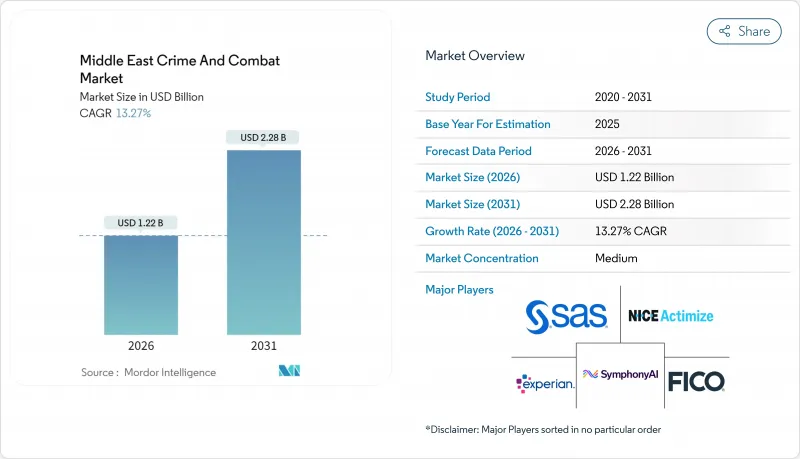
這一強勁成長反映了阿拉伯聯合大公國和沙烏地阿拉伯日益普及的數位支付、電子客戶身份驗證 (e-KYC) 要求,以及與「2030願景」相契合的金融業現代化進程,合規支出也成為成長的催化劑。交易量加速成長、地緣政治風險上升以及雲端運算的快速普及,共同推動了對即時監控工具、人工智慧驅動的異常檢測和跨境資料共用中心的穩定需求。由於阿拉伯語的專業性和特定司法管轄區的要求阻礙了新進入者,也使得本地專家能夠與全球供應商並存,因此競爭依然適中。隨著銀行尋求可擴展的基礎設施,雲端運算正逐漸成為主流,但在資料主權至關重要的領域,本地部署系統仍然普遍存在。在全部區域,越來越多的投資決策傾向於選擇整合反洗錢 (AML)、反詐欺、反恐融資和報告功能的平台,從而簡化供應商佈局並縮短部署時間。
中東犯罪和打擊市場的趨勢和洞察
數位支付的快速普及推動了基礎設施現代化
在海灣地區,行動支付和非接觸式支付已成為主流零售消費方式,每日交易量達數百萬筆。儘管沙烏地阿拉伯已投入11億美元用於合規,但仍面臨因金融犯罪損失5.74% GDP的風險,這進一步凸顯了對高吞吐量監控引擎的需求。阿拉伯聯合大公國強制性的電子「了解你的客戶」(KYC)流程已建立起一套標準的客戶准入規則,鄰國也紛紛效仿,從而縮短了身份驗證時間並提高了數據品質標準。數位交易量的成長擴大了攻擊面,尤其是透過遊戲平台進行的合成身分詐騙和洗錢活動。這迫使銀行每季更新其演算法。雲端原生工具提供彈性處理能力,可擴展以因應季節性消費高峰,從而推動雲端採用率以21.24%的複合年成長率成長。已整合人工智慧評分模型的金融機構已實現兩位數的誤報率下降,並顯著縮短了客戶核准週期。
加強海灣合作理事會內部跨境貿易監管,有助於制定區域標準。
沿岸地區的物流走廊促進了亞洲、歐洲和非洲之間的多幣種貿易,使得基於貿易的洗錢(TBML)成為系統性風險。銀行正在部署人工智慧分析技術來檢測高估或低估發票金額的行為,並對海關、運輸和支付數據進行近乎即時的關聯分析。區塊鏈在貿易融資領域的應用提高了透明度,但也產生了需要專門分析引擎的大量資料集。杜拜和利雅德新建的資訊共用中心分發預警指標,並將平均偵測時間從幾天縮短到幾小時。隨著監管趨同,提供多語言和製裁篩檢解決方案的供應商價格更高,而規模較小的金融機構正在採用共用服務模式以降低准入門檻。
缺乏精通阿拉伯語的合規分析師限制了其應用。
法規要求以阿拉伯語撰寫可疑活動報告,但經驗豐富的分析師人才儲備無法滿足需求。與僅使用英語的職位相比,阿拉伯語職位的薪資溢價超過40%,導致成本膨脹,招聘週期延長。銀行正在轉向機器翻譯和人工智慧摘要技術,但監管機構要求對高風險案件進行人工審核,這使得瓶頸問題仍然存在。沙烏地阿拉伯的主要銀行目前贊助大學課程,但專家表示,畢業生需要三到五年才能熟練案件處理技能。提供阿拉伯語介面和在地化工作流程的供應商則能更快獲得實施核准。
細分市場分析
交易監控解決方案將佔2025年收入的28.74%,凸顯其作為反洗錢專案監管支柱的地位。這一佔有率相當於中東地區約3.1億美元的犯罪市場規模。雲端原生引擎每天可無延遲地篩檢數百萬筆小額支付,從而維持供應商與一級銀行的合作關係。詐騙偵測和案件管理是成長最快的細分市場,年複合成長率達14.73%,受益於合成身分和深度造假驅動的洗錢網路的興起。供應商正在將這些曾經獨立的模組整合為整合套件,從而降低整體擁有成本並促進風險管治。
目前,生成式人工智慧元件能夠產生調查方案,為可疑活動報告 (SAR) 提交提案行動計畫建議,並對事件升級的緊迫性進行排序。 Oracle 的代理程式展現出不斷發展的趨勢,包括自主查詢第三方資料庫以豐富警報資訊。像 EastNets 這樣的區域參與企業則透過整合阿拉伯語自然語言生成功能來應對這項挑戰,從而保留文化脈絡。整合了多家供應商的機構表示,模型檢驗審核更加順暢,整合開銷也更低。
到2025年,雲端模式將佔據中東打擊犯罪和因應措施市場60.98%的佔有率,市場規模約6.6億美元。隨著阿拉伯聯合大公國和沙烏地阿拉伯的監管機構批准關鍵工作負載的外部部署託管,雲端模式的採用率將繼續以20.82%的複合年成長率成長。 SaaS產品使中小規模的金融科技公司無需大量前期投資即可獲得企業級分析服務。混合架構受到銀行的青睞,這些銀行需要在本地儲存某些個人識別訊息,同時利用區域資料中心的彈性分析功能。
本地部署在主權財富基金和國防銀行等優先考慮實體資料隔離的機構中仍然佔據著一定的佔有率。但即便如此,這些相關人員也在試辦容器化微服務,以減少修補程式管理週期。供應商藍圖強調單一租戶雲端方案,這些方案在滿足資料主權法規的同時,也能保持與多租戶版本一致的升級節奏。
其他福利
- Excel格式的市場預測(ME)表
- 3個月的分析師支持
目錄
第1章 引言
- 研究假設和市場定義
- 調查範圍
第2章調查方法
第3章執行摘要
第4章 市場情勢
- 市場概覽
- 市場促進因素
- 數位支付的快速普及
- 加強海灣合作理事會區域內跨境交易的監測
- 強制性電子身分驗證架構(阿拉伯聯合大公國、沙烏地阿拉伯)
- 一級銀行採用基於人工智慧的異常檢測現狀
- 加密資產在不同地區的監管一致性
- 公私合營的金融犯罪資訊共用中心
- 市場限制
- 阿拉伯語合規分析師短缺
- 分散的遺留核心銀行系統
- 切換到本地部署系統成本高昂
- 由於地區地緣政治局勢的變化,制裁措施日益複雜化。
- 產業價值/價值鏈分析
- 監管環境
- 技術展望
- 波特五力分析
- 供應商的議價能力
- 消費者議價能力
- 新進入者的威脅
- 替代品的威脅
- 競爭對手之間的競爭
第5章 市場規模與成長預測
- 透過解決方案
- 了解你的客戶(KYC)系統
- 交易監控
- 合規報告套件
- 審核與分析
- 詐欺檢測/案件管理
- 透過部署模式
- 雲
- 本地部署
- 按最終用戶行業分類
- BFSI
- 政府和執法機關
- 金融科技和支付服務供應商
- 透過使用
- 反洗錢(AML)
- 打擊恐怖主義融資(CTF)
- 詐欺和網路犯罪檢測
- 監管和稅務合規(FATCA、CRS)
- 按地區
- 阿拉伯聯合大公國
- 沙烏地阿拉伯王國
- 卡達
- 埃及
- 科威特
- 巴林和阿曼
- 其他中東地區
第6章 競爭情勢
- 市場集中度
- 策略趨勢
- 市佔率分析
- 公司簡介
- SAS Institute Inc.
- NICE Ltd(Actimize Solutions)
- Fair Isaac Corporation(FICO)
- ACI Worldwide Inc.
- Oracle Financial Services Software Ltd.
- Fiserv Inc.
- Experian plc
- Refinitiv Ltd(LSE Group)
- EastNets FZ-LLC
- Tata Consultancy Services Ltd.
- Temenos AG
- Wolters Kluwer NV
- Fidelity National Information Services Inc.(FIS)
- SymphonyAI Financial Crime
- iSPIRAL IT Solutions Ltd.
第7章 市場機會與未來展望
Middle East crime and combat market size in 2026 is estimated at USD 1.22 billion, growing from 2025 value of USD 1.08 billion with 2031 projections showing USD 2.28 billion, growing at 13.27% CAGR over 2026-2031.
This vigorous expansion reflects rising digital-payments usage, mandatory e-KYC rules in the UAE and Saudi Arabia, and Vision 2030-linked financial-sector modernization that turns compliance spending into a growth catalyst. Transaction-volume acceleration, heightened geopolitical risk, and rapid cloud adoption jointly create steady demand for real-time monitoring tools, AI-driven anomaly detection, and cross-border data-sharing hubs. Competitive intensity stays moderate because specialized Arabic-language and jurisdiction-specific requirements deter new entrants, allowing regional specialists to coexist with global vendors. Cloud deployment dominates as banks pursue scalable infrastructure, yet on-premise systems persist where data-sovereignty mandates apply. Across the region, investment decisions increasingly favor integrated platforms that unify AML, fraud, CTF, and reporting functions, streamlining vendor footprints and implementation timelines.
Middle East Crime And Combat Market Trends and Insights
Rapid Digital-Payments Penetration Drives Infrastructure Modernization
Mobile and contactless payments now dominate retail spending across the Gulf, pushing daily transaction counts into the multi-million range. Saudi Arabia risks losing 5.74% of GDP to financial crime despite allocating USD 1.10 billion to compliance, reinforcing the need for high-throughput monitoring engines. Mandatory e-KYC in the UAE standardizes onboarding rules that neighboring states are replicating, trimming verification times, and raising baseline data quality. Higher digital volumes enlarge attack surfaces, especially for synthetic-identity fraud and gaming-platform laundering, compelling banks to refresh algorithms quarterly. Cloud-native tools offer elastic processing that scales with seasonal spending peaks, explaining the 21.24% CAGR logged by cloud deployments. Institutions that integrate AI-scoring models report double-digit drops in false positives and materially faster customer-acceptance cycles.
Intensifying GCC Cross-Border Trade Surveillance Creates Regional Standards
The Gulf's logistics corridors channel multi-currency trade between Asia, Europe, and Africa, turning trade-based money-laundering (TBML) into a systemic risk. Banks deploy AI analytics to flag over- or under-invoices and to correlate customs, shipping, and payment data in near real time. Blockchain pilots in trade finance introduce transparency but also generate vast datasets that require purpose-built analytics engines. Newly formed intelligence-sharing centers in Dubai and Riyadh distribute red-flag indicators, cutting the average detection window from days to hours. As regulations converge, vendors capable of delivering multilingual, sanctions-screening-ready solutions gain a price premium, and smaller institutions adopt shared-service models to lower entry costs.
Shortage of Arabic-Speaking Compliance Analysts Constrains Implementation
Regulations require suspicious-activity reports to be prepared in Arabic, yet the talent pool of experienced analysts lags demand. Salary premiums exceed 40% compared with English-only roles, inflating cost bases and prolonging hiring cycles. Banks turn to automated translation and AI summarization, but regulators insist on human oversight for high-risk cases, preserving the bottleneck. Large Saudi banks now sponsor university programs, yet experts note a 3-5-year maturation window before graduates achieve case-handling proficiency. Vendors that embed Arabic interfaces and localized workflows gain faster deployment approvals.
Other drivers and restraints analyzed in the detailed report include:
- AI-Driven Anomaly Detection Adoption Transforms Detection Capabilities
- Regional Crypto-Asset Regulation Alignment Standardizes Compliance
- Fragmented Legacy Core-Banking Stacks Impede Integration Efficiency
For complete list of drivers and restraints, kindly check the Table Of Contents.
Segment Analysis
Transaction Monitoring solutions generated 28.74% of 2025 revenue, underscoring their status as the regulatory workhorse anchoring every AML program. That share equates to roughly USD 0.31 billion of the Middle East crime and combat market size. Cloud-native engines that screen millions of daily micro-payments without latency maintain vendor lock-in across Tier-1 banks. Fraud Detection and Case Management, the fastest-growing line at 14.73% CAGR, benefits from rising synthetic-identity abuse and deepfake-enabled mule networks. Vendors are converging these once-separate modules into unified suites, lowering the total cost of ownership and easing model-risk governance.
Generative-AI components now draft investigation narratives, recommend SAR filing dispositions, and rank escalation urgency. Oracle's agents exemplify the trajectory, autonomously querying third-party databases to enrich alerts. Regional players such as EastNets respond by embedding Arabic natural-language generation to preserve cultural context. Institutions that consolidate vendors report smoother model-validation audits and reduced integration overhead.
Cloud models held a 60.98% share in 2025, equivalent to roughly USD 0.66 billion of the Middle East crime and combat market share. Adoption will continue at 20.82% CAGR as regulators in the UAE and Saudi Arabia ratify off-premise hosting for critical workloads. SaaS offerings allow smaller fintechs to access enterprise-grade analytics without large upfront capital outlays. Hybrid designs appeal to banks that must keep certain personally identifiable data on domestic soil yet still harness elastic analytics in regional data centers.
On-premise deployments retain niche relevance among sovereign-wealth entities and defense-linked banks that prioritize physical data segregation. Yet even these stakeholders pilot containerized micro-services to slash patch-management cycles. Vendor roadmaps emphasize single-tenant cloud options that satisfy data-sovereignty statutes while preserving upgrade cadence parity with multi-tenant releases.
The Middle East Crime and Combat Market is Segmented by Solutions (KYC Systems, Compliance Reporting Suites, and More), Deployment Mode (Cloud, On-Premises), End-User Vertical(BFSI, Fintechs and Payment Service Providers, and More), Application (Anti-Money Laundering, Counter-Terrorist Financing, and More), and by Country. The Market Forecasts are Provided in Terms of Value (USD).
List of Companies Covered in this Report:
- SAS Institute Inc.
- NICE Ltd (Actimize Solutions)
- Fair Isaac Corporation (FICO)
- ACI Worldwide Inc.
- Oracle Financial Services Software Ltd.
- Fiserv Inc.
- Experian plc
- Refinitiv Ltd (LSE Group)
- EastNets FZ-LLC
- Tata Consultancy Services Ltd.
- Temenos AG
- Wolters Kluwer NV
- Fidelity National Information Services Inc. (FIS)
- SymphonyAI Financial Crime
- iSPIRAL IT Solutions Ltd.
Additional Benefits:
- The market estimate (ME) sheet in Excel format
- 3 months of analyst support
TABLE OF CONTENTS
1 INTRODUCTION
- 1.1 Study Assumptions and Market Definition
- 1.2 Scope of the Study
2 RESEARCH METHODOLOGY
3 EXECUTIVE SUMMARY
4 MARKET LANDSCAPE
- 4.1 Market Overview
- 4.2 Market Drivers
- 4.2.1 Rapid digital-payments penetration
- 4.2.2 Intensifying GCC cross-border trade surveillance
- 4.2.3 Mandatory e-KYC frameworks (UAE, KSA)
- 4.2.4 AI-driven anomaly detection adoption (Tier-1 banks)
- 4.2.5 Regional crypto-asset regulation alignment
- 4.2.6 Public-private financial-crime information-sharing hubs
- 4.3 Market Restraints
- 4.3.1 Shortage of Arabic-speaking compliance analysts
- 4.3.2 Fragmented legacy core-banking stacks
- 4.3.3 High on-premise system switching costs
- 4.3.4 Evolving sanctions complexity linked to regional geopolitics
- 4.4 Industry Value / Supply-Chain Analysis
- 4.5 Regulatory Landscape
- 4.6 Technological Outlook
- 4.7 Porter's Five Forces Analysis
- 4.7.1 Bargaining Power of Suppliers
- 4.7.2 Bargaining Power of Consumers
- 4.7.3 Threat of New Entrants
- 4.7.4 Threat of Substitutes
- 4.7.5 Intensity of Competitive Rivalry
5 MARKET SIZE AND GROWTH FORECASTS (VALUE)
- 5.1 By Solution
- 5.1.1 Know-Your-Customer (KYC) Systems
- 5.1.2 Transaction Monitoring
- 5.1.3 Compliance Reporting Suites
- 5.1.4 Auditing and Analytics
- 5.1.5 Fraud Detection / Case Management
- 5.2 By Deployment Mode
- 5.2.1 Cloud
- 5.2.2 On-premises
- 5.3 By End-user Vertical
- 5.3.1 BFSI
- 5.3.2 Government and Law-Enforcement Agencies
- 5.3.3 FinTechs and Payment Service Providers
- 5.4 By Application
- 5.4.1 Anti-Money Laundering (AML)
- 5.4.2 Counter-Terrorist Financing (CTF)
- 5.4.3 Fraud and Cyber-crime Detection
- 5.4.4 Regulatory and Tax Compliance (FATCA, CRS)
- 5.5 By Geography
- 5.5.1 United Arab Emirates
- 5.5.2 Kingdom of Saudi Arabia
- 5.5.3 Qatar
- 5.5.4 Egypt
- 5.5.5 Kuwait
- 5.5.6 Bahrain and Oman
- 5.5.7 Rest of Middle East
6 COMPETITIVE LANDSCAPE
- 6.1 Market Concentration
- 6.2 Strategic Moves
- 6.3 Market Share Analysis
- 6.4 Company Profiles (includes Global level Overview, Market level overview, Core Segments, Financials as available, Strategic Information, Market Rank/Share for key companies, Products and Services, and Recent Developments)
- 6.4.1 SAS Institute Inc.
- 6.4.2 NICE Ltd (Actimize Solutions)
- 6.4.3 Fair Isaac Corporation (FICO)
- 6.4.4 ACI Worldwide Inc.
- 6.4.5 Oracle Financial Services Software Ltd.
- 6.4.6 Fiserv Inc.
- 6.4.7 Experian plc
- 6.4.8 Refinitiv Ltd (LSE Group)
- 6.4.9 EastNets FZ-LLC
- 6.4.10 Tata Consultancy Services Ltd.
- 6.4.11 Temenos AG
- 6.4.12 Wolters Kluwer NV
- 6.4.13 Fidelity National Information Services Inc. (FIS)
- 6.4.14 SymphonyAI Financial Crime
- 6.4.15 iSPIRAL IT Solutions Ltd.
7 Market Opportunities and Future Outlook
- 7.1 White-space and Unmet-Need Assessment

 2026-2030年全球分析市場
 服務分析市場:全球市場預測,2026-2032年
 NeighborIQ 分析市場預測至 2034 年:按分析類型、部署模式、技術、應用、最終用戶和地區分類的全球分析
 全球服務分析市場
 2026年全球分析市場報告
 全球服務分析市場規模、佔有率、趨勢和成長分析報告(2026-2034)
 犯罪分析工具市場 - 全球產業規模、佔有率、趨勢、機會、預測:按類型、按應用、按部署類型、按地區和競爭對手分類,2021-2031年全球犯罪分析工具市場
 全球旋轉工具市場:成長、未來展望與競爭分析(2024-2032 年)
 旋轉工具市場機會、成長動力、產業趨勢分析與預測 2024 - 2032