


 |
市場調查報告書
商品編碼
1911735
非營利組織軟體:市場佔有率分析、產業趨勢與統計、成長預測(2026-2031)Non-Profit Software - Market Share Analysis, Industry Trends & Statistics, Growth Forecasts (2026 - 2031) |
||||||

※ 本網頁內容可能與最新版本有所差異。詳細情況請與我們聯繫。
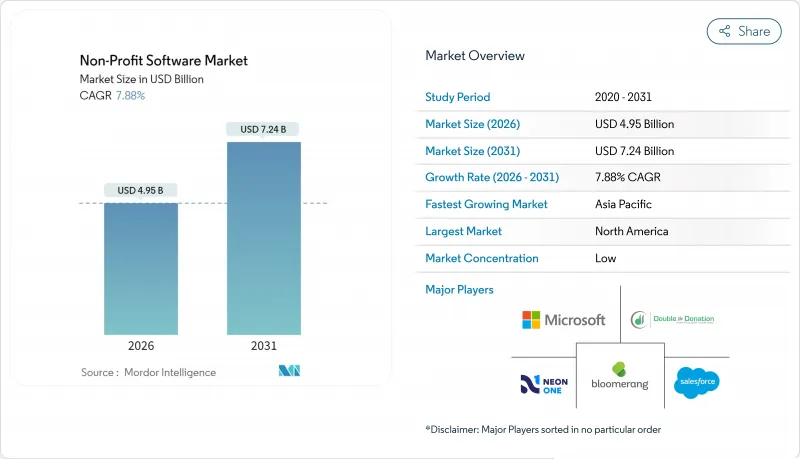
預計到 2026 年,非營利組織軟體市場規模將達到 49.5 億美元,高於 2025 年的 45.9 億美元。預計到 2031 年,該市場規模將達到 72.4 億美元,2026 年至 2031 年的複合年成長率為 7.88%。
市場規模的不斷擴大反映了雲端運算的顯著普及、人工智慧技術的快速應用以及日益嚴格的資料隱私法規對軟體合規性的高要求。市場對能夠打破資料孤島的整合式資金籌措套件和用於解決長期人手短缺問題的自動化工具的需求最為旺盛。那些整合了預測性捐贈者分析、行動優先捐贈選項和嵌入式支付功能的供應商正在獲得明顯的競爭優勢。同時,GDPR 和 CCPA 等法規結構正促使非營利組織的董事會優先選擇具有認證安全控制的平台,加速了傳統本地部署系統的替換。
全球非營利組織軟體市場趨勢與洞察
雲端SaaS解決方案的興起
採用雲端技術可以降低資本支出,並實現遠端訪問,這在疫情封鎖期間變得尤為重要。採用率數據顯示,從本地部署遷移到 SaaS 可以將總體擁有成本 (TCO) 降低約 30-40%。微軟計劃在 2026 年 12 月之前停止其「籌款與互動」產品,凸顯了向雲端原生架構的更廣泛轉變。訂閱收費系統與非營利組織的現金流量週期相契合,而內建的合規功能對面臨 GDPR 和 CCPA 合規義務的董事會來說極具吸引力。這些優勢正在加速從電子表格和老舊的本地伺服器轉向現代化、持續更新且可隨宣傳活動擴展的平台的轉變。
對整合式資金籌措和捐贈者管理平台的需求日益成長
董事會期望獲得整合的影響報告,而各自獨立的、功能單一的解決方案會阻礙這一目標的實現。 OneCause 計劃於 2025 年 1 月發布的 Salesforce Nonprofit Success Pack 連接器,展示了緊密整合如何幫助減少手動資料輸入並提升對捐贈者的洞察。能夠與現有 CRM 系統無縫同步的供應商將更具優勢,因為非營利組織更傾向於漸進式升級,而非風險極高的全面改造計劃。向整合套件的轉變反映了該領域的成熟;如今,各組織需要企業級分析、自動化工作流程和全通路互動,而這些功能過去只有商業品牌才能提供。
小規模非營利組織的預算限制
紐西蘭和澳洲每位全職員工的平均技術預算在2,537美元到3,942美元之間,顯然資金短缺正在減緩軟體更新的速度。即使有許可折扣,實施和培訓成本也會對資源造成壓力,而缺乏專職IT人員則阻礙了全部功能的發揮。免費增值模式和TechSoup補貼雖然降低了實施成本,但很少能涵蓋持續的管理成本,這加劇了大型企業和小規模企業在軟體採用方面的兩極化。
細分市場分析
到2025年,雲端技術在非營利組織軟體市場的佔比將達到61.72%,預計到2031年將以11.32%的複合年成長率成長。隨著非營利組織淘汰老舊伺服器並轉向能夠適應會計週期和遠端辦公模式的SaaS解決方案,雲端解決方案的成長速度預計將超過整個行業的成長速度。供應商正在提供遷移服務,以便在不中斷服務的情況下遷移捐贈者歷史資料、志工記錄和資金帳戶。微軟募款和互動產品即將停止支持,迫使許多組織重新評估其基礎設施,而GDPR也正在影響區域一般資料保護規則託管的決策。
如果大規模機構已對其資料中心進行了大量投資,或者必須滿足嚴格的居住規定(例如醫院基金會),它們將繼續維持在地部署。然而,即使是這些機構也在採用混合模式,以保護敏感的醫療捐贈者文件,同時利用最新的分析技術。預計非營利軟體市場中本地部署解決方案的佔有率將穩步下降,這表明人們越來越接受雲端的彈性、自動修補和付費使用制。
大型非營利組織擁有更充足的預算、專業的IT團隊和複雜的跨地域運營,預計到2025年,其支出將佔總支出的52.05%。美國男孩女孩俱樂部在短短九個月內為旗下350個分會部署了一套通用的客戶關係管理系統(CRM),證明了這種規模部署的可行性。然而,中小企業的成長速度最快,年複合成長率高達13.05%,這得益於軟體即服務(SaaS)降低了進入門檻。雲端訂閱將傳統的資本支出轉化為可預測的營運支出,而免費增值計畫則可在全面實施前提供部分功能。
儘管中小企業發展迅速,但其在人才和資金方面的限制使其難以獲得高級功能。每位員工的平均技術預算仍然低於 4,000 美元,這使得那些提供強大的入職支援、模板化工作流程和同儕培訓社群的供應商更具優勢。 TechSoup 等平台持續提供的折扣計劃對於提高軟體的普及率至關重要。雖然中小企業預計將填補部分現有空白,但大型企業仍將佔據非營利組織軟體市場的大部分佔有率。
區域分析
北美地區將佔2025年總收入的44.05%,這得益於其對慈善捐贈的優惠稅收政策和完善的供應商生態系統。像美國男孩女孩俱樂部這樣的大規模全國性部署項目,展現了美國組織在整合數百個地點數據方面的規模潛力。加拿大和墨西哥也蘊藏著成長空間,尤其是在雲端遷移受到與美國標準相媲美的安全認證所推動的情況下。諸如《加州消費者隱私法案》(CCPA) 等資料保護法提升了具有可驗證合規審核的平台的吸引力,進一步鞏固了領先供應商的地位。
歐洲是一個成熟但監管嚴格的市場。 GDPR強制要求嚴格追蹤用戶同意情況並進行違規通知,這促使非營利組織選擇擁有本地資料中心和完善審核功能的供應商。對永續性指標和社會影響報告的日益重視,推動了對能夠將捐款與實際成果聯繫起來的詳細分析的需求。本地化(語言、貨幣和法定報告)仍然是區域供應商與全球平台之間的差異。儘管GDP成長較為溫和,但歐盟委員會的數位轉型資金仍在持續支持現代化非營利組織技術棧的投資。
亞太地區是成長最快的地區,預計到2031年複合年成長率將達到11.36%。目前只有27%的非營利組織已遷移到雲端,這意味著仍有巨大的成長空間。智慧型手機的普及率遠超過銀行分店,為行動優先的捐贈應用程式提供了強力的支援。 Google.org向Infoxchange提供的150萬美元津貼,凸顯了該地區慈善機構為實現營運數位化所做的共同努力。澳洲和紐西蘭是早期採用者,而東南亞則是一個潛力巨大的未開發市場,非營利組織可以直接遷移到SaaS平台,而無需受到舊有系統的限制。提供輕量級、行動最佳化、客製化介面和區域特定支付選項的供應商將最快獲得市場佔有率。
其他福利:
- Excel格式的市場預測(ME)表
- 3個月的分析師支持
目錄
第1章 引言
- 研究假設和市場定義
- 調查範圍
第2章調查方法
第3章執行摘要
第4章 市場情勢
- 市場概覽
- 市場促進因素
- 雲端SaaS解決方案的興起
- 對整合式資金籌措和捐贈者管理平台的需求日益成長
- 提高非營利組織日常營運的自動化程度
- 拓展行動和數位捐贈管道
- 人工智慧驅動的預測性捐贈者分析的興起提高了投資收益(ROI)
- 內建支付API,支持小額捐贈
- 市場限制
- 小規模非營利組織的預算限制
- 雲端解決方案的資料安全和隱私問題
- 與現有志工管理資料庫整合的複雜性
- 捐贈者疲勞會阻礙新軟體工具的採用
- 價值/供應鏈分析
- 監管環境
- 技術展望
- 波特五力分析
- 新進入者的威脅
- 買方的議價能力
- 供應商的議價能力
- 替代品的威脅
- 競爭對手之間的競爭
- 投資分析
第5章 市場規模與成長預測
- 透過部署
- 本地部署
- 雲
- 按公司規模
- 中小型非營利組織
- 大型非營利組織
- 按功能模組
- 資金籌措和捐贈管理
- 組件/CRM
- 行銷互動
- 志工管理
- 津貼管理
- 財會
- 其他模組
- 按收入模式
- 基於訂閱的SaaS
- 永久許可
- 免費加值軟體和捐款軟體
- 終端用戶產業
- 教育非營利組織
- 醫療和醫院基金會
- 基於信仰/宗教的
- 人類服務與國際援助
- 藝術與文化
- 環境/動物福利
- 其他
- 按地區
- 北美洲
- 美國
- 加拿大
- 墨西哥
- 歐洲
- 德國
- 英國
- 法國
- 俄羅斯
- 其他歐洲地區
- 亞太地區
- 中國
- 日本
- 印度
- 韓國
- 澳洲
- 亞太其他地區
- 中東和非洲
- 中東
- 沙烏地阿拉伯
- 阿拉伯聯合大公國
- 其他中東地區
- 非洲
- 南非
- 埃及
- 其他非洲地區
- 中東
- 南美洲
- 巴西
- 阿根廷
- 南美洲其他地區
- 北美洲
第6章 競爭情勢
- 市場集中度分析
- 策略性措施(併購、合作、新服務推出)
- 市佔率分析(前 15 家公司,2024 年)
- 公司簡介
- Blackbaud, Inc.
- Salesforce, Inc.
- Bloomerang, LLC
- Bonterra Tech, Inc.(Network for Good & EveryAction)
- Neon One, LLC
- Microsoft Corporation
- SAP SE
- Intuit Inc.
- Oracle Corporation
- Double the Donation, LLC
- DonorSearch, LLC
- WealthEngine, Inc.
- Community Brands Intermediate, LLC
- Cvent Holding Corp.
- Classy, Inc.
- DonorPerfect(SofterWare, Inc.)
- Virtuous Software, Inc.
- Funraise, Inc.
- Qgiv, Inc.
- Give Lively LLC
第7章 市場機會與未來趨勢
- 評估差距和未滿足的需求
Non-Profit Software market size in 2026 is estimated at USD 4.95 billion, growing from 2025 value of USD 4.59 billion with 2031 projections showing USD 7.24 billion, growing at 7.88% CAGR over 2026-2031.
The market size expansion mirrors a pronounced shift toward cloud deployment, rapid uptake of artificial intelligence features, and stricter data-privacy regulation that elevates software compliance requirements. Demand is strongest for unified fundraising suites that collapse data silos and for automation tools that offset chronic staff shortages. Vendors that embed predictive donor analytics, mobile-first giving options, and embedded payment capabilities are carving out clear competitive advantage. Meanwhile, regulatory frameworks such as GDPR and CCPA encourage nonprofit boards to favor platforms with certified security controls, which in turn accelerates the replacement of legacy on-premises systems.
Global Non-Profit Software Market Trends and Insights
Proliferation of Cloud-Based SaaS Solutions
Cloud adoption trims capital expenditure and delivers remote access that became essential during pandemic lockdowns. Moving from on-premises to SaaS cuts total cost of ownership by around 30-40% according to implementation data. Microsoft's plan to retire its Fundraising and Engagement product by December 2026 underscores a wider pivot to cloud-native architectures. Subscription pricing meshes with nonprofit cash-flow cycles, and built-in compliance features appeal to boards grappling with GDPR and CCPA obligations. These attributes accelerate migration from spreadsheets and aging local servers into modern, continuously updated platforms that scale with campaign volume.
Growing Demand for Integrated Fundraising and Donor Management Platforms
Boards expect consolidated impact reporting, and siloed point solutions undermine that goal. OneCause's January 2025 connector for Salesforce Nonprofit Success Pack shows how tight integration reduces manual data entry and improves donor insights. Vendors able to sync seamlessly with existing CRMs gain an edge because nonprofits prefer evolutionary upgrades over risky rip-and-replace projects. The move toward unified suites reflects the sector's maturation: organizations now demand enterprise-grade analytics, automated workflows, and omnichannel engagement once reserved for commercial brands.
Budget Constraints Among Small Nonprofits
Average technology budgets of USD 2,537-3,942 per full-time employee in New Zealand and Australia reveal how limited funds delay software upgrades. Even when license discounts exist, implementation and training costs strain resources, and the absence of dedicated IT staff hampers full feature utilization. Freemium tiers and TechSoup subsidies alleviate entry costs yet rarely cover ongoing administration, reinforcing a two-speed adoption pattern between large and small organizations.
Other drivers and restraints analyzed in the detailed report include:
- Rising Automation of Routine Nonprofit Workflows
- Expansion of Mobile and Digital Giving Channels
- Data Security and Privacy Concerns with Cloud Solutions
For complete list of drivers and restraints, kindly check the Table Of Contents.
Segment Analysis
Cloud deployments generated 61.72% of the Non-Profit Software market in 2025 and are projected to expand at an 11.32% CAGR through 2031. The Non-Profit Software market size for cloud solutions is therefore set to outpace overall sector growth as nonprofits retire aging servers in favor of SaaS that matches fiscal cycles and remote-work patterns. Vendors bundle migration services so that historical donor data, volunteer records, and fund accounts transfer without downtime. The looming sunset of Microsoft's Fundraising and Engagement product compels many organizations to reevaluate infrastructure, and GDPR is shaping decisions about regional data hosting.
On-premises installations persist within large institutions that already invested heavily in in-house data centers or that must meet strict residency rules, such as hospital foundations. Yet even these organizations are adopting hybrid models to tap modern analytics while safeguarding sensitive medical donor files. The Non-Profit Software market share of on-premises solutions is forecast to decline steadily, signaling widening acceptance of cloud resilience, automatic patching, and consumption-based pricing.
Large nonprofits held 52.05% of 2025 spending thanks to deeper budgets, dedicated IT teams, and complex multi-site operations. The Boys and Girls Clubs of America deployed a universal CRM across 350 chapters within nine months, highlighting the scale possible in this tier. However, the small and medium band grows fastest at 13.05% CAGR as SaaS lowers entry barriers. Cloud subscriptions convert what used to be capital expenditure into predictable operating outlays, while freemium plans introduce functionality before a full commitment.
Despite growth, SMEs confront staff and capital shortages that limit advanced feature usage. Average technology allocations remain under USD 4,000 per employee, so vendors that provide robust onboarding, templated workflows, and peer training communities stand to gain. Continued discount programs from platforms such as TechSoup will be critical in widening adoption. The Non-Profit Software market size for SMEs is expected to close part of today's gap, yet large organizations will still account for a majority of absolute dollars.
The Non-Profit Software Market Report is Segmented by Deployment (On Premises, Cloud), by Enterprise Size (SMEs, Large Enterprise), by Type (Admission-Based Nonprofit Software, Fundraising Software, Marketing Software, Volunteer Management, CRM, Other Types), and by Geography. The Market Forecasts are Provided in Terms of Value (USD).
Geography Analysis
North America delivered 44.05% of 2025 revenue, underpinned by favorable tax incentives for charitable giving and sophisticated vendor ecosystems. Large national implementations such as Boys and Girls Clubs of America highlight the scale potential when U.S. organizations unify data across hundreds of locations. Canada and Mexico add headroom, particularly for cloud migrations spurred by security certifications that now rival U.S. standards. Data-privacy laws such as CCPA reinforce the appeal of platforms with demonstrable compliance audits, further entrenching leading vendors.
Europe forms a mature but highly regulated landscape. GDPR mandates rigorous consent tracking and breach notification, so nonprofits select providers with local data centers and robust audit trails. Emphasis on sustainability metrics and social-impact reporting fuels demand for granular analytics that tie donations to outcomes. Localization-language, currency, and statutory reporting-remains a differentiator for regional vendors competing against global platforms. Despite modest GDP growth, digital-transformation funding from the European Commission keeps investment flowing into modern nonprofit stacks.
Asia-Pacific is the fastest-growing region at an 11.36% CAGR through 2031. Only 27% of nonprofits have migrated to cloud, revealing significant runway for uptake. Smartphone penetration vastly exceeds branch banking coverage, so mobile-first giving apps resonate strongly. Google.org's USD 1.5 million grant to Infoxchange underscores a coordinated push to digitize operations among regional charities. Australia and New Zealand provide early-adopter case studies, while Southeast Asia offers a greenfield prospect where nonprofits can leapfrog directly to SaaS without legacy baggage. Vendors that tailor lightweight, mobile-optimized interfaces and deliver regional payment options stand to gain share fastest.
- Blackbaud, Inc.
- Salesforce, Inc.
- Bloomerang, LLC
- Bonterra Tech, Inc. (Network for Good & EveryAction)
- Neon One, LLC
- Microsoft Corporation
- SAP SE
- Intuit Inc.
- Oracle Corporation
- Double the Donation, LLC
- DonorSearch, LLC
- WealthEngine, Inc.
- Community Brands Intermediate, LLC
- Cvent Holding Corp.
- Classy, Inc.
- DonorPerfect (SofterWare, Inc.)
- Virtuous Software, Inc.
- Funraise, Inc.
- Qgiv, Inc.
- Give Lively LLC
Additional Benefits:
- The market estimate (ME) sheet in Excel format
- 3 months of analyst support
TABLE OF CONTENTS
1 INTRODUCTION
- 1.1 Study Assumptions and Market Definition
- 1.2 Scope of the Study
2 RESEARCH METHODOLOGY
3 EXECUTIVE SUMMARY
4 MARKET LANDSCAPE
- 4.1 Market Overview
- 4.2 Market Drivers
- 4.2.1 Proliferation of cloud-based SaaS solutions
- 4.2.2 Growing demand for integrated fundraising & donor management platforms
- 4.2.3 Rising automation of routine nonprofit workflows
- 4.2.4 Expansion of mobile & digital giving channels
- 4.2.5 Emergence of AI-driven predictive donor analytics boosting ROI
- 4.2.6 Embedded payment APIs enabling micro-donations
- 4.3 Market Restraints
- 4.3.1 Budget constraints among small nonprofits
- 4.3.2 Data security & privacy concerns with cloud solutions
- 4.3.3 Integration complexity with legacy volunteer databases
- 4.3.4 Donor fatigue limiting uptake of new software tools
- 4.4 Value / Supply-Chain Analysis
- 4.5 Regulatory Landscape
- 4.6 Technological Outlook
- 4.7 Porter's Five Forces Analysis
- 4.7.1 Threat of New Entrants
- 4.7.2 Bargaining Power of Buyers
- 4.7.3 Bargaining Power of Suppliers
- 4.7.4 Threat of Substitutes
- 4.7.5 Intensity of Competitive Rivalry
- 4.8 Investment Analysis
5 MARKET SIZE AND GROWTH FORECASTS (VALUE)
- 5.1 By Deployment
- 5.1.1 On-Premises
- 5.1.2 Cloud
- 5.2 By Enterprise Size
- 5.2.1 Small & Medium Nonprofits
- 5.2.2 Large Nonprofits
- 5.3 By Functional Module
- 5.3.1 Fundraising & Donation Management
- 5.3.2 Constituent / CRM
- 5.3.3 Marketing & Engagement
- 5.3.4 Volunteer Management
- 5.3.5 Grant Management
- 5.3.6 Finance & Accounting
- 5.3.7 Other Modules
- 5.4 By Revenue Model
- 5.4.1 Subscription SaaS
- 5.4.2 Perpetual License
- 5.4.3 Freemium & Donationware
- 5.5 By End-User Vertical
- 5.5.1 Education Nonprofits
- 5.5.2 Healthcare & Hospital Foundations
- 5.5.3 Faith-based & Religious
- 5.5.4 Human Services & International Aid
- 5.5.5 Arts & Culture
- 5.5.6 Environmental & Animal Welfare
- 5.5.7 Others
- 5.6 By Geography
- 5.6.1 North America
- 5.6.1.1 United States
- 5.6.1.2 Canada
- 5.6.1.3 Mexico
- 5.6.2 Europe
- 5.6.2.1 Germany
- 5.6.2.2 United Kingdom
- 5.6.2.3 France
- 5.6.2.4 Russia
- 5.6.2.5 Rest of Europe
- 5.6.3 Asia-Pacific
- 5.6.3.1 China
- 5.6.3.2 Japan
- 5.6.3.3 India
- 5.6.3.4 South Korea
- 5.6.3.5 Australia
- 5.6.3.6 Rest of Asia-Pacific
- 5.6.4 Middle East and Africa
- 5.6.4.1 Middle East
- 5.6.4.1.1 Saudi Arabia
- 5.6.4.1.2 United Arab Emirates
- 5.6.4.1.3 Rest of Middle East
- 5.6.4.2 Africa
- 5.6.4.2.1 South Africa
- 5.6.4.2.2 Egypt
- 5.6.4.2.3 Rest of Africa
- 5.6.4.1 Middle East
- 5.6.5 South America
- 5.6.5.1 Brazil
- 5.6.5.2 Argentina
- 5.6.5.3 Rest of South America
- 5.6.1 North America
6 COMPETITIVE LANDSCAPE
- 6.1 Market Concentration Analysis
- 6.2 Strategic Moves (M&A, Partnerships, Launches)
- 6.3 Market Share Analysis (Top-15, 2024)
- 6.4 Company Profiles (includes Global Level Overview, Market Level Overview, Core Segments, Financials as available, Strategic Information, Market Rank/Share, Products and Services, Recent Developments)
- 6.4.1 Blackbaud, Inc.
- 6.4.2 Salesforce, Inc.
- 6.4.3 Bloomerang, LLC
- 6.4.4 Bonterra Tech, Inc. (Network for Good & EveryAction)
- 6.4.5 Neon One, LLC
- 6.4.6 Microsoft Corporation
- 6.4.7 SAP SE
- 6.4.8 Intuit Inc.
- 6.4.9 Oracle Corporation
- 6.4.10 Double the Donation, LLC
- 6.4.11 DonorSearch, LLC
- 6.4.12 WealthEngine, Inc.
- 6.4.13 Community Brands Intermediate, LLC
- 6.4.14 Cvent Holding Corp.
- 6.4.15 Classy, Inc.
- 6.4.16 DonorPerfect (SofterWare, Inc.)
- 6.4.17 Virtuous Software, Inc.
- 6.4.18 Funraise, Inc.
- 6.4.19 Qgiv, Inc.
- 6.4.20 Give Lively LLC
7 MARKET OPPORTUNITIES AND FUTURE TRENDS
- 7.1 White-space & Unmet-Need Assessment

 2026-2030年全球會計軟體市場
 2026-2030年全球非營利組織軟體市場
 會計軟體市場規模、佔有率、成長、全球產業分析、區域趨勢及2026年至2034年預測。
 會計軟體:市佔率分析、產業趨勢與統計、成長預測(2026-2031)
 會計軟體市場:2026-2032年全球市場預測(依軟體、定價模式、應用程式、部署類型、企業規模、最終用戶和產業分類)
 2026-2030年全球商業會計軟體市場薪資稅合規自動化:市佔率分析、產業趨勢與統計及成長預測(2026-2031 年)薪資和人力資源合規軟體:市場佔有率分析、行業趨勢和統計數據以及成長預測(2026-2031 年)
 2026年全球稅務和會計軟體市場報告
 人力資源和薪資管理軟體市場:按部署類型、行業和地區分類