


 |
市場調查報告書
商品編碼
1911499
印度整車運輸 (FTL):佔有率分析、產業趨勢、統計數據、成長預測 (2026-2031)India Full-Truck-Load (FTL) - Market Share Analysis, Industry Trends & Statistics, Growth Forecasts (2026 - 2031) |
||||||

※ 本網頁內容可能與最新版本有所差異。詳細情況請與我們聯繫。
2025年印度整車運輸(FTL)市值為1,238.5億美元,預計2031年將達到2,032.3億美元,而2026年為1,344.9億美元。
預計在預測期(2026-2031 年)內,複合年成長率將達到 8.60%。
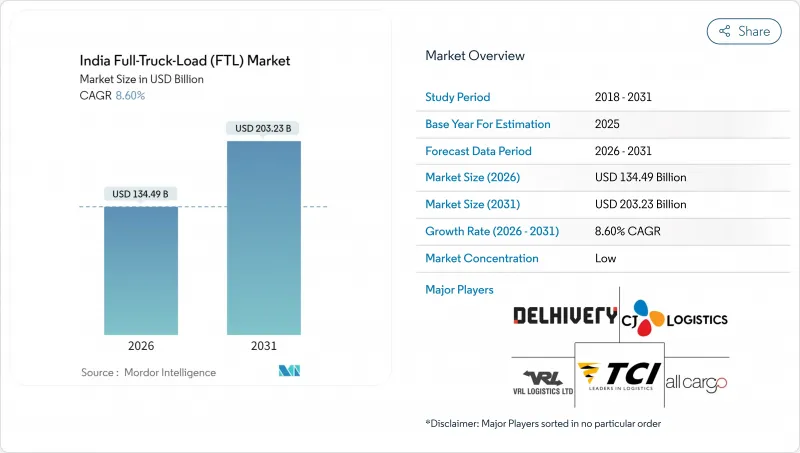
這一持續成長歸功於有組織的零售活動日益活躍、生產連結獎勵計畫計劃下的本地化製造業發展,以及基礎設施現代化進程的加速,特別是專用貨運走廊的建設,這些走廊已將主要路線的運輸時間縮短了高達 65%。商品及服務稅 (GST) 支援的樞紐輻射式倉庫、國家物流政策激勵措施以及即時數位貨運平台正在進一步重塑貨運流程,使承運商能夠最佳化運力、減少空駛里程並實現更穩定的收入。同時,FASTag 98% 的普及率消除了現金收費站的堵塞,每日通行費收入達 1.78 億盧比(12.8 億美元),是 2021 會計年度的兩倍多,直接提高了卡車運轉率和準時交付率。日益激烈的競爭、輕資產營運商的逐步整合、電子商務物流、快速消費需求以及跨國公司採購策略的轉變,持續推動印度整車運輸 (FTL) 市場的上升趨勢。
印度整車運輸 (FTL) 市場趨勢與洞察
有組織的零售和電子商務出貨量激增
電子商務的快速普及促使零售商採用即時庫存策略,導致整車運輸更加頻繁、規模更小,價格也更高。如今,快消業者期望在城市內實現數小時的補貨週期,這迫使承運商配備更先進的溫控和遠端資訊處理追蹤系統的城市車隊。在印度政府為食品加工產業提供的1,090億盧比生產環節獎勵計畫(PLI)的支持下,大型連鎖超市已在加工中心和大都會圈配銷中心之間建立了可預測的長途運輸路線。同時,全通路零售商正在重新設計其配送網路,利用幹線整車運輸車連接區域履約中心,從而增加了對中程短途運輸和交叉轉運的需求。這些轉變有利於擁有可擴展的樞紐輻射式網路而非點對點配送的營運商,鞏固了電子商務作為印度整車運輸市場永續成長驅動力的地位。
透過擴建專用貨運走廊縮短運輸時間
東西向專用貨運走廊目前每天運行391列貨運列車,預計2025年12月全面運作後,鐵路運力將呈指數級成長。低成本的鐵路運輸能夠長途運輸超過1500公里的大宗貨物,而這種模式轉換也同時擴展了公路運輸網路在新建鐵路樞紐附近的「最後一公里」和「首端」運輸業務。運輸業者正在重新配置資產,以應對那些對時間要求高、價值高且易損的貨物,這些貨物需要盈利、高附加價值的處理。投資於鐵路公路連鎖規劃軟體的營運商正在利用該走廊25%的鐵路成本優勢,透過協調取貨和送貨時間,將原本被視為競爭關係的局面轉變為互補的收入來源。此外,三條規劃中的走廊,總投資達2兆盧比(約240億美元),代表著一項持續的基礎設施發展計劃,該計劃將在未來十年重塑印度整車運輸市場的地理分佈格局。
司機嚴重短缺且離職率率高
儘管重型商用車司機在州際路線上的月收入在 3 萬至 5 萬印度盧比之間,但人員留任仍然是一個挑戰。缺乏休息設施、在收貨碼頭停留時間過長以及社會保障體係不完善阻礙了新從業者的加入,導致司機平均年齡超過 38 歲。儘管 2025 會計年度貨運需求有所成長,但重型商用車 (HCV) 的零售交付量同比下降了 4.07%,凸顯了印度整車運輸 (FTL) 市場供需失衡的加劇。業者通常會僱用 15% 至 20% 的額外員工以應對缺勤,從而推高了固定成本。雖然政府的干涉措施,例如總理 Mudra Yojana 貸款計劃和 E-Shram 保險,具有建設性意義,但尚未帶來觀念上的根本轉變。由於離職率徘徊在 28% 左右,車隊管理人員正在實施技能培訓、遠端醫療支援和獎勵薪資計畫。然而,在自主安全裝置得到更廣泛應用和道路基礎設施加強之前,不太可能出現顯著改善。
細分市場分析
2025年,製造業佔印度整車運輸(FTL)市場佔有率的30.62%,預計2026年至2031年將以10.02%的驚人複合年成長率成長,凸顯其在核心貨運量和增量成長中的核心作用。先進化學電池、電子組裝和特殊化學品(兩者均受益於1.97兆印度盧比(1.97兆美元)的生產關聯激勵(PLI)計畫)需要特殊的卡車規格,包括危險物品處理和隔熱性能。同時,在高速公路和物流園區等基礎設施投資的推動下,建設業確保了大量建材的穩定供應,並支持了運輸網路的重新規劃。農業、漁業和林業與食品加工的生產關聯激勵計劃掛鉤,該計劃刺激了對冷藏貨物的季節性但利潤豐厚的需求。其他產業,包括可再生能源設備和國防製造,被歸類為「其他」類別,其規模正從試點階段逐步擴大。隨著工廠使用率接近75%,以及出口商擴大成品運往沿海地區和內陸邊境地區的規模,印度製造業整車運輸市場規模持續成長。
在營運方面,製造商傾向於採用多年期合約的專屬車隊,這些合約結合了遠端資訊處理、低溫運輸完整性保障和周轉時間保證。利用預測性維護分析和路線規劃API的運輸公司報告稱,與傳統的點對點調度相比,準點率提高了5-7%。此外,工業走廊的建設減少了空駛路段,提高了服務可靠性並擴大了利潤空間。這些趨勢已使製造業成為印度整車運輸(FTL)市場的結構性基礎。
其他福利:
- Excel格式的市場預測(ME)表
- 3個月的分析師支持
目錄
第1章 引言
- 研究假設和市場定義
- 調查範圍
第2章調查方法
第3章執行摘要
第4章 市場情勢
- 市場概覽
- 按經濟活動分類的GDP分配
- 按經濟活動分類的GDP成長
- 經濟表現及概況
- 電子商務產業的趨勢
- 製造業趨勢
- 運輸和倉儲業GDP
- 物流績效
- 道路長度
- 出口趨勢
- 進口趨勢
- 燃油價格趨勢
- 卡車運輸營運成本
- 卡車運輸車隊規模(按車輛類型分類)
- 主要卡車供應商
- 公路貨運量趨勢
- 公路貨運價格趨勢
- 透過交通方式分享
- 通貨膨脹
- 法律規範
- 價值鍊和通路分析
- 市場促進因素
- 有組織的零售和電子商務配送量激增
- 拓寬專用貨運走廊以縮短運輸時間
- 消費稅的實施將促進中心輻射式倉儲業的發展
- 國家物流政策主導的多模態物流園區提升樞紐連結性
- 利用數位化貨運市場提高資產利用率
- 強制使用 Fastag 和基於距離的收費系統收取通行費將減少車輛停留時間。
- 市場限制
- 促進要素嚴重短缺且離職率率高
- 儘管燃油稅合理化,柴油價格仍波動不定。
- 小規模車輛所有者的所有權結構分散,他們佔總數的95%以上
- 都市區貨運樞紐的基礎設施瓶頸
- 市場創新
- 波特五力分析
- 新進入者的威脅
- 買方的議價能力
- 供應商的議價能力
- 替代品的威脅
- 競爭對手之間的競爭
第5章 市場規模與成長預測
- 終端用戶產業
- 農業、漁業、林業
- 建設業
- 製造業
- 石油天然氣、採礦和採石
- 批發和零售
- 其他
- 目的地
- 國內的
- 國際的
第6章 競爭情勢
- 市場集中度
- 關鍵策略舉措
- 市佔率分析
- 公司簡介
- ABC Express
- Abhi Impact Logistics
- Allcargo Logistics Ltd.(including Gati Express)
- BLR Logistiks
- CJ Darcl Logistics Limited
- Delhivery Ltd.
- DHL Group
- KRS Logistics Services
- Navata SCS
- Om Logistics Supply Chain
- Relay Express Pvt. Ltd.
- Sahara Logistics
- Shree Azad Transport Co.Pvt.Ltd
- Skyblue Logistics
- SRD Logistics Pvt.Ltd
- Suntek Axpress
- Transport Corporation of India Ltd.(TCI)
- VRL Logistics Ltd.
- V-TRANS
- XpressBees
第7章 市場機會與未來展望
The India full-truck-load market was valued at USD 123.85 billion in 2025 and estimated to grow from USD 134.49 billion in 2026 to reach USD 203.23 billion by 2031, at a CAGR of 8.60% during the forecast period (2026-2031).
This sustained expansion stems from rising organized-retail activity, localization of manufacturing under Production Linked Incentive schemes, and accelerating infrastructure modernization-especially the dedicated freight corridors that are cutting transit times on trunk routes by as much as 65%. GST-enabled hub-and-spoke warehousing, National Logistics Policy incentives, and real-time digital freight platforms are further reshaping freight flows and allowing carriers to optimize capacity, cut empty miles, and achieve steadier yields. Meanwhile, FASTag's 98% penetration is eliminating cash toll queues and yielding daily toll receipts of INR 178 crore (USD 1.28 billion)-more than doubling FY21 levels-which directly boosts truck utilization and on-time delivery ratios. Heightened competition dovetails with progressive consolidation among asset-light operators, all while e-commerce logistics, quick-commerce demand, and multinational sourcing shifts continue to set an upward trajectory for the India Full-Truck-Load market.
India Full-Truck-Load (FTL) Market Trends and Insights
Surge in Organized Retail and E-Commerce Shipments
Rapid e-commerce penetration has prompted retailers to adopt just-in-time inventory strategies, generating higher-frequency yet smaller-batch full-truck runs that command premium rates. Quick-commerce players now expect intra-city refill cycles measured in hours, compelling carriers to dedicate urban-compatible fleets with superior temperature control and telematics tracking. Organized grocery chains supported by food-processing PLI incentives worth INR 10,900 crore have carved out predictable long-haul lanes between processing hubs and metropolitan distribution centers. In parallel, omnichannel retailers redesign distribution footprints using regional fulfillment nodes connected by trunk-route FTL shuttles, raising demand for medium-distance drayage and cross-dock operations. These changes reward operators that own scalable hub-and-spoke networks rather than point-to-point dispatch, cementing e-commerce as a durable growth flywheel for the India Full-Truck-Load market.
Expansion of Dedicated Freight Corridors Lowering Transit Times
The Western and Eastern Dedicated Freight Corridors already host 391 freight trains daily, and full commissioning by December 2025 is set to expand railhaul capacity dramatically. Although lower-cost rail captures bulk commodities on 1,500 km-plus hauls, the modal shift simultaneously widens first-mile and last-mile obligations for trucking fleets around new rail terminals. Carriers are repositioning assets toward time-critical, high-value, or fragile consignments that command higher yields and value-added handling. Operators investing in synchronized rail-road planning software benefit from the corridor's 25% rail cost advantage by aligning pickup and drop windows, thereby turning perceived competition into complementary revenue streams. Additionally, three more corridors worth INR 2 lakh (USD 24 billion) crore are in planning, indicating a sustained infrastructure pipeline that will reshape geographic demand distribution within the India Full-Truck-Load market over the next decade.
Acute Driver Shortage and High Attrition
Heavy-commercial-vehicle driver wages range from INR 30,000-50,000 per month for interstate lanes, yet retention remains problematic. Limited rest facilities, protracted dwell times at consignee docks, and inconsistent social-security coverage deter new entrants, pushing average driver age beyond 38 years. FY25 saw HCV retail deliveries slide 4.07% year-over-year even as freight demand climbed, underscoring a widening supply imbalance in the India Full-Truck-Load market. Operators routinely over-staff fleets by 15-20% to buffer against no-show risk, inflating fixed costs. Government interventions such as PM Mudra Yojana loans and E-Shram insurance are constructive but have yet to shift structural sentiment. As attrition hovers near 28%, fleet managers are rolling out skilling academies, telemedicine support, and incentive pay programs, yet meaningful relief is unlikely before wider adoption of autonomous safety aids and enhanced roadside infrastructure.
Other drivers and restraints analyzed in the detailed report include:
- GST-Enabled Hub-and-spoke Warehousing Growth
- National Logistics Policy-Driven Multimodal Logistics Parks Boosting Hub Connectivity
- Volatile Diesel Prices Despite Fuel Tax Rationalization
For complete list of drivers and restraints, kindly check the Table Of Contents.
Segment Analysis
Manufacturing contributed 30.62% of the India full-truck-load market share in 2025 while registering a stellar 10.02% CAGR between 2026 and 2031, underscoring its pivotal role in both baseline freight generation and incremental growth. Advanced chemistry cell batteries, electronics assembly, and specialty chemicals-all beneficiaries of INR 1.97 lakh crore (USD 1.97 trillion) in Production Linked Incentive allocation-command specialized truck specs spanning hazardous-goods compliance and thermal shielding. Simultaneously, construction, boosted by infrastructure outlays on highways and logistics parks, supplies a steady stream of bulk building materials that anchor fleet backhaul planning. Agriculture, fishing, and forestry ride on food-processing PLI cues that trigger seasonal but high-yield refrigerated loads. Remaining verticals, including renewable-energy equipment and defense manufacturing, coalesce into an "Others" pocket that is emerging from pilot stage into scalable lane volumes. The India Full-Truck-Load market size for manufacturing-bound transport continues to widen as factory capacity utilization edges toward 75% and exporters scale finished-goods shipments to both coast-bound and regional land-border outlets.
On the operating front, manufacturers prefer multi-year dedicated fleet contracts bundling telematics, cold-chain integrity, and guaranteed turnaround windows. Carriers leveraging predictive-maintenance analytics and route-planning APIs now report 5-7% higher on-time service compared with conventional point-to-point dispatch. Additionally, upgraded industrial corridors reduce empty repositioning legs, sharpening service reliability and amplifying margins. These dynamics establish manufacturing as the structural backbone of the India Full-Truck-Load market.
The India Full-Truck-Load (FTL) Market Report is Segmented by End User Industry (Agriculture, Fishing, and Forestry, Construction, Manufacturing, Oil and Gas, Mining and Quarrying, Wholesale and Retail Trade, and Others), and Destination (Domestic and International). The Market Forecasts are Provided in Terms of Value (USD).
List of Companies Covered in this Report:
- ABC Express
- Abhi Impact Logistics
- Allcargo Logistics Ltd. (including Gati Express)
- BLR Logistiks
- CJ Darcl Logistics Limited
- Delhivery Ltd.
- DHL Group
- KRS Logistics Services
- Navata SCS
- Om Logistics Supply Chain
- Relay Express Pvt. Ltd.
- Sahara Logistics
- Shree Azad Transport Co.Pvt.Ltd
- Skyblue Logistics
- SRD Logistics Pvt.Ltd
- Suntek Axpress
- Transport Corporation of India Ltd. (TCI)
- VRL Logistics Ltd.
- V-TRANS
- XpressBees
Additional Benefits:
- The market estimate (ME) sheet in Excel format
- 3 months of analyst support
TABLE OF CONTENTS
1 Introduction
- 1.1 Study Assumptions and Market Definition
- 1.2 Scope of the Study
2 Research Methodology
3 Executive Summary
4 Market Landscape
- 4.1 Market Overview
- 4.2 GDP Distribution by Economic Activity
- 4.3 GDP Growth by Economic Activity
- 4.4 Economic Performance and Profile
- 4.4.1 Trends in E-Commerce Industry
- 4.4.2 Trends in Manufacturing Industry
- 4.5 Transport and Storage Sector GDP
- 4.6 Logistics Performance
- 4.7 Length of Roads
- 4.8 Export Trends
- 4.9 Import Trends
- 4.10 Fuel Pricing Trends
- 4.11 Trucking Operational Costs
- 4.12 Trucking Fleet Size by Type
- 4.13 Major Truck Suppliers
- 4.14 Road Freight Tonnage Trends
- 4.15 Road Freight Pricing Trends
- 4.16 Modal Share
- 4.17 Inflation
- 4.18 Regulatory Framework
- 4.19 Value Chain and Distribution Channel Analysis
- 4.20 Market Drivers
- 4.20.1 Surge in Organised Retail and E-Commerce Shipments
- 4.20.2 Expansion of Dedicated Freight Corridors Lowering Transit Times
- 4.20.3 GST-Enabled Hub-and-Spoke Warehousing Growth
- 4.20.4 National Logistics Policy-Driven Multimodal Logistics Parks Boosting Hub Connectivity
- 4.20.5 Digital Freight Marketplaces Improving Asset Utilisation
- 4.20.6 Mandatory Fastag Tolling and Distance-Based Pricing Cutting Haulage Dwell Times-
- 4.21 Market Restraints
- 4.21.1 Acute Driver Shortage and High Attrition
- 4.21.2 Volatile Diesel Prices Despite Fuel Tax Rationalisation
- 4.21.3 Fragmented Ownership Among >95 % Small Fleet Operators
- 4.21.4 Infrastructure Bottlenecks at Urban Freight Consolidation Nodes
- 4.22 Technology Innovations in the Market
- 4.23 Porter's Five Forces Analysis
- 4.23.1 Threat of New Entrants
- 4.23.2 Bargaining Power of Buyers
- 4.23.3 Bargaining Power of Suppliers
- 4.23.4 Threat of Substitutes
- 4.23.5 Competitive Rivalry
5 Market Size and Growth Forecasts (Value, USD)
- 5.1 End User Industry
- 5.1.1 Agriculture, Fishing, and Forestry
- 5.1.2 Construction
- 5.1.3 Manufacturing
- 5.1.4 Oil and Gas, Mining and Quarrying
- 5.1.5 Wholesale and Retail Trade
- 5.1.6 Others
- 5.2 Destination
- 5.2.1 Domestic
- 5.2.2 International
6 Competitive Landscape
- 6.1 Market Concentration
- 6.2 Key Strategic Moves
- 6.3 Market Share Analysis
- 6.4 Company Profiles (Includes Global Level Overview, Market Level Overview, Core Segments, Financials as Available, Strategic Information, Market Rank/Share for Key Companies, Products and Services, and Recent Developments)
- 6.4.1 ABC Express
- 6.4.2 Abhi Impact Logistics
- 6.4.3 Allcargo Logistics Ltd. (including Gati Express)
- 6.4.4 BLR Logistiks
- 6.4.5 CJ Darcl Logistics Limited
- 6.4.6 Delhivery Ltd.
- 6.4.7 DHL Group
- 6.4.8 KRS Logistics Services
- 6.4.9 Navata SCS
- 6.4.10 Om Logistics Supply Chain
- 6.4.11 Relay Express Pvt. Ltd.
- 6.4.12 Sahara Logistics
- 6.4.13 Shree Azad Transport Co.Pvt.Ltd
- 6.4.14 Skyblue Logistics
- 6.4.15 SRD Logistics Pvt.Ltd
- 6.4.16 Suntek Axpress
- 6.4.17 Transport Corporation of India Ltd. (TCI)
- 6.4.18 VRL Logistics Ltd.
- 6.4.19 V-TRANS
- 6.4.20 XpressBees
7 Market Opportunities and Future Outlook
- 7.1 White-Space and Unmet-Need Assessment

 2026年全球林業產品卡車運輸市場報告
 油氣壓力變送器市場:依壓力類型、測量原理、技術、安裝方式、壓力範圍、接觸介質材質、應用、最終用戶產業分類,全球預測(2026-2032年)
 交通即服務 (TaaS) 市場分析及至 2035 年預測:按類型、產品、服務、技術、組件、應用、部署模式、最終用戶、模式和解決方案分類半導體製造領域水資源回收市場分析及預測(至2035年):依類型、產品類型、服務、技術、組件、應用、製程、最終用戶、安裝類型及解決方案分類
 美國整車運輸 (FTL):市場佔有率分析、產業趨勢與統計、成長預測 (2026-2031)
 2026-2034年全球高空作業車市場規模、佔有率、趨勢及成長分析報告
 全球晶片製造本土化市場:預測(至2034年)-按晶片類型、本土化階段、製程技術、最終用戶和地區分類的分析
 2026-2030年全球整車運輸(FTL)市場整車運輸 (FTL) 服務市場:2026-2032 年全球預測(按合約類型、服務類型、客戶規模、承運商類型、設備類型、應用程式和最終用戶產業分類)
 包裹運輸市場規模、佔有率和成長分析(按服務、負載容量、營運類型、最終用途和地區分類)-2026-2033年產業預測