


 |
市場調查報告書
商品編碼
1911495
硬碟機 (HDD) - 市場佔有率分析、產業趨勢與統計資料、成長預測 (2026-2031)Hard Disk Drive (HDD) - Market Share Analysis, Industry Trends & Statistics, Growth Forecasts (2026 - 2031) |
||||||

※ 本網頁內容可能與最新版本有所差異。詳細情況請與我們聯繫。
預計到 2026 年,硬碟 (HDD) 市值將達到 518.2 億美元,從 2025 年的 488.3 億美元成長到 2031 年的 697.4 億美元。
預計2026年至2031年年複合成長率(CAGR)為6.12%。
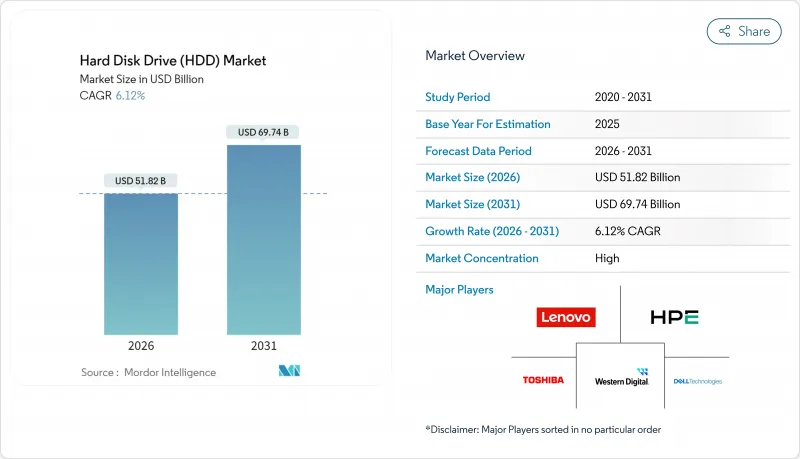
硬碟仍然是超大規模儲存策略的核心,這主要得益於每Terabyte的成本優勢、HAMR技術推動的100TB以上容量藍圖,以及人工智慧產生的冷資料的快速成長。隨著雲端服務供應商將2025年創紀錄的3,150億美元資本預算中的約15-20%分配給儲存基礎設備,近線企業部署正在不斷擴展。同時,每Terabyte的能耗指標也支撐了電力受限的資料中心市場的需求。介面趨勢證實了SATA的廣泛應用,而SAS和新興的NVMe介面在高頻寬至關重要的領域正獲得發展動力。供應動態依然脆弱。由於幾乎所有生產都由三家供應商控制,任何中斷,從貿易摩擦到自然災害,都可能迅速影響硬碟(HDD)市場。 [WESTERN DIGITAL.COM] 同時,亞太和北美地區的製造業激勵措施正在推動生產結構調整,並支持關鍵企業訂單的最終組裝流程近岸外包。
全球硬碟市場趨勢與洞察
對超大規模和雲端儲存容量的需求不斷成長
預計到2024年底,超大規模資料中心的數量將達到1,136個,到2030年將成長三倍,因為人工智慧加速器正在重塑運算格局。儲存約佔主要雲端服務供應商2025年資本支出計畫的五分之一,數十億美元將用於超高容量機架。這將主導冷層部署的硬碟(HDD)市場。西部數據預測,2024年至2028年間,HDD Exabyte貨量將成長23%,主要驅動力是HAMR技術帶來的密度提升。美國佔超大規模容量的54%,但當地的電力限制促使人們選擇每Terabyte功耗效能更高的硬碟。分散式架構將運算和儲存分離,HDD處理大量冷數據,而SSD則管理熱數據存取。
對於近線工作負載,固態硬碟相比固態硬碟具有每TB成本優勢
希捷報告稱,2024會計年度出貨量達到Exabyte時,其每Terabyte成本將達到15美元,與企業級固態硬碟(SSD)相比,成本優勢約為2.5倍。在30TB容量級別,此價格優勢擴大到約3-4倍,進一步鞏固了硬碟(HDD)在成本敏感型連續式資料儲存領域的市場主導地位。儘管快閃記憶體製造商透過3D NAND快閃記憶體的小型化技術不斷降低每Terabyte成本,但耐用性和寫入成本的限制意味著,對於順序密集型工作負載,硬碟仍然具有總體擁有成本(TCO)優勢。企業買家正擴大採用混合策略,將高效能SSD與大規模容量HDD結合,以最佳化支出並實現服務水準目標。
SSD 每 TB 成本快速下降以及快閃記憶體對企業的整體擁有成本優勢
目前,快閃記憶體廠商正在生產232層3D NAND快閃記憶體,並且每季都在降低每位元成本。 Pure Storage的超大規模資料中心業者設計採用案例表明,快閃記憶體結合功耗、散熱和面積的節省,能夠提供極具吸引力的整體成本優勢。 61.44TB企業級固態硬碟的出現標誌著容量趨於融合,儘管價格不菲。 QLC NAND快閃記憶體有望進一步降低每個位元成本,但其耐久性限制了這些產品在讀取密集型工作負載中的應用。隨著企業買家採用整體採購觀點,硬碟容量的提升速度必須超過快閃記憶體縮小成本差距的速度。
細分市場分析
預計到2025年,3.5吋硬碟產品將佔總營收的65.62%,並在2031年之前以9.29%的複合年成長率超越整個硬碟市場。高容量盤片能夠顯著提高每機架千兆位元組的儲存效率,這對於每平方英尺價值數千美元的超占地面積營運商至關重要。預計到2031年,3.5吋硬碟市場規模將超過452億美元。磁熱旋轉記錄(HAMR)和超高密度磁記錄(UltraSMR)技術的進步,使得廠商能夠實現在同一機殼內達到40TB的藍圖,從而提升該領域的規模經濟效益。
較小的 2.5 吋硬碟主要面向筆記型電腦和小型伺服器,但逐漸被固態硬碟 (SSD) 取代,限制了其成長前景。 1.8 吋及更小的硬碟尺寸則應用於小眾消費性電子產品和工業設備領域。基於 3.5 吋平台的高密度 JBOD底盤,透過減少硬碟數量即可實現Exabyte級容量,從而在冷端架構中保持成本優勢。希捷近期在日本發布了面向消費者的 20TB 和 24TB BarraCuda 硬碟,凸顯了其對 3.5 吋大容量藍圖的持續投入。
到2025年,近線企業環境將占到總出貨量的44.10%,在主要工作負載中以9.52%的複合年成長率(CAGR)實現最快成長。雲端架構師會將不斷擴展的AI訓練集整合到成本更低、密度更高的儲存層上,從而鞏固硬碟(HDD)作為Petabyte級叢集核心的地位。麥肯錫預測冷數據將出現爆炸性成長,而硬碟的順序寫入效能和經濟的儲存特性也與此相契合,這將進一步提升硬碟在近線應用中的市場佔有率。
消費性桌上型電腦和遊戲PC正穩定轉向固態硬碟(SSD),1TB以下入門硬碟的需求量正在下降。監控陣列和NAS設備的需求仍然強勁,因為它們的寫入模式和容量需求更適合磁介質。雖然企業資料中心團隊仍在採用SSD和HDD共存的分散式模型,但未來十年,近線儲存層(nearline layer)的絕對Exabyte成長將最為顯著。
區域分析
亞太地區將在2025年佔全球營收的36.10%,並在2031年之前以6.84%的複合年成長率成長。中國和日本將透過超大規模資料中心擴張和國內OEM出貨量來支撐區域需求,而泰國則憑藉西部數據公司於2024年8月核准的6.93億美元擴張計劃,繼續保持製造地。受電子商務和在家工作趨勢持續的影響,印度零售驅動的出貨量在2024年第二季較上季成長了12%。東南亞各地的智慧城市預算,包括馬來西亞170億美元的資料中心監控項目,正在推動該地區對Exabyte的需求。
北美是第二大市場,這主要得益於美國超大規模營運商的推動,它們佔據了全球54%的雲端容量。貿易政策的不利因素造成了成本的不確定性,但提案的激勵措施可能會鼓勵國內組裝,從而縮短供應鏈。維吉尼亞州資料中心走廊周邊日益成長的電網壓力促使設計人員更加重視Terabyte的能源效率,這使得硬碟(HDD)市場比全Flash陣列更具優勢。加拿大和墨西哥則發揮輔助作用,提供了土地、再生能源和跨境物流的優勢。
在歐洲,嚴格的資料主權法規確保了企業穩定的資料更換週期。德國和英國正在部署冷儲存叢集以滿足合規的資料保留期限要求,而法國則在擴大公共部門的雲端工作負載。該地區對循環經濟的重視與供應商的回收計劃相契合;例如,西部數據計劃在2024年從價值5萬英鎊的廢棄硬碟中回收稀土元素。長期的碳排放稅討論可能會影響儲存技術的選擇。硬碟製造商表示,其產品生命週期內的二氧化碳排放低於其他儲存媒體。
其他福利
- Excel格式的市場預測(ME)表
- 分析師支持(3個月)
目錄
第1章 引言
- 研究假設和市場定義
- 調查範圍
第2章調查方法
第3章執行摘要
第4章 市場情勢
- 市場概覽
- 市場促進因素
- 對超大規模和雲端儲存容量的需求不斷成長
- 對於近線工作負載,固態硬碟相比固態硬碟具有每TB成本優勢
- 智慧城市發展導致視訊監控數據增加
- 引入人工智慧驅動的冷數據分層
- 高容量HAMR藍圖(最高可達50TB硬碟)
- 透過循環經濟回收計畫減少物料清單 (BOM)
- 市場限制
- SSD 每 TB 價格大幅下降,企業級快閃記憶體整體擁有成本降低。
- 供應商高度集中和供應鏈中斷
- 對高能耗硬碟生產徵收潛在的碳排放稅
- 機架密度限制有利於基於快閃記憶體的架構
- 價值/供應鏈分析
- 監管環境
- 技術展望
- 波特五力分析
- 新進入者的威脅
- 買方的議價能力
- 供應商的議價能力
- 替代品的威脅
- 競爭對手之間的競爭
- 宏觀經濟影響評估
第5章 市場規模與成長預測
- 按外形尺寸
- 2.5英寸
- 3.5英寸
- 其他(1.8 吋或更小,企業級 JBOD)
- 透過使用
- 行動/可攜式
- 消費性桌上型電腦和遊戲
- NAS 和 SOHO
- 企業和資料中心
- 近線/冷數據
- 監測與智慧城市
- 按儲存容量
- 1TB 或更少
- 1~3TB
- 3~5TB
- 超過5TB
- 透過介面
- SATA
- SAS
- PCIe/NVMe(U.2、U.3)
- 按最終用戶行業分類
- 資訊科技/通訊
- 家用電器製造商
- 雲端和超大規模提供者
- 工業和視訊監控
- 政府/國防
- 透過記錄技術
- CMR/PMR
- SMR
- HAMR 和能量輔助
- 按地區
- 北美洲
- 美國
- 加拿大
- 墨西哥
- 歐洲
- 德國
- 英國
- 法國
- 俄羅斯
- 其他歐洲
- 亞太地區
- 中國
- 日本
- 印度
- 韓國
- 澳洲
- 亞太其他地區
- 中東和非洲
- 中東
- 沙烏地阿拉伯
- 阿拉伯聯合大公國
- 其他中東地區
- 非洲
- 南非
- 埃及
- 其他非洲地區
- 中東
- 南美洲
- 巴西
- 阿根廷
- 南美洲其他地區
- 北美洲
第6章 競爭情勢
- 市場集中度
- 策略趨勢
- 市佔率分析
- 公司簡介
- Western Digital Corporation
- Toshiba Electronic Devices & Storage Corporation
- Hewlett Packard Enterprise Company
- Dell Technologies Inc.
- Lenovo Group Limited
- Huawei Technologies Co., Ltd.
- Transcend Information Inc.
- ADATA Technology Co., Ltd.
- Buffalo Inc.
- Nidec Corporation
- Showa Denko KK
- Hoya Corporation
- NetApp Inc.
- Pure Storage Inc.
- Samsung Electronics Co., Ltd.(external HDD brand)
- Micron Technology Inc.(external storage systems)
- Violin Systems LLC
- Synology Inc.
- QNAP Systems Inc.
- LaCie SAS(Seagate brand)
第7章 市場機會與未來展望
Hard Disk Drive market size in 2026 is estimated at USD 51.82 billion, growing from 2025 value of USD 48.83 billion with 2031 projections showing USD 69.74 billion, growing at 6.12% CAGR over 2026-2031.
Cost-per-terabyte advantages, HAMR-driven capacity roadmaps that point to 100 TB and beyond, and the explosion of AI-generated cold data keep hard drives central to hyperscale storage strategies. Near-line enterprise deployments expand as cloud providers allocate roughly 15-20% of their record USD 315 billion 2025 capital budgets to storage infrastructure, while energy-per-terabyte metrics sustain demand in power-constrained data-center markets. Interface trends reveal SATA's broad installed base, yet SAS and emerging NVMe pathways gain momentum where higher bandwidth is essential. Supply dynamics remain delicate because three suppliers control nearly all output; any disruption, from trade friction to natural disasters, propagates quickly through the Hard Disk Drive market [WESTERN DIGITAL.COM]. At the same time, regional manufacturing incentives in Asia-Pacific and North America are rewriting production footprints and favoring near-shoring of final assembly for mission-critical enterprise orders.
Global Hard Disk Drive (HDD) Market Trends and Insights
Rising Demand for Hyperscale and Cloud Storage Capacity
Hyperscale data-center count reached 1,136 at year-end 2024 and is projected to triple by 2030 as AI accelerators reshape computing footprints. Storage represents roughly one-fifth of the 2025 capex plans of major cloud operators, channeling billions into very-large-capacity racks that favor the Hard Disk Drive market for cold-tier deployments. Exabyte shipments of HDDs are forecast by Western Digital to grow at 23% between 2024 and 2028, driven primarily by HAMR-enabled density gains. The United States holds 54% of installed hyperscale capacity, yet local power constraints reward drives that deliver superior watts-per-terabyte performance. Disaggregated architectures now separate compute from storage, letting HDDs handle vast cold data pools while SSDs manage hot data access.
Cost/TB Advantage Over SSDs in Near-line Workloads
Seagate reported achieving USD 15 per terabyte across 398 exabytes shipped in fiscal 2024, preserving an estimated 2.5X cost gap against enterprise SSDs. At 30 TB capacity points, the price delta widens to roughly 3-4X, reinforcing the Hard Disk Drive market in cost-sensitive cold-data tiers. Flash manufacturers continue lowering dollars-per-terabyte through 3D NAND scaling, yet endurance and write-cost constraints keep total-cost-of-ownership favorable to drives for sequential-heavy workloads. Enterprise buyers increasingly articulate hybrid strategies that blend high-performance SSD tiers with large pools of HDD capacity to optimize spend and service-level objectives.
Rapid SSD $/TB Declines and Enterprise Flash TCO Gains
Flash vendors now produce 232-layer 3D NAND, pushing bit costs lower each quarter. Pure Storage's design wins at hyperscalers highlight scenarios where flash achieves compelling total cost when energy, cooling, and floor space savings are lumped into the equation. The arrival of 61.44 TB enterprise SSDs signals capacity convergence, albeit at a premium price. QLC NAND promises further dollar-per-bit gains, yet endurance constraints confine such products to read-heavy workloads. As corporate buyers increasingly adopt a holistic procurement lens, HDDs must continue to elevate capacity faster than flash narrows its cost gap.
Other drivers and restraints analyzed in the detailed report include:
- Growth of Video-Surveillance Data for Smart-City Roll-outs
- AI-Driven Cold-Data Tiering Adoption
- Extreme Supplier Concentration and Supply-Chain Shocks
For complete list of drivers and restraints, kindly check the Table Of Contents.
Segment Analysis
3.5-inch units delivered 65.62% revenue in 2025, outpacing the overall Hard Disk Drive market with a 9.29% CAGR to 2031. Their large platters enable superior gigabytes-per-rack metrics, critical for hyperscale operators that price floor space in thousands of dollars per square foot. The Hard Disk Drive market size for 3.5-inch products is projected to eclipse USD 45.2 billion by 2031. HAMR and UltraSMR advances let vendors roadmap 40 TB on the same envelope, reinforcing the segment's scale economics.
Smaller 2.5-inch drives cater to notebooks and compact servers but face SSD substitution, limiting growth prospects. Sub-1.8-inch form factors occupy niche consumer electronics and industrial gear. High-density JBOD chassis relying on 3.5-inch platforms retain cost leadership in cold-tier architectures because fewer spindles meet exabyte targets. Seagate's recent Japan launch of 20 TB and 24 TB BarraCuda SKUs at consumer-friendly pricing underscores continued investment in the high-capacity 3.5-inch roadmap.
Near-line enterprise environments garnered 44.10% of 2025 shipments and will grow at a 9.52% CAGR, the fastest among major workloads. Cloud architects funnel expanding AI training sets onto low-cost, high-density tiers, keeping the Hard Disk Drive market central to petabyte-scale clusters. The Hard Disk Drive market share for near-line roles benefits from the cold-data swell forecast by McKinsey, which aligns with drives' sequential write and economical retention strengths.
Consumer desktop and gaming PCs move steadily to SSD, trimming unit demand for entry drives below 1 TB. Surveillance arrays and NAS devices remain resilient because write patterns and capacity needs suit magnetic media. Enterprise data-center teams continue adopting disaggregated models where SSD and HDD coexist, but the near-line layer commands the highest absolute exabyte growth through the decade.
The Hard Disk Drive Market Report is Segmented by Form Factor (2. 5-Inch, 3. 5-Inch, Others), Application (Mobile/Portable, Consumer Desktop and Gaming, and More), Storage Capacity (<1TB, 1-3TB, 3-5TB, >5TB), Interface (SATA, SAS, PCIe/NVMe), End-User Industry (IT and Telecommunications, and More), Recording Technology (CMR/PMR, SMR, HAMR and Energy-Assisted), and Geography. The Market Forecasts are Provided in Terms of Value (USD).
Geography Analysis
Asia-Pacific commanded 36.10% of global revenue in 2025 and is growing at a 6.84% CAGR through 2031. China and Japan anchor regional demand through hyperscale build-outs and domestic OEM shipments, while Thailand continues as a manufacturing hub with Western Digital's USD 693 million expansion approved in August 2024. India's retail drive volumes expanded 12% quarter-over-quarter in Q2 2024 as e-commerce and home-office trends persisted. Smart-city budgets across Southeast Asia, including Malaysia's USD 17 billion data-center and surveillance programs, intensify regional exabyte uptake.
North America is the second-largest territory, propelled by U.S. hyperscale operators that hold 54% of installed cloud capacity. Trade-policy headwinds inject cost uncertainty, though proposed incentives encourage domestic assembly that could shorten supply chains. Growing power-grid constraints around Virginia's data-center corridor steer architects toward watts-per-terabyte efficiencies that favor the Hard Disk Drive market versus all-flash arrays. Canada and Mexico play supportive roles by providing land, renewable electricity, and cross-border logistics advantages.
Europe maintains consistent enterprise replacement cycles amid stringent data-sovereignty mandates. Germany and the United Kingdom deploy cold-tier clusters to meet compliance retention windows, while France expands public-sector cloud workloads. The region's circular-economy focus dovetails with vendor recycling programs, such as Western Digital's recovery of rare-earth elements from 50,000 pounds of retired drives in 2024. Long-term carbon tax discussions may influence recording-technology choices as HDD makers showcase lower lifecycle CO2 than competing storage media.
- Western Digital Corporation
- Toshiba Electronic Devices & Storage Corporation
- Hewlett Packard Enterprise Company
- Dell Technologies Inc.
- Lenovo Group Limited
- Huawei Technologies Co., Ltd.
- Transcend Information Inc.
- ADATA Technology Co., Ltd.
- Buffalo Inc.
- Nidec Corporation
- Showa Denko K.K.
- Hoya Corporation
- NetApp Inc.
- Pure Storage Inc.
- Samsung Electronics Co., Ltd. (external HDD brand)
- Micron Technology Inc. (external storage systems)
- Violin Systems LLC
- Synology Inc.
- QNAP Systems Inc.
- LaCie S.A.S. (Seagate brand)
Additional Benefits:
- The market estimate (ME) sheet in Excel format
- 3 months of analyst support
TABLE OF CONTENTS
1 INTRODUCTION
- 1.1 Study Assumptions and Market Definition
- 1.2 Scope of the Study
2 RESEARCH METHODOLOGY
3 EXECUTIVE SUMMARY
4 MARKET LANDSCAPE
- 4.1 Market Overview
- 4.2 Market Drivers
- 4.2.1 Rising demand for hyperscale and cloud storage capacity
- 4.2.2 Cost/TB advantage over SSDs in near-line workloads
- 4.2.3 Growth of video-surveillance data for smart-city roll-outs
- 4.2.4 AI-driven cold-data tiering adoption
- 4.2.5 Large-capacity HAMR roadmap up to 50 TB drives
- 4.2.6 Circular-economy recycling programs lowering BOM costs
- 4.3 Market Restraints
- 4.3.1 Rapid SSD $/TB declines and enterprise flash TCO gains
- 4.3.2 Extreme supplier concentration and supply-chain shocks
- 4.3.3 Prospective carbon taxes on energy-intensive HDD output
- 4.3.4 Rack-density limits favouring flash-based architectures
- 4.4 Value / Supply-Chain Analysis
- 4.5 Regulatory Landscape
- 4.6 Technological Outlook
- 4.7 Porter's Five Forces Analysis
- 4.7.1 Threat of New Entrants
- 4.7.2 Bargaining Power of Buyers
- 4.7.3 Bargaining Power of Suppliers
- 4.7.4 Threat of Substitutes
- 4.7.5 Intensity of Competitive Rivalry
- 4.8 Macroeconomic Impact Assessment
5 MARKET SIZE AND GROWTH FORECASTS (VALUE)
- 5.1 By Form Factor
- 5.1.1 2.5-inch
- 5.1.2 3.5-inch
- 5.1.3 Others (<1.8-inch, Enterprise JBOD)
- 5.2 By Application
- 5.2.1 Mobile/Portable
- 5.2.2 Consumer Desktop and Gaming
- 5.2.3 NAS and SOHO
- 5.2.4 Enterprise and Data-Center
- 5.2.5 Near-line / Cold-Data
- 5.2.6 Surveillance and Smart-City
- 5.3 By Storage Capacity
- 5.3.1 <1 TB
- 5.3.2 1 - 3 TB
- 5.3.3 3 - 5 TB
- 5.3.4 >5 TB
- 5.4 By Interface
- 5.4.1 SATA
- 5.4.2 SAS
- 5.4.3 PCIe / NVMe (U.2, U.3)
- 5.5 By End-User Industry
- 5.5.1 IT and Telecommunications
- 5.5.2 Consumer Electronics OEMs
- 5.5.3 Cloud and Hyperscale Providers
- 5.5.4 Industrial and Video-Surveillance
- 5.5.5 Government and Defence
- 5.6 By Recording Technology
- 5.6.1 CMR / PMR
- 5.6.2 SMR
- 5.6.3 HAMR and Energy-Assisted
- 5.7 By Geography
- 5.7.1 North America
- 5.7.1.1 United States
- 5.7.1.2 Canada
- 5.7.1.3 Mexico
- 5.7.2 Europe
- 5.7.2.1 Germany
- 5.7.2.2 United Kingdom
- 5.7.2.3 France
- 5.7.2.4 Russia
- 5.7.2.5 Rest of Europe
- 5.7.3 Asia-Pacific
- 5.7.3.1 China
- 5.7.3.2 Japan
- 5.7.3.3 India
- 5.7.3.4 South Korea
- 5.7.3.5 Australia
- 5.7.3.6 Rest of Asia-Pacific
- 5.7.4 Middle East and Africa
- 5.7.4.1 Middle East
- 5.7.4.1.1 Saudi Arabia
- 5.7.4.1.2 United Arab Emirates
- 5.7.4.1.3 Rest of Middle East
- 5.7.4.2 Africa
- 5.7.4.2.1 South Africa
- 5.7.4.2.2 Egypt
- 5.7.4.2.3 Rest of Africa
- 5.7.4.1 Middle East
- 5.7.5 South America
- 5.7.5.1 Brazil
- 5.7.5.2 Argentina
- 5.7.5.3 Rest of South America
- 5.7.1 North America
6 COMPETITIVE LANDSCAPE
- 6.1 Market Concentration
- 6.2 Strategic Moves
- 6.3 Market Share Analysis
- 6.4 Company Profiles (includes Global level Overview, Market level overview, Core Segments, Financials as available, Strategic Information, Market Rank/Share, Products and Services, Recent Developments)
- 6.4.1 Western Digital Corporation
- 6.4.2 Toshiba Electronic Devices & Storage Corporation
- 6.4.3 Hewlett Packard Enterprise Company
- 6.4.4 Dell Technologies Inc.
- 6.4.5 Lenovo Group Limited
- 6.4.6 Huawei Technologies Co., Ltd.
- 6.4.7 Transcend Information Inc.
- 6.4.8 ADATA Technology Co., Ltd.
- 6.4.9 Buffalo Inc.
- 6.4.10 Nidec Corporation
- 6.4.11 Showa Denko K.K.
- 6.4.12 Hoya Corporation
- 6.4.13 NetApp Inc.
- 6.4.14 Pure Storage Inc.
- 6.4.15 Samsung Electronics Co., Ltd. (external HDD brand)
- 6.4.16 Micron Technology Inc. (external storage systems)
- 6.4.17 Violin Systems LLC
- 6.4.18 Synology Inc.
- 6.4.19 QNAP Systems Inc.
- 6.4.20 LaCie S.A.S. (Seagate brand)
7 Market Opportunities & Future Outlook
- 7.1 White-space & Unmet-need Assessment

 硬碟市場-2026-2032年全球市場預測
 硬碟機 (HDD) 和固態硬碟 (SSD) 產業:市場分析與加工趨勢
 2026-2030年全球外接硬碟市場
 外接硬碟市場-全球產業規模、佔有率、趨勢、機會、預測:按容量、最終用戶、應用、地區和競爭格局分類,2021-2031年
 2026年全球外置磁碟系統市場報告
 全球硬碟市場-策略分析與預測(2026-2031)
 可刻錄光碟市場分析及預測(至2035年):依類型、產品、技術、組件、應用、材質、製程及最終用戶分類硬碟機市場分析及預測(至2035年):依類型、產品類型、技術、組件、應用、形狀、材質、設備及最終用戶分類硬碟市場 - 全球產業規模、佔有率、趨勢、機會和預測:按類別、類型、性別、最終用戶、地區和競爭格局分類,2021-2031年熱輔助磁記錄(HAMR)設備市場-2026-2031年預測