


 |
市場調查報告書
商品編碼
1911287
新加坡金融科技:市場佔有率分析、產業趨勢與統計、成長預測(2026-2031)Singapore Fintech - Market Share Analysis, Industry Trends & Statistics, Growth Forecasts (2026 - 2031) |
||||||

※ 本網頁內容可能與最新版本有所差異。詳細情況請與我們聯繫。
新加坡金融科技市場預計到 2026 年將達到 139.7 億美元,高於 2025 年的 120.5 億美元。預計到 2031 年將達到 292.2 億美元,2026 年至 2031 年的複合年成長率為 15.9%。
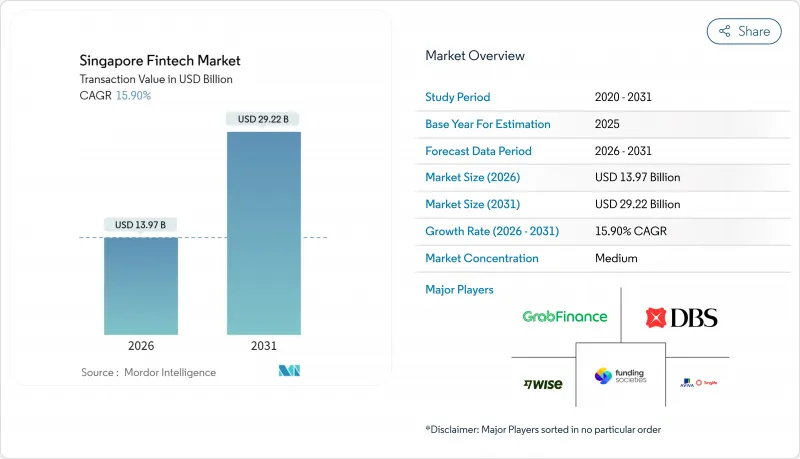
強力的政策支持、先進的數位基礎設施以及持續的私人資本流入,使得新加坡金融科技市場在競爭日益激烈和監管審查不斷加強的情況下,依然保持快速成長。新加坡金融管理局(MAS)推出的1億新元(約7,700萬美元)FSTI 3.0計劃,正是對此市場動能的有力體現。該計畫將共同資助抗量子攻擊的網路安全技術和人工智慧驅動的風險模型,為早期採用者提供永續的技術優勢。此外,計劃於2026年運作的五國即時支付走廊計劃「Nexus」預計將縮短結算週期,並為跨境貿易服務供應商開闢新的收入來源。新加坡金融科技市場也受惠於PayNow不斷擴大的區域合作,這刺激了從事跨境電商的中小型企業對多幣種錢包的需求。同時,針對加密貨幣和先買後付(BNPL)後付款服務的消費者保護條例日益嚴格,限制了短期內的收入成長,並促使經營模式轉向嵌入式金融和B2B2C分銷模式。
新加坡金融科技市場趨勢與洞察
即時支付基礎設施正在改變支付經濟。
Nexus計劃於2026年前連接新加坡、馬來西亞、泰國、菲律賓和印度的付款基礎,屆時將不再需要代理行帳戶,結算速度也將從T+2提升至即時。這項轉變預計將釋放1,200億美元的流動性,並降低跨境交易費用,從而為商家和中小企業帶來即時的成本節約。早期整合商預計在B2B貿易融資領域佔據更大的佔有率,因為即時支付能夠實現與運輸里程碑掛鉤的營運資金產品。 PayNow、PromptPay和DuitNow的互聯互通在2024年處理了超過250萬筆交易,充分展現了客戶對即時本地支付的需求。隨著支付基礎設施的整合,傳統銀行面臨升級舊版API的壓力,否則將面臨失去利潤豐厚的市場佔有率,敏捷的新興企業的風險。這項新的基礎設施也將支援小額支付和微額保險,從而拓展其在東南亞地區的應用場景。
抗量子創新基金加速競爭優勢
新加坡金融管理局(MAS)將透過其金融系統技術計畫(FSTI)3.0,為實施抗量子加密技術和基於人工智慧的風險分析的計劃提供高達50%的共同資助。這項津貼將降低中型金融科技公司的資本投資門檻,並使其能夠在監管要求之前加強網路安全基礎設施建設。網路技術韌性專家小組(CTREX)的合作將確保從微軟、亞馬遜和谷歌雲端等公司獲取知識,使國內標準與全球最佳實踐接軌。領先採用者已在試點可抵禦Shor演算法攻擊的量子安全支付通訊協定,從而確保在後量子密碼技術成為強制性要求時能夠合規。採用量子安全金鑰交換的銀行將保護高價值資金流動,並使新加坡在安全金融託管方面獲得先發優勢。從長遠來看,量子增強最佳化可望提高信用風險建模和投資組合再平衡的效率,進而提升整個產業的生產力。
客戶獲取成本對金融科技公司的收入模式帶來壓力。
智慧型手機的近乎普及使得潛在基本客群趨於飽和,獲取新客戶的邊際成本持續上升。到2024年,電子錢包註冊獎勵預算將飆升40%至60%,將使小規模金融科技公司的投資回收期延長至30個月以上。隨著消費者更傾向於使用Grab等集網約車、外賣和支付於一體的多功能超級應用,應用飽和進一步降低了行銷支出的回報率。這一趨勢迫使獨立營運商轉向嵌入式金融夥伴關係,透過將服務整合到提供者和平台生態系統中來分攤客戶獲取成本。 B2B2C分銷模式也有助於改善單位經濟效益。例如,中小企業軟體供應商可以整合與發票關聯的信用額度,從而將行銷成本分攤到多個收入來源。因此,不斷上升的客戶獲取成本起到了一種篩選機制的作用,有利於擁有強大生態系統和差異化知識產權的金融科技公司,而迫使資金匱乏的Start-Ups進行整合或退出市場。
細分市場分析
到2025年,數位支付將佔新加坡金融科技市場的26.20%,反映出其在日常交易中的核心地位。在SGQR+互通性、商家軟POS機普及以及PayNow區域整合的推動下,預計到2031年,該領域將以16.95%的複合年成長率成長。透過帳戶間轉帳繞過卡片付款流程,可以降低支付手續費,從而鼓勵商家優先考慮QR CODE支付和即時支付。同時,數位借貸領域的替代信用評分雖然成長速度不如支付,但仍持續為零工人員提供快速小額貸款。保險科技公司正在將小額保險嵌入叫車和外帶應用程式中,以擴大客戶群,而無需用戶單獨購買保單。 StashAway等財富科技平台正透過低成本ETF投資組合擴大規模,並挑戰私人銀行在高淨值資產領域的地位。新加坡金融管理局(MAS)的監理沙盒支援支付、貸款和保險整合的實驗,從而促進提供全面的金融服務。到 2030 年,綜合平台預計將處理該國 40% 以上的零售交易金額,使支付成為更廣泛的金融科技生態系統的基石。
隨著數位錢包業者擴大信用額度和保險附加服務,傳統細分市場的界線日益模糊,競爭也愈發激烈。超級應用利用自身消費資料最佳化信用評估,而現有業者則開放API以維持其在商家支付流程中的地位。因此,新加坡金融科技市場將繼續青睞那些能夠掌控銷售點並為高頻支付場景提供高利潤附加服務的營運商。監管機構對代幣化存款和網路代幣化的支持將進一步提升安全性和互聯互通的經濟效益。隨著即時支付基礎設施的日趨成熟,支付收入中來自增值數據分析、忠誠度計畫和支付服務的比例將逐漸增加,而非單筆交易手續費。
其他福利:
- Excel格式的市場預測(ME)表
- 分析師支持(3個月)
目錄
第1章 引言
- 研究假設和市場定義
- 調查範圍
第2章調查方法
第3章執行摘要
第4章 市場情勢
- 市場概覽
- 市場促進因素
- 即時付款基礎(PayNow、Project Nexus)的快速普及
- 新加坡金融管理局津貼加速人工智慧和量子金融科技創新
- 跨境電商推動多幣種錢包發展
- 純數位銀行牌照開闢了新的細分市場
- ESG和綠色金融指令創造了新的金融科技收入來源
- 小型企業貸款短缺催生了替代貸款平台
- 市場限制
- 激烈的應用程式競爭導致獲客成本不斷上升。
- 新加坡金融管理局加強了對加密資產和後付款服務的消費者保護條例
- 由於人工智慧/網路安全人才短缺,營運成本(OPEX)增加。
- 互通性和傳統核心銀行系統整合的障礙
- 價值/供應鏈分析
- 監管環境
- 技術展望
- 波特五力模型
- 新進入者的威脅
- 供應商的議價能力
- 買方的議價能力
- 替代品的威脅
- 競爭對手之間的競爭
第5章 市場規模與成長預測
- 透過服務提案
- 數位支付
- 數字借貸和資金籌措
- 數位投資
- 保險科技
- 新銀行
- 最終用戶
- 零售
- 公司
- 透過使用者介面
- 行動應用
- 網頁/瀏覽器
- POS/物聯網設備
- 按地區
- 中部地區
- 東部地區
- 北部地區
- 東北部地區
- 西部地區
第6章 競爭情勢
- 市場集中度
- 策略趨勢
- 市佔率分析
- 公司簡介
- Grab Financial Group
- DBS Bank
- OCBC Bank
- UOB Bank
- PayPal Singapore
- Wise
- Stripe Singapore
- Adyen Singapore
- Nium
- Thunes
- FOMO Pay
- Funding Societies
- Validus
- StashAway
- Endowus
- Singlife with Aviva
- Bolttech
- GXS Bank
- Trust Bank
- ANEXT Bank
- Revolut Singapore
第7章 市場機會與未來展望
Singapore fintech market size in 2026 is estimated at USD 13.97 billion, growing from 2025 value of USD 12.05 billion with 2031 projections showing USD 29.22 billion, growing at 15.9% CAGR over 2026-2031.
Strong policy support, deep digital infrastructure, and sustained inflows of private capital keep the Singapore fintech market on a steep expansion path, even as competitive intensity and regulatory scrutiny increase. Market momentum reflects the Monetary Authority of Singapore's (MAS) SGD 100 million (USD 77 million) FSTI 3.0 program, which co-funds quantum-safe cybersecurity and AI-driven risk models, giving early adopters a durable technology lead. Additional uplift comes from Project Nexus-the five-country instant-payment corridor that is scheduled to go live by 2026-which will compress settlement cycles and open new revenue pools for cross-border trade service providers. The Singapore fintech market also benefits from PayNow's growing regional linkages, accelerating demand for multi-currency wallets among SMEs engaged in cross-border e-commerce. At the same time, tightened consumer-protection rules for crypto and buy-now-pay-later (BNPL) products temper near-term revenue growth, prompting business-model pivots toward embedded finance and B2B2C distribution.
Singapore Fintech Market Trends and Insights
Real-Time Payment Rails Transform Settlement Economics
Project Nexus will connect payment rails in Singapore, Malaysia, Thailand, the Philippines, and India by 2026, eliminating the need for nostro accounts and cutting settlement from T+2 to real-time . The shift frees up an estimated USD 120 billion in trapped liquidity and reduces cross-border transaction fees, generating immediate cost savings for merchants and SMEs. Early integrating fintech firms will gain share in B2B trade finance, where real-time settlement unlocks working-capital products tied to shipment milestones. PayNow's bilateral links with PromptPay and DuitNow processed more than 2.5 million transactions in 2024, demonstrating proven customer appetite for instant regional payments. As rails converge, traditional banks must overhaul legacy APIs or risk ceding high-margin corridors to nimble challengers. The new infrastructure also supports micropayments and micro-insurance, widening addressable use cases across Southeast Asia.
Quantum-Ready Innovation Funding Accelerates Competitive Differentiation
Through FSTI 3.0, MAS co-funds up to 50% of projects deploying quantum-resistant encryption and AI-powered risk analytics. The subsidy lowers capex barriers for mid-tier fintechs, enabling them to harden cybersecurity stacks ahead of regulatory mandates. Collaboration inside the Cyber and Technology Resilience Experts (CTREX) panel ensures knowledge transfer from Microsoft, Amazon, and Google Cloud, aligning domestic standards with global best practices. Early movers already test quantum-safe payment protocols that withstand Shor-algorithm attacks, positioning them for compliance once post-quantum cryptography becomes compulsory. Banks adopting quantum-secure key exchange safeguard high-value treasury flows, giving Singapore a first-mover lead in safe-harbor financial hosting. Over the long term, quantum-enhanced optimization may also streamline credit-risk modelling and portfolio rebalancing, boosting sector productivity.
Customer Acquisition Costs Strain Fintech Profitability Models
Nearly universal smartphone ownership produces a saturated addressable base, making marginal customer wins increasingly expensive. Incentive budgets for e-wallet sign-ups ballooned by 40-60% in 2024, pushing payback periods for small fintechs beyond 30 months. App fatigue further erodes return on marketing spend because consumers prefer multifunction super-apps such as Grab, which bundle ride-hailing, food delivery, and payments. The trend forces standalone providers to pivot toward embedded-finance partnerships, integrating services into merchant or platform ecosystems to share acquisition costs. B2B2C distribution also improves unit economics; SME software vendors, for example, can embed invoicing-linked credit lines, spreading marketing costs across multiple revenue streams. Elevated acquisition costs therefore act as a filtering mechanism, rewarding fintechs with strong ecosystems or differentiated IP, while pushing under-capitalized startups to consolidate or exit.
Other drivers and restraints analyzed in the detailed report include:
- Cross-Border E-Commerce Growth Drives Multi-Currency Innovation
- Digital Banking Licenses Create Niche Market Opportunities
- Regulatory Tightening Constrains High-Growth Fintech Segments
For complete list of drivers and restraints, kindly check the Table Of Contents.
Segment Analysis
In 2025, digital payments accounted for 26.20% of the Singapore fintech market size, reflecting their central role in day-to-day commerce. The segment is on track to expand at a 16.95% CAGR through 2031, propelled by SGQR+ interoperability, merchant SoftPOS adoption, and PayNow's regional links. Card-rail bypass via account-to-account transfers reduces interchange fees, encouraging merchants to prioritize QR and instant payments. Meanwhile, alternative credit scoring in digital lending continues to unlock quick-turnaround microloans for gig workers, albeit at a slower growth than payments. Insurtech firms embed bite-sized coverage within ride-hailing and delivery apps, widening reach without requiring stand-alone policy purchases. Wealth-tech platforms such as StashAway scale on low-cost ETF portfolios, challenging private banks for mass-affluent assets. MAS's regulatory sandbox supports experiments that bundle payments, lending, and insurance, fostering holistic financial offerings. By 2030, integrated platforms are expected to direct more than 40% of domestic retail transaction value, cementing payments as the linchpin of broader fintech ecosystems.
Competition intensifies as digital-wallet providers extend credit lines and insurance add-ons, blurring traditional segment boundaries. Super-apps leverage first-party consumption data to refine underwriting, while incumbents open APIs to retain relevance within merchant checkout flows. The Singapore fintech market, therefore, continues to reward providers that control the point of sale and can layer higher-margin, add-on services onto high-frequency payment use cases. Regulatory support for tokenized deposits and network tokenization further improves security and interchange economics. As real-time rails mature, payments revenue will increasingly derive from value-added data analytics, loyalty, and payment services rather than per-transaction fees.
The Singapore Fintech Market Report is Segmented by Service Proposition (Digital Payments, Digital Lending & Financing, Digital Investments, Insurtech, Neobanking), End-User (Retail, Businesses), User Interface (Mobile Applications, Web/Browser, POS/IoT Devices), and Geography (Central Region, East Region, North Region, North-East Region, West Region). The Market Forecasts are Provided in Terms of Value (USD).
List of Companies Covered in this Report:
- Grab Financial Group
- DBS Bank
- OCBC Bank
- UOB Bank
- PayPal Singapore
- Wise
- Stripe Singapore
- Adyen Singapore
- Nium
- Thunes
- FOMO Pay
- Funding Societies
- Validus
- StashAway
- Endowus
- Singlife with Aviva
- Bolttech
- GXS Bank
- Trust Bank
- ANEXT Bank
- Revolut Singapore
Additional Benefits:
- The market estimate (ME) sheet in Excel format
- 3 months of analyst support
TABLE OF CONTENTS
1 Introduction
- 1.1 Study Assumptions & Market Definition
- 1.2 Scope of the Study
2 Research Methodology
3 Executive Summary
4 Market Landscape
- 4.1 Market Overview
- 4.2 Market Drivers
- 4.2.1 Rapid real-time payment rail adoption (PayNow, Project Nexus)
- 4.2.2 MAS grants spurring AI & quantum-ready fintech innovation
- 4.2.3 Cross-border e-commerce fueling multi-currency wallets
- 4.2.4 Digital-only banking licences opening new niches
- 4.2.5 ESG & green-finance mandates creating new fintech revenue pools
- 4.2.6 SME credit gap boosting alternative lending platforms
- 4.3 Market Restraints
- 4.3.1 High customer-acquisition costs amid intense app competition
- 4.3.2 Tightened MAS consumer-protection rules on crypto & BNPL
- 4.3.3 Talent shortages in AI / cybersecurity raising OPEX
- 4.3.4 Interoperability & legacy core-bank integration hurdles
- 4.4 Value / Supply-Chain Analysis
- 4.5 Regulatory Landscape
- 4.6 Technological Outlook
- 4.7 Porter's Five Forces
- 4.7.1 Threat of New Entrants
- 4.7.2 Bargaining Power of Suppliers
- 4.7.3 Bargaining Power of Buyers
- 4.7.4 Threat of Substitutes
- 4.7.5 Competitive Rivalry
5 Market Size & Growth Forecasts
- 5.1 By Service Proposition
- 5.1.1 Digital Payments
- 5.1.2 Digital Lending & Financing
- 5.1.3 Digital Investments
- 5.1.4 Insurtech
- 5.1.5 Neobanking
- 5.2 By End-User
- 5.2.1 Retail
- 5.2.2 Businesses
- 5.3 By User Interface
- 5.3.1 Mobile Applications
- 5.3.2 Web / Browser
- 5.3.3 POS / IoT Devices
- 5.4 By Geography
- 5.4.1 Central Region
- 5.4.2 East Region
- 5.4.3 North Region
- 5.4.4 North-East Region
- 5.4.5 West Region
6 Competitive Landscape
- 6.1 Market Concentration
- 6.2 Strategic Moves
- 6.3 Market Share Analysis
- 6.4 Company Profiles (includes Global level Overview, Market level overview, Core Segments, Financials as available, Strategic Information, Market Rank/Share for key companies, Products & Services, and Recent Developments)
- 6.4.1 Grab Financial Group
- 6.4.2 DBS Bank
- 6.4.3 OCBC Bank
- 6.4.4 UOB Bank
- 6.4.5 PayPal Singapore
- 6.4.6 Wise
- 6.4.7 Stripe Singapore
- 6.4.8 Adyen Singapore
- 6.4.9 Nium
- 6.4.10 Thunes
- 6.4.11 FOMO Pay
- 6.4.12 Funding Societies
- 6.4.13 Validus
- 6.4.14 StashAway
- 6.4.15 Endowus
- 6.4.16 Singlife with Aviva
- 6.4.17 Bolttech
- 6.4.18 GXS Bank
- 6.4.19 Trust Bank
- 6.4.20 ANEXT Bank
- 6.4.21 Revolut Singapore
7 Market Opportunities & Future Outlook
- 7.1 Embedded finance in non-financial super-apps
- 7.2 Green fintech solutions for carbon-credit trading

 金融科技市場:2026-2032年全球市場預測(按支付方式、部署模式、企業規模、技術、最終用戶和應用分類)金融科技即服務市場:依產品類型、部署模式、組織規模及最終用戶分類-2026-2032年全球預測
 金融科技市場商業分析及預測(至2035年):類型、產品類型、服務、技術、組件、應用、部署模式、最終用戶、解決方案
 2026年金融科技多重雲端全球市場報告
 金融科技市場規模、佔有率、趨勢和預測:按部署類型、技術、應用、最終用戶和地區分類,2026-2034 年
 2026-2030年全球金融科技市場金融科技市場分析及預測(至2035年):依類型、產品類型、服務、技術、組件、應用、部署類型、最終用戶及功能分類
 美國金融科技市場:市場佔有率分析、產業趨勢與統計及成長預測(2026-2031年)英國金融科技:市場佔有率分析、產業趨勢與統計、成長預測(2026-2031)
 全球金融科技即服務 (FaaS) 市場規模、佔有率、趨勢和成長分析報告,2026-2034 年