


 |
市場調查報告書
商品編碼
1910919
中東油氣管線:市場佔有率分析、產業趨勢與統計、成長預測(2026-2031)Middle-East Oil And Gas Line Pipe - Market Share Analysis, Industry Trends & Statistics, Growth Forecasts (2026 - 2031) |
||||||

※ 本網頁內容可能與最新版本有所差異。詳細情況請與我們聯繫。
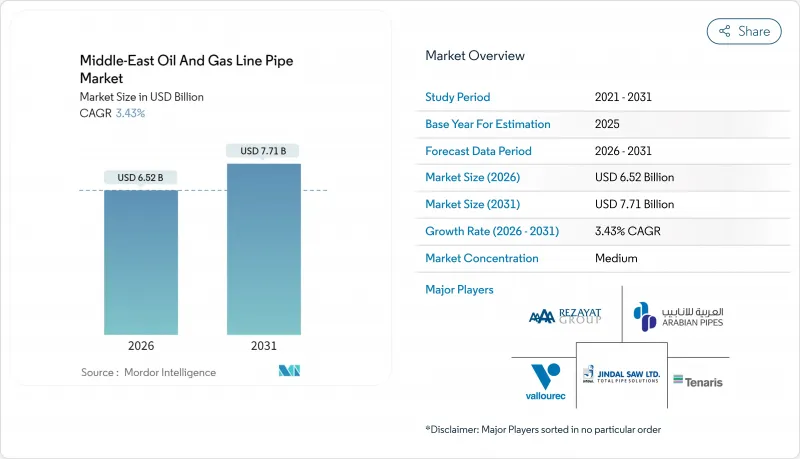
2025年中東油氣管線市場價值為63億美元,預計到2031年將達到77.1億美元,高於2026年的65.2億美元。
預計在預測期(2026-2031 年)內,複合年成長率將達到 3.43%。
強勁的上游天然氣業務、跨境幹線管道和氫能試點計畫是關鍵的成長引擎,而在地採購要求正推動採購趨勢向國內製造商傾斜。對大直徑螺旋焊管的需求不斷成長,雙相不銹鋼在酸性氣體和氫氣環境中的應用日益廣泛,以及政府的支出支持,都在增強區域製造商的競爭力。同時,歐盟碳邊境調節機制(CBAM)帶來的成本壓力和突發的油價衝擊限制了出口商的近期擴張。伊朗的計劃延期和伊拉克部分資金籌措的延遲表明,地緣政治風險仍在持續影響支出趨勢。
中東油氣管線市場趨勢及分析
阿拉伯灣海上天然氣田上游投資增加
阿布達比國家石油公司 (ADNOC) 耗資 170 億美元的哈伊勒和加薩計畫需要一條耐腐蝕襯裡 (CRA) 管道,能夠日輸送 15 億立方英尺高酸性天然氣,所有競標均包含高耐腐蝕性要求。卡達的北田西部計畫(預算約 170-180 億美元)顯著增加了對海底管道的需求,因為 EPCI 承包商正在整合高壓額定直徑 24 英吋及以上的管段。沙烏地阿拉伯的紅海海上評估計劃旨在到 2030 年將天然氣產量提高 60%,該計畫傾向於在淺水區使用軟性輸油管線,這為複合複合材料替代方案創造了獨特的市場機會。海灣地區水深的增加需要直徑 24 英吋及以上的管道,推動了焊接 SAW 管道供應量的成長。認證要求也變得更加嚴格,ISO 14001 現在對在阿拉伯聯合大公國和沙烏地阿拉伯油田作業的離岸承包商是強制性的,這實際上提高了資格門檻。
擴建跨國原油出口幹管線管
巴士拉-亞喀巴輸油管(全長1,200公里,耗資50億營運成本)於2024年3月獲得伊拉克內閣核准,目標日出口量為225萬桶。然而,銀行製裁使資金籌措複雜化,並可能延長專案實施時間。沙烏地阿拉伯和科威特的合作夥伴正在為多拉氣田設計一條聯合管道,這表明海上單元化如何促進管道項目的擴展。印度-中東-歐洲經濟走廊(IMEC)設想的氫能走廊正在透過引入斷裂韌性指標,將材料規格從API 5L X70提升至耐氫鋼材。政治敏感的長距離管道線路需要更厚的壁厚和更完善的陰極防蝕,從而增加噸位和價值。
原油價格波動導致EPC合約授予延遲
歷史上,中東地區油價下跌與EPC合約授予之間存在12個月的滯後;例如,2014年至2015年間,合約數量在18個月內下降了60%。目前管道EPC合約中的對沖條款規定,如果布蘭特原油價格連續90天低於每桶50美元,則成本將增加15%至20%。在伊拉克,由於財政收入短缺,石油部下屬的多個管道計劃被安排在2026年預算週期內。雖然沙烏地阿拉伯和阿拉伯聯合大公國的主權財富基金在一定程度上具有反週期性,但海灣合作理事會(GCC)小規模的國家缺乏類似的緩衝機制,這加劇了計劃工期風險。
細分市場分析
2025年,焊接管材在中東油氣管線市場佔有62.25%的佔有率,為重視埋弧焊(SAW)成本優勢的長距離原油和天然氣計劃提供了支援。 G5PS公司從沙烏地阿美公司訂購的價值1.86億沙烏地里亞爾(約5000萬美元)的螺旋訂單進一步鞏固了埋弧焊在關鍵運輸管道中的應用。雖然無縫管材的供應對於高壓氫氣先導工廠仍然至關重要(在這些裝置中,材料完整性比成本更為重要),但其在大宗運輸領域的佔有率正在逐步下降。本地化生產正在提升焊接管材工廠的競爭力,因為運輸成本的節省和在地採購的收益超過了進口無縫管材的優勢。隨著幹線管道的不斷擴張,預計到2031年,中東油氣管線市場中焊接管材的規模將以3.44%的複合年成長率成長。
自動化超音波檢測和機器人焊接技術的日益普及提高了品質標準,降低了現場廢品率和生命週期成本。為了滿足即將開展的大型天然氣計劃需求,泰納瑞斯沙烏地鋼管公司於2024年7月將其朱拜勒工廠的LSAW(長埋弧焊鋼管)產能加倍。將塗層和螺紋加工生產線整合到工廠內部的製造商能夠提高產品附加價值,並更好地滿足日益加快的交貨週期。
由於碳鋼在傳統油氣運輸領域具有成本績效優勢,預計到2025年,碳鋼將佔64.40%的市場佔有率。然而,由於氫氣、藍氨和超酸性氣體的運輸需要更優異的耐腐蝕性和抗脆性,雙相不銹鋼和超級雙相不銹鋼市場預計將以6.00%的複合年成長率成長。沙烏地基礎工業公司(SABIC)年產120萬噸藍氨計劃的前期工程設計(FEED)需要一條低溫雙相不銹鋼管道,這使得其採購目標從碳鋼轉向雙相不銹鋼。此外,沙烏地阿拉伯的主天然氣系統也在向高壓氣體應用領域轉向API 5L X80鋼材,這顯示市場正朝著更高強度鋼材發展。
阿拉伯聯合大公國鋼鐵公司(Emirates Steel Alcan)對超級雙相鋼熔煉製程的投資表明,區域性鋼鐵廠正在追求特種鋼的利潤率。儘管特種合金在中東油氣管線市場的佔有率仍然不大,但它們對利潤的貢獻卻十分顯著,能夠使鋼鐵廠免受大宗商品價格波動的影響。
中東油氣管線市場報告按類型(無縫管和焊接管)、材質類型(碳鋼、合金鋼、不銹鋼/耐腐蝕合金鋼、雙相/超級雙相鋼)、直徑類型(小於 12 英寸、12-24 英寸和大於 24 英寸)、應用(運輸、地下套管和油管、油氣集輸、302 英寸和大於 24 英寸)、應用(運輸、地下套管和油管、油氣集輸、安全
其他福利:
- Excel格式的市場預測(ME)表
- 3個月的分析師支持
目錄
第1章 引言
- 研究假設和市場定義
- 調查範圍
第2章調查方法
第3章執行摘要
第4章 市場情勢
- 市場概覽
- 市場促進因素
- 阿拉伯灣海上天然氣田上游投資增加
- 擴建跨國原油出口幹管線管
- 對老舊管道網路更換的需求
- 阿布達比國家石油公司和沙烏地阿美氫氣就緒管線試點計畫
- IKTVA 和 ICV 計劃下的在地採購義務
- GTL和藍氨計劃需要低溫合金
- 市場限制
- 原油價格波動導致EPC合約延期
- 淺水區過渡到複合軟性管道。
- 制裁引發的伊朗和伊拉克資金籌措限制
- 歐盟碳邊境調節機制(CBAM)推高了海灣合作理事會地區鋼管出口成本
- 供應鏈分析
- 監管環境
- 技術展望
- 已安裝管道容量分析
- 即將進行的主要計劃
- 波特五力模型
- 供應商的議價能力
- 買方的議價能力
- 新進入者的威脅
- 替代品的威脅
- 競爭強度
第5章 市場規模與成長預測
- 按類型
- 無縫的
- 焊接(ERW 和 SAW)
- 材料
- 碳鋼
- 合金鋼
- 不銹鋼/耐腐蝕合金鋼
- 雙相/超級雙相不銹鋼
- 依直徑
- 小於12英寸
- 12 至 24 英寸
- 24吋或以上
- 透過使用
- 運輸(陸上和海上)
- 井下套管和油管
- 石油和天然氣聚合
- 水/氣注入
- 按地區
- 沙烏地阿拉伯
- 阿拉伯聯合大公國
- 卡達
- 科威特
- 阿曼
- 巴林
- 伊拉克
- 伊朗
- 其他中東地區
第6章 競爭情勢
- 市場集中度
- 策略性舉措(併購、聯盟、購電協議)
- 市場佔有率分析(主要企業的市場排名/佔有率)
- 公司簡介
- Arabian Pipes Company
- Rezayat Group
- EEW Group
- Sumitomo Corp.
- Vallourec SA
- Abu Dhabi Metal Pipes & Profiles
- Jindal SAW Ltd
- ArcelorMittal SA
- Tenaris SA
- National Pipe Company(NPC)
- TMK Group
- Tata Steel
- ChelPipe Group
- Nippon Steel Corp.
- Welspun Corp.
- Salzgitter AG
- Borusan Mannesmann
- JSW Steel
- SeAH Steel
- Al Jazeera Steel
第7章 市場機會與未來展望
The Middle-East Oil And Gas Line Pipe Market was valued at USD 6.30 billion in 2025 and estimated to grow from USD 6.52 billion in 2026 to reach USD 7.71 billion by 2031, at a CAGR of 3.43% during the forecast period (2026-2031).
Robust upstream gas programs, cross-border trunk lines, and hydrogen-ready pilots are the principal growth engines, while localization mandates tilt procurement in favor of domestic mills. Rising demand for large-diameter spiral-welded pipes, widening use of duplex alloys in sour-gas and hydrogen service, and supportive sovereign spending buffers are strengthening the competitive positions of regional manufacturers. At the same time, cost pressures from the EU Carbon Border Adjustment Mechanism (CBAM) and episodic oil-price shocks temper near-term expansion for exporters. Project deferrals in Iran and selective funding delays in Iraq demonstrate how geopolitical risk continues to impact spending trajectories.
Middle-East Oil And Gas Line Pipe Market Trends and Insights
Rising Upstream Investment in Arabian Gulf Offshore Gas Fields
ADNOC's USD 17 billion Hail & Ghasha program requires CRA-lined lines that can carry 1.5 billion cubic feet per day of ultra-sour gas, inserting premium corrosion-resistant requirements into every bid. Qatar's North Field West, budgeted at about USD 17-18 billion, adds substantial subsea pipe demand as EPCI contractors integrate 24-in-plus spools with elevated pressure ratings. Saudi Arabia's offshore Red Sea appraisals, linked to meeting a 60% gas production growth target by 2030, favor flexible flowlines in shallow waters-a niche opportunity for composite alternatives. Deeper water profiles across the Gulf now mandate diameters of>= 24 inches, shifting volumes toward welded SAW supply. Certification requirements are tightening, with ISO 14001 compliance compulsory for offshore contractors operating in the UAE and Saudi blocks, effectively lifting qualification thresholds.
Expansion of Cross-Border Crude Export Trunk Lines
The 1,200 km, USD 5 billion Basra-Aqaba pipeline, which won Iraqi cabinet clearance in March 2024, targets a 2.25 million bpd export capacity. However, banking sanctions complicate financing, lengthening the execution window. Saudi and Kuwaiti partners are designing shared pipelines for the Dorra gas field, underscoring how maritime unitization is enlarging pipe packages. Hydrogen corridors outlined in the India-Middle East-Europe Economic Corridor (IMEC) enhance material specifications toward hydrogen-compatible steels that exceed API 5L X70 by incorporating fracture-toughness metrics. Longer, politically sensitive routes are also specifying thicker walls and expanded cathodic protection, magnifying tonnage and value.
Oil-Price Volatility Postponing EPC Awards
Historical data indicate a 12-month lag between crude-price dips and Middle East EPC awards, with the 2014-2015 episode resulting in a 60% reduction in contracts over 18 months. Current hedging clauses in pipeline EPCTs include cost-escalation bandwidths of 15-20% once Brent oil prices fall below USD 50 per barrel for 90 consecutive days. In Iraq, several pipeline projects linked to the Ministry of Oil have been included in the 2026 budget cycle amid revenue shortfalls. Saudi and UAE sovereign funds are partially counter-cyclical; however, smaller GCC states lack similar buffers, thereby amplifying project timing risk.
Other drivers and restraints analyzed in the detailed report include:
- Aging Pipeline Network Replacement Demand
- Hydrogen-Ready Line-Pipe Pilots by ADNOC & Aramco
- EU CBAM Raising Cost for GCC Steel Pipe Exports
For complete list of drivers and restraints, kindly check the Table Of Contents.
Segment Analysis
Welded pipe claimed a 62.25% share of the Middle East oil and gas line pipe market in 2025, underpinning long-distance crude and gas projects that favor SAW cost economics. G5PS secured a SAR 186 million (USD 50 million) Aramco spiral-welded order, reinforcing SAW acceptance in critical transmission. Seamless supply remains indispensable for high-pressure hydrogen pilots where material integrity trumps cost, but its share is inching down within bulk transmission. Localization makes welded plants more competitive because shipping savings and local-content credits outweigh the benefits of seamless imports. The Middle East oil and gas line pipe market size attributable to welded categories is projected to post a 3.44% CAGR through 2031 as trunk-line kilometers expand.
The growing adoption of automated ultrasonic inspection and robotic welding is enhancing quality levels, reducing field rejects, and lowering lifecycle cost profiles. Tenaris Saudi Steel Pipes doubled LSAW capacity in Jubail in July 2024 to address upcoming master-gas packages. Mills that integrate coating and threading lines in-house are capturing additional value and better meeting accelerated delivery timetables.
Carbon steel captured a 64.40% share in 2025 thanks to its cost-performance fit in conventional oil and gas flows. However, the duplex and super-duplex segment is growing at a 6.00% CAGR because hydrogen, blue ammonia, and ultra-sour gas service require superior corrosion and embrittlement resistance. SABIC's FEED for a 1.2 million tpa blue ammonia project calls for cryogenic-capable duplex lines, moving procurement beyond carbon grades. Alloy selections are also migrating toward API 5L X80 for high-pressure gas in Saudi Arabia's Master Gas System, cementing a trend toward higher strength.
Investment by Emirates Steel Arkan into super-duplex melt routes indicates regional mills are chasing specialty margins. The Middle East oil and gas line pipe market share for specialty alloys remains modest, but its contribution to profits is outsized, shielding mills from commodity price swings.
The Middle-East Oil and Gas Line Pipe Market Report is Segmented by Type (Seamless and Welded), Material (Carbon Steel, Alloy Steel, Stainless/CRA, and Duplex/Super-Duplex), Diameter (Below 12 Inch, 12 To 24 Inch, and Above 24 Inch), Application (Transmission, Down-Hole Casing and Tubing, Oil and Gas Gathering, and Water/Gas Injection), and Geography (Saudi Arabia, United Arab Emirates, Qatar, Kuwait, Bahrain, Iraq, and More).
List of Companies Covered in this Report:
- Arabian Pipes Company
- Rezayat Group
- EEW Group
- Sumitomo Corp.
- Vallourec SA
- Abu Dhabi Metal Pipes & Profiles
- Jindal SAW Ltd
- ArcelorMittal SA
- Tenaris SA
- National Pipe Company (NPC)
- TMK Group
- Tata Steel
- ChelPipe Group
- Nippon Steel Corp.
- Welspun Corp.
- Salzgitter AG
- Borusan Mannesmann
- JSW Steel
- SeAH Steel
- Al Jazeera Steel
Additional Benefits:
- The market estimate (ME) sheet in Excel format
- 3 months of analyst support
TABLE OF CONTENTS
1 Introduction
- 1.1 Study Assumptions & Market Definition
- 1.2 Scope of the Study
2 Research Methodology
3 Executive Summary
4 Market Landscape
- 4.1 Market Overview
- 4.2 Market Drivers
- 4.2.1 Rising upstream investment in Arabian Gulf offshore gas fields
- 4.2.2 Expansion of cross-border crude export trunk lines
- 4.2.3 Aging pipeline network replacement demand
- 4.2.4 Hydrogen-ready line-pipe pilots by ADNOC & Aramco
- 4.2.5 Localization mandates under IKTVA & ICV programs
- 4.2.6 GTL & blue-ammonia projects needing low-temperature alloys
- 4.3 Market Restraints
- 4.3.1 Oil-price volatility postponing EPC awards
- 4.3.2 Shift toward composite flexible pipe in shallow offshore
- 4.3.3 Sanctions-driven funding limits in Iran & Iraq
- 4.3.4 EU CBAM raising cost for GCC steel pipe exports
- 4.4 Supply-Chain Analysis
- 4.5 Regulatory Landscape
- 4.6 Technological Outlook
- 4.7 Installed Pipeline Capacity Analysis
- 4.8 Key Upcoming Projects
- 4.9 Porter's Five Forces
- 4.9.1 Bargaining Power of Suppliers
- 4.9.2 Bargaining Power of Buyers
- 4.9.3 Threat of New Entrants
- 4.9.4 Threat of Substitutes
- 4.9.5 Intensity of Rivalry
5 Market Size & Growth Forecasts
- 5.1 By Type
- 5.1.1 Seamless
- 5.1.2 Welded (ERW and SAW)
- 5.2 By Material
- 5.2.1 Carbon Steel
- 5.2.2 Alloy Steel
- 5.2.3 Stainless/CRA
- 5.2.4 Duplex/Super-Duplex
- 5.3 By Diameter
- 5.3.1 Below 12 inch
- 5.3.2 12 to 24 inch
- 5.3.3 Above 24 inch
- 5.4 By Application
- 5.4.1 Transmission (Onshore and Offshore)
- 5.4.2 Down-hole Casing and Tubing
- 5.4.3 Oil and Gas Gathering
- 5.4.4 Water/Gas Injection
- 5.5 By Geography
- 5.5.1 Saudi Arabia
- 5.5.2 United Arab Emirates
- 5.5.3 Qatar
- 5.5.4 Kuwait
- 5.5.5 Oman
- 5.5.6 Bahrain
- 5.5.7 Iraq
- 5.5.8 Iran
- 5.5.9 Rest of Middle East
6 Competitive Landscape
- 6.1 Market Concentration
- 6.2 Strategic Moves (M&A, Partnerships, PPAs)
- 6.3 Market Share Analysis (Market Rank/Share for key companies)
- 6.4 Company Profiles (includes Global level Overview, Market level overview, Core Segments, Financials as available, Strategic Information, Products & Services, and Recent Developments)
- 6.4.1 Arabian Pipes Company
- 6.4.2 Rezayat Group
- 6.4.3 EEW Group
- 6.4.4 Sumitomo Corp.
- 6.4.5 Vallourec SA
- 6.4.6 Abu Dhabi Metal Pipes & Profiles
- 6.4.7 Jindal SAW Ltd
- 6.4.8 ArcelorMittal SA
- 6.4.9 Tenaris SA
- 6.4.10 National Pipe Company (NPC)
- 6.4.11 TMK Group
- 6.4.12 Tata Steel
- 6.4.13 ChelPipe Group
- 6.4.14 Nippon Steel Corp.
- 6.4.15 Welspun Corp.
- 6.4.16 Salzgitter AG
- 6.4.17 Borusan Mannesmann
- 6.4.18 JSW Steel
- 6.4.19 SeAH Steel
- 6.4.20 Al Jazeera Steel
7 Market Opportunities & Future Outlook
- 7.1 White-space & Unmet-Need Assessment
