


 |
市場調查報告書
商品編碼
1910913
IT外包(ITO)-市場佔有率分析、產業趨勢與統計、成長預測(2026-2031年)IT Outsourcing (ITO) - Market Share Analysis, Industry Trends & Statistics, Growth Forecasts (2026 - 2031) |
||||||

※ 本網頁內容可能與最新版本有所差異。詳細情況請與我們聯繫。
2025 年 IT 外包 (ITO) 市值為 6,181.3 億美元,預計到 2031 年將達到 7,520.8 億美元,而 2026 年為 6,386.5 億美元。
預計在預測期(2026-2031 年)內,複合年成長率將達到 3.32%。
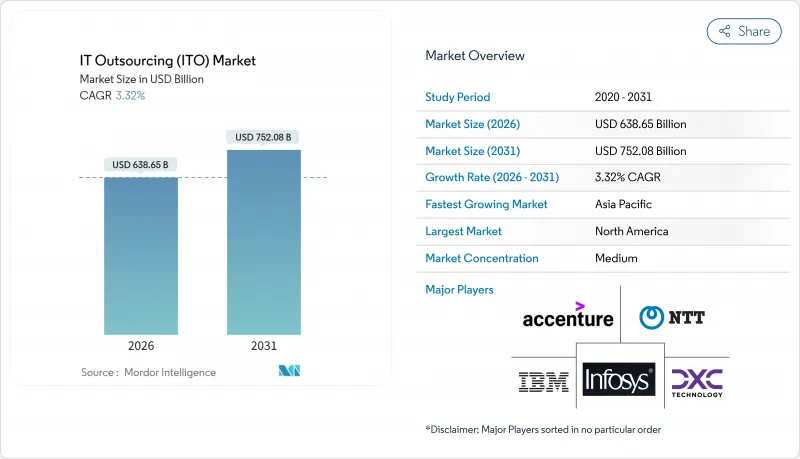
這項預測通道反映了產業的成熟度,生成式人工智慧驅動的自動化正在改變勞動密集的交付模式,推動新型人工智慧服務的發展,同時減少對傳統員工依賴型合約。日益加劇的地緣政治緊張局勢促使企業為應對主權雲指令和資料居住法規而實現採購多元化,許多買家傾向於採用離岸、近岸和在岸中心相結合的模式來降低風險。全球網路安全人才缺口高達480萬人,這催生了託管偵測和回應服務的超額需求。產業整合正在加速。近期的一些案例,例如Cognizant以13億美元收購Belcan以及Capgemini SA收購WNS的談判,顯示成熟企業正在吸收細分領域的專家,以增強其人工智慧能力並拓展服務組合。隨著企業在管理混合雲和多重雲端環境方面面臨挑戰,雲端管理服務的重要性日益凸顯,而基於績效的定價模式因其與可衡量的業務成果掛鉤而越來越受歡迎。
全球IT外包(ITO)市場趨勢與洞察
雲端原生應用程式現代化改造的需求
企業正在將單體系統重構為微服務、容器和無伺服器函數,這給平台工程、Kubernetes編配和事件驅動設計帶來了大規模的挑戰。尤其是在金融服務和醫療保健等監管嚴格、合規性日益複雜的行業,服務提供者擴大提供基本契約,以保證性能、成本目標和可擴展性,而不是按工作量收費。技術轉型也需要管理文化變革,通常需要外部合作夥伴來指導敏捷流程,因為內部團隊很難輕易採用這些流程。
利用生成式人工智慧實現服務台自動化
生成式人工智慧透過智慧路由和自癒腳本,將一級工單量減少了高達 40%,平均解決時間縮短了 25%。虛擬助理現在能夠理解跨多個系統的上下文,提供個人化回應,並在使用者註意到故障之前預測事件。然而,對於需要上下文判斷的複雜安全問題,服務提供者必須將自動化與人工監控結合。
智慧財產權竊盜和勒索軟體保險成本飆升
網路安全事件的增加迫使企業增加加密、存取監控和隔離開發環境等措施,這推高了計劃成本,同時保險費上漲,承保範圍縮小(安永)。採購者現在要求供應商持有更高的保險限額並定期進行穿透測試,這些限制使規模較小的供應商處於不利地位,並加速了行業整合。
細分市場分析
到2025年,基礎設施外包將佔IT外包(ITO)市場的45.05%,這主要得益於企業對需要持續監控和合規性的彈性資料中心營運的日益依賴。然而,隨著企業面臨涵蓋AWS、Azure、Google Cloud和私有環境的混合環境的複雜性,雲端管理服務將以3.44%的複合年成長率推動市場成長。目前,服務提供者正在將統一的管理平台捆綁在一起,這些平台能夠根據成本、延遲和合規性要求對工作負載進行排序,從而模糊了傳統基礎設施管理和新興的多重雲端編配之間的界限。
低程式碼和人工智慧輔助開發正在重塑應用開發和維護的需求,迫使供應商透過領域知識和整合專長來脫穎而出。邊緣運算和人工智慧模式生命週期服務屬於「其他」類別,代表著一個新興但利潤豐厚的市場機會。隨著雲端運算的普及,現有企業正轉向自動化站點可靠性工程服務,透過人工智慧驅動的自癒機制來確保服務等級目標的達成,從而保護基礎設施收入免受價格壓縮的影響。
即使到了2025年,大型企業仍將佔據67.25%的支出佔有率,這主要是因為維護複雜的傳統環境需要深厚的架構專業知識。然而,中小企業(SME)的成長速度更快,複合年成長率(CAGR)達到3.96%。中小企業更傾向於績效付費的合約模式,因為它將IT支出與具體的業務成果而非員工人數掛鉤。雲端原生供應商透過自助服務入口網站和自動化配置降低了進入門檻,將以往只有財富500強企業才能享有的按需人工智慧、分析和網路安全安全功能帶給了中小企業。這種技術的普及化正在擴大IT外包市場的潛在規模,同時也迫使現有供應商創建模組化、標準化的服務,以便在不損害利潤率的情況下實現經濟規模化。
IT外包(ITO)市場按服務類型(基礎設施外包、應用開發與維護及其他)、組織規模(中小企業和大型企業)、外包地點(境內、近岸及其他)、最終用戶行業(銀行、金融服務和保險、醫療保健和生命科學及其他)以及地區進行細分。市場預測以美元計價。
區域分析
北美24.12%的市佔率鞏固了其作為人工智慧和雲端現代化舉措領先採用地區的地位,這些專案需要經驗豐富的服務供應商。美國公司正在重新談判傳統契約,轉向基於結果的條款,明確規定每次交易的成本和收入提升指標,從而降低勞動力套利風險。加拿大公司優先考慮零信任安全框架和主權雲端實例,以遵守嚴格的隱私法律。墨西哥的近岸外包中心正在擴展敏捷團隊和DevOps能力,以減少計劃延誤並增強與美國客戶的文化契合度。
亞太地區3.66%的複合年成長率主要得益於印度的持續領先地位和東協日益成長的貢獻。越南、印尼和馬來西亞正透過政府獎勵和學術合作加強其工程人才儲備,試圖將自身打造成為應用開發測試的二級中心。日本和韓國正將下一代網路營運和邊緣雲端編配外包,以彌補國內人才短缺。澳洲對託管網路安全和雲端金融營運服務的需求不斷成長。
在歐洲,我們看到嚴格的資料保護條例和對數位主權的高度重視。本地服務供應商正與超大規模資料中心業者商合作,開發區域專屬的主權雲端區域。德國、法國和荷蘭在推動特定產業的雲端遷移的同時,也維持國內資料處理能力。即使在脫歐之後,英國仍然是金融服務外包的中心,並強調彈性測試和營運風險管理。東歐的軟體工程叢集提供高階研發外包服務,並透過與西歐客戶達成多元化協議,規避地緣政治的不確定性。
其他福利
- Excel格式的市場預測(ME)表
- 3個月的分析師支持
目錄
第1章 引言
- 研究假設和市場定義
- 調查範圍
第2章調查方法
第3章執行摘要
第4章 市場情勢
- 市場概覽
- 市場促進因素
- 雲端原生應用程式現代化改造的需求
- 利用生成式人工智慧實現服務台自動化
- 將人工智慧和自動化整合到 DevOps 外包中
- 網路安全和可觀測性領域的人才短缺
- 主權雲端的興起與資料居住義務
- 供應商轉向基於績效的定價模式
- 市場限制
- 智慧財產權侵權和勒索軟體保險成本飆升
- 地緣政治緊張局勢加劇擾亂了離岸交付中心
- 超大規模資料中心業者出口費用波動
- 利用基於人工智慧的程式碼產生技術減少外包範圍
- 供應鏈分析
- 監管環境
- 技術展望
- 波特五力模型
- 新進入者的威脅
- 買方的議價能力
- 供應商的議價能力
- 替代品的威脅
- 激烈的競爭
- 評估市場中的宏觀經濟因素
第5章 市場規模與成長預測
- 按服務類型
- 基礎建設外包
- 應用開發和維護
- 雲端管理服務
- 其他
- 按組織規模
- 小型企業
- 主要企業
- 依採購地點
- 陸上
- 近岸
- 離岸
- 按最終用戶行業分類
- BFSI
- 醫療保健和生命科學
- 媒體傳播
- 零售與電子商務
- 製造業
- 其他
- 按地區
- 北美洲
- 美國
- 加拿大
- 墨西哥
- 南美洲
- 巴西
- 阿根廷
- 南美洲其他地區
- 歐洲
- 英國
- 德國
- 法國
- 義大利
- 西班牙
- 其他歐洲
- 亞太地區
- 中國
- 日本
- 韓國
- 印度
- 澳洲
- 亞太其他地區
- 中東和非洲
- 中東
- 沙烏地阿拉伯
- 阿拉伯聯合大公國
- 土耳其
- 其他中東地區
- 非洲
- 南非
- 奈及利亞
- 埃及
- 其他非洲地區
- 中東
- 北美洲
第6章 競爭情勢
- 市場集中度
- 策略趨勢
- 市佔率分析
- 公司簡介
- IBM Corporation
- Tata Consultancy Services
- Infosys Ltd
- Cognizant Technology Solutions
- Wipro Ltd
- HCLTech
- Capgemini SE
- DXC Technology
- NTT Data Corporation
- Atos SE
- CGI Inc.
- Tech Mahindra
- EPAM Systems
- LTI Mindtree
- Globant
- Endava plc
- Softtek
- Andela Inc.
- Persistent Systems
- Accenture plc
第7章 市場機會與未來展望
The IT outsourcing market was valued at USD 618.13 billion in 2025 and estimated to grow from USD 638.65 billion in 2026 to reach USD 752.08 billion by 2031, at a CAGR of 3.32% during the forecast period (2026-2031).
The measured trajectory mirrors the sector's maturation as generative AI automation reshapes labor-intensive delivery models, spurring new AI-enabled services while compressing traditional headcount-driven contracts. Geopolitical tensions are prompting enterprises to diversify sourcing footprints in response to sovereign-cloud mandates and data-residency rules, leading many buyers to blend offshore, nearshore, and onshore centers for risk mitigation. The cybersecurity talent shortfall of 4.8 million positions worldwide is creating premium demand for managed detection and response offerings. Consolidation is accelerating: recent deals such as Cognizant's USD 1.3 billion Belcan purchase and Capgemini's negotiations to acquire WNS illustrate how scale players absorb niche specialists to deepen AI capabilities and broaden portfolios. Cloud-managed services are gaining prominence as enterprises struggle to govern hybrid, multicloud estates, while outcome-based pricing gains favor for its alignment with measurable business results.
Global IT Outsourcing (ITO) Market Trends and Insights
Cloud-native Application Modernization Demand
Enterprises are re-architecting monolithic systems into microservices, containers, and serverless functions, which opens sizable engagements for platform engineering, Kubernetes orchestration, and event-driven design. Providers increasingly deliver outcome-based contracts that guarantee performance, cost targets, and scalability rather than billing for effort, particularly in highly regulated verticals such as financial services and healthcare where compliance adds complexity. Cultural change management complements the technical shift, and external partners frequently guide agile processes that internal teams cannot easily instill.
GenAI-enabled Service-desk Automation
Generative AI is cutting Level 1 ticket volumes by up to 40% and trimming mean-time-to-resolution by 25% through intelligent routing and self-healing scripts. Virtual assistants now grasp context across multiple systems, drive personalized responses, and predict incidents before users notice disruption. Providers must, however, pair automation with human oversight for complex security issues that demand contextual judgment.
Escalating IP-theft and Ransomware Insurance Costs
Increasing cyber incidents raise premiums and narrow coverage, forcing enterprises to add encryption, access monitoring, and segregated development zones that inflate project costs EY. Buyers now demand providers carry higher insurance limits and submit to regular penetration tests, a hurdle that disadvantages smaller vendors and fuels consolidation.
Other drivers and restraints analyzed in the detailed report include:
- Integration of AI and Automation in DevOps Outsourcing
- Talent-scarcity in Cybersecurity and Observability
- Rising Geopolitical Tensions Disrupting Offshore Delivery Centers
For complete list of drivers and restraints, kindly check the Table Of Contents.
Segment Analysis
Infrastructure outsourcing commanded 45.05% of the IT outsourcing market in 2025 due to enterprises' reliance on resilient data center operations that need continuous monitoring and regulatory compliance. Cloud-managed services, however, are pacing the field with a 3.44% CAGR as organizations confront the complexity of hybrid estates spanning AWS, Azure, Google Cloud, and private environments. Providers now bundle unified management platforms that sequence workloads by cost, latency, and compliance preferences, challenging the boundaries between traditional infrastructure management and emerging multicloud orchestration.
Demand for application development and maintenance is being reshaped by low-code and AI-assisted development, pushing vendors to differentiate through domain knowledge and integration expertise. Edge computing and AI model lifecycle services sit in the "Others" bucket and represent nascent yet high-margin opportunities. As cloud adoption rises, incumbents pivot to automated site-reliability-engineering services that deliver guaranteed service-level objectives using AI-driven self-healing, thereby protecting infrastructure revenue streams against price compression.
Large enterprises retained 67.25% of spending in 2025 as their complex legacy estates require deep architectural know-how, yet SMEs are expanding faster at a 3.96% CAGR. Outcome-based contracts resonate with smaller firms because they align IT spending to tangible business outcomes instead of headcount. Cloud-native vendors lower entry barriers with self-service portals and automated provisioning, giving SMEs on-demand access to AI, analytics, and cybersecurity capabilities once exclusive to Fortune 500 budgets. This democratization of technology widens the total addressable IT outsourcing market and pressures established providers to create modular, standardized offerings that scale down economically without compromising margin.
IT Outsourcing (ITO) Market is Segmented by Service Type (Infrastructure Outsourcing, Application Development and Maintenance, and More), Organization Size (SMEs and Large Enterprises), Sourcing Location (On-Shore, Near-Shore, and More), End-User Industry (BFSI, Healthcare and Life-Sciences, and More), and by Geography. The Market Forecasts are Provided in Terms of Value (USD).
Geography Analysis
North America's 24.12% share confirms its status as the prime adopter of AI and cloud modernization initiatives that demand seasoned providers. United States enterprises are renegotiating legacy contracts toward outcome-based terms that stipulate cost-per-transaction or revenue uplift metrics, reducing labor-arbitrage exposure. Canadian firms prioritize zero-trust security frameworks and sovereign cloud instances to comply with stringent privacy acts. Mexican nearshore centers expand agile pods and DevOps capabilities, reducing project latency and enhancing cultural alignment for US clients.
Asia-Pacific's 3.66% CAGR stems from India's continued dominance and rising contributions from ASEAN economies. Vietnam, Indonesia, and Malaysia are nurturing engineering talent pipelines through government incentives and academic partnerships, positioning themselves as secondary hubs for application development and testing. Japan and South Korea outsource next-generation network operations and edge-cloud orchestration to compensate for local workforce gaps, and Australia increases demand for managed cybersecurity and cloud FinOps services.
Europe combines stringent data-protection mandates with an appetite for digital sovereignty. Local providers form alliances with hyperscalers to launch region-specific sovereign cloud zones. Germany, France, and the Netherlands drive sectoral cloud migration while insisting on in-country data processing. The United Kingdom, despite Brexit, remains a hub for financial-services outsourcing, emphasizing resilience testing and operational-risk controls. Eastern Europe's software-engineering clusters offer high-end R&D outsourcing but navigate geopolitical uncertainty through diversification agreements with Western European clients.
- IBM Corporation
- Tata Consultancy Services
- Infosys Ltd
- Cognizant Technology Solutions
- Wipro Ltd
- HCLTech
- Capgemini SE
- DXC Technology
- NTT Data Corporation
- Atos SE
- CGI Inc.
- Tech Mahindra
- EPAM Systems
- LTI Mindtree
- Globant
- Endava plc
- Softtek
- Andela Inc.
- Persistent Systems
- Accenture plc
Additional Benefits:
- The market estimate (ME) sheet in Excel format
- 3 months of analyst support
TABLE OF CONTENTS
1 INTRODUCTION
- 1.1 Study Assumptions and Market Definition
- 1.2 Scope of the Study
2 RESEARCH METHODOLOGY
3 EXECUTIVE SUMMARY
4 MARKET LANDSCAPE
- 4.1 Market Overview
- 4.2 Market Drivers
- 4.2.1 Cloud-native application modernisation demand
- 4.2.2 GenAI-enabled service-desk automation
- 4.2.3 Integration of AI and automation in DevOps outsourcing
- 4.2.4 Talent-scarcity in cybersecurity and observability
- 4.2.5 Rise of sovereign-cloud and data-residency mandates
- 4.2.6 Vendor shift to outcome-based pricing models
- 4.3 Market Restraints
- 4.3.1 Escalating IP-theft and ransomware insurance costs
- 4.3.2 Rising geopolitical tensions disrupting offshore delivery centers
- 4.3.3 Volatility in hyperscaler egress pricing
- 4.3.4 AI-enabled code-generation reducing outsourcing scope
- 4.4 Supply-Chain Analysis
- 4.5 Regulatory Landscape
- 4.6 Technological Outlook
- 4.7 Porter's Five Forces
- 4.7.1 Threat of New Entrants
- 4.7.2 Bargaining Power of Buyers
- 4.7.3 Bargaining Power of Suppliers
- 4.7.4 Threat of Substitutes
- 4.7.5 Intensity of Rivalry
- 4.8 Assesment of Macroeconomic Factors on the market
5 MARKET SIZE AND GROWTH FORECASTS (VALUE)
- 5.1 By Service Type
- 5.1.1 Infrastructure Outsourcing
- 5.1.2 Application Development and Maintenance
- 5.1.3 Cloud-Managed Services
- 5.1.4 Others
- 5.2 By Organization Size
- 5.2.1 Small and Medium Enterprises
- 5.2.2 Large Enterprises
- 5.3 By Sourcing Location
- 5.3.1 On-shore
- 5.3.2 Near-shore
- 5.3.3 Off-shore
- 5.4 By End-user Industry
- 5.4.1 BFSI
- 5.4.2 Healthcare and Life-Sciences
- 5.4.3 Media and Telecommunications
- 5.4.4 Retail and E-commerce
- 5.4.5 Manufacturing
- 5.4.6 Others
- 5.5 By Geography
- 5.5.1 North America
- 5.5.1.1 United States
- 5.5.1.2 Canada
- 5.5.1.3 Mexico
- 5.5.2 South America
- 5.5.2.1 Brazil
- 5.5.2.2 Argentina
- 5.5.2.3 Rest of South America
- 5.5.3 Europe
- 5.5.3.1 United Kingdom
- 5.5.3.2 Germany
- 5.5.3.3 France
- 5.5.3.4 Italy
- 5.5.3.5 Spain
- 5.5.3.6 Rest of Europe
- 5.5.4 Asia-Pacific
- 5.5.4.1 China
- 5.5.4.2 Japan
- 5.5.4.3 South Korea
- 5.5.4.4 India
- 5.5.4.5 Australia
- 5.5.4.6 Rest of Asia-Pacific
- 5.5.5 Middle East and Africa
- 5.5.5.1 Middle East
- 5.5.5.1.1 Saudi Arabia
- 5.5.5.1.2 United Arab Emirates
- 5.5.5.1.3 Turkey
- 5.5.5.1.4 Rest of Middle East
- 5.5.5.2 Africa
- 5.5.5.2.1 South Africa
- 5.5.5.2.2 Nigeria
- 5.5.5.2.3 Egypt
- 5.5.5.2.4 Rest of Africa
- 5.5.5.1 Middle East
- 5.5.1 North America
6 COMPETITIVE LANDSCAPE
- 6.1 Market Concentration
- 6.2 Strategic Moves
- 6.3 Market Share Analysis
- 6.4 Company Profiles (includes Global level Overview, Market level overview, Core Segments, Financials as available, Strategic Information, Market Rank/Share for key companies, Products and Services, and Recent Developments)
- 6.4.1 IBM Corporation
- 6.4.2 Tata Consultancy Services
- 6.4.3 Infosys Ltd
- 6.4.4 Cognizant Technology Solutions
- 6.4.5 Wipro Ltd
- 6.4.6 HCLTech
- 6.4.7 Capgemini SE
- 6.4.8 DXC Technology
- 6.4.9 NTT Data Corporation
- 6.4.10 Atos SE
- 6.4.11 CGI Inc.
- 6.4.12 Tech Mahindra
- 6.4.13 EPAM Systems
- 6.4.14 LTI Mindtree
- 6.4.15 Globant
- 6.4.16 Endava plc
- 6.4.17 Softtek
- 6.4.18 Andela Inc.
- 6.4.19 Persistent Systems
- 6.4.20 Accenture plc
7 MARKET OPPORTUNITIES AND FUTURE OUTLOOK
- 7.1 White-space and Unmet-need Assessment


