


 |
市場調查報告書
商品編碼
1910883
自流平混凝土:市場佔有率分析、產業趨勢與統計、成長預測(2026-2031)Self Leveling Concrete - Market Share Analysis, Industry Trends & Statistics, Growth Forecasts (2026 - 2031) |
||||||

※ 本網頁內容可能與最新版本有所差異。詳細情況請與我們聯繫。
預計到 2026 年,自流平混凝土市場規模將達到 2,555 萬立方米,高於 2025 年的 2,456 萬立方米。預測到 2031 年,市場規模將達到 3,113 萬立方米,2026 年至 2031 年的複合年成長率為 4.03%。
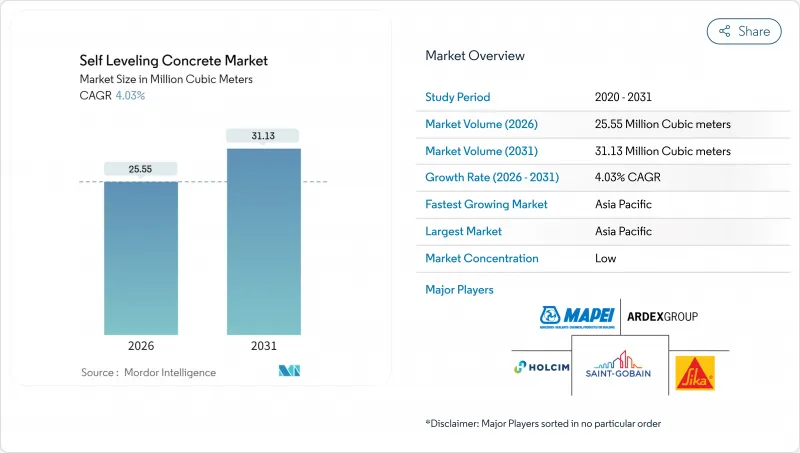
這一穩步成長的趨勢反映了持續的維修活動、低碳接合材料的廣泛應用以及對快速施工地板材料解決方案日益成長的需求。電商履約中心的強勁需求、公共建築的持續維修以及政府鼓勵使用無揮發性有機化合物(VOC)產品的獎勵,都持續推動著用戶成長。安裝人員也在尋求採用泵車運輸系統來減少人工成本,並確保大規模澆築的一致性,從而進一步推動銷售成長。然而,特種水泥價格的波動、安裝人員日益短缺以及與潮濕相關的投訴限制了近期的成長,凸顯了培訓和成本控制措施的重要性。
全球自流平混凝土市場趨勢及展望
疫情後商業維修計劃迅速復甦
從2024年起,受資料中心、醫療保健和教育產業資產重新定位策略的推動,商業建築業主將優先考慮內部維修而非新建設。美國建設業承包商協會 (AGC) 的一項調查顯示,42% 的公司預計 2025 年資料中心相關工作量將有所成長,其次是醫療保健和教育產業。這些計劃通常存在地面高度不平整的問題,因此自流平地面成為加快施工進度、滿足緊迫的重新入住期限的首選產品。老舊辦公大樓的改造也進一步推動了市場需求,因為不平整的地面會阻礙模組化地毯和彈性地板材料的鋪設。美國聯邦政府的基礎建設資金正在加速公共建築的維修,而自流平材料正幫助政府機構在滿足緊迫的施工進度的同時,保護現有建築結構。
整合式自乾型低碳CSA黏合劑
與一般波特蘭水泥相比,硫鋁酸鈣黏合劑可將產品的固有碳排放降低高達 40%,並可實現當日地板材料。這些特性滿足了追求 LEED v4.1 認證積分和淨零排放目標的業主的需求。承包商則受惠於更快的施工速度、更低的除濕成本和更低的濕度測試風險。BASF和西卡已開始將硫鋁酸鈣技術與先進的聚合物固化劑相結合,以提高抗彎強度和耐磨性,展現了兼顧性能和永續性的合作模式。加州的「清潔採購」計畫已將基於硫鋁酸鈣的自流平材料指定為公共工程項目的首選規範,不列顛哥倫比亞省和歐盟也正在考慮類似的採購規則。
特種水泥和外加劑價格波動;
碳定價導致歐洲水泥熟料成本在2024年每噸上漲18美元,進而推動特種水泥價格較去年同期上漲約11%。天氣原因導致的礦場關閉也造成了聚合物流動改質劑和碳酸鋰的嚴重供不應求,使承包商在固定價格合約下面臨競標風險。儘管跨國公司正擴大將外加劑生產在地化以縮短前置作業時間,但規模較小的混凝土混合料生產商仍然依賴進口原料,不可避免地將成本轉嫁給客戶。客戶開始在混凝土合約中加入鋼鐵業的價格上漲條款,但並非所有公共機構都接受這些條款,這可能導致資金籌措缺口和計劃啟動延誤。
細分市場分析
到2025年,底塗劑將佔據自流平混凝土市場64.58%的佔有率,這主要歸功於其作為幾乎所有建築類型中用於找平不平整基材的標準解決方案。大型生產商透過設計最佳化流動性、養護時間和成本平衡的混合料,使這類產品更加通用。然而,持續存在的培訓短缺問題依然嚴峻,因為工人常常低估底塗劑附著力和水分管理的重要性,導致需要重複塗刷,從而降低承包商的盈利。
儘管絕對銷量仍然較小,但飾面材料正迅速普及,預計從2026年到2031年將以4.34%的複合年成長率成長。拋光飾面材料正被零售連鎖店、精品酒店和企業配套設施空間所採用,以在無需傳統播種方法的高昂成本和複雜施工的情況下,營造出類似水磨石的美感。諸如數位印刷表面、半透明彩色覆蓋層和混合聚氨酯水泥耐磨層等創新技術,正在提升設計的柔軟性。隨著業主在預算有限的情況下尋求獨特的飾面效果,能夠大規模提供創意十足、高性能飾面材料的製造商擁有明顯的優勢。
自流平混凝土報告按產品類型(面層和基層)、最終用途領域(商業、工業及公共、基礎設施、住宅)和地區(亞太地區、北美、歐洲、南美、中東和非洲)進行細分。市場預測以體積(立方米)為單位。
區域分析
到2025年,亞太地區將佔據全球38.34%的市場佔有率,這主要得益於中國的「一帶一路」計劃、印度的「智慧城市」計畫以及東南亞工廠擴張的蓬勃發展。隨著各國政府加大對公共運輸、機場和資料中心的投入,預計到2031年,亞太市場將以4.14%的複合年成長率成長。僅中國預計到2025年將在省級基礎設施建設方面投入超過3940億美元,並指定使用自流平產品進行候機大廳鋪設和航站樓擴建。 Holcim的SMARTFlow模擬程序已在新加坡和韓國獲得認可,並受到重視高層建築泵適用性預測模型的建築商的支持。
儘管成長放緩,北美仍是關鍵市場。 《基礎設施投資和就業創造法案》提供的聯邦資金正在提振政府大樓、橋樑和公共交通樞紐的需求,但由於辦公大樓市場的不確定性,私人商業計劃的開工受到抑制。預計2025年底的降息可能會重啟一些被推遲的計劃,尤其是在生命科學研究設施和園區以及先進製造業領域。
歐洲不同地區的發展趨勢各不相同。西歐市場正積極引領永續性,德國和法國已將碳減排的CSA產品納入公共採購清單;西班牙和義大利則正在維修老舊酒店,以實現其2030年的旅遊業目標。東歐則持續依賴歐盟凝聚津貼補貼公路和鐵路的改善工程,包括自流平橋面鋪設。
其他福利:
- Excel格式的市場預測(ME)表
- 3個月的分析師支持
目錄
第1章 引言
- 研究假設和市場定義
- 調查範圍
第2章調查方法
第3章執行摘要
第4章 市場情勢
- 市場概覽
- 市場促進因素
- 疫情後商業維修計劃迅速復甦
- 自乾低碳CSA黏合劑的整合
- 加速電子商務履約中心的地板鋪設流程
- 大型計劃中採用泵車式大容量污水處理系統
- 政府對不含揮發性有機化合物的室內產品提供誘因
- 市場限制
- 特種水泥和外加劑價格波動;
- 由於缺乏施工技能,導致性能不佳
- 快速施工樓板中與潮濕相關的索賠
- 價值鏈分析
- 波特五力模型
- 新進入者的威脅
- 供應商的議價能力
- 買方的議價能力
- 替代品的威脅
- 競爭對手之間的競爭
第5章 市場規模與成長預測
- 依產品
- 食材
- 基材
- 按最終用途面積
- 商業的
- 工業和公共設施
- 基礎設施
- 住宅
- 按地區
- 亞太地區
- 中國
- 印度
- 韓國
- 日本
- 東南亞國協
- 亞太其他地區
- 北美洲
- 美國
- 加拿大
- 墨西哥
- 歐洲
- 法國
- 德國
- 義大利
- 俄羅斯
- 西班牙
- 英國
- 其他歐洲地區
- 南美洲
- 巴西
- 阿根廷
- 南美洲其他地區
- 中東和非洲
- 沙烏地阿拉伯
- 南非
- 其他中東和非洲地區
- 亞太地區
第6章 競爭情勢
- 市場集中度
- 策略趨勢
- 市佔率/排名分析
- 公司簡介
- ARDEX Group
- Arkema
- BASF
- Cemex SAB DE CV
- Duraamen Engineered
產品有限公司
- 流化混凝土
- H.B.富勒
- 荷希姆
- 拉蒂克雷特國際有限公司
- 馬貝株式會社
- 麥克森有限公司
- 純環氧樹脂
- 聖哥班
- 西卡公司
- Target Products Co., Ltd.
- TCC材料
第7章 市場機會與未來展望
Self Leveling Concrete market size in 2026 is estimated at 25.55 Million Cubic meters, growing from 2025 value of 24.56 Million Cubic meters with 2031 projections showing 31.13 Million Cubic meters, growing at 4.03% CAGR over 2026-2031.
This steady trajectory reflects sustained renovation activity, the adoption of low-carbon binders, and rising demand for rapid-install flooring solutions. Strong uptake in e-commerce fulfillment centers, ongoing public-building refurbishment, and government incentives that reward VOC-free products continue to widen the user base. Contractors also view pump-truck delivery systems as a route to reduce labor requirements and maintain consistency on large pours, further propelling volume growth. At the same time, price volatility in specialty cement, a widening installation skill gap, and moisture-related callbacks temper near-term gains, underscoring the importance of training and cost-management initiatives.
Global Self Leveling Concrete Market Trends and Insights
Rapid Rebound of Commercial Renovation Projects Post-Pandemic
Commercial building owners have prioritized interior upgrades over ground-up construction since 2024, bolstered by asset-repositioning strategies in data centers, healthcare, and education. The Associated General Contractors survey shows 42% of firms anticipate more data-center work in 2025, with healthcare and education following close behind. These projects typically involve highly variable existing substrates, making self-leveling underlayments the product of choice to speed installation and meet tight re-occupancy deadlines. Adaptive-reuse conversions of legacy office towers further expand demand because substrate irregularities hinder the installation of modular carpet tiles and resilient floor coverings. U.S. federal infrastructure funding accelerates public-building refurbishment, and self-leveling compounds help agencies meet aggressive construction timetables while preserving existing structures.
Integration of Self-Drying, Low-Carbon CSA Binders
Calcium sulfoaluminate binders cut embodied-carbon emissions by up to 40% versus ordinary Portland cement and unlock same-day flooring readiness, attributes that resonate with owners pursuing LEED v4.1 points and net-zero goals. Contractors benefit from shorter project schedules, fewer dehumidification costs, and reduced moisture-testing risk. BASF and Sika have begun pairing CSA technology with advanced polymer hardeners to improve flexural strength and abrasion resistance, illustrating a collaborative approach to performance and sustainability. California's Buy Clean program has already positioned CSA-based self-levelers as a preferred specification in public work, and similar procurement rules are under review in British Columbia and the European Union.
Volatility in Specialty Cement and Admixture Prices
Carbon-pricing schemes added USD 18/tons to European clinker costs in 2024, pushing specialty cement prices up by nearly 11% year-on-year. Polymer-based flow modifiers and lithium carbonate also experienced abrupt shortages following weather-related mine closures, exposing contractors to bid risk on fixed-price jobs. Multinationals have responded by regionalizing admixture production to shorten lead times, but smaller formulators remain reliant on imported ingredients, making cost pass-through unavoidable. Owners have begun to implement steel-like escalation clauses in concrete contracts, yet not all public entities accept such provisions, creating a funding mismatch that can delay project starts.
Other drivers and restraints analyzed in the detailed report include:
- Fast-Track Flooring Schedules in E-Commerce Fulfillment Centers
- Adoption of Pump-Truck High-Volume SLU Systems on Megaprojects
- Installation Skill-Gap Causing Performance Failures
For complete list of drivers and restraints, kindly check the Table Of Contents.
Segment Analysis
Underlayments held 64.58% self-leveling concrete market share in 2025, thanks to their role as the default solution for leveling out-of-tolerance substrates across virtually every building type. Bulk producers have optimized mix designs to balance flow, set time, and cost, drawing the category closer to commodity status. However, recurring training deficits frequently show up here, since crews may underestimate the importance of bonding primers and controlled water addition, leading to callbacks that dent contractor profitability.
Toppings, though smaller in absolute volume, are moving quickly toward mass adoption, projected to expand at a 4.34% CAGR over 2026-2031. Polished toppings now appear in retail chains, boutique hotels, and corporate amenity spaces, offering terrazzo-like aesthetics without the cost and installation complexity of traditional seeded systems. Innovations such as digital print-ready surfaces, translucent pigmented overlays, and hybrid PU-cement wear layers foster design flexibility. With owners hunting for unique finishes that still respect lean budgets, suppliers that can deliver creative, high-performance toppings at scale gain a clear advantage.
The Self Leveling Concrete Report is Segmented by Product (Topping and Underlayment), End-Use Sector (Commercial, Industrial and Institutional, Infrastructure, and Residential), and Geography (Asia-Pacific, North America, Europe, South America, and Middle-East and Africa). The Market Forecasts are Provided in Terms of Volume (Cubic Meters).
Geography Analysis
Asia-Pacific accounted for 38.34% of 2025 volume, supported by China's Belt and Road projects, India's Smart Cities Mission, and Southeast Asia's factory-expansion wave. Regional volume is projected to increase at a 4.14% CAGR through 2031 as governments channel spending into mass transit, airport, and data center programs. China alone is pouring more than USD 394 billion into provincial infrastructure in 2025, with self-leveling products specified for concourse overlays and terminal expansions. Holcim's SMARTFlow simulation program has found receptive audiences in Singapore and South Korea, where contractors value predictive pumpability models for high-rise construction.
North America remains a heavyweight, albeit with slower growth. Federal funding from the Infrastructure Investment and Jobs Act elevates demand in government buildings, bridges, and public-transit hubs, but private commercial starts are dampened by office-sector uncertainty. Interest-rate cuts expected in late 2025 should unlock some deferred projects, particularly in life-science research and campuses and advanced manufacturing.
Europe shows divergent trends. Western markets pursue sustainability leadership; Germany and France employ carbon-reduced CSA products on public procurement lists, while Spain and Italy refurbish aging hotels ahead of 2030 tourism goals. Eastern Europe continues to rely on EU cohesion funds, channeling grants into roadway and rail upgrades that include self-leveling bridge-deck overlays.
- ARDEX Group
- Arkema
- BASF
- Cemex S.A.B DE C.V.
- Duraamen Engineered Products, Inc.
- Flowcrete
- H.B. Fuller Company
- HOLCIM
- LATICRETE International, Inc.
- MAPEI S.p.A.
- Maxxon, Inc.
- PurEpoxy
- Saint-Gobain
- Sika AG
- Target Products Ltd
- TCC Materials
Additional Benefits:
- The market estimate (ME) sheet in Excel format
- 3 months of analyst support
TABLE OF CONTENTS
1 Introduction
- 1.1 Study Assumptions and Market Definition
- 1.2 Scope of the Study
2 Research Methodology
3 Executive Summary
4 Market Landscape
- 4.1 Market Overview
- 4.2 Market Drivers
- 4.2.1 Rapid rebound of commercial renovation projects post-pandemic
- 4.2.2 Integration of self-drying, low-carbon CSA binders
- 4.2.3 Fast-track flooring schedules in e-commerce fulfillment centers
- 4.2.4 Adoption of pump-truck high-volume SLU systems on megaprojects
- 4.2.5 Government incentives for VOC-free indoor products
- 4.3 Market Restraints
- 4.3.1 Volatility in specialty cement and admixture prices
- 4.3.2 Installation skill-gap causing performance failures
- 4.3.3 Moisture-related callbacks in fast-track slabs
- 4.4 Value Chain Analysis
- 4.5 Porter's Five Forces
- 4.5.1 Threat of New Entrants
- 4.5.2 Bargaining Power of Suppliers
- 4.5.3 Bargaining Power of Buyers
- 4.5.4 Threat of Substitutes
- 4.5.5 Competitive Rivalry
5 Market Size and Growth Forecasts (Volume)
- 5.1 By Product
- 5.1.1 Topping
- 5.1.2 Underlayment
- 5.2 By End Use Sector
- 5.2.1 Commercial
- 5.2.2 Industrial and Institutional
- 5.2.3 Infrastructure
- 5.2.4 Residential
- 5.3 By Geography
- 5.3.1 Asia-Pacific
- 5.3.1.1 China
- 5.3.1.2 India
- 5.3.1.3 South Korea
- 5.3.1.4 Japan
- 5.3.1.5 ASEAN Countries
- 5.3.1.6 Rest of Asia-Pacific
- 5.3.2 North America
- 5.3.2.1 United States
- 5.3.2.2 Canada
- 5.3.2.3 Mexico
- 5.3.3 Europe
- 5.3.3.1 France
- 5.3.3.2 Germany
- 5.3.3.3 Italy
- 5.3.3.4 Russia
- 5.3.3.5 Spain
- 5.3.3.6 United Kingdom
- 5.3.3.7 Rest of Europe
- 5.3.4 South America
- 5.3.4.1 Brazil
- 5.3.4.2 Argentina
- 5.3.4.3 Rest of South America
- 5.3.5 Middle-East and Africa
- 5.3.5.1 Saudi Arabia
- 5.3.5.2 South Africa
- 5.3.5.3 Rest of Middle-East and Africa
- 5.3.1 Asia-Pacific
6 Competitive Landscape
- 6.1 Market Concentration
- 6.2 Strategic Moves
- 6.3 Market Share/Ranking Analysis
- 6.4 Company Profiles (includes Global level Overview, Market level overview, Core Segments, Financials as available, Strategic Information, Market Rank/Share, Products and Services, and Recent Developments)
- 6.4.1 ARDEX Group
- 6.4.2 Arkema
- 6.4.3 BASF
- 6.4.4 Cemex S.A.B DE C.V.
- 6.4.5 Duraamen Engineered
Products, Inc.
- 6.4.6 Flowcrete
- 6.4.7 H.B. Fuller Company
- 6.4.8 HOLCIM
- 6.4.9 LATICRETE International, Inc.
- 6.4.10 MAPEI S.p.A.
- 6.4.11 Maxxon, Inc.
- 6.4.12 PurEpoxy
- 6.4.13 Saint-Gobain
- 6.4.14 Sika AG
- 6.4.15 Target Products Ltd
- 6.4.16 TCC Materials
7 Market Opportunities and Future Outlook
- 7.1 White-space and Unmet-Need Assessment

 自流平密封膠市場:全球市場預測,2026-2032年
 全球自流平混凝土市場
 2026年全球自流平混凝土市場報告
 自流平材料市場:按產品類型、應用、最終用途行業和地區分類。
 自流平混凝土市場規模、佔有率及成長分析(按產品類型、應用、最終用途及地區分類)-2026-2033年產業預測