


 |
市場調查報告書
商品編碼
1910807
浮法玻璃:市場佔有率分析、產業趨勢與統計、成長預測(2026-2031)Float Glass - Market Share Analysis, Industry Trends & Statistics, Growth Forecasts (2026 - 2031) |
||||||

※ 本網頁內容可能與最新版本有所差異。詳細情況請與我們聯繫。
預計到2026年,浮法玻璃市場規模將達到7,686萬噸,高於2025年的7,427萬噸。預測2031年,市場規模將達到9,118萬噸,2026年至2031年的複合年成長率為3.48%。
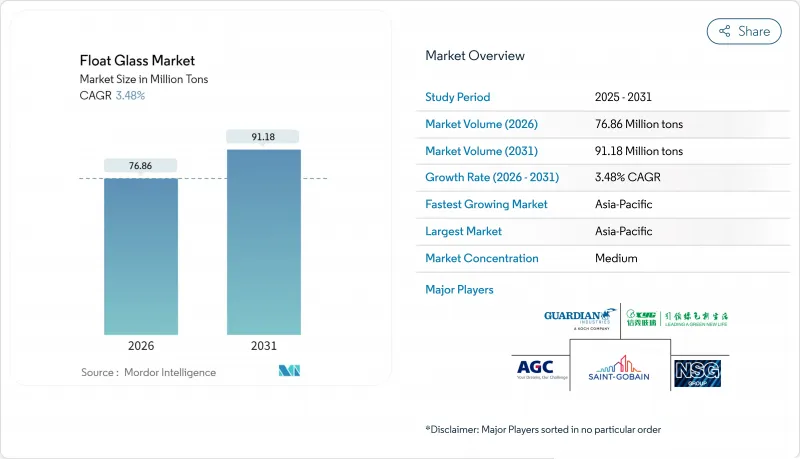
儘管傳統建築應用日趨成熟,但太陽能光電、汽車和節能建築幕牆等高性能基板的強勁需求仍支撐著市場銷售的穩定成長。製造商正利用製程自動化和爐窯升級來緩解堿灰和天然氣等原料成本波動的影響。同時,脫碳投資有助於確保企業能夠進入面臨碳基貿易障礙的出口市場。競爭優勢日益依賴精度、可靠性以及供給能力,而非產量。北美大規模太陽能光電裝置的快速部署以及歐洲向低碳建築圍護結構的轉型正在重塑全球採購模式,迫使亞洲供應商加快減排藍圖以維持市場佔有率。隨著中國和美國數十億美元的排放能擴張計劃,浮法玻璃市場正持續向區域化供應鏈轉型,優先考慮韌性和碳效率。
全球浮法玻璃市場趨勢及展望
擴大新興經濟體的建築業
在南亞和東南亞,公共部門在交通、住宅和工業走廊建設方面的持續投入,推動了建築玻璃的持續成長。印度的建築計劃總量相當於該行業年營業收入的3.5倍。儘管由於勞動力短缺導致計劃執行延誤,泰國東部經濟走廊仍持續吸收大量的平板玻璃。區域性浮法玻璃生產線的產運轉率已低於80%,這使得靠近這些需求中心的生產商無需新的投資即可迅速提高出貨量。因此,浮法玻璃市場將依靠快速成長的新興經濟體來彌補成熟西方國家消費停滯的情況。
車身越輕,每輛車的玻璃面積。
電氣化法規使得車身重量成為汽車製造商最重要的關鍵績效指標 (KPI),同時,先進駕駛輔助系統、全景天窗和身臨其境型資訊娛樂螢幕的普及卻增加了每輛車的玻璃表面積。這種矛盾的局面推動了浮法玻璃市場的結構性成長,汽車製造商 (OEM) 指定使用更薄、更大尺寸的夾層鋼化玻璃,以整合天線、加熱器和抬頭顯示器塗層。福耀玻璃決定投資 58 億元人民幣(約 8.04 億美元)新建一條專門用於電動車平台的浮法玻璃生產線,凸顯了這一市場機會的巨大規模。由此產生的對光學透明度和電磁滲透性的要求支撐了高價位,確保產量的增加能夠直接轉化為技術供應商更高的收入和利潤率。
安全玻璃中的聚合物和聚碳酸酯替代品
汽車和建築規範現在允許使用聚碳酸酯解決方案,其抗衝擊性可與夾層玻璃媲美,但重量卻輕40-50%。注重輕量化的原始設備製造商(OEM)正在嘗試使用聚合物車頂和後窗。然而,諸如耐刮擦性、紫外線穩定性和光學畸變等挑戰限制了其應用範圍,使其僅限於小眾領域。玻璃製造商正在透過採用先進的PVB中間層來生產更薄、更輕的夾層玻璃,伊士曼公司擴大在歐洲的產能便證明了這一點。雖然這場材料之爭限制了浮法玻璃市場的複合年成長率(CAGR),但也刺激了創新,拓展了產品功能,並提高了市場進入門檻。
細分市場分析
2025年,透明平板玻璃佔據浮法玻璃市場62.70%的佔有率,預計到2031年將以3.79%的複合年成長率保持最高成長。這一主導地位反映了其無與倫比的多功能性,對於建築幕牆玻璃、汽車擋風玻璃和低鐵太陽能罩等應用至關重要,這些應用需要著色或圖案產品無法達到的清晰度。製造商正投入大量研發預算,致力於改進精煉和熔體均質化技術,以減少氣泡含量和鐵殘留,從而確保利潤率,抵消商業化進程中的阻力。著色和圖案平板玻璃仍然是一個以設計主導的小眾市場,但其應用更與週期性的建築趨勢相關,而非結構性的技術變革。
超白低鐵玻璃在高階市場佔據主導地位,這主要得益於太陽能產業蓬勃發展帶來的經濟效益以及高階建築幕牆的美學需求。 NSG 的 Pilkington Mirai™ 和 Shin-i 的 2.0mm 玻璃系列便是兼顧碳減排和超薄設計的典範。隨著 N 型太陽能組件生產線的擴張,平板玻璃的廢品率不斷上升,而每吉瓦裝置容量所需的透明玻璃用量卻出乎意料地增加。這使得整合式砂礦和即時雜質檢測成為浮法玻璃市場中的關鍵競爭優勢。
本浮法玻璃報告按產品類型(透明、有色、花紋、鋼絲、超白/低鐵)、應用領域(建築、汽車、太陽能玻璃及其他應用)和地區(亞太、北美、歐洲、南美、中東和非洲)進行細分。市場預測以噸為單位。
區域分析
預計亞太地區將主導浮法玻璃市場,到2025年將佔全球產量的62.65%,並在2031年之前以3.92%的複合年成長率持續成長。中國正大力發展其巨型窯爐集群,而印度則正經歷前所未有的1.5兆美元建設熱潮,以滿足住宅大樓和物流園區對大尺寸面板的需求。在泰國,東部經濟走廊周邊的基礎設施投資正在緩解住宅市場放緩導致的本地需求下降。然而,亞洲出口商必須應對不斷上漲的運費和即將實施的CBAM課稅,這促使他們嘗試投資混合式窯爐和屋頂太陽能發電系統,以減少每噸運輸產品的二氧化碳排放量。
歐洲歷來是浮法創新的發源地,如今已成為低碳製造的標竿:聖戈班的 ORAE 系列產品兼具高回收率和搖籃到搖籃認證,而 AGC Interpane 在德國和奧地利的升級改造正在住宅開工放緩的情況下提高生產線效率。
北美正利用近岸外包趨勢和清潔能源激勵政策。福耀玻璃在伊利諾州投資4億美元興建浮法玻璃廠,確保為中西部電動車工廠提供及時供應。加上《通貨膨脹控制法案》提供的製造業稅額扣抵,這些措施正促使企業減少對進口的依賴,轉向國內熔煉平板玻璃,從而減少延誤和碳排放。在南美洲以及中東和非洲,體育場館建設、海水淡化計劃和智慧城市計畫的推出推動了產量成長,但當地產能有限,導致人均消費量低於成熟市場。
其他福利:
- Excel格式的市場預測(ME)表
- 分析師支持(3個月)
目錄
第1章 引言
- 研究假設和市場定義
- 調查範圍
第2章調查方法
第3章執行摘要
第4章 市場情勢
- 市場概覽
- 市場促進因素
- 擴大新興經濟體的建築業
- 車身越輕,每輛車的玻璃面積多。
- 大型太陽能發電廠建設的擴張將提振對低鐵浮法玻璃的需求。
- 都市更新要求採用節能型建築幕牆
- 光電建築建築幕牆規範推廣超透明低鐵基板
- 市場限制
- 堿灰和天然氣價格波動
- 安全玻璃中的聚合物和聚碳酸酯替代品
- 遵守歐盟碳邊境調節機制的成本(未受到太多關注)
- 價值鏈分析
- 原料分析
- 沙
- 石灰石
- 堿灰
- 白雲石
- 波特五力模型
- 供應商的議價能力
- 買方的議價能力
- 新進入者的威脅
- 替代品的威脅
- 競爭程度
第5章 市場規模及成長預測(價值及數量)
- 依產品類型
- 清除
- 有色
- 模式
- 有線
- 超白/低鐵浮法玻璃
- 透過使用
- 建築/施工
- 車
- 太陽能玻璃
- 其他用途
- 按地區
- 亞太地區
- 中國
- 印度
- 日本
- 韓國
- 越南
- 泰國
- 印尼
- 馬來西亞
- 亞太其他地區
- 北美洲
- 美國
- 加拿大
- 墨西哥
- 歐洲
- 德國
- 英國
- 法國
- 義大利
- 西班牙
- 俄羅斯
- 北歐國家
- 其他歐洲地區
- 南美洲
- 巴西
- 阿根廷
- 哥倫比亞
- 南美洲其他地區
- 中東和非洲
- 沙烏地阿拉伯
- 奈及利亞
- 卡達
- 阿拉伯聯合大公國
- 埃及
- 南非
- 其他中東和非洲地區
- 亞太地區
第6章 競爭情勢
- 市場集中度
- 策略趨勢
- 市佔率(%)/排名分析
- 公司簡介
- AGC Inc.
- BG
- CARDINAL GLASS INDUSTRIES, INC
- China Glass Holding
- China Luoyang Float Glass Group Co., Ltd.
- Flat Glass Group Co., Ltd
- Fuyao Group
- Guardian Industries Holdings
- Kibing Group
- Nippon Sheet Glass Co., Ltd
- PRESS GLASS Holding SA
- PT Mulia Industrindo Tbk
- Saint-Gobain
- SCHOTT
- Sisecam
- Taiwan Glass Ind. Corp.
- Vitro
- Xinyi Glass Holdings Limited
第7章 市場機會與未來展望
Float Glass Market size in 2026 is estimated at 76.86 million tons, growing from 2025 value of 74.27 million tons with 2031 projections showing 91.18 million tons, growing at 3.48% CAGR over 2026-2031.
Surging demand for high-performance substrates in solar, automotive, and energy-efficient facades supports steady volume gains even as traditional construction end-uses mature. Manufacturers leverage process automation and furnace upgrades to curb the volatility stemming from soda-ash and natural-gas input costs, while decarbonization investments safeguard access to export markets facing carbon-based trade barriers. Competitive differentiation now rests less on throughput and more on precision, reliability, and the capacity to deliver ultra-clear, thin, or multi-functional sheets that command premium margins. Rapid installations of utility-scale solar arrays in North America and the shift toward low-carbon building envelopes in Europe are reshaping global procurement models, forcing Asian suppliers to accelerate emission-reduction roadmaps to maintain share. With multibillion-dollar capacity additions scheduled in both China and the United States, the float glass market continues to rebalance toward regionalized supply chains that prioritize resilience and carbon efficiency.
Global Float Glass Market Trends and Insights
Construction-Sector Expansion in Emerging Economies
Decisive public-sector outlays on transport, housing, and industrial corridors are fueling sustained purchases of architectural glass across South and Southeast Asia. India's construction pipeline equals 3.5 times the sector's annual operating revenue. Thailand's Eastern Economic Corridor continues to absorb large sheet volumes even as labor shortages slow project execution. With regional float lines already running at utilization rates below 80%, producers situated near these demand hubs can ramp shipments swiftly without green-field investments. As a result, the float glass market will rely on fast-growing emerging economies to offset plateauing consumption in mature Western countries.
Automotive Lightweighting Raises Glazing M2 Per Vehicle
Electrification mandates have made weight a premium KPI for automakers, yet advanced driver-assistance systems, panoramic roofs, and immersive infotainment screens are simultaneously expanding the glass surface area per car. This paradox underpins a structural upswing for the float glass market, as OEMs specify thinner yet larger laminated or tempered panes that integrate antennas, heaters, and head-up-display coatings. Fuyao's decision to inject CNY 5.8 billion (USD 804 million) into new float lines dedicated to electrified vehicle platforms illustrates the scale of the opportunity. The resulting requirement for optical clarity and electromagnetic transparency supports premium pricing, ensuring that volume growth feeds directly into revenue and margin expansion for technologically capable suppliers.
Polymer and Polycarbonate Substitutes in Safety Glazing
Automotive and architectural standards permit polycarbonate solutions that weigh 40-50% less than laminated glass while matching impact resistance. Weight-sensitive OEMs therefore experiment with polymer roofs and rear windows; however, scratch performance, UV stability, and optical distortion issues still confine usage to niche placements. Glass makers answer with thinner, lighter laminates using advanced PVB interlayers, as evidenced by Eastman's European capacity expansion. The resulting material joust moderates the float glass market CAGR but also catalyzes innovation, widening the product envelope and raising entry barriers.
Other drivers and restraints analyzed in the detailed report include:
- Utility-Scale Solar Build-Outs Boost Demand for Low-Iron Float Glass
- BIPV Facade Regulations Spur Ultra-Clear Low-Iron Substrates
- EU Carbon Border Adjustment Mechanism Compliance Costs
For complete list of drivers and restraints, kindly check the Table Of Contents.
Segment Analysis
Clear sheet controlled 62.70% of the float glass market share in 2025 and will register the highest 3.79% CAGR through 2031. This dominance reflects unrivaled versatility: facade glazing, automotive windscreens, and low-iron solar covers all demand transparency levels unattainable by tinted or patterned variants. Manufacturers channel research and development budgets into purification and melt-homogeneity technologies that suppress bubble content and iron residue, securing margins that offset commodity headwinds. Tinted and patterned sheets persist as design-driven niches, yet their uptake follows cyclical architectural trends rather than structural technology shifts.
Extra-clear low-ferrous grades sit at the premium apex, powered by solar boom economics and luxury facade aesthetics. NSG's Pilkington Mirai(TM) and Xinyi's 2.0 mm glass lines exemplify the emphasis on both embodied-carbon cuts and extreme thinness. As N-type solar modules cascade through production lines, sheet rejection rates rise, paradoxically lifting clear-glass tonnage per installed gigawatt. Integrated sand quarries and real-time impurity scanners thus become critical competitive assets across the float glass market.
The Float Glass Report is Segmented by Product Type (Clear, Tinted, Patterned, Wired, and Extra Clear/Low Ferrous), Application (Building and Construction, Automotive, Solar Glass, and Other Applications), and Geography (Asia-Pacific, North America, Europe, South America, and Middle-East and Africa). The Market Forecasts are Provided in Terms of Volume (Tons).
Geography Analysis
Asia-Pacific dominates the float glass market, supplying 62.65% of global output in 2025 and advancing at a 3.92% CAGR to 2031. China anchors the base with mega-scale kiln clusters, while India rides an unprecedented USD 1.5 trillion construction upcycle that absorbs large sheets for residential towers and logistics parks. Thailand's infrastructure spend around the Eastern Economic Corridor cushions regional demand dips tied to residential slowdowns. Yet Asian exporters must navigate rising freight charges and looming CBAM levies, prompting pilot investments in hybrid furnaces and rooftop solar to reduce shipped-ton CO2.
Europe, historically the cradle of float innovation, is now the crucible for low-carbon manufacturing. Saint-Gobain's ORAE series combines high recycled content with cradle-to-cradle certification, while AGC Interpane's upgrades in Germany and Austria elevate line efficiencies despite weak housing starts.
North America capitalizes on nearshoring dynamics and clean-energy incentives. Fuyao's USD 400 million boost to its Illinois float facility ensures just-in-time supply for Midwest EV plants. Combined with the Inflation Reduction Act's manufacturing tax credits, these moves shift import reliance toward domestically melted sheets, narrowing latency and carbon footprints. South America and the Middle East and Africa deliver incremental tonnage via stadium builds, desalination projects, and smart-city launches, but limited local capacity keeps per-capita consumption below mature-market norms.
- AGC Inc.
- BG
- CARDINAL GLASS INDUSTRIES, INC
- China Glass Holding
- China Luoyang Float Glass Group Co., Ltd.
- Flat Glass Group Co., Ltd
- Fuyao Group
- Guardian Industries Holdings
- Kibing Group
- Nippon Sheet Glass Co., Ltd
- PRESS GLASS Holding SA
- PT Mulia Industrindo Tbk
- Saint-Gobain
- SCHOTT
- Sisecam
- Taiwan Glass Ind. Corp.
- Vitro
- Xinyi Glass Holdings Limited
Additional Benefits:
- The market estimate (ME) sheet in Excel format
- 3 months of analyst support
TABLE OF CONTENTS
1 Introduction
- 1.1 Study Assumptions and Market Definition
- 1.2 Scope of the Study
2 Research Methodology
3 Executive Summary
4 Market Landscape
- 4.1 Market Overview
- 4.2 Market Drivers
- 4.2.1 Construction Sector Expansion in Emerging Economies
- 4.2.2 Automotive Lightweighting Raises Glazing M2 Per Vehicle
- 4.2.3 Utility-Scale Solar Buildouts Boost Demand for Low-Iron Float Glass
- 4.2.4 Urban Regeneration Mandates Energy-Efficient Facades
- 4.2.5 BIPV Facade Regulations Spur Ultra-Clear Low-Iron Substrates
- 4.3 Market Restraints
- 4.3.1 Volatile Soda-Ash and Natural-Gas Prices
- 4.3.2 Polymer and Polycarbonate Substitutes in Safety Glazing
- 4.3.3 EU Carbon Border Adjustment Mechanism Compliance Costs (under-radar)
- 4.4 Value Chain Analysis
- 4.5 Raw Material Analysis
- 4.5.1 Sand
- 4.5.2 Limestone
- 4.5.3 Soda Ash
- 4.5.4 Dolomite
- 4.6 Porter's Five Forces
- 4.6.1 Bargaining Power of Suppliers
- 4.6.2 Bargaining Power of Buyers
- 4.6.3 Threat of New Entrants
- 4.6.4 Threat of Substitutes
- 4.6.5 Degree of Competition
5 Market Size and Growth Forecasts (Value and Volume)
- 5.1 By Product Type
- 5.1.1 Clear
- 5.1.2 Tinted
- 5.1.3 Patterned
- 5.1.4 Wired
- 5.1.5 Extra Clear/Low Ferrous Floated Glass
- 5.2 By Application
- 5.2.1 Building and Construction
- 5.2.2 Automotive
- 5.2.3 Solar Glass
- 5.2.4 Other Applications
- 5.3 By Geography
- 5.3.1 Asia-Pacific
- 5.3.1.1 China
- 5.3.1.2 India
- 5.3.1.3 Japan
- 5.3.1.4 South Korea
- 5.3.1.5 Vietnam
- 5.3.1.6 Thailand
- 5.3.1.7 Indonesia
- 5.3.1.8 Malaysia
- 5.3.1.9 Rest of Asia-Pacific
- 5.3.2 North America
- 5.3.2.1 United States
- 5.3.2.2 Canada
- 5.3.2.3 Mexico
- 5.3.3 Europe
- 5.3.3.1 Germany
- 5.3.3.2 United Kingdom
- 5.3.3.3 France
- 5.3.3.4 Italy
- 5.3.3.5 Spain
- 5.3.3.6 Russia
- 5.3.3.7 Nordic Countries
- 5.3.3.8 Rest of Europe
- 5.3.4 South America
- 5.3.4.1 Brazil
- 5.3.4.2 Argentina
- 5.3.4.3 Colombia
- 5.3.4.4 Rest of South America
- 5.3.5 Middle-East and Africa
- 5.3.5.1 Saudi Arabia
- 5.3.5.2 Nigeria
- 5.3.5.3 Qatar
- 5.3.5.4 United Arab Emirates
- 5.3.5.5 Egypt
- 5.3.5.6 South Africa
- 5.3.5.7 Rest of Middle-East and Africa
- 5.3.1 Asia-Pacific
6 Competitive Landscape
- 6.1 Market Concentration
- 6.2 Strategic Moves
- 6.3 Market Share (%)/Ranking Analysis
- 6.4 Company Profiles (includes Global level Overview, Market level overview, Core Segments, Financials as available, Strategic Information, Market Rank/Share for key companies, Products and Services, and Recent Developments)
- 6.4.1 AGC Inc.
- 6.4.2 BG
- 6.4.3 CARDINAL GLASS INDUSTRIES, INC
- 6.4.4 China Glass Holding
- 6.4.5 China Luoyang Float Glass Group Co., Ltd.
- 6.4.6 Flat Glass Group Co., Ltd
- 6.4.7 Fuyao Group
- 6.4.8 Guardian Industries Holdings
- 6.4.9 Kibing Group
- 6.4.10 Nippon Sheet Glass Co., Ltd
- 6.4.11 PRESS GLASS Holding SA
- 6.4.12 PT Mulia Industrindo Tbk
- 6.4.13 Saint-Gobain
- 6.4.14 SCHOTT
- 6.4.15 Sisecam
- 6.4.16 Taiwan Glass Ind. Corp.
- 6.4.17 Vitro
- 6.4.18 Xinyi Glass Holdings Limited
7 Market Opportunities and Future Outlook
- 7.1 White-space and Unmet-need Assessment

 2026年全球建築用透明浮法玻璃市場報告2026年全球浮法玻璃市場報告
 全球浮法玻璃市場:按厚度、產品、終端用途產業和地區分類的市場規模-預測至2030年
 浮法玻璃市場按產品類型、厚度、塗層類型、應用和分銷管道分類-2025-2030 年全球預測
 浮法玻璃的全球市場的評估:各類型,各用途,各地區,機會,預測(2018年~2032年)浮法玻璃的印度市場評估:各類型,各用途,各地區,機會,預測(2019年度~2033年度)
 浮法玻璃機械市場、佔有率、規模、趨勢、行業分析報告(按類型、應用和地區)- 市場預測,2025-2034 年
 全球浮法玻璃市場規模、佔有率和趨勢分析:按最終用途、產品和地區分類的展望和預測(2024-2031)