


 |
市場調查報告書
商品編碼
1910678
核能發電:市場佔有率分析、產業趨勢與統計、成長預測(2026-2031)Nuclear Power - Market Share Analysis, Industry Trends & Statistics, Growth Forecasts (2026 - 2031) |
||||||

※ 本網頁內容可能與最新版本有所差異。詳細情況請與我們聯繫。
預計核能發電市場將從 2025 年的 402.60 吉瓦成長到 2026 年的 404.98 吉瓦,到 2031 年達到 417.06 吉瓦,2026 年至 2031 年的複合年成長率為 0.59%。
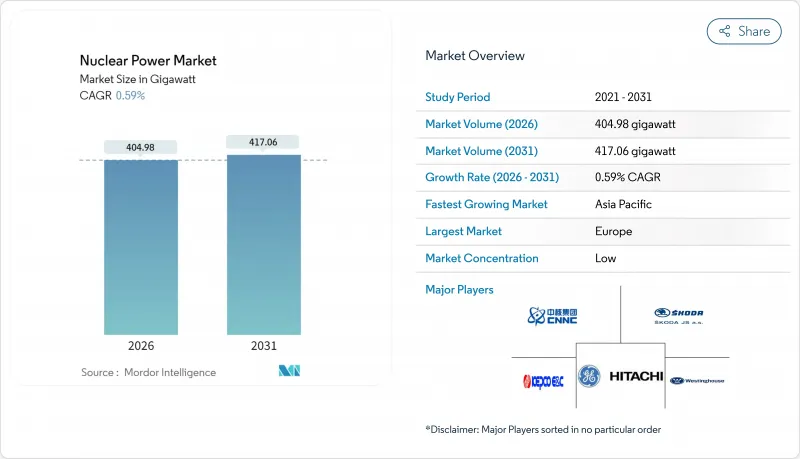
儘管持續的裝置容量成長依然溫和,但核電產業正經歷結構性轉變。小型模組化反應器(SMR)正從研發階段邁向商業部署階段,而延壽計畫則為現有基本負載發電提供支援。開發商正專注於工廠預製模組以降低建設風險,而傳統的吉瓦級計劃則面臨著不斷上漲的資本成本、更長的前置作業時間以及日益嚴格的資金籌措規則。區域趨勢體現在:歐洲擁有龐大的現有核電廠群,亞太地區建設步伐迅猛,而北美則專注於延壽計畫。此外,工業脫碳的需求也帶來了新的機會。高溫核能製程熱可望取代鋼鐵、水泥和化學工業的煤炭和天然氣燃氣鍋爐。
全球核能發電市場趨勢及展望
對清潔基本負載電力的需求不斷成長
隨著電力產業脫碳目標的不斷收緊,電網營運商在不影響供電可靠性的前提下,難以整合大量可變再生能源來源。因此,各國政府正在運作核能作為全天候無碳能源的潛力,尤其是在電力消耗每年成長15%至20%的資料中心集群中。包括日本和韓國在內的一些經濟體,先前計劃逐步淘汰核能發電為了確保能源安全,它們正在調整策略。容量費和輔助業務收益正被納入核能產業計畫,從而縮小了核電與太陽能和風能之間的成本差距。這為核能市場提供了政策支持,即使在現貨電價波動的情況下也是如此。同時,監管機構要求更嚴格的安全裕度,這延長了許可證核准週期,並提高了公眾對核電的接受度。
延長運行週期和提高功率輸出計劃
電力公司意識到,運作一座已有40年歷史的核子反應爐60年甚至80年,每千瓦的成本為500至1000美元,而新建設的成本則為每千瓦6000至12000美元。美國美國核能管理委員會已核准95項延期許可,法國目前正在進行一項耗資494億歐元的維修計劃,旨在加固存儲殼並更換關鍵零件。升級渦輪機和內部核心零件通常可使每座反應器的發電量提高4%至7%,這是在不爭奪新位置的情況下擴大核能市場的最快途徑。電力公司仍然必須解決核子反應爐壓力容器的脆化和儀器老化問題。儘管60年後的監管不確定性阻礙了長期規劃,但許多電力公司將延壽視為在2030年代部署下一代核子反應爐的過渡方案。
成本超支和資金籌措挑戰
喬治亞的沃古爾3-4號機組擴建計劃預算已飆升至350億美元,是最初預算的兩倍多;英國欣克利角C核電廠的預算也接近430億美元。這些超支是由於供應鏈短缺、施工期間的設計變更以及由於數十年來新建設數量低迷導致的技術純熟勞工流失造成的。因此,貸款方要求政府擔保、受監管的資產支持模式或長期購電協議才能獲得資金。開發商正在大力推進模組化以加快建造速度,但首批小型模組化反應器(SMR)仍需證明其成本曲線的可靠性。政府貸款擔保和稅收優惠可以降低風險,但私人企業主導的核能計劃仍然十分罕見。
細分市場分析
到2025年,壓水反應器將佔總裝置容量的74.02%,鞏固其作為核能市場支柱的地位。然而,受中國600兆瓦CFR-600反應器和印度原型反應器計畫的推動,快滋生式反應爐預計在2031年實現19.4%的複合年成長率。氣冷反應器和熔鹽反應器目前仍處於試驗階段,但其高溫能力正吸引工業供熱用戶的注意。
因此,輕水反應器設計在中期內將維持其核能市場佔有率,而示範快堆將為閉式燃料循環奠定知識基礎。監管機構對鈉鉛冷卻系統有了更深入的了解,但商業資金籌措將取決於早期在安全性和經濟性驗證方面的成功。如果CFR-600能夠達到其性能目標,增殖反應器技術可望在2030年代佔據核能市場的重要佔有率。
到2025年,500-1000兆瓦的中型機組將佔總裝置容量的48.12%,並將繼續成為電網成熟國家的首選。 500兆瓦以下的小型反應器預計將以19.2%的複合年成長率成長,反映出電力公司對模組化擴容以降低風險資本的興趣。 20兆瓦以下的微型反應器主要面向採礦和國防應用,可在離網環境中提供電力保障。
工廠化生產對小型核子反應爐的經濟效益至關重要。供應商正在推動標準化,在10-12台機組運作後,經驗累積將降低成本,有助於擴大小型模組化反應器(SMR)市場。然而,裝置容量超過1000兆瓦的大型核子反應爐在小規模國家面臨成本壓力和併網限制,這限制了除中國和印度以外的新訂單。
核能市場報告按核子反應爐類型(壓水慢化冷卻反應器、快滋生式反應爐等)、核子反應爐規模(大型、中型、小型)、燃料類型(低濃縮鈾等)、應用(併網電力、工業過程的熱能和蒸氣等)、最終用戶(電力公司、獨立發電商、工業和石化等)以及地區(歐洲、亞太地區分析。
區域分析
到2025年,歐洲仍將維持核能市場最大佔有率,達到39.35%,這主要得益於法國擁有的56座核子反應爐,這些反應堆供應了該國65%的電力。歐盟已在其綠色能源分類體系中將核能定位為過渡性資產,從而開闢了永續的資金籌措途徑。然而,在福島核事故後,延長運作壽命和加強安全措施的成本給營運商的財務狀況帶來了壓力。德國核能發電廠於2023年關閉,使得中歐越來越依賴從法國進口電力。英國正在推動3.2吉瓦的欣克利角C核能發電廠,並考慮引進六座歐洲壓水反應器(EPR),這些反應器可望維持英國國內核能技術發展至2050年。
亞太地區核電年均複合成長率(CAGR)高達6.6%,是成長最快的地區,主要得益於中國新建的24座核子反應爐以及印度自主研發的重水反應器(PHWR)和快堆計畫。中國正努力核能擴張與2060年實現碳中和的承諾相銜接,並計畫在2030年實現120吉瓦(GW)的裝置容量。日本正透過分階段運作的方式增加運轉率,但公眾的疑慮仍是阻礙因素。同時,韓國擁有28座核子反應爐,並向阿拉伯聯合大公國出口APR-1400型機組。越南和印尼等新興經濟體正在進行可行性研究,但進入核能市場仍面臨資金籌措和監管方面的障礙。
在北美,核電廠的延期運作和選擇性新建設十分普遍。美國20%的總發電量和50%的無碳電力都依賴核能。延期運行計畫旨在支持老舊核電廠的運營,而聯邦稅額扣抵和貸款擔保則推動了愛達荷州和懷俄明州的小型模組化反應器(SMR)計劃。加拿大正在維修其CANDU反應器,計畫於2024年為達靈頓2號機組增加881兆瓦的裝置容量。此外,面向偏遠北極社區和重油礦區的小型模組化反應器示範計畫也在進行中。墨西哥目前仍在營運兩座拉古納維德反應爐,但沒有新建設計畫。在全部區域,通往先進反應器的道路取決於高濃縮鈾(HALEU)的供應和簡化的許可程序。
其他福利:
- Excel格式的市場預測(ME)表
- 3個月的分析師支持
目錄
第1章 引言
- 研究假設和市場定義
- 調查範圍
第2章調查方法
第3章執行摘要
第4章 市場情勢
- 市場概覽
- 市場促進因素
- 對清潔基本負載電力的需求不斷成長
- 生命延長和能量提升計劃
- 先進小型模組化反應器(SMR)的商業化
- 工業脫碳製程—熱需求
- 核能製氫和氨業務
- 核能發電資料中心與海洋應用的興起
- 市場限制
- 成本超支和資金籌措挑戰
- 來自低成本可再生能源的競爭
- 高濃縮鈾燃料供應瓶頸
- 出口管制和擴散監測
- 供應鏈分析
- 監管環境
- 技術展望
- 波特五力模型
- 供應商的議價能力
- 買方的議價能力
- 新進入者的威脅
- 替代品的威脅
- 競爭強度
第5章 市場規模與成長預測
- 按反應器類型
- 壓水慢化反應器(PWR)
- 壓水慢化冷卻反應器(PHWR)
- 沸水冷卻輕慢化反應器(BWR)
- 氣冷石墨慢化反應器(GCR)
- 高溫反應爐(HTGR)
- 輕型水冷石墨慢化核子反應爐(LWGR)
- 快滋生式反應爐(FBR)
- 其他
- 按反應器尺寸
- 大型(1000兆瓦或以上)
- 中型(500-1000兆瓦)
- 小型(小於 500 兆瓦;包括小型模組化反應器 (SMR) 和微型反應器)
- 按燃料類型
- 低濃縮鈾(U-235含量低於5%)
- 高檢出率 LEU (U-235 5-20%)
- 混合氧化物燃料(MOX)
- 釷基燃料
- 透過使用
- 併網電力
- 離網/偏遠地區電氣化
- 工業製程熱和蒸氣
- 海水淡化和區域供熱
- 國防/軍事基地
- 按最終用戶行業分類
- 公共產業和獨立發電商(IPP)
- 工業和石油化工
- 採礦和遠端作業
- 政府/國防
- 研究所
- 按地區
- 北美洲
- 美國
- 加拿大
- 墨西哥
- 歐洲
- 英國
- 法國
- 瑞典
- 西班牙
- 烏克蘭
- 俄羅斯
- 其他歐洲地區
- 亞太地區
- 中國
- 印度
- 日本
- 韓國
- 亞太其他地區
- 南美洲
- 巴西
- 阿根廷
- 其他南美洲
- 中東和非洲
- 阿拉伯聯合大公國
- 南非
- 埃及
- 其他中東和非洲地區
- 北美洲
第6章 競爭情勢
- 市場集中度
- 策略性措施(併購、合資、資金籌措、購電協議)
- 市場佔有率分析(主要企業的市場排名和佔有率)
- 公司簡介
- Electricite de France SA(EDF)
- Rosatom State Atomic Energy Corporation
- China National Nuclear Corporation(CNNC)
- Westinghouse Electric Company LLC
- GE-Hitachi Nuclear Energy
- Framatome SA
- Mitsubishi Heavy Industries Ltd
- Korea Hydro & Nuclear Power/KEPCO E&C
- BWX Technologies Inc.
- Bechtel Corporation
- Doosan Enerbility Co. Ltd
- Fluor Corporation(NuScale)
- SKODA JS as
- Holtec International
- TerraPower LLC
- Rolls-Royce SMR Ltd
- X-Energy LLC
- General Fusion Inc.
- Ontario Power Generation
- Babcock International Group
- Bilfinger SE
- Duke Energy Corporation
- Japan Atomic Power Company
- Ansaldo Nucleare
第7章 市場機會與未來展望
The Nuclear Power market is expected to grow from 402.60 gigawatt in 2025 to 404.98 gigawatt in 2026 and is forecast to reach 417.06 gigawatt by 2031 at 0.59% CAGR over 2026-2031.
Sustained capacity additions remain modest, yet the sector is undergoing a structural transition in which lifetime-extension programs shore up existing baseload generation even as small modular reactors (SMRs) move from the development stage toward commercial roll-out. Developers are focusing on factory-built modules to mitigate construction risk, while traditional gigawatt-scale projects contend with rising capital costs, lengthy lead times, and stricter financing rules. Regional dynamics are shaped by Europe's large installed base, the Asia-Pacific's rapid build-out pace, and North America's focus on life extension. Opportunities also arise from industrial decarbonization needs, where high-temperature nuclear process heat can displace coal and natural-gas boilers in the steel, cement, and chemicals industries.
Global Nuclear Power Market Trends and Insights
Increase in Demand for Clean Baseload Power
Electric-sector decarbonization targets continue to tighten, and grid managers struggle to integrate large shares of variable renewable energy sources without eroding reliability. Governments, therefore, revisit nuclear as a 24/7 carbon-free source, especially for data-center clusters whose electricity use rises 15-20% each year. Several economies that once planned to phase out nuclear power, such as Japan and South Korea, are reversing course to safeguard energy security. Capacity-value payments and ancillary-service revenues now feature in nuclear business cases, narrowing the apparent cost gap with solar and wind. The nuclear power market thereby secures a policy floor even where spot electricity prices remain volatile. At the same time, regulators insist on stricter safety margins, which lengthen licensing reviews while also reinforcing public acceptance.
Lifetime Extension & Uprate Programs
Operators find that keeping a 40-year-old reactor running for 60 or even 80 years costs USD 500-1,000 per kW, a fraction of the USD 6,000-12,000 per kW needed for new construction. The U.S. Nuclear Regulatory Commission has granted 95 license renewals, while France's EUR 49.4 billion grand carenage project strengthens containment structures and replaces key components. Uprating turbines and core internals typically adds 4-7% capacity per unit, making these projects the swiftest way to expand the nuclear power market without new siting battles. Operators must still address the embrittlement of reactor pressure vessels and the obsolescence of instrumentation. Uncertainty about regulations beyond 60 years weighs on longer-range planning; yet, most utilities view life extension as a bridge to advanced-reactor deployment in the 2030s.
Cost Overruns & Financing Challenges
The Vogtle 3-4 expansion in Georgia has more than doubled its initial budget to USD 35 billion, and Hinkley Point C in the United Kingdom now stands at nearly USD 43 billion. Such overruns stem from supply-chain gaps, design changes during construction, and the loss of skilled labor after decades of limited new build. Lenders, therefore, demand sovereign guarantees, regulated asset-based models, or long-term power-purchase agreements before committing funds. Developers pursue modularization to compress schedules; yet, first-of-a-kind SMRs must still demonstrate credible cost curves. Government loan guarantees and tax incentives mitigate risk, but merchant nuclear projects remain rare.
Other drivers and restraints analyzed in the detailed report include:
- Commercialization of Advanced SMRs
- Industrial Decarbonization Process-Heat Demand
- Competition from Low-Cost Renewables
For complete list of drivers and restraints, kindly check the Table Of Contents.
Segment Analysis
Pressurized light-water reactors accounted for 74.02% of total capacity in 2025, solidifying their role as the backbone of the nuclear power market. Fast breeder reactors, however, are on track for a 19.4% CAGR through 2031, propelled by China's 600 MWe CFR-600 and India's prototype reactor programs. Although gas-cooled and molten-salt concepts remain at the pilot stage, their high-temperature capabilities attract industrial heat clients.
The nuclear power market, therefore, sees light-water designs maintaining share in the medium term, while demonstration fast reactors build the knowledge base for closed-fuel cycles. Regulators gain familiarity with sodium and lead-coolant systems, but commercial financing hinges on early successes that demonstrate safety and economic viability. Should the CFR-600 hit performance milestones, breeder technologies may capture a meaningful nuclear power market share in the 2030s.
Medium-scale 500-1,000 MWe units held 48.12% of the installed capacity in 2025 and remain the preferred option for countries with mature grids. Small reactors under 500 MWe are forecast to expand at a 19.2% CAGR, reflecting utility interest in modular additions that lower capital at-risk. Micro-reactors with a capacity below 20 MWe target mining and defense applications, offering off-grid resilience.
Factory production is crucial to the economics of small reactors. Vendors pursue standardization so that the nuclear power market size for SMRs benefits from learning-curve cost declines after 10-12 units are in operation. Meanwhile, large reactors exceeding 1,000 MWe face cost headwinds and grid integration limits in smaller countries, curbing new orders outside China and India.
The Nuclear Power Market Report is Segmented by Reactor Type (Pressurized Light-Water Moderated and Cooled Reactor, Fast Breeder Reactor, and More), Reactor Size (Large, Medium, and Small), Fuel Type (Low-Enriched Uranium, and More), Application (Grid-Connected Power, Industrial Process Heat and Steam, and More), End-User (Utilities and IPPs, Industrial and Petro-Chemical, and More), and Geography (Europe, Asia-Pacific, and More).
Geography Analysis
Europe retained the largest 39.35% share of the nuclear power market in 2025, buoyed by France's 56-reactor fleet, which supplies 65% of the country's electricity. The European Union includes nuclear energy as a transitional asset under its green taxonomy, unlocking sustainable finance channels. Yet lifetime-extension costs and post-Fukushima upgrades strain operator balance sheets, and Germany's 2023 shutdown leaves Central Europe more reliant on French exports. The United Kingdom advances the 3.2 GW Hinkley Point C and explores a fleet of six EPRs that will sustain domestic nuclear skills through 2050.
Asia-Pacific delivers the fastest 6.6% CAGR, led by China's pipeline of 24 reactors under construction and India's indigenous PHWR and fast-reactor programs. China aligns its nuclear growth with its 2060 carbon neutrality pledge and targets 120 GW by 2030. Japan's gradual restarts lift capacity factors but remain constrained by public skepticism, while South Korea maintains a 28-reactor fleet and exports APR-1400 units to the United Arab Emirates. Emerging economies, such as Vietnam and Indonesia, conduct feasibility studies; however, financing and regulatory readiness remain hurdles before they can join the nuclear power market.
North America opts for life extension and selective new build. The United States relies on nuclear power for 20% of its total generation and 50% of its carbon-free power. License renewals keep aging plants online, while federal tax credits and loan guarantees encourage SMR projects in Idaho and Wyoming. Canada refurbishes its CANDU fleet, adding 881 MWe from Darlington unit 2 in 2024, and advances SMR demonstrations for remote Arctic communities and heavy-oil sites. Mexico retains its two-unit Laguna Verde plant with no new build on the horizon. Across the region, deployment pathways for advanced reactors hinge on HALEU supply and streamlined licensing.
- Electricite de France SA (EDF)
- Rosatom State Atomic Energy Corporation
- China National Nuclear Corporation (CNNC)
- Westinghouse Electric Company LLC
- GE-Hitachi Nuclear Energy
- Framatome SA
- Mitsubishi Heavy Industries Ltd
- Korea Hydro & Nuclear Power / KEPCO E&C
- BWX Technologies Inc.
- Bechtel Corporation
- Doosan Enerbility Co. Ltd
- Fluor Corporation (NuScale)
- SKODA JS a.s.
- Holtec International
- TerraPower LLC
- Rolls-Royce SMR Ltd
- X-Energy LLC
- General Fusion Inc.
- Ontario Power Generation
- Babcock International Group
- Bilfinger SE
- Duke Energy Corporation
- Japan Atomic Power Company
- Ansaldo Nucleare
Additional Benefits:
- The market estimate (ME) sheet in Excel format
- 3 months of analyst support
TABLE OF CONTENTS
1 Introduction
- 1.1 Study Assumptions & Market Definition
- 1.2 Scope of the Study
2 Research Methodology
3 Executive Summary
4 Market Landscape
- 4.1 Market Overview
- 4.2 Market Drivers
- 4.2.1 Increase in demand for clean baseload power
- 4.2.2 Lifetime extension & uprate programs
- 4.2.3 Commercialization of advanced SMRs
- 4.2.4 Industrial decarbonization process-heat demand
- 4.2.5 Nuclear-produced hydrogen & ammonia initiatives
- 4.2.6 Emergence of nuclear-powered data-center & marine applications
- 4.3 Market Restraints
- 4.3.1 Cost overruns & financing challenges
- 4.3.2 Competition from low-cost renewables
- 4.3.3 HALEU fuel-supply bottlenecks
- 4.3.4 Export-control & proliferation scrutiny
- 4.4 Supply-Chain Analysis
- 4.5 Regulatory Landscape
- 4.6 Technological Outlook
- 4.7 Porters Five Forces
- 4.7.1 Bargaining Power of Suppliers
- 4.7.2 Bargaining Power of Buyers
- 4.7.3 Threat of New Entrants
- 4.7.4 Threat of Substitutes
- 4.7.5 Intensity of Rivalry
5 Market Size & Growth Forecasts
- 5.1 By Reactor Type
- 5.1.1 Pressurized Light-Water Moderated and Cooled Reactor (PWR)
- 5.1.2 Pressurized Heavy-Water Moderated and Cooled Reactor (PHWR)
- 5.1.3 Boiling Light-Water Cooled and Moderated Reactor (BWR)
- 5.1.4 Gas Cooled, Graphite Moderated Reactor (GCR)
- 5.1.5 High-Temperature Gas-Cooled Reactor (HTGR)
- 5.1.6 Light-Water Cooled, Graphite Moderated Reactor (LWGR)
- 5.1.7 Fast Breeder Reactor (FBR)
- 5.1.8 Others
- 5.2 By Reactor Size
- 5.2.1 Large (Above 1,000 MWe)
- 5.2.2 Medium (500 to 1,000 MWe)
- 5.2.3 Small (Below 500 Mwe; includes SMRs and Micro-reactors)
- 5.3 By Fuel Type
- 5.3.1 Low-Enriched Uranium (Below 5% U-235)
- 5.3.2 High-Assay LEU (5 to 20% U-235)
- 5.3.3 Mixed Oxide (MOX)
- 5.3.4 Thorium-based Fuels
- 5.4 By Application
- 5.4.1 Grid-Connected Power
- 5.4.2 Off-grid/Remote Electrification
- 5.4.3 Industrial Process Heat and Steam
- 5.4.4 Desalination and District Heating
- 5.4.5 Defense and Military Bases
- 5.5 By End-User Sector
- 5.5.1 Utilities and IPPs
- 5.5.2 Industrial and Petro-chemical
- 5.5.3 Mining and Remote Operations
- 5.5.4 Government/Defense
- 5.5.5 Research Institutions
- 5.6 By Geography
- 5.6.1 North America
- 5.6.1.1 United States
- 5.6.1.2 Canada
- 5.6.1.3 Mexico
- 5.6.2 Europe
- 5.6.2.1 United Kingdom
- 5.6.2.2 France
- 5.6.2.3 Sweden
- 5.6.2.4 Spain
- 5.6.2.5 Ukraine
- 5.6.2.6 Russia
- 5.6.2.7 Rest of Europe
- 5.6.3 Asia-Pacific
- 5.6.3.1 China
- 5.6.3.2 India
- 5.6.3.3 Japan
- 5.6.3.4 South Korea
- 5.6.3.5 Rest of Asia-Pacific
- 5.6.4 South America
- 5.6.4.1 Brazil
- 5.6.4.2 Argentina
- 5.6.4.3 Rest of South America
- 5.6.5 Middle East and Africa
- 5.6.5.1 United Arab Emirates
- 5.6.5.2 South Africa
- 5.6.5.3 Egypt
- 5.6.5.4 Rest of Middle East and Africa
- 5.6.1 North America
6 Competitive Landscape
- 6.1 Market Concentration
- 6.2 Strategic Moves (M&A, JVs, Funding, PPAs)
- 6.3 Market Share Analysis (Market Rank/Share for key companies)
- 6.4 Company Profiles (includes Global-level Overview, Market-level Overview, Core Segments, Financials, Strategic Information, Products & Services, Recent Developments)
- 6.4.1 Electricite de France SA (EDF)
- 6.4.2 Rosatom State Atomic Energy Corporation
- 6.4.3 China National Nuclear Corporation (CNNC)
- 6.4.4 Westinghouse Electric Company LLC
- 6.4.5 GE-Hitachi Nuclear Energy
- 6.4.6 Framatome SA
- 6.4.7 Mitsubishi Heavy Industries Ltd
- 6.4.8 Korea Hydro & Nuclear Power / KEPCO E&C
- 6.4.9 BWX Technologies Inc.
- 6.4.10 Bechtel Corporation
- 6.4.11 Doosan Enerbility Co. Ltd
- 6.4.12 Fluor Corporation (NuScale)
- 6.4.13 SKODA JS a.s.
- 6.4.14 Holtec International
- 6.4.15 TerraPower LLC
- 6.4.16 Rolls-Royce SMR Ltd
- 6.4.17 X-Energy LLC
- 6.4.18 General Fusion Inc.
- 6.4.19 Ontario Power Generation
- 6.4.20 Babcock International Group
- 6.4.21 Bilfinger SE
- 6.4.22 Duke Energy Corporation
- 6.4.23 Japan Atomic Power Company
- 6.4.24 Ansaldo Nucleare
7 Market Opportunities & Future Outlook
- 7.1 White-space & Unmet-Need Assessment
- 7.2 Advanced Small Modular Reactors
- 7.3 Floating Nuclear Plants
- 7.4 Nuclear Hydrogen & Ammonia Production
- 7.5 Data-Center & Marine Micro-reactors
- 7.6 Lifetime Extension Services Market
- 7.7 Decommissioning & Waste-Management Services

 全球核能服務市場:策略洞察與預測(2026-2031年)
 2026年全球核能發電市場報告2026年全球核能發電廠運作、燃料和儀器市場報告
 三通道二極體功率感測器市場:按產品類型、頻寬、分銷管道、應用和最終用戶分類的全球預測(2026-2032年)核能發電市場按反應器類型、運作類型、電廠規模、燃料類型、階段和應用分類-全球預測,2026-2032年核能發電廠服務市場按服務類型、核子反應爐類型、合約類型和最終用戶分類 - 全球預測 2026-2032核能發電廠運轉維護服務市場依服務類型、核子反應爐類型、生命週期階段及提供模式分類-2026-2032年全球預測核能發電管道市場按核子反應爐類型、電廠容量、建設狀態、冷卻系統、燃料類型、應用和最終用戶分類-2026年至2032年全球預測
 核能市場-全球產業規模、佔有率、趨勢、機會及預測(按類型(單相混合、三相混合)、最終用戶(住宅、商業、其他)、區域及競爭格局分類,2021-2031年預測)核電廠服務市場-全球產業規模、佔有率、趨勢、機會和預測,依電站類型、服務、地區和競爭格局分類,2021-2031年預測