


 |
市場調查報告書
商品編碼
1910607
醫藥物流:市場佔有率分析、產業趨勢與統計、成長預測(2026-2031)Pharmaceutical Logistics - Market Share Analysis, Industry Trends & Statistics, Growth Forecasts (2026 - 2031) |
||||||

※ 本網頁內容可能與最新版本有所差異。詳細情況請與我們聯繫。
2025年,醫藥物流市場價值為5,608.1億美元,預計從2026年的5,914.8億美元成長到2031年的7,723.8億美元,在預測期(2026-2031年)內,複合年成長率為5.47%。
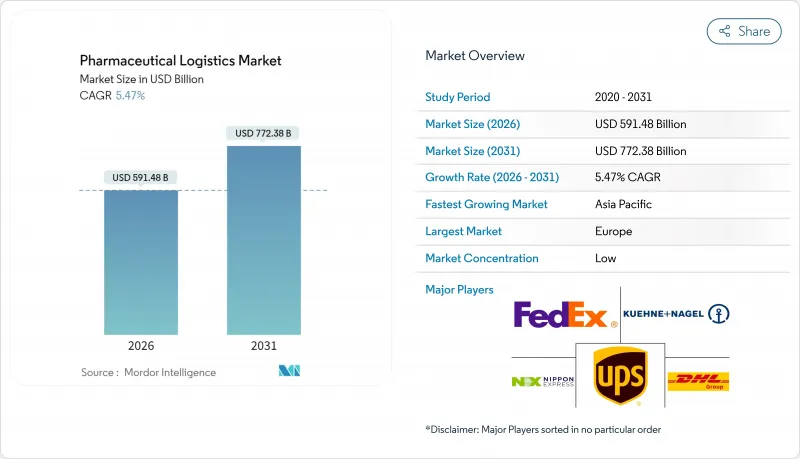
強勁成長歸功於生物製藥的廣泛應用、嚴格的序列化要求以及向直接面向患者的配送模式的轉變,而這些都需要精準的配送能力。全球整合商的大量資本投入、網路藥局的持續普及以及溫控基礎設施的擴展,不斷加劇市場競爭,同時也擴大了對端到端合規供應鏈解決方案的潛在需求。隨著相關人員採取措施防止溫度偏差和假冒偽劣風險,技術應用,特別是物聯網感測器、區塊鏈溯源和人工智慧驅動的網路最佳化,正在加速發展。同時,為減少排放採取的永續性正在推動運輸方式向多式聯運和海運轉變,為專業服務供應商創造了新的市場機會。儘管與低溫運輸能源成本和多司法管轄區合規性相關的價格壓力仍然是不利因素,但它們也推動了對低碳包裝、區域庫存管理和替代燃料的投資,最終促進了醫藥物流市場的擴張。
全球醫藥物流市場趨勢與洞察
網路藥局的擴張
如今,近半數消費者更傾向於在線訂購藥品,這就要求物流公司建立送貨上門的網路,以確保對溫度敏感的藥品能夠保存在2°C至8°C的環境中。亞太地區的供應商正利用數位支付和遠端醫療平台拓展常溫和冷藏小包裹服務。同時,美國整合商正透過物聯網賦能的包裝解決方案提升最後一公里配送的透明度。監管機構也積極回應,將序列化和追蹤細化到單品層級。合規門檻不斷提高,而提供即時溫度和位置數據的供應商也日益多元化。隨著網路藥局量的成長,微型倉配中心的網路改造正在縮短前置作業時間,提高病患的用藥依從性,從而推動整個醫藥流市場需求的成長。
成藥需求不斷增加以及慢性病負擔加重
成藥受到的處理監管比處方藥寬鬆,因此可以採取混合運輸路線,從而降低綜合經銷商的倉儲成本。然而,糖尿病和心血管疾病的日益普及導致藥品需要持續補貨,並增加了對時效性庫存的產能需求。物流合作夥伴利用機器人揀貨包裝和智慧泡殼包裝等自動化技術,將成藥和慢性病藥物整合到一個統一的物流流程中,以縮短停留時間。混合模式使醫藥物流市場能夠提高資產利用率並保持盈利,同時也能提升對藥局和診所的服務品質。
溫控運輸成本高成本
低溫運輸故障每年造成製藥企業約350億美元的損失,其中包括廢棄物處理、重新包裝和運輸罰款。使用相變材料的被動包裝可以將保護期延長至96小時,但通常會使每個小包裹的成本增加一倍,這給資源匱乏的新興市場專案帶來了更大的壓力。冗餘的監控設備和合格人員的需求增加了營運成本,限制了製藥物流市場中小型承運商的利潤率。低碳冷媒和可重複使用的托特包等創新旨在降低運輸成本,但由於初始投資成本高昂,其廣泛應用仍受到限制。
細分市場分析
到2025年,運輸環節將佔總收入的51.40%,這顯示實體運輸是醫藥物流市場的支柱。公路貨運負責區域間配送,尤其是在歐洲和北美之間;空運則支援長距離生物製藥補給,並保證隔日送達。隨著托運人尋求永續的運輸方式,例如使用符合GDP標準的冷藏集裝箱以減少排放,海運的重要性日益凸顯。
附加價值服務正以4.42%的複合年成長率快速成長,涵蓋貼標、二次包裝、訂單套件組裝和序列化諮詢等服務,從而減輕製造商的非核心營運負擔。亞太地區的需求成長最為迅速,該地區的契約製造製造商正在尋找能夠處理多語言法規印刷的單一來源合作夥伴。隨著資料完整性法規的日益嚴格,經認證的重新貼標和防篡改包裝正從可選附加服務轉變為採購的必備條件,從而推動了醫藥物流市場利潤率的提升。
區域分析
2025年,歐洲在全球收入佔有率中保持31.70%的領先地位,這得益於統一的GDP執行標準、密集的公路網路以及德國、瑞士和愛爾蘭的大型製造群。對跨境鐵路和航空走廊的投資正在推動模式轉換,從而在不影響前置作業時間的前提下減少排放。歐洲醫藥物流市場規模的擴大也受惠於產能的持續成長,例如低溫運輸技術公司在荷蘭新建的物流中心,這將加強區域相變材料(PCM)的生產並降低運輸風險。
北美仍然是關鍵市場,這得益於其成熟的DSCSA序列化系統以及持續的疫情應對公共資金支持。 DHL已將其20億歐元(20.8億美元)計畫的50%分配給其美國和加拿大的設施,引入太陽能倉庫和液化天然氣動力卡車,以在維持服務水準的同時減少排放。加之聯邦快遞斥資4.4億美元擴建其醫療配銷中心,該地區正不斷重新定義資料可見性和永續性的最佳實踐。
亞太地區預計將成為成長最快的地區,2026年至2031年的複合年成長率將達到5.02%,這主要得益於中國和印度產量的成長、保險覆蓋範圍的擴大以及網路藥局的普及。各國政府都在鼓勵低溫運輸升級,例如印度計畫在2025年為符合GDP標準的倉儲設施提供稅收優惠。區域性物流公司正在中歐走廊沿線實施鐵路-公路-海運-空運聯運方案,以降低運輸成本和排放氣體。儘管中東和非洲的基礎建設相對滯後,波灣合作理事會(GCC)的在地化計畫正在刺激倉儲投資,並確保醫藥物流市場的未來發展。
其他福利:
- Excel格式的市場預測(ME)表
- 3個月的分析師支持
目錄
第1章 引言
- 研究假設和市場定義
- 調查範圍
第2章調查方法
第3章執行摘要
第4章 市場情勢
- 市場概覽
- 市場促進因素
- 網路藥局的擴張
- 成藥需求不斷成長,慢性病負擔日益加重。
- 生技藥品和疫苗低溫運輸需求加速成長
- 外包給第三方/第四方物流專家的業務迅速成長
- 一個必不可少的端對端物聯網/區塊鏈追蹤系統
- 透過淨零物流投資促進基礎建設更新
- 市場限制
- 溫控運輸成本高成本
- 複雜多元的全球合規標準
- 先進相變封裝材料短缺
- 新興市場生技藥品最後一公里配送瓶頸
- 價值/供應鏈分析
- 監管環境
- 技術展望
- 波特五力模型
- 供應商的議價能力
- 買方的議價能力
- 新進入者的威脅
- 替代品的威脅
- 競爭對手之間的競爭
- 新冠疫情與地緣政治事件的影響
第5章 市場規模與成長預測
- 按服務類型
- 運輸
- 公路貨運
- 空運
- 海上運輸
- 鐵路貨運
- 倉儲和存儲
- 附加價值服務及更多
- 運輸
- 按操作模式
- 低溫運輸物流
- 非低溫運輸物流
- 依產品類型
- 處方藥
- 非處方藥
- 生物製藥和生物相似藥
- 疫苗和血液製品
- 臨床試驗材料
- 細胞和基因治療
- 醫療設備和診斷設備
- 獸醫學
- 其他
- 按地區
- 北美洲
- 美國
- 加拿大
- 墨西哥
- 南美洲
- 巴西
- 秘魯
- 智利
- 阿根廷
- 其他南美洲
- 亞太地區
- 印度
- 中國
- 日本
- 澳洲
- 韓國
- 東南亞(新加坡、馬來西亞、泰國、印尼、越南、菲律賓)
- 亞太其他地區
- 歐洲
- 英國
- 德國
- 法國
- 西班牙
- 義大利
- 比荷盧經濟聯盟(比利時、荷蘭、盧森堡)
- 北歐國家(丹麥、芬蘭、冰島、挪威、瑞典)
- 其他歐洲地區
- 中東和非洲
- 阿拉伯聯合大公國
- 沙烏地阿拉伯
- 南非
- 奈及利亞
- 其他中東和非洲地區
- 北美洲
第6章 競爭情勢
- 市場集中度
- 策略趨勢
- 市佔率分析
- 公司簡介
- Deutsche Post DHL
- Kuehne+Nagel
- UPS
- FedEx
- Nippon Express
- World Courier
- SF Express
- CEVA Logistics
- DSV
- Kerry Logistics
- CH Robinson
- Lineage Logistics
- United States Cold Storage
- Americold Logistics
- Nichirei Logistics Group
- Kloosterboer
- NewCold Advanced Cold Logistics
- VersaCold Logistics Services
- Rhenus Logistics
- Cencora
第7章 市場機會與未來展望
The Pharmaceutical Logistics Market was valued at USD 560.81 billion in 2025 and estimated to grow from USD 591.48 billion in 2026 to reach USD 772.38 billion by 2031, at a CAGR of 5.47% during the forecast period (2026-2031).
Robust growth stems from biologics proliferation, rigorous serialization mandates, and the pivot toward direct-to-patient delivery models that require precision distribution capacities. Strong capital spending by global integrators, sustained e-pharmacy adoption, and expanding temperature-controlled infrastructure continue to intensify competition while enlarging addressable demand for end-to-end, compliant supply-chain solutions. Technology deployment-particularly IoT sensors, blockchain traceability, and AI-driven network optimization-has accelerated as stakeholders guard against temperature excursions and counterfeit risk. At the same time, sustainability commitments are redirecting capacity toward intermodal and ocean transportation to curb emissions, opening new service niches for specialty providers. Price pressures linked to cold-chain energy costs and multi-jurisdictional compliance remain headwinds, yet they also spur investment in low-carbon packaging, regionalized inventories, and alternative fuels that ultimately expand the pharmaceutical logistics market.
Global Pharmaceutical Logistics Market Trends and Insights
Expansion of Online Pharmacies
Nearly half of consumers now prefer ordering medicines online, compelling carriers to engineer door-step delivery networks that secure 2 °C-8 °C conditions for sensitive products. Providers in Asia-Pacific leverage digital payments and telehealth platforms to scale ambient and refrigerated parcel services, while U.S. integrators enhance last-mile visibility through IoT-enabled pack-out solutions. Regulators have responded by extending serialization and track-and-trace to the single-unit level, raising compliance hurdles but also differentiating operators that offer real-time temperature and location data. As e-pharmacy volumes climb, network redesign toward micro-fulfillment hubs tightens lead-times, improving medication adherence and fueling incremental demand across the pharmaceutical logistics market.
Rising OTC-Medicine Demand & Chronic-Disease Burden
OTC formulations carry less-stringent handling rules than prescription drugs, enabling blended transport lanes that cut storage costs for integrated distributors. However, the rising prevalence of diabetes and cardiovascular disease forces continual replenishment cycles that intensify throughput requirements for time-critical inventory. Logistics partners exploit automation, such as robotic pick-and-pack and smart blister packaging, to combine OTC and chronic-care medications within unified flows that reduce dwell time. Hybrid models improve asset utilization and sustain profitability within the pharmaceutical logistics market while enhancing service quality for pharmacies and clinics.
High Cost of Temperature-Controlled Distribution
Cold-chain failures cost drug makers an estimated USD 35 billion each year, reflecting write-offs, repackaging, and penalty shipments. Passive packaging with phase-change materials can extend protection to 96 hours but often doubles per-parcel expenses, placing strain on emerging-market programs where funding is scarce. The need for redundant monitoring equipment and qualified staff compounds overhead, limiting profit margins for smaller carriers within the pharmaceutical logistics market. Innovation in low-carbon refrigerants and reusable totes aims to reduce cost per shipment, yet wide deployment remains constrained by initial capital outlay.
Other drivers and restraints analyzed in the detailed report include:
- Acceleration of Biologics & Vaccine Cold-Chain Needs
- Outsourcing Surge to 3PL/4PL Specialists
- Complex & Divergent Global Compliance Standards
For complete list of drivers and restraints, kindly check the Table Of Contents.
Segment Analysis
Transportation generated 51.40% of 2025 revenue, illustrating that physical movement remains the backbone of the pharmaceutical logistics market. Road freight captures regional flows, particularly across Europe and North America, while air freight underpins long-haul biologics replenishment with next-day service guarantees. Ocean lanes gain relevance as shippers pursue sustainable options, leveraging GDP-compliant reefer containers to curb emissions.
Value-added services, growing at a 4.42% CAGR, include labeling, secondary packaging, order kitting, and serialization consulting that relieve manufacturers of non-core tasks. Demand rises fastest in Asia-Pacific, where contract manufacturers seek single-source partners to handle regulatory printing in multiple languages. As data integrity rules tighten, certified relabeling and tamper-evident pack-outs transform from optional extras into procurement prerequisites, driving incremental margin across the pharmaceutical logistics market.
The Pharmaceutical Logistics Market Report is Segmented by Service Type (Transportation, Warehousing & Storage, and Value-Added Services & Others), Mode of Operation (Cold-Chain Logistics and Non-Cold-Chain Logistics), Product Type (Prescription Drugs, OTC Drugs, Biologics & Biosimilars, and More), Geography (North America, South America, Europe, Asia-Pacific, and, More). The Market Forecasts are Provided in Terms of Value (USD).
Geography Analysis
Europe maintained a 31.70% revenue share in 2025, underpinned by harmonized GDP enforcement, dense road networks, and large-scale manufacturing clusters in Germany, Switzerland, and Ireland. Investment in cross-border rail-air corridors supports modal shifts that lower emissions without compromising lead times. The pharmaceutical logistics market size in Europe benefits from continual capacity additions such as Cold Chain Technologies' new Netherlands hub, which augments regional PCM production and reduces transit risk.
North America remains a powerhouse thanks to DSCSA-driven serialization maturity and sustained public-sector funding for pandemic preparedness. DHL allocated 50% of its EUR 2 billion (USD 2.08 billion) plan to U.S. and Canadian facilities, integrating solar-powered warehouses and LNG trucks that curb emissions while preserving service standards. Combined with FedEx's USD 440 million expansion of healthcare distribution centers, the region continues to redefine best practices around data visibility and sustainability.
Asia-Pacific is expected to post the fastest growth at 5.02% CAGR from 2026 to 2031, buoyed by increased production out of China and India, widening insurance coverage, and e-pharmacy proliferation. Governments incentivize cold-chain upgrades, as evidenced by India's 2025 tax rebates on GDP-compliant warehousing equipment. Regional carriers deploy rail-truck sea-air solutions along the China-Europe corridor, trimming cost and cutting transit emissions. Middle East & Africa trail in infrastructure, yet Gulf Cooperation Council localization programs spur warehouse investment, securing future pharmaceutical logistics market expansion.
- Deutsche Post DHL
- Kuehne + Nagel
- UPS
- FedEx
- Nippon Express
- World Courier
- SF Express
- CEVA Logistics
- DSV
- Kerry Logistics
- C.H. Robinson
- Lineage Logistics
- United States Cold Storage
- Americold Logistics
- Nichirei Logistics Group
- Kloosterboer
- NewCold Advanced Cold Logistics
- VersaCold Logistics Services
- Rhenus Logistics
- Cencora
Additional Benefits:
- The market estimate (ME) sheet in Excel format
- 3 months of analyst support
TABLE OF CONTENTS
1 Introduction
- 1.1 Study Assumptions & Market Definition
- 1.2 Scope of the Study
2 Research Methodology
3 Executive Summary
4 Market Landscape
- 4.1 Market Overview
- 4.2 Market Drivers
- 4.2.1 Expansion of online pharmacies
- 4.2.2 Rising OTC-medicine demand & chronic-disease burden
- 4.2.3 Acceleration of biologics & vaccine cold-chain needs
- 4.2.4 Outsourcing surge to 3PL/4PL specialists
- 4.2.5 Mandatory end-to-end IoT / blockchain track-and-trace
- 4.2.6 Net-zero logistics investments driving infrastructure renewal
- 4.3 Market Restraints
- 4.3.1 High cost of temperature-controlled distribution
- 4.3.2 Complex & divergent global compliance standards
- 4.3.3 Shortage of advanced phase-change packaging materials
- 4.3.4 Last-mile biologic delivery bottlenecks in emerging markets
- 4.4 Value / Supply-Chain Analysis
- 4.5 Regulatory Landscape
- 4.6 Technological Outlook
- 4.7 Porter's Five Forces
- 4.7.1 Bargaining Power of Suppliers
- 4.7.2 Bargaining Power of Buyers
- 4.7.3 Threat of New Entrants
- 4.7.4 Threat of Substitutes
- 4.7.5 Competitive Rivalry
- 4.8 Impact of COVID-19 & Geo-Political Events
5 Market Size & Growth Forecasts (Value, USD)
- 5.1 By Service Type
- 5.1.1 Transportation
- 5.1.1.1 Road Freight
- 5.1.1.2 Air Freight
- 5.1.1.3 Sea Freight
- 5.1.1.4 Rail Freight
- 5.1.2 Warehousing & Storage
- 5.1.3 Value-added Services and Others
- 5.1.1 Transportation
- 5.2 By Mode of Operation
- 5.2.1 Cold-Chain Logistics
- 5.2.2 Non-Cold-Chain Logistics
- 5.3 By Product Type
- 5.3.1 Prescription Drugs
- 5.3.2 OTC Drugs
- 5.3.3 Biologics & Biosimilars
- 5.3.4 Vaccines & Blood Products
- 5.3.5 Clinical Trail Materials
- 5.3.6 Cell & Gene Therapies
- 5.3.7 Medical Devices & Diagnostics
- 5.3.8 Veterinary Medicine
- 5.3.9 Others
- 5.4 By Geography
- 5.4.1 North America
- 5.4.1.1 United States
- 5.4.1.2 Canada
- 5.4.1.3 Mexico
- 5.4.2 South America
- 5.4.2.1 Brazil
- 5.4.2.2 Peru
- 5.4.2.3 Chile
- 5.4.2.4 Argentina
- 5.4.2.5 Rest of South America
- 5.4.3 Asia-Pacific
- 5.4.3.1 India
- 5.4.3.2 China
- 5.4.3.3 Japan
- 5.4.3.4 Australia
- 5.4.3.5 South Korea
- 5.4.3.6 South East Asia (Singapore, Malaysia, Thailand, Indonesia, Vietnam, and Philippines)
- 5.4.3.7 Rest of Asia-Pacific
- 5.4.4 Europe
- 5.4.4.1 United Kingdom
- 5.4.4.2 Germany
- 5.4.4.3 France
- 5.4.4.4 Spain
- 5.4.4.5 Italy
- 5.4.4.6 BENELUX (Belgium, Netherlands, and Luxembourg)
- 5.4.4.7 NORDICS (Denmark, Finland, Iceland, Norway, and Sweden)
- 5.4.4.8 Rest of Europe
- 5.4.5 Middle East and Africa
- 5.4.5.1 United Arab of Emirates
- 5.4.5.2 Saudi Arabia
- 5.4.5.3 South Africa
- 5.4.5.4 Nigeria
- 5.4.5.5 Rest of Middle East And Africa
- 5.4.1 North America
6 Competitive Landscape
- 6.1 Market Concentration
- 6.2 Strategic Moves
- 6.3 Market Share Analysis
- 6.4 Company Profiles (includes Global level Overview, Market level overview, Core Segments, Financials, Strategic Info, Market Rank/Share, Products & Services, Recent Developments)
- 6.4.1 Deutsche Post DHL
- 6.4.2 Kuehne + Nagel
- 6.4.3 UPS
- 6.4.4 FedEx
- 6.4.5 Nippon Express
- 6.4.6 World Courier
- 6.4.7 SF Express
- 6.4.8 CEVA Logistics
- 6.4.9 DSV
- 6.4.10 Kerry Logistics
- 6.4.11 C.H. Robinson
- 6.4.12 Lineage Logistics
- 6.4.13 United States Cold Storage
- 6.4.14 Americold Logistics
- 6.4.15 Nichirei Logistics Group
- 6.4.16 Kloosterboer
- 6.4.17 NewCold Advanced Cold Logistics
- 6.4.18 VersaCold Logistics Services
- 6.4.19 Rhenus Logistics
- 6.4.20 Cencora
7 Market Opportunities & Future Outlook
- 7.1 White-space & Unmet-need Assessment

 生物製藥物流:市場佔有率分析、產業趨勢與統計、成長預測(2026-2031)亞太地區醫藥物流:市場佔有率分析、產業趨勢與統計及成長預測(2026-2031)
 醫藥物流市場:按類型、產品類型、組件、運輸方式和最終用戶分類-2026-2032年全球市場預測生物製藥物流市場:2026-2032年全球市場預測(依產品類型、服務類型、運輸方式、溫度需求及最終用戶分類)中國醫藥物流:市場佔有率分析、產業趨勢與統計及成長預測(2026-2031)印度醫藥物流:市場佔有率分析、產業趨勢與統計及成長預測(2026-2031)德國醫藥物流:市場佔有率分析、產業趨勢與統計及成長預測(2026-2031)
 生物製藥物流市場-全球產業規模、佔有率、趨勢、機會、預測:按服務、營運類型、地區和競爭格局分類,2021-2031年
 全球醫藥物流市場:依服務類型、類型、產品類型、最終用戶和地區分類
 醫藥物流市場規模、佔有率及成長分析:依運輸方式、服務類型、物流類型、產品類型、最終用戶、應用及地區分類-2026-2033年產業預測